Bone Soup: A Spooky Tasty Tale by Alyssa Satin Capucilli

Share

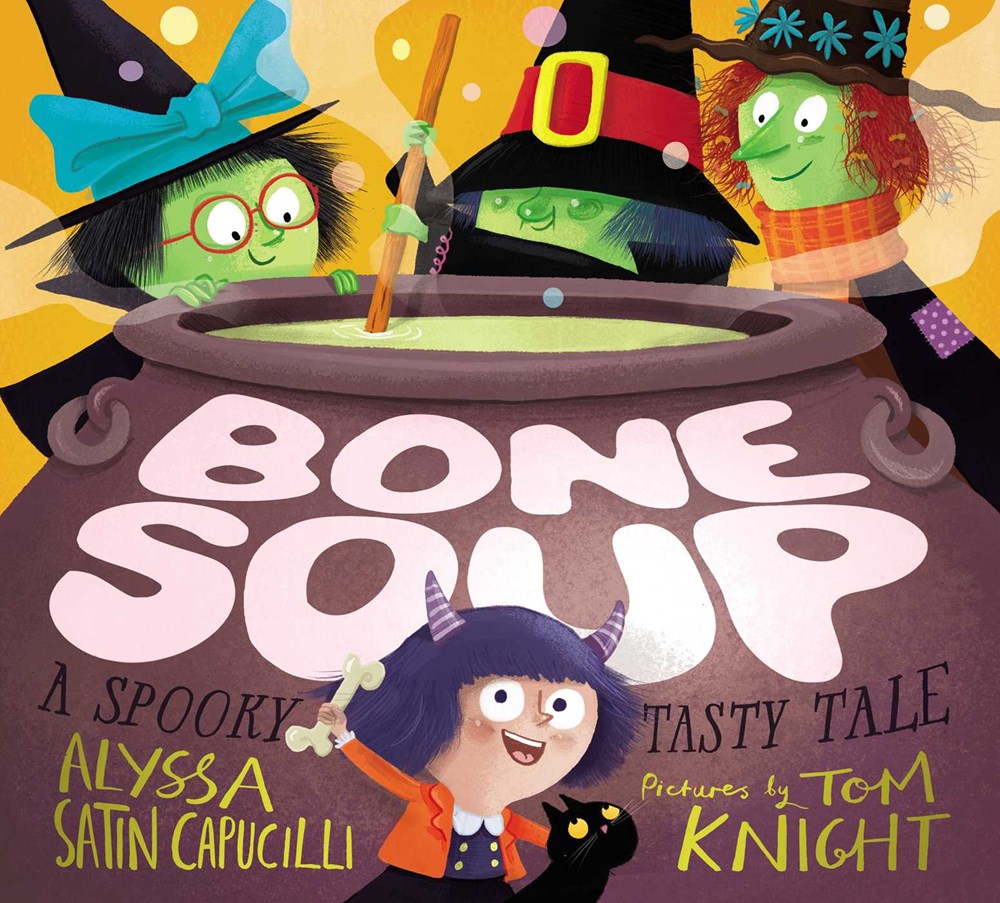
Bone Soup: A Spooky Tasty Tale
Author: Alyssa Satin Capucilli
Illustrator: Tom Knight
Published: July 24, 2018 by Simon & Schuster

Goodreads Summary: Three little witches and a bunch of spooky characters come together to prepare a delicious batch of Bone Soup in this Halloween tale based on the beloved fable, Stone Soup. This just-scary-enough picture book comes with a recipe for Bone Soup—perfect for Halloween eating.

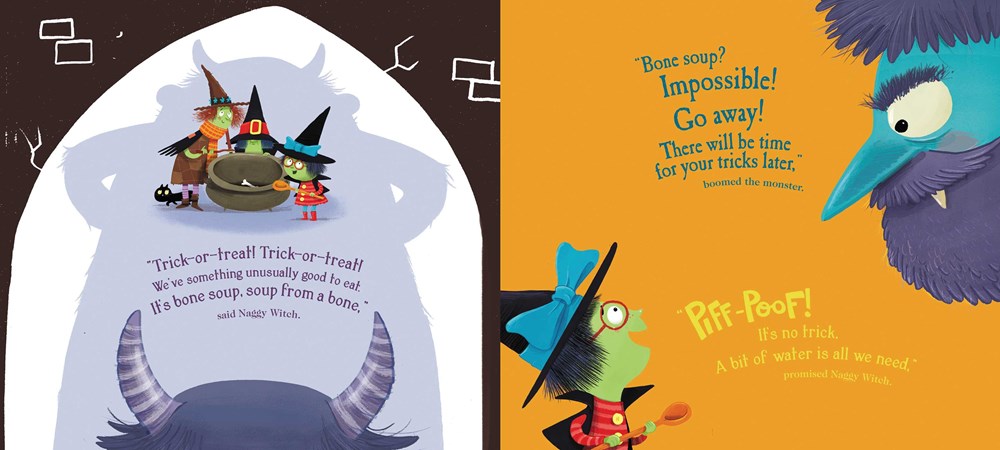
Trick-or-treat? Trick-or-treat!
We’ve something usually good to eat!

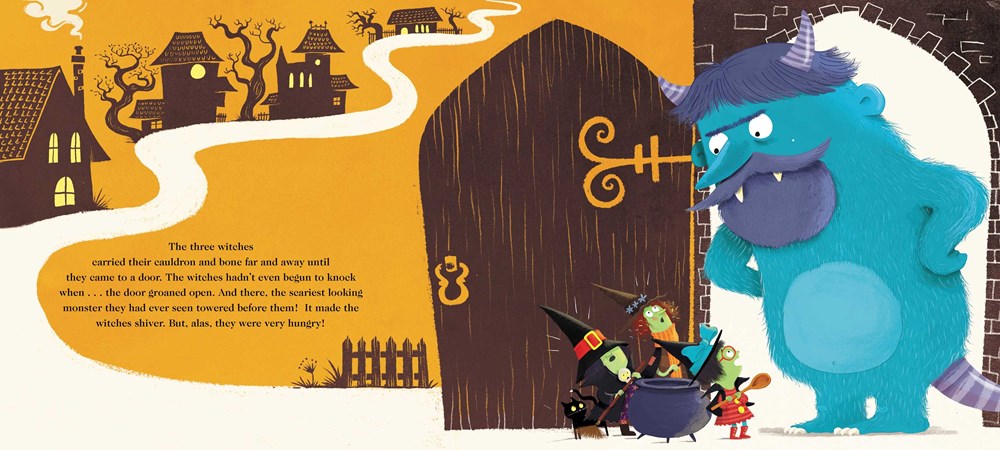
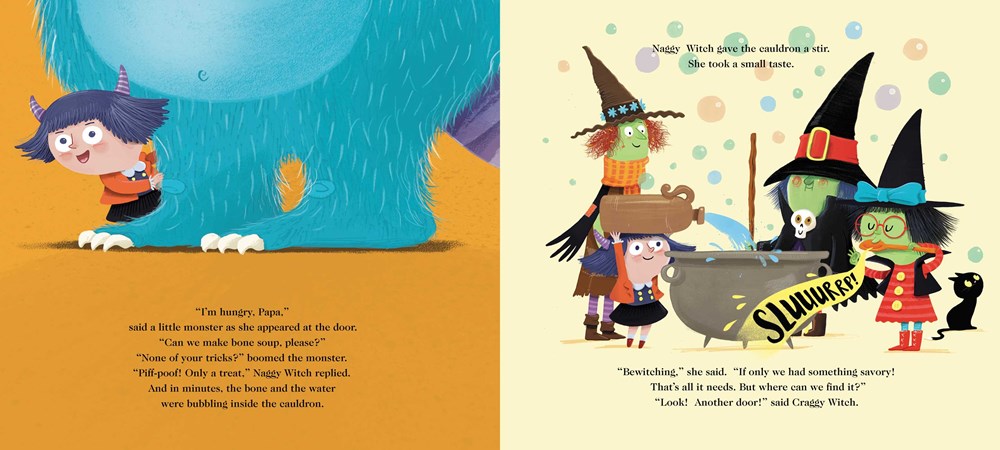
One Halloween morning three witches are looking for a tasty treat and they find only a small bone in their cupboard. So they decide to go from door to door in their village to find just the right ingredients for their Bone Soup. No one in the village is convinced that soup can be made from a bone, until the littlest monster reveals just what the special ingredient should be.

My Review: We received this book earlier in the month, and we’ve read it dozens and dozens of times. I was very excited about it and have held it in my pocket for Halloween! If you enjoy spooky, fun tales, this book is for you. I find myself walking around repeating, “It’s bone soup! Soup from the bone!” and “Piff-Poof!” The text is quite catchy, and it’s a highly entertaining read-aloud. This is a book that parents and teachers will find extra fun for their classrooms and homes. I recommend adding Bone Soup to your Halloween collection!

Teacher’s Tools for Navigation: Students might take a trip outdoors and gather their own materials for bone soup. For instance, a stick could be imagined as the bone from a pirate. Grass might be the hair from a goblin. Then, they can take their materials inside and craft their own class story together.

Discussion Questions: 

  • How do the sister witches interact?
  • How do they build their bone soup? What do they add to it?
  • What creative things would you add to your own bone soup?

We Flagged:

Read This If You Loved: Halloween Hustle by Charlotte Gunnufson, Spider and the Fly by Mary Howitt, Dragon’s Halloween by Dav Pilkey, Goodnight Goon by Michael Rex, Monster Mash (Babymouse #9) by Jennifer L. Holm, Scaredy Squirrel Prepares for Halloween by Melanie Watt; Man Made Boy by Jon Skovron

Recommended For: 

readaloudbuttonsmall 

RickiSig

**Thank you to Barbara at Blue Slip Media for providing a copy for review!**

Blog Tour with Review and Giveaway!: Garbage Island by Fred Koehler

Share

Garbage Island
Author and Illustrator: Fred Koehler
Published October 9th, 2018 by Boyds Mills Press

Summary: Mr. Popli, the mouse mayor of Garbage Island, is always at odds with Archibald Shrew, a brilliant but reckless inventor. When Garbage Island, their home in the Great Pacific Garbage Patch, splits apart, they are trapped together in Mr. Popli’s houseboat, desperate to find their way back home. At first, they only argue, but when they face a perilous thunderstorm and a series of predators, they begin to work together and recognize – in themselves and in each other – strengths they didn’t know they had.

About the Author: Fred Koehler won a Boston Globe/Horn Book Honor Award for his illustrations for One Day, The End. He is the author-illustrator of How To Cheer Up Dad, which received three starred reviews, and he is the illustrator of This Book Is Not About Dragons and Puppy, Puppy, Puppy and Flashlight Night.  He lives with his children in Lakeland, Florida.

Visit the Garbage Island Boyds Mills Press page to view an interview about his inspirations and what’s coming next!

Praise: 

“In this series opener, a mouse and a shrew find themselves unlikely allies as they unite to save Garbage Island. The clever pairing of opposites adds humor, making the gradual emergence of friendship…all the sweeter. Dramatic black-and-white illustrations highlight key action. Exciting, fast-paced adventure and unexpected friendship in a “trashy” venue.” –Kirkus Reviews

“This adventurous tale is packed with action, examples of creative thinking, and ingenuity. Use this as an introduction to STEM thinking, a science fair project, a lesson on ecology, or simply read it for the enjoyment the story provides. This book will appeal to the adventure seeker, animal lover, explorer, and just about everyone else. A must-read for readers ready to strap in for a great ride!” – School Library Connection, starred review

“(With) fast-paced action and danger… this entertaining animal adventure stands out… because of its strong characters and an underlying message of environmental awareness.”–School Library Journal

Review: I love Archibald Shrew. He actually reminds me of Tinkerbell, specifically from the movie Tinkerbell and the Lost Treasure. Archie is a genius; he just is a genius that sometimes makes a mess when he is creating or may forget something essential if he’s brainstorming or might put him or someone else in danger if trying something new. But he is just so gosh darn lovable! From the very first page when we meet him, and he’s trying out his bicycle invention. Archie is obviously just ahead of his time. And while Mr. Popli starts off as a bit of a stern, uptight character, he is forced to see what is most important through this journey. Lastly, Merri. She is a special character who I connect with so much. She tries so hard to take care of everyone. She is never not helping or doing something; everyone can rely on her. But she also feels a lot of pressure to be a caregiver in so many different ways; so much that she pushes herself way too hard sometimes. It is because of these three characters plus the plot arc of Mr. Popli and Archie’s nearly always perilous adventure that this book is hard to put down. I know this is going to be one that Trent and I will read when he is a bit older: so much to unpack and just so entertaining!

Teachers’ Tools for Navigation: There is an Educator Guide available:

Discussion Questions: 

  • How did Mr. Popli change over the course of the book?
  • What did the egg teach Archie and Mr. Popli?
  • What are the differing character traits between Archie, Mr. Popli, Merri, and Edward? Similarities?
  • How does Archie effect the other characters at the beginning of the book? The end?
  • What part of the book surprised you?
  • How does the book promote environmental awareness?
  • Which of the opponents was the biggest foe for Archie and Mr. Popli? Explain why you think that foe was the toughest?

Flagged Passages: Chapter 3

“A week into his punishment for the sea-cycle incident, Archie had taken to his new routine with all the enthusiasm of a one-armed starfish. During the day, he did everything that was asked of him, but the work made him hungry, and the hunger made him grumpy. And still, his yearning for his workshop rose in his throat each evening like the moon in the sky.

Merrie had come to visit Archie each night at the Watchtower. She was the only bird left on Garage Island. He was the only shrew. In many ways, they were kindred. But Merri was an outsider because of her species. And she was sure that Archie was treated as an outsider because of his actions. If she could get him to see that, perhaps his life could improve. Her attempts to convince him turned into another argument.” (p. 30)

Read This If You Love: Anthropomorphic stories like Redwall by Brian Jacques, Silverwing by Kenneth Oppel, Seekers series by Erin Hunter, Mez’s Magic by Eliot Schrefer, Good Dog by Dan Gemeinhart, An Army of Frogs by Trevor Pryce;Fiction that promotes environmental awareness; Plastics Ahoy! by Patricia Newman

Giveaway!:

a Rafflecopter giveaway

Don’t Miss Out on the Other Blog Tour Stops!: 

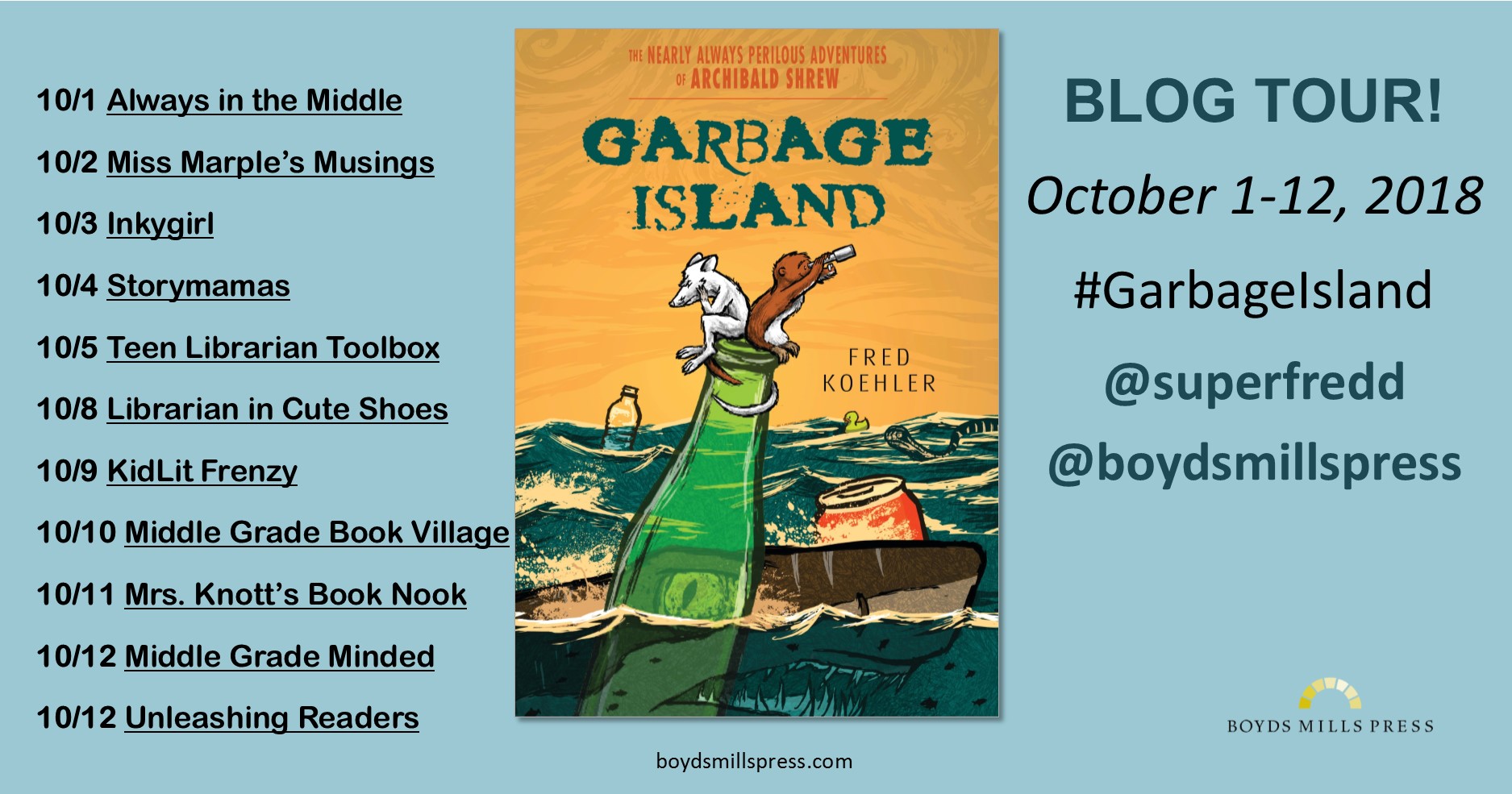
Mon 10/1           Always in the Middle
Tue 10/2             Miss Marple’s Musings
Wed 10/3           Inkygirl
Thu 10/4             Storymamas
Fri 10/5               Teen Librarian Toolbox
Mon 10/8           Librarian in Cute Shoes
Tue 10/9             KidLit Frenzy
Wed 10/10         Middle Grade Book Village
Thu 10/11          Mrs. Knott’s Book Nook
Fri 10/12             Middle Grade Minded
Fri 10/12            Unleashing Readers

Recommended For: 

classroomlibrarybuttonsmall 

Signature

**Thank you to Boyds Mills for providing copies for review and giveaway and for hosting the blog tour!**

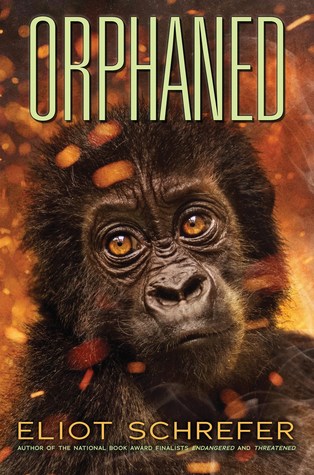
Ape Quartet #4: Orphaned by Eliot Schrefer

Share

Orphaned
Author: Eliot Schrefer
Published September 25th, 2018 by Scholastic Press

Summary: Before humans, and before human history, there were the apes.
Snub is a young gorilla, living in the heart what will eventually be known as Africa. She is jealous of her mother’s new baby . . . and restless in her need to explore. When a natural disaster shakes up her family, Snub finds herself as the guardian of her young sibling . . . and lost in a reshaped world.

Snub may feel orphaned, but she is not alone. There are other creatures stalking through the woods — a new form of predator, walking on two legs. One of their kind is also orphaned, and is taken in by Snub. But the intersection of the human world and the gorilla world will bring both new connections and new battles.

In his boldest work yet, two-time National Book Award finalist Eliot Schrefer shows us a riveting, heartbreaking early encounter between ape and man — told from the ape’s point of view. It is a journey unlike any other in recent literature.

About the Author: Eliot Schrefer is a New York Times-bestselling author, and has twice been a finalist for the National Book Award. In naming him an Editor’s Choice, the New York Times has called his work “dazzling… big-hearted.” He is also the author of two novels for adults and four other novels for children and young adults. His books have been named to the NPR “best of the year” list, the ALA best fiction list for young adults, and the Chicago Public Library’s “Best of the Best.” His work has also been selected to the Amelia Bloomer List, recognizing best feminist books for young readers, and he has been a finalist for the Walden Award and won the Green Earth Book Award and Sigurd Olson Nature Writing Award. He lives in New York City, where he reviews books for USAToday.

Praise: “Scientific accuracy paired with lyrical, subjective language describing the young gorilla’s impressions of her surroundings and bodily needs make this book an imaginative, eloquent evocation of a little-known era in prehistory from an animal’s viewpoint. A plausibly authentic account skillfully avoiding risk of excessive anthropomorphism.” – Kirkus Reviews

Review: What a fascinating book! Orphaned is so different than Schrefer’s other novels but in a way that is new and so well done. Where Endangered, Rescued, and Threatened were about humans interacting with apes in a contemporary setting, Orphaned is about apes interacting with early humans in a pre-historic setting. There is no book like this! And it is done beautifully.

When we visited virtually with Eliot Schrefer he shared with us that the story was originally told in prose but his editor, David Levithan, pointed out to him that apes, though intelligent, would not think the way that Eliot writes prose. That their thoughts would be focused on immediate needs and would lack in descriptive and fluffy language. He then completely rewrote the story in verse and WOW! Snub’s voice is perfect.

While I originally thought that the point of view and setting would make the story a challenge, but it was the contrary–it made it just that more interesting!

Teachers’ Tools for Navigation: What a great mentor text for point of view and setting! Have students write a story with an animals main character in an interesting setting. Then have them change from prose to verse to hone in on the point of view of the animal and make sure they are including the setting as a main aspect of the story.

Discussion Questions: 

  • How does the inclusion of the ape “language” help with the realism of the story?
  • Why do you think the author included the illustrations of what apes were currently in the story at the top of the page?
  • How did the change from prose to verse storytelling impact the way the story was perceived?
  • How do you think the early humans perceived the gorillas when they interacted with them?
  • How does the point of view shape this story?
  • How did the eruption change the life of the gorillas and early humans?
  • How are gorillas and early humans similar and different?

Flagged Passages: 

Central Eastern Africa
600,000 Years Ago

Until this time, gorillas lived by the millions in a broad band of jungle across Africa. Then a series of volcanic eruptions, many times more foreful than any the modern world has experience, occurred in the Great Rift Valley. The shift in landscape allowed tribes of early humans to travel south into this area for the first time. 

It would be the first meeting between ape and human.

Part One: Home

Rock. Nut.
Snub looks between the two, thinking.
This tree keeps its nuts high in its branches–
a fallen one is a lucky treat.
She imagines rolling the inside nugget in her mouth,
biting its oily flesh.
Tongue between her teeth, brow scrunched,
she raps the rock on top of the nut.
It does not crack.
She licks the rock.
The rock tastes like rock.
She licks the nut.
The nut tastes like dirt.
Snub twists the woody halves.
They will not part.
Opening nuts is Mother’s job,
but Mother let Snub go off alone.

                                                                              mrgh. 

Fresh fury surges.
Snub hurts the nut, aiming
at a pair of magpies.
It goes wide and disappears into the foliage.
Worthless nut.
Snub looks to see if anyone has
been impressed by her rage.
But this only reminds her:
Her family is not here.”

Read This If You Love: The Ape Quartet books #1-3, Early humans, Gorillas

Recommended For: 

classroomlibrarybuttonsmall 

Signature

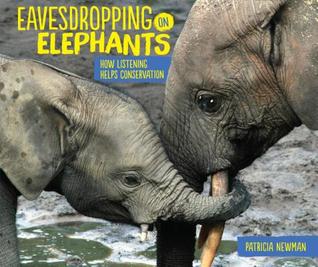
Eavesdropping on Elephants: How Listening Helps Conservation by Patricia Newman

Share

Eavesdropping on Elephants: How Listening Helps Conservation
Author: Patricia Newman
Published August 1st, 2018 by Millbrook Press

Summary: Deep in the Central African Republic, forest elephants trumpet and rumble along with the forest’s symphony. And scientists are listening.

Scientist Katy Payne started Cornell University’s Elephant Listening Project to learn more about how forest elephants communicate and what they’re saying. But the project soon grew to be about so much more.

Poaching, logging, mining, and increasing human populations threaten the survival of forest elephants. Katy and other members of the Elephant Listening Project’s team knew they needed to do something to protect these majestic animals. By eavesdropping on elephants, the Elephant Listening Project is doing its part to save Africa’s forest elephants and preserve the music in the forest.

About the Author: Patricia Newman has a passion for uncovering fascinating aspects about our world and crafting books that lead children on an adventure of discovery. She gravitates toward stories about animals and conservation science and enjoys sharing her excitement with readers. Books include Sibert Honor title Sea Otter Heroes: The Predators That Saved an Ecosystem; Junior Library Guild Selection Eavesdropping on Elephants; Bank Street College Best Book Zoo Scientists to the Rescue; Booklist Editor’s Choice Ebola: Fears and Facts; and Green Earth Book Award winner Plastic, Ahoy! Investigating the Great Pacific Garbage Patch. She frequently speaks at schools, libraries, and conferences about writing and conservation. Visit her at www.patriciamnewman.com.

Praise: 

“…this book does an excellent job of transporting readers and providing a clear, multifaceted picture of African forest elephants…The more you listen to wildlife, the more your mind opens up to new ideas about why the world is a place worth saving… VERDICT: A great pick for middle school nonfiction collections.” —School Library Journal

“Fascinating for earnest conservationists.” —Kirkus Reviews

Review: I am never disappointed when I read a Patricia Newman book. Each of her books are filled with fascinating information told in a way that will make any reader feel the passion that Newman obviously feels about her topics.

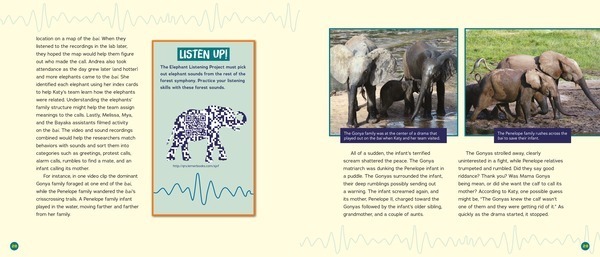
Her newest, Eavesdropping on Elephants, takes it to a whole new level! Not only does the book still include informational and narrative nonfiction, sidebars, glossaries, and classroom connections all well-researched and interesting, but it also includes QR codes (or links if you do not have a QR reader) to actually see and/or hear the elephants that are being discussed in the book. This really makes the book come to life in a way that I haven’t seen before.

Like all of her books, by the end I wanted to talk to people about what I read, wanted to go make a difference, and wanted to keep learning. If this isn’t a testament to how good her nonfiction is then I don’t know what is.

Teachers’ Tools for Navigation: “Consider an Authors for Earth Day visit in conjunction with Eavesdropping on Elephants. Students research a list of five conservation nominees selected by Patricia Newman and then vote for their favorite. Newman writes a check to the winning organization. The mission? To empower young readers to shape the world around them!”  –https://www.patriciamnewman.com/books/eavesdropping-on-elephants/ 

Research, reading, and writing activities for the classroom in conjunction with Eavesdropping on Elephants can be found on Patricia Newman’s Elephants Pinterest Board!

I, personally, am going to use Newman’s texts in my passion project research unit this year. I’m going to use her texts to show mentor texts of a nonfiction picture book and students are going to make their own nonfiction book or video. I also hope to have my lunch book club read Newman’s books as one of their month choices.

Discussion Questions: 

  • How do the videos/recordings help with the understanding of the book?
  • What is a keystone species? And how are the forest elephants a keystone species of their habitat?
  • What is the difference between ultrasound and infrasound? What does this have to do with elephants?
  • What figurative journey did Katy take to finally make it to Africa to study elephants in the wild?
  • What did the scientists learn by listening to the elephants?
  • Why are elephants’ ears the shape that they are?
  • How is what Katy did with elephant sounds similar to a dictionary?
  • How are humans a threat to forest elephants?
  • What did Teagan Yardley do when she learned about these threats?

Book Trailer: 

Flagged Passages: 

Read This If You Love: Nonfiction about animals, Nonfiction titles by Patricia Newman

Recommended For: 

classroomlibrarybuttonsmall 

Signature

**Thank you to Lerner Publishing and Patricia for providing a copy for review!**

Complexity in The Impossible Knife of Memory by Laurie Halse Anderson

Share

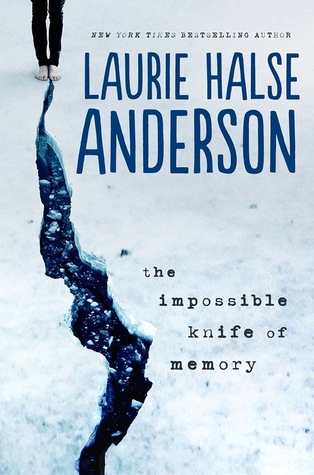
The Impossible Knife of Memory
Author: Laurie Halse Anderson
Published January 7th, 2014

ALAN Walden Award Finalist 2015
National Book Award Longlist 2014
School Library Journal Best Young Adult Book of 2014

Summary: For the past five years, Hayley Kincain and her father, Andy, have been on the road, never staying long in one place as he struggles to escape the demons that have tortured him since his return from Iraq. Now they are back in the town where he grew up so Hayley can attend school. Perhaps, for the first time, Hayley can have a normal life, put aside her own painful memories, even have a relationship with Finn, the hot guy who obviously likes her but is hiding secrets of his own.

Will being back home help Andy’s PTSD, or will his terrible memories drag him to the edge of hell, and drugs push him over? The Impossible Knife of Memory is Laurie Halse Anderson at her finest: compelling, surprising, and impossible to put down.


Complexity in Young Adult Literature

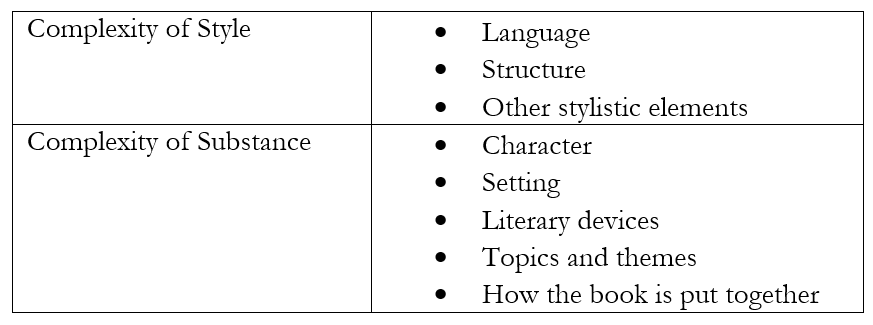
In Teaching Reading with YA Literature: Complex Text, Complex Lives by Jennifer Buehler, Chapter 2 looks at Young Adult Literature and Text Complexity and gives 8 different elements to think about to help analyze the complexity of a text:

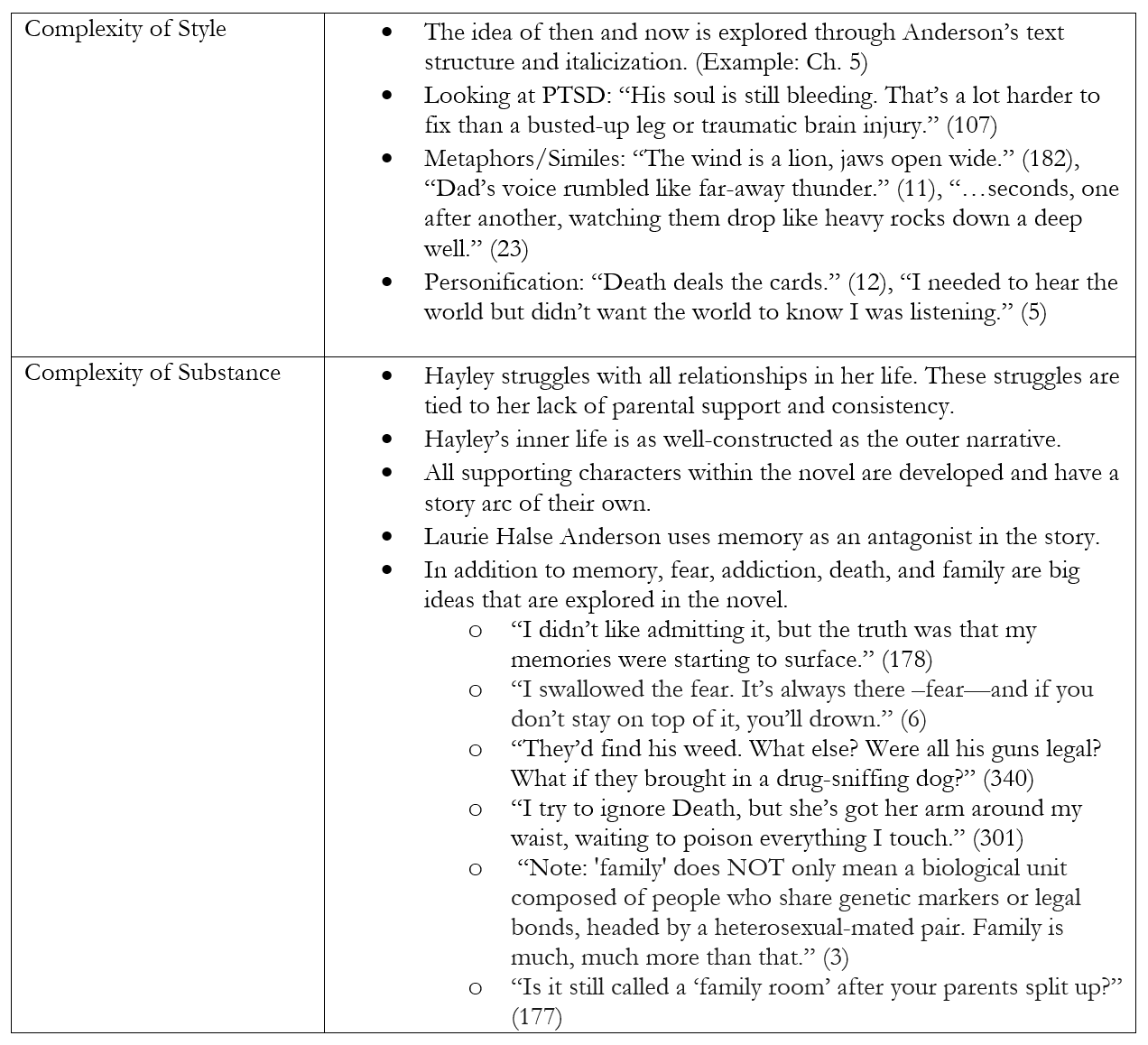
Examples of complexity in The Impossible Knife of Memory by Laurie Halse Anderson

Other questions that could be asked while reading to find complexity in YAL
(Examples from Teacher Reading with YA Literature, Buehler 36-37)

  • Language: Are the sentences artfully constructed? Are the words carefully chosen? Does the author incorporate figurative language or poetic expression? Can we hear voice in the writing?
  • Structure: How is it built in terms of form and structure? How do other elements such as titles and subtitles, vignettes and interludes, shifts between past and present, or multiple points of view work together to service the whole?
  • Other Stylistic Elements: Are there other distinct elements in the text?
  • Character: What is there to explore in terms of the character’s thoughts and feelings; conflicts and contradictions; struggles, growth, and change?
  • Setting: How does the author bring us into the world of the story? What details help us to see, hear, and imagine this place?
  • Literary Devices: How does the author use literary or cultural allusions, intertextual references, dialogue, internal monologue, metaphor and symbolism, magical realism, or repetition to build meaning?
  • Topics and themes: What questions does the book ask? What ideas does it explore? What is at stake for teen readers in this book?
  • How the book is put together: How effective is the interplay between plot layers and thematic layers?

Discussion Questions/Writing Prompts for The Impossible Knife of Memory

Complexity can also be increased by the characteristics of the reader (such as motivation, knowledge, and experiences) and task variables (such as purpose and the complexity generated by the task assigned and the questions posed). Here are some examples of discussion questions or writing prompts that could be used in classrooms or with independent readers who are reading The Impossible Knife of Memory.

  • Hayley classifies all people into two categories: freaks & zombies. What does Hayley’s idea of the world show us about her outlook on life?
  • How does Laurie Halse Anderson use the idea of THEN and NOW throughout the novel to build on the theme that memories are a very complex part of life?
  • Drowning is a motif throughout the novel.
  • How does Laurie Halse Anderson show the reader that Hayley’s father is suffering and found addiction without using those words?
  • How did the inclusion of Hayley’s romantic relationship with Finn help move along the story and Hayley’s transformation? Do you feel that Hayley’s story arc would have been the same without Finn in the story?
  • How was the setting an integral part of the story? How did Hayley returning to her deceased grandmother’s home propel the story?
  • .Trish is one of the most complex characters in the book because there are many different Trishes shared with us throughout the story: Trish then, Trish now in reality, and Trish now in Hayley’s mind. How did Laurie Halse Anderson develop each of these different characters to show the reader a full picture of Trish?

This complexity information and activities can be found as a PDF on Laurie Halse Anderson’s website or my SlideShare.

To learn more about complexity in young adult literature, please read Teaching Reading with YA Literature: Complex Text, Complex Lives by Jennifer Buehler!

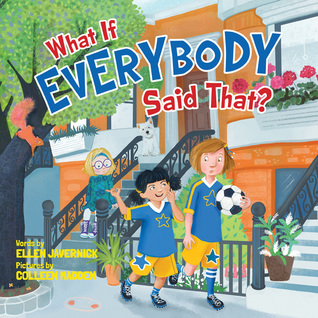
What If EVERYBODY Said That? by Ellen Javernick

Share

What If EVERYBODY Said That?
Author: Ellen Javernick
Illustrator: Colleen Madden
Published August 1st, 2018 by Two Lions

Summary: What if everybody chose to be kind?

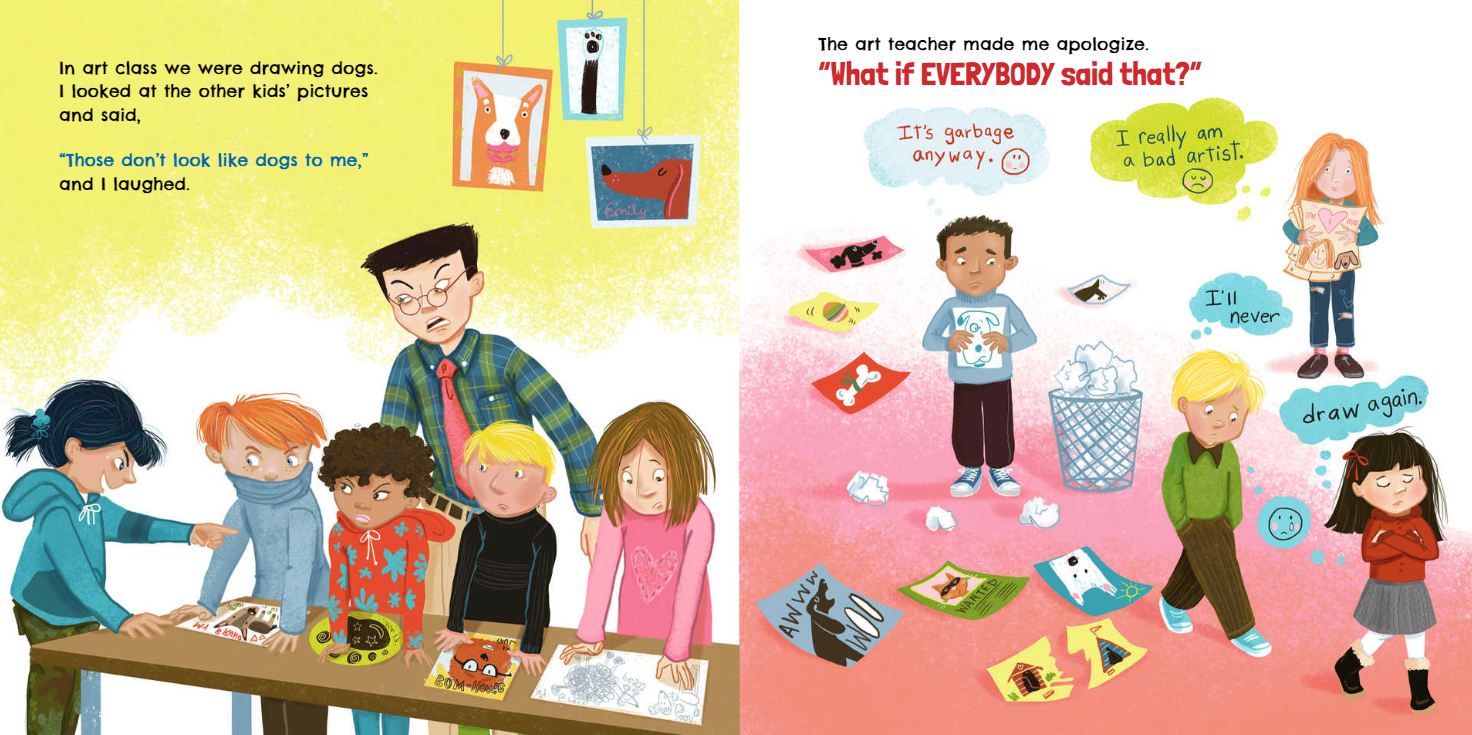
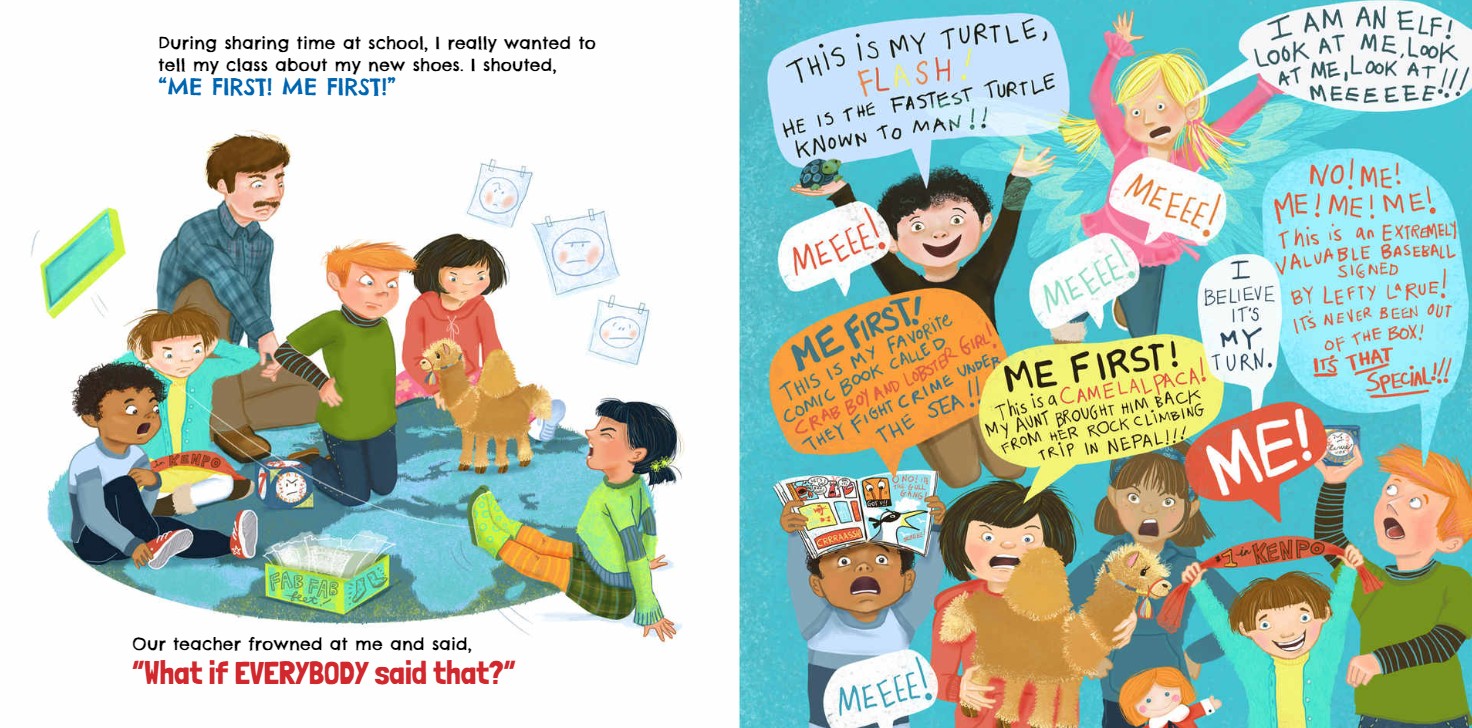
If you tell someone that they can’t play with you, there’s no harm done, right? But what if everybody said that? What if everybody forgot to be kind…and made fun of other kids’ artwork at school, or told a fib, or refused to share with a person in need? The world wouldn’t be a very nice place to live. But what if everybody thought before they spoke, so the world would be a kinder place?

With clear prose and lighthearted artwork, this companion book to the bestseller What If Everybody Did That? explores the power of words and shows kids that the things we say matter.

About the Creators: 

Ellen Javernick has taught 1-3 grade classes for over 20 years. Her B.A. is from DePauw University. Her M.A. in Early Childhood Education is from the University of Northern Colorado. She has completed classes with Barbara Wise and is Lindamood-Bell trained. In addition to being a teacher, Ellen has written more than 20 books for children. She currently teaches second grade in Loveland, CO.

The weird fourth kid in a family of 8, Colleen Madden made it through childhood pretending to be a wookie and doodling in her cardboard box art studio. Colleen spent some time acting and training at The Second City in Chicago, then went on to graduate from a small liberal arts school on the East coast. Colleen eats and works and runs around in the Philadelphia area.

Praise: “A reminder to be aware of what one says, as well as a discussion starter about actions and consequences.” —Kirkus Reviews

Review: Empathy and kindness are both things that I truly believe need to be directly taught to children. Kids are born thinking only of their own needs and maybe of the needs of their family, but they have to learn how to care about those around them. This teaching can start at a very young age but then needs to be reinforced for years to come. Anyone who teaches knows this is true. We may have some of the best students but even they make a mistake sometimes that is hurtful to someone else. What If Everybody Said That? is a testament of thinking about others. Though a bit didactical, the different scenarios put on each page truly do show a cause and effect of the words we say to others.

Teachers’ Tools for Navigation: This text is a perfect book to add to any community building, kindness, empathy, or anti-bullying text set.

Discussion Questions: 

  • How does each spread show the cause and effect of what she said?
  • What finally made the young girl realize she needed to apologize?
  • What if everybody said that? (Pick a page and discuss)
    • Look at the cause and effect from everybody saying what the girl said.
    • Compare and contrast the two pages.
  • What is something you can think of that you said before that may not have been the best choice?

Flagged Passages: 

Read This If You Love: Each Kindness by Jacqueline Woodson, Eraser by Anna Kang, I Walk with Vanessa by Kerascoët, and other books helping students think about the words and choices they make

Recommended For: 

classroomlibrarybuttonsmall 

Signature

**Thank you to Two Lions for providing a copy for review!**

The Girl with More Than One Heart by Laura Geringer Bass

Share

The Girl With More Than One Heart
Author: Laura Geringer Bass
Published April 17th, 2018 by Abrams Books

Summary: There are times we all feel we need more than one heart to get through. When Briana’s father dies, she imagines she has a new heart growing inside her. It speaks to her in her Dad’s voice. Some of its commands are mysterious.

Find Her!  it says. Be Your Own!  

How can Briana “be her own” when her grieving mother needs her to take care of her demanding little brother all the time? When all her grandpa can do is tell stories instead of being the “rock” she needs? When her not-so-normal home life leaves no time to pursue her dream of writing for the school literary magazine? When the first blush of a new romance threatens to be nipped in the bud? Forced by the loss of her favorite parent to see all that was once familiar with new eyes, Briana draws on her own imagination, originality, and tender loving heart to discover a surprising path through the storm.

About the Author: Laura Geringer Bass is the author of over 20 highly acclaimed books for children, tweens, and teens. Her new novel for middle graders about friendship, love, and loss — The Girl with More Than One Heart — is the lyrical story of a courageous girl who imagines she needs an extra heart to navigate her grief after the death of her dad. It will be published by Abrams this Spring. Laura serves on the National Advisory Board of First Book, a non-profit organization that has delivered over 170 million books to children in need and as a mentor for Girls Write Now and Prison Writes, teaching teens at risk.

Review: This book looks at the struggle of grief when life keeps moving on around you. And like another book I love, Courage for Beginners, it shows the struggle a child has if a parent is suffering and they have to step up in a way that is not what their peers have to. Briana doesn’t know how to deal with the grief and with her mother incapacitated with grief also, Briana finds that she needs a second heart to help guide her through this huge bump in her life. Briana’s story also shows the struggle yet love of being a sibling to a child with special needs.

Written beautifully in a way that will pull at your heartstrings, Bass’s story shows how one girl uses art, love, and courage to make her way through a loss that is unimaginable for most of us.

Teachers’ Tools for Navigation: The Girl With More Than One Heart needs to be in classroom, school, and public libraries. There are so many readers that need this book. There are other readers that will want this book. There are definite readers for this book.

Another way in the classroom that it could be used is a mentor text for writing about memories. Briana’s second heart shares memories with her, one of the ways we get to know her dad, and the memories are so full of imagery. There are many sections that could be read for a mentor text when asking students to write a personal narrative.

Discussion Questions: 

  • How did Briana use art to help her through her grief?
  • How did Briana’s life change after the loss of her dad?
  • Aaron is described in the summary as her demanding little brother, but Briana loves him. What are some examples in the story that show this love?
  • How does Grandpa Ben help guide Briana?
  • Briana’s second heart is only figurative. What does it represent?

Flagged Passage: “The day my father’s heart stopped, I discovered an extra heart deep in my belly, below my right rib. It talked to me. I wasn’t crazy. Before that day, I had just one heart that never said a word.” (p. 1)

Read This If You Love: Courage for Beginners by Karen Harrington, Rules by Cynthia Lord, How to Speak Dolphin by Ginny Rorby, Be Light Like a Bird by Monika Schröder, Snicker of Magic by Natalie Lloyd, Some Kind of Happiness by Claire Legrand, Far from Fair by Elana K. Arnold

Recommended For: 

classroomlibrarybuttonsmall

Signature

**Thank you to Casey at Media Masters Publicity for providing a copy for review!**