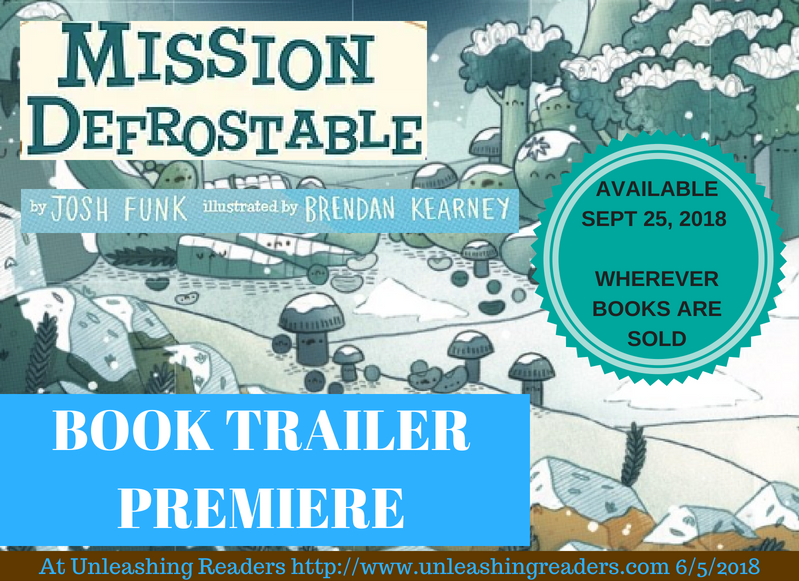
Mission Defrostable by Josh Funk BOOK TRAILER PREMIERE!!! (with Prediction Activity)

Share

We are honored to premiere the book trailer of one of our favorite authors, Josh Funk. Josh has made a huge mark in the field of children’s literature, and we are thrilled to share the book trailer for his third book in the Lady Pancake and Sir French Toast series (below).

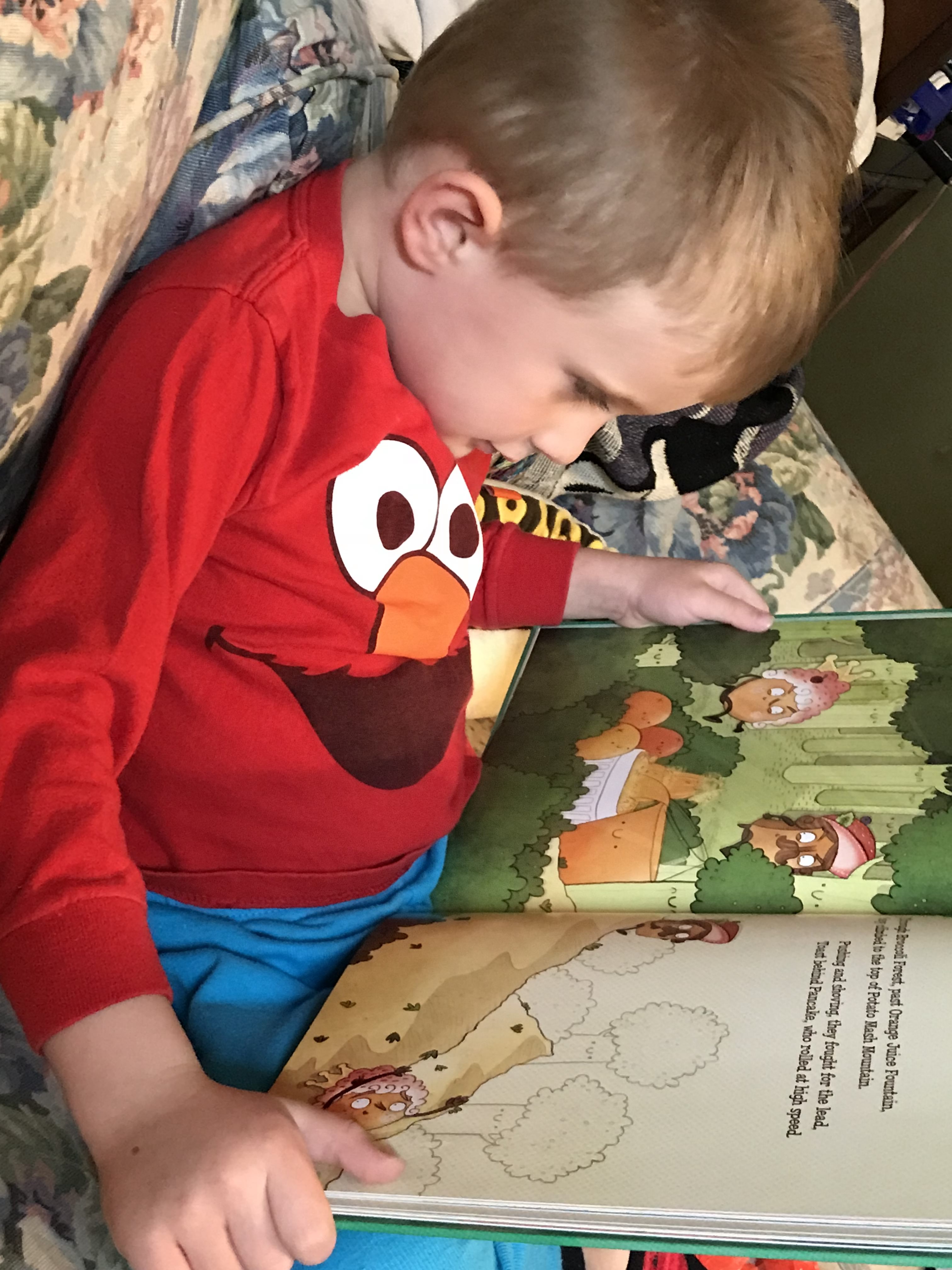
Not only is Josh a favorite of parents and teachers, he is a favorite of kids! Our sons are so, so excited for the new book in the series. As teacher moms, we thought it would be fun to build their anticipation and help them learn about making predictions. We invite you to have this same fun with your own children or students!

We asked Trent to review Lady Pancake and Sir French Toast (Book #1).

Warning: Trent’s review has a bit of a spoiler in it!!!

  • Trent’s Review: Lady Pancake and Sir French Toast were fighting. They both wanted syrup. The adventure through the refrigerator was silly. I liked the broccoli forest and jumping over the strawberry. But the awful waffle is the bad guy. Baron von Waffle makes me grumpy because I wouldn’t like if someone ate all of my food. I do like that they [Lady Pancake and Sir French Toast] didn’t fight eventually. And the rhymes were silly willy!

  • Kellee’s and Ricki’s Review with teachers’ tools, discussion questions, etc. can be found here.

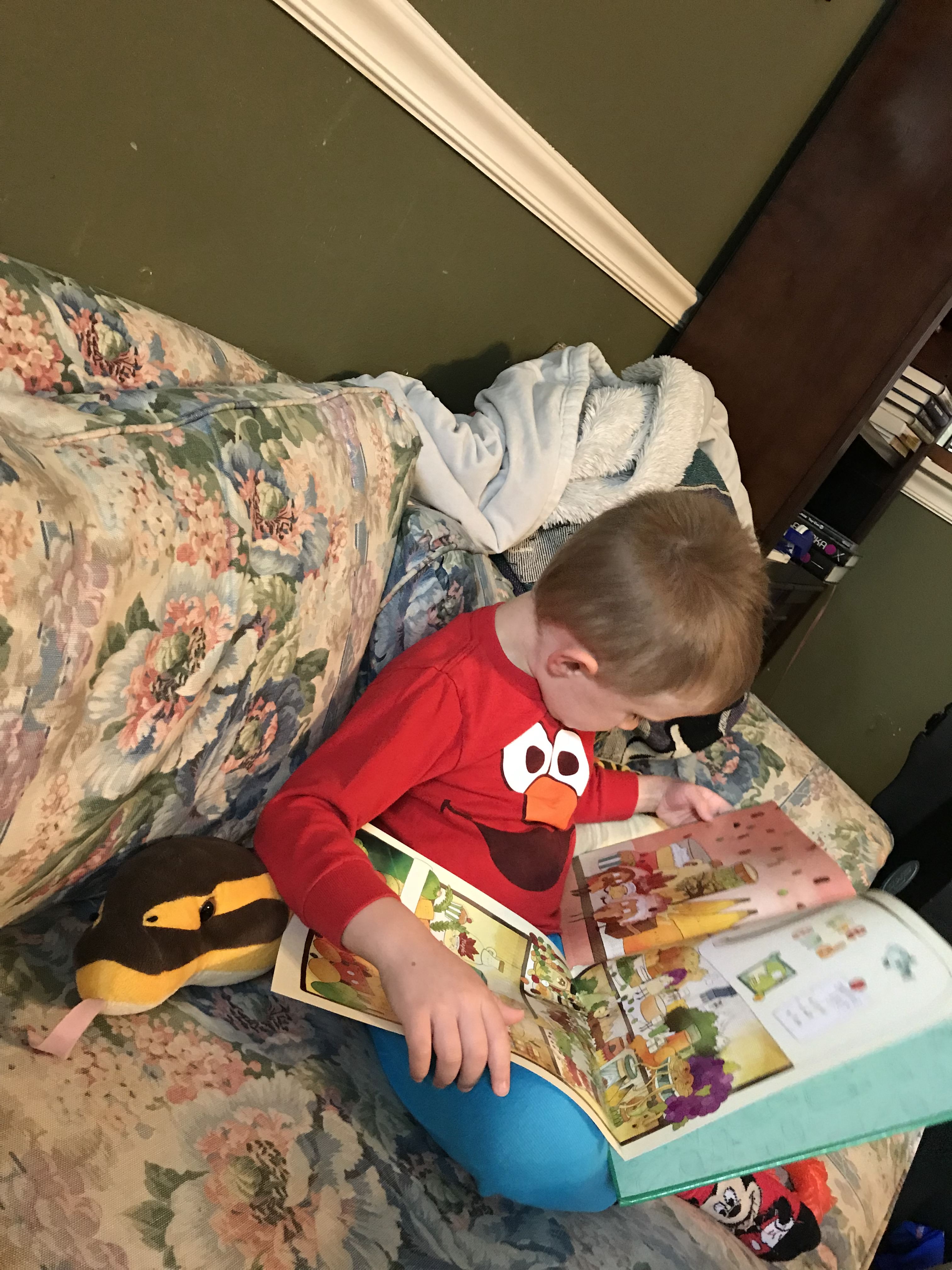
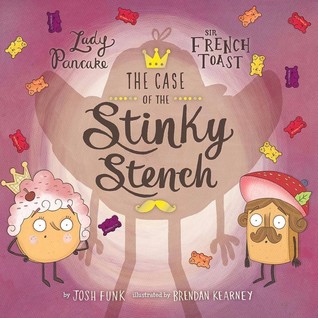
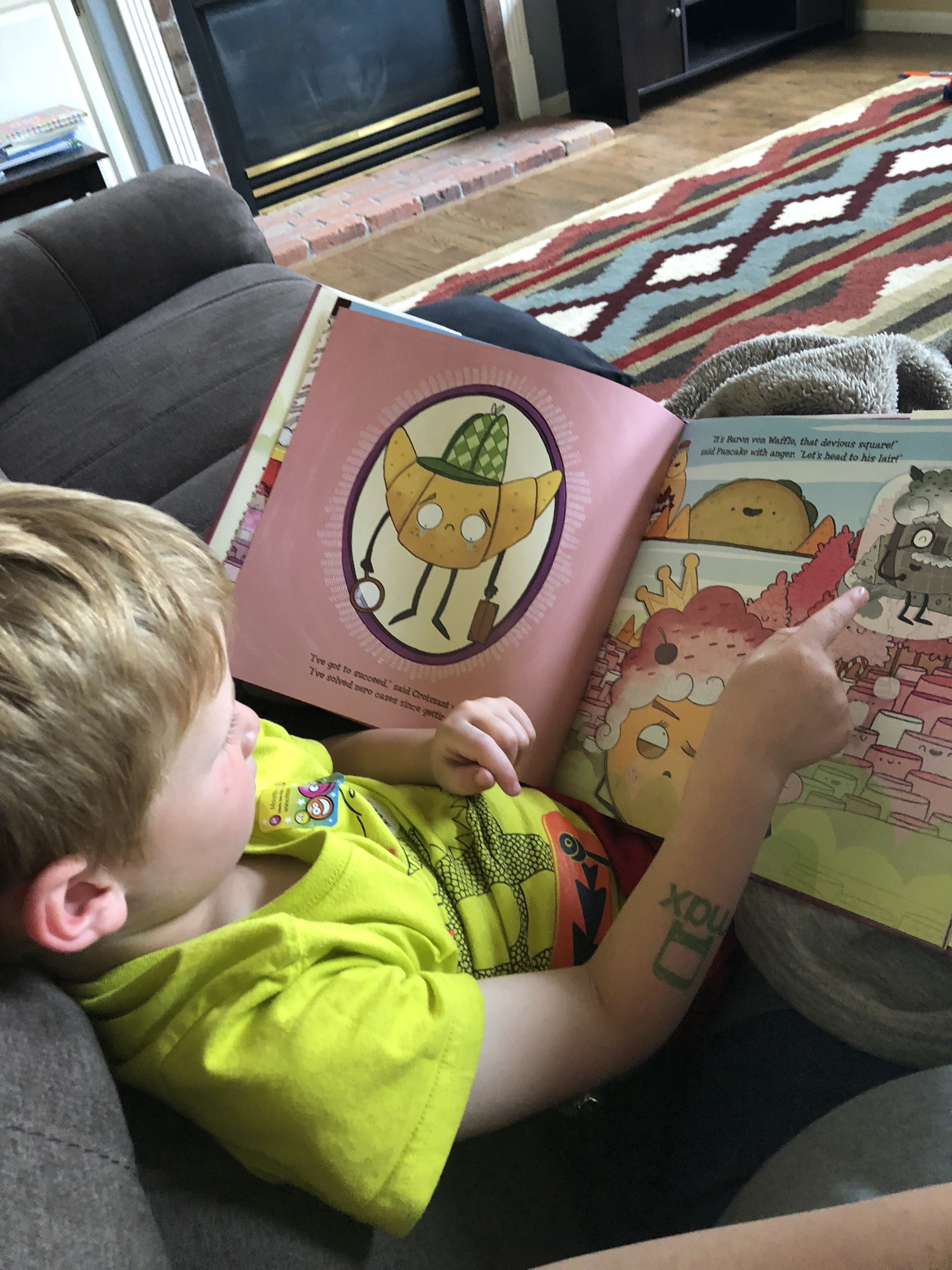
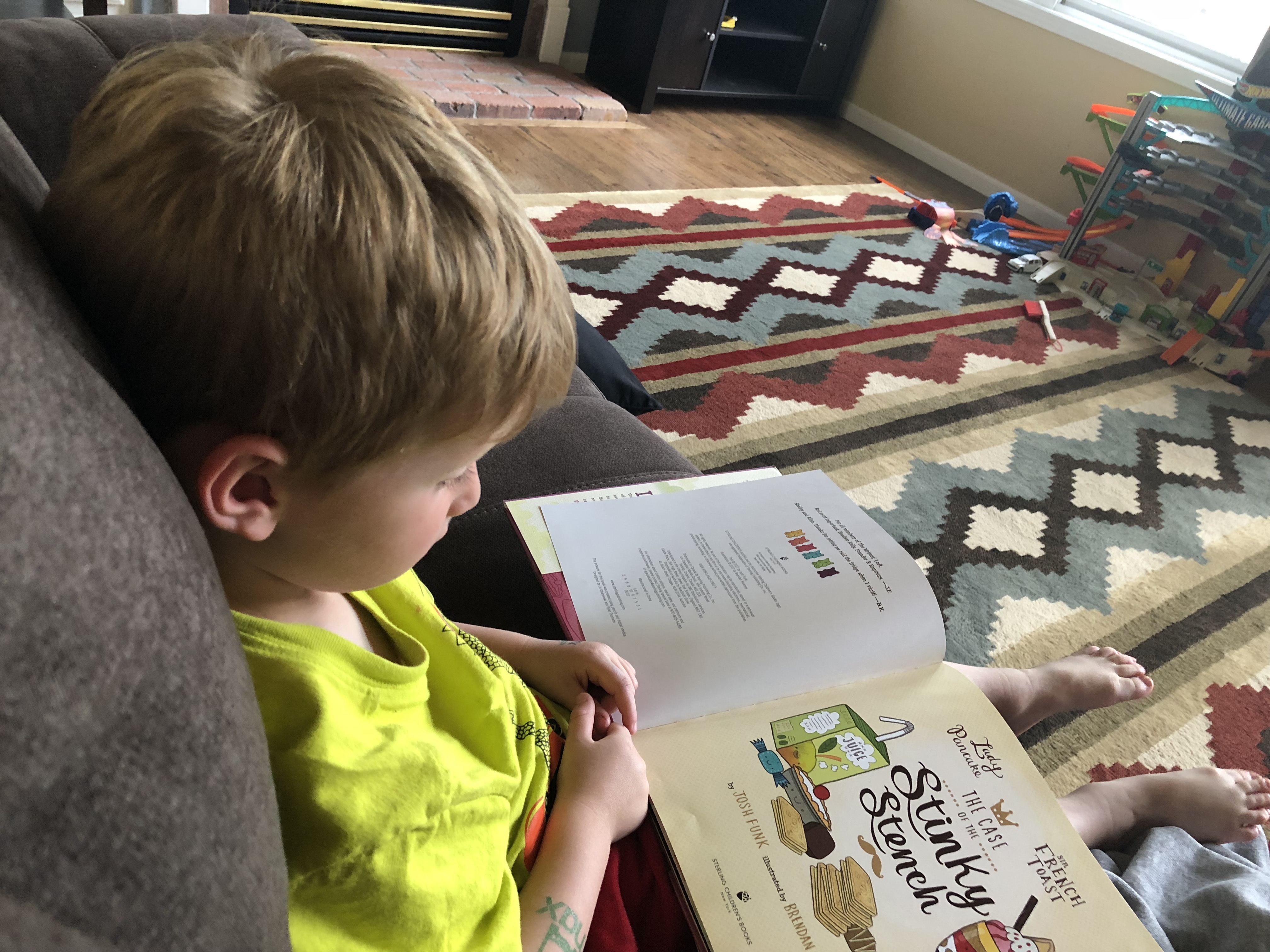
We asked Henry to review The Case of the Stinky Stench (Book #2).

Warning: Henry’s review has a bit of a spoiler in it!!!

  • Henry’s Review: I think that there were things in the book that were stinky! At the beginning of the book I thought Croissant was making the smell. The fruitcake was stinky and rotten and sad. I think Baron von Waffle got him that way. I like when the fruit cake stands next to cheese. “Type that, Mommy. It’s important.” The book is very good. I like Lady Pancake and Sir French Toast. I really like the gummy bears on the cover because I am really hungry for one right now. The story is so good. I would give it to a friend to read, but I want to keep it for myself. It’s my book that I like to read a lot.

  • Ricki’s and Kellee’s Review with teachers’ tools, discussion questions, etc. can be found here.

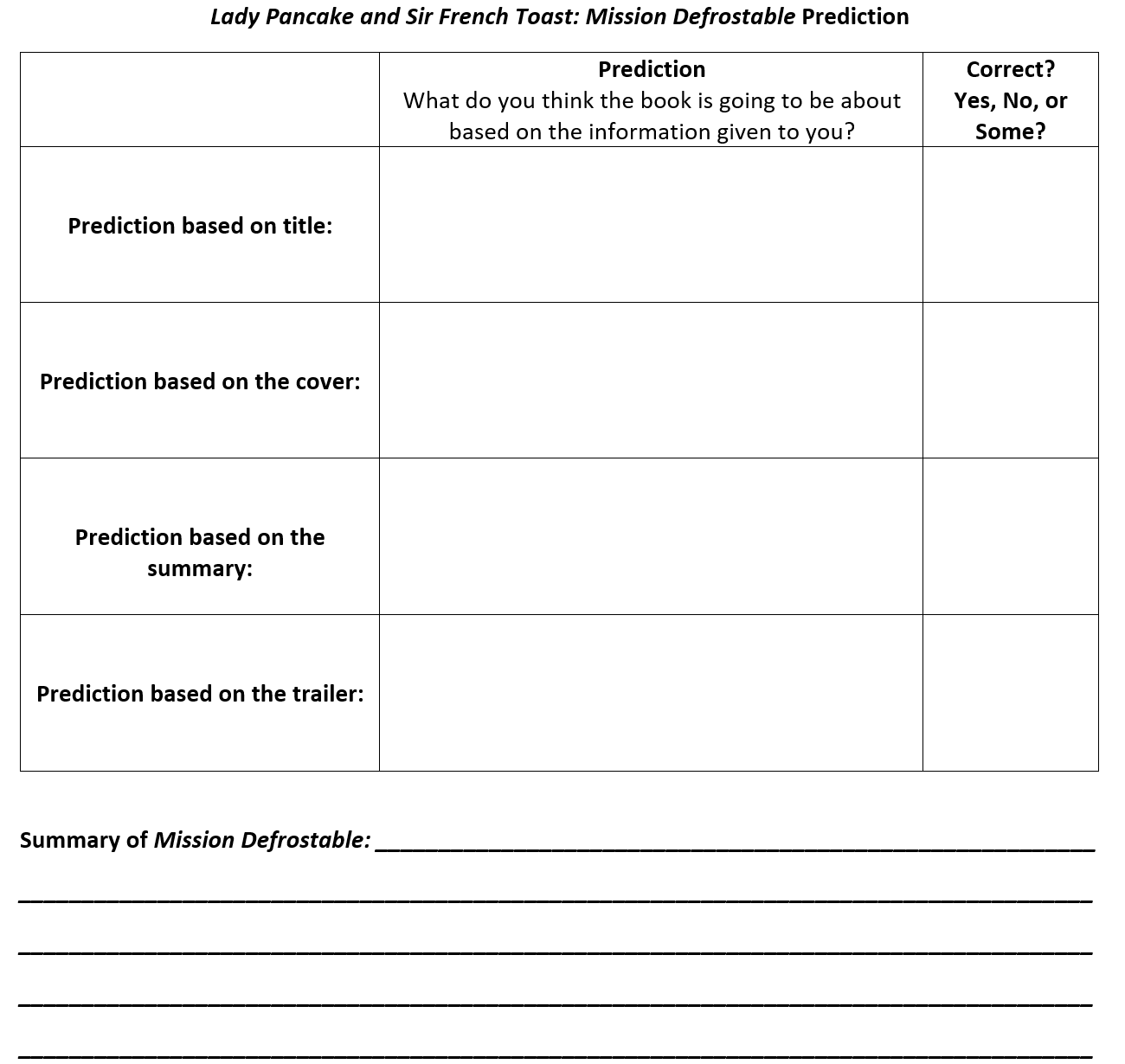
Then to get the boys excited about the next book, we decided to have them take part in a prediction activity!
Here is a graphic organizer for the activity: 

First, we told them what the new Lady Pancake and Sir French Toast title was: 

Mission Defrostable

  • Trent’s prediction: Sir French Toast is going to get frosting. But I don’t know who is the bad guy.
  • Henry’s prediction: I think Sir French Toast is going to get defrostable. I don’t know what will happen with Lady Pancake. Can I see the cover now?

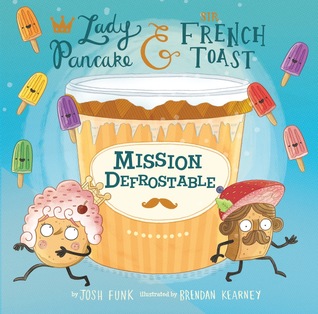
Next, we showed them the cover of Mission Defrostable and asked them if they wanted to change their prediction: 

  • Henry’s prediction: Somebody is going to drop into the big container! Lady Pancake and Sir French Toast are going to…maybe they will eat some of the ice cream. I hope they don’t get hurt. I want to have this book. Can we get it, Mom?
  • Trent’s prediction: Lady Pancake and Sir French Toast are running from the bad guy. I don’t think the popsicles are the bad guys because they are dancing with their friend, ice cream. Maybe the waffle is the bad guy again.

Then, we read them the summary of Mission Defrostable and asked them to prediction what else they think would happen in the book: 

Our favorite breakfast food friends are back and all bready for their next adventure! Can they save the fridge before all the food is iced? It’s mission . . . defrostable.

“And now with the two of you out of the fold,
I’ve got my revenge and I’m serving it cold!”

Brrr! There’s a frost in the fridge—and it’s hardened Pudding Pond and frozen Yogurt Falls. Agent Asparagus is on the case, and she begs Lady Pancake and Sir French Toast to join her superspy team. But when the enemy snatches Asparagus, Pancake and French Toast have only one dough man to turn to for help: the evil Baron von Waffle! Will he help them save the fridge . . . or are they doomed to become frozen food?

  • Trent’s prediction: Yes. They’re frozen food. Because the refrigerator is really cold, and waffle won’t help because he is a bad guy. The popsicles are dancing because it is cold.
  • Henry’s prediction: They are going to be frozen food! I think Agent Asparagus is going to become a bad guy and get Lady Pancake and Sir French Toast and catch them and shoot a web over them with sticky slime to get them caught!

Finally, we showed them this WORLD PREMIERED book trailer and asked them what they thought now:

  • Henry’s prediction: I think the popsicles on the cover are going to come into the book more and Lady Pancake and Sir French Toast are going to lick them and get their tongues stuck. Baron von Waffle…I don’t know what is going to happen to him. But I think it is bad. I don’t know any guesses about what might happen to him though. We will see in the book when we get it. It’s going to be fun to get to read it. After this one, is there going to be another one coming out? I think there should be, and it should be called Mission Accomplished.
  • Trent’s prediction: Baron von Waffle is going to ruin the world because his friends, the popsicles, want the refrigerator cold. The bananas look bad also. Maybe the big bad person are in the castle! Maybe the popsicles aren’t dancing, they are laughing and that is why Lady Pancake and Sir French Toast are running because the popsicles are bad. I’m excited to see about the popsicles–I want the book!

The boys’ summary (the last part of the prediction activity) and review will be shared when we review the final title!

We are so excited to be able to premiere this book trailer with the world!
Thank you, Josh, for the incredible work that you do. You are a gift to the literary world.
And we cannot wait to share our (and the boys’) thoughts about the newest title!

and 

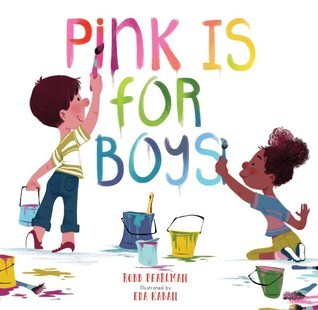
Pink is for Boys by Robb Pearlman

Share

Pink Is for Boys
Author: Robb Pearlman
Illustrator: Eda Kaban
Published: June 5, 2018 by Running Press

Goodreads Summary: An empowering and educational picture book that proves colors are for everyone, regardless of gender.

Pink is for boys . . . and girls . . . and everyone! This timely and beautiful picture book rethinks and reframes the stereotypical blue/pink gender binary and empowers kids-and their grown-ups-to express themselves in every color of the rainbow. Featuring a diverse group of relatable characters, Pink Is for Boys invites and encourages girls and boys to enjoy what they love to do, whether it’s racing cars and playing baseball, or loving unicorns and dressing up. Vibrant illustrations help children learn and identify the myriad colors that surround them every day, from the orange of a popsicle, to the green of a grassy field, all the way up to the wonder of a multicolored rainbow.

Parents and kids will delight in Robb Pearlman’s sweet, simple script, as well as its powerful message: life is not color-coded.

Ricki’s Review: I have two sons. I very much appreciate all of the wonderful girl-empowering books that have been published recently. I am constantly shooting up my fist and shouting “Hooray!” when these books are published. But as a mom, I appreciate even more the opportunities to tell my son, “Yes, it’s okay that your favorite color is ‘rainbow,'” “No, boys are not necessarily better at fixing things” (I’ll secretly admit that this one is actually true in our house—my husband is an engineer), or “Yes, it’s okay if your favorite Disney song is ‘Let It Go,’ even when you are the only boy in your class who thinks this.” (I should backtrack here and say that Moana is far better than Frozen.)

I have one more anecdote. The day after I read this book to my son, I went to a birthday party with my sons. My 19-month-old crashed into a boy who was about 2 and half. My kid, who is oddly resilient, popped right up, but the other boy cried. His dad said, “You need to man up. Boys don’t cry.” This kind of stuff has to end. It’s only with the publication of books like these that we will be able to defy these gender norms that drive me bonkers. Pink is for boys.

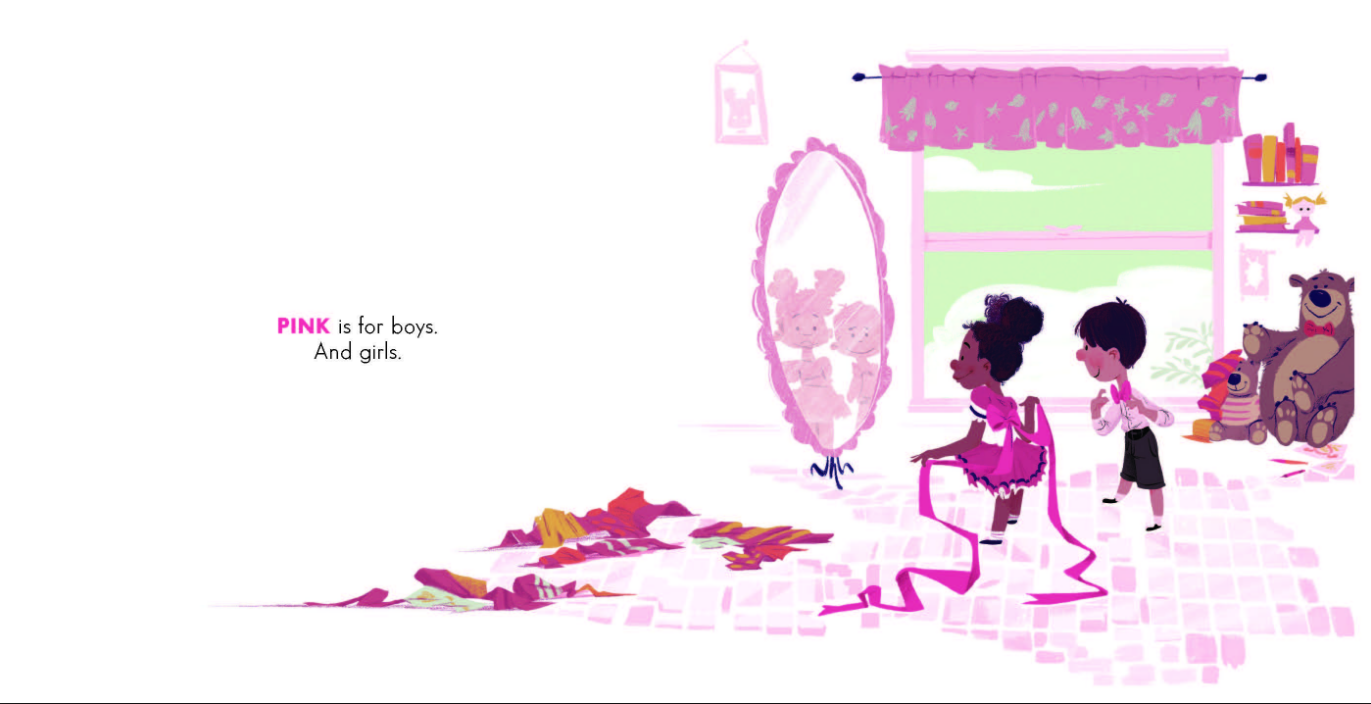
The basic (but well-conceived) drawings of this book make it shine. The point is clear—and younger readers will easily make sense of it. The characters are drawn as simple sketches and are understated. This makes the message all the more powerful. 

Kellee’s Review: My son loves all the colors. Except, according to him, pink and purple. Where did this come from?! In my house, all colors are wonderful colors and girls and boys can like and do whatever they want, but he must have been told by someone ‘out there’ that pink and purple are girl colors, and Trent, wanting to be accepted, now felt he couldn’t like these colors. I try to counteract this notion in my house, but it is ‘out there’ that minds need to shift or I am fighting a battle so much bigger than I may be able to handle. When will we [general societal we] stop saying “You throw like a girl” as an insult or “Man up” as a way to tell kids to not cry?! I can teach my son to be a feminist, but until things like those stated above change, society will always be pushing against what I am teaching him at home. 

Within the text, in addition to promoting the brilliance and beauty of all colors, I also truly appreciated how the characters were diverse in all aspects of the word and that the author purposefully rotated between girls and boys & boys and girls to show that neither deserves to go first.

Teachers’ Tools for Navigation: This book makes us itch to teach young kids. We would ask students to create their own versions (or posters) of this book. For example, they might create books called Crying is For Boys or Dirt is for Girls. As a secondary teacher, this book would be a great discussion starter about gender prejudice and assumptions in society.

Discussion Questions: How does the illustrator use simplistic drawings to better convey the meaning of the text?; How does the author convey the message implicitly and explicitly?

Flagged Passage:

Read This If You Loved: Julián Is a Mermaid by Jessica Love, Red: A Crayon’s Story by Michael Hall, The Boy In the Dress by Michael Walliams, The Sissy Duckling by Harvey Fierstein

Recommended For: 

readaloudbuttonsmall classroomlibrarybuttonsmall

RickiSigand Kellee Signature

**Thank you to Casey at Media Masters for providing copies for review!**

Author Guest Post with Teaching Tools!: “Take a Trip to the Moon” by Matthew Brenden Wood, Author of The Space Race: How the Cold War Put Humans on the Moon

Share

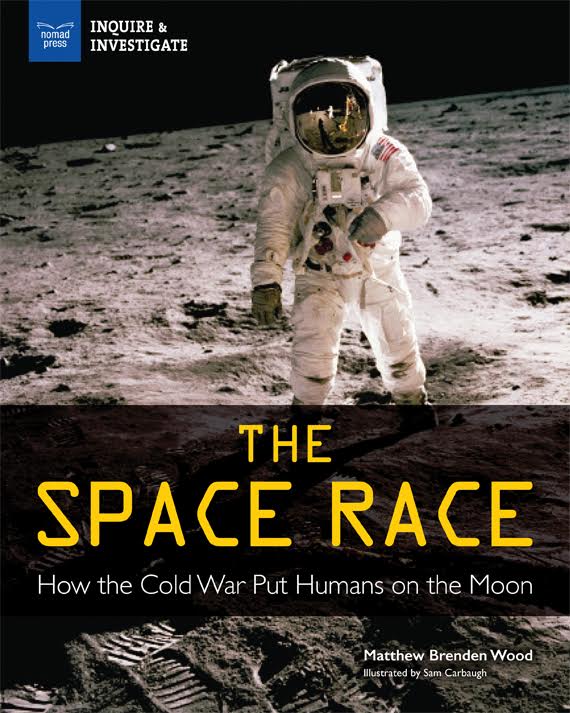
The Space Race: How the Cold War Put Humans on the Moon
From the Nomad Press Inquire and Investigate Series
Author: Matthew Brenden Wood
Illustrated by: Sam Carbaugh

Summary: What do you see when you look up at the night sky? The potential for amazing discoveries and scientific advancement? During the 1950s and 60s, some people also saw a place that needed to be claimed.

In The Space Race: How the Cold War Put Humans on the Moon, middle school students will explore the bitter rivalry between the United States and the Soviet Union that served as fuel for the fire that catapulted rockets into the great unknown of the next frontier-space. While Neil Armstrong will always be remembered as the first person to set foot on the moon, the people and events behind this accomplishment populate a fascinating tale of politics, science, technology, and teamwork that resulted in what might be the greatest accomplishment of the twentieth century.

About the Author: Matthew Brenden Wood is a math and science teacher with a passion for STEAM education. He is also an avid amateur astronomer and astrophotographer. Wood holds a bachelor’s degree in astronomy from the University of Massachusetts at Amherst and lives in Phoenix, Arizona.

Author Guest Post: 

“Take a Trip to the Moon!”

What pops into your head when you think about the Space Race? Most people probably think of Neil Armstrong’s famous line, “That’s one small step…” Or perhaps they think of the sound of Sputnik’s beep as it circled the globe. But that’s only a part of the amazing story of a race that started more than two decades before Neil and Buzz left their bootprints in the lunar dust, even before President Kennedy declared that the United States would send people to the moon and return them safely to Earth.

The path to the moon started at the end of World War II, as the United States and Soviet Union eyed each other warily across what became known as the Iron Curtain. New and fearsome weapons such as the atomic bomb and the Inter-Continental Ballistic Missile were front-page news as both nations looked to outdo the other.

The West viewed the Soviets as a backwards nation, lagging far behind in technology, education, and industry. However, everything changed with the launch of Sputnik on October 4, 1957. People around the world marveled at the feat, and a new fear of communism swept across America. How had the Soviets beaten the Americans into space? What would they do next? How would the United States respond?

The launch of the world’s first artificial satellite was the firing of the starting gun in the race to the moon—it was also a new, dangerous development in the early days of the Cold War. Not only did the Soviets have a rocket that might carry a person into space, but that same rocket could carry an atomic bomb to any place on Earth. Suddenly, the United States was behind, and needed to catch up—fast. The race was on.

I wrote The Space Race: How the Cold War Put Humans on the Moon to take kids on the journey through the Space Race and the backdrop of the Cold War. For kids interested in history, it’s a look at how the relationship between the United States and Soviet Union shaped the world we live in today, from North Korea and Cuba to Russia and China. For those interested in space, it’s a window into the early days of space exploration and the incredible accomplishments on the way to the moon.

Teachers’ Tools for Navigation: Here are some activities to get your kids thinking about the space race!

FIRST-PERSON ACCOUNT

The Cold War and Space Race were very important events in history. People around the world lived through the struggle between the United States and the Soviet Union, and millions tuned in to witness humanity’s first steps on a different world. Do you know someone who lived through these events?

  • Interview a family member or friend who experienced the Cold War and Space Race up close.

Questions to consider include the following:

  • How was life during the Cold War different from today?
    • Did it affect their everyday life?
    • Were they ever afraid during the Cold War? Why or why not?
    • Did they watch the moon landing? How did they and their friends and family react?
    • How did it feel to watch such an important moment in human history? Did they know how special it was at the time?

To investigate more, present their story however you think best represents their experience. You could write an essay, create a presentation, film a documentary—it’s up to you!

SPLAT!

Protecting an astronaut from the dangers of space travel is a difficult task. The early spacecraft used by both space programs were small, cramped capsules designed with only one thing in mind—bringing the passenger back safely to Earth. Can you do the same? Here’s your challenge: design a “space capsule” to protect a raw egg from the forces of gravity!

  • Assemble the materials you have on hand. What can you use that could protect an egg?
    • Design your space capsule. How will you use your materials? What is the best way to protect your “eggstronaut”?
    • Assemble your craft and test it (you can try using a hard-boiled egg first) by dropping it from shoulder height. Make any changes needed.
    • Try dropping your capsule with its passenger from differing heights. How does your design hold up? What is the biggest drop your eggstronaut can survive?

To investigate more, challenge others to a contest. Compare your strategies and designs. What materials and ideas work best?

Find more resources in the free classroom teaching guide!

Thank you so much, Matthew & Nomad Press!

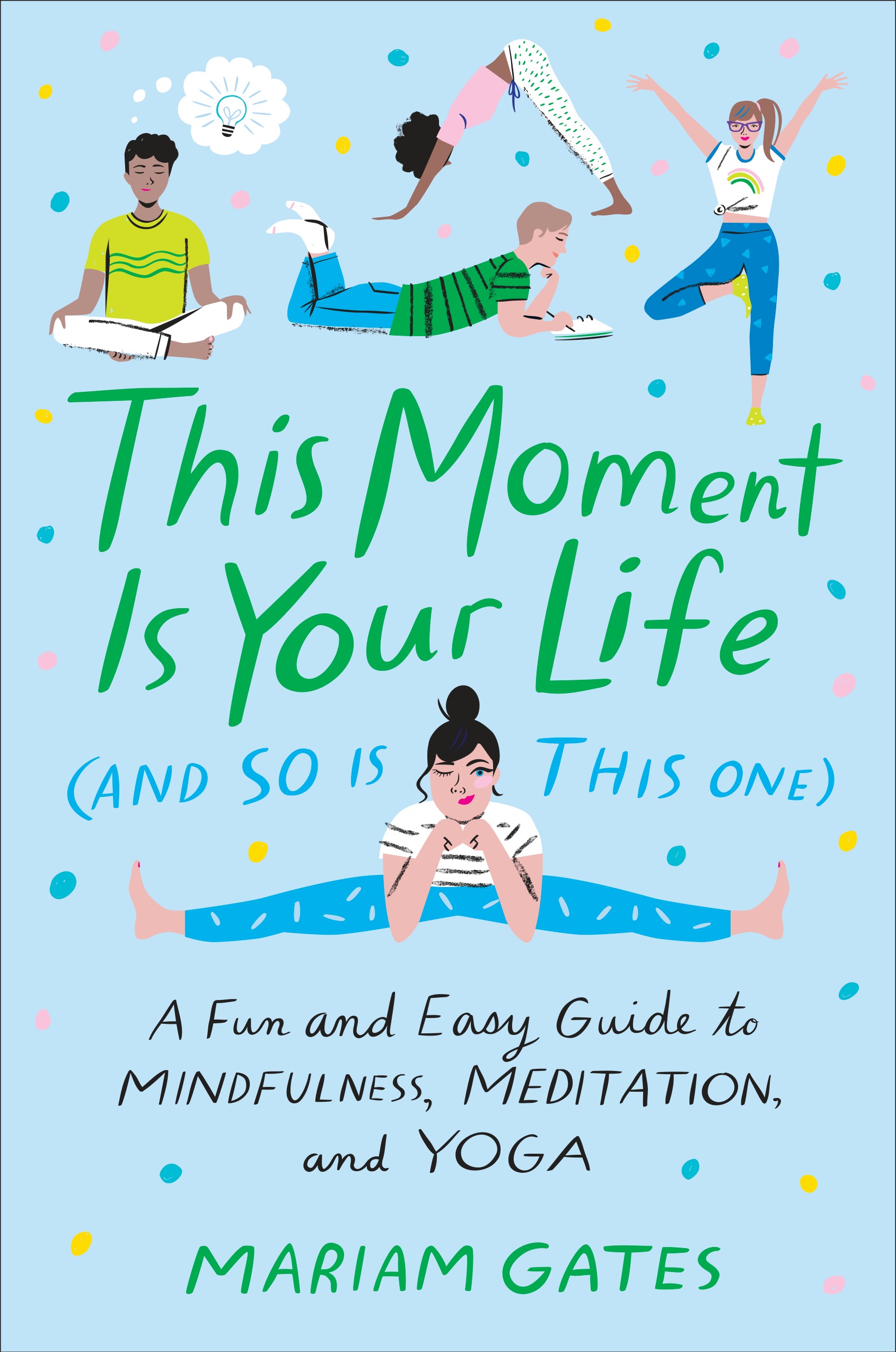
Blog Tour with Review!: The Moment is Your Life (And So Is This One) by Mariam Gates

Share

The Moment is Your Life (And So Is This One)
Author: Mariam Gates; Illustrator: Libby VanderPloeg
Published May 22, 2018 by Dial

Book Summary: Don’t just do something, be here.

The key to happiness is being able to find comfort in this moment, here and now. When you are completely present and not distracted by regrets, worries, and plans, even for a little while, you begin to feel more confident and can deal more easily with everything you experience. This is mindfulness: paying attention to this very moment, on purpose and without judgment–simply being present with curiosity.

This engaging guide, packed with simple exercises and endearing full-color artwork, provides a handy starting point for bringing mindfulness into your daily life. Chapters on meditation, yoga, and mindful breathing explain the benefits of these practices, and you are free to pick and choose what to try. There are quick exercises throughout, and a more extensive tool kit at the end of each chapter. The final chapter offers satisfying five-day challenges that map out ways to pull all of the book’s mindfulness techniques together in your day-to-day life.

With the appeal of a workbook or guided journal, and full of examples relevant to tweens and teens today, this book will be your trusted companion as you begin the valuable, stress-relieving work of being still with skill.

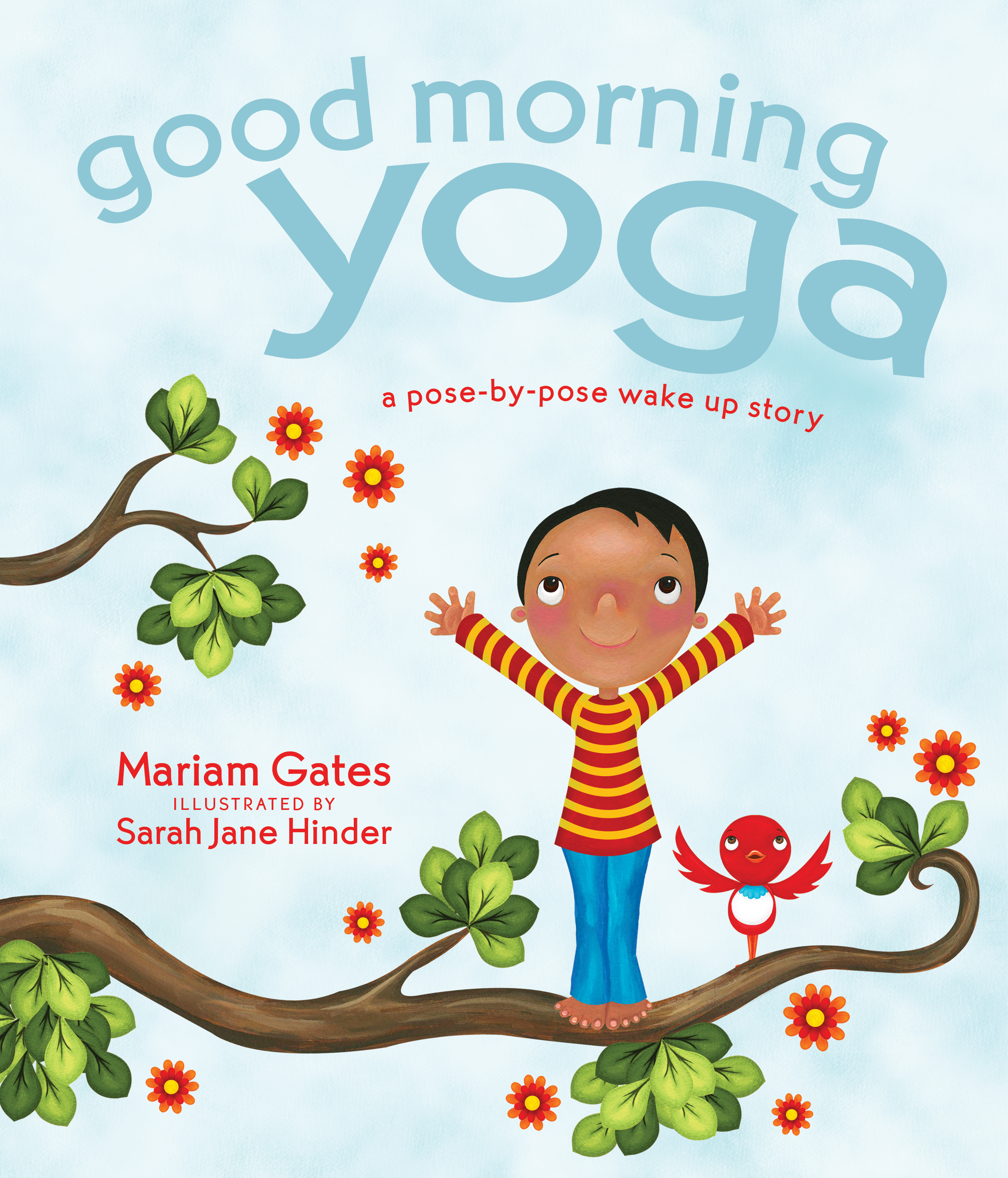
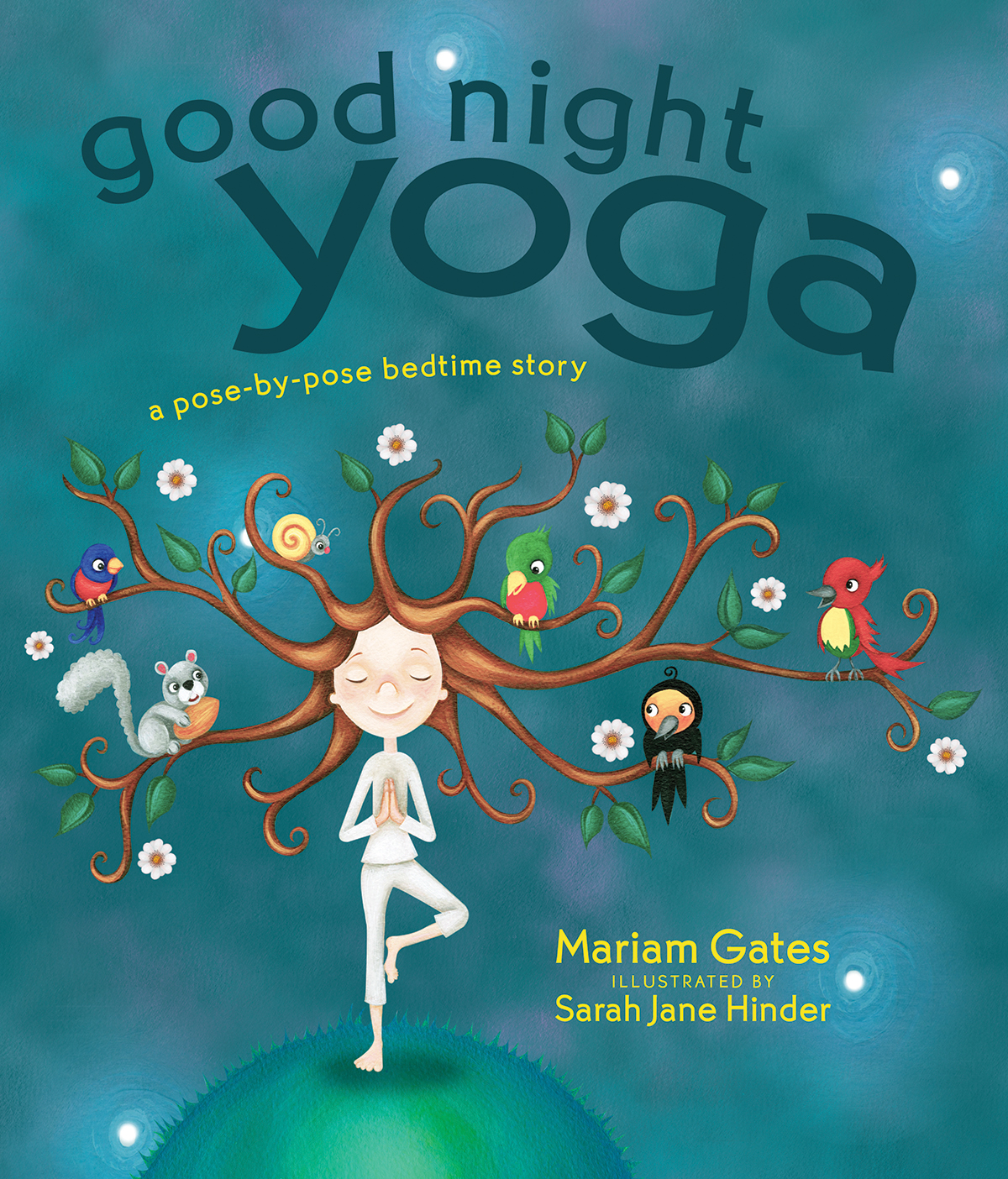
About the Author: Mariam Gates has a master’s degree in education from Harvard University and has been teaching children for more than twenty years. The founder of Kid Power Yoga, she now devotes herself to training children and adults in yoga and mindfulness. She is the author of the picture books Meditate with MeGood Night Yoga, and Good Morning Yoga. She lives with her husband, Rolf Gates, and their two children in Santa Cruz, California.

Mariam Gates

About the Author: Libby VanderPloeg is an illustrator and designer living in Greenpoint, Brooklyn. She grew up in Grand Haven, Michigan, on the edge of the Great Lakes, and since then, she has lived in Grand Rapids, Chicago, New York, and Stockholm. She’s created book covers and editorial illustrations for the New York Times, the Wall Street Journal, and Design*Sponge, among others, and as well as a line of cards and prints that she sells via her Etsy shop and in stores.

Review: I wish I’d had this book as a pre-teen/early adolescent. It would have truly helped me as I struggled with a lot of emotions that made me frustrated, unsure, and overwhelmed. This is a book that has a very expansive age range. I’d give it to a reader between the ages of 8 and 14, but it can be read and appreciated by people of all ages. After I was done reading it, I gifted it to a preservice teacher student who is very passionate about infusing mindfulness in the classroom. We spent a lot of time talking about how she might infuse this book into her student teaching with targeted read alouds. I loved Gates’ picture books (see Good Morning Yoga), and this book was no different. It’s thoughtfully crafted and incredibly relevant to young people. I particularly appreciated the action steps within the text. This provided me with concrete steps for infusing mindfulness into my life.

Teachers’ Tools for Navigation: As a classroom teacher, I would use this book as an initiation each day. It’s always very difficult to get students into the learning mindset. They come in with baggage and also with a lot of energy (positive and negative). This book serves as a reset and allows students to be mindful of their bodies and minds. It also allows students to destress to prepare for the classroom learning.

Discussion Questions: How do the author and illustrator work together to effectively present the material?; What is the author’s purpose? How does she effectively convey this purpose?; Which sections felt most relevant to your life?; What are the key takeaways that emerged from this book? How will you employ the strategies in this book directly into your life?

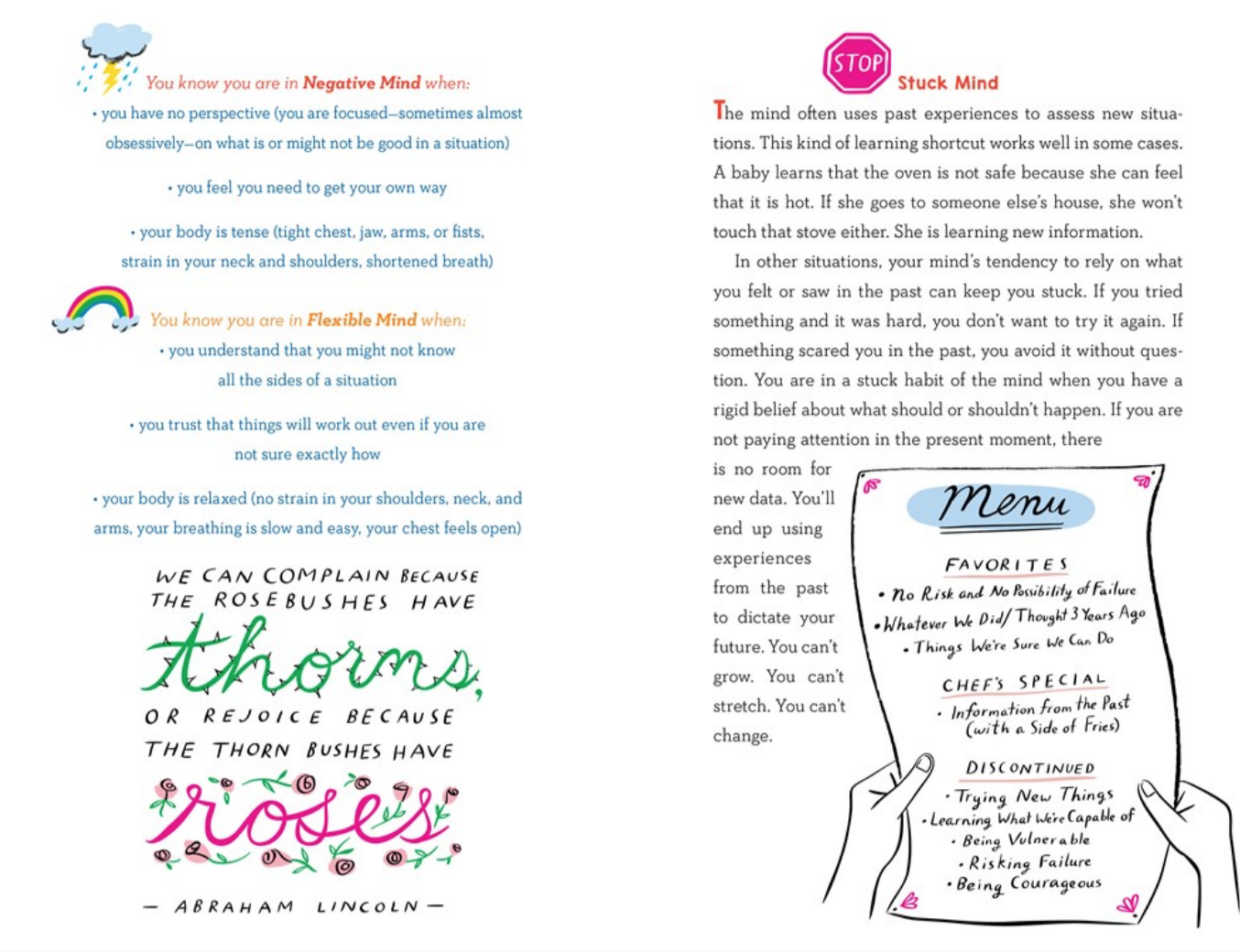
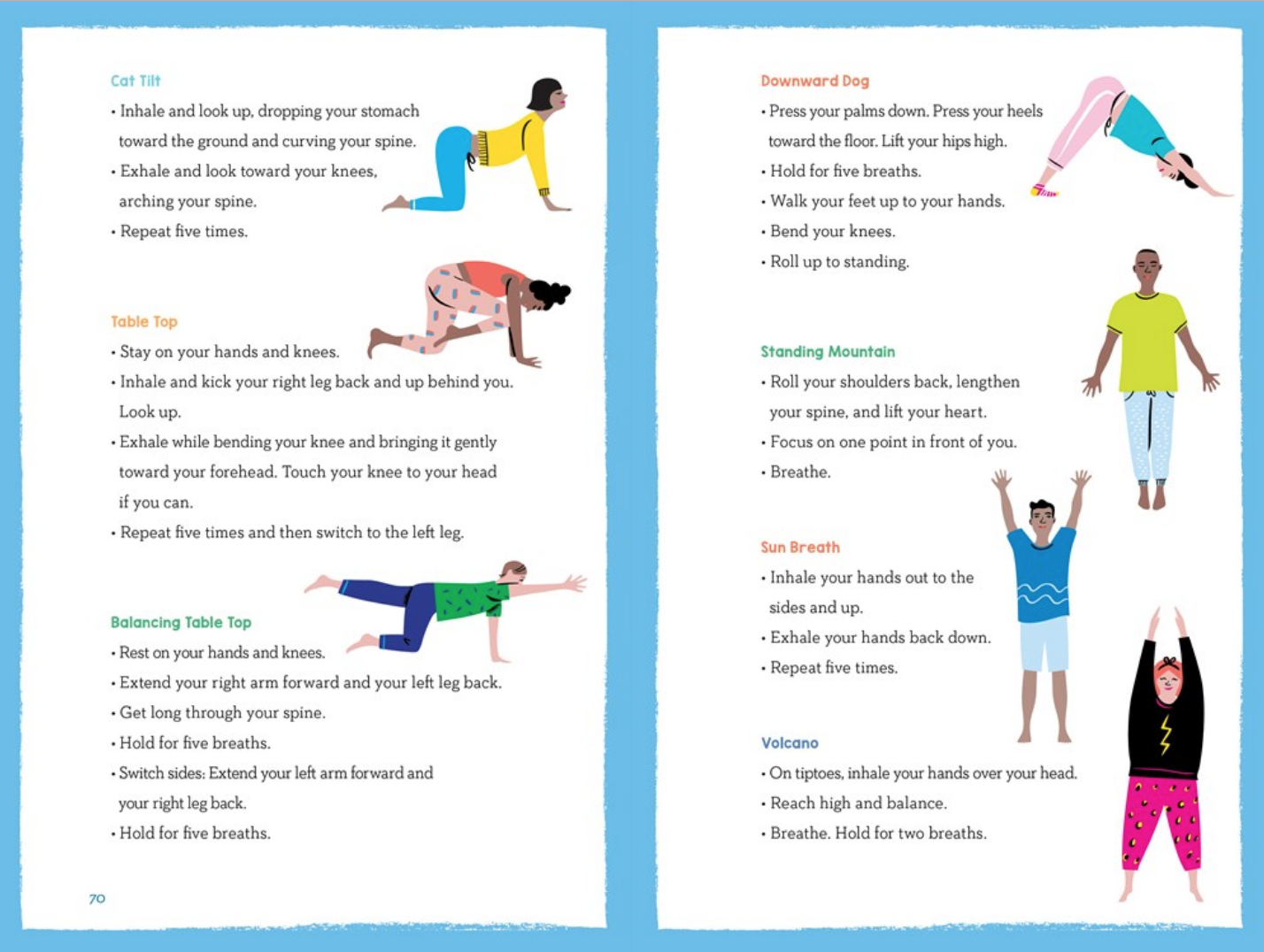
Flagged Pages:


Read This If You Loved: 

Good Night Yoga (2)

Recommended For: 

readaloudbuttonsmall classroomlibrarybuttonsmall


Follow All the Stops on the Tour: 

WEEK ONE

May 15 – Little Flower Yoga – Review

May 16 – Crossroad Reviews – Review

May 17 – Alissa Yoga – Review

May 18 – Whitney Davis Yoga – Review

WEEK TWO

May 21 – Prose and Khan – Review + Favorite Yoga Poses with Pictures

May 22 –  Librariel Book Reviews – Favorite Yoga Poses + Review

May 23 – Foodie Bibliophile in Wanderlust – Review

May 24 – Unleashing Readers – Review

RickiSig

**Thank you to Friya at Penguin for sending this book for review!**

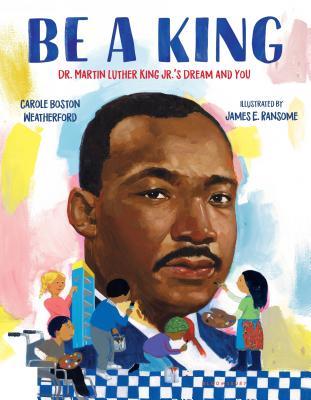
Be A King: Dr. Martin Luther King Jr.’s Dream and You by Carole Boston Weatherford

Share

Be A King: Dr. Martin Luther King Jr.’s Dream and You
Author: Carole Boston Weatherford
Illustrator: James E. Ransome
Published January 2nd, 2018 by Bloomsbury USA Childrens

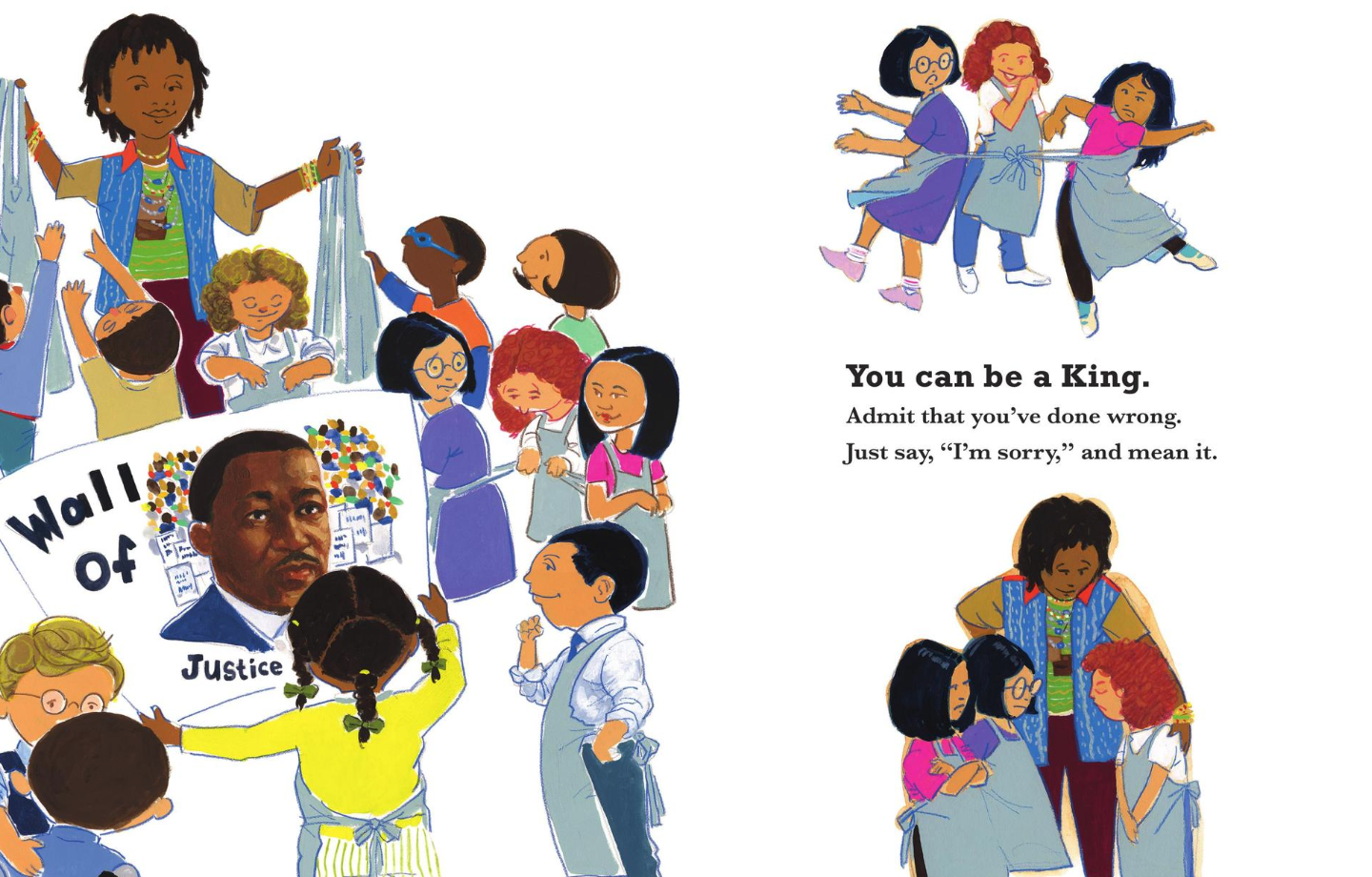
Summary: You can be a King. Stamp out hatred. Put your foot down and walk tall.
You can be a King. Beat the drum for justice. March to your own conscience.

Featuring a dual narrative of the key moments of Dr. King’s life alongside a modern class as the students learn about him, Carole Weatherford’s poetic text encapsulates the moments that readers today can reenact in their own lives. See a class of young students as they begin a school project inspired by Dr. Martin Luther King Jr. and learn to follow his example, as he dealt with adversity and never lost hope that a future of equality and justice would soon be a reality. As times change, Dr. King’s example remains, encouraging a new generation of children to take charge and change the world . . . to be a King. 

Praise: 

“While the book is accessible as an inspiring primer on social justice and taking action, it also challenges more sophisticated readers to make connections between the art, the text, Dr. King’s life, the civil rights movement at large, and the continuing struggle to affect change . . .This book is sure to spark discussion and empower readers of all ages.” –  Starred review, School Library Journal

“Thoughtful paintings of moving scenes are paired with brief, motivational reflections that evoke all the sentiment and fervor of the American civil rights movement.” –  Foreword Review

“The book manages to make essential lessons in civic responsibility accessible to the very young reader.” –  Booklist

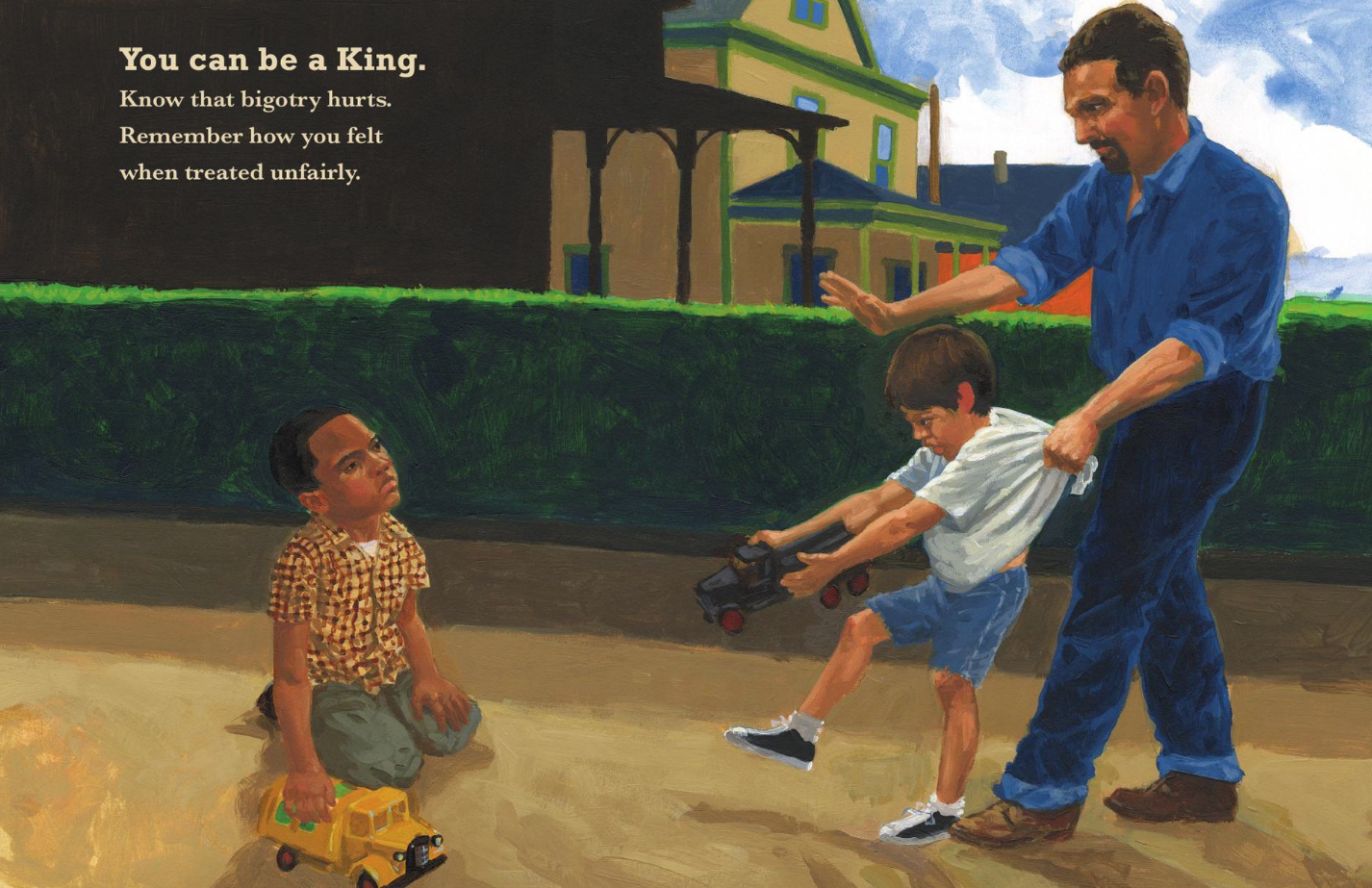
“The historical scenes, painted in Ransome’s signature thick, saturated style, are infused with a powerful sense of narrative.” –  Publishers Weekly

“The use of rich, realistic paintings with pencil detailing for King’s life contrasts with the brighter, simpler drawings for the contemporary children, giving a physical reminder that his work is ongoing.” –  School Library Connection

ReviewI am so happy that a book like this exists! It makes a beautiful connection between King’s history and how the same concepts can (and should!) drive us today. The book is very young kid friendly and is a great scaffold to talk about Dr. King or about kindness; however, it could also be used with older kids to infer and go deeper into the lyrical language Weatherford uses. I also loved how Ransome’s illustrations changed between King’s biography and the more contemporary school narrative.

P.S. As a teacher and a person who believes in kindness and equity and acceptance and friendship, I am so happy to see conversations like this happening so freely now! My students and I speak about injustice and prejudice and equity so often now when it would have been a stigma just a few years ago to even mention race or other social justice issues. It is important to talk about race in a non-prejudicial way with children to allow them to learn and grown and reflect. Sadly, it has been through horrific injustices that has gotten us to this point, but hopefully with our future generations having these types of conversations starting at such a young age, these injustices will stop.

Teachers’ Tools for Navigation: Have students look at each school spread (or split up the spreads between groups of students) and ask them to connect the ideals happening in the spread with something that King spoke about. This idea can also be used with the King spreads because it does not explicitly state what historical event each spread is representing, so students could look through King’s story and try to match each illustration and words with an event in his life.

Discussion Questions: 

  • What was Dr. King’s dream?
  • What are some ways you can fulfill this dream?
  • Although he was speaking of a much larger issue than a classroom, how can King’s ideals be transferred to how we treat each other in the classroom?
  • What events of King’s life were portrayed in the illustrations?
  • What other ways could you BE A KING?
  • Why do you believe the author wrote this story?
  • What is the author trying to teach the reader?
  • How did the author structure the story to reach her purpose and theme?

Flagged Passages: 

Read This If You Love: Stories of MLK, Jr.’s life, Books (historical fiction or nonfiction) about the Civil Rights MovementEach Kindness by Jacqueline Woodson

Recommended For: 
classroomlibrarybuttonsmall closereadinganalysisbuttonsmall 

Signature

How to Code a Sandcastle by Josh Funk

Share

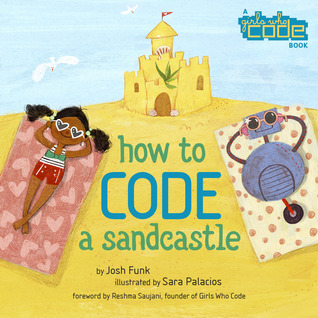
How to Code a Sandcastle
(How to Code with Pearl and Pascal #1)
Author: Josh Funk
Illustrator: Sara Palacios
Foreword by Reshma Saujani, founder of Girls Who Code
Published May 15th, 2018 by Viking

Summary: From the computer science nonprofit Girls Who Code comes this lively and funny story introducing kids to computer coding concepts.

Pearl and her trusty rust-proof robot, Pascal, need to build a sandcastle before summer vacation is over, and they’re going to do it using code. Pearl breaks the big we-need-a-sandcastle problem into smaller steps, then uses conditionals, loops, and other basic coding concepts to tell Pascal exactly what to do. But building a sandcastle isn’t as easy as it sounds when surfboards, mischievous dogs, and coding mishaps get in the way! Just when it looks like the sandcastle might never work, Pearl uses her coding skills to save the day and create something even better: a gorgeous sandcastle kingdom!

Kellee’s Review:  Through books like the Secret Coders series, Two Naomis, and now How to Code a Sandcastle, I’ve slowly begun to learn more and more about coding, and I find it fascinating! If I was a kid now, I would be so excited to have books like these to introduce me to coding. How to Code a Sandcastle is special because it takes coding, which is a tool that is primarily not taught until middle school or later, and makes it accessible to younger kids helping them build their coding vocabulary and knowledge at a young age. My son at age 4 now knows a basic idea of what coding is which is such a great foundation! Bravo Josh and Brava Sara for producing such an essential and gosh-darn funny book for kids.

Ricki’s Review: Josh Funk does it again and again and again. He creates highly engaging books that are so teachable! This is my first book in the Girls Who Code series, and it most certainly won’t be my last. It makes coding quite fun and offers an engaging introduction to children. I don’t know anything about coding, and I had fun learning the vocabulary with my son. After we read the book, we went through again and reviewed all of the new words that we learned about coding. The educational value of this book is very high—it is a great first dive into STEM, it could be used to teach step-by-step instructional writing, and it’s an incredible and hilarious read-aloud! Thanks for this wonderful new text for our classrooms, Josh!

Teachers’ Tools for Navigation: Like we shared above, How to Code a Sancastle is a wonderful foundation for learning about coding and would be an awesome read aloud in an elementary classroom as students are first being introduced to coding maybe on the “Day of Code” or before a computer course. It has a lot of introductory vocabulary and ideas that won’t overwhelm young children but will instead make them curious. Alternatively, it is also a great example of step-by-step instructional writing mixed with a hilarious narrative, so it would be a great mentor text for these writings.

Discussion Questions: 

  • Why did Pearl feel she needed to bring Pascal to build a sandcastle?
  • How did Pearl fix mistakes when she made them when coding Pascal?
  • What cause and effect relationships do you see in the story?
  • What problem and solution relationships do you see in the story?
  • How did the author include step-by-step instructions within the narrative while also keeping the story going?

Flagged Passages: 

Read This If You Love: Secret Coders series by Gene Luen Yang, Girls Who Code books, The coding references in Two Naomis by Olugbemisola Rhuday-Perkovich, Twenty Yawns by Jane SmileyOn Gull Beach by Jane Yolen

Recommended For: 

classroomlibrarybuttonsmall closereadinganalysisbuttonsmall 

Signatureand 

Summer Brain Quest and Star Wars Workbooks

Share

Star Wars Workbooks (Writing, ABCs, Reading, and Math)

and

Summer Brain Quest Workbooks

Published by Workman

Star Wars Workbooks Summary: The Force is strong with this series! Introducing a line of workbooks that marries the iconic popularity of Star Wars with the unique mix of editorial quality, fun presentation, and rigorous educational standards that Workman applied to the BRAIN QUEST Workbooks.

Twelve titles launch the series―three each for Pre-K through 2nd Grade―and dig deep into core subjects, including numbers, ABCs, phonics, and reading readiness for younger grades, and math, reading, and writing for the older ones. The material, which aligns with national Common Core State Standards, is designed to reinforce essential concepts and lessons taught in schools. Any child, not just fans of Star Wars―but yes, those fans will be especially delighted (as will reluctant learners)―will love the “A” is for Anakin approach to phonics. Kids will practice learning numbers by counting and circling X-wing starfighters and clone troopers. Master place values by sorting groups of Wookiees. There are math problems―Yoda is holding 7 lightsabers. 5 of the lightsabers are blue. The rest are green. How many green lightsabers is he holding? And Language Arts―Circle the correct homophone in this sentence: Luke is a Jedi knight/night.

Featuring favorite characters like Luke Skywalker, Queen Amidala, Yoda, and Obi-Wan Kenobi, and other creatures, monsters, Jedi, and Sith, the workbooks are filled with thousands of original illustrations drawing from all six Star Wars movies and the expanded Star Wars universe.

Learn well, you will.

Summer Brain Quest Workbooks Summary (Pre-K to K Summary): It’s time to get ready for school! Now, the series that keeps K–6th graders sharp, active, and curious in between grades is expanding to meet popular demand: Introducing Summer Brain Quest: Between Grades Pre-K & K, covering the summer between Preschool and Kindergarten so 4- and 5-year-olds can get ready for school—and have fun doing it.

Part workbook, part game, part adventure, it’s the interactive book that combines educational activities with indoor and outdoor play—with entertaining and effective results. The pullout map guides kids on a learning quest; to cross the finish line, they fulfill the curriculum-based exercises and customize their path by pursuing the bonus challenges and outdoor activities that excite them most. How about extra counting or reading calendars? A hunt for three-dimensional shapes? Identifying landforms? Or finding words that rhyme? Along the way, they earn stickers for completing pages, tick off an adventure list, and get fresh air with outdoor learning challenges, like writing the alphabet with sidewalk chalk.

Teacher-approved, parent-trusted, and designed to appeal to kids’ natural love of learning and playful curiosity, Brain Questmakes it fun to be smart all summer long!

Ricki’s ReviewMy son LOVES these books. They have made him so excited about reading, writing, and math. I am not a workbook kind of teacher, but these books defy all notions of worksheet and workbook teaching. The Summer Brain Quest books feature a map at the end. As kids finish each page, they earn stickers to go along the map. The books ask them about themselves in the “my world” pages. They make learning very fun. He particularly loves the Star Wars reading book. He enjoys matching the letters to words and circling answers. My son is an outdoors-y kind of kid. He doesn’t enjoy sitting at the table and practicing his reading. Therefore, we do these at night. After we read together, he picks one of these workbooks to do together. We sit on the floor, and he loves it. It extends his awake time, and he loves thinking he is doing something fun to stay up later than his brother. We found the workbooks in the bookstore yesterday, and he was thrilled to see his books on the shelves. We ended up buying other books in the Brain Quest series because he enjoyed them so much. He chose this rather than a new toy! I’ll be purchasing these books for my younger son when he gets a bit older. They are absolutely wonderful and make learning fun! 

Kellee’s ReviewLike Ricki, I am skeptical whenever I see a workbook, but as soon as these arrived, my son became a bit obsessed with “doing his Star Wars letters,” and I just cannot argue with that as Trent is not a sit-and-do-something type of kid. But since the workbook is a mix of writing and activities, it doesn’t seem like work to him but instead is seen as a game. Because of this, I view them more as an activity book than just a workbook. We’ve currently been focusing primarily on the Star Wars activity book because I don’t want to overwhelm him, and it also leaves the Brain Quest for us to do when he is done. (Though, I do LOVE Brain Quest cards. My sister, Natalie, gives them to Trent for his birthday, and we do his “cards” in the car.) Lastly, I want to give a shout out to these helping parents who want to include educational activities at home. I know that even I, as a teacher mom, struggle with figuring out what to do to help my child learn to read and keep learning, and these activity books are perfect!

We Flagged: 

Star Wars “A”

to “Z”

Tracing and Coloring the Number 3

Brainquest “MNO” and “Living Things”

“Summer Brain Quest” map

Recommended For: 
classroomlibrarybuttonsmall

 and

**Thank you to Diana and Christi at Workman for providing a copy for review**