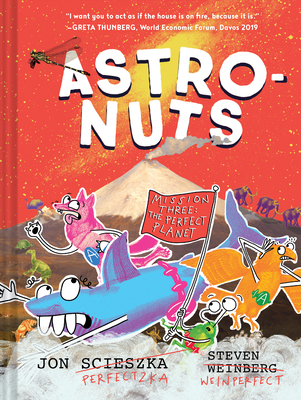
Astro-Nuts Mission Three: The Perfect Planet
Author: Jon Scieszka
Illustrator: Steven Weinberg
Published: September 21st, 2021 by Chronicle Books
Summary: This series is The Hitchhiker’s Guide to the Galaxy meets The Bad Guys in a funny, visually daring adventure series for reluctant readers, teachers, and librarians alike.
This hilarious, visually groundbreaking read is the conclusion to a major series by children’s literature legend Jon Scieszka.
The book follows a final mission, where AlphaWolf, LaserShark, SmartHawk, and StinkBug must find a planet fit for human life after we’ve finally made Earth unlivable.
Time is up for our friends the AstroNuts. In fact, time is up for you, too. If they don’t succeed on this mission, Earth is doomed! So when the team finds out they’re being sent to a place called “the perfect planet,” their mission sounds way too easy. Unfortunately, the second they land, they realize they’ll be dealing with the most dangerous species of all time . . . humans. Huh? Where in the universe is this supposedly perfect place? And how will the Nuts manage to convince the humans to risk death . . . for the sake of their lives?!
Featuring full-color illustrations throughout, Planet Earth as the narrator, an out-of-this-world gatefold, and how-to-draw pages in the back, eager and reluctant readers alike will be over the moon about this new mission. Full of laugh-out-loud humor with a thoughtful commentary on the reality of climate change at the core of the story, this creatively illustrated, full-color, action-packed space saga is a can’t-put-it-down page-turner for readers of all levels and fans ready to blast past Dogman.
EXCITING BIG-NAME TALENT: Jon Scieszka is one of the biggest names in children’s books. The first National Ambassador of Young People’s literature, he and Steven Weinberg toured extensively for this series. They’ll continue making their way around the world for Book 3!
POPULAR SERIES: MISSIONS 1 and 2 received starred reviews, amazing blurbs, and tons of industry love. MISSION 1 was an Amazon Best Book of the Year! Dav Pilkey, Jennifer Holm, LeUyen Pham, and Gene Luen Yang are all big fans—check out those blurbs!
FUN AND SCIENTIFIC: The book incorporates STEM elements in a way that readers will find fun and entertaining, while teachers and librarians will find it clever and original.
PERFECT FOR BUDDING GRETA THUNBERGS: This book successfully talks about the effect of climate change and impels its readers to take action, without feeling didactic or message-y at all.
TIES TO REAL-WORLD ISSUES: Readers will recognize quite a few dilemmas the AstroNuts face from current events on Earth. Making connections between fiction and non-fiction is a big developmental milestone for young readers, and this book works as an effective allegory for our most dire contemporary concerns.
RELUCTANT READER–FRIENDLY: The book is a great vehicle for reluctant readers, featuring cool topics and bright art, and relying on visual literacy and very few words.
A CONSTELLATION OF TOPICS: Space, STEM, and talking animals: There’s something here for every reader!
LOLs FOR DAYS: The book is funny and will delight kids who love books like Wimpy Kid, The 39-Story Treehouse, Dog Man, and Captain Underpants. While it contains serious ideas, it’s a quick, easy, and fun visual read.
GROUNDBREAKING DESIGN: The hundreds of pages of full-color art are dynamic and engaging—and it doesn’t look like anything else out there. Steven Weinberg bases his art on public domain pieces from the Smithsonian museum! Teachers turn to the books for this element of the art and use it in classrooms to talk about collage, idea sourcing, history, and art medium.
PERFECT ART PROJECT: On the website, kids can download pages of the “original” art and use it to make their own hybrid animal collages.
Teachers Guide with Teachers’ Tools & Discussion Questions:
Please view and enjoy the teachers’ guide I (Kellee) created for Chronicle Books for Astro-Nuts Vol. 3:
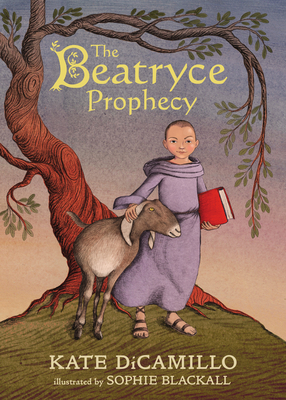
The Beatryce Prophecy
Author: Kate DiCamillo
Illustrator: Sophie Blackall
Publishing September 28th, 2021 by Candlewick Press
Summary: From two-time Newbery Medalist Kate DiCamillo and two-time Caldecott Medalist Sophie Blackall comes a fantastical meditation on fate, love, and the power of words to spell the world.
We shall all, in the end, be led to where we belong. We shall all, in the end, find our way home.
In a time of war, a mysterious child appears at the monastery of the Order of the Chronicles of Sorrowing. Gentle Brother Edik finds the girl, Beatryce, curled in a stall, wracked with fever, coated in dirt and blood, and holding fast to the ear of Answelica the goat. As the monk nurses Beatryce to health, he uncovers her dangerous secret, one that imperils them all–for the king of the land seeks just such a girl, and Brother Edik, who penned the prophecy himself, knows why.
And so it is that a girl with a head full of stories–powerful tales-within-the-tale of queens and kings, mermaids and wolves–ventures into a dark wood in search of the castle of one who wishes her dead. But Beatryce knows that, should she lose her way, those who love her–a wild-eyed monk, a man who had once been king, a boy with a terrible sword, and a goat with a head as hard as stone–will never give up searching for her, and to know this is to know everything. With its timeless themes, unforgettable cast, and magical medieval setting, Kate DiCamillo’s lyrical tale, paired with resonant black-and-white illustrations by Caldecott Medalist Sophie Blackall, is a true collaboration between masters.
Teachers’ Tools for Navigation and Discussion Questions:
Please view and enjoy the teachers’ guide I created for Candlewick Press for The Beatryce Prophecy:
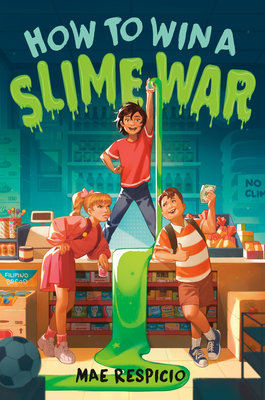
Bow to Win a Slime War Author: Mae Respicio
Published September 14th, 2021 by Wendy Lamb Books
Summary: Two kids face off in an epic battle to see who can sell the most slime, while navigating sticky situations with friends and family.
Alex Manalo and his dad have just moved back to Sacramento to help out with their extended family’s struggling Filipino market. While Alex likes helping in the store, his true passion is making slime! He comes up with his own recipes and plays with ingredients, colors, and different bumpy or sparkly bits, which make his slime truly special. A new friend encourages Alex to sell his creations at school, which leads to a sell-off battle with a girl who previously had a slime-opoly. Winner gets bragging rights and the right to be the only slime game in town.
But Alex’s dad thinks Alex should be focused more on traditional boy pastimes and less on slime. As the new soccer coach, Dad gets Alex to join the team. Even though he hates sports, Alex gives in.
Alex is battling on multiple fronts–with his new friends at school, and with his dad at home. It will be a sticky race to the finish to see who oozes out on top.
Praise:
“Oozing with fun.” —Kirkus Reviews
★ “A well-written story of family and friendship. Slime aficionados and newbies alike will enjoy the recipes for slime at the beginning of each chapter. Highly recommended.” —SLJ, starred review
About the Author: Mae Respicio writes novels full of hope and heart. Her debut, The House That Lou Built, received the Asian/Pacific American Library Association Honor Award in Children’s Literature and was an NPR Best Book of the Year. Mae lives with her husband and two sons in the Bay Area suburban wild, where they love hiking, hanging at the beach, and some good old-fashioned family slime time. Visit her online at maerespicio.com.
Review:Happy book birthday!!!!
How to Win a Slime War is definitely about slime, but it is about so much more.
It is about family. Alex and his dad have a lot of changes happening in their life and they are figuring out how to deal with it all. The kid characters aren’t the only characters that need to grow and change.
It is about friendship. Alex is starting at a new school, which means leaving his best friend, so he has to figure out how to fit into a new place. It is so much fun to meet all of his new friends with him and navigate the new environment.
It is about passion. And also about how passions of kids are not always what the parent wants it to be.
It is about entrepreneurship. Alex wants to be a business owner when he grows up and is already talking about it. He has been to conferences and has so many great ideas.
It is because of all of these different aspects that I found the book so engaging and a book that many people will find connection with Alex and his story.
Teachers’ Tools for Navigation: This book will find the most success in classroom, school, and public libraries in the hands of students; however, I could definitely see a teacher using aspects in their classroom: both the slime science aspect and the business/entrepreneurship.
Discussion Questions:
How did each character grow and change throughout the book?
Why was Alex so hesitant about the changes in the Manalo Market? How did Alex and his father end up combining some of the new ideas with honoring Lolo & Lola’s market?
How was Meadow more than what meets the eye?
How did Alex’s science teacher add extra engagement to her classroom?
How do you feel about schools banning things that have become popular?
How does Alex use what he has learned about business when it comes to selling slime?
Alex got really good at soccer but decided not to keep playing. Why did he make that choice, even after becoming successful? Is there anything you have been good at but you ended up not liking?
Flagged Passages: Chapter 1
The world has plenty of twelve-year-olds who’ve accomplished amazing things, like:
Hoisting 308 pounds in one clean lift.
Inventing a braille printer from a Lego set.
Making millions of dollars from candy that’s good for your teeth.
I wish I could add myself to this list, but I can barely lift a fifty-pound bag of rice, when I play with Legos I usually lose the pieces, and when it comes to candy–especially my favorite kind, with an edible wrapper–I’d rather eat it than sell it.
I do have one hobby I’m not bad at: Making slime.
I’m stellar at slime challenges. This morning my best friend, Raj, and I are doing one final face-off before my dad and I move from San Jose to Sacramento. It’s our way of saying goodbye.
I lay out the ingredients, a couple of bowls, and some fat wooden stirring sticks. Raj sets my laptop on the kitchen counter, raises the volume, and cues up a video: Slime Time Soraya’s 30-Second Challenge!
He rubs his hands together. “I’ve been waiting the whole week for this!”
We’ve done all her challenges except this one, which we’ve been saving for a special occasion.
“Okay, Slime Squad!” Slime Time Soraya says on-screen. “Today we make . . . classic slime! Your goal: mix as fast as you can.”
“Challenge accepted!” Raj says back.
“Who makes good slime in thirty seconds?” I say. “Art takes much longer than that.”
Raj smiles slyly. “You’re not the only one with skills, Alex.”
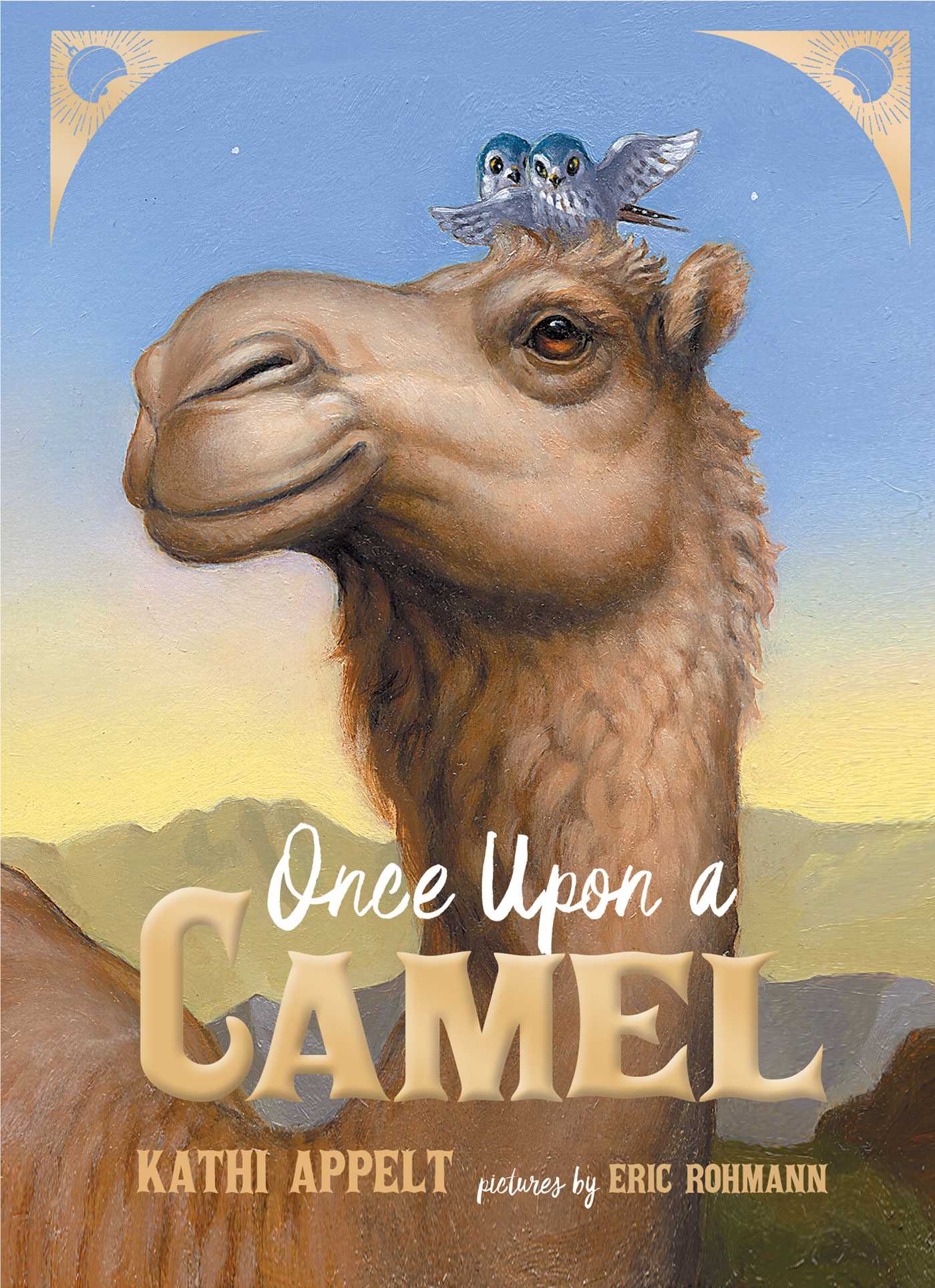
Once Upon a Camel Author: Kathi Appelt
Illustrator: Eric Rohmann
Published September 7th, 2021 by Atheneum/Caitlyn Dlouhy Books
Summary: An old camel is out to save two baby kestrel chicks during a massive storm in the Texas desert.
Zada is a camel with a treasure trove of stories to tell. She’s won camel races for the royal Pasha of Smyrna, crossed treacherous oceans to new land, led army missions with her best camel friend by her side, and outsmarted a far too pompous mountain lion.
But those stories were from before. Now, Zada wanders the desert as the last camel in Texas. But she’s not alone. Two tiny kestrel chicks are nestled in the fluff of fur between her ears—kee-killy-keeing for their missing parents—and a dust storm the size of a mountain is taking Zada on one more grand adventure. And it could lead to this achy old camel’s most brilliant story yet.
About the Author: Kathi Appelt is the author of the Newbery Honoree, National Book Award Finalist, and bestselling The Underneath as well as the National Book Award Finalist for The True Blue Scouts of Sugar Man Swamp. Some of her award-winning books include Maybe a Fox (with Alison McGhee), Keeper, and Max Attacks to name just a few. She lives in College Station, Texas. To learn more, visit her website at kathiappelt.com.
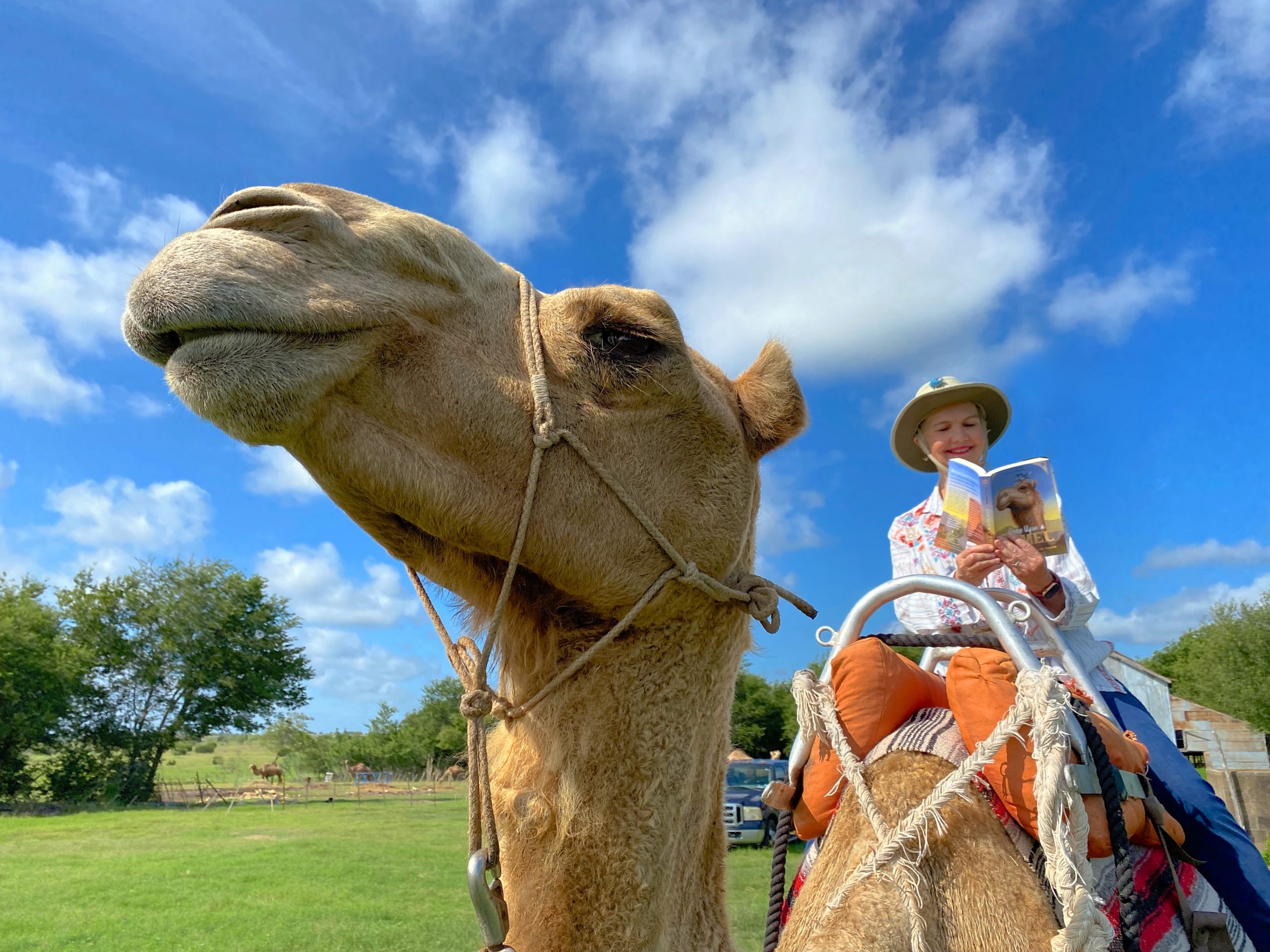
Richard, the camel, and Kathi Appelt taken at Texas Camel Corps. Photo credit: Doug Baum.
Review:Happy book birthday, Kathi & Once Upon a Camel! So honored to review this special book on your special day!
In all of Kathi Appelt’s books, what I have found that I adore the most is her ability to craft voice. She is brilliant. In this book, Zada the camel’s voice rings throughout with patience and determination. I was calmed by her stories of her upbringing as she works to keep the baby kestrels’ minds off of their parents. I think part of Appelt’s magic to craft voice is through her very specific word choice in all instances. Her descriptive words are so precise, and she is never deterred to use a word that may be challenging if it is the correct word. This leads to such lyrical prose–it is a pleasure to read!
There is also so much to learn throughout this story about stories: weather events (haboobs), animals of West Texas (kesterels, mountain lions, hawks, and more), and the history of camels. I found myself going on research tangents as I was introduced to different animals or different adventures that Zada goes on. It is no wonder that the Reading Group Guide is so extensive–there is so much to delve into!
Explain to students that alliteration is a literary device in which initial consonant sounds of successive or closely related words are repeated. This book contains tons of alliteration. Some examples include “arches and arroyos,” “moving mountain,” “posh Pasha palace,” “Pasha’s princess turns a little pale,” and “best beloved babies.” Using game tiles with letters or small pieces of paper with letters written on them, allow each student to draw a letter and write five alliterative sentences using that letter. Each sentence must contain a subject, verb, and describing words. Once everyone has written their sentences, each person should share their best alliterative sentence with the class.
Zada has had a long life filled with experiences and relationships. Her story in the book moves in time as she shares memories while continuing present experiences. Ask students to create a time line for Zada. There are online resources such as Adobe (https://www.adobe.com/express/create/timeline) and TimeGraphics (https://time.graphics) to help with organization. They may also do this in a slideshow format. Have them include dates, locations, and important experiences.
Beulah licks Wims, and he is upset. He is described as being “incensed. Put out. Piqued.” Discuss with students how this alliterative and repetitive approach to communicating his feelings is an effective way to convey the strength of those feelings as well as a lyrical way to engage the reader. Ask students to choose one emotion and make a list of synonyms or short expressions that express that emotion. Next, ask them to express the emotion in as many ways as possible in short sentences. Finally, ask them to use their list and sentences to write a paragraph that first explains why their character is feeling that emotion and that then elaborates on how they are feeling in as many ways and with as much creative imagery as possible.
Like humans and all other members of the animal kingdom, camels and kestrels have been classified based on shared characteristics. Looking at the list below, you can see that camels, kestrels, and humans are classified together in their kingdom and phylum, but begin to diverge at class groups and fully diverge in orders. Ask students to review the table and have a class discussion about classification. Give students the opportunity to consult some sources, if necessary, to answer their questions.
The story’s action begins with Pard and Perlita telling Zada that a mountain is eating everything and is soon going to eat them. Zada cannot comprehend this. Why do you think that is? How do you handle things you don’t understand? In truth, the mountain is a great sand-and-dust storm coming their way. How does knowing this change your perspective of the situation? How does Zada react?
The author explains how a camel has adapted to the desert, and how American kestrels are built for flight. All animals have adaptations: evolved physical and behavioral traits that help their species survive and thrive. Can you think of any other examples of this? What about cultural adaptations? Are there ways in which groups or individuals adapt for their own safety, comfort, or survival?
As Zada tries to outrun the storm, she wishes she could fly. This is not the first time in her life she has wished this. Why do you think she has continued to yearn for this ability? Thinking about your life and the environment in which you live, what other animal adaptations would come in handy for you? Explain your answers.
As Zada worries about Pecos de Leon, she reflects on the fact that she and the mountain lion have “both traveled a lot of miles and traversed a lot of country. That was worth something.” How can having many experiences help you? Do you think it’s important to experience situations similar to and different from your own life? What might you learn from someone who has lived a long time and done many things? Explain your answers.
As Zada moves through the storm carrying the chicks, an enormous old tree comes down behind them. “The wind had yanked it up by its roots. A hundred years, that old tree had stood there, watching over the creek, keeping generations of bird families safe. Now it lay in a heap on its side.” How does the falling tree make Zada feel? How did it make you feel? Do you think generations of bird families will be able to find a new home?
As the storm spins Perlita and Pard around, they call out, “‘Keep them safe!’” This is described as the “universal prayer” of parents. What does it mean for something to be universal? Do you have knowledge, ideas, or habits that are universal?
Zada’s and Asiye’s motto is “En parlak yildiz ol.” This means “Become the brightest star.” What do they mean by this? How do you see them striving to do this throughout the story?
Flagged Passages: “Chapter 1: Foothills, Chisos Mountains West Texas, 1910
“Incoming!”
Even in her sleep, Zada recognized that voice.
The old camel raised one eyelid. It was still dark. There was at least an hour left before dawn. She did not recall setting an early alarm bird.”
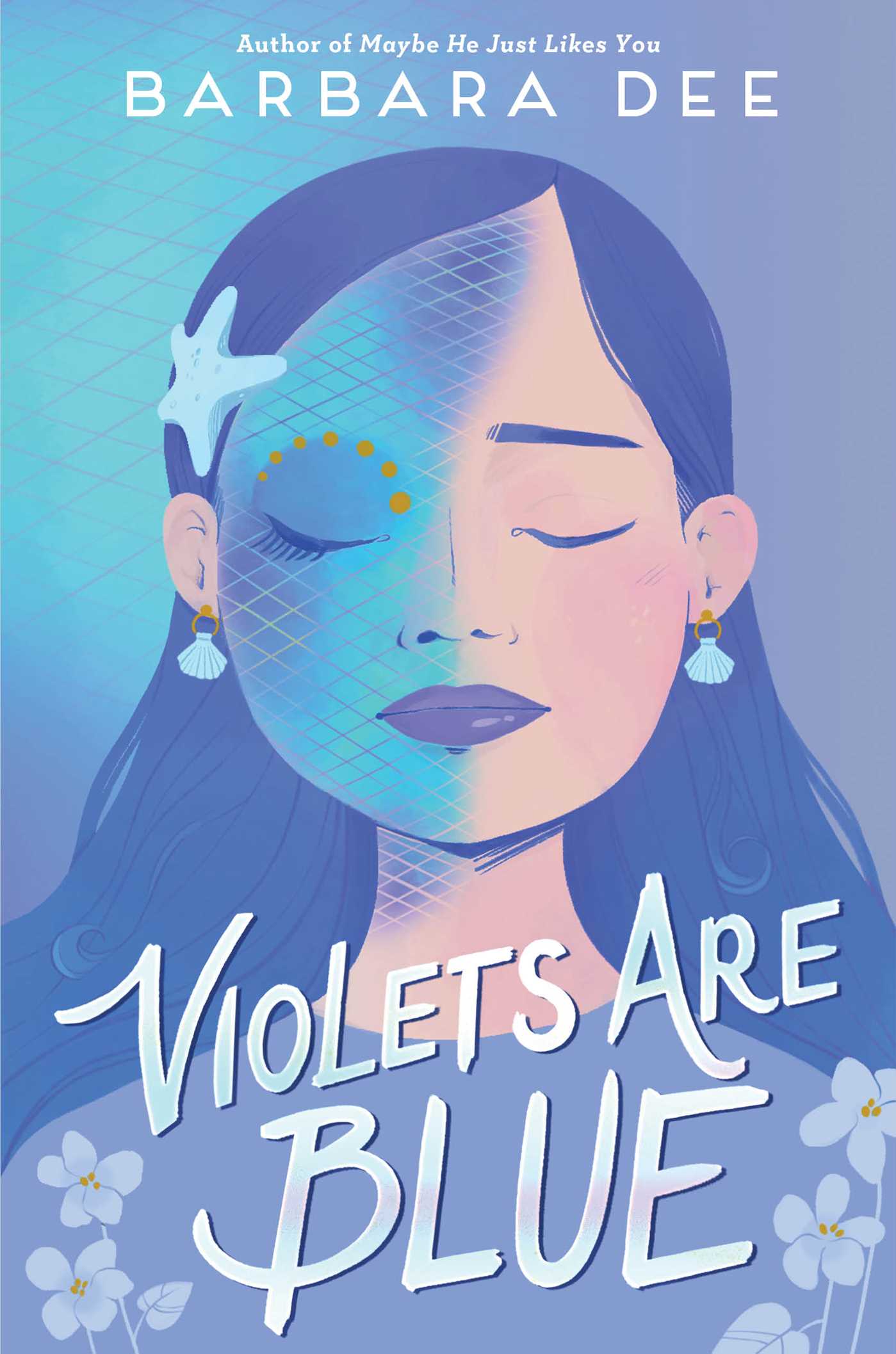
Violets are Blue Author: Barbara Dee
Published: September 28, 2020 by Aladdin
Summary: From the author of the acclaimed My Life in the Fish Tank and Maybe He Just Likes You comes a moving and relatable middle grade novel about secrets, family, and the power of forgiveness.
Twelve-year-old Wren loves makeup—special effect makeup, to be exact. When she is experimenting with new looks, Wren can create a different version of herself. A girl who isn’t in a sort-of-best friendship with someone who seems like she hates her. A girl whose parents aren’t divorced and doesn’t have to learn to like her new stepmom.
So, when Wren and her mom move to a new town for a fresh start, she is cautiously optimistic. And things seem to fall into place when Wren meets potential friends and gets selected as the makeup artist for her school’s upcoming production of Wicked.
Only, Wren’s mom isn’t doing so well. She’s taking a lot of naps, starts snapping at Wren for no reason, and always seems to be sick. And what’s worse, Wren keeps getting hints that things aren’t going well at her new job at the hospital, where her mom is a nurse. And after an opening night disaster leads to a heartbreaking discovery, Wren realizes that her mother has a serious problem—a problem that can’t be wiped away or covered up.
After all the progress she’s made, can Wren start over again with her devastating new normal? And will she ever be able to heal the broken trust with her mom?
Ricki’s Review: This book ripped me apart and put me back together. It is unflinchingly honest, and it is a book that so many middle grade kids need. The characterization is beautiful, and the book would make for a great study on the relationships between humans and a general study on humanity. No character in this book is perfect—all are flawed, and this reflects who we are as people. I stayed up late at night reading this book (when I should have been sleeping), and I cannot recommend it highly enough. We all deserve to reinvent ourselves, and this book gives us permission to do so.
Kellee’s Review: Barbara Dee is so wonderful at writing such relatable middle school books with characters that deal with the real issues that middle schoolers are dealing with today. This book is no different as we get to watch Wren deal with her own identity, dealing with divorce & remarriage, moving, finding new friends, and just learning how to be happy. All of this in addition to what Wren ends up needing to work through when it comes to her mom. Dee does a great job balancing all of these plot points while also building such full characters. All characters in the main characters in the book are well developed and are truly themselves–flaws and all!
Teachers’ Tools for Navigation: This book works beautiful to teach about characterization. Students might select a character to study in a group and then work individually to study a person in their own lives (personal or famous). This offers opportunities for rich discussions about imperfection and the flaws in all of us.
Discussion Questions:
How does Wren’s hobby with makeup reflect her life? How does it connect with the story?
How does Wren’s mother evolve in the story, and why do you think she makes specific decisions in the text?
Why do we keep secrets? How does secret-keeping impact others?
What did you learn from this story? What will you take with you?
How does Wren and her mom moving change the trajectory of the story?
Were there clues about Wren’s mom earlier in the book?
Why is it that people have such a hard time with girls and boys just being friends with each other?
Flagged Passage:
Chapter 2: Changes: “The day Dad left us, just a little over nine months ago, it all happened so fast. One gray Saturday morning in February, when we were still living in the house in Abingodon, I woke up to the sound of loud arguing in the kitchen. Yelling, actually, which happened a lot those days, followed by a car zooming out of our driveaway.”
Chapter 9: Nebula “[CatFX’s YouTube Channel] Here’s my secret message to you guys: fantasy is not the opposite of truth.”
Read This Book If You Loved: My Life in a Fish Tank by Barbara Dee; The Seventh Wish by Kate Messner; Sunny Side Up by Jennifer Holm and Matthew Holm; Genesis Begins Again by Alicia D. Williams
Recommended For:
and
**Thank you to Casey at Media Masters Publicity for providing a copy for review!
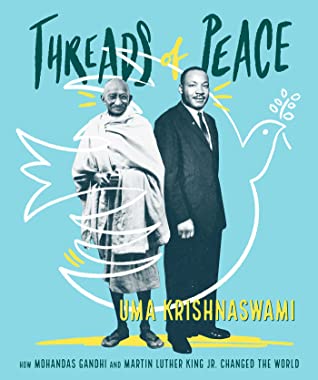
Threads of Peace: How Mohandas Gandhi and Martin Luther King Jr. Changed the World Author: Uma Krishnaswami Published August 17th, 2021
Summary: Mahatma Gandhi and Reverend Martin Luther King Jr. both shook, and changed, the world, in their quest for peace among all people, but what threads connected these great activists together in their shared goal of social revolution?
A lawyer and activist, tiny of stature with giant ideas, in British-ruled India at the beginning of the 20th century.
A minister from Georgia with a thunderous voice and hopes for peace at the height of the civil rights movement in America.
Born more than a half-century apart, with seemingly little in common except one shared wish, both would go on to be icons of peaceful resistance and human decency. Both preached love for all human beings, regardless of race or religion. Both believed that freedom and justice were won by not one, but many. Both met their ends in the most unpeaceful of ways—assassination.
But what led them down the path of peace? How did their experiences parallel…and diverge? Threads of Peace keenly examines and celebrates these extraordinary activists’ lives, the threads that connect them, and the threads of peace they laid throughout the world, for us to pick up, and weave together.
Praise: ★“The book’s attractive design, lucid text, and carefully chosen details combine to create an inviting and original treatment of its subjects. History has been carefully intertwined with the present in this engaging and reflective book.” —Kirkus Reviews (starred)
About the Author: Uma Krishnaswami is the author of several books for children including Book Uncle and Me (International Literacy Association Social Justice Literature Award, USBBY Outstanding International Book) and Step Up to the Plate, Maria Singh (Asian Pacific American Librarians Award, FOCAL Award). She was born in New Delhi, India, and now lives in British Columbia, Canada. To learn more, visit her website: umakrishnaswami.org.
Review:First, happy book birthday!!!!!! 🎉
In the Author’s Note, Krishnaswami notes, “Then, in 2008, I read The End of Empires: African Americans and India by historian and African American studies professor Gerald Horne. It was an eye-opener. I was born in India and I’d lived in the United States for nearly thirty years, but in neither country had I ever learned this history.” As I’ve noted over and over again when I review nonfiction or historical fiction, it is only through brilliant books that I have learned true history as my history classes were so US-centered that we hardly learn anything other than basic history about the world and it is so white-washed that even when slavery or Civil Rights is covered, it very much focuses on the successes. It is because of this that I am so thankful that books like this exist and allow me to share the erased history with students. Because even with Martin Luther King Jr., who all are familiar with, there is so much of him and his journey and point of view that are erased in history books.
Everything I learned about India’s history was from some books before I read this: The Night Diary by Veera Hiranandani, I am Gandhi (both picture book & graphic novel) by Brad Meltzer, and A Taste of Freedom: Gandhi and the Great Salt March by Elizabeth Cody Kimmel. That was all of my prior knowledge, so I was taken aback by the breadth of India’s history that I was ignorant about. Krishnaswami did a brilliant job telling about Gandhi’s personal life while also teaching about Indian history. In the second half of the book, we switch to Martin Luther King Jr.’s life and the racial injustices happening in the United States. Again, the book focuses not only on King’s personal life but the history of the US at the time as well. I learned so much in this book. It made me think, reflect, get angry, cry, and have purpose for continuing with a focus on anti-racism.
Uma Krishnaswami does a beautiful job using the imagery of threads figuratively throughout this book to tie Gandhi and King through their views on peace and nonviolence as well as Gandhi and King to the histories they helped shape.
Teachers’ Tools for Navigation & Discussion Questions: There is so much to discuss in this book! I could see parts of it being used to supplement curriculum, I could see it being used AS the curriculum, I could see it being used as a resource for research, I could see it being an independent reading book for an interested student…. It has endless potential.
Why would the author choose thread to be the figurative imagery in the book?
Although Gandhi and King both were focused on equality and nonviolence, they differed in many ways also–how so?
In both cases, Gandhi and King continued their work despite potentially putting their family in danger. Why would they do this?
How was India’s reach for freedom similar to the Civil Rights Movement in the United States?
Both Gandhi and King had assassination attempts multiple times in their life. They both did not want their attackers charged–why not? What does this tell you about them?
In the end they were both assassinated, how did hatred, fear, and ignorance lead to both of their deaths?
Both had such strong women as wives. How did both women help support their husband’s mission?
Do you believe that Martin Luther King Jr. would have the same beliefs without Gandhi pathing the way?
Flagged Passages: “Chapter 25: Spinning New Threads of Peace”
To spin thread on a spilling wheel like the one Gandhi designed when he was in jail, you bein with a roll of fluffy, carded cotton. In the Hindi language, this is called pooni. You attach the pooni to a length of thread looped around a small metal spindle. You hold the fluffy cotton loosely in one hand and draw it slowly, outward and upward, to arm’s length. With your other hand, you turn a flat wheel. A few turns clockwise, then a quarter turn counterclockwise, over and over, until the rhythm takes hold of you and you no longer have to link about it.
It takes patience. It takes time. Each had has to learn to do its work without getting distracted.
At first, the cotton drifts apart. The yarn is not twisted enough. This it’s twisted too tightly. It breaks. The spindle falls off its course. The cord that drives the spinning wheel slips from its grove. But slowly, slowly, if you keep at it, the thousands of fibers contained within a single handful of cotton begin to twist around one another, becoming one, united and strong enough to endure. The cotton springs to life, and a thread begins to form! Only inches of it, but it is real cotton thread.
The threads of peace movements are like that. They continue to spin outward over and over, long after they have been created.
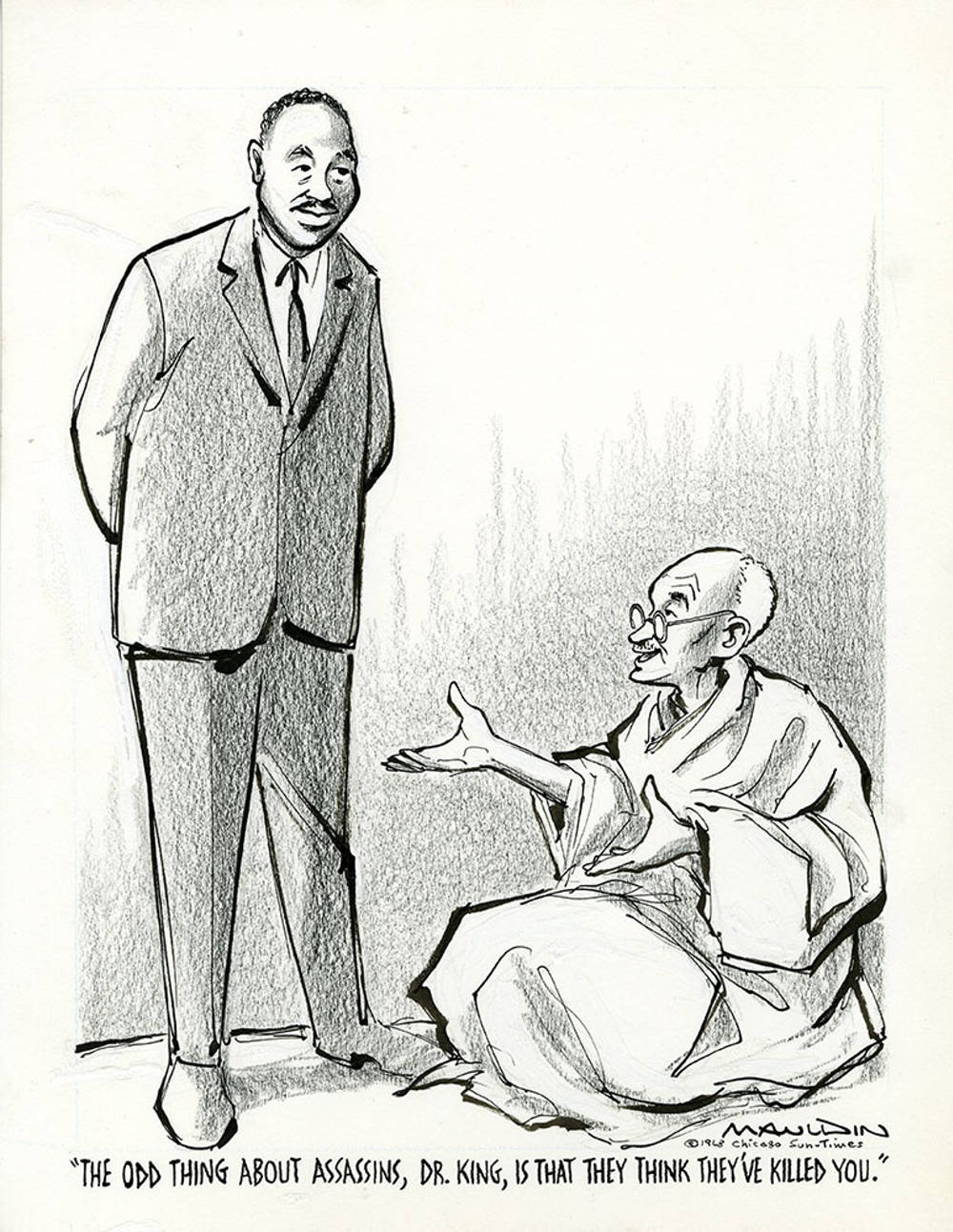
In April 1968, after Dr. King’s assassination, the Chicago Sun-Times published this cartoon:
Look at Gandhi, seated on the floor, his hand outstretched, making his point to an attentive Dr. King. You’d think they were old friends. There they are in this alternate reality, perhaps even in the artist’s imagined heaven, reminding us that the voices of peacemakers can resonate long after they are gone.
Although they never met, Gandhi and King were kindred spirits. Gandhi was aware of racial injustice in the United States and hoped that Black American would create their own nonviolent movement.
Martin Luther King Jr. read books by and about Gandhi. He knew people who had met Gandhi. Gandhi’s teaching supported King’s own beliefs that grew out of the love of family, of community, of Jesus. King integrated Gandhian methods and principles into the work of his life, much as he did with the Christian gospel.”
Read This If You Love:I am Gandhi (both picture book & graphic novel) by Brad Meltzer; A Taste of Freedom: Gandhi and the Great Salt March by Elizabeth Cody Kimmel; Chasing Lincoln’s Killer by James L. Swanson; Martin’s Big Words: The Life of Dr. Martin Luther King Jr. by Doreen Rappaport; Be a King: Dr. Martin Luther King Jr.’s Dream and You by Carole Boston Weatherford; Memphis, Martin, and the Mountaintop: The Sanitation Strike of 1968 by Alice Faye Duncan; March trilogy by John Lewis with Andrew Aydin; A Good Kind of Trouble by Lisa Ramée; The Night Diary by Veera Hiranandani
Recommended For:
**Thank you to Barbara at Blue Slip Media for providing a copy for review!**
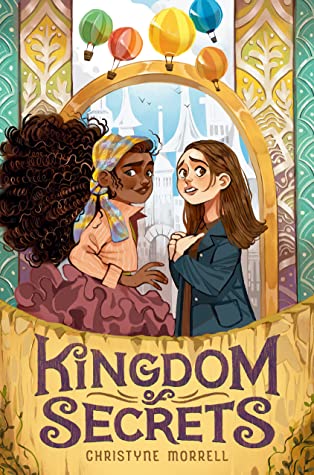
Kingdom of Secrets Author: Christyne Morrell
Expected Publication August 3rd, 2021 by Delacorte Press
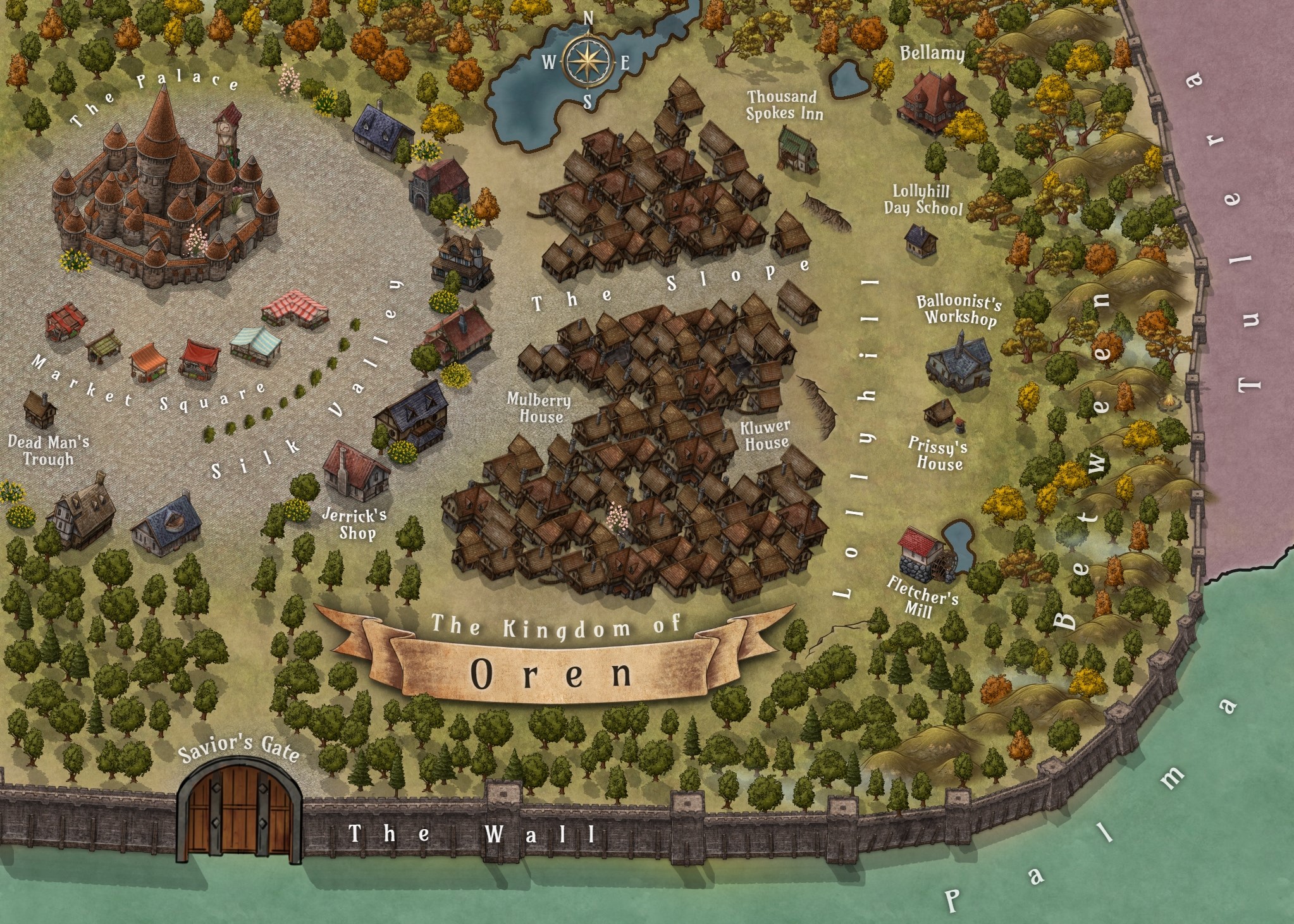
Summary: Prismena’s father is the hot air balloonist in the peaceful kingdom of Oren. She assists him by mending torn balloons, but she yearns to build and fly the complicated machines herself. One day, a waif named Abi steals Prissy’s only remaining memento of her deceased mother – a silk scarf – and promises to return it only if Prissy smuggles a mysterious box onto one of her father’s flights. Since balloon travel is strictly regulated in Oren, that single act of rebellion results in her father’s arrest and kicks off a spiraling series of events that will yank Prissy out of her predictable life.
Along the way to free her father from jail, she’ll get caught up in a bar fight, nabbed by a sadistic schoolmistress, tossed into a home for unwanted children, schooled in the art of stealing, and thrust into the center of a brewing rebellion. On her journey through Oren – with its glitzy neighborhoods and its seedy underbelly – Prismena will uncover secrets that change the way she views her family, her kingdom, herself, and even her beloved hot air balloons. She’ll have to break a few rules – and even forge metal – to save the people she loves, but she may also get a chance to soar.
About the Author: Christyne Morrell is a children’s book author and attorney. She lives in Decatur, Georgia with her husband, daughter, and hyperactive beagle. Christyne has been writing poems and stories since she could hold a pencil, but KINGDOM OF SECRETS (Delacorte 2021) is her debut middle-grade novel.
Christyne is also the author of the picture book Abra, Cadabra & Bob (Clear Fork Publishing 2019), and her work has appeared in Highlights,Spider, and The School Magazine. She can be found online at christynewrites.com and on Twitter and Instagram at @ChristyneWrites. Christyne is represented by Danielle Chiotti at Upstart Crow Literary.
Review:When I started reading this book, it caught me right away because Abi comes out of nowhere, blackmails Prissy, then her dad gets arrested, and really I truly had no idea what was going on! Since the book is in Prissy’s point of view it gives the reader the suspense and disbelief that Prismena has as the story begins. This makes you want to just keep reading to figure everything out.
Then, add in a second story about a mysterious young lady named Wren from the past that will crash land into the main story in a very unexpected way–it just sucks the reader in more!
In addition to the plot, I found the characters intriguing and very well crafted. The development of Prismena is definitely the highlight as she learns how to be on her own and have her own thoughts, but even the secondary characters had stories that Morrell found time to tell in the book. I do wish I knew more about Abi’s life, but maybe that will come in another book!
I also think the book is timely as it looks at government corruption and propaganda based in fear of others and loss of power. Because of Prismena’s ignorance, we get to experience the realizations as she does, so this allows for good discussions about these topics without bringing up current events.
I am pretty picky about high fantasy, but this one is one of my recent favorites, and I cannot wait to share it with my students!
Teachers’ Tools for Navigation: The author’s website has a plethora of extra information to bring great discussions about this book to your classroom or book club!
First, there is an interview with balloonists which goes more into the science of the balloons, how Prissy’s valves would work, and other fun balloon anecdotes.
At the beginning of A Blood Red Smile, a little girl treats Prissy like a celebrity because she’s the “balloonist’s daughter.” Later, Marybeth does the same. Why do you think that is?
Mr. Dudley is arrested for having “contraband,” including rubber. It may seem silly to you that something as common as rubber would be considered dangerous. Why do you think King Michael feels that rubber and other simple inventions are threatening?
When they first meet, Prissy and Abi don’t get along. Why not? What are some of their differences? What do they have in common? What changes over the course of the book that leads to them becoming friends?
Note: Some of the discussion questions in the complete guide are spoilers!!
Book Trailer:
Flagged Passages: Chapter 1. The Stranger and the Scarf
Abigail Smeade arrived like a black eye: sudden, fierce, and blossoming under my skin. When I met her, I was sitting in the shade of an old oak tree, minding my own business. I’d just removed a burlap sack from a hollow in the tree’s trunk and poured its contents out in the grass–scraps of metal, twisted brackets, and a few strips of a stretchy material called rubber. Most people would’ve described those things as junk fit for the bin, but I knew better. Pieced together just right, that “junk” would become more than the sum of its parts. And figuring out which way was just right happened to be one of my favorite pastimes.
But Father didn’t like me tinkering with the odds and ends I gathered (and sometimes even pinched from his workshop). It wasn’t proper, he said, and making something nobody had ever seen before might get a person looked at twice, which was the last thing we wanted. That’s why I kept my collection stashed inside an oak tree in the middle of Fletcher’s field. Nobody but Mr. Fletcher and me ever wandered into that field anymore, if you didn’t count the sheep.
At the bottom of the bundle, rolled up tight, was a scarf, a single piece of fabric more precious than all the rest of it put together. I unfurled it across my knees, and the silk shone and rippled like running water. It was cool to the touch, but the pattern–in shades of blue and yellow and purple–made me think of places drenched in sun. The kind of faraway places Mother liked to visit when she was flying hot-air balloons. In fact, the scarf had been a souvenir from one of her trips. She’d had a weakness for beautiful, unnecessary things. She’d filled the house with them once.
“Peanut brittle?”
Startled, I crumpled the scarf and crammed it back into the sack. Then I whipped my head left and right, hunting for the owner of that voice. It wasn’t until I looked up that I spotted her, sitting on a branch of the tree and kicking her legs like she was lounging on a swing. She peered down at me with shrewd, glittering brown eyes. Without prompting, she extended a half-eaten shard of candy through the leaves. It glistened with a semicircle of saliva where she’d taken the last bite.
“No, thanks,” I said.
“Your loss.” She wedged the peanut brittle into the far reaches of her mouth and cracked off a piece. It rattled against her teeth as she spoke. “What’s that?” She pointed down at one of my projects, something I was still trying to get just right. A small flying machine I’d made using those strips of rubber Mr. Dudley had given me.
“Excuse me . . . who are you?” I asked. She looked about my age–long-limbed and gangly, with light brown skin. Her hair had been pulled into a ponytail that erupted at the back of her head in a burst of copper corkscrews. She wore several layers of clothes–an apple-green vest, a striped jacket two sizes too small, and two gauzy skirts that looked like petticoats that had been dyed pink and cut short. Her scuffed boots kicked at the air over my head.
“Abigail Smeade, at your service,” she said. “You can call me Abi.” She smiled with a mouth full of crowded, crooked teeth, each one shoving its way to the front. She stretched her arm down to me again, this time offering her long, tapered fingers for a handshake. As though it were completely normal to meet someone while perched in a tree. I unpretzeled my legs and stood on tiptoes to give her hand a single uninspired shake.
“I’m Prismena,” I said. “What are you doing here?”
Read This If You Love: The Land of Stories books by Chris Colfer, The Trouble with Shooting Stars by Meg Cannistra, A Tear in the Ocean by H.M. Bouwman, and other middle grade fantasy books
Recommended For:
**Thank you to the author and publisher for providing a copy for review!**