Author Guest Post!: “There’s No Such Thing as Pantsers” by Justin Lantier-Novelli, Author of Don’t Mess with Coleman Stoops

Share

“There’s No Such Thing as Pantsers”

Like every other profession and hobby, creative writing has developed its own lingo or jargon writers share with each other; these are phrases that non-writers would neither understand nor care about. Thank NanoWrimo – the month-long writing contest that takes place every November – for coining one of these terms a few years ago to describe writers who never do any planning for their stories. Imagine deciding to compose your very own novel or short story, sitting down at your favorite typewriter or laptop, starting on a blank screen and just going. No thought. No worry. Perhaps not even a developed idea…

That is the essence of being a Pantser: a writer who doesn’t think, he just writes. Maybe the inspiration came from a dream, or a conversation.  Maybe there was nothing but a “Once upon a time.” This theory begs to know where the greatest stories of humanity actually come from: the head or the heart? My theory, however, is that Pantsers don’t exist. Even if a writer cracks his knuckles and begins with nothing, once he’s finished his first draft and knows the story and characters a bit, he’s invariably going to proofread, re-tool, and revise his work. Any narrative needs drafting as part of its process. Whether or not you, as a writer, plan at the very beginning (before you start on page one, line one), or you start planning using your first draft as the catalyst, none of us can write without it. Everyone’s a Plotter (the opposite of a Pantser).

Why is planning so important? 

There are many reasons. To compose a story that could speak to millions of people isn’t an easy task. It takes a very delicate blend of art and science. The art, comes from the heart, but the science… science is the product of the mind. I would say that 80-90% of my time is spent in the pre-writing phase. I am a plotter with a capital P. I’m also a drafter, as much as I wish I could crank out that flawless first draft (nobody can). Planning can take many forms and has many benefits, some of which will seem obvious to you and some not-so-much. The type of planning you do is also a direct correlation to what you intend your final product to be.

My personal background is in writing for the screen. I went to college for audio/video production and minored in screenwriting. There are some really great ‘how to’ books I can recommend to teach novelists how to craft that perfect character arc or story arc or secondary plot thread – all of which have their roots in motion picture writing. Let’s face it: screenplays were born out of novels, but that doesn’t mean that novelists can’t learn a thing or two from screenwriters.

Which brings me to my first point about planning. Planning gives the writer the ability to stand back and see the story as a god would, as one big picture. Screenwriters are taught to use corkboards and notecards in their planning. Each card is a scene and the board is divided up into the typical (and formulaic) three-act structure: set-up, rising action, resolution. This simple exercise, which I have used for both my screenplays and novels, helps the writer to visualize the arcs. Where will this scene fit best in telling my tale? Is that scene even needed? Once he’s staring at his board with all the scenes displayed, a writer can ask himself: does this scene advance the plot, subplot, or character development at all? If the answer to any of those questions is yes, then the scene is kept. If it’s no, then it can be scrapped (and to use an industry term: to the cutting room floor).

Planning your story arcs is essential in creating the emotional and logical experience that writers want, need, and expect their audience to get. It doesn’t matter if that audience is sitting in a dark room watching the screen, or curled up in their bed turning pages. But what is a story arc? If you know, great. If you don’t, a story arc is comprised of beats, or plot points. Different events throughout the course of a story have to happen to move the plot forward, or drive the character onto becoming the protagonist the writer – and reader – want him to be. And by planning, the writer can see all possible scenes, brainstorming as many as he wants before choosing the perfect one.

The first plot point is also known as the inciting incident (at least in the screenwriting world). No story – in literature or on film – is complete without one.

Would Luke Skywalker been able to destroy the Death Star without R2-D2 and C-3PO taking that escape pod to Tatooine?

Would Romeo and Juliet have ended up dead (to add a bit of high culture to this mix) if Romeo had never crashed the Capulet’s party?

Of course, the inciting incident is only one instance where planning is needed, but each act in the three (or five) act story structure has major plot points. Writers must plan them to do their stories justice and take the reader along on a wondrous journey.

Planning is important in a single, stand-alone novel, however it couldn’t be more essential when writing a series. Series contain multiple story and character arcs, A plot threads, B plot threads, even C plot threads (truly they can be infinite) that span each book individually, but also continue strands across multiple books. Two great examples of writers who plant seeds for future books as part of their pre-writing stage planning are Stephen King and J.K. Rowling – and it’s no accident that they are two of the most successful authors of all time. If you want to see how to plant ideas for future books in a series, just read Harry Potter and The Dark Tower (in fact, King literally has been planting seeds in all his books, even the non-DT works, for decades).

Still not convinced that planning is important? Think about the horcruxes in the Wizarding World… The very first one was revealed in the second book in a seven book series. Rowling didn’t wing her writing. Her seeds were intentionally planted. She knew what horcruxes were before she started typing line one, page one. The rest of us, her loyal readers, didn’t find out until book six! But we didn’t need to know. She did.

The second reason to plan is more about spring cleaning. The more ideas you get out of your system early in your drafting, the more bad ideas you get out of your system. You can easily put together a dozen versions of the same scene, chapter, or character sketch. And all that brainstorming churns the waters of ideas. Sooner or later, the writer will hit the nail on the proverbial head, and get the perfect idea for some aspect or another of his work.

So if you want to clear away bad ideas, take a step back and look at your book(s) from a 3rd person omniscient perspective, then I cannot recommend planning more. Pre-writing is necessary to crafting a well thought out, logical, and emotional story filled with three-dimensional characters that your audience can relate to and keep them furiously flipping pages until the wee hours of the morning.

You can follow Justin Lantier-Novelli on Twitter: @jlnovelli. Find him on Goodreads, Facebook, and Amazon. His debut middle grade fiction novel, Don’t Mess with Coleman Stoops, is available in paperback and for Amazon Kindle.
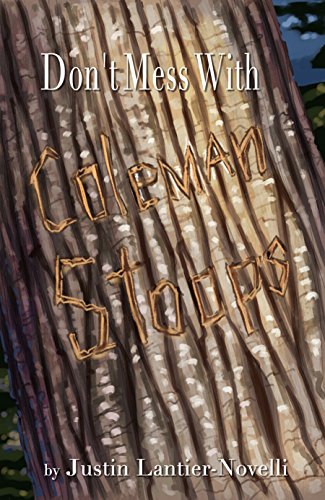
About the Book: Coleman Stoops just had his twelfth birthday, but he’s not getting popular anytime soon. The kids in his grade call him “Stoopy”. He hates the cruel nickname almost as he hates himself for always managing to accidentally play into it. The clothes he wears, the hobbies he loves, and the way he behaves in school all contribute to his eternal low ranking as the butt of everyone’s jokes. Coleman’s a dork, a dweeb, a nerd. He’s the fool of the school.

So when the most popular kid in his class, B. Bradford Woffington III, approaches him with a proposition and a potential girlfriend, Coleman can’t help ignoring his instincts as they tell him not to trust “Trey”. He accepts the boy’s offer and begins the social and physical grooming that will make him fit for dating – gasp! – a real, live girl. No matter what happens though, Coleman can’t shake the sneaking suspicion that there’s something Trey isn’t being completely forthcoming about. What isn’t the most popular kid in school telling him?

Thank you, Justin! Planning is something all teaches struggle with students understanding, so this post is going to be so helpful!

 and


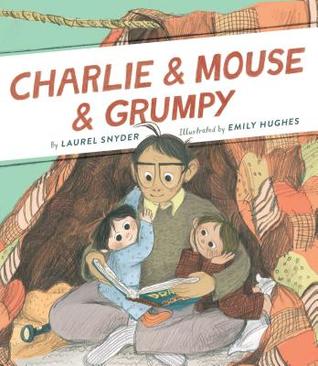
Teaching Guide with Activities and Discussion Questions for Charlie and Mouse and Grumpy by Laurel Snyder

Share

Charlie & Mouse & Grumpy
Author: Laurel Snyder
Illustrator: Emily Hughes
Published October 3rd, 2017 by Chronicle

Summary: In this heartwarming sequel to Laurel Snyder’s beginning chapter book Charlie & Mouse, the two brothers enjoy a special visit from their grandpa, Grumpy. Follow along as they discuss being medium, pounce each other, sing the wrong songs, build blanket forts, and more. Paired with effervescent illustrations by Emily Hughes, this touching, funny celebration of imagination and bonding will enchant readers young and old.

View our post about Charlie and Grumpy book one (with teaching guide) here!

Activities include: 

Bedtime Songs

Grumpy doesn’t know the right bedtime song to sing for Charlie and Mouse, so he tries to guess. Using the clues he gave, we can assume he was talking about “Circle Game” by Joni Mitchell, “Hush, Little Baby,” and possibly “Jump in the River” by Sinead O’Connor. Play these three songs for your students.

  • Which do you like the most? Why?
  • Which do you think would be the best bedtime song? Why?

After Grumpy guesses, Charlie sings the right bedtime song to Grumpy.

  • We don’t know what song Charlie sang, but what song would you have sung to Grumpy?

After gathering all of the bedtime songs discussed as a group, have students analyze the different songs (theirs and the three Grumpy mentioned) by having them (in groups or independently):

  • Identify rhyming words within the songs.
  • Does the author repeat any words? Why did the author choose to repeat these words?
  • How does the author supply rhythm in the song?

Infer

There are a few times in the book that the text doesn’t tell you what happened, but you can infer from the illustrations what occurred such as p. 17, p. 27, and p.37. Have students use the illustrations to see how each of these chapters concluded and have them write out what they see in the illustrations.

Rain

In the final chapter, it is raining while Charlie and Mouse say good-bye to Grumpy. Even though the rain seems to be happening because of the mood of the chapter, rain actually occurs because of the water cycle. After discussing the mood of the chapter (see discussion question), share the scientific reason for rain by sharing the water cycle. One activity that could be done to help students understand the water cycle is the “Simple Water Cycle in a Bag” experiment: http://www.rookieparenting.com/what-is-water-cycle/.

Discussion Questions include: 

  • The text never says that Grumpy is Charlie and Mouse’s grandfather, but you can infer he is. What clues from the text and illustration help you know that he is their grandfather?
  • In the final chapter, the author chose to have it be raining. Why does this type of weather make the most sense for this final chapter? What mood does it set for the chapter?
  • Using the clues throughout the book, how many days and nights did Grumpy stay with Charlie and Mouse? How did you know?

Teaching Guide Created by Me (Kellee): 

You can also access the teaching guide through Chronicle’s website here.

Recommended For: 

readaloudbuttonsmall classroomlibrarybuttonsmall closereadinganalysisbuttonsmall

Kellee Signature

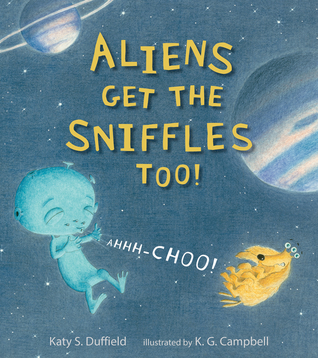
Aliens Get the Sniffles Too! Ahhh-Choo! by Katy S. Duffield

Share

Aliens Get the Sniffles Too
Author: Katy S. Duffield
Illustrator: K. G. Campbell
Published November 7, 2017 by Candlewick

Summary: Ahhh-flying-saucer-shooting-star-CHOO! Laughter is the best medicine when you’re a little alien feeling under the weather.

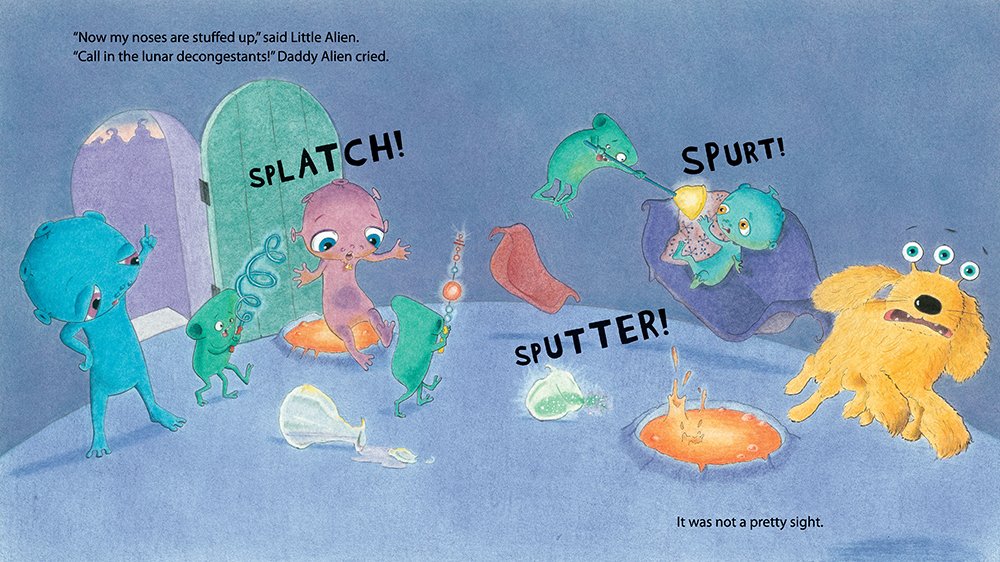
Little Alien is sick. And sick is extra-terrestrial bad when you have two scratchy throats, five ears that hurt, and three runny noses. Splatch! Sputter! Spurt! Luckily Mama and Daddy Alien have an arsenal of lunar decongestants and meteor showers on hand to make him feel a little better (not to mention a Milky Way milkshake to help the medicine go down). Even so, the family’s alien pooch, Mars Rover, can’t stand to see his little buddy feeling out of sorts. Can a loyal pup’s funny tricks finally coax a smile?

About the Author and Illustrator: Katy Duffield is the award-winning author of more than twenty-five books for children. She lives in Florida with her husband. To learn more, and to download classroom resources, visit katyduffield.com. Twitter: @KatyDuffield

Check out Katy on Pinterest!
 
K. G. Campbell is the illustrator of Flora & Ulysses by Kate DiCamillo and the author-illustrator of Lester’s Dreadful Sweaters. He was born in Kenya, raised in Scotland, and now lives in southern California.

Ricki’s Review: This book has been a blessing in my house. Both of my kids have had colds for the past several weeks. It seems they catch cold after cold! We’ve been reading this book quite often and making connections with Little Alien. As a parent, I particularly appreciate that the end of the book allows me space to talk about how Little Alien got Mars Rover sick. Every time we read the book, we point to the part where Little Alien spreads his germs to Mars Rover. Then, we make the cause-effect relationship about what happens when we spread our germs. I know that teachers in elementary school will love this connect. We spend a lot of time talking with kids of all ages about spreading germs!

On a literary note, the author has some great plays on words. I chuckle every time that I read the book. Kids who are obsessed with space will adore this book and all of its space references.

Kellee’s Review: Whenever Trent is sick, he is so miserable, so Little Alien’s story of trying everything to feel better is going to be the perfect companion to my sweet boy when he is feeling under the weather. Just like Mars Rover will do anything to help make Little Alien feel better, I will as well, and Aliens Get the Sniffles, Too! will be a perfect part of our feel better routine.

I loved the use of onomatopeoias in the book and mixed with the detailed, colorful, full page illustrations really brings Little Alien’s story to life.

Teachers’ Tools for Navigation: Teacher might group students in pairs and assign them a spread. Students might hunt for the references to space on the pages and look up to learn more about those aspects of space. For example, for the spread below, students might look up the word “lunar” and share it with the whole group. Then, the teacher might reread the entire text again and pause to allow students to share the word play of their assigned spread as they read the book aloud together.

Discussion Questions: How does Mars Rover feel when Little Alien gets sick? Have you ever felt that way when a friend or family member got sick?; How does Mars Rover get sick? Can you point to the specific page?; Which new words did you learn while reading this book? How are they connected to the story? How does the author create a theme around the concept of space?

Flagged Passages: 

Read This If You Loved: Your Alien by Tammi Sauer,  Faraway Friends by Russ CoxBoy + Bot by Ame DyckmanLife on Mars by Jon Agee

Giveaway:  TWO giveaway opportunities!!

  1. One grand-prize winner will receive a out-of-this-world alien backpack with a signed copy of Aliens Get the Sniffles Too! along with tissue packs, toy mini aliens, and space pencils.
  2. Ten lucky runners-up will receive a copy of Aliens Get the Sniffles Too!
To enter, click here.

Recommended For:

  readaloudbuttonsmall classroomlibrarybuttonsmall

andKellee Signature

**Thank you to Barbara from Blue Slip Media for providing copies for review!**

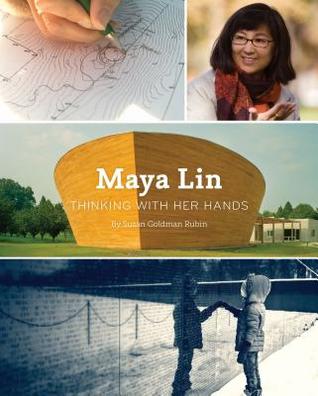
Teaching Guide with Activities and Discussion Questions for Maya Lin: Thinking With Her Hands by Susan Goldman Rubin

Share

Nonfiction Wednesday

Nonfiction Picture Book Wednesday is hosted by Kid Lit Frenzy and was started to help promote the reading of nonfiction texts. Most Wednesdays, we will be participating and will review a nonfiction text (though it may not always be a picture book).
Be sure to visit Kid Lit Frenzy and see what other nonfiction books are shared this week!

Maya Lin: Thinking With Her Hands
Author: Susan Goldman Rubin
Published November 7th, 2017 by Chronicle

Summary: In the tradition of DELICIOUS, WIDENESS & WONDER, and EVERYBODY PAINTS!, this is Susan Goldman Rubin’s extensively researched and very accessible biography of civic activist Maya Lin, most famous for her design of the Vietnam Veterans Memorial. The Vietnam Veterans Memorial in Washington, D.C., is one of the most famous pieces of civic architecture in the world. But most people are not as familiar with the reserved college student who entered and won the design competition to build it. This accessible biography tells the story of Maya Lin, from her struggle to stick with her vision of the memorial to the wide variety of works she has created since then. Illustrated extensively with photos and drawings, the carefully researched text crosses multiple interests–American history, civic activism, art history, and cultural diversity–and offers a timely celebration of the memorial’s 35th anniversary, as well as contributing to the current, important discussion of the role of women and minorities in American society.

Activities include: 

Pre-Reading

  • Building Historical and Scientific Background Knowledge: To better understand much of Maya Lin’s extensive work, background knowledge of certain historical and scientific events are needed. Before reading Maya Lin’s biography, separate the class into five groups and assign each group one of these events:
    1. Vietnam War
    2. Civil Rights Movement
    3. Chinese-American Immigration
    4. Endangered and threatened animals
    5. Lewis and Clark’s expedition and the effect on the Indigenous People of Washington State

    Have each group create a timeline using an interactive timeline creator that showcases their event chronologically.  Within the timeline, the students should not only have important dates but they should incorporate visuals, the impact of each event on history/science, and any other supplemental information/media that will increase the knowledge of their event.

    Students then will present their timelines to their classmates to allow for all students to possess knowledge of all five historical and scientific events before beginning Maya Lin’s biography.

Post-Reading

  • Symbolism: Unlike traditional minimalists, Maya Lin uses symbolism in her work. Begin with working with students on symbolism within familiar stories they know. Show students What is Symbolism? at https://www.youtube.com/watch?v=8Vwek28P9Gk then read the Story of William Tell (http://www.mainlesson.com/display.php?author=baldwin&book=fifty&story=tell) and discuss what the apple symbolizes. After this discussion tell students that symbolism in art is the same–symbolism is when a piece of art or an aspect of a piece of art represents something more than its literal meaning.Then, have students analyze her pieces of work for symbols within them. Students should then create a symbolism T-chart showing their found symbolism.Some examples:
    The ark shape of the Riggio-Lynch Chapel Symbolizes that the chapel is a safe place just as Noah’s Ark was.
    The water on the Civil Rights memorial Symbolizes the justice rolling down like waters and righteousness like a mighty stream mentioned in “I Have a Dream” speech by Martin Luther King, Jr.
  • Cumulative Writing Assignment: Legacy
    Maya Lin states, “You need to see me whole as an artist. What I’m doing is art, architecture, and memorials.” Have students write an informative essay explaining how Lin has fulfilled her legacy as an artist, architect, and memorial designer. Have students use evidence from the text, as well as other provided resources if you choose, to support their claim.Other resources:
    http://www.whatismissing.net/
    http://www.mayalin.com
    http://www.biography.com/people/maya-lin-37259
    http://www.theartstory.org/artist-lin-maya.htm

Discussion Questions include: 

  • From a young age, Maya Lin did not like the color red. Why does she not like the color red? What does red represent to her? The color red was included in the Museum of Chinese in America, however. Why was the color included in this project even though Maya Lin does not like it?
  • After completing the Vietnam War Memorial, Lin felt like she was boxed in as a “monument designer,” and refused many invitations to complete more memorials. Why do you think the Civil Rights Memorial was the work that she finally agreed to complete?
  • Maya Lin’s message of sustainability (avoiding the depletion of natural resources to maintain a balance within nature) reaches us through not only her What is Missing? project but through many of her other pieces of work. She states, “A lot of my work is not very glorious. If I succeed, you may never know I was here.” How did Maya Lin’s message of sustainability come through her works?
  • Susan Goldman Rubin’s chapter titles are very specific word choices. Looking at the titles (Clay, Granite, Water, Earth, Glass, Celadon, Dunes and Driftwood, Wood, and Memories), why do you believe the author choose these words to title each chapter?

Teaching Guide Created by Me (Kellee): 

You can also access the teaching guide through Chronicle’s website here.

Recommended For: 

readaloudbuttonsmall classroomlibrarybuttonsmall closereadinganalysisbuttonsmall

Kellee Signature

Top Ten Tuesday: Ten Characters Who Would Make Great Leaders

Share

top ten tuesday

Top Ten Tuesday is an original feature/weekly meme created at The Broke and the Bookish. The feature was created because The Broke and Bookish are particularly fond of lists (as are we!). Each week a new Top Ten list topic is given and bloggers can participate.

 Today’s Topic: Ten Characters Who Would Make Great Leaders

Ricki

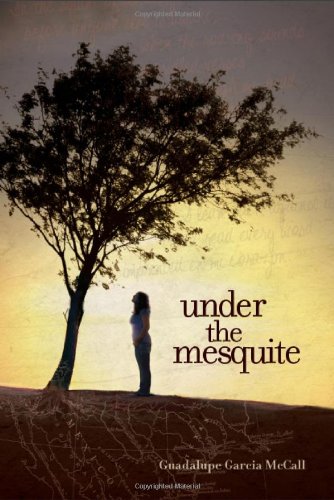
1. Lupita from Under the Mesquite

She does a great job leading her siblings.

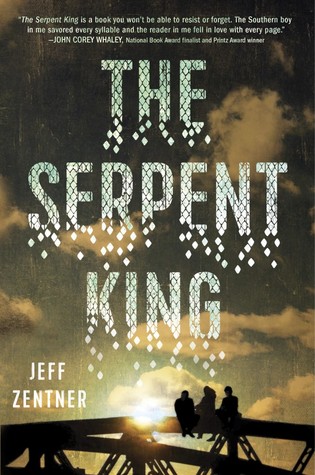
2. Lydia from The Serpent King

She isn’t very well-liked by her peers, but she would be a fearless leader.

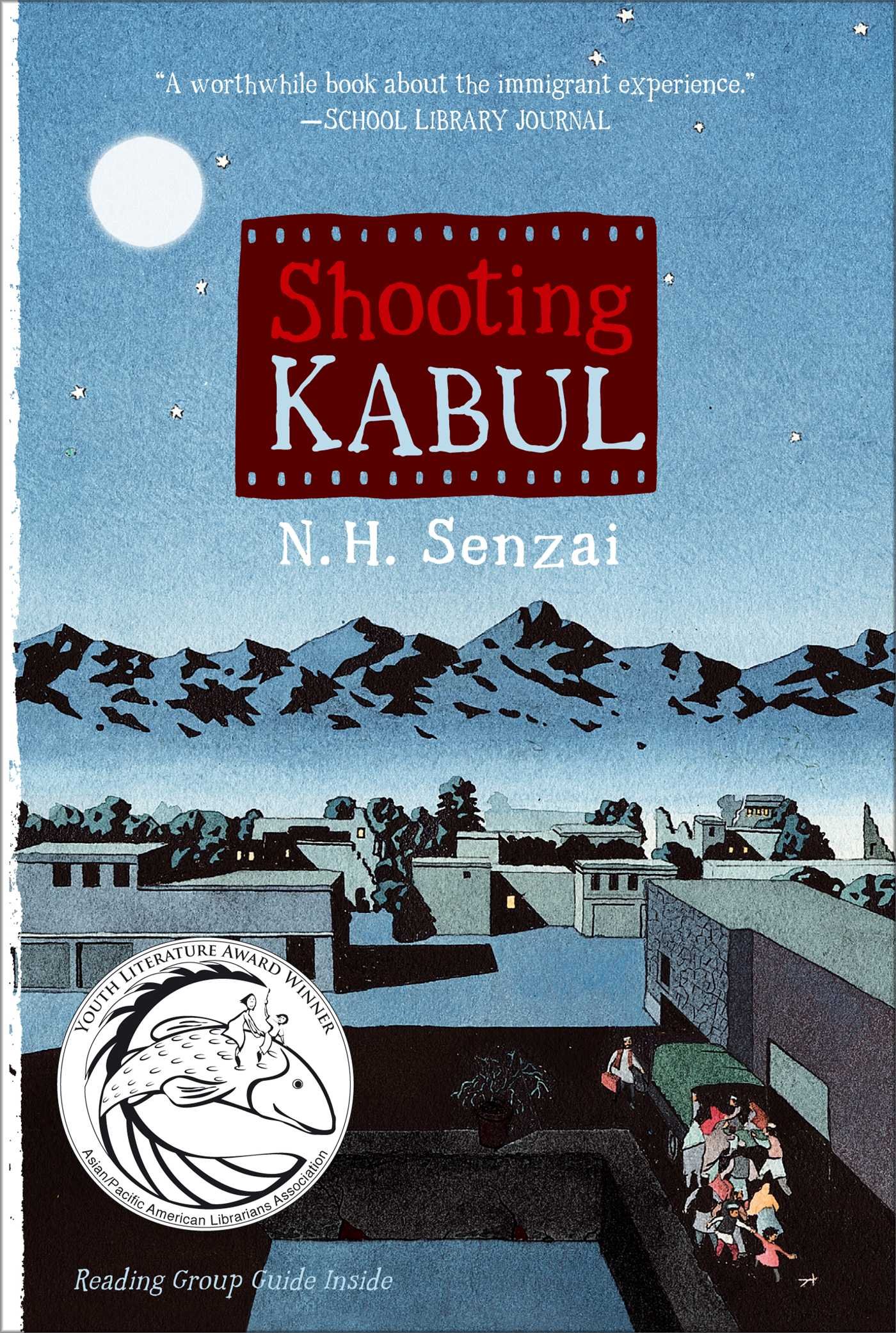
3. Fadi from Shooting Kabul

Fadi is brave and determined to find his sister. He’d make a great leader.

4. Tyrell from Tyrell

Tyrell is a natural leader.

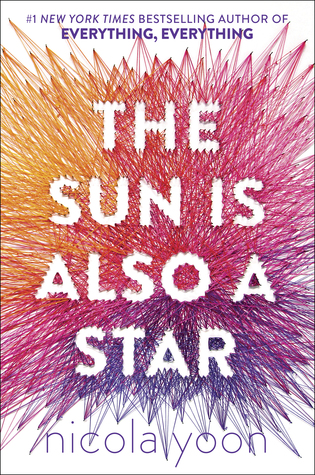
5. Natasha from The Sun Is Also a Star

When Natasha finds out she is going to be deported, she doesn’t take no for an answer. She would be a phenomenal leader.

Kellee

So, I wasn’t really sure what direction I wanted to go with for this TTT post, but I decided that I was going to focus on characters that I would want to be my Student Council President if they were running in high school.

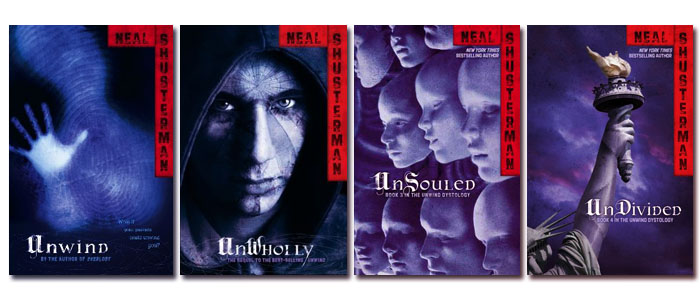
1. Risa from the Unwind Dystology

I would know that Risa would get what was needed done while not going against her conscience.

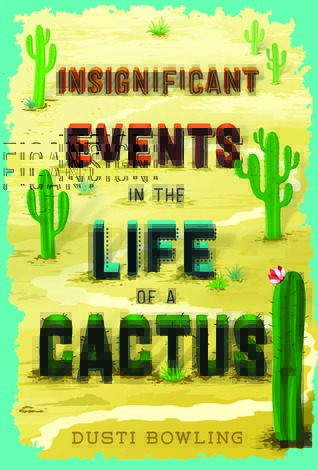
2. Aven from Insignificant Events in the Life of a Cactus by Dusti Bowling

Aven is hilarious and smart, and I know she would be a great leader (not to mention that she wouldn’t let any obstacle stop her from succeeding).

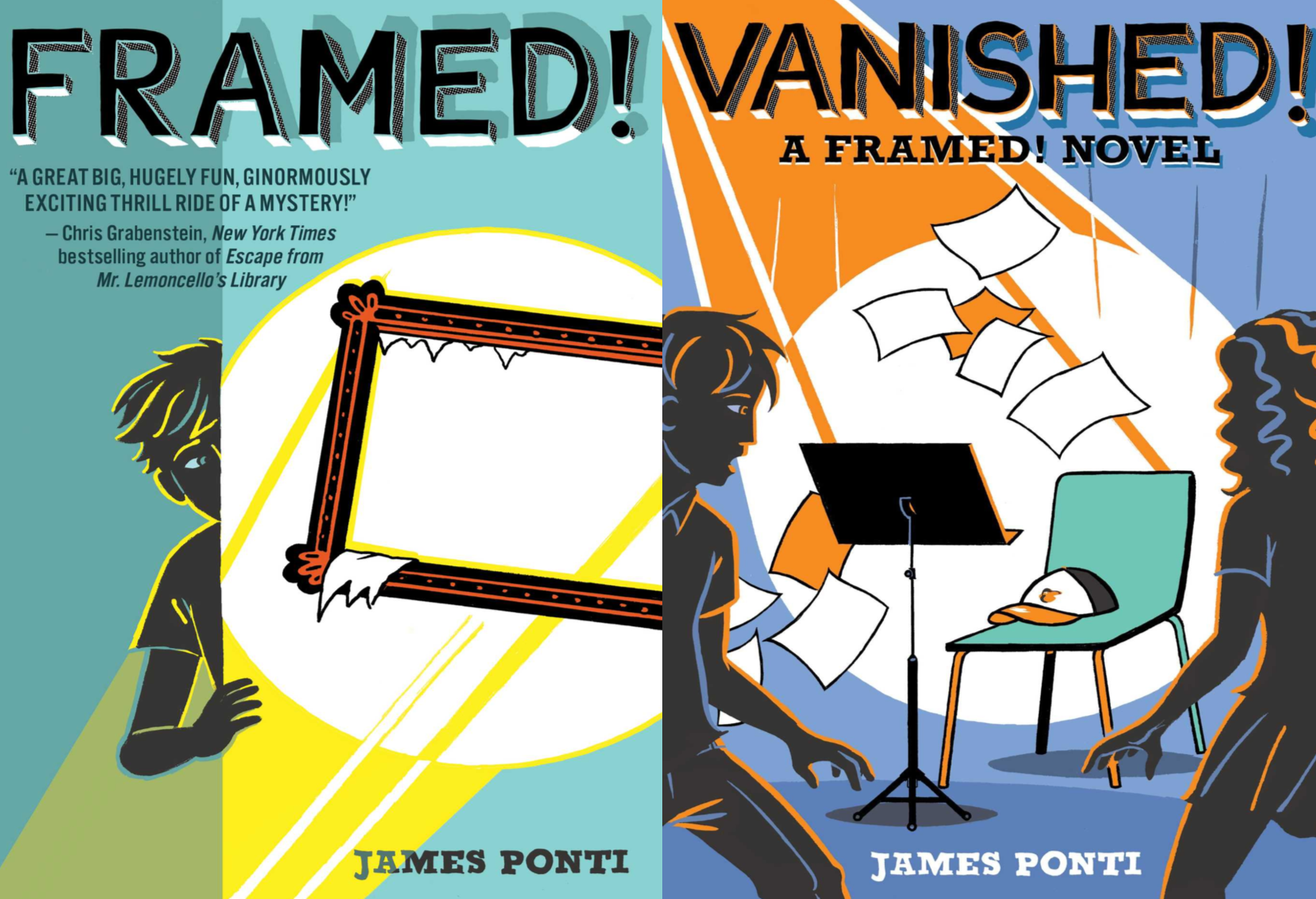
3. Florian Bates from the T.O.A.S.T series by James Ponti

If Florian can help the FBI, think of what he could do for a school!!

4. Alex Rider from the Alex Rider series by Anthony Horowitz

And Alex keeps saving the world with the help of MI6, why not save a high school from bad policies?!

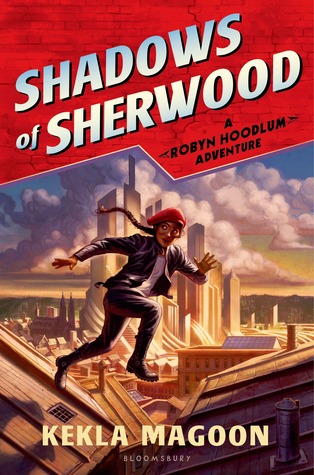
5. Robyn from Shadows of Sherwood by Kekla Magoon

Even after losing everything, Robyn keeps her head on straight and focuses on making the decisions that need to be made. Just think if this was in a high school situation instead of life-and-death?!

Which characters do you think would make great leaders? 

RickiSig and Signature

It’s Monday! What Are You Reading? #IMWAYR 11/6/17

Share

IMWAYR 2015 logo

It’s Monday! What Are You Reading? From Picture Books to YA!

It’s Monday! What are you Reading? is a meme started by Sheila at Book Journeys and now hosted by Kathryn at The Book Date. It is a great way to recap what you read and/or reviewed the previous week and to plan out your reading and reviews for the upcoming week. It’s also a great chance to see what others are reading right now…you just might discover the next “must-read” book!

Kellee and Jen, of Teach Mentor Texts, decided to give It’s Monday! What Are You Reading? a kidlit focus. If you read and review books in children’s literature – picture books, chapter books, middle grade novels, young adult novels, anything in the world of kidlit – join us! We love this meme and think you will, too.

We encourage everyone who participates to support the blogging community by visiting at least three of the other book bloggers that link up and leave comments for them.

Bold_line

Last Week’s Posts

**Click on any picture/link to view the post**

top ten tuesday 

Tuesday: Books to Read on Halloween

Wednesday: Living Things and Nonliving Things: A Compare and Contrast Book by Kevin Kurtz

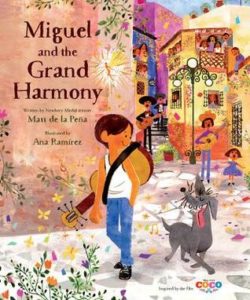
Thursday: Miguel and the Grand Harmony by Matt de la Peña

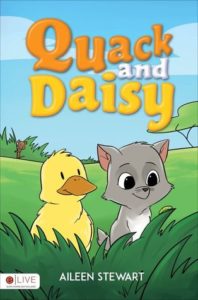
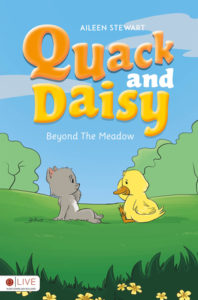
Friday: Quack and Daisy series by Aileen Stewart

Sunday: Author Guest Post and Giveaway!: “The Power of Imaginative Play” by Dian Curtis Regan, Author of the Space Boy series
Giveaway open until Friday!!

Bold_line

 Last Week’s Journeys

Kellee

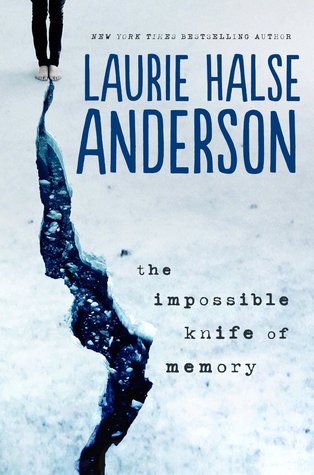
I am so glad I reread The Impossible Knife of Memory before hosting a round table with Laurie Halse Anderson. It is brilliant, and rereading definitely allowed for me to be able to get more in depth with it when I am chatting with her.

 Ricki

Ricki just moved, so she is away this week 🙂

Bold_line

This Week’s Expeditions
Kellee

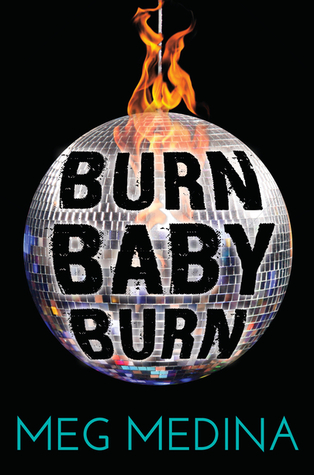
This month’s Faculty Book Club choice is Burn Baby Burn by Meg Medina, so I started that today.

Bold_line

Upcoming Week’s Posts

top ten tuesday 

Tuesday: Ten Characters Who Would Make Great Leaders

Wednesday:  Teaching Guide with Activities and Discussion Questions for Maya Lin: Thinking With Her Hands by Susan Goldman Rubin

Thursday: Aliens Get the Sniffles Too! by Katy S. Duffield

Friday:  Teaching Guide with Activities and Discussion Questions for Charlie and Mouse and Grumpy by Laurel Snyder

Sunday:  Author Guest Post!: “There’s No Such Thing as Pantsers” by Justin Lantier-Novelli, Author of Don’t Mess with Coleman Stoops

Bold_line

 So, what are you reading?

Link up below and go check out what everyone else is reading. Please support other bloggers by viewing and commenting on at least 3 other blogs. If you tweet about your Monday post, tag the tweet with #IMWAYR!

 Signature andRickiSig

Author Guest Post and Giveaway!: “The Power of Imaginative Play” by Dian Curtis Regan, Author of the Space Boy series

Share

“The Power of Imaginative Play”

“Imagination is more important than knowledge.”  ~ Albert Einstein

I grew up without digital devices.

I was the child with my nose in a book, or out in the yard slaying dragons, reigning over my kingdom, or teaching school—if I could round up a “student” or two.

Here is how I entered an imaginary world from my backyard: when the wind gusted against bed sheets on the clothesline, I knew if I ran beneath them at the proper moment, I’d find myself in another land. And that was before I’d read about the wardrobe leading to Narnia.

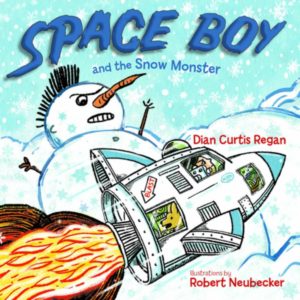
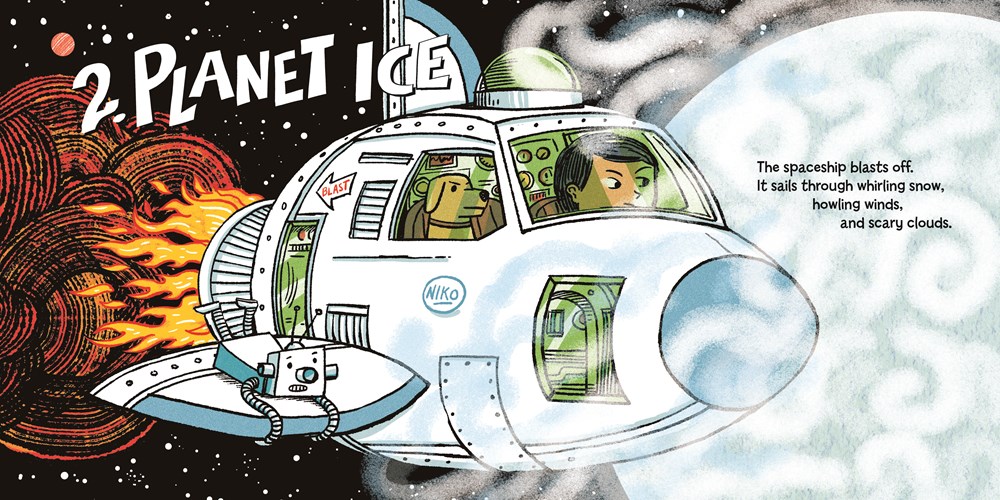
In my Space Boy books, if Niko, in his imagination, has fashioned a spaceship out of a cardboard box, then of course the ship is going to blast off into outer space.

And of course excitement and danger will follow. Luckily, Niko can rely on his loyal crew: Tag, his dog, and Radar, his copilot.

Robert Neubecker’s illustrations depict Radar as a toy robot who morphs into a full-sized partner, overcoming the bad guys with Niko and Tag. Plus, Radar smartly knows how to navigate a spaceship. Makes perfect sense in Niko’s pretend world.

Today, children are entertained too often by their devices, with fewer opportunities to get lost in their imaginations. As a former elementary teacher, I know that pretend play is essential to cognitive and social development, as well as creativity. One of the best exercises in imagination is reading–or being read to. A story’s ups and downs are vividly played out in a young reader’s mind.

In backyard role-playing games, children can try on various roles: a fighter pilot, a parent, a puppy. All they need is a cardboard box, maybe a stuffed toy, and perhaps even a sibling. Then off goes their imagination.

Illustrator friend Doug Cushman shared this with me: During school programs, I’d ask a child to scribble something on my drawing pad in front of the class. Then I’d turn the scribble into a character and create a fun background.

The class would brainstorm a story to go with the images. Their collective imaginations were incredible. The exercise showed that ideas can come from anywhere, even a mere scribble.”

One of the nicest bits of feedback I’ve received about the Space Boy books is from a mom who told me that her kids don’t just read Niko’s stories—they act them out. Bingo—pretend play! Which is exactly what Space Boy is doing in his story within a story.

Here’s to limiting device time for our children, and sending them outside to create their own adventures in imaginary worlds, on other planets like Niko–or at least to lose themselves in a good book.

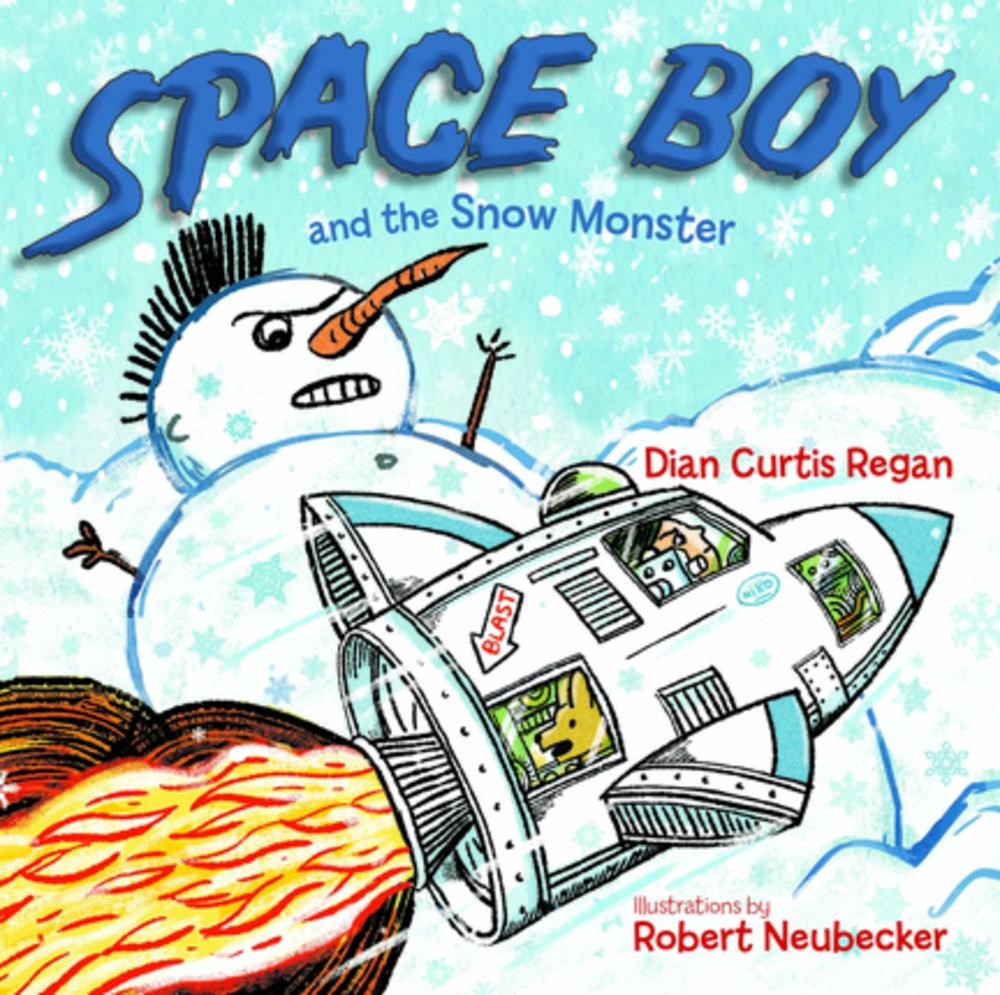
About the Author: Dian Curtis Regan is the author of more than 60 books for young readers, ranging from picture books to YA novels.  Her books have received many honors, including Best Books for Young Adults, Children’s Choice Awards, Junior Library Guild selections, Los Angeles Times Recommended Book, and New York Public Library’s Best Books.  Space Boy and the Space Pirate was a 2017 finalist for the Colorado Book Award, and the winner of a 2017 Crystal Kite Award from the Society of Children’s Book Writers & Illustrators. Space Boy and the Snow Monster is brand new this fall. Dian lives in Colorado Springs, Colorado.  To learn more, and to download a curriculum guide, visit diancurtisregan.com and spaceboybooks.com.

About the Illustrator: Robert Neubecker is the award-winning author-illustrator of Wow! City!, Wow! America!, and Wow! School!, and the illustrator of The Problem with Not Being Scared of Monsters and its companion The Problem with Not Being Scared of Kids. He lives in Park City, Utah. Visit neubecker.com.

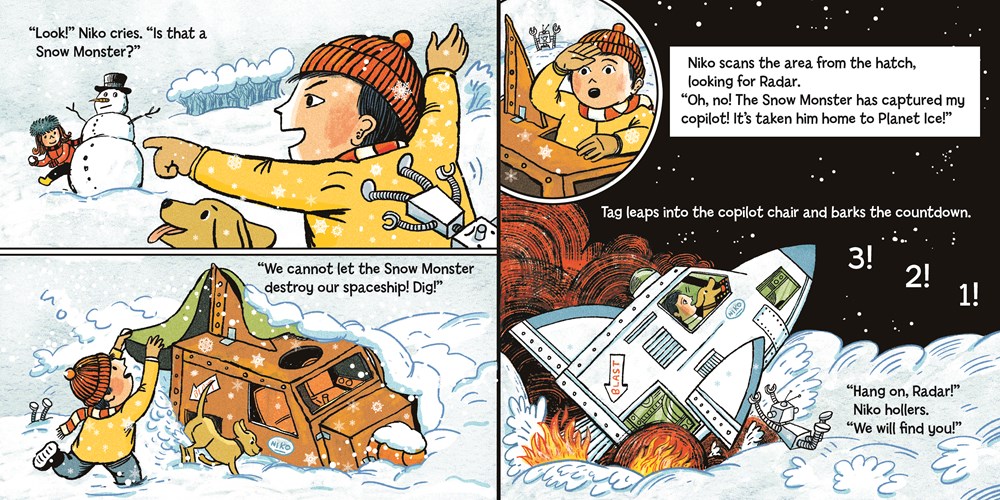
About the Book: Niko and his crew are digging their spaceship out of a snowdrift when Radar, Niko’s robot copilot, disappears. Oh, no! Was he captured by a Snow Monster? They blast off on a rescue mission to Planet Ice, only to find the Snow Monster building an army of scary snowmen. Then they get tricked by a Killer Bunny! Can Niko rescue Radar, flee the Snowmen Army, outwit the Killer Bunny, and fly his crew back to Planet Home in time for hot cocoa?

Click here to read our review of the first Space Boy book, Space Boy and his Sister Dog.

GIVEAWAY!!

Get ready to blast off–one lucky winner will receive SPACE BOY AND THE SNOW MONSTER (U.S. addresses).

 a Rafflecopter giveaway

Thank you Dian for helping us continue to promote imagination!
Thank you also to Barbara at Blue Slip Media for today’s post and giveaway!

 and