Blog Tour with Review, Giveaway, and Author Interview!: The Sky Painter: Louis Fuertes, Bird Artist by Margarita Engle

Share

NFPB2015

Nonfiction Picture Book Wednesday

Nonfiction Picture Book Wednesday is hosted by Kid Lit Frenzy and was started to help promote the reading of nonfiction texts. Most Wednesdays, we will be participating and will review a nonfiction text (though it may not always be a picture book).
Be sure to visit Kid Lit Frenzy and see what other nonfiction books are shared this week!
sky painter

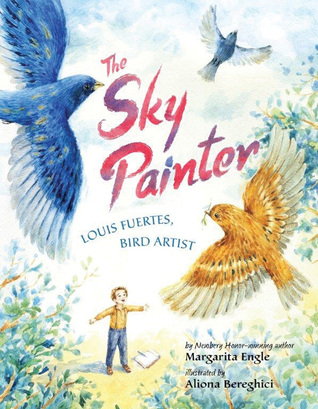
The Sky Painter: Louis Fuertes, Bird Artist
Author: Margarita Engle
Illustrator: Aliona Bereghici
Published April 28th, 2015 by Two Lions

Goodreads Summary: Louis loves to watch birds. He takes care of injured birds and studies how they look and how they move. His father wants him to become an engineer, but Louis dreams of being a bird artist. To achieve this dream, he must practice, practice, practice. He learns from the art of John James Audubon. But as Louis grows up, he begins to draw and paint living, flying birds in their natural habitats.

Louis Agassiz Fuertes (1874–1927) is now known as the father of modern bird art. He traveled with many scientific expeditions all over the world. His best-known works—paintings for habitat exhibits at the American Museum of Natural History in New York—are still beloved by visitors today. His art helped to encourage wildlife conservation, inspiring people to celebrate and protect the world of wings.

Poems by Newbery Honor–winning author Margarita Engle and illustrations by Aliona Bereghici capture the life of Louis Fuertes and the deep sense of wonder that he felt when he painted the sky.

About the Author: Margarita Engle is a Cuban American poet and novelist whose work has been published in many countries. Her books include The Poet Slave of Cuba, winner of the Pura Belpré Award for narrative and the Américas Award; The Surrender Tree, a Newbery Honor book; Summer Birds: The Butterflies of Maria Merian, a Kirkus Best Book for Children; and The Lightning Dreamer, Cuba’s Greatest Abolitionist, winner of the 2014 PEN Center USA Literary Award for Young Adult/Children’s Literature. Margarita lives in California, where she enjoys bird-watching and helping her husband with his volunteer work for wilderness search-and-rescue dog training programs. To learn more, and to download a free activity kit for The Sky Painter, visit: www.margaritaengle.com

Margarita Engle_credit Marshall W. Johnson

Kellee’s Review: Louis Fuertes is an inspirational man, and Engle’s biography of him is perfect. I think what I enjoyed most was how Fuertes was not only an artist, but an animal activist, family man, and educator. He is a role model for any kid that wants to grow up to be happy. Like Ricki shares below, this book shares an important lesson about how there are so many different special things out there to be observed. Nature is phenomenal.

I loved learning not only of Fuertes and his journey to live his passion, I loved the beautiful poetry and watercolor that were used to craft his story.  Both the poetry and the artwork do Fuertes’s story justice like no other format would have.  The format also gives the reader a chance to look at each poem as a stand alone and also part of the whole biography which gives each poem two different purposes and two different ways they can be analyzed.

Ricki’s Review: Louis Fuertes is a remarkable man, and this book not only pays homage to his extraordinary life, but it teaches young people important lessons. He nurtures and cares for birds in ways that children can emulate in many aspects of their lives. The book shows he devoted his life to birds and wanted others to see their beauty. I’ve seen Fuertes’ artwork in a variety of places, but I never considered him as an artist. This book reminded me that sometimes I go about life, not considering something very important and special. I am so glad I learned about Fuertes’ story and will think about him whenever I read or learn about birds. This book would be an excellent gift to give to a child. The poetry is gorgeous, and the illustrations are breath-taking.

Teachers’ Tools for Navigation: As a teacher, we can think of a plethora of ways to use this text in the classroom. We love to offer our students options, so we might provide them opportunities to  read different biographies of different people who are following their passion. Students the could get in lit circles to discuss the biography then come back together to share what they learned. They could also choose any artist or person in history and write poems reflecting this individual’s biography. It would be fun to illustrate and bind these books to share them with others. We can imagine a class sitting in a circle, reading their poetry and learning about lesser-known individuals in history.

Discussion Questions: How did Fuertes change animal painting/drawing forever?; How do you feel that some artists kill animals to draw or paint them?; How did following his passions help make Fueres’s life happier?

Book Trailer: 

Interview with Margarita Engle

Unleashing Readers: What inspired you to write about Fuertes?

Margarita Engle: I became fascinated by Fuertes while I was researching rain forest ecology and visiting wildlife preserves, during the process of writing a historical verse novel called Silver People: Voices From the Panama Canal. In many references, Fuertes was mentioned as the bird artist for all the great geographic expeditions of the early twentieth century. When I learned that he was a conservationist who pioneered the painting of living birds in flight—instead of killing and posing them like Audubon—I was astonished. Why wasn’t he a household name, like Audubon? Instantly, Fuertes became the most important link in my ongoing quest for biographical picture books about great Latino naturalists who have been forgotten by history. I hope The Sky Painter helps teachers, librarians, and parents introduce children from all backgrounds to this amazing Puerto Rican/American scientist. Fuertes is a fantastic role model because he was a creative thinker who decided to learn how to paint faster, to save the lives of birds.

UR: What did your research process look like?  Do you have any recommendations for students who are doing research?

ME: I try to read every book I can find, in addition to online sources. Many historical studies simply have not yet been digitized, so interlibrary loan is really helpful. I rely on bibliographies to help me move farther and farther back in time, until I discover first person narratives. Diaries, letters, field notes, etc. are incredibly helpful. Fortunately, Fuertes and the scientists he worked with on expeditions recorded fascinating details!

UR: Was there any information that you found interesting that you decided not to include in the book?

ME: Yes, because this book is for young children, I decided not to include the tragic way he died. Soon after he returned from his expedition to Africa, he was driving to show new paintings to another ornithologist. His car was hit by a train. The paintings survived, but he did not.

UR: Because we are a blog devoted to teachers, do you have any ideas about how you envision your book in classrooms?

ME: The Sky Painter can fit into science, art, poetry, or multicultural programs. One of the really clever cartoon exercises Fuertes taught children who visited his studio was simply sketching three circles, then deciding how to connect them. Two circles could become arms or wings, depending on how they’re connected. One circle is always the head. Children decide whether to create a person, a bird, or some sort of funny hybrid.

For older children, I think The Sky Painter can also be used to teach history, if a teacher discusses the way important accomplishments are sometimes omitted from textbooks. Because there’s a tendency for each generation of textbooks to include material from past editions, incredibly important topics may be gradually forgotten.

Fuertes was not only a great artist and scientist, he was also a groundbreaking conservationist. It would make me very happy to see The Sky Painter featured during Hispanic Heritage Month in September–October, as well as on Earth Day, which happens to fall during National Poetry Month in April. It would be especially thrilling to see The Sky Painter used by a teacher preparing students for a field trip, whether it’s a video or a virtual trip on a nature website, an outdoor nature walk on the school-grounds, a walk in a nearby park, or a visit to the Natural History Museum in New York to see the murals Fuertes painted as backgrounds for habitat displays. The possibilities are incredible!

Perhaps most important, The Sky Painter can be used to teach about creative thinking. Are there old attitudes we might try changing—just as Fuertes did—to promote conservation of wildlife and natural habitats?

Read This If You Loved: Feathers: Not Just For Flying by Melissa Stewart, A Boy and a Jaguar by Alan Rabinowitz, Manfish by Jennifer Berne, Look Up!: Bird-Watching In Your Own Backyard by Annette LeBlanc Cate

Recommended For: 

classroomlibrarybuttonsmall readaloudbuttonsmall

closereadinganalysisbuttonsmall litcirclesbuttonsmall

Follow along on THE SKY PAINTER blog tour!
 
Mon, Apr 20
Library Fanatic
Tues, Apr 21
Kid Lit Frenzy
Wed, Apr 22
Unleashing Readers
Thurs, Apr 23
5 Minutes for Books
Fri, Apr 24
Teach Mentor Texts
Sat, Apr 25
Booking Mama
Mon, Apr 27
Sharpread
Tues, Apr 28
The Children’s Book Review
Wed, Apr 29
Cracking the Cover
Thurs, Apr 30
A Foodie Bibliophile in Wanderlust
Fri, May 1
Archimedes Notebook

GIVEAWAY

a Rafflecopter giveaway

Signature andRickiSig


**Thank you to Blue Slip Media and Margarita Engle for the interview and providing a copy for review!**

Rain Reign by Ann M. Martin (Ricki’s Review)

Share

rain

Rain Reign
Author: Ann M. Martin
Published October 7th, 2014 by Feiwel & Friends

Goodreads Summary: In her most powerful novel yet, Newbery Honor author Ann M. Martin tells the story of girl with mental/emotional challenges and the dog she loves.

Rose Howard has OCD, Asperger’s syndrome, and an obsession with homonyms (even her name is a homonym). She gave her dog Rain a name with two homonyms (Reign, Rein), which, according to Rose’s rules of homonyms, is very special. Rain was a lost dog Rose’s father brought home. Rose and Rain are practically inseparable. And they are often home alone, as Rose’s father spends most evenings at a bar, and doesn’t have much patience for his special-needs daughter.

Just as a storm hits town, Rain goes missing. Rose’s father shouldn’t have let Rain out. Now Rose has to find her dog, even if it means leaving her routines and safe places to search. Rose will find Rain, but so will Rain’s original owners.

Hearts will break and spirits will soar for this powerful story, brilliantly told from Rose’s point of view.

My Review and Teachers’ Tools for Navigation: Rose reminded me of a dear student I had when I was teaching. Because I had this strong connection with her character, I felt very attached to the story, in general. Rose is a passionate, caring young girl, and I think students will learn much from her.The story line is well-done, and I appreciated that it wasn’t a problem novel that only focused on her disorder. Her bond with her dog, her bravery, and her relationship with her uncle teach great lessons. This book reminded me of Wonder by R.J. Palacio because it teaches empathy quite well. It is one of those books that makes me want to be a better person. While Rose’s repetition may feel overdone, it is her reality, and Ann M. Martin hits that home. Rose pushes and pushes her father and teachers (at the same time as she pushes and pushes the reader) in ways that are a hallmark of Asperger’s. It shows the realities of individuals who live with this disorder. I think it is incredibly important for students to read books about people who are different from them, so they can see the similarities despite the differences in characters. I would love to use this book as a read-aloud.

Kellee’s Review: Check out Kellee’s Review here!

Discussion Questions: Was Rose’s dad an evil man? What can we learn from him?; Do you think Rose made the right choice about Rain?; How does Rose make friends in school? What can we learn from her?

We Flagged: “I’m going to tell you a story. It’s a true story, which makes it a piece of nonfiction.”

Read This If You Loved: Rules by Cynthia Lord, Wonder by R.J. Palacio, Mockingbird by Kathryn Erskine, Out of my Mind by Sharon Draper, Each Kindness by Jaqueline Woodson; The Curious Incident of the Dog in the Night-Time by Mark Haddon

Recommended For: 

classroomlibrarybuttonsmall readaloudbuttonsmall litcirclesbuttonsmall

RickiSig

Reviews and Educators’ Guide: Matt Tavares’s Baseball Biographies

Share

henry aaronted williams

 babe ruthpedro

Henry Aaron’s Dream
Author: Matt Tavares
Published January 12th, 2010 by Candlewick Press

Goodreads Summary: Matt Tavares hits one out of the park with this powerful tale of a kid from the segregated south who would become baseball’s home-run king.

Before he was Hammerin’ Hank, Henry Aaron was a young boy grow ing up in Mobile, Alabama, with what seemed like a foolhardy dream: to be a big-league baseball player. He didn’t have a bat. He didn’t have a ball. And there wasn’t a single black ball player in the major leagues. B ut none of this could stop Henry Aaron. In a captivating biography of Henr y Aaron’s young life – from his sandlot days through his time in the Negro Leagues to the day he played his first spring training game for the Braves – Matt Tavares offers an inspiring homage to one of baseball’s all-time greats.

There Goes Ted Williams: The Greatest Hitter Who Ever Lived
Author: Matt Tavares
Published February 14th, 2012 by Candlewick Press

Goodreads Summary: A lively picture book biography of Ted Williams from a master of the genre — just in time for Fenway Park’s centennial.

Ted Williams lived a life of dedication and passion. He was an ordinary kid who wanted one thing: to hit a baseball better than anyone else. So he practiced his swing every chance he got. He did fingertip push-ups. He ate a lot of food. He practiced his swing again. And then practiced it some more. From his days playing ball in North Park as a kid to his unmatched .406 season in 1941 to his heroic tours of duty as a fighter pilot in World War II and Korea, the story of Teddy Ballgame is the story of an American hero. In this engrossing biography, a companion to Henry Aaron’s Dream, Matt Tavares makes Ted Williams’s life story accessible to a whole new generation of fans who are sure to admire the hard work, sacrifice, and triumph of the greatest hitter who ever lived.


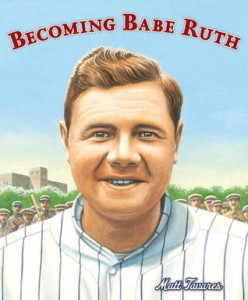
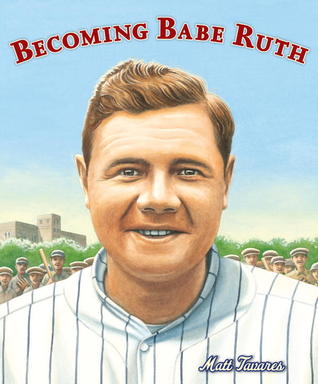
Becoming Babe Ruth
Author: Matt Tavares
Published February 12th, 2013 by Candlewick Press

Goodreads Summary: Matt Tavares’s striking homage to one of baseball’s legends offers a rare view into Babe Ruth’s formative years in “the House that built Ruth.”

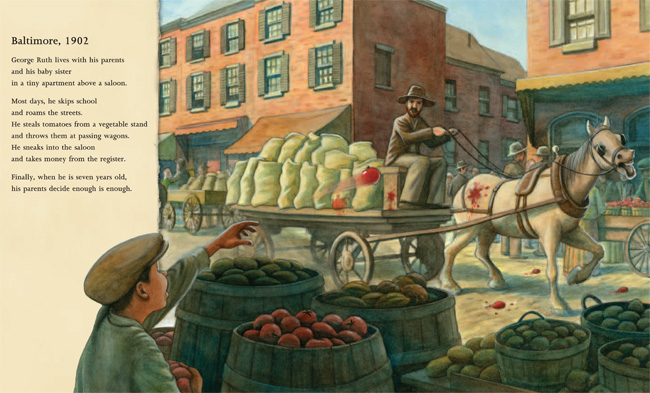
Before he is known as the Babe, George Herman Ruth is just a boy who lives in Baltimore and gets into a lot of trouble. But when he turns seven, his father brings him to the gates of Saint Mary’s Industrial School for Boys, and his life is changed forever. At Saint Mary’s, he’s expected to study hard and follow a lot of rules. But there is one good thing about Saint Mary’s: almost every day, George gets to play baseball. Here, under the watchful eye of Brother Matthias, George evolves as a player and as a man, and when he sets off into the wild world of big-league baseball, the school, the boys, and Brother Matthias are never far from his heart. With vivid illustrations and clear affection for his subject, Matt Tavares sheds light on an icon who learned early that life is what you make of it — and sends home a message about honoring the place from which you came.

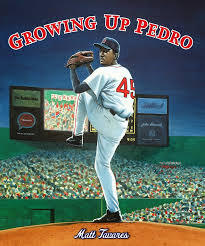
Growing Up Pedro: How the Martinez Brothers Made it From the Dominican Republic All Way to the Major Leagues
Author: Matt Tavares
Published February 10th, 2015

Goodreads Summary: The love between brothers is key to Matt Tavares’s tale of Dominican pitcher Pedro Martinez, from his days of throwing rocks at mangoes to his years as a major-league star.

Before Pedro Martinez pitched the Red Sox to a World Series championship, before he was named to the All-Star team eight times, before he won the Cy Young three times, he was a kid from a place called Manoguayabo in the Dominican Republic. Pedro loved baseball more than anything, and his older brother Ramon was the best pitcher he’d ever seen. He’d dream of the day he and his brother could play together in the major leagues—and here, Matt Tavares tells the story of how that dream came true. In a fitting homage to a modern day baseball star, the acclaimed author-illustrator examines both Pedro Martinez’s improbable rise to the top of his game and the power that comes from the deep bond between brothers.

My Review: These four superbly crafted biographies take a look at the life of each man, but as more than a baseball player. We learn about their childhoods, where they came from, and their dreams and hopes. Each book includes aspects of the history surrounding them including the Depression, wars, and racism. Additionally, these books are crafted beautiful with lyrically written prose. These books are must reads for lovers of baseball, history, and biographies in general.

Teachers’ Tools for Navigation: I was lucky enough to be asked to write a teachers’ guide for each of these books. For each book, I created discussion questions and activities (including cross-curricular activities). I plan on using this guide in my own classroom with the books in a lit circle type of setting. Each group will be given one of the biographies, will complete the discussion questions and activities, and then become experts on their player before presenting. These biographies are asking to be in classrooms, and I hope the guide helps show how they can fit into a language arts/reading class.

Please check out the complete guide at http://www.candlewick.com/book_files/0763668249.btg.1.pdf 

Examples from the guide: 

Becoming Babe Ruth
News spread differently in the early twentieth century. Discuss with your students the way news about Babe Ruth was spread during his lifetime and have students find examples in the text. Then have them discuss the way news is spread digitally nowadays. Invite the class to debate the pros and cons of digital news.; How did Babe Ruth’s life change when he left Saint Mary’s to play for the Orioles?

There Goes Ted Williams
Have students write down Ted Williams’s batting average and home run stats as well as those of two other Hall of Famers. After comparing the players’ stats, have students write a paragraph discussing whether or not they believe that Ted Williams is the best hitter ever.; How did Ted Williams’s childhood perseverance help him become a professional baseball player?

Henry Aaron’s Dream
Baseball began integrating before all cities in the United States had ended segregation. As a class, discuss how this reality affected black players on major-league baseball teams and how black players’ trips to segregated cities differed from those of their white teammates. Then, with your students, complete a graphic organizer comparing and contrasting the life of white and black baseball players during Hank Aaron’s lifetime. Invite students to write an essay about how life has changed for players of color over time.; How did Jackie Robinson influence Henry Aaron? What did Jackie Robinson’s accomplishments mean for other black baseball players? 

Growing Up Pedro
Pull up a map of North America. Have students mark all the different places that Pedro played: the Dominican Republic, Montana, Montreal, and so on. Ask students to determine the miles between each location. Which place was the farthest from Pedro’s home? Which place was the closest?; Have students write a journal entry as Pedro Martínez. Invite them to write, from Pedro’s point of view, what it feels like to move so far away from home when he is so young. Does he miss his family? Is he sad, happy, or excited to be in Montana.

Discussion Questions: Examples of discussion questions and activities for each of the biographies can be found in my teachers’ guide; however, after reading all four of the books, two discussion questions could be: Most of the baseball players had a mentor or idol that he looked up to and learned from. How did these mentors or idols help guide the players into becoming the greats they are?; Each of the baseball players helped a charity that was close to his heart. Who did each player help? Why did players choose the charity they did?

We Flagged: 

Becoming Babe Ruth, byMatt Tavares
http://www.matttavares.com/becomingbaberuth.html from Becoming Babe Ruth

Check out Matt Tavares’s You Tube channel to see sneak peeks into Growing Up Pedro and  There Goes Ted Williams.

Recommended For: 

readaloudbuttonsmall closereadinganalysisbuttonsmall

classroomlibrarybuttonsmall litcirclesbuttonsmall

Signature

Never Fall Down by Patricia McCormick

Share

NFPB2015

Nonfiction Picture Book Wednesday

Nonfiction Picture Book Wednesday is hosted by Kid Lit Frenzy and was started to help promote the reading of nonfiction texts. Most Wednesdays, we will be participating and will review a nonfiction text (though it may not always be a picture book).
Be sure to visit Kid Lit Frenzy and see what other nonfiction books are shared this week!
**This book is technically historical fiction, but I felt it was pretty darn close to nonfiction**

never fall down

Never Fall Down
Author: Patricia McCormick
Published May 8th, 2012 by Balzer + Bray

Goodreads Summary: This National Book Award nominee from two-time finalist Patricia McCormick is the unforgettable story of Arn Chorn-Pond, who defied the odds to survive the Cambodian genocide of 1975-1979 and the labor camps of the Khmer Rouge.

Based on the true story of Cambodian advocate Arn Chorn-Pond, and authentically told from his point of view as a young boy, this is an achingly raw and powerful historical novel about a child of war who becomes a man of peace. It includes an author’s note and acknowledgments from Arn Chorn-Pond himself.

When soldiers arrive in his hometown, Arn is just a normal little boy. But after the soldiers march the entire population into the countryside, his life is changed forever.

Arn is separated from his family and assigned to a labor camp: working in the rice paddies under a blazing sun, he sees the other children dying before his eyes. One day, the soldiers ask if any of the kids can play an instrument. Arn’s never played a note in his life, but he volunteers.

This decision will save his life, but it will pull him into the very center of what we know today as the Killing Fields. And just as the country is about to be liberated, Arn is handed a gun and forced to become a soldier.

My Review: When I started Never Fall Down, I had no idea what I was getting myself into. I began it because Ricki recommended it to me, but I didn’t read the back or have any prior knowledge about the book. So, when I began, I had no idea how tough this book was going to be.

I also have to preface with my ignorance of the Cambodian Genocide. I blame my lack of world history education because this is a time of history that should be taught. It, along with the Holocaust and Armenian Genocide, was based in racism and the attempt to purify a country. Reading Arn’s story throws you right in the middle of the genocide, and Patricia McCormick doesn’t hold anything back. Every time you think nothing can get worse for Arn and the Cambodians, something does, but you also have such hope for Arn’s survival as you seen him overcome every obstacle he faces. Even though death actually stares him in the face throughout the book, this young boy somehow continues. He continues through starvation, excessive work, lack of sleep, and murder surrounding him.  Arn stated in interviews with McCormick that music saved his life, but I think it was more about his willingness to do whatever was needed to survive and especially anything to help those he cared for to survive.

Patricia McCormick tells our story in a broken English dialect that was influenced by “Arn’s own beautiful, improvised English” that McCormick heard in her head after interviewing him and traveling with him to Cambodia over a couple of years.  The extent that Ms. McCormick went to ensure that Arn’s story was a true representation of his trials and heroism is honorable.

Teachers’ Tools For Navigation: This would be a perfect cross-curricular text! It could be read in a world history class in full or in parts. Although it is McCormick’s writing, it is definitely Arn’s story, and Arn’s story is one that needs to be shared. This book could also be used in lit circles where each group has a different book about a piece of history or an individual who/that is not usually learned about (maybe with Between Shades of Gray by Ruta Sepetys, Sold, Caminar by Skila Brown, The Glass Collector by Anna Perera, Son of a Gun by Anne de Graaf, Inside Out & Back Again by Thanhha Lai, Guantanamo Boy by Anna Perera, A Long Walk to Water by Linda Sue Park, The Queen of Water by Laura Resau, or Now is the Time for Running by Michael Williams).

One of my amazing 8th grade students read this book recently, and she was as enthralled with it as I was. Immediately after finishing, she got online and started learning more about Arn and Cambodia. She came across an amazing video with both Patricia McCormick and Arn in it. It is 27 minutes long, but it is so worth watching:

Discussion Questions: What do you think ultimately helped Arn survive?; How did Sombo save Arn’s life at the orphan camp? When the war with the Vietnamese started? At the killing fields?; Do you think music is what saved Arn?; How were the Khmer Rouge able to make their prisoners do whatever they wanted them to?; Why did the Khmer Rouge kill all the educated Cambodians?; Why was Sombo so unsure about the Coca Cola?

We Flagged: “All the time now we hear girl screaming, girl running, girl crying. At night but also sometime in the daytime. All the tie, the Khmer Rouge they chase the girl, cut the hair. Sometime with scissor, sometime with knife. Chop short, to the chin, like boy. The girl, they cry and sometime they run. They run, it’s no good. The Khmer Rouge may shoot them, maybe take them to the bushes, do whatever they want. A lot of the girl afterward, they pull on their hair, pull like maybe they can stretch it, make it long, make it beautiful again.

My number two big sister, Maly, her hair like silk. Most proud thing about her, her hair. Shiny black, like blue, like a crow has. Every night she brush her hair, every morning. Sometime even she brush her hair not thinking, just dreaming maybe about the boy she love. One morning I wake up before everyone and see her making rice. Her neck, it’s bare now, her skin there is pale, never saw the sun, her long hair gone. Last night while I was asleep, the soldier, they cut her beauty. So now when she give me a bowl of rice soup, her eyes stay on the ground.” (p. 29-30)

Read This If You Loved: Titles listed above in Teachers’ Tools for Navigation

Recommended For: 

classroomlibrarybuttonsmall litcirclesbuttonsmall closereadinganalysisbuttonsmall

Signature

Jellaby: The Lost Monster & Jellaby: A Monster in the City by Kean Soo

Share

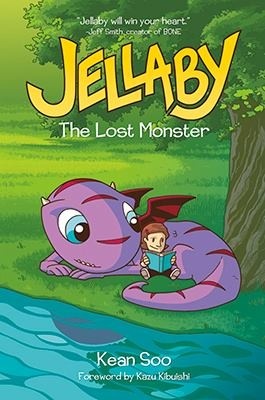
jellaby 1

Jellaby
Author & Illustrator: Kean Soo
Published February, 2008 by Hyperion Books for Children
(Rereleased in 2014 by Stone Arch Books)

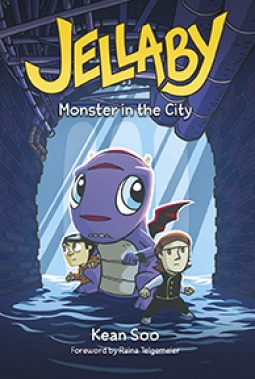
jellaby 2

Jellaby
Author & Illustrator: Kean Soo
Published April, 2009 by Hyperion Books for Children
(Rereleased in 2014 by Stone Arch Books)

Jellaby Goodreads Summary: Quiet, brilliant Portia has just moved to a new neighborhood with her mom. Adjusting to life without a father is hard enough, but school is boring and her classmates are standoffish — and even Portia’s mom is strangely distant. But things start looking up when Portia mounts a late-night excursion into the woods behind her house and discovers a shy, sweet-natured purple monster. Life with Jellaby is a lot more exciting, but Portia’s purple friend has secrets of his own; secrets that may even lead to the mystery of Portia’s father’s disappearance!

Jellaby: Monster in the City Goodreads Summary: As Portia, Jason, and Jellaby continue their journey through the city of Toronto, Portia is torn between her friendship with Jellaby and her duty to help the sweet monster find his way back to his home. How can Portia say goodbye forever, when Jellaby has become her best friend?
But the clues leading them to Jellaby’s origins begin to turn sinister. When a hooded wizard introduces them to another monster like Jellaby, Portia and her purple friend are in for a gruesome shock — this monster befriends children, too — and then she eats them Now Portia must find a home for Jellaby, save Jason from the grasping tentacles of his new “best friend,” and come to terms with the mysterious disappearance of her father. It’s a lot to take on, but Portia is mad, bad, and ready to kick some monster butt.

My Review and Teachers’ Tools for Navigation: I am a big fan of the mostly single color comics (ala Babymouse, Lunch Lady, etc.) and Jellaby is one as well with primarily purple in its illustrations. Also, Kean Soo’s style of illustrations are perfect for the story he is telling. They are very comicy, but realistic and filled with emotions.

This little graphic novel has a lot of heart in it. Portia, Jason (her classmate) and Jellaby all feel abandoned and the story is not only about finding where Jellaby belongs, but also helping Portia and Jason feel like they belong as well.

You will want the second one as soon as you are done, so make sure you have it available! And luckily, this sequel is a continuation of the first Jellaby because that one definitely left you hanging and the story does not disappoint. You see the characters growing so much through this journey even when they encounter obstacles that they shouldn’t be able to overcome. I, personally, didn’t like this one as much as the first one because I wish it had more answers, but I truly loved the ending. I am sad that there is no more Jellaby, but luckily the author has extras on his website!!  I will be buying both for my classroom.

Discussion Questions: Portia doesn’t feel like she fits in at her new school- when was a time that you felt like you didn’t belong? How did you deal with the situation?

We Flagged: “I hope you like Tuna.  I remember mom making me a tuna sandwich for my first day of school.  It was terrible.  My first day of school, I mean, not the sandwich. We had just moved out here, and I didn’t know anyone at all.  Everyone was so strange and they all had their own friends anyway.  I really didn’t want to be there, so I snuck out at lunchtime and ate my sandwich out on the bleachers.  Now whenever I smell tuna, I always think about that first day.” (Jellaby p. 28-29)

Since the snatch doesn’t give you the full picture, below you will find the an interview with Kean Soo to give you an idea of the drawing style:

Read This If You Loved: Bone (series) by Jeff Smith, Zita and the Spacegirl (series) by Ben Hatke, Sidekicks by Dan Santat

Recommended For: 

classroomlibrarybuttonsmall

Signature

**Thank you Netgalley and Stone Arch Books for providing the e-galleys**

YALSA Morris Finalists’ Blog Hop: The Carnival at Bray by Jessie Ann Foley

Share

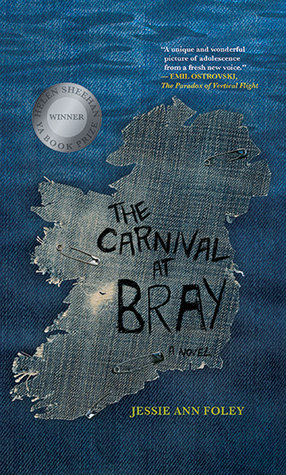
carnival at bray

The Carnival at Bray
Author: Jessie Ann Foley
Published: October 1, 2014 by Elephant Rock Books

Goodreads Summary: It’s 1993, and Generation X pulses to the beat of Kurt Cobain and the grunge movement. Sixteen-year-old Maggie Lynch is uprooted from big-city Chicago to a windswept town on the Irish Sea. Surviving on care packages of Spin magazine and Twizzlers from her rocker uncle Kevin, she wonders if she’ll ever find her place in this new world. When first love and sudden death simultaneously strike, a naive but determined Maggie embarks on a forbidden pilgrimage that will take her to a seedy part of Dublin and on to a life- altering night in Rome to fulfill a dying wish. Through it all, Maggie discovers an untapped inner strength to do the most difficult but rewarding thing of all, live.

The Carnival at Bray is an evocative ode to the Smells Like Teen Spirit Generation and a heartfelt exploration of tragedy, first love, and the transformative power of music. The book won the 2014 Helen Sheehan YA Book Prize.

Ricki’s Review: When I read the back of this book, I thought, “Hmm.” It felt like a (recent) historical fiction with its emphasis on ’90s grunge music and the highlights of Kurt Cobain’s life. Because my teen years spanned through part of the ’90s, I was intrigued.

My favorite aspect of this book was the fact that the writing felt effortless. Too often, books’ messages or prose feel forced, and with this book, I felt as if I was whisked along for the (very bumpy) ride. As a former high school teacher, I enjoyed the myriad, richly realized themes. The reader feels a wild sense of adventure, the uneasiness that comes with living in a new environment, the loyalty that is tied with love, the heartbreak that emerges with loss and grief, and the utter purity that comes with finding oneself. At times, YA texts feature absent (or horrid) parents, but the complexity of Maggie’s mother was realistic to many parents, I believe. This will leave teens (and adults!) pondering their own relationships with their parents. The intricacies of this text will allow for book groups, students, and readers to have much to ponder and discuss.

Teacher’s Tools for Navigation: This would be a great novel to discuss theme. As stated in my review above, there are many themes to ponder. I would put butcher paper around the room and write a different theme on each paper. Students could travel around the room, discussing each theme, placing post-it notes with evidence from the text. Or, the teacher might discuss a different theme on each day. Beyond the classroom setting, I think this would be an excellent selection for book clubs.

Download the comprehensive study guide (from Elephant Rock Books) here.

Discussion Questions: How does Maggie handle the challenges she faces? Do you think she makes the right choices? Is she brave?; What does her uncle teach her? Was he an admirable character?; What role does the setting (both time and place) play in this novel?; Is Maggie’s mother a positive or negative role in her life?

We Flagged: “But don’t you think that never suffering at all—is its own form of suffering?” (p. 150).

I am not sure whether or not I agree with this quote, but weeks later, I am still thinking about it.

Read This If You Loved: Love Letters to the Dead by Ava Dellaira, Timely Persuasion by Jacob LaCivita, Five Flavors of Dumb by Antony John, The Perks of Being a Wallflower by Stephen Chbosky, Time Between Us by Tamara Ireland Stone, The Future of Us by Jay Asher and Carolyn Mackler, Get Happy by Mary Amato

Recommended For:

 litcirclesbuttonsmall classroomlibrarybuttonsmall

Make sure to stop by Cinco Puntos Press blog to see the other stops on the tour!

RickiSig

**A special thank you to Jessica Powers at Cinco Puntos Press for organizing this blog hop and to Elephant Rock Books for providing this book for review!**

YALSA Morris Finalists’ Blog Hop: Gabi, a Girl in Pieces by Isabel Quintero

Share

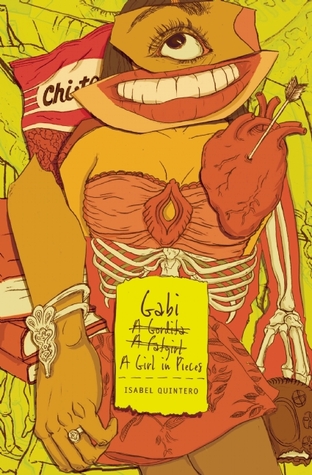
gabit

Gabi, A Girl in Pieces
Author: Isabel Quintero
Published October 14th, 2014 by Cinco Puntos Press

Goodreads Summary: For all the gorditas, flaquitas, and in-between girls trying to make their space in the world. Don’t worry, you got this.

Gabi Hernandez chronicles her last year in high school in her diary: college applications, Cindy’s pregnancy, Sebastian’s coming out, the cute boys, her father’s meth habit, and the food she craves. And best of all, the poetry that helps forge her identity.

Author Bio: Isabel Quintero is a library technician in the Inland Empire. She is also the events coordinator for Orange Monkey and helps edit the poetry journal Tin Cannon. Gabi is her debut novel.

Kellee’s Review: What I found in this book was a book of truth. While I normally find a book that has so many topics in it to be cumbersome (just some of the topics hit were: pregnancy, abortion, meth, family, religion, ethnicity, school, homosexuality, sex, death, poetry, college, rape, and gender expectations), I felt that Gabi was just truthful. Her story was just a story full of real life which just happens to be messy. I enjoyed the unique format, the diversity (not just race/ethnicity, but lbgt, body size, class, ELL, etc.), and the amazing cast of characters. Gabi’s voice rang true throughout, and even got stronger as she became more independent within the story. Well done.

Teacher’s Tools for Navigation: Parts of Gabi’s story could easily be pulled out to be a mentor text for many different literary elements; however, I feel like one of the best ways it could be used is to have students emulate Gabi’s writing. For example, Gabi writes letters to her father sharing how she really feels. Students could write to someone sharing something with them that they are keeping from them. You could also use Gabi’s magazine and poetry the same way. Gabi’s writing is very raw, and I think that students will definitely connect with it.

Discussion Questions: Gabi makes a choice towards the end of the book that makes Cindy be upset with Gabi. Do you agree with what Gabi did?; Gabi’s mother is very protective of her. Why do you think she is so hard on Gabi?; Gabi deals with body issues throughout the book. How do you think our society affects how she pictures herself?; Sebastian and Cindy’s parents are both disappointed in their kids for different reasons and deal differently with their disappointment. Do you agree with how they treat their children?

We Flagged: “My brother is fifteen. He knows many things. He knows how to make a pipe out of an apple, and he knows how to make beautiful murals on public property. He likes wresting and biking and skateboarding but doesn’t like school because school doesn’t understand kids like us. My brother–the brat, the crybaby, the quite one, the brown one, Mami’s favorite: where will he go? I ask myself the question over and over. Y no se. I don’t know where he will go, but I hope wherever it is it’s better than here.” (p. 94)

Read This If You Loved: Yaqui Delgado Wants To Kick Your Ass by Meg Medina, Jumped In by Patrick Flores-Scott, What Can(t) Wait by Ashley Hope Perez, Under the Mesquite by Guadalupe Garcia MacCall, Bridget Jones Diary by Helen Fielding

Recommended For:

 litcirclesbuttonsmall classroomlibrarybuttonsmall

Make sure to stop by Cinco Puntos Press blog to see the other stops on the tour!

Signature

**A special thank you to Jessica Powers at Cinco Puntos Press for organizing this blog hop!**