Review and Giveaway!: Like Bug Juice on a Burger and Like Carrot Juice on a Cupcake by Julie Sternberg

Share

bug juice

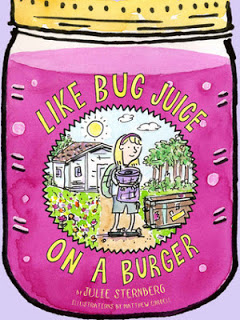
Like Bug Juice on a Burger (Eleanor #2)
Author: Julie Sternberg
Illsutrator: Matthew Cordell
Published April 2nd, 2013 by Amulet Books

Goodreads Summary: I hate camp. I just hate it. I wish I didn’t. But I do. Being here is worse than bug juice on a burger. Or homework on Thanksgiving. Or water seeping into my shoes. In this sequel to the critically acclaimed Like Pickle Juice on a Cookie, Eleanor is off to summer camp. At first she’s excited to carry on the family tradition at Camp Wallumwahpuck, but when she gets there she finds icky bugs, terrible food, and worst of all: swim class, where she just can’t seem to keep up with everyone else. But as the days go on, Eleanor realizes that even the most miserable situations can be full of special surprises and that growing up is full of belly flops. 

Review and Teachers’ Tools for Navigation: This book definitely brought back memories! I loved the idea of summer camp and many of the activities, but I hated the bugs and the food and the changing in front of other people. There are many times when I was away that I just wanted to go home; however, there were things that saved me- specifically, like Eleanor, the animals. I loved working in the barn with the horses and it is what saved me and then got me going back year after year. I remember walking into the barn and being able to be part of these horses’ lives and the scene where Eleanor meets Cornelius the goat brought me right back to that moment. 

This book would be a wonderful read aloud for right before summer because even if students are not going to summer camp, there is probably something new and scary that they will try this summer and this book will definitely cause discussion about how something new may be scary, but that doesn’t mean you won’t like it eventually. Julie Sternberg’s writing also lends itself to some amazing discussions about free verse poetry and, in this one, letter writing. Maybe use the letter writing part of the book to segue into writing a letter to next year’s class. 

Finally, I love the idea of the Wall of Feelings! The Wall of Feelings is where the campers put up how they feel about camp; however, Eleanor is given the job of writing about how she used to feel about camp and then how she feels about camp now. What a great way for students to express themselves! This would be a great formative assessment for looking at how students feel about reading or school or some other topic at the beginning of the year vs. the end. 

Discussion Questions: Think about a time in your life when you did something you were scared to do. How did you overcome your fear/nervousness? How did it turn out in the end?  

We Flagged: “The bus was bumping
down a gravel road
with bushes and trees and weeds all around. 
This isn’t beautiful
I thought. 
This is creepy
I missed sidewalks full of people
checking their phones
and walking their cute dogs. 
I missed paved roads, too, 
filled with taxis and bik riders.” (Chapter 5) 
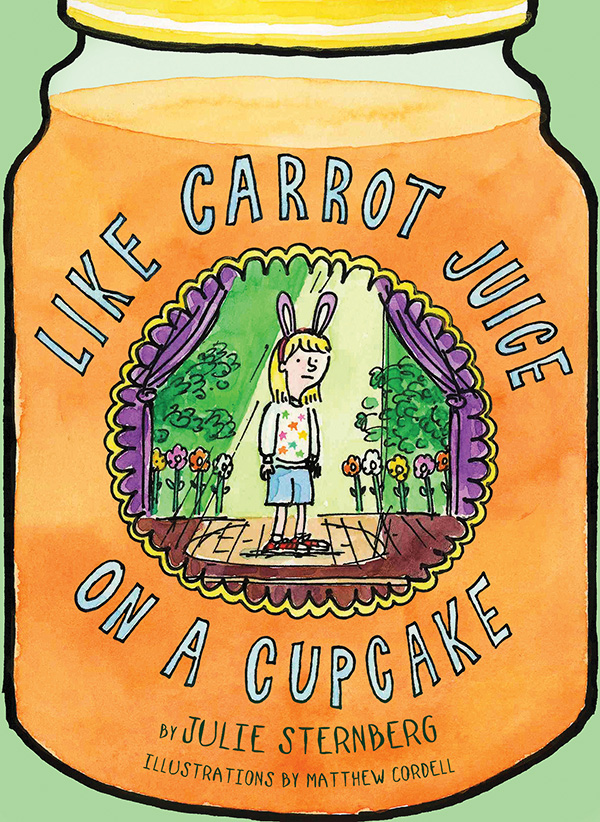
Like Carrot Juice on a Cupcake_cover (1)

Like Carrot Juice on a Cupcake
Author: Julie Sternberg
Illustrator: Matthew Cordell
Published March 18th, 2014 by Amulet Books

Goodreads Summary: I did a mean thing.
A very mean thing.
I HATE that I did it.
But I did.
This is worse than
carrot juice on a cupcake
or a wasp on my pillow
or a dress that’s too tight at the neck.
In the third installment from the team who created Like Pickle Juice on a Cookie and Like Bug Juice on a Burger, Eleanor’s relationship with her best friend, Pearl, experiences its first growing pains. When a glamorous new student transfers to school, at first Eleanor’s excited about the possibility of a new friend. But when Pearl is assigned to be the new girl’s buddy, Eleanor fears she can’t compete. To make matters worse, Eleanor’s been chosen for the lead role in the springtime musical, which means she has to sing a solo in front of the entire school!
From overcoming stage fright to having a secret crush, young readers will relate to Eleanor as she navigates the bittersweet waters of growing up.

Review and Teachers’ Tools for Navigation: This book has multiple levels going on at the same time. There is the story of Eleanor and Pearl’s friendship and their first speed bump. Then there is Eleanor getting the lead in the play, and dealing with the fear of singing a solo. Eleanor dealing with her puppy having trouble getting house trained. And finally, the Eleanor and Nicholas story. But Sternberg balances it all because it is just all part of Eleanor’s life. Julie Sternberg is so great at writing in an elementary student’s voice. It is so authentic and well done!

What I love so much about all of the “Eleanor” books are that they are written in verse, and Eleanor is an amazing poet. I love that it is free verse and includes such beautiful language, but it never comes off as anything but authentic. Teachers could definitely take Eleanor’s writing and use it as a mentor text for students to write about their own experiences.

Discussion Questions: Have you ever hurt a friend’s feelings? What did you do to make it better?; How was Eleanor able to overcome her stage fright?; Why was Eleanor so scare and jealous of Ainsley?; Do you think Eleanor likes Nicholas?


Read These If You Loved: Like Pickle Juice on a Cookie by Julie Sternberg, Marty McGuire and Marty McGuire Digs Worms by Kate Messner, Where I Live by Eileen Spinelli, Go Out and Play! by KaBoom!, Lunch Lady and the Summer Camp Shakedown by Jarrett Kroscozka, Camp Babymouse by Jenni and Matt Holm, Bink and Gollie by Kate DiCamillo, Ramona books by Beverly Cleary

Curriculum Guide for All of the “Eleanor” Books Can be Found Here.

Both Books Recommended For: 

classroomlibrarybuttonsmall closereadinganalysisbuttonsmall readaloudbuttonsmall

GIVEAWAY

a Rafflecopter giveaway

Signature

**Thank you to Barbara at Blue Slip Media for providing copies for review**
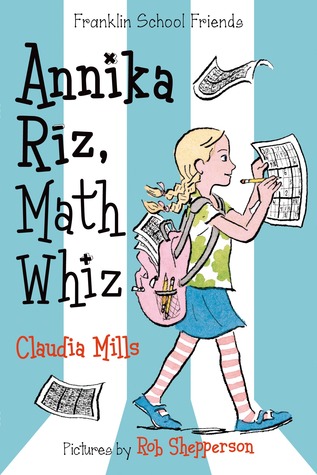
Annika Riz, Math Whiz by Claudia Mills

Share

annika riz math whiz

Annika Riz, Math Whiz (Franklin School Friends series)

Author: Claudia Mills

Pictures by: Rob Shepperson

Published: May 13th, 2014 by Farrar, Strous, and Giroux

Summary: (Grades 2-4) Annika Riz loves math more than anything. She’s trying to teach her dog, Prime, to count. She’s determined to beat fellow math whiz Simon Ellis in a Sudoku contest at the public library. She even sleeps under number-patterned sheets. But Annika’s best friends Kelsey and Izzy think math is boring. All they care about is the upcoming school carnival: their principal is going to be dunked in a dunking tank and their class is going to have a booth selling home-baked cookies. But then disaster foils the friends’ cookie-baking plans. Can math save the day?

Review: Each of the books in the Franklin School Friends series tells the story of a different third-grade student with a passion for a school subject.  I was excited to read Annika Riz’s story because she is a math whiz—and I love math! Annika looks at the world through math-tinted glasses, and she wants everyone to love the subject as much as she does. She even attempts to teach her dog, Prime, how to count. I found the story to be so very charming. Annika is an endearing character who will resonate with many kids (and adults). Her energy and enthusiasm is refreshing. I suspect that readers will appreciate math much more by the end of this book. This series would be a great addition to elementary school classrooms. Series books are a big step in many students’ journey to becoming avid readers. Most adult readers list series books as a major part of their reading identities, so I am a strong advocate of having these texts available to students.

Teacher’s Tools for Navigation: Annika looks at the world through a math mind. Teachers might ask students to pick a school subject and show how that subject is important in many of their everyday activities. This would teach students to apply what they are learning in school to their world.

Check out the downloadable curriculum guide for the Franklin School Friends here!

Discussion Questions: How does Annika approach the sudoku contest? Do you think she does a good job preparing for it?; What role do Annika’s friends play in her life? Because the girls have such varying interests, are you surprised they are friends? Why or why not?; Why do the girls decide to make lemonade? Do you think this was a good choice?; In what ways does Annika use math to examine aspects of her world?

We Flagged: “Kelsey loved reading and Izzy loved running the same way that Annika loved math. But Annika didn’t hate reading and running the same way that the others hated math. It was hard when your two best friends hated the thing in the world that you loved the most” (4).

Read This If You Loved: Clementine by Sara Pennypacker, Judy Moody by Megan McDonald, and Ivy and Bean by Annie Barrows

Recommended For:

litcirclesbuttonsmall classroomlibrarybuttonsmall

Claudia Mills, Philosophy claudia.mills@colorado.edu photo by: Larry Harwood

Claudia Mills is the acclaimed author of fifty early-chapter and middle-grade books, including 7 x 9 = Trouble!, How Oliver Olson Changed the World, and Zero Tolerance. Claudia was a professor of philosophy for over twenty years at the University of Colorado at Boulder, where she received many teaching awards, before leaving the university to write full time. She has two sons. To learn more, visit her website at claudiamillsauthor.com.

RickiSig

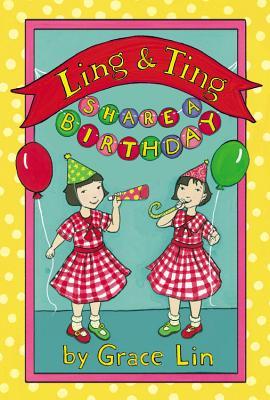
Ling & Ting Share A Birthday by Grace Lin

Share

ling

Ling & Ting Share A Birthday
Author and Illustrator: Grace Lin
Published September 10th, 2013 by Little, Brown Books for Young Readers

Goodreads Summary: Ling & Ting are twins. They share a birthday. They bake cakes, and they make birthday wishes. They tell stories and wrap gifts. They also share a birthday secret!

Have fun with Ling and Ting! They stick together and look alike. But they are not exactly the same.

Review and Teacher’s Tools For Navigation: I am not an expert on early chapter books, but I am trying to read more than I did in the past. What I have noticed is that most early readers have short compelling stories or chapters with interesting characters and often teach a lesson or would make the reader thing. Ling & Ting is no different and is an excellent addition to the early readers I’ve read. Ling & Ting are twins, but are very different people. It is a great opportunity to discuss identity and personality. Also, each chapter of Ling & Ting’s story put them in different situations and are all opportunities to discuss these situations. Finally, Grace Lin gives teachers/students/readers many opportunities to discuss character traits and compare/contrast the two twins.

Discussion Questions: How are Ling & Ting different? The same?; When Ling & Ting didn’t know what to buy for the other twin, what did they do? Do you agree with what they did?

We Flagged: “Ling reads the cookbook very carefully. She mixes butter, sugar, eggs, and flour. Ting does not read the cookbook carefully. She mixes butter, sugar, and eggs. Ling and Ting put their cake in the oven. They watch them bake. Ling’s cake bakes golden. Ting’s cake does not.” (p. 17-19)

Read This If You Loved: Penny series by Kevin Henkes, Elephant and Piggie series by Mo Willems, Sadie and Ratz by Sonya Hartnett

Recommended For: 

readaloudbuttonsmall

Signature

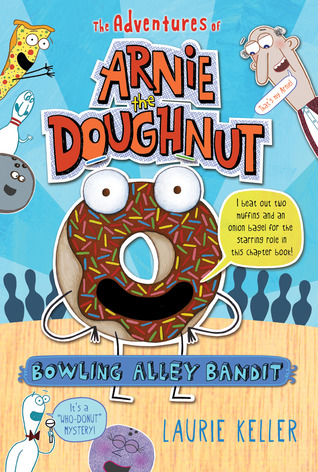
The Adventures of Arnie the Doughnut: Bowling Alley Bandit by Laurie Keller

Share

arnie

Bowling Alley Bandit
Author and Illustrator: Laurie Keller
Published June 4th, 2013 by Henry Holt and Co.

Goodreads Summary: As Mr. Bing’s new pet “doughnut dog,” Arnie couldn’t be happier. When Mr. Bing joins a bowling league, Arnie gets to go along to practices and competitions. But then Mr. Bing starts rolling gutter balls. Someone or something is behind the madness. Arnie, together with his team of goofball friends, must sort through the shenanigans and solve the mystery. Get ready for some sleuthing and even some magic.

Full of Laurie Keller’s winning charm and silly humor, this chapter book—the first in the series—is sure to please her many fans.

My Review and Teacher’s Tools For Navigation: This book is going to be loved by kids. It is hilarious and is one rung below Big Nate on the humor, illustrated novel ladder. It is a great book to help readers get from early readers to middle grade illustrated novels. In the classroom, it would be a great book to use to practice prediction as the reader is given clues throughout the book to figure out who the bowling alley bandit is. Also, as a teacher, I personally loved all of the wit, puns, and funny similes in the book! These would be great to read with kids.

Discussion Questions: What other doughnut songs could Arnie sing at karaoke? Think of famous songs and tweak their title or lyrics to make them about doughnuts.

We Flagged: “But of all the great things about the bowling alley, my favorite is that there’s a restaurant inside called the Bowl-o’-Chow and they have a KARAOKE MACHINE! I usually watch Mr. Bing bowl for a while, and then I wander over to the Bowl-o’-Chow to sing a few songs. I was scared to try it at first, but now I’m a regular.

Here are a few of my old standbys:
Living’ la vi-DOUGH loca!
You ain’t nothin’ but a DOUGHNUT-DOG cryin’ all the time.
Fried in the U.S.A.!

And I always end with my signature song:
DOUGHNUT make my brown eyes blue.”

Book Trailer: 

Read This If You Loved: Big Nate series by Lincoln Peirce, Captain Underpants series by Dav Pilkey, Frankie Pickle series by Eric Wight

Recommended For: 

classroomlibrarybuttonsmall readaloudbuttonsmall

Signature

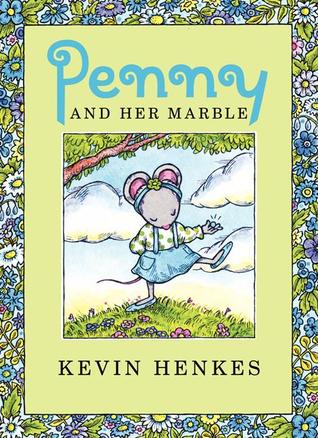
Penny and Her Marble by Kevin Henkes

Share

penny

Penny and her Marble
Author and Illustrator: Kevin Henkes
Published February 19th, 2013 by GreenwillowBooks

Goodreads Summary: In the third easy-to-read book about Penny the mouse, written by Caldecott Medalist and bestselling author Kevin Henkes, Penny finds a beautiful marble on her neighbor’s lawn and must decide whether or not to keep it. With age-appropriate vocabulary, compelling characters, and a memorable storyline, this is just right for newly independent readers.

Kevin Henkes is known for his mouse characters, including Lilly, Owen, Chrysanthemum, Wemberly, and now Penny! In Penny and her Marble, the third book in the Penny series, Penny finds a marble on Mrs. Goodwin’s yard and takes it home. But does the marble really belong to Penny? Kevin Henkes is a master at creating beautifully illustrated books that resonate with young children. The Penny books are new classics for beginning readers and will appeal to fans of Frog and Toad, Little Bear, and Henry and Mudge.

Review and Teacher’s Tools for Navigation: I am a huge fan of Kevin Henkes. I really enjoy everything he writes—he is so talented! His work ranges from picture books to early readers to chapter books to middle grade novels and all that I’ve read, I’ve enjoyed, and Penny and Her Marble was no different. Like the Goodreads summary says, Penny’s story is perfect for our early readers. Her story is one that children will connect with; however, Henkes never talks down to his readers. What struck me was the beautiful language that he used throughout–to describe Penny’s feelings, the marble, the day, etc.

Discussion Questions: If you were Penny, would you have kept the marble?; Is there anything you’ve taken without asking? What did you do?; Like Kevin Henkes does, look at different marbles and use similes to describe them.

We Flagged: “The marble was so blue it looked like a piece of the sky. Penny went to the window and held up the marble. She was right. The marble was like a piece of the sky.” (p. 16-17)

Read This If You Loved: Other Kevin Henkes books, Frog and Toad by Arnold Lobel, Little Bear by Else Holmelund Minarik, Scaredy Squirrel by Melanie Watt

Recommended For: 

readaloudbuttonsmall classroomlibrarybuttonsmall

Signature

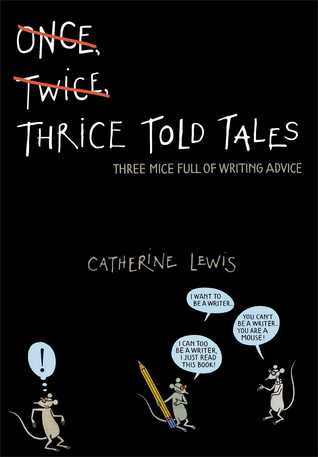
Thrice Told Tales: Three Mice Full of Writing Advice by Catherine Lewis

Share

Thrice Told Tales

Thrice Told Tales: Three Mice Full of Writing Advice
Author: Catherine Lewis
Published: August 27th, 2013 by Atheneum Books for Young Readers

GoodReads Summary: Three Blind Mice. Three Blind Mice. See how they run? No. See how they can make all sorts of useful literary elements colorful and easy to understand! Can one nursery rhyme explain the secrets of the universe? Well, not exactly—but it can help you understand the difference between bildungsroman, epigram, and epistolary.

From the absurd to the wish-I’d-thought-of-that clever, writing professor Catherine Lewis blends Mother Goose with Edward Gorey and Queneau, and the result is learning a whole lot more about three not so helplessmice, and how to fine tune your own writing, bildungsroman and all.

If your writing is your air, this is your laughing gas.*

*That’s a metaphor, friends.

Review: This is one of those books that is so clever, I am depressed that I didn’t come up with the idea myself. Reading and writing teachers will adore the way this book is constructed and be excited to use it in their classrooms. A different writing term is creatively interpreted on each page within the context of the Three Blind Mice nursery rhyme. At the bottom of each page, Lewis gives an explanation of the writing term and how it can be employed in writing (see the flagged passage below). I loved the ways Lewis humorously portrayed each term. For example, on the page about style, she takes a line from the nursery rhyme and rewrites it in the style of famous authors like Dickens and Hemingway. As a bonus, I learned about a few literary terms that I didn’t know! It was so fun to read. I shared it with my pre-service teachers, and they also adored it and were excited to use it in their own classrooms.

Teacher’s Tools for Navigation: Teachers can hand-pick terms they want to teach to their students. I wish this book was published when I was teaching because it makes the literary terms very accessible. Teachers can take the terms and ask students to reinterpret them within the context of a different nursery rhyme (or even within the context of a song or movie).

Discussion Questions: How can I rewrite a nursery rhyme to show a literary term?; How can I employ these literary/writing terms to make me a better writer?

We Flagged: “Developing one’s style is like developing a sense of fashion. You may start off by trying on a lot of costume jewelry; big showy ten-dollar words. They’ll get attention all right, but maybe you’ll discover there’s something better out there for you. Perhaps you’ll try a charm bracelet full of dangling modifiers. Or a simple silver bracelet and an onyx ring. Keep experimenting for pleasant combinations, and a truer picture of yourself and your work will begin to emerge” (p. 134).

Read This If You Loved: In the Middle by Nancie Atwell, Bird by Bird by Anne Lamott, Writing Workshop by Ralph Fletcher, Celebrating Writers by Ruth Ayres with Christi Overman

Recommended for:

readaloudbuttonsmall closereadinganalysisbuttonsmall classroomlibrarybuttonsmall

026F3FBCC8C3913BD3A4D3F6920340D5

What is your favorite book for teaching writing? Can you think of creative ways to use this in the classroom?


The Chatswood Spooks #1 & #2 by Notti Thistledore

Share

Halloween

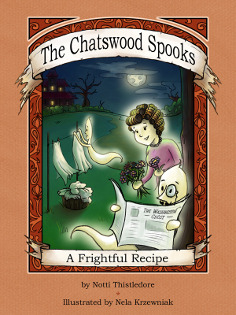
chatswood1 chatswood2

The Chatswood Spooks
Author: Notti Thistledore
Illustrator: Nela Krzewniak
A Frightful Recipe published January 15th, 2013 by CreateSpace Independent Publishing
Sheets and Ladders published February 17th, 2013 by Crooked Chimney Books

Goodreads Summary (A Frightful Recipe): The Chatswood Spooks are in trouble. If they don’t improve their scare tactics they’ll have to find somewhere else to haunt. But the spooks have lived their entire afterlives at the Chatswood Manor, and are determined to show just how scary they can be.

Unfortunately, they haven’t counted on having to scare Ivan the Fearless…

The Chatswood Spooks: A Frightful Recipe is the first in the Chatswood Spooks series. Each story is illustrated with detailed line drawings and is bursting with silliness.

Goodreads Summary (Sheets and Ladders): With his sheets, chains and pet spider, Jingo likes to look the part of the classic ghost. So when someone puts their red knickers in with Jingo’s favourite white haunting sheets, Jingo is devastated.

Feeling hurt and unloved, he decides to run away to join the local Carnival. But what Jingo has in spooking skills he lacks in street smarts, and he soon finds himself in trouble…

My Review: A cute (non)scary ghost story early chapter book that features 3 very different ghost personalities. I loved the vocabulary throughout this book that was not overwhelming yet showed that the author was obviously not writing down to her readers. She also had allusions to fairy tales, word play, and onomatopoeias making the narrative more interesting. I also found the author’s humor really rang throughout.

Teacher’s Tools for Navigation: I could definitely see these books being used as a read aloud in a classroom as well as a great mentor text to introduce narrative elements since it has a perfect plot arc, conflict, and interesting characters as well as an introduction into figurative and descriptive language and allusions.

Discussion Questions: Book 1: What do you think the ghosts are going to do to be scarier?; Book 2: Do you think Jingo did the right thing by running away?

We Flagged: “On Tuesday evening Toby, the caretaker of Chatswood Manor, called a meeting. All three Chatswood Manor ghosts were there, as well as two crows and a stone gargoyle.
“That gargoyle is worse than Hansel and Gretel,” muttered Winifred as she swept a trail of rocks from the carpet.
“Ahem!” Toby adjusted his half-moon spectacles and consulted a sheet of paper with a squiggly graph on it. Now, listen up, spooks. You’re here because my research shows that you’re all lazy to the bone!”” (Book #1, Location 5)

“Hauling his battered suitcase along behind him, Jingo wandered out onto Bridges Road. All the way he kept telling himself that the Chatswood ghosts were very disrespectful and didn’t deserve to work with him.” (Book #2, Location 34)

“The moon was starting to drag across the sky when the Ghost Bus appeared. Jingo stuck out his thumb to flad it down. The Ghost Bus was the sort of old-fashioned car that had to be started with a hand crank, and its headlights could only be turned on with a switch near the grille.”(Book #2, Location 40)

Read This If You Loved: Scaredy Squirrel Prepares for Halloween by Melanie Watts, The Witches by Roald Dahl, Ivy Bean and the Ghost that had to Go by Annie Barrows

Recommended For: 

classroomlibrarybuttonsmall readaloudbuttonsmall

Signature

**Thank you to Notti Thistledore for supplying copies of these books for review**