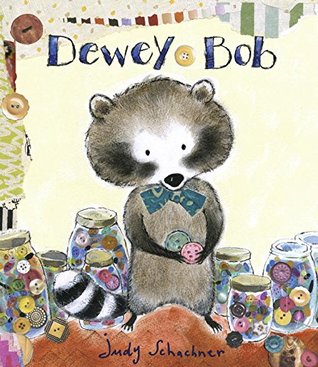
Dewey Bob by Judy Schachner

Share

dewey bob

Dewey Bob
Author and Illustrator: Judy Schachner
Published September 8th, 2015 by Dial Books

Summary: Dewey Bob Crockett is a durn cute raccoon who lives by himself in a house filled to the brim with the wonderful objects he collects. Buttons, wheels, furniture and bricabrac adorn his cozy quarters and keep him busy as he finds and fixes, turning trash into treasures. But there’s something missing from Dewey’s collections—a friend! He tries gathering up some critters and bringing them home in his shopping cart, but that doesn’t work out so well. In the end, a friend does come Dewey’s way, and, with a little DIY help from this clever raccoon, returns again and again.

Combining art and heart with storytelling genius and a lilting twang, Judy Schachner’s tale of unexpected friendship will delight readers young and old.

Author Judy Schachner Introduces Dewey Bob: 

My Review: Dewey is a little different than the other raccoons, so he finds himself in a beautiful home with a lot of things but no friends or family. Although Dewey is a bit untraditional, he finds himself a friend who will warm your heart!

Judy Schachner has a way with story telling. She brings her character’s voice to life, this time with a little bit of twang and rhyming. By being able to hear the character’s voice, the book is more engaging because you connect with the character more. Additionally, her illustrations in Dewey Bob are brilliant. They are a mixture of her what I believe is pencil and watercolor illustrations with found object collage. It is perfect for Dewey’s story.

Teachers’ Tools for Navigation: Dewey Bob gives many opportunities for discussion while reading aloud. You can discuss the difference between Dewey and the other raccoons, how the book is structured, Dewey’s rhyming and accent, Dewey’s friend, and even the illustrations. Each page really has opportunities for you to talk to your students about what is happening. This book is going to be a favorite read aloud for many.

Discussion Questions: How is Dewey Bob different than the other raccoons?; How does the author choose what goes in speech bubbles and what was in her prose?; How does the collage illustration help with the experience of reading Dewey Bob?

We Flagged: “‘No pants for me! No pants for me! Cuz’ I’m gonna live in a big oak tree,’ he sang, looking straight up at his future home.

The place was empty as a hatched egg…and filthy, too! But a little dirt didn’t scare Dewey. ‘I’m a mean, clean, washin’ machine!” said the li’l raccoon as he scrubbed the place spotless. Then he took a long soak in the tub with some of his favorite buttons.”

Read This If You Loved: This is a Moose by Richard T. Morris, The Snatchabook by Helen Docherty, Odd Duck by Cecil Castellucci, Skippyjon Jones by Judy Schachner

Recommended For: 

readaloudbuttonsmall classroomlibrarybuttonsmall

Kellee Signature

**Thank you to Lauri at Dial Books for providing a copy for review!!**

Blog Tour, Review, and Giveaway!: The Not Very Merry Pout-Pout Fish by Deborah Diesen and Illustrated by Dan Hanna

Share

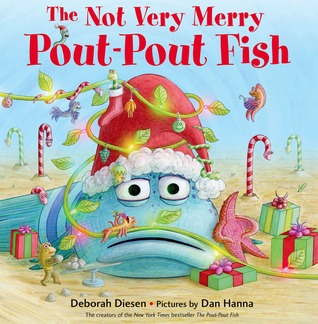
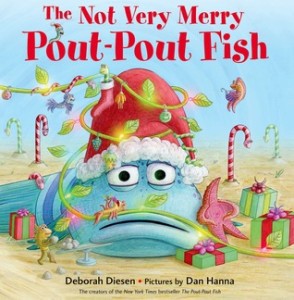
The Not Very Merry Pout-Pout Fish

The Not Very Merry Pout-Pout Fish
Author: Deborah Diesen; Illustrator: Dan Hanna
Published: September 8, 2015 byFarrar, Straus and Giroux (BYR)

Summary: Holiday sequel to The New York Times bestselling Pout-Pout Fish series reminds young readers what being merry is all about

The grumpiest fish in children’s literature is back with another case of “the dreary wearies.” This time, Mr. Fish, star ofThe New York Times bestselling Pout-Pout Fish series, is down in the dumps over holiday shopping. With a message for readers of all ages, The Not Very Merry Pout-Pout Fish (Farrar, Straus, & Giroux Books | Macmillan Children’s Publishing Group, Ages 2-6) finds Mr. Fish so consumed with finding that perfect gift for each of his friends that he forgets the true meaning of the holidays.

When Mr. Fish—with his signature Pout-Pout Fish frown—comes up empty-handed, Miss Shimmer intervenes with a plan to make homemade gifts. He soon learns that it’s not about busting the budget or gifting the season’s hottest item, but giving from the heart. Together they experience the joy that comes from giving and sharing—the merriest gifts of all.

Ricki’s Review: Ever since I received this book, my toddler has demanded I read it to him multiple times a day. The story has a wonderful moral that is very important for the gift-giving season. As a mom, I work really hard to try to show my son that material items should not be significant. Not only does this book teach lessons related to this topic, but it prizes friendship. I suspect we will be reading this book again and again in years to come because the need for this lesson will recur as he grows older. He loves the complexity of the illustrations. There is so much to look at on each page!

Teachers’ Tools for Navigation: This book offers opportunities for students to create their own homemade gifts for friends, family, or those in need. It will inspire students to want to create something that will be greatly appreciated by another person.

Discussion Questions: How might you show your love to a family member or friend without buying anything? Do you think they would appreciate it more or less? Why?; How does pout-pout fish learn the value of gift-giving? What do his friends think about his gifts?

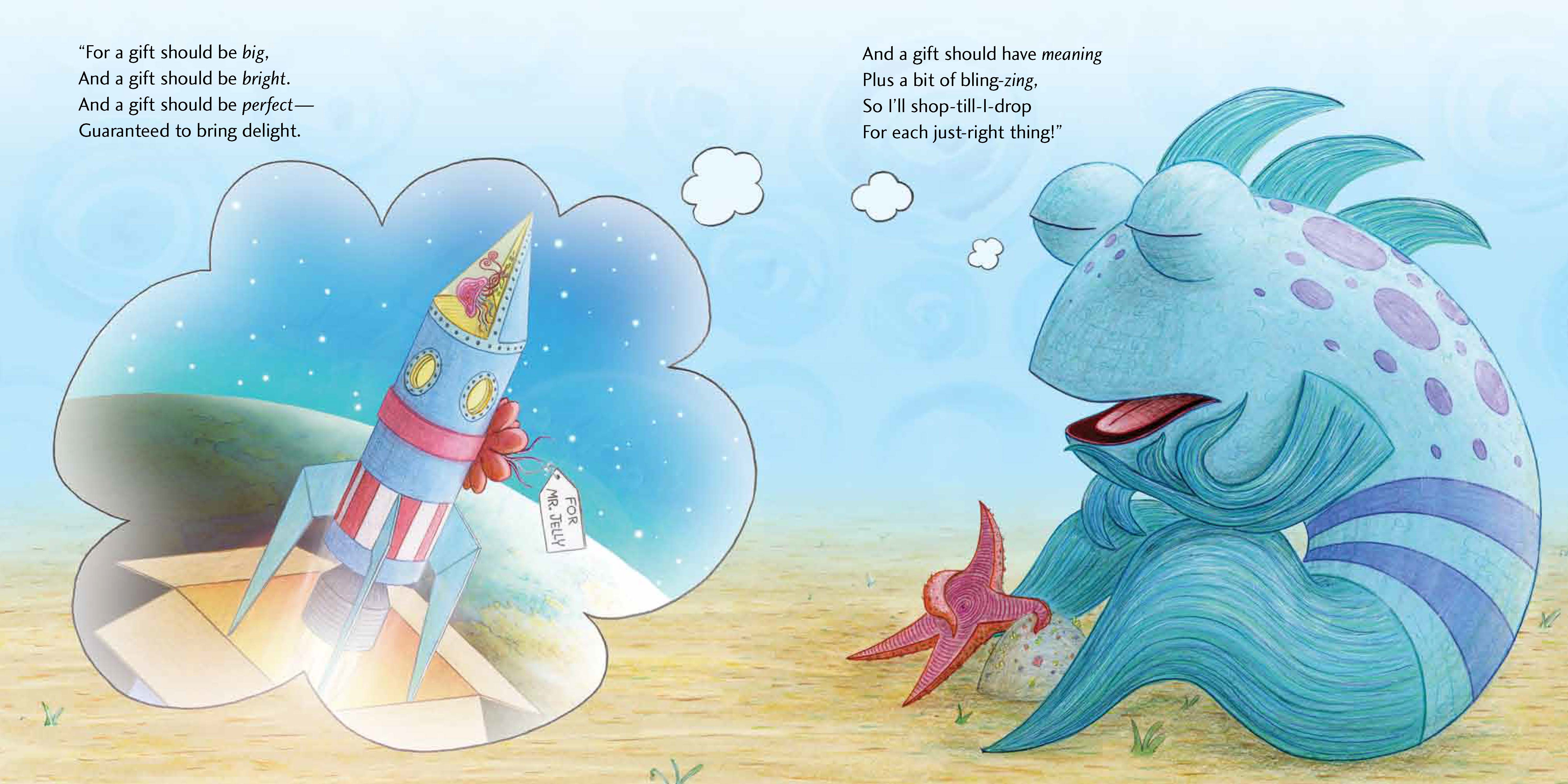
We Flagged:
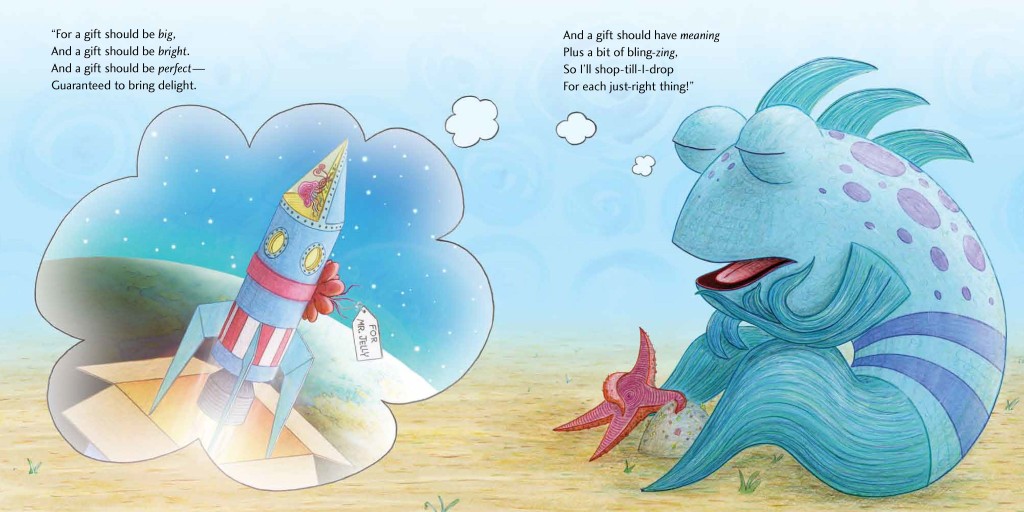
Pout Pout 2 (1)

Read This If You Loved: The Pout-Pout Fish by Deborah Diesen; The Giving Tree by Shel Silverstein; Books about Giving and Generosity; Books about Christmas

Giveaway!

a Rafflecopter giveaway

Recommended For: 

 readaloudbuttonsmall classroomlibrarybuttonsmall

Q&A with Author Deborah Diesen

How did you come up with the original Pout-Pout fish book in 2008?

The story grew out of an actual pout! One day many, many years ago, when my elder son was a preschooler, he was having a very grouchy afternoon. Hoping to amuse him, I made an exaggerated pouty face at him. He smiled and then pouted right back, which got us both laughing. “We look like fish,” I said. “Like pout-pout fish!” As soon as I said that out loud, it became a story idea. I jotted the idea down and I started writing The Pout-Pout Fish that same day. Years later, I started sending the story to publishers, and in 2005 it was accepted at Farrar, Straus & Giroux Books for Young Readers. The book was published in 2008 and began a series of stories, all featuring Mr. Fish, his friends, and their adventures.

Since the first book, we’ve seen Mr. Fish go to school, learn to smile, face the dark, discover how to dream and play hide-and-seek. What do kids (and their parents) love most about the series?

I think one of the things that makes Mr. Fish an appealing character for many kids and parents is that kids and parents alike can identify with his experiences. Toddlers sometimes pout; so do adults! Preschoolers have things they’re scared of; so do adults! Kindergarteners get nervous about starting something new; so do adults! Mr. Fish’s experiences provide a way for kids and grown-ups to explore those issues together. In addition, the stories have rhyme, repetition, and wordplay, which are fun in a read-aloud book. And Dan Hanna’s illustrations! They’re fantastic. They truly bring the stories to life.

What is Mr. Fish up to now? Does he have a case of the “dreary wearies” in the latest book, too?

Mr. Fish’s newest adventure is called The Not Very Merry Pout-Pout Fish. In it, Mr. Fish is in a bit of a holiday panic, searching for perfect gifts for all of his friends. His shopping trip is unsuccessful, and Mr. Fish is sure that he’s let all of his friends down. But his friend Miss Shimmer reminds him that the best gifts of all come straight from the heart, and she helps him craft simple and meaningful presents to bring to the holiday party. His friends are delighted with their presents, and together everyone celebrates peace, joy, and love – what a very merry gift!

What do you hope young readers (ages 3-6) will learn from The Not Very Merry Pout-Pout Fish? Is there a message here for grown-ups as well?

I hope that Mr. Fish’s latest tale will help children to realize that presents don’t need to be expensive or complicated or splashy. Simple, heartfelt presents that connect us to one another are the best gifts of all. A drawing; a craft project; time spent together; even just a smile! These sorts of gifts are the most cherished and the most enduring. It’s a lesson we grown-ups have to re-learn periodically as well.

Do you have any tips for parents of toddlers about the joy of giving presents, rather than just receiving them, this holiday season?

Kids love to give presents, and they especially love having an active role in the process of creating the presents. Try a craft idea or project that’s extremely simple and stress-free, and then let your child have at it with a minimum of help. The more messy, lopsided, and imperfect the results the better! Have fun with the process, and as you do you’ll create not just gifts but memories as well.

How do you and the illustrator, Dan Hanna, work together on the books? (Are there any special stories about the illustrations on Not-Very-Merry that you can share?)

I absolutely adore Dan’s art, and I credit it as the reason for the success of the series. We work independently of one another during the creation of the books. I work with our editor on the stories; then, when a story is finished and ready, she passes it along to Dan. Dan moves through the art creation process, from sketches to finished product, working with our editor and with the art director. I do see some of the steps along the way, but during the illustration process the author’s most important task is to stay out of the way! And that’s for the best, because it allows the artist to bring the story to life in the way only an artist can. Dan brings a thousand times more to the illustrations than I could ever begin to imagine – the characters and their expressions; the settings and their details; and all the funny and quirky extras. For instance, in The Not Very Merry Pout-Pout Fish, one of the spreads shows a store full of what I describe in the text as shiny trinkets and handy gadgets. Dan took that description and brought it alive by imagining, drawing, and labeling shelf after shelf in the gift shop with hilarious and unique sea gifts. His creativity is amazing. I feel very grateful and happy to get to make books with Dan!

Any future plans for Mr. Fish? What adventures can we expect to see him in next?

Mr. Fish has a new mini-adventure coming out later this year called Kiss-Kiss, Pout-Pout Fish. This mini-adventure, like the previous mini-adventures Smile, Pout-Pout Fish and Sweet Dreams, Pout-Pout Fish, is a very short board book with just a few words per page, meant for babies and young toddlers. In spring 2016, there will be a touch-and-feel alphabet book and a sticker book. Another mini-adventure, called Trick or Treat, Pout-Pout Fish, will arrive later in 2016. And in 2017, Mr. Fish will be in a new full-length hardcover called The Pout-Pout Fish, Far, Far From Home. He stays pretty busy these days! But he’s enjoying all of his adventures.

As am I!

Q&A with Illustrator Dan Hanna

How long have you been illustrating the Pout-Pout Fish books? What inspired your depiction of the main character, Mr. Fish?

I started illustrating the first book in early 2007 and so it’s been about 8 or 9 years now.

About 15 years ago I was scuba diving in Fiji.  There was a huge rusting hulk of a shipwreck about 80 feet down.  At the end of a pole extending above the deck was a small metal basket.  Resting in that basket was a pudgy fish about the size of my fist.  I swam up and looked right into his eyes and he looked right back with a deep, gloomy frown.  Years later, when I received the manuscript for The Pout-Pout Fish, that memory bubbled up.  I realized, at that moment, that Mr. Fish was an actual fish, living on the other side of the world, 80 feet down on a shipwreck.

When there’s a new Pout-Pout story to illustrate, how do you collaborate with author Deborah Diesen?

It may seem odd but I don’t communicate with Debbie regarding the illustrations.  I work with are the Editor (Janine O’Malley) and Art Director (Roberta Pressel).  When I initially receive a manuscript I’m given complete freedom to break it down into pages and to illustrate it however I think best.  After I complete the first dummy (a mock-up of the book) I send it to Janine and Roberta.  That begins a long series of feedback and changes until we get to a version that we’re all happy with.  At that point I begin the final art that will eventually be delivered to make the book.

What has been your favorite Pout-Pout book to illustrate? Why?

The first book!  Nothing can compare to getting your first book published.  Its success paved the way for all the others.  The original book was the first for both Debbie and me and that made it extra special.  Usually a publisher will team up a first timer with someone who has experience.  Fortunately, FSG took a chance on two rookies.

What medium do you use to make the illustrations? What’s your favorite to work with? Tell us about your creative process.

I use the PPPPP approach: Paper, Pencils, Pens, Paint and Photoshop.

My favorite is just pencil and paper.  When I start a new book I like to visit a variety of coffee shops in my area.  I let my caffeinated mind roam, scribbling out ideas and laughing to myself.  If a sketch doesn’t make me laugh then it usually doesn’t make the cut.

What illustration in The Not Very Merry Pout-Pout Fish did you have the most fun creating?

I especially like the one where Mr. Fish imagines giving Ms. Clam the robot body.  She just looks so happy and empowered.

The items in the shop and the gifts Mr. Fish imagines in this story are so detailed and quirky. How did you come up with them? Did you have a specific inspiration?

For the imagined gifts, I drew on my own experience as a kid where I would dream up magnificent presents for my family and friends.  Eventually, as with Mr. Fish, I would have to confront reality and drastically scale back my plans.

The shop items are based on all the goofy stuff you can find on the shelves of some of the more interesting gift shops.

Of all the items that the Pout-Pout fish dreams up (robot, spaceship, submarine etc.), which one would you love to get this Christmas?

The Submarine!  When I was a kid there was an ad in the back of a comic book for a submarine.  The ad went something like this:

“Delux Submarine!  Life Size!  Torpedo Tubes!  Absolutely NO Cardboard Parts!  Only $10!!

I saved up the money and sent away for it.   As I waited for it to be delivered my dreams were filled with visions of underwater adventure.  Eventually it arrived and sank my dreams into the abyss.  It was just a cardboard box with torpedo tubes made from toilet roll tubes.  It was even more depressing than the Sea Monkeys and X-Ray Glasses.

What do you think was your most valuable childhood experience?

Being bored.  I firmly believe that having enough free time to sit around and be bored is very important for the development of a healthy imagination.

What kinds of things inspire you to work?

I’m primarily motivated by death.  When I contemplate my eventual demise it scares me into action.  Although what really gets me going — is death and a cup of coffee.

What do you want the students to get out of your school visits?

That being a writer or illustrator is like being a wizard.  Your magic wand is a pencil.  Your potions are words and scribbles.  And the spells you cast will be the stories you write and the pictures you draw.  So pick up a pencil and make some magic happen!

Do you enjoy researching or do you prefer working totally from your imagination?

Initially I let my imagination run wild.  Then I knock it out with a tranquilizer dart while I do some research.  Finally, my groggy imagination re-awakes, snarls angrily and then runs wild again.  I’ve found that this approach works best for me.

Do you have any advice for aspiring picture book illustrators?

Buy one thousand parrots and place them in a room with a looped recording saying something like: “Dan Hanna can sure draw fish!” Then release the parrots, using a helicopter, over each of the major publishing houses. When the editors leave for lunch they’ll hear the parrots in the trees screeching “Aaaaccck, Dan Hanna can sure draw fish!” Now I know this scheme seems rather elaborate, but it worked for me.

How did it feel to have your first book (and author Deborah Diesen’s first book) become so successful?

It feels like a hot air balloon ride.  But not like one of those rides where the basket catches on fire or the balloon hits a power line or something.

What do you think will be the ultimate fate of your work?

Five billion years from now, when our sun has blown up and the Earth is a smoldering chunk of charcoal, humanity will hopefully have escaped to another planet.  Perhaps, packed away in one of the zillions of moving boxes will be an old, dusty copy of “The Pout-Pout Fish”.  Maybe then, some remnant of my wandering soul will smile as a genetically enhanced child stumbles across it and cracks open its ancient spine.

www.BlueBellyLizard.com

www.DanHanna.com

 RickiSig

**Thank you to Alessandra for providing a copy for review!**

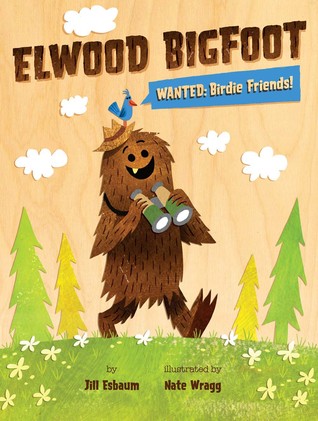
Elwood Bigfoot: Wanted: Birdie Friends! by Jill Esbaum

Share

9781454908791_cvr_1P.indd

Elwood Bigfoot: Wanted: Birdie Friends!
Author: Jill Esbaum
Illustrator: Nate Wragg
Published September 1st, 2015 by Sterling Children’s Books

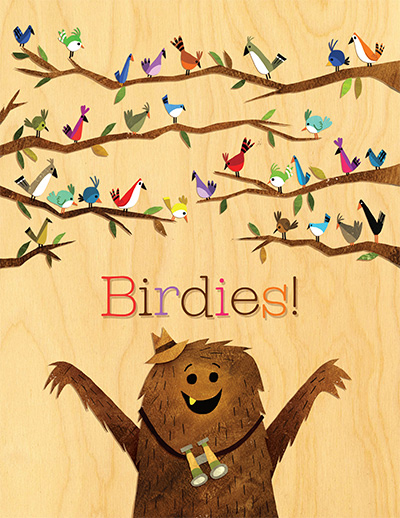
Goodreads Summary: Elwood Bigfoot is big, clumsy, LOUD . . . and lonely. It’s hard for him to make friends—especially with the tiny, delicate birdies he loves so much. Each flash of their feathers, each chirp and cheerful song helps him feel less alone. But whenever a birdie swoops by, and Elwood hollers at it to STAY, the scared creature flies away. He tries everything: sitting on a branch, having a housewarming party, even building an amusement park with snacks and pools. But nothing helps—until Elwood finally learns how to make his bird dreams come true.

Kellee’s Review and Teachers’ Tools for Navigation: Elwood Bigfoot is such an sweet character. Throughout I just wanted to jump into the book and give him a hug. He doesn’t deserve to be alone, but he has to figure out how to make friends in the situation he is in. Elwood’s story would be a great way to introduce character traits as well as how a plot propelled a change in a character. Although Elwood does stay true to himself in the end, he does change throughout. Additionally, the book does have different birds throughout, and it would be fun to learn more about the different types.  

Ricki’s Review and Teachers’ Tools for Navigation: When my son and I read this book, we were both smiling at the wonderful illustrations. I think every person can find a piece of themselves in this character. We all approach situations where we are nervous, lonely, or uncomfortable. This would be a great book to ask students to make personal connections to the story. Then, teachers could host discussions about empathy and use the text as a way to teach metaphor. Elwood Bigfoot is a charming character that will stick with me. I can see him being very popular in classrooms!

Discussion Questions: What character traits did Elwood have at the beginning of the book? What did he have to change to help him get birdie friends?; What clues did the birds give Elwood to show him what scared them about him?; What are the different birdies that you saw throughout the book?

We Flagged: “Elwood loved birdies. Each flash of feather, each chirp and cheerful song helped him feel less alone. Whenever a birdie swooped by, Elwood hollered, “COME BACK, BIRDIE! BE MY FRIEND!” But no birdie every came back.”

elwood bigfoot illustration
From http://www.jillesbaum.com/elwood.html

Read This If You Loved: You Will Be My Friend by Peter Brown, Look Up! by Annette LeBlanc Cate; Giraffes Can’t Dance by Giles Andreae

Recommended For:

classroomlibrarybuttonsmall readaloudbuttonsmall

  Signatureand RickiSig

**Thank you to Joshua at Sterling Children’s Books for providing copies for review!**

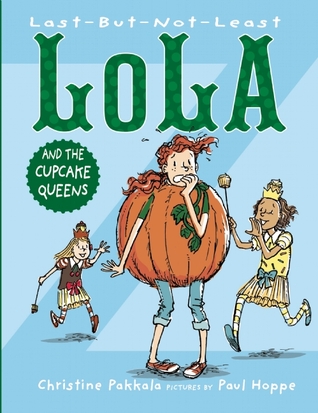
Blog Tour!: Last-But-Not-Least Lola and the Cupcake Queens by Christine Pakkala

Share

Lola and the Cupcake Queens

Last-But-Not-Least Lola and the Cupcake Queens
Author: Christine Pakkala
Illustrator: Paul Hoppe
Published October 6th, 2015 by Boyds Mills Press

Goodreads Summary: Lola’s mom is home but not home, because she’s frantically working all the time. Lola’s friends are here but not here as allegiances among the foursome change faster than you can forget your lines for a school play. Lola means well but can’t help acting on her emotions and getting into trouble. She’ll need to dig for bravery as she deals with a possible ghost next door, stage fright, and, hardest of all, making amends with her friends. Lola is braver than she thinks and her friendships are stronger than she realizes in this funny, heartwarming tale.

Kellee’s Review: I love that we are finding more and more girls like Lola in books. Lola is unique and smart and creative and not perfect yet also so very normal. She can be both a really good friend yet also a girl who makes mistakes. Lola is such a great role model for readers because she is all of these things, both good and bad. Readers will see themselves in her because she is very human.

In Lola and the Cupcake Queens, we get to know Lola even better. We learn that she has insecurities, that she loves her friends but doesn’t always know how to act, and that she underestimates herself. Each story about Lola’s puts her in more and more situations that readers will be able to connect with.

Ricki’s Review: I adored this charming series and immediately contacted a few friends who have young daughters who I know will fall in love with these books. Lola is a feisty redhead who seems to get herself into quite a bit of trouble. My favorite scene in the book is when Lola finds herself (yet again) in the principal’s office. She and the principal are great friends, and she casually struts into the office and is a bit taken aback when her friend is nervous. Her confidence and feistiness made me want to meet her! As she talks to the principal, she stops halfway through her sentence to lower her voice because yelling is not allowed. She knows the rules but seems to have a bit of difficulty following them—despite how hard she tries.

Lola reminds me of so many kids that I taught. She wants to do well, so she strives to be a good person. Even though she gets into a lot of trouble, it isn’t malicious. She just makes a lot of mistakes. These kinds of characters are fantastic for young readers because, like Kellee said, they allow children to see that they can learn from their mistakes. This series is a must for classrooms—it is the kind of series that turn kids into avid readers.

Teachers’ Tools for Navigation: Lola is going to be a favorite character of so many readers. She belongs in classroom and school libraries so readers can fall in love with her in the ways that we did.  In the book, Lola’s teacher did an activity that would also be great in the classroom. As the students were planning their Halloween costumes, she asked each child describe his/her costume without saying what it was. This activity would be a great way to help students build their imagery and descriptive language skills within creative writing.

As another idea, teachers might ask students to consider what it means to be a good friend. They could trace Lola’s actions to determine how she evolves as a friend in the series and then apply her actions to their own lives. This will help them think about friendship critically and relate it back to their own lives.

Discussion Questions: Do you think Lola intentionally gets into trouble? Why or why not?; What qualities would you use to describe Lola? Which of her actions reflect these qualities?; Is Lola a good friend? Why or why not?

We Flagged: “N-n-n-no,” she cries. “I’ve just never ever gotten in trouble and gone to the principal’s office. I’m not bad like you.”

“I’m not bad!” I yell, but part-way through I turn the volume down because yelling is bad. Especially right in front of the principal” (p. 65).

Read This If You Loved: Franklin School Friends series by Claudia Mills, Marty McGuire series by Kate Messner, Bink and Gollie series by Kate DiCamillo, Cody and the Fountain of Happiness by Tricia Springstubb, Eleanor books by Julie Sternberg, Babymouse series by Jennifer L. Holm, Bramble and Maggie series by Jessie Haas, The Trouble with Ants by Claudia Mills

Recommended For:

classroomlibrarybuttonsmall

  Signatureand RickiSig

**Thank you to Kayleigh at Boyds Mills Press for providing copies for review!**

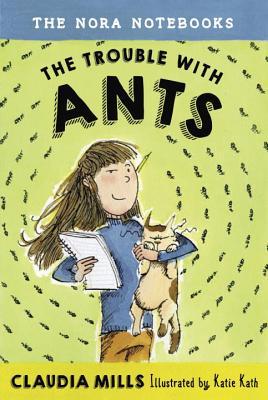
Review, Author Q&A, and Giveaway!: The Trouble with Ants by Claudia Mills

Share

Trouble with Ants

The Nora Notebooks: The Trouble with Ants
Author: Claudia Mills
Illustrator: Katie Kath
Published September 22nd, 2015 by Knopf Books for Young Readers

Goodreads Summary: Science-obsessed fourth grader Nora has ants all figured out—now she just has to try to understand her fellow humans!

The trouble with ants is . . .
. . . people think they’re boring.
. . . they are not cuddly.
. . . who would ever want them for a pet?

Nora Alpers is using her new notebook to record the behavior of ants. Why? Because they are fascinating! Unfortunately, no one agrees with her. Her mom is not happy about them being in the house, and when Nora brings her ant farm to school for show and tell, her classmates are not very impressed. They are more interested in cat videos, basketball practice, or trying to set a Guinness World Record (although Nora wouldn’t mind that).

Mostly they are distracted by the assignment their teacher Coach Joe has given them—to write a persuasive speech and change people’s minds about something. Will Nora convince her friends that ants are as interesting as she thinks they are? Or will everyone still think of ants as nothing but trouble?

With real science facts, a classroom backdrop, an emphasis on friendship, and appealing black-and-white interior illustrations from artist Katie Kath, The Nora Notebooks is perfect for newly independent readers—especially budding scientists like Nora!—and adults who want to encourage awareness of STEM subjects in young readers.

About the Author: Claudia Mills is the author of over fifty books for young readers. She does not personally keep an ant farm, but she does have a cat, Snickers, with whom she curls up on her couch at home in Boulder, Colorado, drinking hot chocolate and writing. To learn more, and to download free curriculum guides for her books, visit her website at claudiamillsauthor.comClaudia Mills, Philosophy claudia.mills@colorado.edu photo by: Larry Harwood

My Review: I love books that promote girls being smart and doing well in school. This book goes even further and promotes girls finding a love in science and, specifically, insects. Nora is a girl that I hope that lots of readers find a connection with and strive to be like. She is a role model for all kids. She is smart, doesn’t mind being a bit different, and has great friends and family. I also love that she is at the heart of it a normal girl who just happens to be smart and like science. The story is more than just her science and ants. It is about growing up.  There is so much you will love in this book: Nora, her parents, her teacher, her friends, and, of course, Precious Cupcake.

Author Q&A: We are so excited to host Claudia today! Thank you for taking part in the Q&A.

Do you like ants as much as Nora does?

No! But some ants somewhere must have read my book and gotten the wrong impression, as I had my first-ever invasion of ants in my pantry as the book was going to press. It was hard to convince them that I much prefer to have them outside in their usual habitat. But I had a pang thinking how much Nora would have come to their defense.

What was the hardest part about writing this book?

The research was a challenge. Most of my books are contemporary school stories. It helps that I love going to schools on author visits where I pay close attention to the details on how the classrooms are organized, what kind of work the kids are doing, and how classmates interact. But I don’t need to do any other research. Here I had to try to equal Nora’s knowledge about ants, and that meant reading about ants, interviewing a leading ant scientist, and combing the internet for promising ant experiments.

What’s next for Nora?

She is going to star in two more books. In The Trouble with Babies she devotes herself to the scientific study of babies as a new a-u-n-t; in The Trouble with Friends she wants to replicate Mendel’s experiments on the genetics of peas in the class garden, but finds herself instead learning the limits of her own scientific approach to life.

Thanks for hosting me today, Kellee!

Teachers’ Tools for Navigation: I love the cross-curricular aspect of this novel. You can use aspects in science and in language arts. I love Nora’s example of an experiment and persuasive essay. I also think having an ant farm while reading the novel would really add an extra aspect to the reading.

Discussion Questions: What are the steps to doing a science experiment?; Why did all of Nora’s ants die?; How is Nora different than her friends? How does their relationship show that different types of people can be friends.; How did Nora’s parents influence her?; Why do you think Dunk acts the way he does?; What was so special about Nora’s classroom?

We Flagged: “Nora loved scribbling down all kinds of facts in all kinds of notebooks: big ones, little ones, fat ones, skinny ones, spiral ones, and now this new super fancy one.

She had waited to start her new notebook on the first day of the new year.

‘Fascinating Facts About Ants,’ she now wrote on the first blank page with her blue ballpoint pen.” (p. 2)

Read This If You Loved: The Categorical Universe of Candice McPhee by Barry Jonsberg, Cody and the Fountain of Happiness by Tricia Springstubb

Giveaway: 

a Rafflecopter giveaway

Recommended For:

classroomlibrarybuttonsmall readaloudbuttonsmall closereadinganalysisbuttonsmall

  Signature

**Thank you to Barbara at Blue Slip Media for providing copies for review and giveaway and also a big thank you to Claudia Mills for taking part in the Q&A!!**

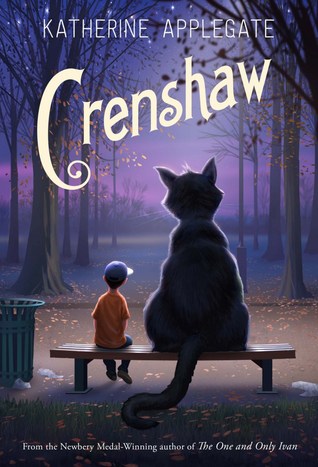
Crenshaw by Katherine Applegate

Share

crenshaw

Crenshaw
Author: Katherine Applegate
Published September 22nd, 2015 by Feiwel & Friends

Goodreads Summary: In her first novel since winning the Newbery Medal, Katherine Applegate delivers an unforgettable and magical story about family, friendship, and resilience.

Jackson and his family have fallen on hard times. There’s no more money for rent. And not much for food, either. His parents, his little sister, and their dog may have to live in their minivan. Again.

Crenshaw is a cat. He’s large, he’s outspoken, and he’s imaginary. He has come back into Jackson’s life to help him. But is an imaginary friend enough to save this family from losing everything?

Beloved author Katherine Applegate proves in unexpected ways that friends matter, whether real or imaginary.

My Review: It is not fair to compare this book to The One and Only Ivan. The only similarity is that they are both beautifully written and put a very special issue in the spotlight. Like Ivan made you think about animal’s imprisonment, Crenshaw makes you think about homelessness; however, it is more than that. This book made me think about so many things. First, this book shows the speed and brutality of homelessness. It can affect anyone and can come from no where. There is an extended scene from Jackson’s past that made me want to jump into the book to give him a hug and help his family in anyway I could. Second, this book looks at how much children sometimes have to deal with because of their home situation. Jackson had such anxiety and pressure on him because he felt like he had to be a grown up (specifically for his sister). Finally, the book looks at friendship–both of the imaginary and real kind–and how important they are. And specifically how the magic of both kinds are something you need to hold onto.

Teachers’ Tools for Navigation: Crenshaw is going to be added to so many teachers’ read aloud queue. It is such a special book that can cause lots of discussion and enlightening reflection.

Discussion Questions: What are ways that Jackson and Robin try to trick their stomachs when they are hungry? Why do you think the games work?; What did you learn about homelessness by reading this book?; Why did Crenshaw return to Jackson when he did?; What type of friend is Marisol? Why is she so important to Jackson?

We Flagged: “My mom was right, of course. They were just things. Bits of plastic and wood and cardboard and steel. Bunches of atoms. I knew all too well that there were people in the world who didn’t have Monopoly games or race car beds. I had a roof over my head. I had food most of the time. I had clothes and blankets and a dog and a family. Still I felt twisted inside. Like I’d swallowed a knotted-up rope.

It wasn’t about losing my stuff. Well, okay. Maybe that was a little part of it. It wasn’t about feeling different from other kids. Well, okay. Maybe that was part of it too.

What bothered me the most, though, was that I couldn’t fix anything. I couldn’t control anything. It was like driving a bumper car without a steering wheel. I kept getting slammed, and I just had to sit there and hold tight.”

Read This If You Loved: Hold Fast by Blue Balliett, No Place by Todd Strasser, Almost Home by Joan Bauer

Recommended For: 

classroomlibrarybuttonsmall readaloudbuttonsmall

Kellee Signature

Review and Giveaway!: Your Alien by Tammi Sauer

Share

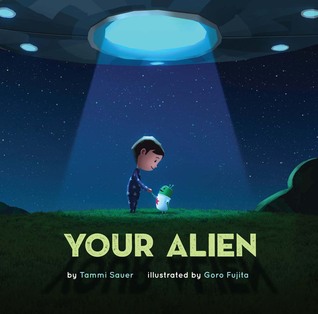
Your Alien

Your Alien
Author: Tammi Sauer
Illustrator: Gorō Fujita
Published: August 4, 2015 by Sterling Children’s Books

Summary: When a little boy meets a stranded alien child, the two instantly strike up a fabulous friendship. They go to school, explore the neighborhood, and have lots of fun. But at bedtime, the alien suddenly grows very, very sad. Can the boy figure out what his new buddy needs most of all? This funny, heartwarming story proves that friends and family are the most important things in the universe . . . no matter who or where you are.

Ricki’s Review and Teachers’ Tools for Navigation: This charming story hooked me from the very first page. Books are rarely written in second person point-of-view, and I am always intrigued by this stylistic choice. I’d love to have students write their own stories in the second person point-of-view. This would offer valuable discussions about the power of POV and why authors might intentionally use this in their writing. Beyond considering the point-of-view, I also enjoyed thinking about the several, implicit themes. This is a story about friendship and about family. However, it is also a story about homesickness. I can imagine that this would be a great story for kids to read when they go off to camp. Teachers might also read this book to a class if students are considering keeping a wild animal, which may be missing its natural home and a habitat. While the main character wants to keep the alien, it has a different home. I suspect that teachers and parents can find a variety of clever ways to integrate this book into their units. The illustrations are captivating, and I suspect that students will fall in love with the story.  

Kellee’s Review and Teachers’ Tools for Navigation: I love the little boy and the alien in this book! They are both so cute and sweet. I was impressed with the story which is much deeper than it looks, and the illustrations are so full and colorful. Like Ricki, I am completely intrigued by the point-of-view of the book. The second person point-of-view really makes the reader become invested in the story.  I’ve only read novels in second person, so this is a wonderful addition to the picture book world. In addition to the themes Ricki discussed, I think it is also a discussion about sometimes not being able to keep/get everything you want and sometimes you have to say good bye to those you love. The book also has a perfect plot arc with an easy to discuss conflict and resolution. Would be a good introduction to this element of narratives as well as characterization and point of view.  This book is going to be a read aloud favorite and is going to start a lot of important discussions.

Discussion Questions: Why was the alien sad? Have you ever been sad for a similar reason?; Do you think the main character made the right choice? Would you have made the same choice?; Why is the book written in second person point-of-view? How does this enhance your reading of the story?

We Flagged: “One day, you’ll be looking out your window when something wonderful comes your way… and you will want to keep him.”

Read This If You Love: Boy + Bot by Ame Dyckman, Space Boy and His Dog by Dian Curtis ReganFaraway Friends by Russ CoxEven Aliens Need Snacks by Matthew McElligott

Giveaway

a Rafflecopter giveaway

Recommended For: 

classroomlibrarybuttonsmall readaloudbuttonsmall closereadinganalysisbuttonsmall

RickiSigandSignature

**Thank you to Lauren at Sterling Publishing Co., Inc. for providing copies for review and for the giveaway!**