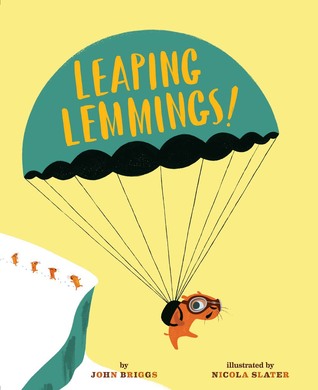
Leaping Lemmings! Author: John Briggs
Illustrator: Nicola Slater
Published September 6th, 2016 by Sterling Children’s Books
Summary: Think before you leap! Lemmings look alike, they sound alike, and they act alike. So if one jumps off a cliff, the others will jump right after him . . . except Larry. Larry’s very independent-minded and he won’t follow his fellow lemmings blindly to their doom. But can he teach them to use their brains and stop making terrible group decisions? John Briggs has created a wonderfully funny, quirky tale about staying true to yourself, while Nicola Slater’s witty illustrations capture all the humor and pathos of Larry’s situation.
My Thoughts:Leaping Lemmings looks at human identity but the message is symbolized by lemmings. The book personifies the saying, “If your friend jumped off a cliff, would you?!” and has the reader examine the dangers of trying to follow a crowd as well as the excitement of being yourself. Told in a silly way but with a very important message, this story is a perfect one to share with kids as they struggle with being themselves versus being accepted by their peers.
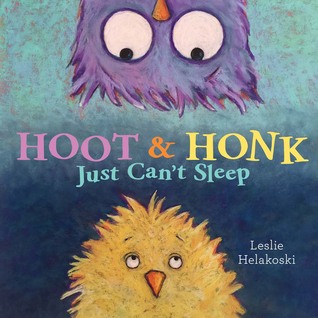
Hoot & Honk Just Can’t Sleep Author and Illustrator: Leslie Helakoski
Published March 14th, 2017 by Sterling Children’s Books
Summary: Dark sky. Wake or doze? Some eyes open. Some eyes close.
Some chicks like day, others like night. Some sleep in the dark, and some in the light. Hoot, an adorable owlet, and Honk, a fuzzy gosling, have just hatched—but their eggs got switched and now they’re in the wrong nests. Will they find their way home? Leslie Helakoski’s gentle, lilting verse and irresistible illustrations make the perfect bedtime story as they capture two adorable babies exploring the world for the first time.
My Thoughts: Hoot & Honk’s story is literally an animal identity story. It looks at nature and different types of birds, and tells the story of two birds trying to find their correct home and sleep schedule. The text is a perfect time to discuss nocturnal versus diurnal animals and how they work within nature. The story is also a perfect bedtime story because the writing is so rhythmic and the story is all about finding the right time to sleep. Kids are going to love this story whenever it is used–before bed or in the classroom.
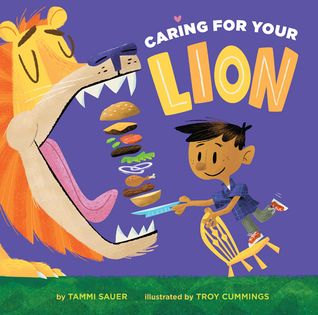
Caring for Your Lion Author: Tammi Sauer
Illustrator: Troy Cummings
Anticipated Published: May 2, 2017 by Sterling
Goodreads Summary: What happens when you expect an itty-bitty kitty . . . but get a lion instead?
It’s kitten delivery day, but—SURPRISE. Congratulations on your new LION! We know you ordered a kitten, but we ran out of those. Fortunately, the big cat comes with instructions—like, try very hard NOT to look like a zebra. Or a gazelle. And give your lion PLENTY of space to play. But soon the feathers and fur start flying and everything’s in chaos. Is there any way a lion could actually be a child’s purr-fect pet?
Ricki’s Review: This text will be a fantastic read-aloud for elementary school classrooms. It is a how-to book that will make kids roll with laughter. There is much to be taught from this text, so teachers will love teaching it as much as students will love listening to it. I enjoyed how straight-forward the text was. The pages include step-by-step instructions that are very clear and direct. The pictures show the consequences (e.g. the lion will eat you!). This is a perfect mentor text for a variety of teaching tools (see below) and a great addition to classrooms.
Kellee’s Review:Kids are going to love this step-by-step introduction into how to care for a pet lion. (Though I predict there are going to be some “No, you cannot have a lion as a pet.” conversations because of this book! The lion is just that adorable!) I loved how the book was a combination of a how-to guide and a narrative of the boy’s experience with his lion–what a unique concept! It is going to be such a fun book to read aloud with time to examine each page. And like Sauer’s Alien books, it really makes you think about expectations, prejudice, and first impressions vs. reality.
Teachers’ Tools for Navigation: Teachers might use this book to teach sequence and how-to directions. They could also use it with students to discuss how caring for a lion would compare and contrast to caring for a more typical animal like a cat, dog, or fish. Students could then write their own how-to guides about caring for an exotic animal.
Discussion Questions: What is difficult about caring for a lion? What is important to remember?; When should you use a feather? What does the feather do?
Flagged Passage: “Step 3: Try very hard NOT to look like a zebra. Or a gazelle. Or a bunny. (See Diagram A).”
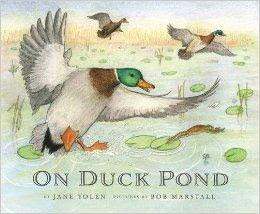
On Duck Pond
Author: Jane Yolen; Illustrator: Bob Marstall
Published: April 11, 2017 by Cornell Lab Publishing Group
Goodreads Summary: From award-winning and NY Times bestselling children’s author of more than 350 books, Jane Yolen, and award-winning illustrator, Bob Marstall, On Duck Pond is the first sequel to the acclaimed On Bird Hill, which launched the children’s picture book series written for the esteemed Cornell Lab of Ornithology, the world authority on birds.
In On Bird Hill, Yolen and Marstall took readers on a surreal journey with a boy and his dog, as they stopped, looked, and noticed things along their path—ultimately discovering the miracle of the birth of a baby bird. On Duck Pond continues the journey of the boy and dog story, this time in a new place—a serene pond, filled with birds, frogs, turtles and other creatures going about their quiet business. Their intrusion stirs the pond into a cacophony of activity, reaching climactic chaos, before slowly settling back to it’s quiet equilibrium.
This beautiful and enchanting sequel is sure to delight On Bird Hill fans and millions of readers and fans of Jane’s popular classics.
Ricki’s Review:This is a beautiful book that is reminiscent of the classics. Kids will read this book and be reminded of the beauty of nature—its sights and its sounds, in particular. After we read this book, my kids and I took a walk and stopped to remind ourselves of how beautiful the world is around us. Too often, I think we forget to take in how wonderful our world is, and this book will make us pause. Jane Yolen is a rock star, and this book is another winner. I am in awe of how she writes so many stunning books. Her language is incredibly powerful. I recommend you get this one. It is a book that will endure.
Kellee’s Review: This book reminds me of many of Yolen’s book in that it is multi-faceted and beautifully done. At face value, it is a story of nature. There have been many reports recently about kids’ lack of time outside, and Yolen combats that by pointing out so many different species that can be found at a pond and interesting information about them. In the back matter, even more facts about each of the species are shared along with activities to do in nature. If you go a bit deeper though, it is also a book of poetry. The consistent rhyme scheme throughout gives the book some really great rhythm and a really beautiful, lyrical feel.
Teachers’ Tools for Navigation: This is a great book to read before a nature walk with kids. Ricki is planning to give it to her son’s preschool teacher because the teacher is always teaches the students about the things they are seeing outside. We’d also love to compare this book with other duck books (e.g. Dump Truck Duck, Make Way for Ducklings) to look at the ways that ducks are featured in different writing styles and genres.
Discussion Questions: How do the other animals react to the ducks? What other animals cause big reactions?; How does the simple text make the story more compelling?; How do the author and illustrator work together to make for a beautifully depicted setting?
Flagged Passage: “Old Duck Pond, once still and quiet / Now seemed battered by the riot.”
Read This If You Loved: On Bird Hill by Jane Yolen,Make Way for Ducklings by Robert McCloskey, The Very Hungry Caterpillar by Eric Carle, 5 Little Ducks by Denise Fleming
Recommended For:
and
**Thank you to Tracey from Media Masters for providing copies for review!**
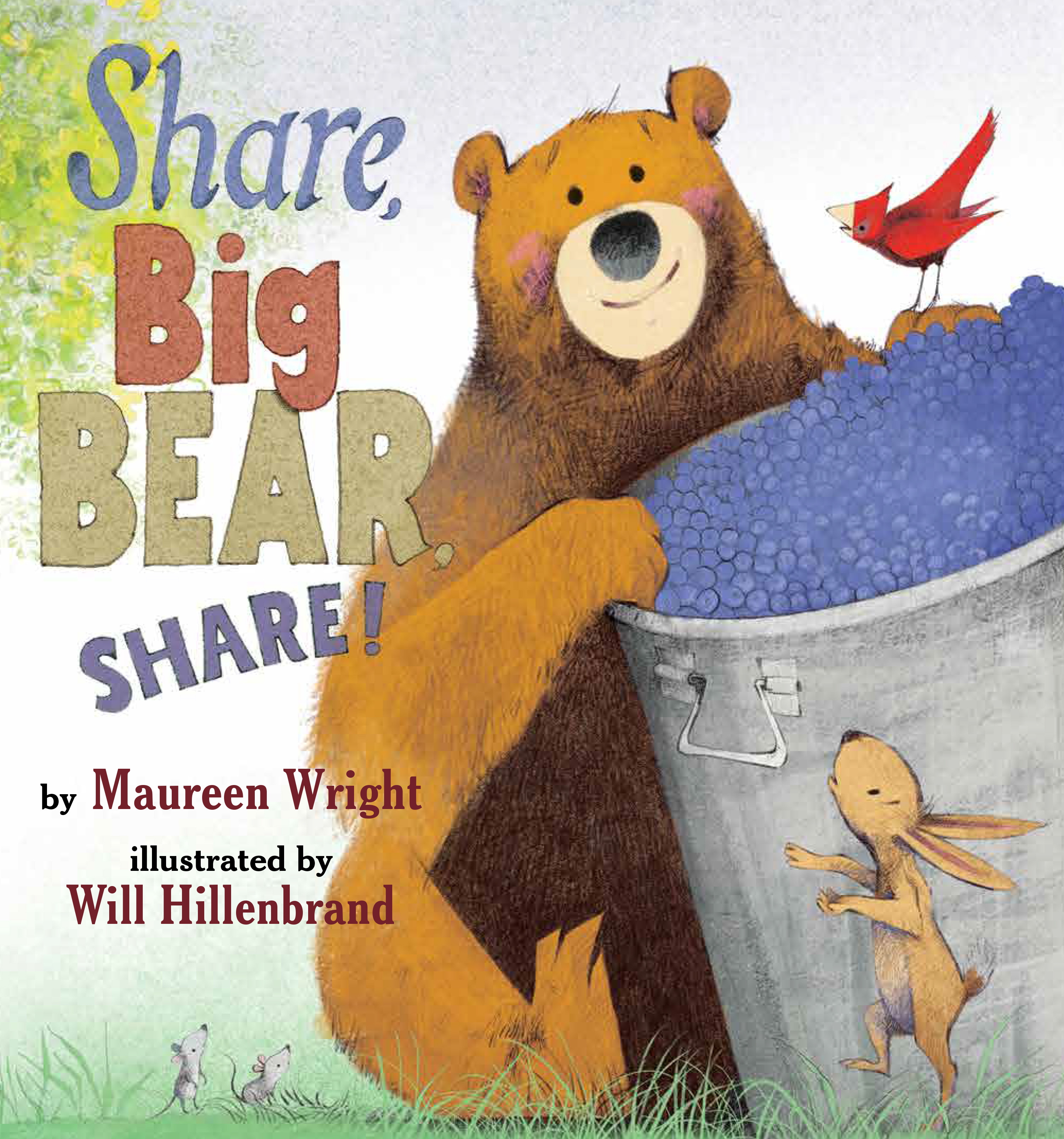
Share, Big Bear, Share Author: Maureen Wright
Illustrator: Will Hillenbrand
Published April 25, 2017 by Two Lions
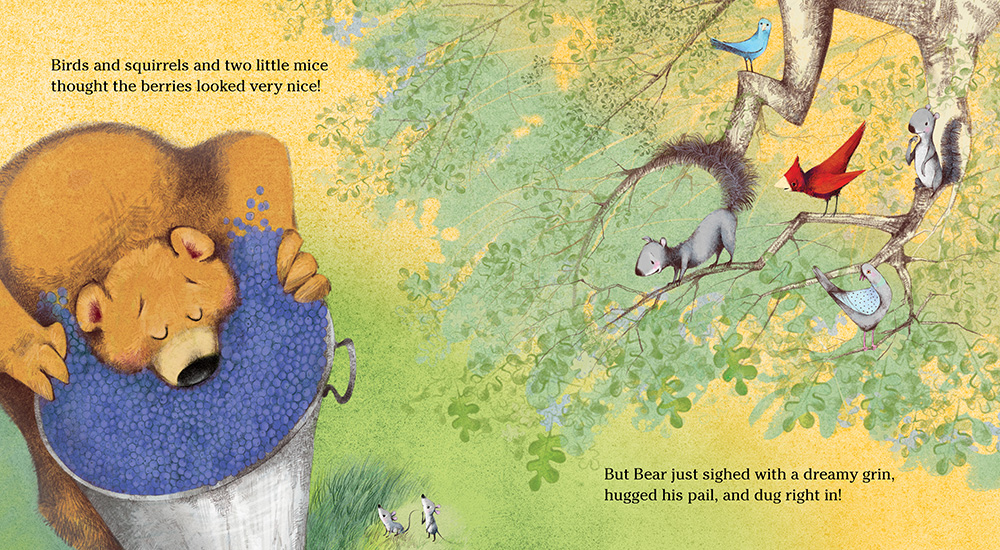
Goodreads Summary: Big Bear’s forest friends eye his berries hungrily, but he doesn’t notice as he digs into his delicious snack. When the old oak tree says, “Share, Big Bear, share,” he thinks the tree has said, “Hair, Big Bear, hair!” One comical scene follows another as Big Bear keeps misunderstanding the old oak tree’s message until things finally get sorted out. Whimsical illustrations highlight the humor in this gentle story about the importance of sharing something special with friends.
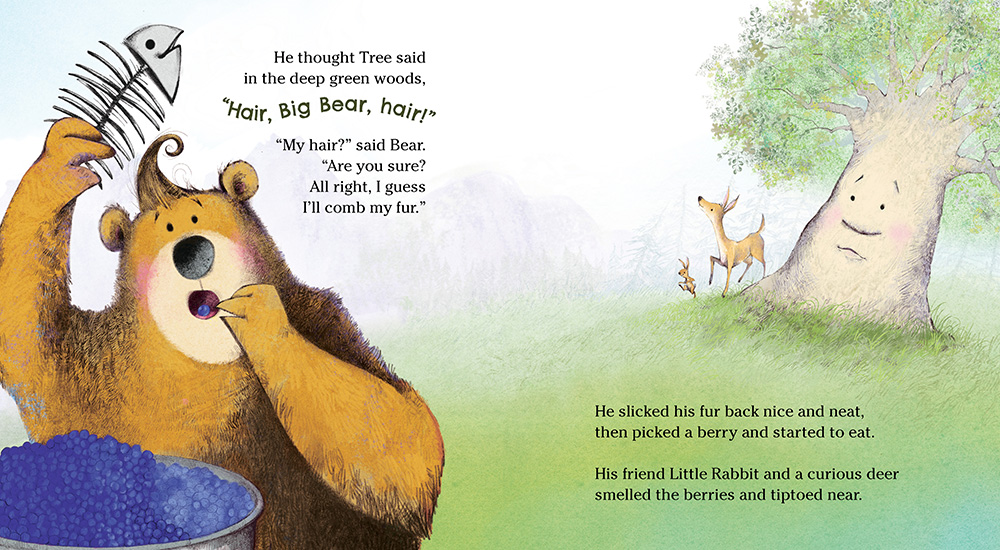
Review: This book is absolutely delightful. I wish I’d filmed myself reading it because I realized halfway through my reading that I had a goofy grin on my face. Bear is so occupied with the berries that he is eating that he doesn’t realize his animal friends want him to share. Instead, he thinks they are saying “hair,” “lair,” “scare,” etc., and he acts out all of the misinterpretations he hears. So, for example, when he thinks they are saying “Hair, Big Bear, Hair!” he combs his hair into a goofy hairstyle (see the spread featured below). I can’t WAIT to read this to my son. He is going to crack up. I loved how the book teaches vocabulary words, too. Big Bear teaches us, for instance, what a “lair” is. This is going to be one of my favorite children’s books this year. I will need to buy the others in the series.
Teachers’ Tools for Navigation: It would be so much fun for readers to create their own Big Bear story as a class. Perhaps he could misinterpret another commonly rhymed word. Each student could be in charge of a different page to create a class book!
Discussion Questions: Why doesn’t Big Bear hear his friends?; What are some of the ways Big Bear misinterprets his friends?; What does this book teach us about sharing? About listening?
We Flagged:
Read This If You Loved: That’s (Not) Mine by Anna Kang,You Are (Not) Small by Anna Kang, Bear Snores On by Karma Wilson, Lady Pancake and Sir French Toast by Josh Funk, Your Alien by Tammi Sauer, The Pigeon Needs a Bath by Mo Willems, Elephant and Piggie books by Mo Willems
About the Author: WILL HILLENBRAND has written and/or illustrated over 60 books for young readers including Down by the Barn, Mother Goose Picture Puzzles and the Bear and Mole series. He has lived almost all of his life in Cincinnati, Ohio, where he grew up as the youngest of four boys. He now lives in Terrace Park and was recently honored as Author/Illustrator in Residence at Kent State University.
Nonfiction Picture Book Wednesday is hosted by Kid Lit Frenzy and was started to help promote the reading of nonfiction texts. Most Wednesdays, we will be participating and will review a nonfiction text (though it may not always be a picture book).
Be sure to visit Kid Lit Frenzy and see what other nonfiction books are shared this week!
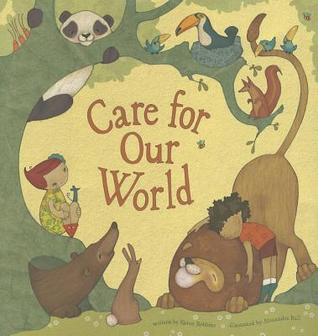
Care For Our World Author: Karen Robbins
Illustrator: Alexandra Ball
Originally Published: July 15th, 2012 by Compendium Publishing and Communications
App Release: March 1st, 2017 by Sunbreak Games, LLC
Book Summary: Get ready to meet some truly wonderful wild animals from every continent on Earth. As children turn the pages of this book, they’ll encounter dozens of playful creatures in their natural habitats and will learn about the importance of caring for all the plants, animals, and people that call planet Earth their home. A timely reminder of the responsibility every generation shares: to nurture and respect life in all its many forms.
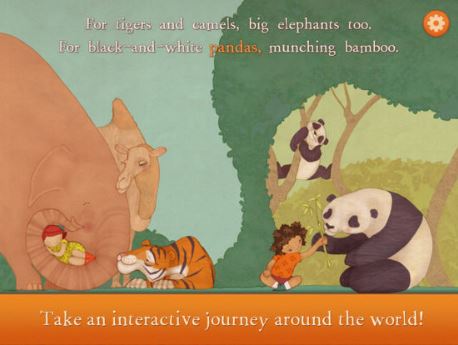
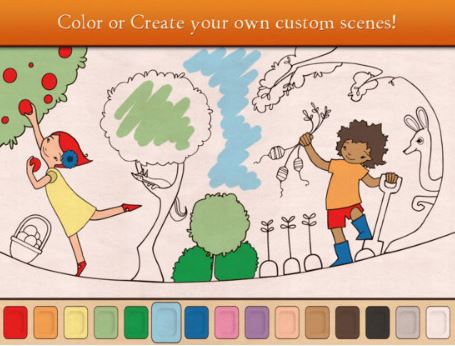
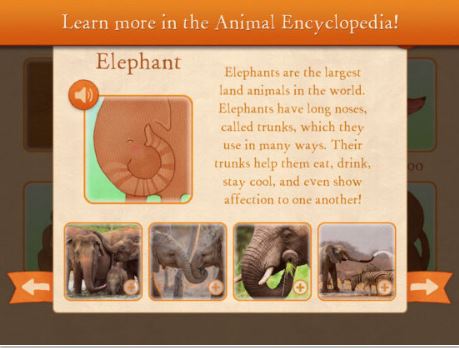
App Information: Take an interactive journey around the world, discovering diverse environments and the animals that call them home, in this animated adaptation of the award-winning children’s book, Care for Our World. Additional creative activities are included, like Coloring Book pages, Creating custom habitats, and even Learning facts, sounds, and photo galleries in the Animal Encyclopedia.
“Care for our world, for you and for me, for all living things from mountain to sea.”
Author Karen Robbins’ delightful words and illustrator Alexandra Ball’s captivating images combine to inspire children to care for the earth they call home: a timely reminder of the responsibility every generation shares to nurture and respect life in all its many forms.
Features:
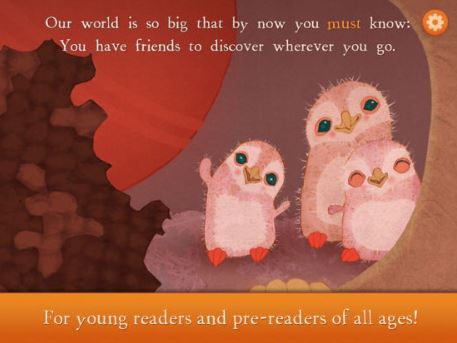
• Listen to the animated story, with narration, music, and sounds.
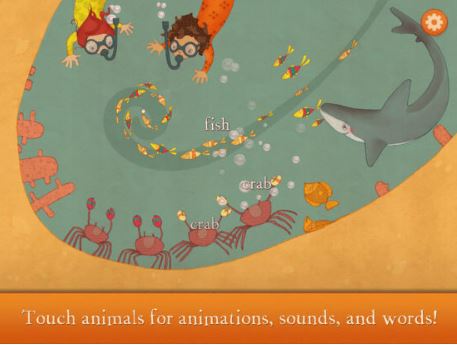
• Touch characters to see and hear them react, and practice their words.
• Color select pages from the book
• Create custom habitats with select animals and backgrounds.
• Save images of your creations to the Gallery.
• Learn more with facts, sounds, and photos in the Animal Encyclopedia.
Recommended for ages 3-8
Review and Teachers’ Tools for Navigation: I’m so impressed with so many of the book apps that are becoming available! As a 21st century mom and teacher, technology is just inevitable in our lives, so I want to make sure that whatever my son and my students interact with is the best out there and isn’t just a tech babysitter. Care For Our World fits this definition and is definitely an app that I am going to recommend to my mom friends and my elementary teacher friends.
The story by itself is a wonderful read aloud and discussion starter. It takes the two main characters around the world to visit different habitats and the animals that live there. The author’s theme is quite clear throughout: this is OUR world and we need to take care of it because we share it with some amazing animals. This theme makes it a perfect read aloud for Earth Day and many animal and Earth-centered activities and inquiry projects could stem from the story.
The app takes the book to a whole new level. Everything wonderful about the book is still there, but now the story is interactive! First, it reads to you. On each page, you can also click on the plants and animals and the narrator will tell you what they are. You can also click on each word, and it’ll read it to you. This is perfect for kids learning to read! The viewer, when finished with the book, can now go explore more about some of the animals in the story by going to the Animal Encyclopedia where you can hear the sounds the animals make, learn about their behaviors, and see photos of them. Lastly, kids will have a blast coloring different scenes from the book or creating their own habitat (all artwork can be saved in a gallery to view later). The app is fun and informative–a perfect mix for the type of app I’m always trying to find for my son.
Nonfiction Picture Book Wednesday is hosted by Kid Lit Frenzy and was started to help promote the reading of nonfiction texts. Most Wednesdays, we will be participating and will review a nonfiction text (though it may not always be a picture book).
Be sure to visit Kid Lit Frenzy and see what other nonfiction books are shared this week!
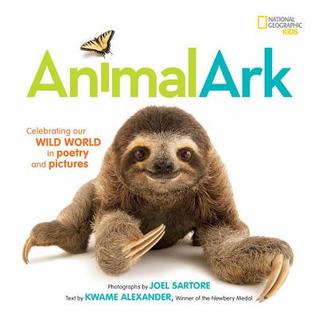
Animal Ark Created by and Photographer: Joel Sartore
Poet: Kwame Alexander
Published February 14th, 2017 by National Geographic Society
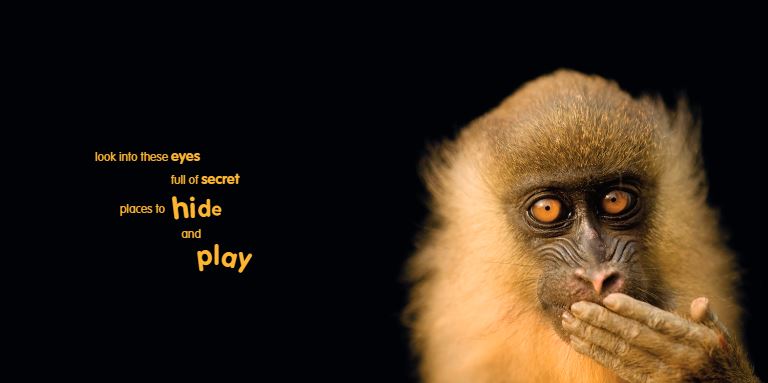
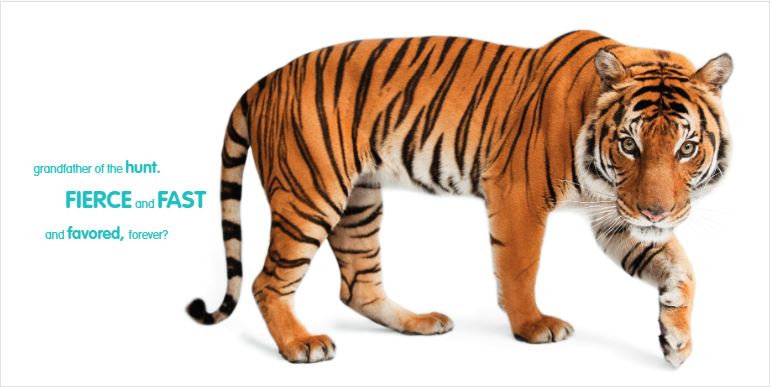
About the Book: National Geographic Kids proudly announces the release of Animal Ark: Celebrating Our Wild World in Poetry and Pictures, a picture book for children ages 4-8 written by Newbery Medal-winning author Kwame Alexander and featuring photographs by acclaimed National Geographic Fellow and photographer Joel Sartore. Animal Ark pairs Alexander’s uplifting poetry and prose with more than 100 of Sartore’s most compelling images of the world’s species to create a book for children that highlights the importance of conservation and the beauty of the animal kingdom.
Animal Ark is inspired by the National Geographic Photo Ark, a multiyear effort with Sartore and the National Geographic Society to document every species in captivity—inspiring people not just to care, but also to help protect these animals for future generations. To date, Sartore has completed portraits of more than 6,000 species, photographed on either a plain black or white background. No matter its size, each animal is treated with the same amount of affection and respect. The results are portraits that are not just stunningly beautiful, but also intimate and moving.
The companion adult book, National Geographic The Photo Ark: One Man’s Quest to Document the World’s Animals (National Geographic Books)—with a foreword by Harrison Ford—also showcases Sartore’s animal portraits: from tiny to mammoth, from the Florida grasshopper sparrow to the greater one-horned rhinoceros. In 2017, National Geographic Photo Ark exhibitions are opening at Omaha’s Henry Doorly Zoo and Aquarium, the Dallas Zoo, and the Cincinnati Zoo. Learn more at NatGeoPhotoArk.org and join the conversation on social media with #SaveTogether.
About Joel Sartore: Joel Sartore is a photographer, speaker, author, teacher, conservationist, National Geographic fellow, regular contributor to National Geographic magazine and founder of the National Geographic Photo Ark. In addition to the work he has done for National Geographic, Sartore has contributed to Audubon magazine, Time, Life,Sports Illustrated, The New York Times, the Smithsonian magazine and numerous book projects. His next book for adults, National Geographic The Photo Ark: One Man’s Quest to Document the World’s Animals will be released in March 2017.
About Kwame Alexander: Kwame Alexander is a poet, educator, and New York Times bestselling author of 21 books, including The Crossover, which received the 2015 John Newbery Medal for the Most Distinguished Contribution to American Literature for Children. His other recent works include Booked, Surf’s Up, and He Said, She Said. He is the founder of Book-in-a-Day, a student-run publishing program that has created more than 3,000 student authors in 75 schools; and LEAP for Ghana, an international literacy project that builds libraries, trains teachers, and empowers children through literature. In 2015, Kwame served as Bank Street College of Education’s first writer-in-residence.
Book Trailer:
My Review: I am in love with all of these animals! Do you see how cute they are?!?! And I love the message that Joel Sartore, National Geographic Kids, and Kwame Alexander are spreading with this text: “At its heart, the Photo Ark was born out of necessity… I started to see that people weren’t paying much attention to the fate of all the others species we share this planet with. Without action, and soon, I worried that many animals could go extinct. The Photo Ark is my answer to this. By introducing the entire world to thoughts of photographs of [animals], I hope we can get everyone following, liking, tweeting, and even talking about this wondrous world of ours.” -Joel Sartore. I care deeply for all living things, and I have the same fear that Sartore has–that too many people are so caught up in their own little worlds that they aren’t focusing on the big world around us. The continual denial of climate change, the recent possible elimination of many of the EPA’s environmental protections, and so many other things makes the possibilities of us ruining our Earth even closer to reality 🙁
Teachers’ Tools for Navigation: Animal Ark has writing and science opportunities for the classroom. First, the theme of the book works beautifully within a science unit about endangered animals. Mix the text with the website What is Missing? by Maya Lin, and there are so many opportunities to discuss conservation and sustainability. Kwame Alexander’s poetry also gives an opportunity for poetry writing. In the Author’s Note, National Geographic shares information about haiku. Although all of Kwame’s poetry does not fit the traditional haiku format and we wouldn’t recommend it for a haiku mentor text, it shows how poets can take a traditional format and embrace yet manipulate it for their purpose.
Discussion Questions: Which animal would you like to learn more about?; What can humans do to help save these animals?; What is the theme of Animal Ark? What is the author/photographer trying to teach us?
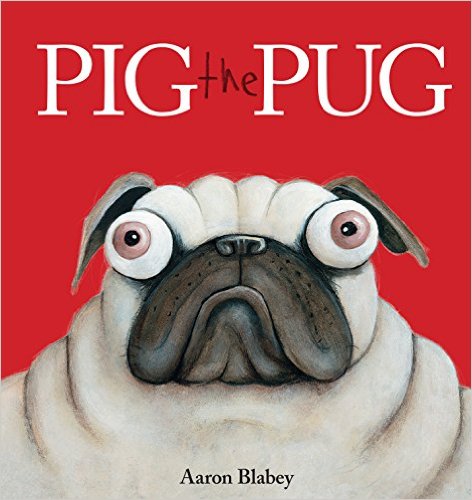
Pig the Pug Author: Aaron Blabey
Published: July 1, 2014 by Scholastic
A Guest Review by Rebecca Welch
Summary: Pig is a greedy dog and does not want to share his toys with his housemate, Trevor. Trevor thinks it would be a great idea if him and Pig shared toys because then they would be able to play together. Pig does not give in and gathers all of his toys so Trevor can’t get to them. A mishap occurs that makes pig realize the importance of sharing and friendship.
Review: This book is great for any elementary school classroom! I absolutely loved it and thought that the message at the end was applicable to any group of young children. The rhyming makes the book great for a fun read aloud and the illustrations are fantastic. There was also a bit of humor. I highly recommend this picture book.
Teachers’ Tools for Navigation: This book would be great to teach rhyming because each page rhymes. You could talk about the moral of a story and use it as a segway to students’ writing about a time where they learned an important lesson (moral). You could have students determine the meaning of the idiom “flip a wig” by the using context clues and then study other common idioms afterwards. In addition, you could introduce character traits and determine the traits of Pig and Trevor. You can also practice making predictions by predicting what will happen to Pig. It would also be a great classroom discussion facilitator on sharing and the importance of friendship.
Discussion Questions: How do you think Trevor may be feeling when Pig won’t share his toys?; What does it mean to be greedy or selfish?; What do you predict will happen to Pig?; Can we think of any times that we have been greedy or selfish?; What does “flip a wig mean”?; What is the moral of this story?
Flagged Passage: “I know what your game is, you want me to SHARE! But I’ll never do that! I won’t and I swear!” (p. 7).
Read This If You Loved: Dog vs. Cat by Chris Gall; Mr. Fuzzbuster Knows He’s the Favorite by Stacy McAnulty