Author Guest Post!: Turning Young Readers on to Historical Fiction by Laurie Calkhoven, author of the Boys of Wartime series

Share

“Turning Young Readers on to Historical Fiction” by Laurie Calkhoven

It’s hard to believe that something as small as a broken egg could change the course of American history, but one did. It was March of 1775 and the fifth anniversary of the Boston Massacre. The Sons of Liberty planned a church service at Old South Meeting House to honor the men who had died. All of the leaders of the Sons of Liberty, indeed all Patriots in Boston, would be in attendance.

The Redcoats had a plan to bring the colonial rebellion to an end. They ordered a soldier to go to the meeting and throw an egg at the speaker. An insult like that would start a riot, and they intended to arrest the leaders of the Sons of Liberty—Samuel Adams, John Adams, John Hancock, and the others—and ship them to England to stand trial for starting a riot. The British thought that with the leaders out of the way, those hotheads in Boston would settle down and stop their foolish rebellion.

The reason why you haven’t read about those arrests in your history texts is that the soldier fell on his way to the service. Not only did he break the egg. He hurt his leg so badly that he didn’t make it to the meeting at all. There were no arrests. The rebellion lived on. The next time the Redcoats went after those leaders, war erupted in Lexington and Concord.

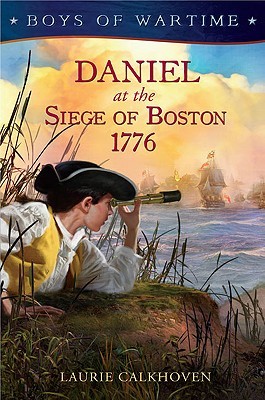
That egg incident, one I came across in long out-of-print history of the time period, frames the beginning of my novel Daniel at the Siege of Boston, 1776. Daniel helps foil the British plan and goes on to do much more, but if not for that broken egg, there wouldn’t be a story to tell.

Historical fiction can be a hard sell for young readers. Many of them expect it to be boring. When I visit schools and talk to young readers, I always begin by telling them stories—true stories. Soon they’re hooked. They want to know what happens next.

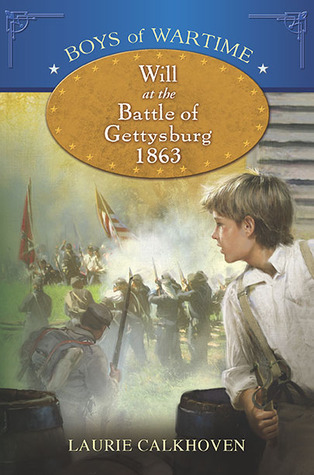
Kids love wacky facts, and so in my Civil War novel (Will at the Battle of Gettysburg, 1863), I included the fact that on the first night of the battle six-year-old Mary McLean stuck her head out of her window and sang a song to the Confederate soldiers who had taken her town—a song about their President, Jefferson Davis:

Hang Jeff Davis from a sour apple tree.

Mary’s father thought the whole family would be shot, but the Rebel soldiers only laughed and sang their own song about President Lincoln.

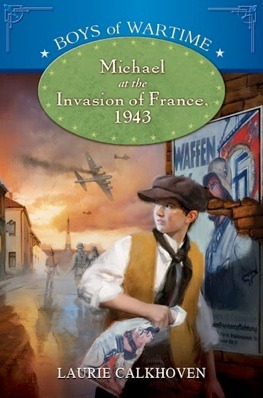
My latest Boys of Wartime novel, Michael at the Invasion of France, 1943, is about a boy who helps shot-down and trapped American airmen evade the Nazis in a World War II version of the Underground Railroad. Kids love to hear about all the everyday American habits that gave the men away. Things like walking with their hands in their pockets, or whistling—two things French men never did.

My Boys of Wartime novels are about ordinary boys who get caught up in extraordinary moments in history—they become spies for General Washington, help save the Union, and resist the Nazis. One ordinary person—just like them—and small ordinary moments can change the course of history. I research extensively to fill my novels with real-life action and adventure stories to keep my readers turning the pages.

All kinds weird, wacky, and wonderful stories never make it into our history textbooks. Historical fiction is full of those stories. Once your young readers figure that out, they’ll be back for more.


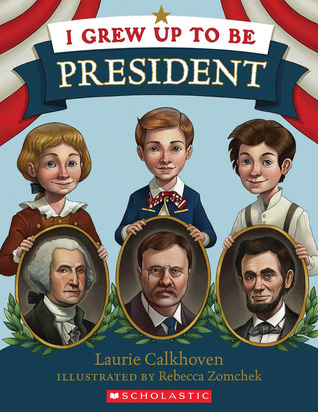
About the author: Laurie Calkhoven is the author of nearly fifty books for young readers including the Boys of Wartime series and I Grew Up to be President. Find CCSS activities and learn about her school visit program at lauriecalkhoven.com.
wartime3 wartime2 wartime 0-545-33152-8

Thank you Laurie for your post!
Signature

Teaching Critical Theory to ALL Students

Share

Critical Encounters in High School English

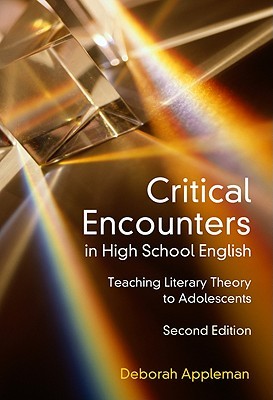
Commentary on Deborah Appleman’s Critical Encounters in High School English: Teaching Literary Theory to Adolescents

This professional development text made me reconsider my teaching philosophy. I’ve used lenses before. In my college credit course (for high school students), I asked students to use nonfiction and fiction as lenses to view other texts. It felt academic, and I believe my students benefited from this skill, but Appleman takes theory a step beyond what I was doing. As a graduate of English Education, critical theory was familiar to me, but I always felt as if I had to teach theory in a hidden way. We talked about gender, but I never told students they were using critical theory.

For most teachers, critical theory is important for advanced placement, high school English classrooms. Appleman provides scaffolding and proves that theory can be used in grades 6-12 and for all levels. Her materials are accessible and engaging.

According to Appleman, teachers should use literary theory as critical lenses to help students understand the ideologies inherent in texts (p. 3) and use skills of reading and writing to come learn about the world (p. 2).  When students read, there are multiple contexts at play, and she provides theoretical grounding and examples of various lenses for teachers: reader response, privilege and social class, gender, post colonialism, and deconstruction. Each lens has its own chapter in her book.

Students bring their own contexts to their reading of a text, so using critical theory allows them to view the literature through a different lens. Reading, interpretation and criticism are all important skills, and too often, teachers “relegate only the reading to students” (p. 6), and through Appleman’s suggestions, we give students authority and power.

No matter how uncomfortable it feels, students should learn to question the notion of a single truth and show the multiplicities that exist in reading. “Meanings are constructed; we create meanings that are influenced by who we are and what we are culturally; historically; psychologically; and, in the case of the Baker version of Miss Muffet, vocationally” (p. 20). Reading allows students to gain perspective of other lenses and theories, but also of their own lives, where the text acts as an equal partner with the reader (p. 31).

There are a plethora of activities and lessons for teachers in the appendix of the book. This book is extremely practical, and I felt as if I could immediately employ the ideas in the classroom, given the resources Appleman provides. I highly recommend this text to teachers.

The Man with the Violin by Kathy Stinson (Kellee’s Review)

Share

NF PB 2014

Nonfiction Picture Book Wednesday

Nonfiction Picture Book Wednesday is hosted by Kid Lit Frenzy and was started to help promote the reading of nonfiction texts. Most Wednesdays, we will be participating and will review a nonfiction text (though it may not always be a picture book).
Be sure to visit Kid Lit Frenzy and see what other nonfiction books are shared this week!

violin

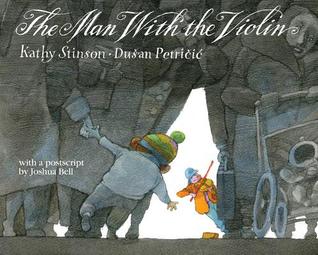
The Man with the Violin
Author: Kathy Stinson
Illustrated: Dušan Petričić
Published August 8, 2013 by Annick Press

Goodreads Summary: “Who is playing that beautiful music in the subway? And why is nobody listening?”

This gorgeous picture book is based on the true story of Joshua Bell, the renowned American violinist who famously took his instrument down into the Washington D.C. subway for a free concert. More than a thousand commuters rushed by him, but only seven stopped to listen for more than a minute. In “The Man With the Violin,” bestselling author Kathy Stinson has woven a heart-warming story that reminds us all to stop and appreciate the beauty that surrounds us.

Dylan is someone who notices things. His mom is someone who doesn’t. So try as he might, Dylan can’t get his mom to listen to the man playing the violin in the subway station. But Dylan is swept away by the soaring and swooping notes that fill the air as crowds of oblivious people rush by. With the beautiful music in his head all day long, Dylan can’t forget the violinist, and finally succeeds in making his mother stop and listen, too.

Vividly imagined text combined with illustrations that pulse with energy and movement expertly demonstrate the transformative power of music. With an afterword explaining Joshua Bell’s story, and a postscript by Joshua Bell himself.

My Review and Teachers’ Tools for Navigation: I must preface by saying that this book is not technically nonfiction. It is based on nonfiction, but the story is actually made up.

Too often our days go by without us slowing down and taking anything in. It may be that we are busy or stressed or late , but it has become too common to see people always rushing wherever they are going. This book shows how much we may be missing out on. It also shows the innocence of childhood, and how we need to allow children to explore and slow down even if we are moving fast. It is wonderful how the illustrations capture this for the reader. Combined with the story, this one definitely hits close to home.

Ricki also had some great thoughts and ideas in her review.

Discussion Questions: This book is an important discussion starter. What have you seen recently that was beautiful that others didn’t notice?; Sit ____ and listen to the sounds around you. What do you hear that is beautiful?; Why do you think people didn’t stop to hear Joshua Bell play?; Why did the author feel this was an important story to turn into a picture book?

Book Trailer: 

Read This If You Loved: The Noisy Paint Box by Barb Rosenstock, Herman and Rosie by Gus Gordon, Marvin Makes Music by Marvin Hamlisch

Recommended For: 

readaloudbuttonsmall classroomlibrarybuttonsmall

Signature

**Thank you to Annick Press and Netgalley for providing a copy for review**

Top Ten Tuesday: Book Characters Who Would Be Sitting At Our Lunch Table

Share

top ten tuesday

Top Ten Tuesday is an original feature/weekly meme created at The Broke and the Bookish. The feature was created because The Broke and Bookish are particularly fond of lists (as are we!). Each week a new Top Ten list topic is given and bloggers can participate.

 Today’s Topic: Top Ten Top Ten Book Characters Who Would Be Sitting At Our Lunch Table

We are back at school, and we can’t wait to dine with these characters!

Ricki

I decided to go the food route because I love to eat!

1. Strega Nona from Strega Nona by Tomie dePaola

BRING ON THE PASTA!

2. Sal and his mother from Blueberries for Sal by Robert McCloskey

Kuplink, kuplank, kuplunk! Let’s enjoy blueberries together!

3. Lucy Knisley from Relish by Lucky Knisley

Hopefully, we can convince Lucy to bring some of her homemade treats for us.

4. The Caterpillar from The Very Hungry Caterpillar by Eric Carle

Just because it is famous and likes to eat as much as I do, I would love for the caterpillar to join us. We will have some tasty treats available!

5. The setting of Cloudy with a Chance of Meatballs by Judi Barrett

An excellently depicted setting can be like a character. I would like to eat in the setting that exists in the first few pages of this book (before things got crazy, of course).

Kellee

I went a bit different with this than Ricki. I decided to think about what teachers I would like to eat lunch with now.

1. Miss Stretchberry from Love that Dog by Sharon Creech

Miss Stretchberry really knows how to reach students, had some amazing ideas, and is overall such a wonderful teacher.

2. Miss Cassidy from Jumped In by Patrick Flores-Scott

Miss Cassidy wouldn’t let Sam and Luis disappear. She obviously cares about all of her students, and that is a type of teacher I would want to hang out with.

3. Mr. McQueen from Bluefish by Pat Schmatz

Mr. McQueen helps Travis and other struggling readers realize that they aren’t stupid, and that reading isn’t an anomaly but something they can do. I would love to talk to him about his strategies.

4. Miss Movado from The Summer of May by Cecilia Galante

Miss Movado doesn’t give up on May when everyone, including May, has given up on her. She changes her life in one summer.

5. Mr. Browne from Wonder by RJ Palacio

I love Mr. Browne and his precepts, and really makes his students think (though makes it fun). I’d love to pick his brain.

Who would you invite to your lunch table?

RickiSig and Signature

It’s Monday! What Are You Reading? 9/1/14

Share

IMWAYR

It’s Monday! What Are You Reading? From Picture Books to YA!

It’s Monday! What are you Reading? is a meme hosted by Sheila at Book Journeys. It is a great way to recap what you read and/or reviewed the previous week and to plan out your reading and reviews for the upcoming week. It’s also a great chance to see what others are reading right now…you just might discover the next “must-read” book!

Jen Vincent, of Teach Mentor Texts, and Kellee decided to give It’s Monday! What Are You Reading? a kidlit focus. If you read and review books in children’s literature – picture books, chapter books, middle grade novels, young adult novels, anything in the world of kidlit – join us! We love this meme and think you will, too.

We encourage everyone who participates to support the blogging community by visiting at least three of the other book bloggers that link up and leave comments for them.

Last Week’s Posts

top ten tuesday Identity Just Call My Name coyote

Tuesday: Top Ten Books We’ve Owned for a Long Time but Haven’t Read

Wednesday: How Being a Mom Has Changed My Identity (Kellee)

**Click on any picture/link to view the post**

 Last Week’s Journeys

Kellee: School is taking up a bit more of my time than I anticipated (I was just told I was teaching a new class a week ago, so I am working on building a curriculum for the class in addition to my journalism class and being reading coach), so I am not having as much reading time as I’d like. During my week, though, I was able to read a phenomenal graphic novel El Deafo by Cece Bell. I loved it, and my students are going to love it. When reading it it automatically connected to Smile and Hurt Go Happy in my brain. I also read 3 picture books that I really liked: How Big Were Dinosaurs? by Lita Judge, Manfish by Jennifer Berne, and The New Girl…and Me by Jacqui Robbins.

Trent and I read some awesome picture books this week. The most important one we read this week was a photo book that my mom made of Trent’s first visit to Chattanooga. It is in chronological order and chronicles his time there. I love how she put it together, and I love that Trent and I can revisit any time we want!

Our other favorites were:

  • Pardon Me by Daniel Miayres is a book that reminds me a bit of Hat Back, but not so much that it didn’t seem unique. Cracked me up!
  • Oliver by Brigitta Sif is a new empathy book for me. It was great and I LOVE Oliver.
  • The Girl and the Bicycle by Mark Pett is a beautiful wordless picture book that I loved sharing with Trent. The ending was superb.
  • Big Bug by Henry Cole gives a great introduction to perspective.

We also read Gravity by Jason Chin and Rules of Summer by Shaun Tan, which were both recommended, but I just didn’t love them as much as I wanted to. Jim really liked Summer, but I just didn’t connect with it.

Ricki: First of all, I want to publicly apologize for not visiting more blogs this week. Reading other educators’ blogs is one of the highlights of my week. I don’t always comment, but I am constantly perusing, and I love learning from you all. Last week, I started school, and I was overwhelmed by the massive amount of work on the syllabi I received. I am back on the wagon, and I am sorry!

I will be sneaking YAL into my coursework, but please expect to see a lot of PD texts. I will post reviews highlighting the best PD texts I find. Of course, you can expect to see the usual YAL in reviews, as well. This week, I read Judith A Hayn and Jeffrey S. Kaplan’s Teaching Young Adult Literature Today. I have a review scheduled for next Thursday, September 11th because there was no space in the blog this week. This text highlights the great things that are happening in the field. Some good friends for the ALAN Workshop are featured authors, and I learned much from them. This is a must-read for scholars and educators in the field.

Henry and I read two phenomenal picture books. I bet some of you have read them, too! We fell into Freedom Summer by Deborah Wiles. My husband and I loved this book and plan to purchase it. This is the best picture book I have read that addresses racism and discrimination. It is also a tale of friendship. We also loved the duality that existed in The Letter Home by Timothy Decker. If you haven’t read either of these books, I can’t recommend them highly enough.

This Week’s Expeditions

Kellee: I am currently reading Be a Changemaker by Lauria Ann Thompson, and I am finding it very inspiring and well done. I will finish it this week. I also am reading Allie Gator and the Seven Stones by Sean Eckenrod on my phone, so it may take a while to finish it because it isn’t an every day book. Trent and I are going to continue working through the picture books I got from the library after reading IMWAYR posts.

Ricki: I was fortunate to receive a copy of Atlantia by Ally Condie. I am excited to read this one. I will also be reading qualitative research methods texts. I was thinking about trying Rosenblatt’s Literature as Exploration this week, too. It is very widely cited, and I want to learn more from this great text. Reader Response is awesome, no? 🙂

Upcoming Week’s Posts

top ten tuesday violin Critical Encounters in High School English

0-545-33152-8 wartime3 wartime2 wartime

Tuesday: Top Ten Book Characters That Would Be Sitting At My Lunch Table

Friday: Laurie Calkhoven Guest Post

 So, what are you reading?

Link up below and go check out what everyone else is reading. Please support other bloggers by viewing and commenting on at least 3 other blogs. If you tweet about your Monday post, tag the tweet with #IMWAYR!

 Signature andRickiSig

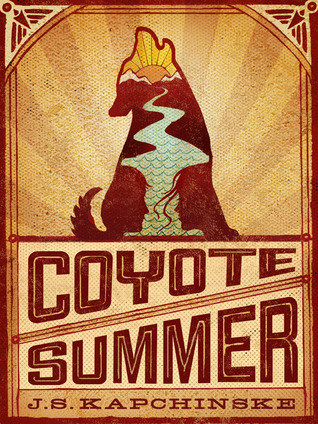
Coyote Summer by J.S. Kapchinske

Share

coyote

Coyote Summer
Author: J.S. Kapchinske
Published March 17, 2013 by Moon Halo Books

Goodreads Summary: Heath always looked forward to summer visits at Grandpa’s—long days in the wild Rocky Mountains, fishing with Dad on the Piedra River, and nights sleeping on the screened-in porch. Plus this summer, Dad promised to finally tell him the secret about old Mrs. Baylis—a mysterious Native American woman living down the dusty dirt road… But now, after Dad’s accident, it can never happen that way. Heath and his mother go to Grandpa’s, but only to spread Dad’s ashes in the river. 

In the beginning, Heath feels like he’s been swallowed by the raging Piedra, held upside down in some dark and unforgiving eddy. But one day, wandering along the riverbank, he meets Annie, a wild-eyed tomboy who shows him a hidden cave with a litter of orphaned coyote pups. Together they discover the cave holds another secret—one that might help them figure out the mystery of old Mrs. Baylis. During that summer in the mountains, Heath comes to realize there is both beauty and ugliness in the world, sometimes all tangled together. By opening himself up to Annie and the coyotes, he rediscovers hope and joy in this big, beautiful, mixed-up world.

My Review: You have never heard of this book have you? That makes me so sad. How do such wonderful books fly under so many people’s radars? This is a special book that should be in the hands of middle schoolers everywhere! Heath is a character that so many kids will connect with, and his journey would definitely touch them like it did me.

Heath recently lost his father senselessly when he was hit by a drunk driver. The sudden loss of a man that Heath looked up to affects him tremendously, and he is struggling to find himself. Everything he does at his Grandpa’s house reminds him of his dad, and his mom and Grandpa are dealing with the death in a way that makes Heath feel alone.  But during this summer, his coyote summer, he finds his own identity, makes an everlasting friend, and begins to figure out how to deal without his dad. And there are other subplots that run throughout he book that just add to the depth of the narrative such as Annie’s story and the story of Mrs. Baylis.

Teachers’ Tools for Navigation: This book just needs to be shared. It could definitely be read as a read aloud, but it will probably find its home the best in the right students’ hands either through the classroom library or lit circles. Students who love nature, have suffered a loss, or enjoy identity books will find this one is perfect for them.

Discussion Questions: How does finding Annie and the coyotes change Heath’s summer?; Why is Grandpa acting the way he is?; Why was it important for Heath to spend the summer with the coyotes? How did it affect him?

We Flagged: “As we sat there, a heron swooped down on the far bank and began stalking the shallows for fish. He moved slowly and hardly made a ripple when he walked. Then he stretched his long neck over the water, cocked his head, and froze.

“He’s pretty,” the girl said under her breath, as if talking to herself.

Somehow, her saying that made me feel better. “Herons were my dad’s favorite. He told me we should all learn to be patient like one of them.”

“Your dad sounds nice.”

I looked down at my hands and felt that horrible lump in my throat.” (Location 196, Kindle book)

Read This If You Loved: Hoot, Flush, Chomp, or Scat by Carl Hiassen, Lost in the River of Grass by Ginny Rorby, My Side of the Mountain by Jean Craighead George, Hatchet by Gary Paulsen

Recommended For:

classroomlibrarybuttonsmall litcirclesbuttonsmall

Signature

**Thank you to the author for providing a copy for review**

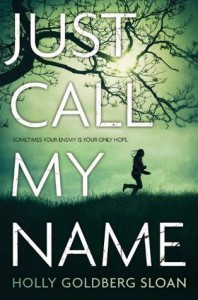
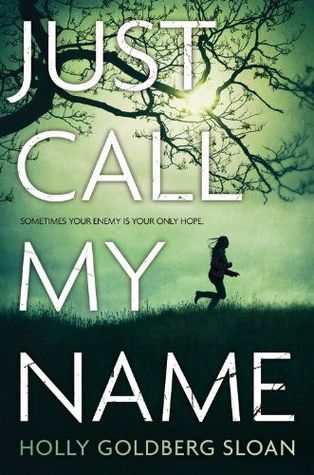
Just Call My Name by Holly Goldberg Sloan

Share

Just Call My Name

Just Call My Name
Author: Holly Goldberg Sloan
Published: August 5, 2014 by Little, Brown Books for Young Readers

Summary: The happily-ever-after of Holly Goldberg Sloan’s acclaimed debut, I’ll Be There, is turned on its head in this riveting, emotional sequel about friends, enemies, and how those roles can shift in a matter of moments.

Emily Bell has it all. She’s in love with a boy named Sam Border, and his little brother has become part of her family. This summer is destined to be the best time of their lives–until a charismatic new girl in town sets her sights on Sam. Now Emily finds herself questioning the loyalty of the person she thought she could trust most.

But the biggest threat to her happiness is someone she never saw coming. Sam’s criminally insane father, whom everyone thought they’d finally left behind, is planning a jailbreak. And he knows exactly where to find Emily and his sons when he escapes…and takes his revenge.

Review: Holly Goldberg Sloan is an incredible writer. I enjoyed the first book in the series, but I liked this one even more. I appreciate the great depth of her characters. Often, coincidences are categorized as poor writing, but Sloan uses them intentionally and in a clever way—defying literary assumptions about quality writing. The book is quite suspenseful, and readers will have the urge to race through it to learn how the plot unravels. The way Sloan builds the plot details is very thoughtful and meticulous, and I found myself constantly reflecting about how intelligent she is. This sequel is well worth the read. It is a difficult one to put down! It reads like a very literary mystery and would be a great text for teachers to have in their classrooms. One aspect that I love about this series is it turns our concept of family on its head; it will teach readers about the power of a strong family unit—traditional or not.

Teacher’s Tools for Navigation: This would be a fantastic resource for teachers teaching plot, suspense, and foreshadowing. The way Sloan builds the events and details is admirable, and students would learn a lot from her design. While it is a sequel, I think this book could certainly stand alone. The ominous mood made my heart race! Check out more curricular connections here: Curricular Connections.

Discussion Questions: How does Sloan thoughtfully use coincidence to build her story?; What is Destiny’s role in the novel? How does Sam perceive her? Is he right? What does this tell us about Sam? Why does the author name her, “Destiny”?; How do the shifts in point-of-view add to your reading of the text?

We Flagged: “That happens to really happy people. They don’t notice the little things” (p.81).

Read This If You Loved: I’ll Be There by Holly Goldberg Sloan, We Were Liars by e. lockhart, YA Suspense/Mystery

Recommended For:

  litcirclesbuttonsmall classroomlibrarybuttonsmall

RickiSig