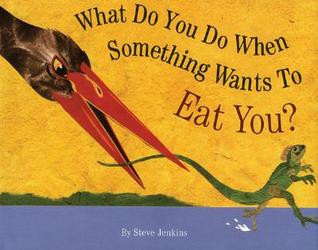
What Do You Do When Something Wants To Eat You? by Steve Jenkins

Share

NF PB 2014

Nonfiction Picture Book Wednesday

Nonfiction Picture Book Wednesday is hosted by Kid Lit Frenzy and was started to help promote the reading of nonfiction texts. Most Wednesdays, we will be participating and will review a nonfiction text (though it may not always be a picture book).
Be sure to visit Kid Lit Frenzy and see what other nonfiction books are shared this week!

eatyou

What Do You Do When Something Wants To Eat You?
Author and Illustrator: Steve Jenkins
Published October 27th, 1997 by HMH Books for Young Readers

Goodreads Summary: What would you do if something wanted to eat you? Walk on water? Stick out your tongue? Play dead? Animals in the wild use all kinds of methods to protect themselves from their enemies. Using dynamic and intricate cut-paper collages, Steve Jenkins explores the many fascinating and unique defense mechanisms creatures use to escape from danger.

My Review: Steve Jenkins just has a way of making nonfiction more interesting than other authors, and this book is no different than his others. This book takes different animals and shows the different ways they protect themselves: from squirting ink to camouflage.  The illustrations are done in Steve Jenkins’s paper-cut style and are done as well as his other books. The text, though simple, is full of information and definitely makes the reader want to learn more.

Teachers’ Tools for Navigation: This book can definitely be used in reading and science class. It is a good introduction to animal defenses and animal adaptations. It can lead to inquiry and research of each of these animals. It would be a great first research project for students to choose one of the animals and learn more about them. It is also a good introduction to cause and effect. What causes _____ to need to defend themselves? What is the effect of ____ being attacked?

Discussion Questions: What type of defenses do animals use to keep themselves from being harmed?; How does camouflage work?; What causes animals to need to defend themselves? What are the effects of them being attacked?

We Flagged: “A flying fish escapes danger by leaping from the water, spreading its winglike fins, and gliding as far as a thousand feet.”

Read This If You Loved: Any Steve Jenkins book, Any Seymour Simon animal book, Lifetime by Lola M. Schaefer, Frog Song by Brenda Z. Guiberson

Recommended For: 

readaloudbuttonsmall closereadinganalysisbuttonsmall
classroomlibrarybuttonsmall litcirclesbuttonsmall

Signature

The Fox in the Library by Lorenz Pauli

Share

the fox in the library

The Fox in the Library
Author: Lorenz Pauli
Illustrator: Kathrin Schaerer
Published August 1st, 2013 by NorthSouth

Summary: Fox didn’t come to the library to read a book–he came to catch a mouse! But  Mouse offers the fox a book, Fox gets all sorts of creative new ideas.  Like eating chickens!  Until Chicken points out that chicken bones are dangerous. But then all the animals must band together when the chicken eating, hating-Farmer walks into the library.

Review: I am a sucker for books about bookstores, books, and libraries. I imagine this is the same for all book lovers. The illustrations in this book are bright, and it was very fun to read it to my son. I don’t think you can read too many books about books to kids. They need to understand that there is a world of books out there, and going to the library is cool! Some books lend themselves to silly voices—and this is certainly one of those books. The mouse even mocks the fox for calling the library a “lie-berry.” I suspect that kids won’t ever forget the pronunciation after hearing this book.

Teacher’s Tool For Navigation: This would be a great book to read to children before a trip to the library. It would stir their imaginations and make them excited to discover all of the creatures that may lurk while they visit.

Discussion Questions: How does Mouse outsmart the fox?; What do the animals learn in their trip?; What kinds of books appeal to each of the animals?


We Flagged: “‘Nothing here belongs to you,’ Mouse said with a giggle. ‘You can only borrow things here. And I’ll never be yours. This isn’t the forest; this is the library'” (6).

Read This If You Loved:  Library Lion by Michelle Knudsen, Wild About Books by Judy Sierra, The Boy who was Raised by Librarians by Carla Morris, Tomas and the Library Lady by Pat Mora

Recommended For: 

readaloudbuttonsmall classroomlibrarybuttonsmall

RickiSig

Locomotive by Brian Floca (Kellee’s Review)

Share

NF PB 2014

Nonfiction Picture Book Wednesday

Nonfiction Picture Book Wednesday is hosted by Kid Lit Frenzy and was started to help promote the reading of nonfiction texts. Most Wednesdays, we will be participating and will review a nonfiction text (though it may not always be a picture book).
Be sure to visit Kid Lit Frenzy and see what other nonfiction books are shared this week!

locomotive

Locomotive
Author and Illustrator: Brian Floca
Published September 3rd, 2013 by Atheneum Books for Young Readers

Goodreads Summary: The Caldecott Medal Winner, Sibert Honor Book, and New York Timesbestseller Locomotive is a rich and detailed sensory exploration of America’s early railroads, from the creator of the “stunning” (Booklist)Moonshot.

It is the summer of 1869, and trains, crews, and family are traveling together, riding America’s brand-new transcontinental railroad. These pages come alive with the details of the trip and the sounds, speed, and strength of the mighty locomotives; the work that keeps them moving; and the thrill of travel from plains to mountain to ocean.

Come hear the hiss of the steam, feel the heat of the engine, watch the landscape race by. Come ride the rails, come cross the young country!

My Review: Rhythm. Onomatopoeias. (Well-researched) History. Gorgeous (and historically accurate) illustrations. Lyrical narrative. Unique point of view. This book has everything.

YOU (second person POV!) are a passenger on a train cross America with your family in 1869. Throughout the book, you will encounter many different landmarks, experience things on a train very few had at this time in history, and learn about the intricacies of the train. So fascinating! And all told in rich, beautiful language. It is hard to even share much more about the book because it is such an experience.

Check out Ricki’s review of Locomotive as well HERE.

Teachers’ Tools for Navigation: I would LOVE to read this to kids. There are so many places to stop and discuss and research and learn, but never without an enthralling story accompanying.  It would be a great book to use across subjects. There are definitely opportunities for all subjects: social studies (trans-continental travel, history, trains); science (the science of steam engines); math (travel); reading/writing (onomatopoeia, point of view, rhythm).

Also, and this is fresh on my mind because I just read it, but I would love to read this and The Donner Dinner Party and then look at the two journeys. How long did each take? Dangers? It would be an interesting look at how trains truly changed transportation.

Discussion Questions: How does having the book in 2nd point of view make it more enthralling?; What onomatopoeias were used in the book? How did these words help suck you into the story?; How did the author’s rhythm make you feel like you are actually on the train?; What are the landmarks that were passed on the trans-continental railroad? Why are these landmarks significant?; How does a steam engine work? What are the jobs of all of the different people on board?

We Flagged:
“Here is how this road was built,
with a grunt and a heave and a swing,
with the ring of shovels on stone,
the ring of hammers on spikes:

CLANK CLANK CLANK!

Men came from far away
to build from the East,
to build from the West,
to meet in the middle.

They cleared the rocks
and dug the tunnels.
They raised the hammers
and brought them down—

“Three strokes to the spike,
ten spikes to the rail!”

CLANK CLANK CLANK!”

Read This If You Loved: The Donner Dinner Party by Nathan Hale, Train by Elisha Cooper

Recommended For: 

readaloudbuttonsmall closereadinganalysisbuttonsmall classroomlibrarybuttonsmall

Signature

Each Kindness by Jacqueline Woodson (Ricki’s Review)

Share

Each Kindness

Each Kindness
Author: Jacqueline Woodson
Illustrator: E.B. Lewis
Published October 2nd, 2012 by Nancy Paulsen Books

Summary: Each kindness makes the world a little better

Chloe and her friends won’t play with the new girl, Maya. Maya is different–she wears hand-me-downs and plays with old-fashioned toys. Every time Maya tries to join Chloe and her gang, they reject her. Eventually, Maya plays alone, and then stops coming to school altogether. When Chloe’s teacher gives a lesson about how even small acts of kindness can change the world, Chloe is stung by the lost opportunity for friendship, and thinks about how much better it could have been if she’d shown a little kindness toward Maya.

This unforgettable book is written and illustrated by the award-winning team that created The Other Side and the Caldecott Honor winner Coming On Home Soon. With its powerful message and striking art, it will resonate with readers long after they’ve put it down.

Review: This is a beautiful story that would be FANTASTIC for the classroom. Students of any age can learn from this book, and I would read it to my class on the very first day of school. It is easy to get caught up in drama and gossip, and Jackie Woodson reminds us how hurtful this can be. I am so glad that I own a copy of this book. I plan to read it to my son very often because the lessons are so important, and the story is simply stunning. Usually, I don’t review a book that Kellee has also reviewed on Unleashing Readers, but I couldn’t help but share my thoughts about this incredible text.

Teacher’s Tool For Navigation: I would be remiss if I didn’t direct you to Kellee’s post about this book. She did a fantastic activity with her class that used multi-flow maps.

One of my favorite parts about this book is that it doesn’t have a happy ending. I would love to discuss this with students–why might this be? Is Woodson teaching us something? Then, we might explore other books that don’t have happy endings and discuss why authors might do this intentionally and how it might impact readers’ feelings about the books. Students are notorious for disliking sad endings, so I think this would provoke much discussion.

This book can be both preventative and reactionary to bullying issues in the classroom/school community. While I would read it at the beginning of the school year, I could also see it as an effective tool for teachers who are having issues with bullying during the school year.  This book makes us want to be better people.
Discussion Questions: Why is Chloe so mean to Maya?; What do we know about Maya? Why do you think Woodson characterizes her this way?; Why does this book end in an unhappy way? What does it teach us?; How might we spread kindness?

We Flagged: “And on that first day, Maya turned to me and smiled. But I didn’t smile back. I moved my chair, myself and my books a little farther away from her. When she looked my way, I turned to the window and stared out at the snow” (6).

Read This If You Loved:  Unicorn Thinks He’s Pretty Great by Bob Shea, Endgame by Nancy Garden, Thirteen Reasons Why by Jay Asher,  The Silver Linings Playbook by Matthew Quick, Burn by Suzanne Phillips, The Perks of Being a Wallflower by Stephen Chbosky, Twisted by Laurie Halse Anderson, Everybody Sees the Ants by A.S. King, The Spectacular Now by Tim Tharp, Inexcusable by Chris Lynch

Recommended For: 

readaloudbuttonsmall classroomlibrarybuttonsmall 

RickiSig


Little Red Writing by Joan Holub

Share

little

Little Red Writing
Author: Joan Holub
Illustrator: Melissa Sweet
Published September 24th, 2013 by Chronicle Books

Goodreads Summary: Acclaimed writer Joan Holub and Caldecott Honoree Melissa Sweet team up in this hilarious and exuberant retelling of Little Red Riding Hood, in which a brave, little red pencil finds her way through the many perils of writing a story, faces a ravenous pencil sharpener (the Wolf 3000)… and saves the day.

My Review and Teachers’ Tools for Navigation: I really think these wonderful woman created this book for just for teachers. It is a perfect, perfect, perfect book for a read aloud AND for a mentor text!

First, the book is a direct allusion to Red Riding Hood and is a great book to throw into the mix when looking at different versions of Red Riding Hood. I can just picture this book, with a version of the original story, Hoodwinked the movie, and Lon Po Po. Wow! What great discussions and activities you could do with this.

Second, this book is not just an awesome narrative and it includes a great lesson about writing a narrative. Red, our main character, is given the job to write a story and the book takes us through her journey of writing the story where she needs to include characters, setting, trouble, and fixing the trouble. A perfect opportunity to discuss narrative elements.  Taking this even further, it would be so much fun to look at the ideas that each of the other pencils had for their stories and write the entire story. You would have to look at each pencil’s personality and think about how s/he would write the story.

Finally, the book also deals with some parts of speech and how to use them. First are verbs where Red looks for more interesting verbs. She then looks for adjectives to add description. Then learns the importance of conjunctions (but watch out! They can lead to run-on sentences). Finally came adverbs with a bit of punctuation and capitalization discussion. Each part of speech is discussed in a nonboring way and the introduction could be a jumping off point to a deeper discussion.

Discussion Questions: How did Red use adjectives throughout the story to help you visualize the action?; What ended up being Red’s trouble, how did it get worse, and how did she fix it?; Pick one of the other pencils’ stories. How do you think it would end?

We Flagged: 

Read This If You Loved: Red Riding Hood by Brothers Grimm, Lon Po Po by Ed Young, The Day the Crayons Quit by Drew Daywalt

Recommended For: 

readaloudbuttonsmall closereadinganalysisbuttonsmall classroomlibrarybuttonsmall

Signature

Locomotive by Brian Floca (Ricki’s Review)

Share

locomotive

Locomotive
Author and Illustrator: Brian Floca
Published September 3rd, 2013 by Atheneum Books for Young Readers

Goodreads Summary: The Caldecott Medal Winner, Sibert Honor Book, and New York Timesbestseller Locomotive is a rich and detailed sensory exploration of America’s early railroads, from the creator of the “stunning” (BooklistMoonshot.

It is the summer of 1869, and trains, crews, and family are traveling together, riding America’s brand-new transcontinental railroad. These pages come alive with the details of the trip and the sounds, speed, and strength of the mighty locomotives; the work that keeps them moving; and the thrill of travel from plains to mountain to ocean.

Come hear the hiss of the steam, feel the heat of the engine, watch the landscape race by. Come ride the rails, come cross the young country!

My Review: Filled with a beautiful array images (watercolor, ink, acrylic, etc.), this incredibly well-researched book takes readers on a journey through the summer of 1869. It took my husband and me three nights to read this title to our son because we needed to pause and take in its magic. After I closed the last page of the book, a library copy, my husband looked at me and mouthed (because our son was asleep), “Let’s buy this one.” There is a wonderful balance of factual information about the train and lyrical language that brims with gorgeous figurative language. This book is a standout and well-deserving of the accolades it has received.

**A special thanks to Kellee, who texted me that I had to read this one. You can read her review here.**

Teachers’ Tools for Navigation: I would use this text in any grade level. I envision the eager eyes of elementary school students as their curiosity is piqued… middle schoolers, suddenly interested in trains and this time in our history…or high schoolers, researching the different parts of the train and learning how effective figurative language can be in writing. This book would be a great mentor text to teach creativity. The layout of the pages is so very purposeful, which pave the way for great classroom discussions.

Discussion Questions: How does Brian Floca grab the readers’ attention? How is his writing purposeful?; In what ways does Floca manipulate language?; How does the second person point-of-view add to the story?; What does this book teach us? Go beyond the obvious.; How do the pages differ in their visual appeal? Why do you think this is?

We Flagged:

Rather than including a quote here, I wanted to show you a few of the gorgeous spreads with this book. These pages are pulled from images posted on Amazon.

locomotive1 locomotive2 locomotive4 locomotive3

Read This If You Loved: The Polar Express by Chris Van Allsburg

Recommended For: 

readaloudbuttonsmall closereadinganalysisbuttonsmall classroomlibrarybuttonsmall

RickiSig

Flying Solo: How Ruth Elder Soared into America’s Heart by Julie Cummins

Share

NF PB 2014

Nonfiction Picture Book Wednesday

Nonfiction Picture Book Wednesday is hosted by Kid Lit Frenzy and was started to help promote the reading of nonfiction texts. Most Wednesdays, we will be participating and will review a nonfiction text (though it may not always be a picture book).
Be sure to visit Kid Lit Frenzy and see what other nonfiction books are shared this week!

flying

Flying Solo: How Ruth Elder Soared into America’s Heart
Author: Julie Cummins
Illustrator: Malene R. Laugesen
Published July 23rd, 2013 by Roaring Brook Press

Goodreads Summary: In 1927, airplanes were a thrilling but dangerous novelty. Most people, men and women, believed that a woman belonged in the kitchen and not in a cockpit. One woman, Ruth Elder, set out to prove them wrong by flying across the Atlantic Ocean. Ruth didn’t make it, crashing spectacularly, but she flew right into the spotlight and America’s heart. This is the story of a remarkable woman who chased her dreams with grit and determination, and whose appetite for adventure helped pave the way for future generations of female flyers.

My Review and Teachers’ Tools for Navigation: Ruth Elder joins the group of amazing women who have eye-opening picture books about them and how they changed history. (I love this trend!) More and more brilliant and brave women from history are getting recognition through their story being told. Ruth Elder was America’s sweetheart daredevil, and through her crazy feats showed America that woman were brave too. Although Amelia Earhart beat her in her mission to cross the Atlantic, she never stopped pushing herself and the women around her. I would love to see a unit about amazing women in history that uses the slew of beautiful picture books about these woman. One idea would be splitting up kids into groups, having them each read about one of the picture books, maybe doing some extra research, and then sharing with the other groups what they learned. It’d be a great way to give these women the spotlight they deserve.

Discussion Questions: Although Ruth did not cross the Atlantic, why did she become famous?; Ruth had the chance to be a Hollywood star, but she chose to go back to flying–why would she make this decision? Do you agree with her decision?; How did Ruth and her race help change America’s view of woman pilots?

We Flagged: “On August 18, 1929, Ruth and nineteen other women set out to show that women could fly airplanes just as well as men in the first women’s cross-country air race. The pilots had more than headwinds to counteract. One reporter sputtered, “The only thing worse than dames in planes is dames racing planes!””

Look inside Flying Solo at Amazon

Read This If You Loved: Daredevil by Meghan McCarthy, Amelia Lost by Candace Fleming

Recommended For: 

readaloudbuttonsmall classroomlibrarybuttonsmall litcirclesbuttonsmall

Signature