If You Find Me by Emily Murdoch

Share

 15793231

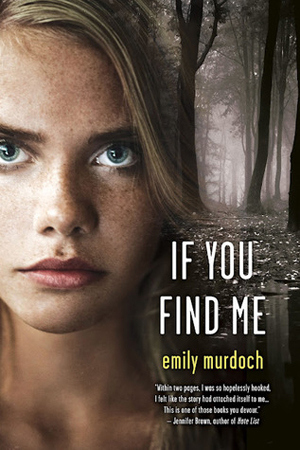
If You Find Me
Author: Emily Murdoch
Published: March 26th, 2013 by St. Martin’s Griffin

GoodReads Summary: There are some things you can’t leave behind…

A broken-down camper hidden deep in a national forest is the only home fifteen year-old Carey can remember. The trees keep guard over her threadbare existence, with the one bright spot being Carey’s younger sister, Jenessa, who depends on Carey for her very survival. All they have is each other, as their mentally ill mother comes and goes with greater frequency. Until that one fateful day their mother disappears for good, and two strangers arrive. Suddenly, the girls are taken from the woods and thrust into a bright and perplexing new world of high school, clothes and boys.

Now, Carey must face the truth of why her mother abducted her ten years ago, while haunted by a past that won’t let her go… a dark past that hides many a secret, including the reason Jenessa hasn’t spoken a word in over a year. Carey knows she must keep her sister close, and her secrets even closer, or risk watching her new life come crashing down.

Review: It has been a while since I couldn’t put a book down. This gut-wrenching tale captivated me from the very beginning. When authors try to portray emotions, they can feel superficial for readers. But Murdoch’s writing feels effortless. I connected with Carey in a way that reminded me of how I understood Melinda in Speak by Laurie Halse Anderson. My hands shook with anger in response to her pain, and as she felt overwhelmed and scared, I cried along with her. The backwoodsy dialect made the story feel real and authentic. It constantly reminded me of where Carey was coming from. Murdoch expertly unfolds the plot for readers, which adds a level of complexity but also makes readers feel as if they are coming to terms with Carey’s life right along with her. This is a beautiful, compelling story that I won’t forget.

Teacher’s Tools for Navigation: One of the strengths of this book is the special bond between the siblings. Carey’s love for her 6-year-old sister, Jenessa, fills the reader with comfort and sureness. It would be interesting for students to consider this bond and what holds these two sisters together. I could also see students researching more about child abuse and neglect. Carey and Jenessa have to make a dramatic adjustment to life on the outside, and I imagine that students will want to learn more about this struggle and its potential difficulties.

Discussion Questions: Why does Carey keep secrets? Do you agree with her decisions?; Why does Carey have difficulty forming a relationship with her father? Do you think she has been brainwashed?; What are the long-term effects of abuse? What kinds of abuse are there? Will Carey ever heal?

We Flagged:

“I answer her with my silence, understanding the full power of it for the first time. Words are weapons. Weapons are powerful. So are unsaid words. So are unused weapons” (p. 24).

“We make attachments to what’s familiar. We find the beauty, even in the lack. That’s human. We make the best of what we’re given” (p. 169).

Read This If You Loved: Speak by Laurie Halse Anderson, Room by Emma Donoghue, A Child Called “It” by Dave Pelzer, The 5th Wave by Rick Yancey (for the sibling bond and the woodsy setting), Bastard Out of Carolina by Dorothy Allison, White Oleander by Janet Fitch, Stolen: A Letter to My Captor by Lucy Christopher

Recommended For:

litcirclesbuttonsmall classroomlibrarybuttonsmall

RickiSig

The Outside of a Horse by Ginny Rorby

Share

This week I am celebrating with my friend and author Ginny Rorby as she receives her award from the Florida Association for Media in Education (FAME) for winning the Sunshine State Young Readers Award (as voted by 6-8 grade students in Florida) for Lost in the River of Grass. To celebrate, I will be reviewing all of her books this week:

outside

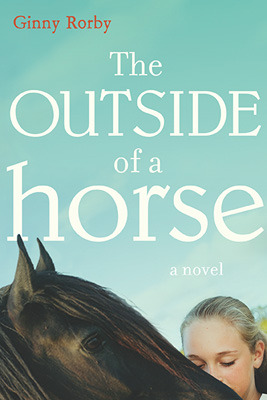
The Outside of a Horse
Author: Ginny Rorby
Published May 13th, 2010 by Dial

Goodreads Summary: Hannah Gale starts volunteering at a horse stable because she needs a place to escape. Her father has returned from the Iraq war as an amputee with posttraumatic stress disorder, and his nightmares rock the household. At the stable, Hannah comes to love Jack, Super Dee, and Indy; helps bring a rescued mare back from the brink; and witnesses the birth of the filly who steals her heart. Hannah learns more than she ever imagined about horse training, abuse, and rescues, as well as her own capacity for hope. Physical therapy with horses could be the answer to her fatherÕs prayers, if only she can get him to try.

My Review: Ginny Rorby writes books about animal-human relationships and the healing power of these animals. This is animal fiction that falls into a completely different realm than others. She breathlessly intertwines human problems with animals. Her previous book, Hurt Go Happy, dealt with Joey, a deaf young girl, her mother’s inability to deal with her disability, and how Sukari, a young chimpanzee, helps Joey and her mother accept their life. Her newest book, The Outside of a Horse, deals with Hannah. Hannah Gale feels so alone. Her mother passed away from cancer a few years ago, her father is fighting in Iraq, her stepmother doesn’t really connect with her, and her brother, Jeffy, is just too young to be there for her. The only comfort to Hannah is when her school bus drives by the stables and she gets to see the horses. It is through these horses that Hannah finds comfort during this difficult time in her life that just keeps getting worse and worse.

It is through Ginny Rorby’s believable characters and realistic situations that the reader feels so connected to the animals and humans of her novels. Both The Outside of a Horse and Hurt Go Happy deal with not only a human issue, but an animal issue as well. The Outside of a Horse shows the reader the truth behind horse racing. What makes Rorby’s books different, though, is that she teaches about an animal issue, but does not preach. She lets you take in the truth and decide for yourself if it is an injustice or not.

Teacher’s Tools for Navigation: Outside of a Horse deals with some hard issues and is a book that many students won’t grab right away; however, read a couple of chapters to your classes and there will be a waiting list for it.

Discussion Questions: The Outside of a Horse shares an injustice with us that many people do not realize and is ignored. What is something that you believe is wrong that others enjoy?

Read This If You Loved: BADD by Tim Tharp, Another Kind of Cowboy by Susan Juby, Gabriel’s Horses by Alison Hart, Faithful Elephants by Yukio Tsuchiya

Recommended For: 

readaloudbuttonsmall

Signature

Hurt Go Happy by Ginny Rorby

Share

This week I am celebrating with my friend and author Ginny Rorby as she receives her award from the Florida Association for Media in Education (FAME) for winning the Sunshine State Young Readers Award (as voted by 6-8 grade students in Florida) for Lost in the River of Grass. To celebrate, I will be reviewing all of her books this week:

hurt

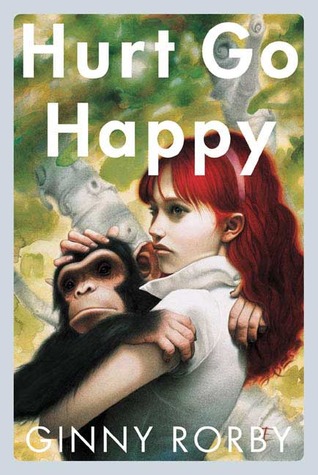
Hurt Go Happy
Author: Ginny Rorby
Published August 8th, 2006 by Starscape

Goodreads Summary: Thirteen-year-old Joey Willis is used to being left out of conversations. Though she’s been deaf since the age of six, Joey’s mother has never allowed her to learn sign language. She strains to read the lips of those around her, but often fails.

Everything changes when Joey meets Dr. Charles Mansell and his baby chimpanzee, Sukari. Her new friends use sign language to communicate, and Joey secretly begins to learn to sign. Spending time with Charlie and Sukari, Joey has never been happier. She even starts making friends at school for the first time. But as Joey’s world blooms with possibilities, Charlie’s and Sukari’s choices begin to narrow–until Sukari’s very survival is in doubt.

My Review and Teacher’s Tools for Navigation: This book is so important to me it is even hard to write this review. I have never written one because the book has become so personal to me that I didn’t know how to share my feelings. When I read Hurt Go Happy for the first time, I knew that it was the book that I wanted to share with every student I ever had.  Hurt Go Happy shows the importance of empathy for animals, for children and for people with disabilities.

Hurt Go Happy has become the number one community builder in my classroom.  After our state test and our Earth day activity with The Lorax we begin our read aloud of  Hurt Go Happy. (One of the saddest things about not being in the classroom this year is that I will not be able to have this moment with students.) Not only does the book give me opportunities to work with setting, characterization, cause/effect, prediction, compare/contrast, sequence, and analogies, throughout the book my class participates in conversations about deafness, sign language, chimpanzees, abuse, research facilities, animal abuse, wild animals as pets, survival, parents, school, death, fear, and their future. The conversations are so deep and wonderful.  But this is just the beginning.  Following the reading of the novel, my students are lucky enough to be able to take part in an interview with the author of  Hurt Go Happy, Ginny Rorby. The students generate the questions, vote on which ones to ask and even ask her the questions. Ginny even allows us to send her extra questions and answers them for my students.

The part that really makes students connect to the novel is the field trip that we go on.  At the end of the book, the setting changes to a rehab facility called The Center for Great Apes (@CFGA) which, while in the book was in Miami, has moved to Wauchula, FL which is 90 minutes from my school.  In the book, you even meet Noelle, a chimp who knows sign language, Kenya, another chimpanzee, and Christopher, an orangutan, who are actually at the center. It is an amazing experience to take the story and turn it into reality.

Hurt Go Happy is a book that I feel not only bring our class together but teaches my students some of the most important lessons for life: to care about every living thing.

Discussion Questions: I have many that would give spoilers, but here are my essential questions for the book: Do you think animal testing is necessary? Defend your answer.; How would being deaf affect your life? How does it affect Joey’s?

We Flagged: “Before she’d lost her hearing, she loved the whisper of wind through pines, and since she had no way of knowing how different it sounded in a redwood forest, the sight of branches swaying re-created the sound in her mind. Even after six and a half years of deafness, she sometimes awoke expecting her hearing to have returned, like her sight, with the dawn.” (p. 11)

Read This If You Loved: Endangered by Eliot Schrefer, The One and Only Ivan by Katherine Applegate, Me…Jane by Patrick McDonnell, Wonderstruck by Brian Selznick, El Deafo by Cece Bell, Half Brother by Kenneth Oppel, Ivan: The Remarkable True Story of the Shopping Mall Gorilla by Katherine Applegate

Recommended For: 

classroomlibrarybuttonsmall readaloudbuttonsmall closereadinganalysisbuttonsmall litcirclesbuttonsmall

Signature

See my extended review of Hurt Go Happy when celebrating the Schneider Award’s 10th birthday include an interview with Ginny Rorby!

Lost in the River of Grass by Ginny Rorby

Share

This week I am celebrating with my friend and author Ginny Rorby as she receives her award from the Florida Association for Media in Education (FAME) for winning the Sunshine State Young Readers Award (as voted by 6-8 grade students in Florida) for Lost in the River of Grass. To celebrate, I will be reviewing all of her books this week.

SSYRA


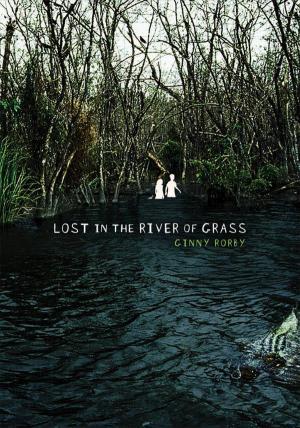
lost

Lost in the River of Grass
Author: Ginny Rorby
Published February 9th, 2011 by Carolrhoda Books

Goodreads Summary: “I don’t realize I’m crying until he glances at me. For a moment, I see the look of anguish in his eyes, then he blinks it away and slips off into the water. I immediately think of the gator. It’s still down there somewhere…”

A science-class field trip to the Everglades is supposed to be fun, but Sarah’s new at Glades Academy, and her fellow freshmen aren’t exactly making her feel welcome. When an opportunity for an unauthorized side trip on an airboat presents itself, it seems like a perfect escape—an afternoon without feeling like a sore thumb. But one simple oversight turns a joyride into a race for survival across the river of grass. They’re forced to walk out of the Everglades (they’ve got a knife, a small amount of Gatorade and some suspicious Spam). Sarah will have to count on her instincts—and a guy she barely knows—if they have any hope of making it back alive.

Lost in the River of Grass takes on the classic survival genre using one of the country’s most unique wild places as a backdrop. It is in the tradition of survival stories like Hatchet or My Side of the Mountain, where the young protagonist finds herself as she struggles to survive in an unforgiving wilderness. In this tense, character-driven thriller, Sarah must overcome prejudice and the unforgiving wilderness in a struggle to survive.

My Review: This is Ginny’s most human of a novel. It is about survival and finding the strength inside of yourself to stand up to anything- even something that has always terrified you. Throughout the novel, Sarah and Andy, who are lost in the Everglades, face things that are only in most of our nightmares. I learned, quite quickly, that I probably wouldn’t survive if I was lost in the river of grass. But Sarah, who is scared of EVERYTHING, grows up right in front of our eyes. This book made me gasp, cry, laugh- go through the cycle of emotions, but that is what makes a book so wonderful. Ginny Rorby knows how to write characters that the reader can connect with and this is no exception- Sarah is just a normal girl and Andy is just a normal boy, but through their journey they found out how extraordinary they are.

Teacher’s Tools for Navigation: This book is loved by students. I saw it when it was an SSYRA nominee—students devoured it and loved talking about the crazy survival moments and the surprise ending. Because of the love that students have for it, Lost in the River of Grass is perfect for classroom libraries and for read alouds.

Discussion Questions: Sarah is afraid of snakes.  How does she overcome her fear?  What are you afraid of? How could you overcome your fear?; What does Lost in the River of Grass teach us about prejudice?

We Flagged: “I onlly get a dozen feet ahead of him when my leg hits something hard and knobby. In a heart-stopping moment, I know it’s the gator, yet I can’t move. In my mind I see its pink throat and huge teeth coming up through the murky water. something brushes the back of my neck, and I scream.” (p. 72)

Read This If You Loved: Brian books by Gary Paulsen, My Side of the Mountain by Jean Craighead George, Trapped by Michael Northrop, Island of the Blue Dolphins by Scott O’Dell, The Great Wide Sea by M.H. Herlong

Recommended For: 

classroomlibrarybuttonsmall readaloudbuttonsmall

Congratulations again Ginny! You deserve it!

Signature

Forgive Me, Leonard Peacock by Matthew Quick

Share

 13477676

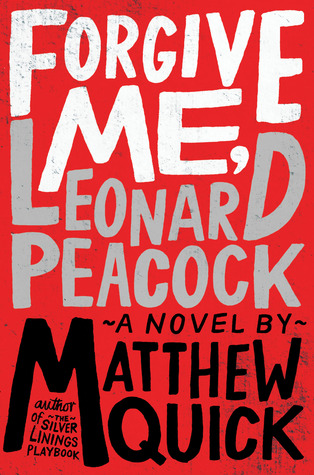
Forgive Me, Leonard Peacock
Author: Matthew Quick
Published: August 13th, 2013 by Little, Brown Books for Young Readers

GoodReads Summary: In addition to the P-38, there are four gifts, one for each of my friends. I want to say good-bye to them properly. I want to give them each something to remember me by. To let them know I really cared about them and I’m sorry I couldn’t be more than I was—that I couldn’t stick around—and that what’s going to happen today isn’t their fault.

Today is Leonard Peacock’s birthday. It is also the day he hides a gun in his backpack. Because today is the day he will kill his former best friend, and then himself, with his grandfather’s P-38 pistol.

But first he must say good-bye to the four people who matter most to him: his Humphrey Bogart-obsessed next-door neighbor, Walt; his classmate Baback, a violin virtuoso; Lauren, the Christian homeschooler he has a crush on; and Herr Silverman, who teaches the high school’s class on the Holocaust. Speaking to each in turn, Leonard slowly reveals his secrets as the hours tick by and the moment of truth approaches.

In this riveting book, acclaimed author Matthew Quick unflinchingly examines the impossible choices that must be made—and the light in us all that never goes out.

Review: I have read every one of Matthew Quick’s books. He is a teacher, and I feel as if he understands teenagers in ways that many people don’t. Quick’s characters feel like real people, and while I read this one, I kept forgetting that I was even reading a book. To be cliché, I was lost in the story.

Leonard Peacock is a complex character. Even with his evil intention to murder a fellow classmate, the reader comes to understand that he is deeply troubled and not at all evil on the inside. His plan is to give three gifts to three individuals who have positively impacted his life, then kill his classmate, and then kill himself. I read this book with an uncomfortable stomach. I couldn’t put it down because I needed to know how the plot unraveled. Kids will be hooked. It teaches incredible messages of bullying and loneliness. Leonard’s mother is such a terrible parent that I think it will make many teens appreciate their own parents. I had the urge to scream at her at several points in the book. I have read many books that are somewhat similar to the themes of this text, yet it felt very different. I would urge teachers to read it because it sheds light on issues that are often difficult (or maybe even taboo) to discuss.

Teacher’s Tools for Navigation: My initial thought was that this would make an incredible read-aloud. I think all types of kids would appreciate it. My only hesitance are there are several references to awkward scenes (like masturbation), and even the most liberal teachers might feel a bit uncomfortable reading these aloud. That said, I think this would make an excellent whole-class text or literature circle book. Teachers would also find value in close readings of portions of this text to jumpstart difficult (but important) conversations with students about bullying, depression, and suicide. The book has over sixty footnotes, and it would be interesting to discuss this text feature and/or the experiments that Quick takes with the text structure. The book ends a bit abruptly, and I think students would love to write and discuss extended endings to the text. I would love to see this book bridged with classic texts like The Awakening by Kate Chopin or Hamlet by William Shakespeare. There are a plethora of Shakespeare references that will make teachers drool!

Discussion Questions: What leads a person to make rash, violent decisions? Can s/he be stopped?; How does our past influence our psyche?; Is revenge sweet? Can it ever be justified?; How do our parents shape our mental behavior?; What happens after the conclusion of this text?

We Flagged:

“I admire [Humphrey] Bogart because he does what’s right regardless of consequences—even when the consequences are stacked high against him—unlike just about everyone else in my life” (p. 23).

“How do you measure suffering?

I mean, the fact that I live in a democratic country doesn’t guarantee my life will be problem-free.

Far from it.

I understand that I am relatively privileged from a socio-economical viewpoint, but so was Hamlet—so are a lot of miserable people” (p. 94).

Read This If You Loved: Endgame by Nancy Garden, Thirteen Reasons Why by Jay Asher, Hamlet by William Shakespeare, The Silver Linings Playbook by Matthew Quick, Burn by Suzanne Phillips, The Perks of Being a Wallflower by Stephen Chbosky, Twisted by Laurie Halse Anderson, Everybody Sees the Ants by A.S. King, The Spectacular Now by Tim Tharp, Inexcusable by Chris Lynch

Recommended For:

litcirclesbuttonsmall closereadinganalysisbuttonsmall classroomlibrarybuttonsmall

026F3FBCC8C3913BD3A4D3F6920340D5

Hilda and the Midnight Giants by Luke Pearson

Share

hilda

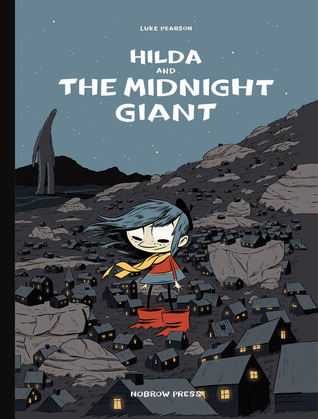
Hilda and the Midnight Giant
Author: Luke Pearson
Published April 17th, 2012 by Nobrow Press

Goodreads Summary: In Hilda and the Midnight Giant, our protagonist finds her world turned upside down as she faces the prospect of leaving her snow-capped birthplace for the hum of the megalopolis, where her mother (an architect) has been offered a prestigious job. During Hilda’s daily one-and-a-half hour trek to school she looks for ways to stall her mother’s decision. She conspires with the beings of the mystical Blue Forest to delay the inevitable. Will they help or hinder her? More importantly, who is this mysterious Midnight Giant?

This is the first part of the Hildafolk series, a series that follows Hilda on her many adventures and travels through the magical fjords and enchanted mountains of her birthplace as she unravels the mysteries of the supernatural world that surrounds her.

My Review: When Hilda and the Midnight Giant was in Mr. Schu and Scope’s Top 20 of 2012 and I hadn’t heard of it, I knew I had to get my hands on it. Graphic novels are the most loved format in my classroom and I try to keep as up to date about them as I can. I went straight to my bookstore, ordered it, and waited patiently. When it arrived, I delved right in. On my first read, I just found the story odd and didn’t find myself connecting to the story at all. I knew then and there that I needed to reread at a later date to see if my perspective changed. Like Penny Kittle says in Book Love, “Rereading is an opportunity to see more. On the first time through a novel I am trying to figure out who is who and what is happening. I’m too engaged in understanding to analyze the book well. ON a second time through, I see the whole and then the parts differently.” And this was no exception with my reread of Hilda.

Hilda reminds me a bit of Coraline- she is independent, a bit quirky and loves rainwear. And just like Coraline, she has a fantastical world surrounding her and she doesn’t even know it.  It took this second time for me to realize the magic within this story: the connection between Hilda’s and the Giant’s story, the love of the Giants, the magical world of Elves, and the fascinating Woffs.

I read one review that said Hilda’s fantastical world reminded them of Miyazaki’s work and though I didn’t see it the first time (I think I was just caught up in the oddness), I definitely saw it the second time. The Woffs reminded me most of him- silent creatures that play a small yet important role in the story.

In the end, I am so glad that I reread Hilda so I could get the full magical experience and I definitely recommend it.

Teachers Tools for Navigation: There are many special things about this book and although I think it will find its best home in classroom libraries, it can definitely be used for a mentor text as well. It is a great text to share about world building and also to learn about graphic novels and paneling. It can also be used to practice predicting as Hilda is filled with unexpectedness throughout.

Discussion Questions: Is there something that you viewed differently after reading/seeing it for the second time like I did with Hilda? If not, try rereading a story that you didn’t like; see if your perspective changes.

We Flagged: 

Read This If You Loved: Coraline by Neil Gaiman, Explorer edited by Kazu Kibuishi, The Arrival by Shaun Tan, Castle Waiting by Linda Medley

Recommended For: 

closereadinganalysisbuttonsmall classroomlibrarybuttonsmall

Signature

Blog Tour and Review!: Hetty Feather & My Sister Jodie by Jacqueline Wilson

Share

JW Blog Tour banner

hetty

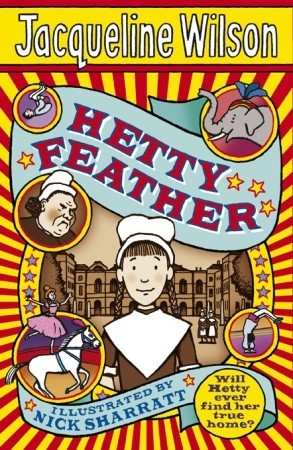
Hetty Feather
Author: Jacqueline Wilson
Published August 5th, 2010 by Random House Children’s Publishers UK

Goodreads Summary: London, 1876 and Hetty Feather is just a tiny baby when her mother leaves her at the Foundling Hospital. The Hospital cares for abandoned children – but Hetty must first live with a foster family until she is big enough to go to school.

Life in the countryside is hard but with her ‘brothers’ Jem and Gideon, she helps in the fields and plays imaginary games. Together they sneak off to visit the traveling circus and Hetty is mesmerised by the show, especially Madame Adeline and her performing horses.

But Hetty’s happiness is threatened once more when she is returned to the Foundling Hospital. The new life of awful uniforms and terrible food is a struggle for her. But now she has the chance to find her real mother. Could she really be the wonderful Madame Adeline? Or will Hetty find the truth is even more surprising?

Jacqueline Wilson will surprise and delight old fans and new with this utterly original take on a historical novel. Set in Victorian times and featuring a brand new feisty heroine, Hetty Feather, this is a Tracy Beaker-esque tale that will thrill young readers. Warm, moving, funny and totally fascinating, it’s the perfect gift for girls of eight and older.

Ricki’s Review: Hetty Feather is a feisty, red-headed little girl. I absolutely loved her spunk and was always rooting for her as she navigated life on the countryside and in the orphanage. Hetty is determined, and she will surely teach young girls to fight for themselves. In turn, she is constantly getting into trouble! I love books that teach girls to be strong and confident, and this one is no exception. I’d love to have a daughter that has the confidence and independence of this young girl. She forms wonderful bonds with her foster siblings and other girls in the orphanage and is extremely loyal to them. I am not surprised that it is so popular in the U.K. and would love for Hetty Feather’s passion and spunk to become more familiar to American girls (and all girls, for that matter)!

Teacher’s Tools for Navigation: I imagine that students who read books about this historical time period will be interested in learning more about the setting. Teachers could help them search for articles and books to learn more about the context of the story. They might also compare Hetty Feather to other strong females of history.

Discussion Questions: Is Hetty Feather too much of a troublemaker or do you think her actions are justified?; Which characters does Hetty bond closely with? What types of people does she pair well with?; Do you think that Hetty’s personality is shaped by the fact that she is an orphan?

We Flagged: “My name is Hetty Feather. Don’t mock. It’s not my real name. I’m absolutely certain my mother would have picked out a beautiful romantic name for me—though sadly I have not turned out beautiful or romantic” (p. 1).

Read This If You Loved: Madeline by Ludwig Bemelmans, Little Orphan Annie by Harold Gray, The Humming Room by Ellen Potter, May Amelia by Jennifer L. Holm, Chains by Laurie Halse Anderson, Esperanza Rising by Pam Munoz Ryan
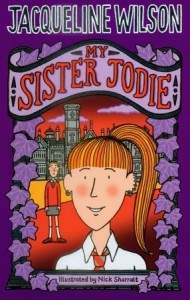
jodie

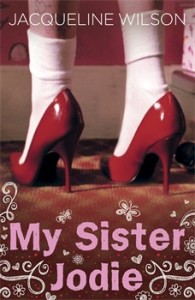
My Sister Jodie
Author: Jacqueline Wilson
Published March 12th, 2009 by Random House Children’s Publishers UK

Goodreads Summary: Pearl and Jodie are sisters. Pearl is the younger one, small, shy and anxious. Jodie is nearly three years older, bold and brash and bad and Pearl adores her. When their parents get new jobs at Melchester College, a Victorian Gothic mansion, the girls spend a bizarre summer holiday in the boarding school with just a few leftover children for company. Things start to change now they are in their new home. Jodie has always been the leader but now it’s Pearl who’s making new friends. When term begins, their strange summer is over. But things keep on changing. Jodie really doesn’t fit in with the posh teenagers in her class. Pearl is blossoming. Maybe she doesn’t need Jodie as much as she used to. But Jodie needs her. And when the school celebration of Firework Night comes around and a tragic event occurs, Pearl realises quite how much she does need her big sister.

Kellee’s Review: I will say that I struggled a bit with getting used to the British lingo, but once I did, it was free sailing. I loved Pearl. She was someone who I wish was my friend. She loved books, had a great imagination, was empathetic, and overall a good person. Jodie was harder to swallow. She was going through what many girls go through in their mid-teens, trying to find herself, and I wish the book had been from her point of view because I wish I understood her more. Instead, we see her from Pearl’s point of view and Pearl loves her sister, but just doesn’t understand her. Also, Pearl, once they reach the boarding school, is working on finding herself and finally making friends. Now, the one person that I probably flat out disliked was their mother. I’d love to talk to someone who has read the book to see if you took her the same way I did…

Also, just for fair warning, this book does elicit many different types of emotions—be ready!

Teacher’s Tools for Navigation: Jacqueline Wilson has had great success in the UK and I can see why. My Sister Jodie will find a whole new group of readers when placed in libraries.

Discussion Questions: What is something that you do/feel that your parents do not understand?; Do you have a sibling? If so, what do they do that you do not understand?

We Flagged: “Jodie. It was the first word I ever said. Most babies lisp Mumma or Dadda or Drinkie or Teddy. Maybe everyone names the thing they love best. I said Jodie, my sister. OK, I said Dodie because I couldn’t say my Js properly, but I knew what I meant. I said her name first every morning.

‘Jodie? Jodie! Wake up. Please wake up!’

She was hopeless in the mornings. I always woke up early – six o’clock, sometimes even earlier. When I was little, I’d delve around my bed to find my three night-time teddies, and then take them for a dawn trek up and down my duvet. I put my knees and they’d clamber up the mountain and then slide down. Then they’d burrow back to base camp and tuck their pretend porridge for breakfast.” (p. 7)


Read This If You Loved: The Wig in the Window by Kristen Kittscher, The Summer of May by Cecilia Galante, The Great Gilly Hopkins by Katherine Patterson

Hetty Feather and My Sister Jodie Recommended For: 

classroomlibrarybuttonsmall

Jacqueline Wilson, known throughout Britain as the most popular writer for girls aged 7-15 has sold over 35 million copies of her books in the UK. She was appointed as the Children’s Laureate from 2005-7 (a prestigious UK award which celebrates outstanding achievement in children’s books) and received an OBE from the Queen in 2002 for services to literacy in schools. In 2008 she was further awarded a DBE in the Queen’s New Year Honour’s List, making her Dame Jacqueline Wilson. Her books contain universal themes popular with children all over the world. Family life, friendship and bullying are regularly featured and her characters often find themselves in difficult circumstances. Her books have been praised for their unique blend of realism and humor, and she is loved by children and parents alike for her non-patronising approach to writing for children.

The book trailers which accompany Jacqueline Wilson’s releases have become a much-anticipated part of the build up to her new releases. Her YouTube channel has over 2,000 subscribers and the most popular trailer, “The Worst Thing About My Sister”, has received 335,000 views.

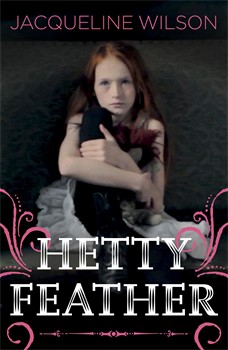
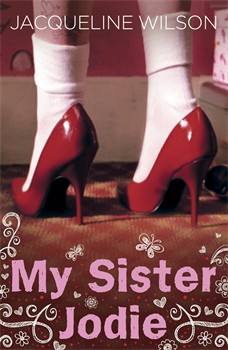
For the US ebook launch this year, new editions of her most recent 9 titles have been created with exclusive bold photographic covers, many of which use imagery from the book’s trailers:
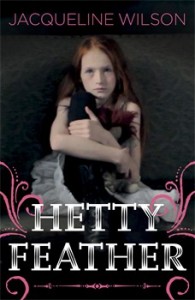
hettyus jodieus

Jacqueline Wilson’s ebooks are available through all major ebook retailers.

Please visit www.jacquelinewilson.us for more information about Jacqueline Wilson and the new collection, including book trailers.

Don’t forget to check out the other stops on the tour: 

October 13th: Hetty Feather on Ms Yingling Reads
October 14th: Lily Alone on Ms Yingling Reads, for Marvellous Middle Grade Monday
October 15th: The Longest Whale Song on Ms Yingling Reads
October 16th: Little Darlings on Ms Yingling Reads
October 17th: Hetty Feather on Ms Yingling Reads
October 18th: The Worst Thing About My Sister on Ms Yingling Reads, for Tomboy Friday!
October 19th: Hetty Feather on The Fourth Musketeer
October 20th: Hetty Feather trilogy 1 on Teacher Dance
October 23rd: Excerpt of Hetty Feather on Great British Reads
October 28th: Hetty Feather trilogy 2 on Teacher Dance
October 30th: Excerpt of Queenie on TBC
November 4th: Hetty Feather Triology on Geo Librarian
November 5th: Hetty Feather on Forget About TV
November 6th: Lily Alone on Geo Librarian
November 7th: The Longest Whale Song on Geo Librarian
November 8th: Little Darlings on Geo Librarian
November 9th: The Worst Thing About My Sister on Geo Librarian
November 10th: Queenie on Geo Librarian
November 11th: My Sister Jodie on Forget About TV

See more at: http://www.jacquelinewilson.us/index.php/jacqueline-wilson-blog-tour/

Signature andRickiSig