Astronaut Annie by Suzanne Slade

Share

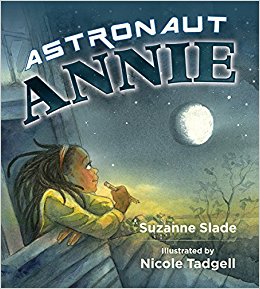
Astronaut Annie
Author: Suzanne Slade; Illustrator: Nicole Tadgell
Published March 6, 2018 by Tilbury House Publishers

Goodreads Summary: Career Day is approaching, and Annie can’t wait to show her family what she’s planning to be when she grows up. But, she must keep it a secret until Friday! So curious family members each ask Annie for a clue. Convinced that she’ll be a news reporter like he once was, Grandpop gives her his old camera and notebook to use for her presentation. Grandma is sure Annie wants to be a champion baker like her, so she offers a mixing bowl and oven mitts to Annie. Hopeful she’ll become the mountain climber he aspired to be, Dad gives Annie an old backpack. Mom presents Annie with a pair of high-top sneakers to pursue Mom’s favorite sport in high school — basketball.

Grateful for each gift, Annie cleverly finds a way to use them all to create her Career Day costume. When the big day arrives, Annie finally reveals her out-of-this-world dream to everyone.

ReviewThis book served as a gentle reminder to me, as a parent! As Annie prepares for career day, all of her family members think she’d be great at their jobs. Annie honors their suggestions by creating a costume that incorporates all of their ideas, and just in case readers doubt her ability to be a female astronaut, the back matter (which features four famous women in space) would prove them wrong. This is a great story about a girl who sets her heart firmly on her dreams and is determined to pursue her passion. I particularly appreciated the ending, in which all of her family members are supportive of her dreams. I got emotional as I read it! I adored this book and feel lucky to have it in my library.

Teachers’ Tools for Navigation: I was very inspired by the school’s Career Day setup! Each child dresses like the career they want to be. Our local school districts does a lot of neat things, and this is the kind of idea that they would adopt. Perhaps teachers could read this book and then set up a Career Day that allows kids to dress up to represent a career that interests them. What a great, inspiring school day this would be!

Discussion Questions: How does Annie react to her family members’ suggestions? How does she honor their suggestions at the end of the story?; Are her family member supportive of her dreams?; What do you want to be when you grow up? What famous people have held this career? How could you learn more about this career?

We Flagged: “And Annie jumped high off her chair, explored far-off places and soared through the air.”

Read This If You Loved: Books about space, books that feature strong females(!), books that feature family

Recommended For: 

classroomlibrarybuttonsmall 

**Thank you to Nicole for providing a copy for review**

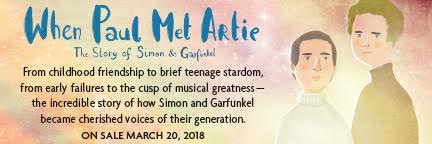
When Paul Met Artie: The Story of Simon & Garfunkel by G. Neri

Share

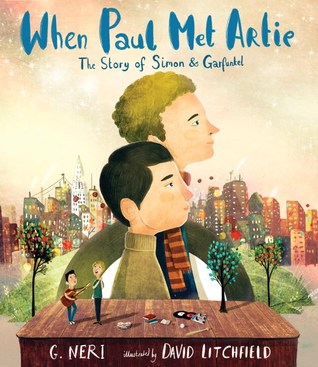
When Paul Met Artie: The Story of Simon & Garfunkel
Author: G. Neri
Illustrator: David Litchfield
Expected Publication on March 20th, 2018 by Candlewick Press

Summary: From childhood friendship to brief teenage stardom, from early failures to musical greatness — the incredible story of how Simon & Garfunkel became a cherished voice of their generation.

Long before they became one of the most beloved and successful duos of all time, Paul Simon and Art Garfunkel were just two kids growing up in Queens, New York — best friends who met in a sixth-grade production of Alice in Wonderland and bonded over girls, baseball, and rock ’n’ roll. As teens, they practiced singing into a tape recorder, building harmonies that blended their now-famous voices until they sounded just right. They wrote songs together, pursued big-time music producers, and dreamed of becoming stars, never imagining how far their music would take them. Against a backdrop of street-corner doo-wop gangs, the electrifying beginnings of rock ’n’ roll, and the rise of the counterculture folk music scene, G. Neri and David Litchfield chronicle the path that led two young boys from Queens to teenage stardom and back to obscurity, before finding their own true voices and captivating the world with their talent. Back matter includes an afterword, a discography, a bibliography, and a fascinating list of song influences.

ReviewWow. G. Neri and David Litchfield have captured the story of Simon & Garfunkel and released it into the world in a way that oozes the same beauty that their music does. Neri’s lyrical narrative flows and is perfect for a biography of one of the most beloved duos ever while Litchfield’s illustrations have the tone and coloring that just fit Simon & Garfunkel’s music–a bit dreamy yet raw and colorful. Their two pieces of artwork put together make for a beautiful picture book biography.

P.S. Make sure you take off the cover and look at the book design. BEAUTIFUL!

Teachers’ Tools for Navigation: While I’m not sure if such a class exists, this text would be perfect for a history of rock and roll class. It really goes through how the time period was changing when it came to music and how each artist influenced each other. If this class doesn’t exist, I wish it did, and I wish I could take it!

The structure of the text also lends to a great lesson looking at both why the author chose verse instead of prose as well as why he chose the timeline that he did. What was his purpose?

Discussion Questions: 

  • How did the author structure the book?
  • Why do you believe that the author chose to write the narrative in verse?
  • Paul and Artie, as children, are both different and similar. Explain.
  • How did Artie use his interest in math to help the duo?
  • How did music around Paul and Artie affect their music?
  • Why is this time period so important for the history of rock and roll?
  • What other artists does the author and illustrator highlight during the book as influences for Simon & Garfunkel?
  • What would have happened if Paul and Artie had given up after all of the rejection?
  • How did the duo go from rejection to success?
  • What clues can the musical connections give to us about the duo’s musical journey?

Flagged Passages: 

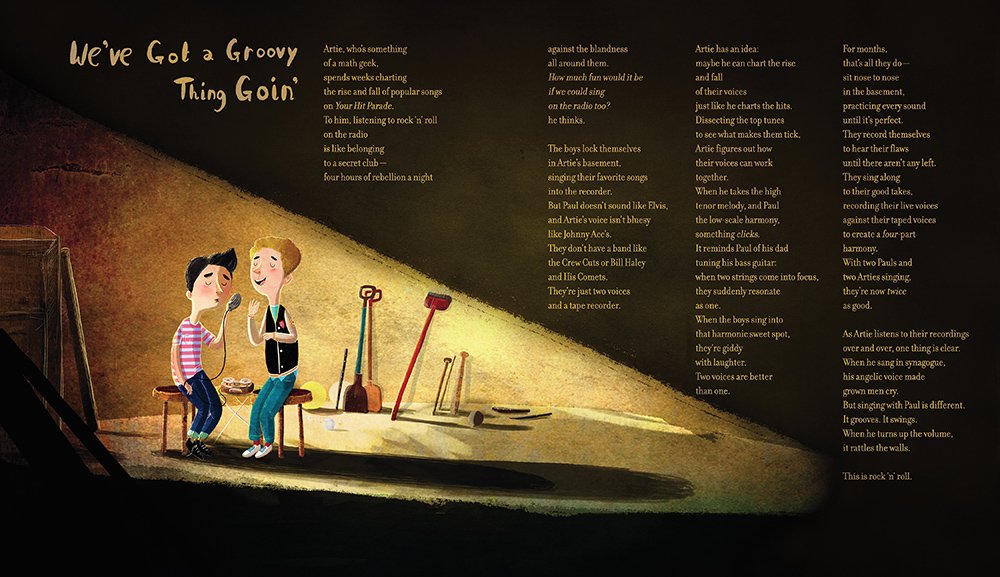
“We’ve Got a Groovy Thing Goin’

…When he takes the high
tenor melody, and Paul
the low-scale harmony,
something clicks.
It reminds Paul of his dad
tuning his bass guitar:
when two strings come into focus,
they suddenly resonate
as one…”

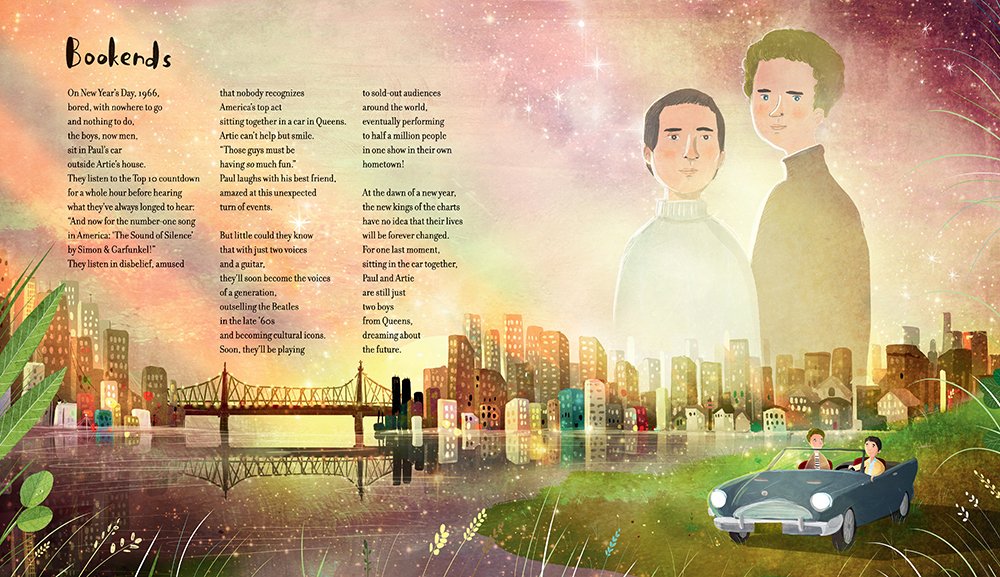
“Bookends

…At the dawn of a new year,
the new kinds of the charts
have no idea that their lives
will be forever changed.
For one last moment,
sitting int he car together,
Paul and Artie
are still just
two boys
from Queens
dreaming about
the future.”

Read This If You Love: Music, the 60s, Rock and Roll, biographies

Recommended For: 

classroomlibrarybuttonsmall closereadinganalysisbuttonsmall 

Signature

**Thank you to Raquel at Candlewick for providing a copy for review!!**

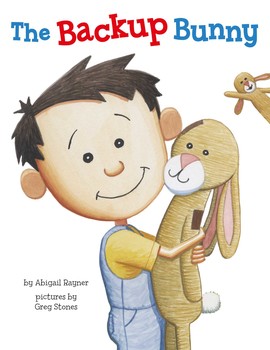
Blog Tour with Giveaway and Review!: The Backup Bunny by Abigail Rayner

Share

The Backup Bunny
Author: Abigail Rayner
Illustrator: Greg Stones
Published March 6th, 2018 by NorthSouth Books

Summary: Everybody needs a backup plan, especially when you lose your favorite toy.

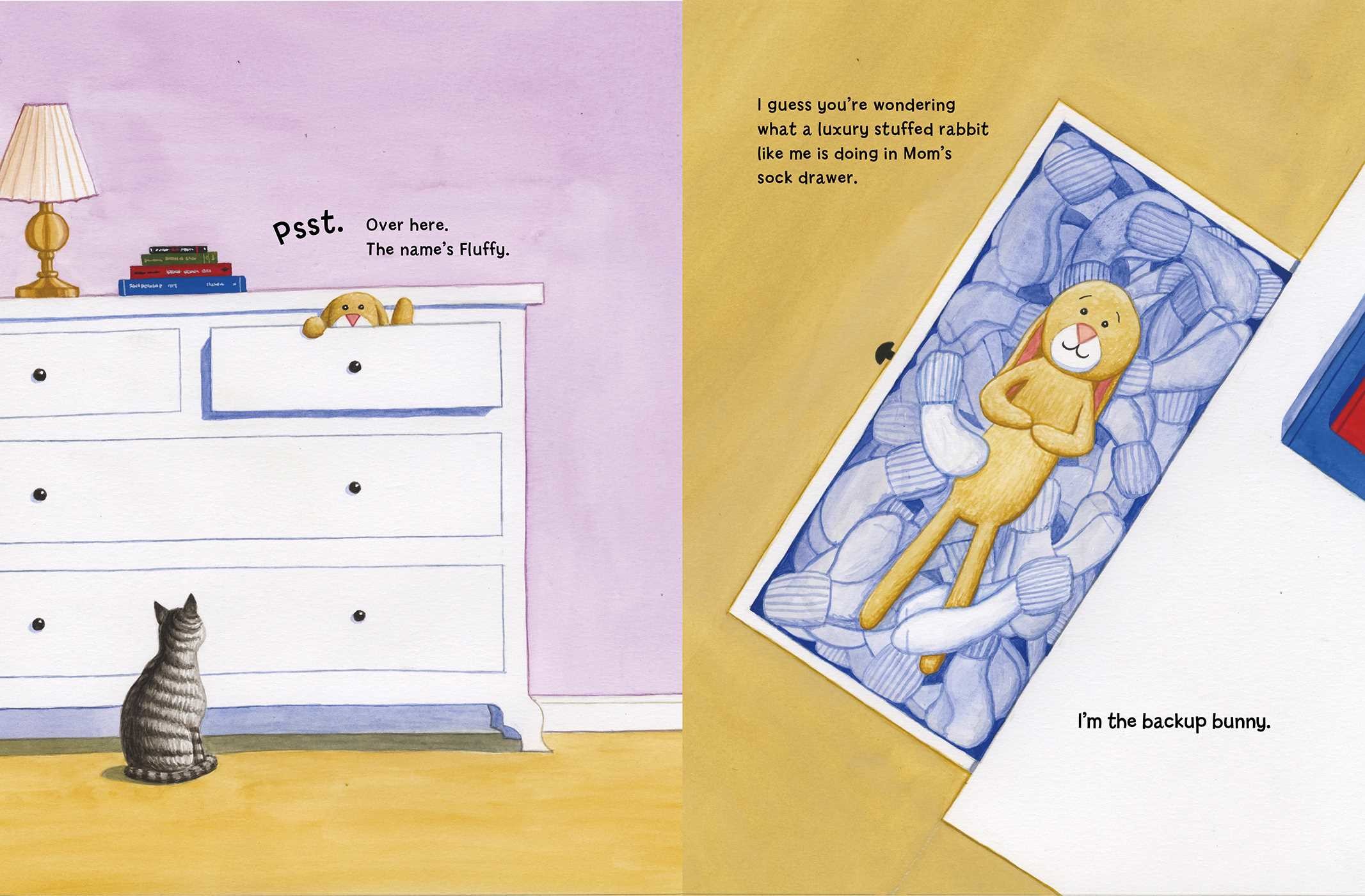
When Max loses his favorite toy—Bunny—his clever mom brings out the “backup bunny”—Fluffy—to save the day. Fluffy is thrilled to have the chance to play with Max, but is soon rejected by the observant child who notices that his ears are too new and perky. Can Fluffy find a way into his favorite boy’s heart?

The Backup Bunny will keep you laughing and inspire you to make room for another favorite story.

ReviewThis book truly made me laugh out loud because it made me think of so many stories! First, as a kid, I had LeeLee and Bean Baby who my mom both tried to get duplicates (Blue LeeLee and Talking Bean Baby) yet they never were equal to the originals. Then, as a sister, my sister had Banky and Huggy Bear who both had backups and were not replaceable. Finally, as a mom, Trent has a baby named Gus who, when I saw that Target was no longer going to carry them, I purchased 2 backup Guses, and when the original got super dirty, I decided it was time to try a backup. I said Gus was going to take a bath, and I brought back a new Gus. Trent hugged him but then looked at him in this super quizzical way and said, “Baby Gus has blue eyes?” And I freaked! I assured him that Gus has blue eyes, but then when we went to sleep, I checked the other Gus only to see that the original had brown eyes. That could have gone worse! Blue-eyed Gus is still going strong, but it almost backfired.

But back to the book. As you can tell from my reminiscing, this book is going to connect with everyone on so many different levels. The adult reader will remember their childhood and be nostalgic, the parent will think of their child and be filled with love, and the child reader will think of the toy that they love so much. And all of these feelings are accompanied by a fun-filled story about Fluffy trying so hard to be Bunny when really he just needs to be Fluffy to be loved.

Teachers’ Tools for Navigation: The Backup Bunny will have a wonderful place in early ed classrooms talking about their important lovies. Having students write about their lovie’s personality would be a perfect early ed creative writing prompt. Fluffy has such a distinct voice, and The Backup Bunny would be a wonderful way to start that conversation about voice and characterization with students both in reading and writing.

Discussion Questions: 

  • How are Fluffy and Bunny different?
  • How did the author give Fluffy a personality that was distinct?
  • Do you have a lovie that is special to you? Tell us about them.
  • In what ways did Fluffy try to be like Bunny? Did it work?
  • What type of socks does Fluffy live with? What does this tell you about that drawer?

Flagged Passages: 

Read This If You Love: Don’t Forget Dexter by Lindsay Ward, Toy StoryCaring for Your Lion by Tammi Sauer

Recommended For: 

Giveaway!: 

Signature

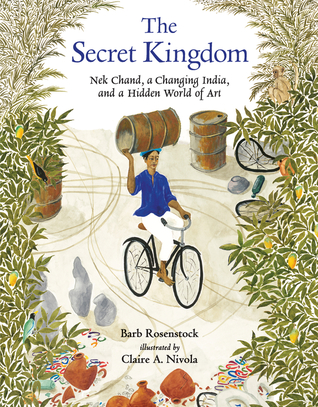
Author Guest Post!: “Let Me Tell You a Secret” by Barb Rosenstock, Author of many nonfiction texts including her newest, The Secret Kingdom

Share

“Let Me Tell You a Secret”

It’s almost always the kids’ first question, “Where do you get your ideas?”

At school visits, I say the typical author stuff: I keep a file of items that I find interesting (true.) I read a lot of books and take notes (true.) I’m a veteran eavesdropper and will ask anyone almost anything (super true.)

But recently, I realized that I’m not being completely honest. All these above techniques give kids (their teachers and librarians) the impression that “ideas” are purposeful. As in, “I think I’ll write a book, which idea will I use?”

That kind of thinking is exactly why I remember disliking the writing I had to do for school (honestly, I hated writing, so if you know a kid that hates it, maybe she’ll be an author!)  I hope things have changed, but I remember school writing as a series of prompts: Write about an adventure. How would your dog talk? What if you lived on the moon?

Though I was a natural blabbermouth, writing prompts paralyzed me.  As a third grader faced with blank paper and a “creative writing” prompt, my overwhelming thought was, “What if a girl has nothing to say?” Which gave me the idea (still in there, btw) that I was somehow “bad” at writing. Because I couldn’t create on cue, didn’t like fantasy, and couldn’t write about what I didn’t care about.

Maybe it’s idealistic, but I’d rather kids want to write, not have to write—you know, the way most of them really want to talk. Rather than making it seem like real writers wrack our brains and go over idea lists when a project is due, it’s time to let you in on a secret

My ideas, almost all of them, are accidents. I’m doing one thing and something else comes up. I’m reading one thing and something else is mentioned. Writing is following your mind wherever it goes. It’s noticing what’s around you. Kids (those who love writing and those who don’t) are great at noticing! Yet, writing ideas are sometimes presented as if they are foreign objects a kid has to sweat over and hunt out. It’s not true. For example, I tripped on the idea for my newest book doing something most kids love, surfing the internet.

The Secret Kingdom, is the true story of an outsider artist in India named Nek Chand.  I had no “ideas” in a folder about Nek Chand, or his large art environment, the Rock Garden of Chandigarh. I knew nothing about outsider art. Instead, I was working on a draft of a Van Gogh picture book (now the book, Vincent Can’t Sleep) that was going nowhere. I was bored. I was frustrated. I spent hours on Twitter and FaceBook. Vincent was driving me crazy–I couldn’t come up with the right words to show how he loved being outside at night. I hated Van Gogh, and I hated writing. I sat in my office searching random things on my laptop, and accidentally googled something like, “artists working outside.”

Boom! There was a picture of a waterfall with oddly cool statues in front of it. What’s that? Wait! One guy made that? How? Out of recycled scraps? Where? In India? Vincent went into a file folder and I was off in search of the story that became The Secret Kingdom.

Every author works differently, but that’s how my books are born. They don’t come from lists of ideas, but instead from accidental encounters and questions. Books are born from what I don’t know. Books are born from, “Wow! Cool!” And since kids are the wow-est, cool-est people on the planet, hopefully we can all find ways to let their reading and writing reflect their passions.

One of the other common school visit questions (teacher prompted I’m sure) is, “How do you do your research?” Again, I usually answer, “in libraries, and traveling to the settings of my books.” For various books I’ve visited national parks, presidential homes and watched cars race on a beach.  When kids write though, schools typically can’t provide those kinds of experiences.  So, what do you do when you can’t visit?

I’d never really run into that situation before, but that was the case with The Secret Kingdom. Though I desperately wanted to travel to Chandigarh and see Nek Chand’s Rock Garden, a research trip to India was totally out of this picture book author’s budget.

How could I experience it instead? Look at every single photo, map and schematic of the Rock Garden I could find. Read every book or article ever written about Nek Chand or his artwork. Track down and talk by email to people around the world who knew Nek Chand, his work and had visited the place themselves. Discover that a small museum within driving distance had the largest collection of his work in the U.S. Contact the U.K. based foundation trying to support his legacy. Most importantly, ask people culturally familiar with the setting and Mr. Chand to read drafts and comment. The way Nek Chand picked up scraps of village life and built them into art is the way I collected people who helped tell his story. We became a community convinced that the story of one refugee who created a new home with his art was important for today’s children.

Here’s the secret about writing that I promise to share from now on. There isn’t a list. There isn’t a right way. Honor the way you think. Be open to what life throws at you. Surround yourself with people who care. Creating books or any other art is a lot like life, a series of lovely accidents.
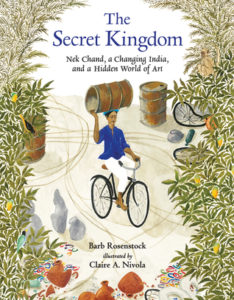
About The Secret Kingdom: Nek Chand, a Changing India, and a Hidden World of Art, by Barb Rosenstock, illustrated by Clarie A. Nivola:

After the partition of India in 1947, Nek Chand Saini settled in the city of Chandigarh, with nothing but stories brought from his homeland. Dismayed at his stark new surroundings, Nek began collecting river rocks, broken glass, and cracked water pots found on the roadside. He cleared a section of jungle and for seven years he stockpiled odds and ends. They were castoffs and rubbish to everyone else, but to Nek, they were treasures. He began to build a labyrinth of curving paths, mosaics, and repeating patterns: his very own tribute to the winding village of his youth, a hidden land of stories. Nek kept his kingdom secret for fifteen years, until a government crew stumbled upon it and sought to destroy it. But local fans agreed in awe: the Rock Garden had to be protected. Author Barb Rosenstock introduces readers to the outsider artist’s stunning creation, while Claire A. Nivola’s illustrations bring to life the land’s natural beauty and the surreal world Nek coaxed from his wild landscape.

About Barb Rosenstock:

Barb Rosenstock is a children’s book author who loves true stories. Her work includes The Camping Trip That Changed America: Theodore Roosevelt, John Muir, and Our National Parks, illustrated by Mordicai Gerstein; The Noisy Paint Box: The Colors and Sounds of Kandinsky’s Abstract Art, illustrated by Mary GrandPré; and many others. Barb Rosenstock lives in Chicago.

Thank you to Barb for her amazing post showing us insight into author-dom!
If you haven’t read any of Barb’s amazing nonfiction picture books, you should get on that now! 🙂

**Thank you to Kathleen and Phoebe at Candlewick for connecting us with Barb!**

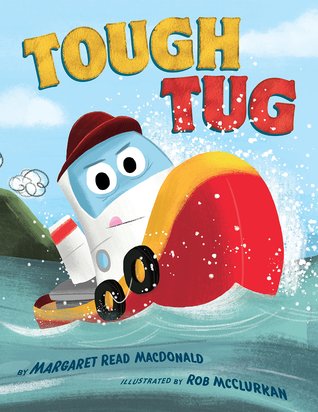
Tough Tug by Margaret Read MacDonald

Share

Tough Tug
Author: Margaret Read MacDonald;  Illustrator: Rob McClurkan
Published: March 1, 2018 by Two Lions

Goodreads Summary: Tough Tug is a brand-new boat. He likes to swirl and twirl—and run and race. He wants everyone to see what he can do. But when he sails to Alaska for the first time, he finds out what being a tug really means…

Ricki’s Review: This delightful book is sure to capture the spirit of young children. Tough Tug has determination and energy, and I yearned to read this book aloud to a classroom of readers. As he adventures to new horizons, Tough Tug realizes just how difficult it is to be a tug boat, but he knows that he passion will get him to his goal. The bright illustrations feature determined, anthropomorphic ships. Readers will feel energized after reading this one.

Teachers’ Tools for Navigation: This book begs for movement. I’d read this book to preschoolers and kindergarteners and ask them to move with tough tug. Reading this story and reacting to the movement words (e.g. “haul”) would help them learn some great new vocabulary!

Discussion Questions: How does Tough Tug show strength? What is he determined to do? What struggles does he face?; How does the illustrator make the boats come alive?; How can you connect this story with your own lives?

Flagged Passage: 

“Launch day!

Here I come…!”

“Hooray! I’m floating! This is fun!

Wait till those boats see what Tough Tug can do!”

Read This If You Loved: Might Tug by Alyssa Satin Capucilli; The Little Engine That Could by Watty Piper; Goodnight, Goodnight, Construction Site by Sherri Duskey Rinker, Demolition by Sally Sutton

Recommended For: 

readaloudbuttonsmall classroomlibrarybuttonsmall

RickiSig

**Thank you to Kristin for providing copies for review!**

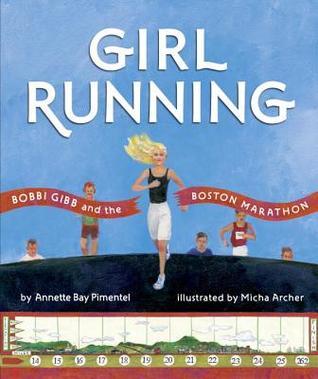
Girl Running: Bobbi Gibb and the Boston Marathon by Annette Bay Pimentel

Share

Girl Running: Bobbi Gibb and the Boston Marathon
Author: Annette Bay Pimentel
Illustrator: Micha Archer
Published February 6th, 2018 by Nancy Paulsen Books

Summary: The inspiring story of the first female to run the Boston Marathon comes to life in stunningly vivid collage illustrations.
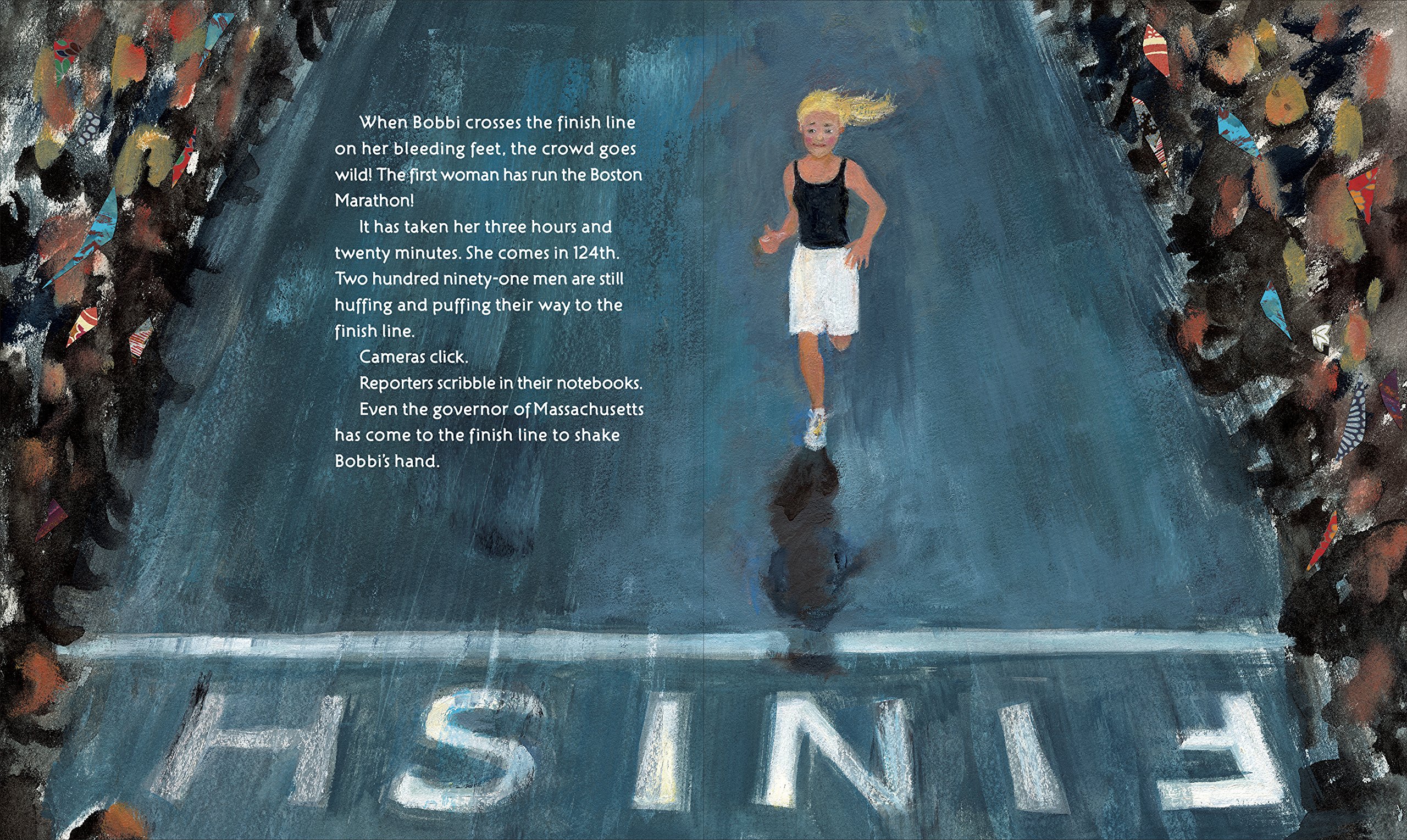
Because Bobbi Gibb is a girl, she’s not allowed to run on her school’s track team. But after school, no one can stop her–and she’s free to run endless miles to her heart’s content. She is told no yet again when she tries to enter the Boston Marathon in 1966, because the officials claim that it’s a man’s race and that women are just not capable of running such a long distance. So what does Bobbi do? She bravely sets out to prove the naysayers wrong and show the world just what a girl can do.

* “A bright salutation of a story, with one determined woman at its center.”–Kirkus Reviews, starred review

ReviewI first learned about Bobbi Gibb when I read The Girl Who Ran by Frances Poletti & Kristina Yee and after reading it, I knew I wanted to learn more about Bobbi Gibb because she did so much for women’s progress when it came to running. Without her standing up and going against everyone, it would have taken longer for women to be accepted as marathoners.

Pimentel does a beautiful job showing Gibb’s inspiration, determination, and journey. I loved seeing more about what happened during the marathon than what I knew before and especially was verklempt by the support she found when ran by Wellesley College and the women at the college came out and cheered for her. I also loved learning that the other runners supported her!

Through the afterwords, I also found out that Gibb had to wait 30 years before she was listed as the female winner of the Boston Marathon in 1966, 1967, and 1968 races because the officials wouldn’t honor her as a runner. This shows that so often even when the masses support something, it is a systemic issue that needs to be fixed.

Last but not least, I must share how much I adore Archer’s artwork. I was a big fan of her work in Daniel Finds a Poem, and once again I found that her illustrations were the perfect addition to the story being told.

Teachers’ Tools for Navigation: Gibb is one example of an American that changed history but may not be well known. I think it would be fascinating to introduce Gibb using Pimentel’s picture book as a way to start discussions about normal people changing the world. I would then share other stories about heroes like Rosa Parks, Malala Yousafzai, and Jesse Owens. I’d also reference other books like Be a Changemaker and 31 Ways to Change the World. The research could also be narrowed down to just sports; however, I think it is a wonderful discussion to have about how Gibb may have “only” changed marathons, it is part of a bigger movement.

Discussion Questions: 

  • Why did people think that women couldn’t run marathons?
  • How did Bobbi Gibb prepare for her first official marathon?
  • Did the other runners react the way you had expected? Explain.
  • How did Archer’s artwork support Pimentel’s story of Gibb?
  • What traits does Gibb show that helped her be successful?
  • When Gibb began to get blisters, were you afraid that she wasn’t going to finish? Explain your thinking and reactions as the story continued.

Flagged Passages: 

Read This If You Love: Picture book biographies, Women’s rights

Recommended For: 

classroomlibrarybuttonsmall closereadinganalysisbuttonsmall 

Signature

Ten(ish) of Trent’s Favorite Books as of his Fourth Birthday

Share

I cannot believe Trent is four! Time is flying so quickly! He is going into pre-kindergarten next year, he is starting to read sight words, he knows all of his letter sounds, and he is just so inquisitive! I am so proud of the awesome kid that he is.

Like last year, I let Trent be part of choosing the books we would share. If you look at the top left photo, that was us trying to narrow it down. He kept adding more then stopping to read books. It was so hard to get down to ten (and you’ll see we only kind of got down to ten). And this list would have probably been different if I’d asked him yesterday or waited until tomorrow (and this isn’t the books I thought he’d choose), but I let him have complete control.

So without further adieu:

Ten(ish) of Trent’s Favorite Books as of his Fourth Birthday

(In no particular order)

1. Pete the Cat: I Love My White Shoes by Eric Litwin & James Dean

Trent says he likes this book because “I like all of it. I like all of the parts like singing.” Then he started reciting the book. I really believe that having the song that goes along with books really sucks him into the book.

2. Baby Monkey Private Eye by Brian Selznick & David Serlin

Trent says he likes this book because “I like all of the stories. And it is funny. Baby monkey can help!” I agree with Trent! Baby Monkey is such a silly book but it is also way funnier and deeper than you first expect it to be.

3. Triangle by Mac Barnett & Jon Klassen

Trent says he likes this book because “I like his short legs. And he walks past triangles and shapes. And then there’s squares. Then triangle is running.” This book was an instant favorite in our house. The perfect Klassen illustrations, the humor, and the repetition definitely help.

4. Hi, Jack! by Mac Barnett and Greg Pizzoli

Trent says he likes this book because “I like Jack taking her bag. But Jack is bad. But when he gives back her purse he’s good.” Trent finds this book hilarious! I think it is going to be a great early reader.

5. Boo Who? by Ben Clanton

Trent says he likes this book because “I like Boo flying. I like Boo hiding.” He roots for Boo all through this book.

6. Fifteen Animals by Sandra Boynton

Trent says he likes this book because “I like his turtle. And I like when you sing it to me.” This book has been around Trent’s whole life. It is a go-to when we sing or read something.

7. Go Dog Go! by P.D. Eastman

Trent says he likes this book because “I like them going to the party in the tree.” Go, Dog, Go! was a favorite of mine when I was younger, and I love that Trent loves it, too.

8. Space books! Including anything Star Wars, Oh No, Astro! by Matt Roeser & Brad Woodard, and Earth! by Stacy McAnulty

In addition to wanting to be a ghost when he grows up, Trent also wants to be an astronaut. Trent says he likes space because “I want to go in space because I want to. I like going to space. I like Mars and the moon. I like the moon because I want to go to the moon.” I also highly recommend a Moon in Your Room if you have a space fan.

9. King Bidgood’s In the Bathtub by Audrey Wood & Don Wood

Trent says he likes this book because “he doesn’t get out of the bathtub because he says get in. He says come in.” This audiobook has singing it in. I really think that music is something that Trent definitely gravitates towards. He also loves the illustrations and points out all of the silly things going on in the bathtub.

10. The Little Shop of Monsters by R.L. Stine

Trent says he likes this book because “I love the monsters because they have horns. And I like listening to it because I love it at the end.” I am so glad I randomly found this audiobook on Hoopla, but I know that when our 9 weeks with the library book ends, I’m going to have to buy this one because it is a pretty constant listen in my car.

Honorary. One Lonely Fish by Andy Mansfield & Thomas Flintham

Trent says he likes this book because “I love it eating the fish.” And I love that this is the first book that he completely reads alone.

Which books are we missing in our lives?

Signature

Past “Trent’s Favorite Books” Posts

Kellee and Trent’s Favorite Picture Books: First Three Months

Trent and Kellee’s Favorite Picture Books: Three to Six Months

Trent and Kellee’s Favorite Picture Books: Six to Nine Months

Trent and Kellee’s Favorite Books: Nine to Twelve Months

A First Year Full of Books: Trent’s Journey Through Books
**Check this one out if you haven’t–it is one of my favorite posts ever!**

Trent’s Favorite Books: One to Two Years Old

Ten of Trent’s Favorite Books as of His Third Birthday