Journey by Aaron Becker

Share

journey

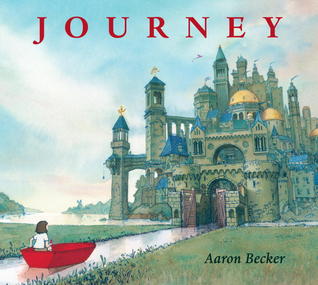
Journey
Author and Illustrator: Aaron Becker
Published August 6th, 2013 by Candlewick Press

Goodreads Summary: Follow a girl on an elaborate flight of fancy in a wondrously illustrated, wordless picture book about self-determination — and unexpected friendship.

A lonely girl draws a magic door on her bedroom wall and through it escapes into a world where wonder, adventure, and danger abound. Red marker in hand, she creates a boat, a balloon, and a flying carpet that carry her on a spectacular journey toward an uncertain destiny. When she is captured by a sinister emperor, only an act of tremendous courage and kindness can set her free. Can it also lead her home and to her heart’s desire? With supple line, luminous color, and nimble flights of fancy, author-illustrator Aaron Becker launches an ordinary child on an extraordinary journey toward her greatest and most exciting adventure of all.

My Review: This book is very hard to explain the magic of it. Lorna (@notforlunch) described it the best, I think: “a wonderful mashup of a David Wiesner book and Harold and the Purple Crayon.” I think this is perfect. It has the illustration beauty and magic of a wordless David Wiesner picture book and it is about creativity (and a crayon) like Harold. The beauty of the castle she visted also reminded me of Cathedral by David Macaulay. This book is just full of amazing! (You know it is good if it is a topic of #SharpSchu book club!)

Teacher’s Tools For Navigation: This was a bit hard for me. I can envision how this book would be used in the middle grades, but I was blanking on ideas for primary. I know this book needs to be shared, but how?

In my classroom, the first thing I would do is project the book and just have the students read it with me. No talking; just looking. Then we’d go back and discuss what is going on in the book, talk about some of the smaller parts of the illustrations, relive the journey. If I wanted to include a writing activity, we could add words to the book (although, I think this book’s illustrations stand alone). We could also discuss what we’d do if we had a magic crayon. I think this book would be a great addition to Dot Day and discussing creativity. Finally, I think a discussion of observing your surroundings would be appropriate as what the girl wanted the most was right in front of her at the beginning of the book.

Discussion Questions: What would you do with a magic crayon?; What was your favorite part of the journey?; Two parts remind me of Where the Wild Things Are, can you figure out which parts?; What do you think the girl’s name is?; Aaron Becker grew up in many different parts of the world including Japan. Can you find influences of Japan in this story? What about some of the other places he lived?

We Flagged: 

Read This If You Loved: Harold and the Purple Crayon by Crockett Johnson, Blackout by John Rocco, David Weisner wordless picture books, Cathedral by David Macaulay, Where the Wild Things Are by Maurice Sendak, Henri Mouse by George Mendoza, Chalk by Bill Thomson, Art & Max by David Weisner, Weslandia by Paul Fleishman, Narnia (series) by C.S. Lewis

Recommended For: 

closereadinganalysisbuttonsmall classroomlibrarybuttonsmall readaloudbuttonsmall

I put “Read Aloud” although this book is wordless; however, I know it needs to be shared with students. How would you share this book with your students in a read aloud fashion? 

Signature

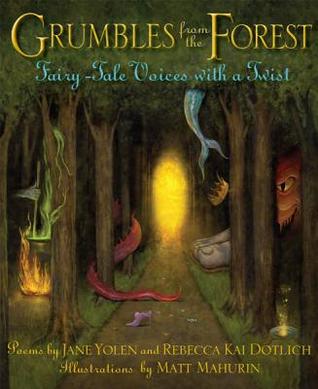
Grumbles from the Forest: Fairy-Tale Voices with a Twist by Jane Yolen and Rebecca Kai Dotlich

Share

grumbles

Grumbles from the Forest: Fairy-Tale Voices with a Twist
Authors: Jane Yolen and Rebecca Kai Dotlich
Illustrator: Matt Mahurin
Published March 1st, 2013 by Wordsong

Goodreads Summary: What were all those fairy-tale characters thinking? Jane Yolen and Rebecca Kai Dotlich answer this question in paired poems, with sometimes startling results. The Princess claims all those mattresses kept her awake–“not” a silly pea–while the poor pea complains that the princess snores. One Snow White begs the witch to settle by the bay and throw that mirror away. Another boldly tells the mirror she “won’t be guided by a glass that’s so one-sided.” Grumbles from the Forest is a bewitching brew of voices–grumbling, pleading, bragging, reminiscing, confiding–that bubbles with magic and wonder. The spectacular paintings that tie the poems together are full of surprise and intrigue. This stunning collection includes end notes that briefly describe the tales and their history and an introduction that invites readers to imagine their own poems from unusual perspectives.

My Review: Jane Yolen just doesn’t make bad books. Every time I read one of her books, I know I am reading a piece of great literature. This book is no different. Grumbles from the Forest takes 15 different fairy tales and then has a poem from two different perspectives for each fairy tale. Some are two different characters: Cinderella and her stepsisters, the frog and the princess, the wicked fairy and Sleeping Beauty, etc. including some characters who didn’t have a voice in the original fairy tale like the pea from The Princess and the Pea. Some are from one character, but two points of view: Snow White talking to the witch and with the magic mirror. I was fascinated with all of the poems they came up with!

Teacher’s Tools For Navigation: This book was built for being used in the classroom. First, each fairy tale section could start its own discussion about what the poem is saying vs. the original fairy tale. Second, the poetry itself stands alone. Look for figurative language and other poetic elements and there is even a haiku and cinquain. Third, we are always trying to get students to see things from different points of view and this is a perfect way. The introduction of the book even invites readers to: “Why not try writing a fairy-tale poem yourself? Pick a character or an object—maybe the bridge in Three Billy Goats Gruff, or Beauty’s father or the chair that Goldilocks broke. Imagine. Enchant. Write a poem that rewrites the tale. Make a little magic.”

Discussion Questions: Why do you think the authors chose to write from ____’s point of view? Do you agree with the point of view they gave the character/object? What would you have had them say instead? Who/what would you have written about instead?

We Flagged: Thumbelina 

“Thumbelina: A Cinquain”
Being
small has its down-
side, but what, pray tell, is
the choice of a little missy
at birth?

“Little Big: A Haiku”
I am just a bit
Of a proper young lady,
Still I got my prince.

(p. 34-35)

Read This If You Loved: The True Story of the Three Little Pigs by Jon Scieszka, Revolting Rhymes by Roald Dahl, and other fractured fairy tales; Stories told from different points of view like The Day the Crayons Quit by Drew Daywalt and Who Stole Mona Lisa? by Ruthie Knapp

Recommended For: 

closereadinganalysisbuttonsmall readaloudbuttonsmall

Signature

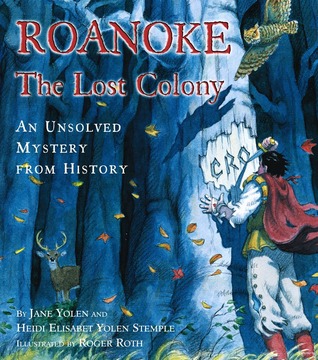
Roanoke, The Lost Colony: An Unsolved Mystery from History by Jane Yolen and Heidi Elisabet Yolen Stemple

Share

NF PB 2013

Nonfiction Picture Book Wednesday

Nonfiction Picture Book Wednesday is hosted by Kid Lit Frenzy and was started to help promote the reading of nonfiction texts. Most Wednesdays, we will be participating and will review a nonfiction text (though it may not always be a picture book).
Be sure to visit Kid Lit Frenzy and see what other nonfiction books are shared this week!

roanoke

Roanoke, The Lost Colony: An Unsolved Mystery from History
Author: Jane Yolen and Heidi Elisabeth Yolen Stemple
Illustrator: Roger Roth
Published July 1st, 2003 by Simon & Schuster Books for Young Readers

Goodreads Summary: In 1587 John White was chosen by Sir Walter Raleigh to lead a new colony at Roanoke off the Atlantic coast. After bringing many men, women, and children to the new land, White went back to England to gather supplies for the long winter. But when he finally returned to the fort almost three years later, he found that all of the colonists had vanished. The only signs of life left were the letters CRO carved into a tree and the word CROATOAN carved into one of the fort’s posts. Some people think that the Spanish army captured the colonists; some people think that the local native people murdered them; others think that the colonists went off to live with the native people and start a new life. Still others think that the colonists tried to sail home to England and were lost at sea. No one knows for sure. Become a detective as you read this true story, study the clues, and try to figure out the fate of the lost colony of Roanoke. The Unsolved Mystery from History series is written by acclaimed author Jane Yolen and former private investigator Heidi Elisabet Yolen Stemple. Read carefully and check your clues. You might be the first to solve a puzzle that has baffled people for years.

My Review: Just like all of the others in this series, I found this story fascinating. Unlike, The Wolf Girls, this is a mystery from history that I wanted to learn more about. I had heard of Roanoke, but I didn’t know anything except that it is the lost colony where everyone disappeared. I was never taught about Roanoke, so this was my initial introduction to the colony and man, it is all so fascinating!

Teacher’s Tools For Navigation: I am going to sound like a broken record here, but this, like the other parts of the series, can be used in such amazing ways in the classroom! Check out my Salem Witch Trials and The Wolf Girls reviews to read about how I envision these books being used in the classroom.

Discussion Questions: What do you think happened to everyone? Do you agree with any of the theories given at the end or do you have one of your own?

We Flagged: Narrative nonfiction The colonists left Portsmouth on April 26, 1587. They planned to meet with the soldiers, then go to Chesapeake Bay, north of Roanoke, where the land was more fertile and the harbor was safer. They sailed in three boats: a flyboat; a pinnace; and the flagship, Lyon. After a month and a haft at sea they reached the Americas at last, stopping first on several islands. At Santa Cruz several colonists ate green fruit. Their lips and tongues swelled badly. A number of people drank from a pond that had ‘water so evil’ they fell dreadfully ill. Some who washed  their faces in the water had swollen eyes for five or six days after. They captured five huge tortoises for meat—so large, sixteen men become exhausted hauling them back to the ship.”

Informational nonfiction “For long ocean journeys several types of ships were generally used, including: Flagship- the fleet’s largest, best, or safest ship, on which the commander sailed; Flyboat- a large boat with one or two masts, generally square rigged; Pinnace- a smaller, faster, more maneuverable boat that sometimes carried oars.”

Vocabulary “Fertile: capable of supporting a plentiful crop; Tortoise: land turtle of the warm climates, a good food source because the meat doesn’t spoil quickly” (p. 10-11)

Read This If You Loved: Any of the Unsolved Mysteries from History, Nonfiction books about Roanoke

Recommended For: 

classroomlibrarybuttonsmall readaloudbuttonsmall

closereadinganalysisbuttonsmall litcirclesbuttonsmall

Signature

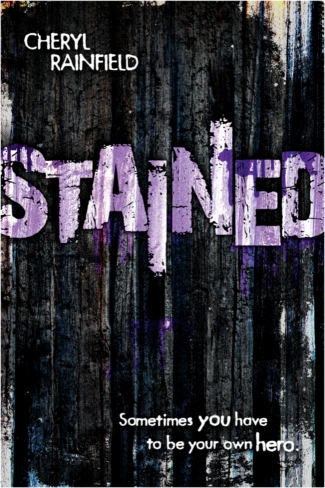
Stained by Cheryl Rainfield

Share

stained

Stained
Author: Cheryl Rainfield
Expected Publication October 1st, 2013 by HMH Books for Young Readers

Goodreads Summary: In this heart-wrenching and suspenseful teen thriller, sixteen-year-old Sarah Meadows longs for “normal.” Born with a port-wine stain covering half her face, all her life she’s been plagued by stares, giggles, bullying, and disgust. But when she’s abducted on the way home from school, Sarah is forced to uncover the courage she never knew she had, become a hero rather than a victim, and learn to look beyond her face to find the beauty and strength she has inside. It’s that—or succumb to a killer.

My Review: Cheryl delves into two very different tough subjects in this book. First, we meet Sarah who is a 16-year-old girl who was born with a port-wine stain. As with anything that makes you different when you are a teenager, it affects your life daily. Sarah has trouble fitting in, is bullied, and only has a few friends. Through this experience, though, she has also had a very narrow focus on physical appearance and pushes people away because she is focused so much on a surgery that would temporarily remove her port-wine stain. However, as she is dealing with not receiving her surgery, Sarah is thrown into the scariest situation a girl could become part of: she is kidnapped, locked away, and abused by her kidnapper.

Though this is a very tough book to read, it was one that I couldn’t put down. It is amazing how Cheryl takes the tragedies she has been through and transports her strength and experiences into her characters.

Teacher’s Tools For Navigation: This story will resonate with many students because it is about a circumstance that far too many teenagers find themselves in or know someone that has experienced being bullied or abused. This makes it a very important book that needs to be accessible because sometimes teenagers need to know about having courage to stand up against evil: “Sometimes you have to be your own hero.”  [I think this is a perfect book to review during Banned Books Week because Cheryl has found her books challenged. However, why should we keep books off the shelf that have ultimately saved readers’ lives? Hear more about my thoughts on banned/challenged books tomorrow.]

Discussion Questions: Sarah has dealt with having a large birthmark on her face since birth and has had to deal with the bullies. Do you think Sarah dealt correctly with the bullies? Could some of the other students around have done something differently?; What traits does Sarah have that helped her during her horrible situation?; Why was the title of the book Stained?

We Flagged: “I feel so dirty, like his smell is clinging to me still, sweat and cologne and sex. Like he’s stained me deeper than my birthmark ever could. Stained my soul, stained everything that makes me who I am.” (p. 99)

Read This If You Loved: Room by Emma Donoghue, Speak by Laurie Halse Anderson, The Mockingbirds by Daisy Whitney, Hunted by Cheryl Rainfield, The Missing Girl by Norma Fox Mazer, Girl, Stolen by April Henry, Stitches by David Small

Recommended For: 

classroomlibrarybuttonsmall

Signature

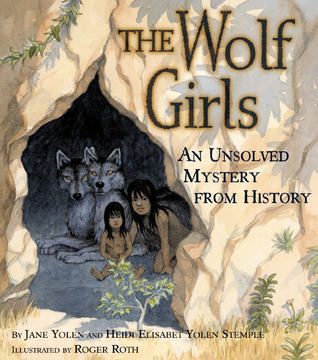
The Wolf Girls: An Unsolved Mystery from History by Jane Yolen and Heidi Elisabet Yolen Stemple

Share

NF PB 2013

Nonfiction Picture Book Wednesday

Nonfiction Picture Book Wednesday is hosted by Kid Lit Frenzy and was started to help promote the reading of nonfiction texts. Most Wednesdays, we will be participating and will review a nonfiction text (though it may not always be a picture book).
Be sure to visit Kid Lit Frenzy and see what other nonfiction books are shared this week!

wolf

The Wolf Girls: An Unsolved Mystery from History
Authors: Jane Yolen and Heidi Elisabet Yolen Stemple
Illustrator: Roger Roth
Published August 1st, 2000 by Simon & Schuster Books for Young Readers

Goodreads Summary: In 1920 a missionary brought two young girls to an orphanage in India. The girls didn’t know how to talk, walk, or eat from a plate. Some people thought the girls had been abandoned by their parents. Some people said the girls were brought up by wolves in the wild. Still others thought that the missionary who ran the orphanage made up the story about the girls. No one knows for sure.

Become a detective as you read this true story, study the clues, and try to figure out the fate of the wolf girls of Midnapore. The Unsolved Mystery from History series is written by acclaimed author Jane Yolen and former private investigator Heidi Elisabet Yolen Stemple. Read carefully and check your clues. You might be the first to solve a puzzle that has baffled people for years.

My Review: This story was fascinating as I had never heard of the wolf girls and came in with no prior knowledge about the mystery. It was so much fun to be full on submerged in the mystery and following the clues that are given throughout the “case notebook”.

Teacher’s Tools for Navigation: This book is set up just like the Salem Witch Trials: An Unsolved Mystery from History and could be used the same way in the classroom: This book promotes studying history, inquiry, and vocabulary. The book begins with an introduction to a young girl who enjoys unsolved mysteries from history and then the book is set up like her case notebook. Each page of the case notebook includes a narrative nonfiction section, an informational nonfiction section where facts about the story are explained even more in detail, and then there are vocabulary words from the two sections defined for the reader. Finally, in the back of the book the different theories about what could be the answer to the unsolved mystery are shared and briefly discussed. The set up of this book leads to infinite possibilities of being used in the classroom. Students could debate, write research papers, could do their very own case notebook about a different mystery, etc. Another option is to get all of the Unsolved Mystery from History books and have students get into lit circle groups and have each group read a different mystery then research and share.

What I like particularly about this one is that there is so much to debate as there aren’t many clues given throughout the story. Many of the eye witnesses are unreliable and there aren’t many facts shared throughout the book. I think this book would lead to a great discussion about primary and secondary sources as well as reliability.

Discussion Questions: Which theory do you believe about the wolf girls?; Do you think a journal written a year after an incident is reliable?; Many of the scientific facts and theories shared are from the 18th and 19th century, are these facts still what science believes?; Why do you think the missionary’s wife never spoke of the wolf girls?; Why do you think that Singh’s accounts were different than his daughter’s?; Singh said he did not want to exploit the girls yet he let people come to see her – is this exploitation? Do you think what he did was wrong?

We Flagged: Narrative nonfiction “After nursing the two girls back to health, the Reverend Singh loaded them into the cart and drove them for eight days to his orphanage in Midnapore. But the wolf girls were so weak and emaciated, they could not move about, so at first no one outside of the orphanage saw them. Singh wrote in his journal, ‘They were accepted simply as neglected children.’

Informational Nonfiction Singh wrote in his journal that the girls were mud-covered, with scratches, scars, and fleas. The heels of their hands were callused from running on all fours. Their ears trembled like a dog’s when they were excited. Their brows were bushy and long. Each had arms almost reaching their knees. Their teeth were close-set, uneven, with fine, sharp edges, the canines longer and more pointed than is usual in humans. However, Singh took no scientific measurements and invited no scientists to examine the girls. He took photographs that were fuzzy and indistinct. Years later, his own daughter, when interviewed, did not remember the distinctive teeth or exceptional ears or terrifically bushy brows.

Vocabulary Emaciated: thin and feeble due to disease or poor food; Neglected: not take proper care of” (p. 20-21)

Read This If You Loved: Yolen’s other Unsolved Mystery from History books

Recommended For: 

classroomlibrarybuttonsmall litcirclesbuttonsmall

closereadinganalysisbuttonsmall readaloudbuttonsmall

What mystery from history do you wish Jane Yolen had written about? 

Signature

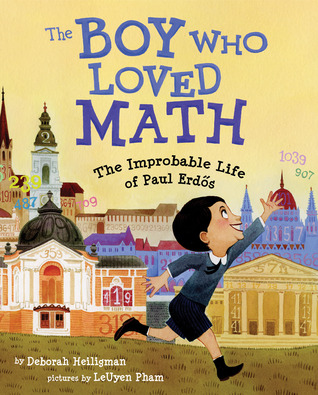
The Boy Who Loved Math by Deborah Heiligman

Share

NF PB 2013

Nonfiction Picture Book Wednesday

Nonfiction Picture Book Wednesday is hosted by Kid Lit Frenzy and was started to help promote the reading of nonfiction texts. Most Wednesdays, we will be participating and will review a nonfiction text (though it may not always be a picture book).
Be sure to visit Kid Lit Frenzy and see what other nonfiction books are shared this week!

lovedmath

The Boy Who Loved Math: The Improbable Life of Paul Erdos
Author: Deborah Heiligman
Illustrator: LeUyen Pham
Published June 25th, 2013 by Roaring Brook Press

Goodreads Review: Most people think of mathematicians as solitary, working away in isolation. And, it’s true, many of them do. But Paul Erdos never followed the usual path. At the age of four, he could ask you when you were born and then calculate the number of seconds you had been alive in his head. But he didn’t learn to butter his own bread until he turned twenty. Instead, he traveled around the world, from one mathematician to the next, collaborating on an astonishing number of publications. With a simple, lyrical text and richly layered illustrations, this is a beautiful introduction to the world of math and a fascinating look at the unique character traits that made “Uncle Paul” a great man.

My Review: I have been on a great streak of picture book narrative biographies and this is another one. I love how the author so cleverly combined Erdos’s story and mathematics without ever overloading the story with numbers. This book is so much fun (and the colorful illustrations add even more playfulness to it) yet teaches so much within its story.  What impresses me the most is just how much the book makes you think about math, want to learn more math, and want to play with numbers. Even in book form, Erdos is making math understandable.

Teacher’s Tools For Navigation: What a great book to use in a math classroom (or elementary classroom). This book makes math sound fun and would definitely be a jumping off point for many different mathematical ideas (such as prime numbers, harmonic primes, amicable numbers, odd/even numbers, Euclid’s Proof of the Infinity of Prime Numbers, Sieve of Eratosthenes, Euler’s map of Konigsburg, negative numbers, the Party Problem, Erdos distinct distances problem, Erdos number, epsilon). Many of the ideas are shared in a fun way and would help be a foundation for scaffolding.

Discussion Questions: What math idea/activity do you find to be the most fun?; Use math to complete Paul’s trick- how old are you in seconds? Minutes? Hours? Days?; What are the answers to Paul’s questions about prime numbers? Do they go on forever? Is there a pattern to them? Why is it that the higher you go up, the farther apart the prime numbers are?

We Flagged: “Paul played with numbers. He added them together and subtracted them. One day he subtracted a bigger number from a smaller number.
The answer was less than 0.
How could a nubmer be <0?
Mama told him numbers below zero are called NEGATIVE NUMBERS. Paul thought that was so cool.
Now he knew for sure he wanted to be a mathematician when he grew up. But first he had to tackle another big problem…” (p. 9)

Read This If You Loved: On a Beam of Light: A Story of Albert Einstein by Jennifer Berne, Jim Henson: The Guy Who Played with Puppets by Kathleen Krull, Lost Boy: The Story of the Man who Created Peter Pan by Jane Yolen, Odd Boy Out: Young Albert Einstein by Don Brown, A Wizard from the Start: The Incredible Boyhood and Amazing Inventions of Thomas Edison by Don Brown, Sandy’s Circus: A Story about Alexander Calder by Tanya Lee StoneMe…Jane by Patrick McDonnell

Recommended For: 

readaloudbuttonsmall classroomlibrarybuttonsmall

This book just makes me want to learn more!

Signature

Hitler Youth: Growing Up in Hitler’s Shadow & The Boy Who Dared by Susan Campbell Bartoletti

Share

These two books are my favorite fiction/nonfiction companion books, so I wanted to share them with you together. 

hitleryouth

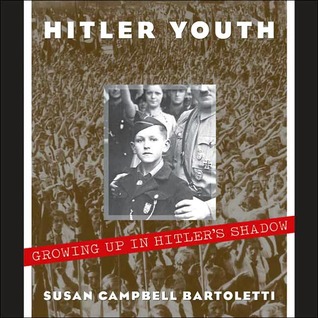
Hitler Youth: Growing Up in Hitler’s Shadow
Author: Susan Campbell Bartoletti
Published April 1st, 2005 by Scholastic Nonfiction

Goodreads Summary: In her first full-length nonfiction title since winning the Robert F. Sibert Award, Susan Campbell Bartoletti explores the riveting and often chilling story of Germany’s powerful Hitler Youth groups.

“I begin with the young. We older ones are used up . . . But my magnificent youngsters! Look at these men and boys! What material! With them, I can create a new world.” –Adolf Hitler, Nuremberg 1933

By the time Hitler became Chancellor of Germany in 1933, 3.5 million children belonged to the Hitler Youth. It would become the largest youth group in history. Susan Campbell Bartoletti explores how Hitler gained the loyalty, trust, and passion of so many of Germany’s young people. Her research includes telling interviews with surviving Hitler Youth members.

My Review: During World War II, Hitler controlled more than just the military; he controlled the entire country of Germany. Much of what this book explains are parts of the WWII history that is not taught in our schools and shows the true extent of the power that Hitler had over everyone.

The Hitler Youth began as a voluntary organization to support Hitler, but it quickly became a way for Hitler to control the youth. Soon the Hitler Youth was not voluntary and they were being used in much the same way as the military.

This book tells true stories of children in the Hitler Youth and children that were brave enough to speak up. It is truly horrific and fascinating. Susan Campbell Bartoletti uses a combination of narrative and expository writing to take her reader on a journey through Nazi controlled Germany starting with their depression and taking us through the the end of World War II. By intertwining true stories of the youth of Germany with historical fact, Bartoletti pulls at your heart strings and shows the true effect that Hitler had on the entire nation. It also takes you through the steps that Hitler took to brainwash the entire population, starting with the most desperate citizens, including the youth.

Although many nonfiction books are hard to get through and are dry, this one has a voice to it that is deeper and more sensitive than most. You become connected to the people of Germany and the youth of the story, so it doesn’t matter if that I already know the outcome- you have to know how they make it out of their deceit filled situation.

boywho

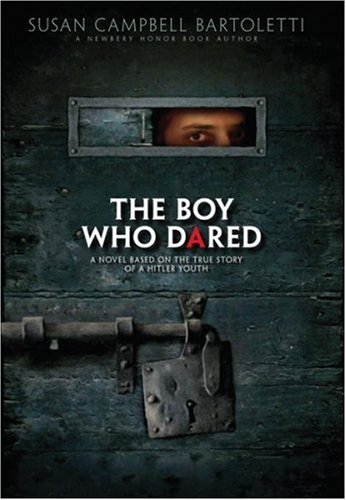
The Boy Who Dared
Author: Susan Campbell Bartoletti
Published February 1st, 2008 by Scholastic Press

Goodreads Summary: Bartoletti has taken one episode from her Newbery Honor Book, HITLER YOUTH, and fleshed it out into thought-provoking novel. When 16-year-old Helmut Hubner listens to the BBC news on an illegal short-wave radio, he quickly discovers Germany is lying to the people. But when he tries to expose the truth with leaflets, he’s tried for treason. Sentenced to death and waiting in a jail cell, Helmut’s story emerges in a series of flashbacks that show his growth from a naive child caught up in the patriotism of the times , to a sensitive and mature young man who thinks for himself.

My Review: Helmuth Hubener thought that Hitler was going to fix Germany, but the longer Hitler was in power, the more Helmuth realized that there was social injustice happening.

Based on a true story, The Boy Who Dared, accounts Helmuth’s life and the choices he makes. Told in flashback, I felt that some of the suspense is taken away since you know Helmuth’s current situation right from the beginning of the story; however, even with knowing the outcome, I wanted to read to figure out how Helmuth got there.

The exposition of the book helped me understand the extent of Helmuth’s society at the time which made me even more sympathetic then I would have been just jumping into Helmuth’s life. Although we all know about World War II and the Holocaust, unless you have read other books on World War II Germany, you may not understand the extent of Hitler’s power and brainwashing. With The Boy Who Dared, we follow Helmuth through his feelings about Hitler and the decisions he made.

This book is fabulous to read with the nonfiction book by Susan Campbell Bartoletti, Hitler Youth, which recounts the history around the Hitler Youth and what Helmuth was living through.

*     *     *     *     *

Teacher’s Tools For Navigation: If I taught a grade level where the Holocaust or WWII was taught in history, I would love to use these books supplementally in English class. These books tell a story within WWII that isn’t normally taught in history and really shines a light on a different side of the story. It would be a great way to discuss point of view, persuasion, and propaganda. I can also see these being used in thematic sets and then in lit circles. Each book adds to a whole look at WWII.

Discussion Questions: After reading both books, why was Hitler able to manipulate and affect the youth of Germany the way he did?; How did Helmuth affect those around him? History?

We Flagged: “The dark streets were already flooded with thousands of excited people, who, like Melita, were running out to watch the victory parade in honor of Adolf Hitler… Melita couldn’t understand why her parents didn’t support a great man like Adolf Hitler, who said that a person’s money and titles didn’t matter.  All that mattered was whether a person contributed to the well-being of the people.” (Hitler Youth p. 15-16)

“It’s morning.  Soft gray lights slips over the tall redbrick wall.  It stretches across the exercise yard and reaches through the high, barred windows.  In a cell on the ground floor, the light shifts dark shapes into a small stool, a scrawny table, and a bed made of wooden boards with no mattress or blanket.  On that bed, a thin, huddled figure, Helmuth, a boy of seventeen, lies awake.  Shivering. Trembling.
It’s Tuesday.
The executioner works on Tuesday.” (The Boy who Dared p. 1)

Read These If You Loved: Parallel Journeys by Eleanor Ayers, Alfons Heck & Helen Waterford, Briar Rose by Jane Yolen, The Book Thief by Markus Zusak, Resistance (series) by Carla Jablonski, London Calling by Edward Bloor, Once (series) by Morris Gleitzman, The Berlin Boxing Club by Robert Sharenow, Between Shades of Gray by Ruta Sepetys

Recommended For: 

classroomlibrarybuttonsmall litcirclesbuttonsmall closereadinganalysisbuttonsmall

Signature