Dining with Dinosaurs: A Tasty Guide to Mesozoic Munching by Hannah Bonner

Share

nfpb2017

Nonfiction Wednesday

Nonfiction Picture Book Wednesday is hosted by Kid Lit Frenzy and was started to help promote the reading of nonfiction texts. Most Wednesdays, we will be participating and will review a nonfiction text (though it may not always be a picture book).
Be sure to visit Kid Lit Frenzy and see what other nonfiction books are shared this week!

Also, I’d like to thank Sarah Brannen for making such a beautiful piece of artwork for our weekly nonfiction link up. It is perfect for illustrating why nonfiction is so important!

dining-with-dinosaurs

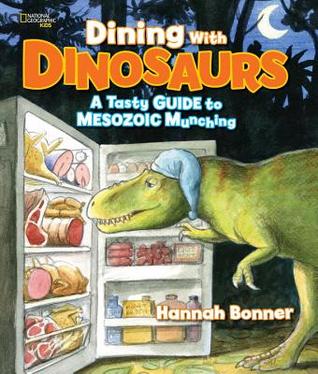
Dining with Dinosaurs: A Tasty Guide to Mesozoic Munching
Author: Hannah Bonner
Published September 20th, 2016 by National Geographic Children’s Books

Summary: Sure you know T-Rex was the meat-eating king and brontosaurus munched on leaves, but what else was on the dino dining menu during the Mesozoic era?

Meet the ‘vores: carnivores, piscivores, herbivores, insectivores, “trashivores,” “sunivores,” and omnivores like us.

Readers will be surprised and inspired to learn about dino diets and they’ll get to explore how scientists can tell which dinosaurs ate what just from looking at fossils!

Journey through artist and author Hannah Bonner’s whimsical world to learn how the dinosaurs and their contemporaries bit, chewed, and soaked up their food.

Review: Although the cover looks a bit silly, this text is to be taken seriously. Hannah Bonner does a wonderful job examining what different dinosaurs ate, the science behind what and why they ate what they did, how paleontologists know what dinos ate, and where all these dinosaurs fit in the grand scheme of things. Told in a unique structure that alternates between Hannah and a microraptor narrating and comic strip interviews with scientists, the text is not only informative but very entertaining.

Teachers’ Tools for Navigation: This is going to be the perfect text for a dinosaur unit in a classroom. It allows for so many different discussions including the different periods within the Mesozoic Era (and Cenozoic Era), connections between dinosaur diets and modern animals, types of scientists that study dinosaurs, different species of dinosaurs, and even text structure. Such a wide range of opportunities for classroom discussion (and even extension activities from the discussions). Additionally, the back matter of the text is filled to the brim with information and even an experiment.

Discussion Questions: What are some ways paleontologists can tell which dinosaurs ate what?; What modern animals fit into each of the ‘vore categories in the text?; Why did the author choose to include the comic strip interviews throughout the book?

Flagged Passages: 

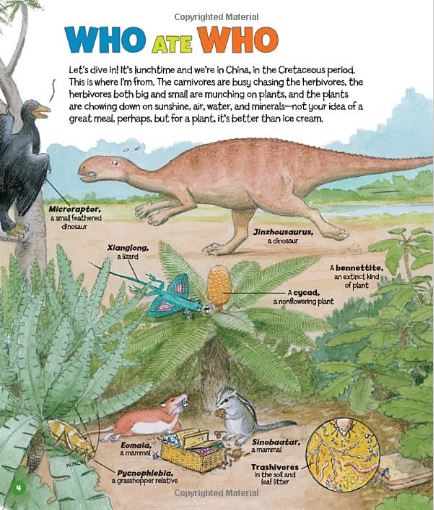
dining-with-dinosaurs-spread

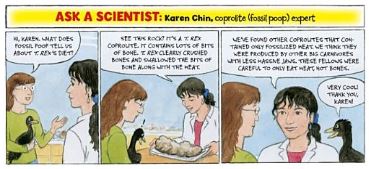
dining-with-dinosaurs-comic-strip-interview

Read This If You Love: Dinosaurs 

Recommended For: 

classroomlibrarybuttonsmall closereadinganalysisbuttonsmall

Signature

**Thank you to Karen at Media Masters Publicity for providing a copy for review!!**

Oh, Ick!: 114 Science Experiments Guaranteed to Gross You Out! by Joy Masoff

Share

NFPB2016

Nonfiction Wednesday

Nonfiction Picture Book Wednesday is hosted by Kid Lit Frenzy and was started to help promote the reading of nonfiction texts. Most Wednesdays, we will be participating and will review a nonfiction text (though it may not always be a picture book).
Be sure to visit Kid Lit Frenzy and see what other nonfiction books are shared this week!

oh-ick

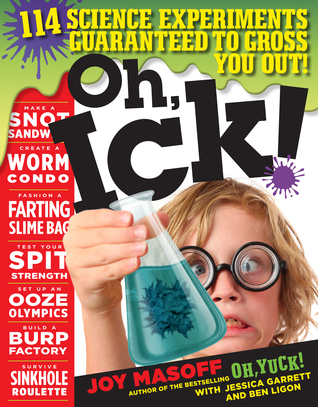
Oh, Ick!: 114 Science Experiments Guaranteed to Gross You Out
Author: Joy Masoff with Jessica Garrett and Ben Ligon
Published November 1st, 2016 by Workman Publishing Company

Summary: From the bestselling author of Oh, Yuck! and Oh, Yikes! here is an A-Z compendium of hands-on grossness.

Featuring 114 interactive experiments and ick-tivities, Oh, Ick!delves into the science behind everything disgusting.

Stage an Ooze Olympics to demonstrate viscosity and the nature of slime. Observe how fungi grow by making a Mold Zoo. Embark on an Insect Safari to get to know the creepy crawlies around your home. And learn what causes that embarrassing acne on your face by baking a Pimple Cake to pop—and eat. Eww!

Review: I always struggled with science, but I think if I had done more science experiments, putting the facts and information that I couldn’t memorize into practice, I would have been able to understand the concepts and information better. Books like Oh, Ick! and its companions Oh, Yuck! and Oh, Yikes! make science interesting thus helping kids put science into action and moving the information from short term to long term!

Teachers’ Tools for Navigation: I would love to see some of these icky experiments used in the classroom! Although the experiments are alphabetical by topic, the index gives teachers the ability to search for what they need. Want to teach about B cells and scabs, why not do “Spaghetti Scab Dinner?” Sound waves? Why not try “Sick Sounds?”

Flagged Passages: 

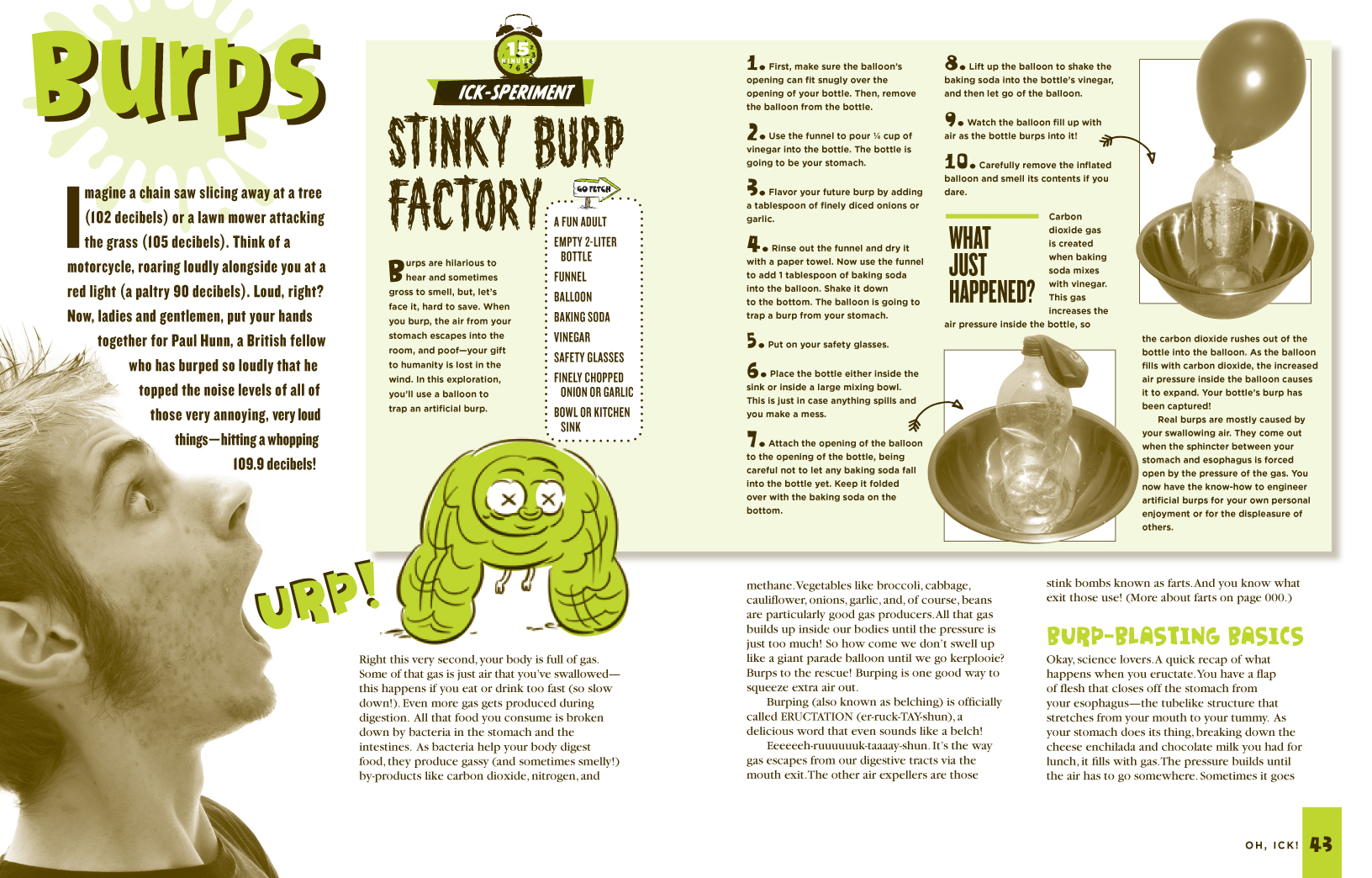
oh-ick-spread

Read This If You Loved: Gross and interesting science experiments

Recommended For: 

closereadinganalysisbuttonsmall

Signature

**Thank you to Estelle from Workman Publishing for providing a copy for review!**

Around America To Win the Vote: Two Suffragists, a Kitten, and 10,000 Miles by Mara Rockliff

Share

NFPB2016

Nonfiction Wednesday

Nonfiction Picture Book Wednesday is hosted by Kid Lit Frenzy and was started to help promote the reading of nonfiction texts. Most Wednesdays, we will be participating and will review a nonfiction text (though it may not always be a picture book).
Be sure to visit Kid Lit Frenzy and see what other nonfiction books are shared this week!

around-america-to-win-the-vote

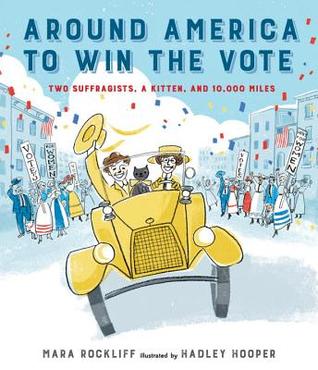
Around America to Win the Vote: Two Suffragists, a Kitten, and 10,000 Miles
Author: Mara Rockliff
Illustrator: Hadley Hooper
Published August 2nd, 2016

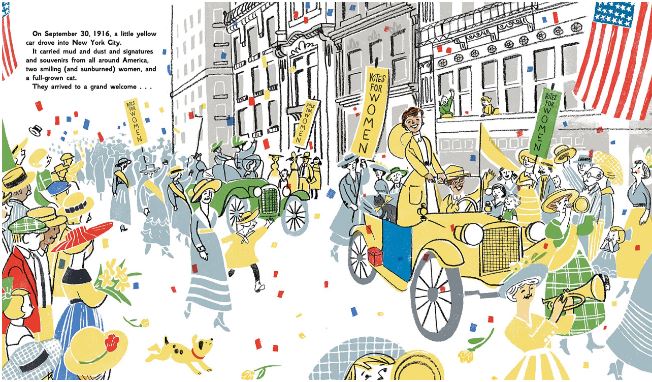
Summary: The author of Mesmerized delivers another fascinating glimpse into history, this time the story of two brave suffragists on a trek across America to spread the word: Votes for Women!

In April 1916, Nell Richardson and Alice Burke set out from New York City in a little yellow car, embarking on a bumpy, muddy, unmapped journey ten thousand miles long. They took with them a teeny typewriter, a tiny sewing machine, a wee black kitten, and a message for Americans all across the country: Votes for Women! The women’s suffrage movement was in full swing, and Nell and Alice would not let anything keep them from spreading the word about equal voting rights for women. Braving blizzards, deserts, and naysayers—not to mention a whole lot of tires stuck in the mud—the two courageous friends made their way through the cities and towns of America to further their cause. One hundred years after Nell and Alice set off on their trip, Mara Rockliff revives their spirit in a lively and whimsical picture book, with exuberant illustrations by Hadley Hooper bringing their inspiring historical trek to life.

Review: I am posting this review specifically today because it is amazing to hear for these women’s journey when today a woman is running for president under a major political power. It is amazing that in 2016 we have made it this far, which is amazing, but we also have to remember how hard woman fought for women’s rights and that women’s equality isn’t here yet.

Another reason why I posted this today is to remind people to vote. All election days are our opportunity to choose our futures. We are not powerless; voting gives us power and a voice. Please vote and remind all those close and dear to you to vote as well.

Now to the book. I loved reading Nell and Alice’s adventure. These are woman that are truly role models because they did something so unexpected and unacceptable at the time to fight for something they believe in a peaceful and intelligent manner. Mara Rockliff, along with Hooper’s busy yet muted and beautiful illustrations, tell us their story in an engaging way that will definitely make the reader think about so much.

Teachers’ Tools for Navigation: In addition to reading Nell and Alice’s story in conjunction to history lessons about suffragists and this time in history or as a lit circle text with other books about strong woman or people making a difference, Michele Knott had an idea that I thought would be fascinating: compare and contrast the way that politics has changed in 100 years. How has tactics changed? How has technology changed the delivery and reception of politics?

Discussion Questions: What obstacles did Nell and Alice face that they would not have faced if they were traveling 10,000 miles in 2016? How would their journey have been different if it was 2016? Do you think face-to-face works better than some of the use of technology that we see nowadays?; Do you think Nell and Alice made a difference?

Flagged Passages: 

around-america-spread

Read This If You Loved: The First Step by Susan E. Goodman, Fearless Flyer by Heather Lang, Hillary Rodham Clinton by Michelle Markel, Brave Girl by Michelle Markel or any book about a strong female of history; Sit-In by Andrea Davis Pinkney or any book about how people made a difference for what they knew was right

Recommended For: 

closereadinganalysisbuttonsmalllitcirclesbuttonsmallreadaloudbuttonsmallclassroomlibrarybuttonsmall

Signature

The Water Princess by Susan Verde

Share

water princess

The Water Princess
Author: Susan Verde
Illustrator: Peter H. Reynolds
Published September 13, 2016 by G. P. Putnam’s Sons Books for Young Readers

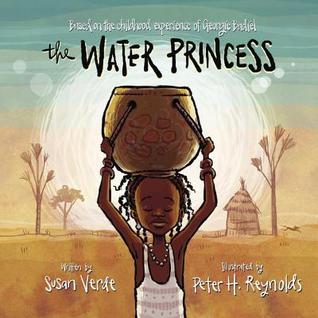
Goodreads Summary: Based on supermodel Georgie Badiel’s childhood, a young girl dreams of bringing clean drinking water to her African village

With its wide sky and warm earth, Princess Gie Gie’s kingdom is a beautiful land. But clean drinking water is scarce in her small African village. And try as she might, Gie Gie cannot bring the water closer; she cannot make it run clearer. Every morning, she rises before the sun to make the long journey to the well. Instead of a crown, she wears a heavy pot on her head to collect the water. After the voyage home, after boiling the water to drink and clean with, Gie Gie thinks of the trip that tomorrow will bring. And she dreams. She dreams of a day when her village will have cool, crystal-clear water of its own.

Inspired by the childhood of African–born model Georgie Badiel, acclaimed author Susan Verde and award-winning author/illustrator Peter H. Reynolds have come together to tell this moving story. As a child in Burkina Faso, Georgie and the other girls in her village had to walk for miles each day to collect water. This vibrant, engaging picture book sheds light on this struggle that continues all over the world today, instilling hope for a future when all children will have access to clean drinking water.

Ricki’s Review: This book captured my attention as soon as I saw the cover. The illustrations are beautiful, and I couldn’t help but sit for long periods of time, studying them closely. I appreciated and enjoyed this lyrical story that is based on Georgie Badiel’s childhood experiences. I have the F&G, and I am particularly excited to read the author’s note when the full book is printed. I know Georgie Badiel is an activist and leads a foundation dedicated to promoting clean drinking water and sanitation in Africa, so I think the author’s note will be particularly insightful. 

Kellee’s Review: The hardest books for me to read are the books where they seem as if they are historical fiction yet they are modern stories. It makes me so sad to know that there are those like Gie Gie who must work this hard just to get water. I feel like our world must help those who struggle in this way because water is a basic need that all should have access to. I think this book is a wonderful introduction to build awareness because many students do not know what is happening around the world, and this story is told in a beautiful yet truthful and hard way. Also, the connection it has with A Long Walk to Water makes it a perfect addition to a unit looking at that novel. Additionally, I must add that Peter H. Reynolds outdid himself with the illustrations in this book. I love Reynolds’s work, but these are pure pieces of art. Beautiful. I also look forward to the end notes because I want to learn more about Georgie Badiel and her work. 

Teachers’ Tools for Navigation: It would be great for teachers to build students’ awareness of the water/sanitation concerns within Africa. This might include reading more books about the subject and visiting websites supporting the cause. Georgie Badiel’s foundation is: http://georgiebadielfoundation.org/, and there are also many others out there, including: http://www.waterforsouthsudan.org/. I know of two elementary school classes who have devoted their entire year to raising money to build wells in Africa. These kinds of social action projects will surely impact students.

Discussion Questions: What does Princess Gie Gie’s day look like? What do the other women’s days look like? Why do you think this is?; Does Gie Gie feel frustrated? How might you feel in the same situation?; What can we do to support our peers who are living in similar situations to Gie Gie?

Flagged Passage: “My kingdom…the African sky, so wide and so close. I can almost touch the sharp edges of the stars.”

Read This If You Loved: A Long Walk to Water by Linda Sue Park; Just Add Water by Robin Hill and Charles Hall

Recommended For: 

readaloudbuttonsmall classroomlibrarybuttonsmall

RickiSigandSignature

Who Wins?: 100 Historical Figures Go Head-to-Head and You Decide the Winner! by Clay Swartz

Share

NFPB2016

Nonfiction Wednesday

Nonfiction Picture Book Wednesday is hosted by Kid Lit Frenzy and was started to help promote the reading of nonfiction texts. Most Wednesdays, we will be participating and will review a nonfiction text (though it may not always be a picture book).
Be sure to visit Kid Lit Frenzy and see what other nonfiction books are shared this week!

who-wins

Who Wins? 100 Historical Figures Go Head-to-Head and You Decide the Winner!
Created by Clay Swartz
Illustrated by Tom Booth
Published July 12th, 2016 by Workman Publishing Company

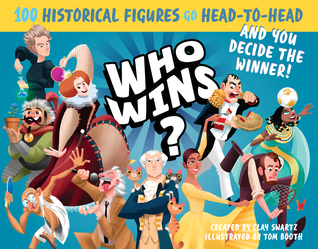
Summary: Who would rock the mic at karaoke night? Abraham “The Great Emancipator” Lincoln or Jane “Lady Persuasion” Austen? How about a hot dog eating contest between Harry “Mr. Magic” Houdini and Mary “Mother of Frankenstein” Shelley? What about a pie contest? A staring contest? And who has a better chance of sneaking into Area 51, Isaac “Gravity Guy” Newton or Sacagawea aka “The Pathfinder”?

In Who Wins?: History, you decide the winner in over 50 head-to-head challenges between 100 of history’s most illustrious characters. But choosing the victor isn’t arbitrary. Readers must justify their answers using each of the historical figures’ six 0-10 category rankings in bravery, leadership, artistry, wealth, wisdom, and fitness; as well as facts from short biographies.

As funny as it is informative, the book is uniquely formatted so readers can match up each and every character in any of the head-to-head battles. History has never been so much fun!

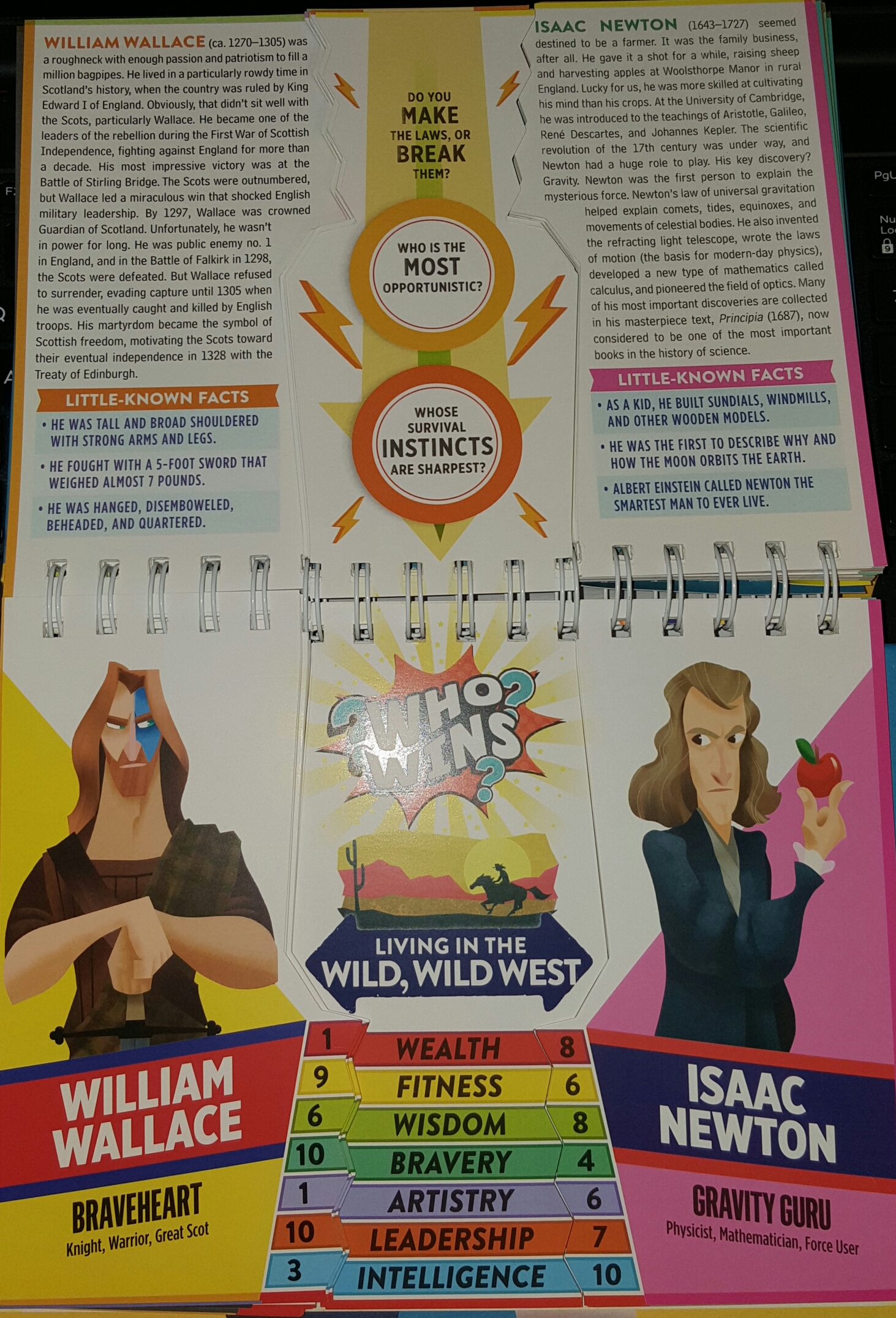
Kellee’s Review: Who Wins? is informative, funny, and so cleverly formatted that it is going to be a star in homes and classrooms. I love how the book gives each historical figure a nickname (either one they already were given, like Satchmo, or made up, like Gravity Guru for Isaac Newton) to add a bit of humor to the book; however, still makes sure to include a plethora of information about each figure including a bio then 3 little-known facts. Each head-to-head situation also helps guide your decision by giving some example questions to think about. Let’s look at a head-to-head, so you can really see how clever it is!

William Wallace “Braveheart” vs. Isaac Newton “Gravity Guru”
Who Wins Living in the Wild, Wild West?

20161008_221140-1

Ricki’s Review: What a clever concept! This spiral-bound book will be a staple for car rides. I could also see it being a great book for fast finishers in the classroom. The book consists of three columns that are split. So, for example, I randomly flipped to three pages (one of each column). At the far right, there is a short summary of Louis Armstrong’s biography and picture. Then, in the middle, the column I flipped to is the “talent show” and asks “Who is the most well-rounded? Who has the most experience entertaining?” Then on the far right, I flipped to Abraham Lincoln. While this one seems like a clear winner for Louis Armstrong, I think we could conceivably argue for either person for the two questions. I’ll be hanging on to this book. It will be a great book to give to my kids in the backseat. Fun family debates are the best!

Teachers’ Tools for Navigation: Are you an elementary school teacher or a social studies teacher or a language arts teacher? Then buy this. It is a perfect bell work or paper prompts or discussion starter or debate topic creator or whatever else you can think of!

Discussion Questions: Who wins?

Read This If You Love: History, Historical Figures, Debates 

Recommended For: 

closereadinganalysisbuttonsmall classroomlibrarybuttonsmall

Signatureand RickiSig

**Thank you to Estelle at Workman’s for providing copies for review!**

Author Guest Post!: “Everybody has a Story” by Beth Vrabel, Author of A Blind Guide to Normal

Share

“Everybody has a Story”

Everybody has a story.

As a writer and a reader, I know this to be true.

Write what you know.

This is another tenet that has stuck with me through my career with writing, especially as I moved from being a lifestyle columnist to a fiction writer. After all, is it any surprise that this girl (picture) wrote a book about a picked-on dorky fourth-grader? PACK OF DORKS, my debut novel, released in 2014.

Lucy’s story reflects many of my experiences as a 10 year old wondering if I’d ever make it to the “cool table” at the cafeteria. Only whereas fourth-grade me wallowed in dorkdom, Lucy stands up to her frenemies and bullies. Even better? She finds others to stand with her. With her “pack,” Lucy realizes she’s exactly where she wants to be. I gave Lucy the ending I wish I had been brave enough to give myself.
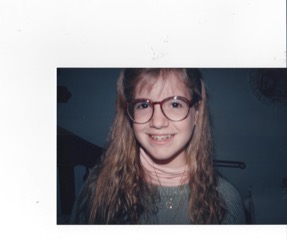
nerdybeth

I’m proud of PACK OF DORKS, but shortly after it was published, I have to admit I also was embarrassed by the personal connection.

I was determined that my next book would be different. It’d be completely imaginative and new and unrelated to my own life. And do you know what happened?

Everyone died.

By page seventeen, all of my characters gave up the ghost. Again and again and again. My husband suggested I start writing short stories instead.

I stopped being embarrassed. I started being scared.

Scared that the only stories inside me were ones connected to my own life. Scared that I wasn’t original or fresh or, frankly, all that creative. And, like many of us do when we’re scared, I ran away from what frightened me—those personal connections. I still hadn’t learned my lesson that a bully must be faced head on, even when that bully is comprised of your own thoughts.

Luckily, something saved me.

As I recently shared in Albinism InSight magazine, shortly after we knew PACK OF DORKS would be published, my daughter asked me for help finding a book.

She wanted to read a book that dealt with a shared experience.

My daughter has albinism, like Alice. My girl’s albinism is mild—you probably wouldn’t recognize it in her when you met her. Her hair is strawberry blonde and her skin pale. Her eyes, like the eyes of everyone with albinism work differently and she is mildly visually impaired.

But we couldn’t seem to find a book, or even a movie, where a character had albinism yet wasn’t creepy, mystical or evil. Nowhere could we find a book about a regular girl who learns, grows, has friends and happens to have albinism.

Go ahead, give it a shot. Type in albinism—or worse, albino—into a popular bookseller’s website. I did and found the following:

  • A dystopian young adult series in which people with albinism take over the world, destroying the lives of the “pigmented.”
  • A crime mystery in which the sinister villain and art thief is called The Albino.
  • A book about a young “albino detective” who is able to psychically solve cases.
  • A story about an “albino witch” who uses her powers to force apart two lovers.

It made me angry. It broke my heart.

My husband and I work hard to show our daughter that though she was born with this challenge, it does not define her. She has more in common with everyone else than this one thing that might set her apart. We tell her again and again that everybody faces challenges.

And today my girl is 13, an avid reader, a brilliant student and, making me the most proud, one of the kindest people I know. We know albinism is beautiful.

That’s why is so frustrating to see it portrayed in such ugly ways.

And so I stopped running from my own connections; instead, I leaned into them.

I wrote the story I wanted my girl to have. A story about a 12-year-old girl named Alice. She’s smart and kind, capable and caring, brave though often overwhelmed. And she happens to have albinism.

Alice scouts out stories in her new town and proves to the townspeople, her family, and, most importantly, herself that blindness is just part of who she is, not all she can be.

It’s gotten great reviews. In fact, The International Literacy Association named it the winner of its intermediate fiction prize, which is a tremendous honor.

But the reviewer whose opinion means most to me has the bedroom next to mine.

And my daughter loves the book. She read it chapter by chapter as I wrote it. Her enthusiasm propelled me to dig deeper and shine a light on other issues too often buried in children’s literature.

Let me be very clear that my daughter and Alice are different. My daughter has her own story, just like each of us, one that’s hers to share whenever and however she’d like.

Everyone has a story.

My stories reflect me.

And here’s the irony—writing stories that mirror my heart has allowed me to write characters I never would’ve dreamed possible.

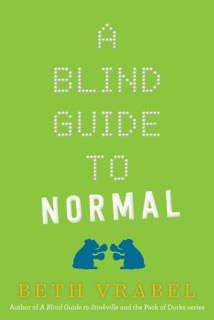
Characters like Richie Ryder Raymond. You’re introduced to this wise-cracking, witty and clever boy in STINKVILLE. Richie gets his own book in A BLIND GUIDE TO NORMAL, releasing Oct. 11 through Sky Pony Press.
blind-guide-revised

Due to a childhood cancer, Richie has an artificial eye and low vision in his remaining eye. I don’t have a lot in common with a 14-year-old boy, let alone a cancer survivor.

But I do know how scary it is start something new. I know what’s like to want something you can’t ever have. I know what it’s like to be awkward and cover it with humor.

Once again, I relied on those shared experiences—and a lot of research—to live through my characters. I realize now doing this makes my stories original, keeps them fresh and requires creativity.

beth_vrabel_final-4

About the Author: Beth Vrabel is the award-winning author of A Blind Guide to Stinkville (winner of the 2016 ILA Award for Intermediate Fiction), A Blind Guide to Normal, and the Pack of Dorks series. She can’t clap to the beat or be trusted around Nutella, but indulges in both often, much to the dismay of her family. Please visit her online at www.bethvrabel.com, on Twitter @beth_vrabel, or on Instagram @authorbethvrabel.

Thank you, Beth, for this outpouring and important post!

Kellee Signature andRickiSig

Teaching Guide for Ada Twist, Scientist by Andrea Beaty

Share

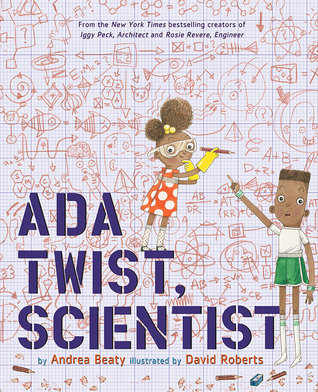
ada twist

Ada Twist, Scientist
Author: Andrea Beaty
Illustrator: David Roberts
Published September 6th, 2016 by Abrams Books for Young Readers

Summary: The creators of the New York Times bestselling picture books Rosie Revere, Engineer and Iggy Peck, Architect are back with a story about the power of curiosity in the hands of a child who is on a mission to use science to understand her world. Ada Twist, Scientist, from powerhouse team Andrea Beaty and David Roberts, is a celebration of STEM, perseverance, and passion.

Like her classmates, builder Iggy and inventor Rosie, scientist Ada, a character of color, has a boundless imagination and has always been hopelessly curious. Why are there pointy things stuck to a rose? Why are there hairs growing inside your nose? When her house fills with a horrific, toe-curling smell, Ada knows it’s up to her to find the source. Not afraid of failure, she embarks on a fact-finding mission and conducts scientific experiments, all in the name of discovery. But, this time, her experiments lead to even more stink and get her into trouble!

Inspired by real-life makers such as Ada Lovelace and Marie Curie, Ada Twist, Scientist champions girl power and women scientists, and brings welcome diversity to picture books about girls in science. Touching on themes of never giving up and problem solving, Ada comes to learn that her questions might not always lead to answers, but rather to more questions. She may never find the source of the stink, but with a supportive family and the space to figure it out, she’ll be able to feed her curiosity in the ways a young scientist should.

Iggy Peck and Rosie Revere have earned their places among the most beloved children’s characters, and they have inspired countless kids and adults to follow their dreams and passions. Now in her own charming and witty picture book, determined Ada Twist, with her boundless curiosity for science and love of the question “Why?,” is destined to join these two favorites.  The book is the perfect tool to remind both young girls and women that they have the intelligence and perseverance to achieve their dreams.

Teaching Guide: 

Beaty and Roberts’s books promote creativity, scientific thinking, and identity, so I was so happy and proud to be able to write the guide for Ada Twist.

You can also view the teaching guide here. Guides for Ada Twist‘s companion books, Iggy Peck and Rosie Revere, can be found here.

Recommended For: 

classroomlibrarybuttonsmall readaloudbuttonsmall closereadinganalysisbuttonsmall litcirclesbuttonsmall

Signature