Salt to the Sea by Ruta Sepetys

Share

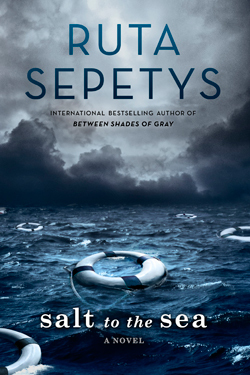
salt to the sea

Salt to the Sea
Author: Ruta Sepetys
Published: February 2nd, 2016 by Philomel Books

GoodReads Summary: The author of Between Shades of Gray returns to WWII in this epic novel that shines a light on one of the war’s most devastating—yet unknown—tragedies.

In 1945, World War II is drawing to a close in East Prussia, and thousands of refugees are on a desperate trek toward freedom, almost all of them with something to hide. Among them are Joana, Emilia, and Florian, whose paths converge en route to the ship that promises salvation, the Wilhelm Gustloff. Forced by circumstance to unite, the three find their strength, courage, and trust in each other tested with each step closer toward safety.

Just when it seems freedom is within their grasp, tragedy strikes. Not country, nor culture, nor status matter as all ten thousand people aboard must fight for the same thing: survival.

My Review: This is a book about humanity. Each voice serves a unique purpose to foster a complete picture of this great tragedy in history. The characters feel real, and their stories and perspectives are so different that readers are able to fully understand a diversity of experiences toward the war. Wow, wow, wow. I don’t feel that summarizing or reviewing this book will even do it justice. I felt like I couldn’t eat or sleep until I finished it. Salt to the Sea takes readers on an epic adventure and throws them for an emotional tailspin. After I closed the cover, I was reeling.  The language is powerful and the story is captivating.

Ruta Sepetys holds a special place in my heart. She is a powerful force in historical fiction, and this book is no exception. Several years ago, I was fortunate to be sharing a drink with Ruta at the ALAN cocktail party. When I asked her what she was working on, her eyes glinted as she talked about the concept of this book. She felt a connection to this tragedy, and while nothing had been written at the time, I knew it would be a remarkable novel. For the next several years, I thought about the way Ruta described the historical event, and I consistently checked her pages to see if I would see any further information about its progress. Several years later, I would (fortunately) receive this book in the mail. Boy was it worth the wait.

Teachers’ Tools for Navigation: The teaching opportunities for this book are endless. I would love to use this book to teach the theme: What does it mean to be human? or What does it mean to be a good person? Then, I might pair other texts (e.g. Kite Runner by Khaled Hosseini) and create a text set to consider these themes. The perspective and voice of these characters are strong, and I imagine rich classroom discussions about the ways these four characters show us a slice of humanity. (One of the four main characters is debatably evil, and this would offer excellent, critical conversations). Beyond these four characters, readers might consider the minor characters of this text (or tangential war figures, such as Hitler or Stalin). Are humans innately selfish? Are the innately good? Are we all flawed? Are there any universal characteristics amongst these characters, or are they too different?

Discussion Questions: How does the author balance historical information and story? What tools does she use to do this?; Why do you think the author chose to feature four points-of-view rather than one? Does it add or detract from the story? What similarities do you see across these voices? What differences?

We Flagged: “Survival had its price: guilt.”

*Quote taken from an advanced reader copy. It may change after publication.*

Read This If You Loved: Between Shades of Gray by Ruta Sepetys; The Watch that Ends the Night by Allan Wolf; The Book Thief by Markus Zusak; A Night to Remember by Walter Lord; The Guernsey Literary and Potato Peel Pie Society by Mary Ann Shaffer; Schindler’s List by Thomas Keneally; Code Name Verity by Elizabeth Wein

Recommended For:

 closereadinganalysisbuttonsmall litcirclesbuttonsmall classroomlibrarybuttonsmall

RickiSig

Bowls of Happiness: Treasures from China and the Forbidden City by Brian Tse

Share

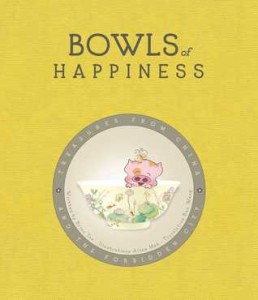
Bowls of Happiness

Bowls of Happiness
Author: Brian Tse, Illustrator: Alice Mak, Translator: Ben Wang, Editor: Nancy S. Steinhardt
Published: November 17, 2015 by China Institute in America

GoodReads Summary: Piggy’s mom loves her so much that she has decided to make a special porcelain bowl just for her. As mom makes the bowl, Piggy enters the world being painted on its outside. There she meets and learns about the animals used on these Chinese artworks and the messages of happiness and good-fortune that they convey.

Created by internationally renowned children’s book artists Brian Tse and Alice Mak, this book teaches children about Chinese artwork and culture and their universal spirit of generosity, love, and respect for nature. The lovable illustrations are coupled with photographs of porcelain art found in the Palace Museum’s collection. Children will learn about how bowls are made and be able to draw their own Bowl of Happiness after they have finished reading the story.

My Review: It was a lot of fun reading this book. It begins with an imaginative story reflecting the designs on a Chinese bowl. Then, in the second part, the book shifts to informational nonfiction. The author shares a variety of different bowls and their meaning. In the last portion, the readers are given instructions on how to create their own bowls. This book taught me a lot about these bowls of happiness, and I wanted to make my own bowl! Readers will enjoy learning about these bowls and will be intrigued to learn and research more.

Teacher’s Tools for Navigation: I would love to teach a book like this one. I’d have students begin by researching even more about these bowls, their symbolic meaning. Then, I might have the students create drafts of their own bowls. The book provides a wealth of information about the symbols and colors of bowls, and students could select their own designs and symbols. While their bowls would not be authentic and teachers would have to be careful to explain appropriation, it would teach the students to enjoy and appreciate another culture and reinforce their knowledge about the bowls.

Discussion Questions: What symbols do you find most interesting? If you could have any of the bowls in the book, which would you pick, and why?; What symbols are used in your culture? How might they compare to the symbols on these bowls?; Why do you think the author divided the book into such different sections?

We Flagged: “These two bowls were not used for eating. Chinese emperors used them for important rituals that paid respect to Heaven and Earth.”

Read This If You Love: Books about culture, history, art, or museums

Recommended For:

  classroomlibrarybuttonsmall

RickiSig

Happy Birthday, Mercy Watson! Review and Giveaway!: Mercy Watson and Deckadoo Drive Books by Kate DiCamillo

Share

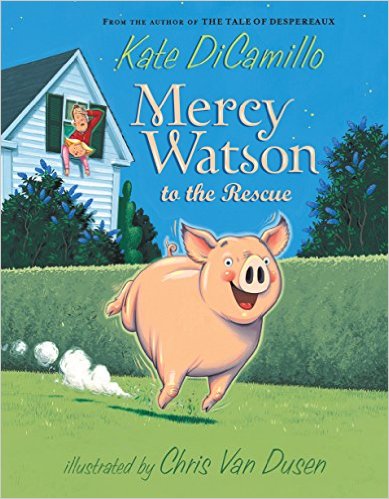
Mercy Birthday

One of the most popular chapter book series for newly independent readers turns ten

And beloved creators Kate DiCamillo and Chris Van Dusen give fans even more reason to celebrate with a new spin-off series Tales from Deckawoo Drive

Mercy Watson, the best-selling early chapter-book series written by the two-time Newbery Medal winner and National Ambassador for Young People’s Literature Kate DiCamillo celebrates its tenth anniversary this year. Launched in 2005 the fun-filled stories aimed at readers age five to eight star Mercy Watson, Deckawoo Drive resident, lover of hot buttered toast and the most single-minded of pigs when it comes to the pursuit of adventure – and treats. Illustrated in full color by award-winning artist Chris Van Dusen in his signature retro style, the Mercy Watson books are a popular choice with younger readers making the transition from picture books to chapter books.

Although the sixth and final Mercy Watson installment was published in 2009, the series continues to attract new fans and is published in ten languages with sales of over two million copies worldwide. Last year Kate DiCamillo reunited children with Mercy and her neighbours in the first book in her spin-off series, Tales from Deckawoo Drive. Once more illustrated by Chris Van Dusen, and with all the rip-roaring adventure of Mercy Watson, the series is aimed at older readers of six to nine. The longer chapters and fewer illustrations allow Kate DiCamillo to introduce another level of pathos and sentiment to this series of funny, touching stories starring some unforgettable, heart-warming characters.

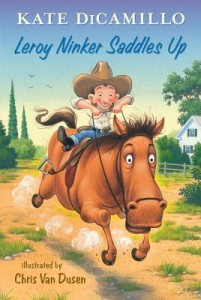
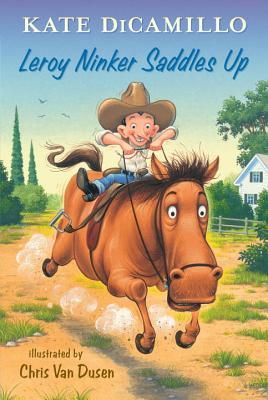
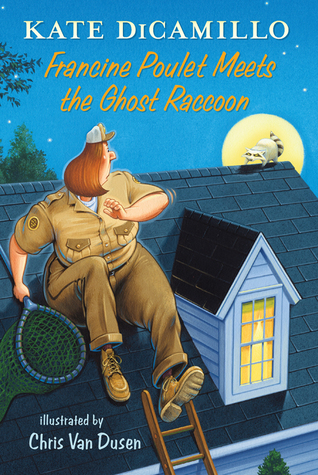
The first title in the new series, Leroy Ninker Saddles Up, became a New York Times bestseller and Amazon Best Book of the Year. Leroy and his rusty rather than trusty steed Maybelline star in this love story bursting with impassioned declarations and plenty of hilarious horsing around. This summer saw the release of book two, Francine Poulet meets the Ghost Raccoon, which also joined the New York Times Best Seller list earlier this month. Francine Poulet is the greatest animal control officer in Gizzford County – but it looks like she may finally have met her match. Funny, fast-paced and with an empowering message at its heart, readers are reunited with some familiar characters amid some riotous raccoon wrangling!

Tales from Deckawoo Drive is the perfect follow-on for original  fans who grew up with Mercy Watson and are ready to move on to a longer read. And for those readers new to Deckawoo Drive, this series is a wonderful introduction to a warm and witty world where readers are left feeling all buttery-toasty inside.
Mercy Watson

My Review: The characters in this story are so endearing. Even Eugenia! The antics of Mercy within these pages mixed with DiCamillo’s way of writing really push the Mercy Watson books past all the other early chapter books into its own league. No wonder Mercy is considered a porcine wonder!

Discussion Questions: What makes the Watsons love Mercy so much? What makes Eugenia dislike Mercy so much?; Did Mercy actually save the day or do you think it was all a coincidence?

We Flagged: 
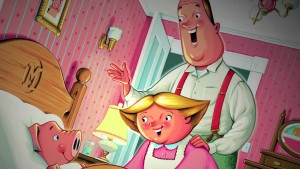
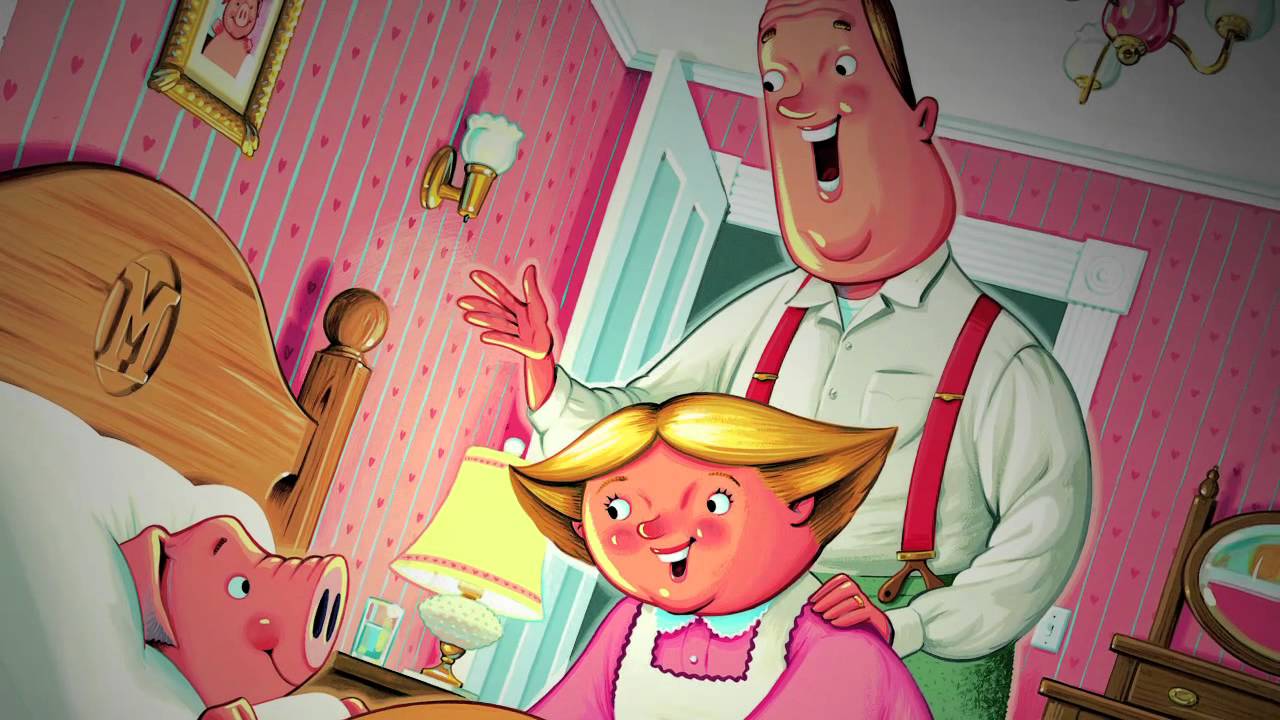
Mercy Illustration

“Mr. Watson and Mrs. Watson have a pig named Mercy.

Each night they sing Mercy to sleep.

‘Bright, bright is the morning sun,” sing Mr. and Mrs. Watson,
but brighter still is our darling one
Dark, dark is the coming night,
but oh, our Mercy shines so bright.

leroy ninker

Goodreads Summary: Yippie-i-oh! Saddle up for the first in a spin-off series starring favorite characters from Kate DiCamillo’s New York Timesbest-selling Mercy Watson books.

Leroy Ninker has a hat, a lasso, and boots. What he doesn’t have is a horse — until he meets Maybelline, that is, and then it’s love at first sight. Maybelline loves spaghetti and sweet nothings, and she loves Leroy, too. But when Leroy forgets the third and final rule of caring for Maybelline, disaster ensues. Can Leroy wrestle fate to the ground, rescue the horse of his heart, and lasso loneliness for good? Join Leroy, Maybelline, and a cast of familiar characters — Stella, Frank, Mrs. Watson, and everyone’s favorite porcine wonder, Mercy — for some hilarious and heartfelt horsing around on Deckawoo Drive.

My Review: Leroy is just so darn loveable. His personality shines through the pages and you just are so happy that Leroy and Maybelline found each other. Also, Kate DiCamillo has a way with voice! I can always hear her characters talking in my head, and they each are so very distinct. I also love her use of vocabulary and humor–perfect! This one is going to be loved by many!

Discussion Questions: Why do you think that Maybelline is the perfect horse for Leroy?; Was Leroy truly prepared to have a horse? How do you know?; Why does Leroy want to be a cowboy?

We Flagged:
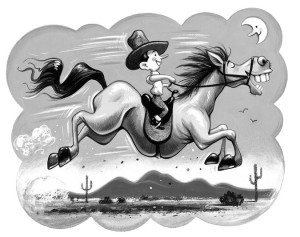
leroy ninker

“Leroy Ninker said ‘Yippie-i-oh’ because Leroy Ninker had a dream. He wanted to be a cowboy.

On Wednesday nights, the Bijou Drive-In Theater ran a Western double feature, and Leroy Ninker Stood and watched in wonder as the great white expanse of the Bijou screen filled with purple mountains, wide-open plains, and cowboys.

The cowboys wore ten-gallon hats. The wore boots. They carried lassos. The cowboys were men who cast long shadows and knew how to fight injustice. They were men who where never, ever afraid.

‘Yippie-i-oh,’ Leroy Ninker whispered to the screen. ‘That is the life for me. A cowboy is who I was meant to be.’”
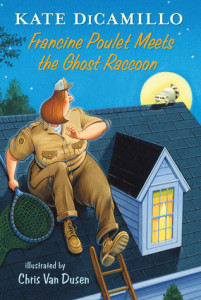
francine poulet

Goodreads Summary: Deckawoo Drive’s intrepid Animal Control Officer meets her match—or does she? A funny, heartfelt, and fast-paced romp from the National Ambassador for Young People’s Literature.

Francine Poulet is the greatest Animal Control Officer in Gizzford County. She hails from a long line of Animal Control Officers. She’s battled snakes, outwitted squirrels, and stared down a bear. “The genuine article,” Francine’s dad always called her. She is never scared—until, that is, she’s faced with a screaming raccoon that may or may not be a ghost. Maybe Francine isn’t cut out to be an Animal Control Officer after all! But the raccoon is still on the loose, and the folks on Deckawoo Drive need Francine back. Can she face her fears, round up the raccoon, and return to the ranks of Animal Control? Join a cast of familiar characters—Frank, Stella, Mrs. Watson, and Mercy the porcine wonder—for some riotous raccoon wrangling on Deckawoo Drive

My Review: Kate DiCamillo has a special way of writing stories. Her characterization is amazing which leads to truly full characters. Her vocabulary always pushes the reader yet never leaves the reader out of the story either. Her voice rings throughout the pages to where you can hear the narrator in your head. In this book, Francine Poulet is a character that all readers will love. She is determined, good at her job, and loves what she is doing. But then she faces her adversary. What happens after is what truly shows what type of person Francine Poulet can be.

Discussion Questions: Do you think Francine does her job because she loves it or because she felt pressured to do it because of her father and grandfather?; What vocabulary words do Kate DiCamillo use throughout the book to add more descriptive language and imagery to the book?; How would you describe Francine? Frank? The raccoon?

We Flagged: 
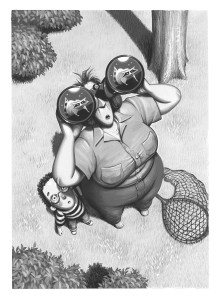
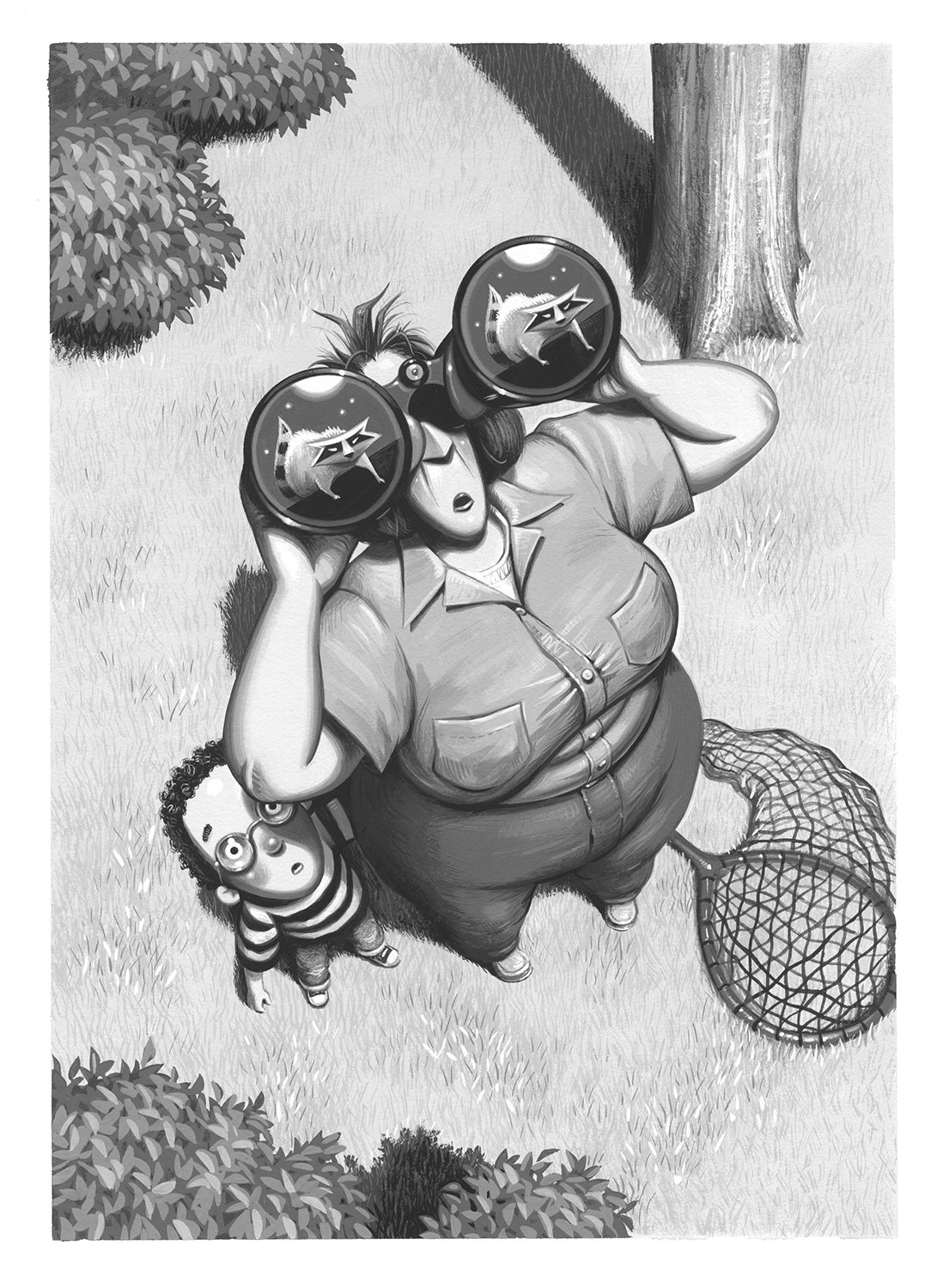
Francine Poulet Image

“Francine put the net on the ground. She took the binoculars. She held them up and looked through them. She saw the raccoon sitting on the roof, staring at her.

The moon was bright, and it was shining on the raccoon’s fur. The raccoon shimmered.”


Teachers’ Tools for Navigation: Teachers’ Guides for Mercy Watson, Leroy Ninker, and Francine Poulet can be found on Candlewick’s website:

Mercy Watson:
http://www.candlewick.com/book_files/0763636444.btg.1.pdf

Leroy Ninker:
http://www.candlewick.com/book_files/0763663395.btg.2.pdf

Francine Poulet:
http://www.candlewick.com/book_files/0763668869.btg.1.pdf

Read These If You Loved: Lulu series by Judish Viorst, Frankie Pickle series by Eric Wight, Bramble and Maggie (series) by Jessie Haas, The Princess in Black (and #2!) by Shannon Hale

Recommended For: 

readaloudbuttonsmall classroomlibrarybuttonsmall litcirclesbuttonsmall closereadinganalysisbuttonsmall

Giveaway!

a Rafflecopter giveaway

Kellee Signature

**Thank you to Alice at Candlewick for providing copies for review and for giveaway!**


I’ll Give You the Sun by Jandy Nelson

Share

I'll Give You the Sun

I’ll Give You the Sun
Author: Jandy Nelson
Published: September 16, 2014 by Dial

Summary: A brilliant, luminous story of first love, family, loss, and betrayal for fans of John Green, David Levithan, and Rainbow Rowell

Jude and her twin brother, Noah, are incredibly close. At thirteen, isolated Noah draws constantly and is falling in love with the charismatic boy next door, while daredevil Jude cliff-dives and wears red-red lipstick and does the talking for both of them. But three years later, Jude and Noah are barely speaking. Something has happened to wreck the twins in different and dramatic ways . . . until Jude meets a cocky, broken, beautiful boy, as well as someone else—an even more unpredictable new force in her life. The early years are Noah’s story to tell. The later years are Jude’s. What the twins don’t realize is that they each have only half the story, and if they could just find their way back to one another, they’d have a chance to remake their world.

This radiant novel from the acclaimed, award-winning author of The Sky Is Everywhere will leave you breathless and teary and laughing—often all at once.

Review: I haven’t been able to stop talking about this book since I read it. I anxiously awaited its release after reading (and loving) The Sky is Everywhere, and it most certainly didn’t disappoint. Jandy Nelson writes characters that step off of the pages and into readers’ hearts. I cried along with Jude and Noah and felt their grief as if it was my own. The passion of the characters was refreshing, and I felt as if they were my friends by the end of the book. Jandy Nelson is a literary genius. This book is quirky, colorful, and different, which makes it unforgettable for me. I plan to use this in my future Methods courses, and I only reserve those reading spots for the best of the best in YAL. It crosses genres a bit (Jude talks to ghosts), and the alternating perspectives span several years in the siblings’ lives. Students and teachers will find many topics and literary qualities that are worthy of analysis and discussion.

Teacher’s Tools for Navigation: Nelson touches on many life lessons in the text, and she presents them in an implicit way. (We all know that readers hate didactic texts!) I would ask my students to create a billboard: “Lessons I Learned from I’ll Give You the Sun.” Then, they could create a word map of different lessons they learned and cut out quotes or draw illustrations of scenes that taught these life lessons.

Discussion Questions: What does this story teach us about humanity?; How do the different characters cope with tragedy? What outlets (creative, emotional, etc.) do the characters use as coping mechanisms?; How does Jude and Noah’s relationship evolve throughout the text?; How does the nonlinear format impact the story?

We Flagged: “I gave up practically the whole world for you,” I tell him, walking through the front door of my own love story. “The sun, stars, ocean, trees, everything, I gave it all up for you.”

Read This If You Loved: All the Bright Places by Jennifer Niven, Love Letters to the Dead by Ava Dellaira, The Impossible Knife of Memory by Laurie Halse Anderson, The Gargoyle by Andrew Davidson, The Perks of Being a Wallflower by Stephen Chbosky, The Secret Hum of a Daisy by Tracey Holczer, Ask the Passengers by A.S. King

Recommended For:

closereadinganalysisbuttonsmall litcirclesbuttonsmall classroomlibrarybuttonsmall

RickiSig

Blog Tour!: Last-But-Not-Least Lola and the Cupcake Queens by Christine Pakkala

Share

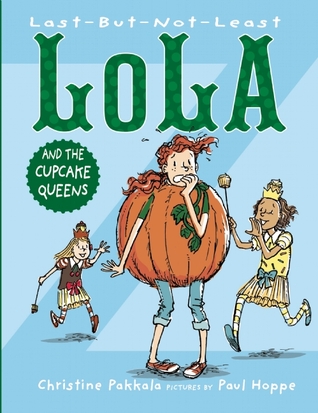
Lola and the Cupcake Queens

Last-But-Not-Least Lola and the Cupcake Queens
Author: Christine Pakkala
Illustrator: Paul Hoppe
Published October 6th, 2015 by Boyds Mills Press

Goodreads Summary: Lola’s mom is home but not home, because she’s frantically working all the time. Lola’s friends are here but not here as allegiances among the foursome change faster than you can forget your lines for a school play. Lola means well but can’t help acting on her emotions and getting into trouble. She’ll need to dig for bravery as she deals with a possible ghost next door, stage fright, and, hardest of all, making amends with her friends. Lola is braver than she thinks and her friendships are stronger than she realizes in this funny, heartwarming tale.

Kellee’s Review: I love that we are finding more and more girls like Lola in books. Lola is unique and smart and creative and not perfect yet also so very normal. She can be both a really good friend yet also a girl who makes mistakes. Lola is such a great role model for readers because she is all of these things, both good and bad. Readers will see themselves in her because she is very human.

In Lola and the Cupcake Queens, we get to know Lola even better. We learn that she has insecurities, that she loves her friends but doesn’t always know how to act, and that she underestimates herself. Each story about Lola’s puts her in more and more situations that readers will be able to connect with.

Ricki’s Review: I adored this charming series and immediately contacted a few friends who have young daughters who I know will fall in love with these books. Lola is a feisty redhead who seems to get herself into quite a bit of trouble. My favorite scene in the book is when Lola finds herself (yet again) in the principal’s office. She and the principal are great friends, and she casually struts into the office and is a bit taken aback when her friend is nervous. Her confidence and feistiness made me want to meet her! As she talks to the principal, she stops halfway through her sentence to lower her voice because yelling is not allowed. She knows the rules but seems to have a bit of difficulty following them—despite how hard she tries.

Lola reminds me of so many kids that I taught. She wants to do well, so she strives to be a good person. Even though she gets into a lot of trouble, it isn’t malicious. She just makes a lot of mistakes. These kinds of characters are fantastic for young readers because, like Kellee said, they allow children to see that they can learn from their mistakes. This series is a must for classrooms—it is the kind of series that turn kids into avid readers.

Teachers’ Tools for Navigation: Lola is going to be a favorite character of so many readers. She belongs in classroom and school libraries so readers can fall in love with her in the ways that we did.  In the book, Lola’s teacher did an activity that would also be great in the classroom. As the students were planning their Halloween costumes, she asked each child describe his/her costume without saying what it was. This activity would be a great way to help students build their imagery and descriptive language skills within creative writing.

As another idea, teachers might ask students to consider what it means to be a good friend. They could trace Lola’s actions to determine how she evolves as a friend in the series and then apply her actions to their own lives. This will help them think about friendship critically and relate it back to their own lives.

Discussion Questions: Do you think Lola intentionally gets into trouble? Why or why not?; What qualities would you use to describe Lola? Which of her actions reflect these qualities?; Is Lola a good friend? Why or why not?

We Flagged: “N-n-n-no,” she cries. “I’ve just never ever gotten in trouble and gone to the principal’s office. I’m not bad like you.”

“I’m not bad!” I yell, but part-way through I turn the volume down because yelling is bad. Especially right in front of the principal” (p. 65).

Read This If You Loved: Franklin School Friends series by Claudia Mills, Marty McGuire series by Kate Messner, Bink and Gollie series by Kate DiCamillo, Cody and the Fountain of Happiness by Tricia Springstubb, Eleanor books by Julie Sternberg, Babymouse series by Jennifer L. Holm, Bramble and Maggie series by Jessie Haas, The Trouble with Ants by Claudia Mills

Recommended For:

classroomlibrarybuttonsmall

  Signatureand RickiSig

**Thank you to Kayleigh at Boyds Mills Press for providing copies for review!**

Like Water on Stone by Dana Walrath

Share

like water on stone

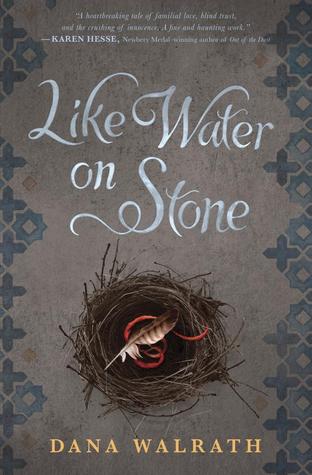
Like Water on Stone
Author: Dana Walrath
Published: November 11th, 2014 by Delacorte Press

Summary: Blending magical realism and lyrical free verse, this is an intense survival story of three siblings caught up in the horrific events of the Armenian genocide of 1915.

It is 1914, and the Ottoman Empire is crumbling into violence.

Beyond Anatolia, in the Armenian Highlands, Shahen Donabedian dreams of going to New York. Sosi, his twin sister, never wants to leave her home, especially now that she is in love. At first, only Papa, who counts Turks and Kurds among his closest friends, stands in Shahen’s way. But when the Ottoman pashas set their plans to eliminate all Armenians in motion, neither twin has a choice.

After a horrifying attack leaves them orphaned, Shahen and Sosi flee into the mountains, carrying their little sister, Mariam. Shahen keeps their parents’ fate a secret from his sisters. But the children are not alone. An eagle named Ardziv watches over them as they run at night and hide each day, making their way across mountain ridges and rivers red with blood.

Review: This is a beautiful book in verse that is set in the Ottoman Empire during the 1910s. It blends genres of magical realism and historical fiction. The point of view alternates with each poem, so I came to understand the differing perspectives of the family depicted in the text. The horrific genocide against Armenians is not common in literature, and this text sheds light on a time period that should be depicted more often. The strength of the children in this book will be inspirational to readers.

Teacher’s Tools for Navigation: I would recommend using this book as a literature circle text. Each group could be assigned a text that depicts a different genocide. This would provide rich opportunities to discuss parallels and differences across texts. Then, teachers might consider having students examine both historical and modern genocide. This might involve critical conversations about how we might work to promote social justice. They might even critique conceptions of social justice, such as slacktivism.

Discussion Questions: What does this story teach us about humanity?; How might a feminist read this text? What issues of gender emerge? Is this acceptable due to the historical setting of the text?

We Flagged:

“Hate makes jagged spikes of light,

and blame can crack the sky.

As pierced with wounds

from sharp white teeth,

the Ottoman air had ruptured.

Massacres would come again

as the drum-capped rulers

spread their hate” (p. 17-18).

Read This If You Loved: Tree Girl by Ben Mikaelsen; Audacity by Melanie Crowder; Requiem: Poems of the Terezin Ghetto by Paul B. Janeczko; Between Shades of Gray by Ruta Sepetys; Night by Elie Wiesel; A Long Way Gone by Ishmael Beah

Recommended For:

closereadinganalysisbuttonsmall litcirclesbuttonsmall classroomlibrarybuttonsmall

RickiSig

Crenshaw by Katherine Applegate

Share

crenshaw

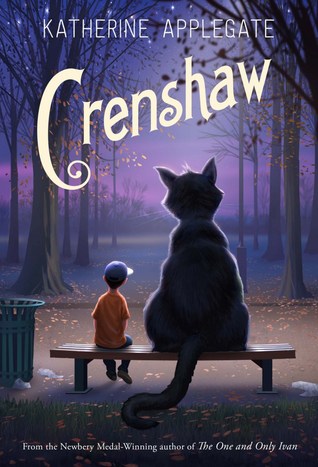
Crenshaw
Author: Katherine Applegate
Published September 22nd, 2015 by Feiwel & Friends

Goodreads Summary: In her first novel since winning the Newbery Medal, Katherine Applegate delivers an unforgettable and magical story about family, friendship, and resilience.

Jackson and his family have fallen on hard times. There’s no more money for rent. And not much for food, either. His parents, his little sister, and their dog may have to live in their minivan. Again.

Crenshaw is a cat. He’s large, he’s outspoken, and he’s imaginary. He has come back into Jackson’s life to help him. But is an imaginary friend enough to save this family from losing everything?

Beloved author Katherine Applegate proves in unexpected ways that friends matter, whether real or imaginary.

My Review: It is not fair to compare this book to The One and Only Ivan. The only similarity is that they are both beautifully written and put a very special issue in the spotlight. Like Ivan made you think about animal’s imprisonment, Crenshaw makes you think about homelessness; however, it is more than that. This book made me think about so many things. First, this book shows the speed and brutality of homelessness. It can affect anyone and can come from no where. There is an extended scene from Jackson’s past that made me want to jump into the book to give him a hug and help his family in anyway I could. Second, this book looks at how much children sometimes have to deal with because of their home situation. Jackson had such anxiety and pressure on him because he felt like he had to be a grown up (specifically for his sister). Finally, the book looks at friendship–both of the imaginary and real kind–and how important they are. And specifically how the magic of both kinds are something you need to hold onto.

Teachers’ Tools for Navigation: Crenshaw is going to be added to so many teachers’ read aloud queue. It is such a special book that can cause lots of discussion and enlightening reflection.

Discussion Questions: What are ways that Jackson and Robin try to trick their stomachs when they are hungry? Why do you think the games work?; What did you learn about homelessness by reading this book?; Why did Crenshaw return to Jackson when he did?; What type of friend is Marisol? Why is she so important to Jackson?

We Flagged: “My mom was right, of course. They were just things. Bits of plastic and wood and cardboard and steel. Bunches of atoms. I knew all too well that there were people in the world who didn’t have Monopoly games or race car beds. I had a roof over my head. I had food most of the time. I had clothes and blankets and a dog and a family. Still I felt twisted inside. Like I’d swallowed a knotted-up rope.

It wasn’t about losing my stuff. Well, okay. Maybe that was a little part of it. It wasn’t about feeling different from other kids. Well, okay. Maybe that was part of it too.

What bothered me the most, though, was that I couldn’t fix anything. I couldn’t control anything. It was like driving a bumper car without a steering wheel. I kept getting slammed, and I just had to sit there and hold tight.”

Read This If You Loved: Hold Fast by Blue Balliett, No Place by Todd Strasser, Almost Home by Joan Bauer

Recommended For: 

classroomlibrarybuttonsmall readaloudbuttonsmall

Kellee Signature