Kid Athletes: True Tales of Childhood from Sports Legends by David Stabler

Share

NFPB2016

Nonfiction Wednesday

Nonfiction Picture Book Wednesday is hosted by Kid Lit Frenzy and was started to help promote the reading of nonfiction texts. Most Wednesdays, we will be participating and will review a nonfiction text (though it may not always be a picture book).
Be sure to visit Kid Lit Frenzy and see what other nonfiction books are shared this week!
kid athlete

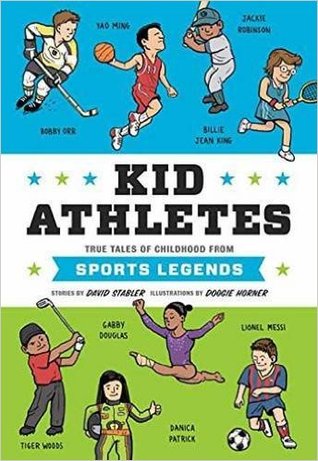
Kid Athletes: True Tales of Childhood from Sports Legends
Author: David Stabler
Illustator: Doogie Horner
Published November 17th, 2015 by Quirk Books

Goodreads Summary: Forget the gold medals, the championships, and the undefeated seasons. When all-star athletes were growing up, they had regular-kid problems just like you. Baseball legend Babe Ruth was such a troublemaker, his family sent him to reform school. Race car champion Danica Patrick fended off bullies who told her “girls can’t drive.” And football superstar Peyton Manning was forced to dance the tango in his school play. Kid Athletestells all of their stories and more with full-color cartoon illustrations on every page. Other subjects include Billie Jean King, Jackie Robinson, Yao Ming, Gabby Douglas, Tiger Woods, Julie Krone, Bruce Lee, Muhammad Ali, Bobby Orr, Lionel Messi, and more!

My Review: I really enjoyed this book of short stories about sports legends as children. I think the author did a great job sucking the reader in by starting with something about each athlete’s career then tying their childhood obstacles into their successes. I was impressed by how each story did have a lesson, but they did not feel didactical, and the author also made the stories ones that kids are going to connect with. This allow with fun illustrations will definitely keep readers entertained!

Teachers’ Tools for Navigation: I’m in a theme unit in my class right now and as I was reading each story, I automatically grasped the theme the author was trying to get across for each short story. Some are quite explicit while others are inferred which makes it a perfect book as you scaffold students determining theme independently. The author also uses primary sources throughout the text would be a good way to discuss primary vs. secondary sources. It could even lead into students writing their own biographical story of a historical person using primary and secondary sources. Finally, I would love to discuss the illustrations with students! They all are a bit quirky and funny though tie into the story in different ways. It would be interesting to see if kids grasp the subtle humor.

Discussion Questions: What obstacle did ______ overcome?; What character traits did _____ show while overcoming ____?; What is the theme of ______ ? How did the author support the theme throughout?; How are the stories within each section similar? Different?

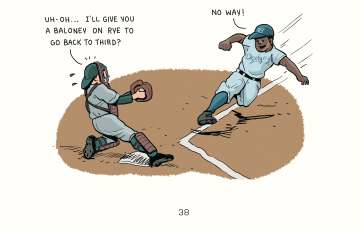
We Flagged: “In 1962, he was elected to the Baseball Hall of Fame. Historians have praised him for refusing to fight back in the face of racial discrimination. But Jackie did fight back, in his won way, by being the best person he could be, instead of following the bad examples of his enemies. That was a lesson he had learned from his days as the tiny terror of the Pepper Street Gang.” (p. 38)

kidathletes_jackierobinson

Read This If You Loved: Picture book biographies of athletes, Sports biographies

Recommended For: 

litcirclesbuttonsmall readaloudbuttonsmall classroomlibrarybuttonsmall

Kellee Signature

**Thank you to Quirk Books for providing a copy for review!**

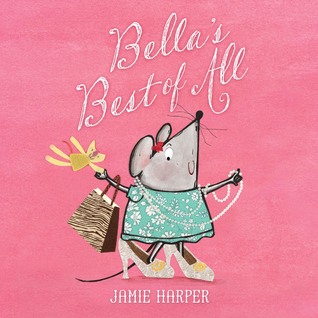
Bella’s Best of All by Jamie Harper

Share

BestOfAll_cvr

Bella’s Best of All
Author and Illustrator: Jamie Harper
Published January 5th, 2016 by Running Press Kids

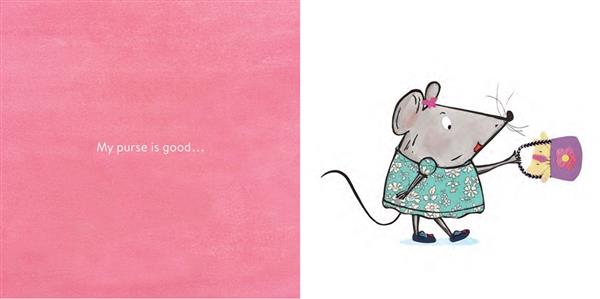
GoodReads Summary: Bella thinks her purse, necklace, and shoes are good. And Mommy’s? Well, Mommy’s things are always better. But what happens when Bella misplaces her favorite toy? Follow this busy little mouse as she discovers what truly is the best of all.

Kellee’s Review: This is such an endearing story of a young girl’s love of her mother as well as the mischief she causes throughout her house. As a mother of an almost two-year-old, I can very much relate to Bella’s story. However, unlike Bella, my son doesn’t have a consistent favorite toy, so I have to guess which toy he wants each day. I also really love Jamie Harper’s artwork. The backgrounds are always a solid color then in the foreground you have a drawn Bella with collage accessories. It is so clever how she uses collage to bring Bella to life.

Ricki’s Review:  This narrator of this story will be relatable to many children. She reminds me of myself as a child! I loved her desire to be just like her mother, and her passion and vigor for life made me smile. Kids focus on individuality, and this would be a great conversation starter about what makes them different and unique from their parents. I particularly loved the illustrations of this book. The layering of images is eye-catching and quite wonderful. I am excited to have this book for my son, and I plan to read it to him again and again. This would be a fun text to use in classrooms.

Teachers’ Tools for Navigation: Bella’s comparisons of her things and her mom’s things would be a great conversation in an early ed classroom about why things that belong to your parents, made by your parents, or approved by your parents seem to always be better. For example, if my mom makes me a sandwich, it always taste better than if I make one. It would also be a way to start a conversation about favorite toys and could extend to a creative writing exercise where students share their favorite toy.

Discussion Questions: Now that you know what Bella loves best of all, look back through the book. Did you notice Kitty the first time? Do you notice her now? Did you see when she disappeared?; What is Bella’s relationship with her mother? What lesson does Bella learn?

We Flagged: 

bella

“Mommy’s is better.”

Read This If You Loved: Chester the Raccoon by Audrey Penn, Hug Time by Patrick McDonnell, Never Too Little to Love by Jeanne Willis, I Love You Through and Through by Bernadette Rossetti-Shustak

Recommended For: 

readaloudbuttonsmall

Kellee Signature andRickiSig

**Thank you to Cassie from Running Press for providing copies for review!!**

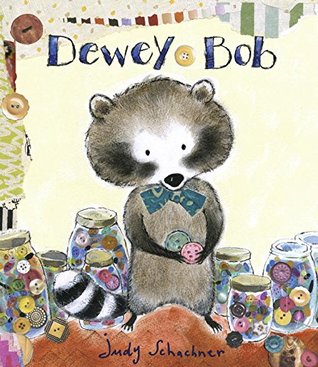
Dewey Bob by Judy Schachner

Share

dewey bob

Dewey Bob
Author and Illustrator: Judy Schachner
Published September 8th, 2015 by Dial Books

Summary: Dewey Bob Crockett is a durn cute raccoon who lives by himself in a house filled to the brim with the wonderful objects he collects. Buttons, wheels, furniture and bricabrac adorn his cozy quarters and keep him busy as he finds and fixes, turning trash into treasures. But there’s something missing from Dewey’s collections—a friend! He tries gathering up some critters and bringing them home in his shopping cart, but that doesn’t work out so well. In the end, a friend does come Dewey’s way, and, with a little DIY help from this clever raccoon, returns again and again.

Combining art and heart with storytelling genius and a lilting twang, Judy Schachner’s tale of unexpected friendship will delight readers young and old.

Author Judy Schachner Introduces Dewey Bob: 

My Review: Dewey is a little different than the other raccoons, so he finds himself in a beautiful home with a lot of things but no friends or family. Although Dewey is a bit untraditional, he finds himself a friend who will warm your heart!

Judy Schachner has a way with story telling. She brings her character’s voice to life, this time with a little bit of twang and rhyming. By being able to hear the character’s voice, the book is more engaging because you connect with the character more. Additionally, her illustrations in Dewey Bob are brilliant. They are a mixture of her what I believe is pencil and watercolor illustrations with found object collage. It is perfect for Dewey’s story.

Teachers’ Tools for Navigation: Dewey Bob gives many opportunities for discussion while reading aloud. You can discuss the difference between Dewey and the other raccoons, how the book is structured, Dewey’s rhyming and accent, Dewey’s friend, and even the illustrations. Each page really has opportunities for you to talk to your students about what is happening. This book is going to be a favorite read aloud for many.

Discussion Questions: How is Dewey Bob different than the other raccoons?; How does the author choose what goes in speech bubbles and what was in her prose?; How does the collage illustration help with the experience of reading Dewey Bob?

We Flagged: “‘No pants for me! No pants for me! Cuz’ I’m gonna live in a big oak tree,’ he sang, looking straight up at his future home.

The place was empty as a hatched egg…and filthy, too! But a little dirt didn’t scare Dewey. ‘I’m a mean, clean, washin’ machine!” said the li’l raccoon as he scrubbed the place spotless. Then he took a long soak in the tub with some of his favorite buttons.”

Read This If You Loved: This is a Moose by Richard T. Morris, The Snatchabook by Helen Docherty, Odd Duck by Cecil Castellucci, Skippyjon Jones by Judy Schachner

Recommended For: 

readaloudbuttonsmall classroomlibrarybuttonsmall

Kellee Signature

**Thank you to Lauri at Dial Books for providing a copy for review!!**

Bowls of Happiness: Treasures from China and the Forbidden City by Brian Tse

Share

Bowls of Happiness

Bowls of Happiness
Author: Brian Tse, Illustrator: Alice Mak, Translator: Ben Wang, Editor: Nancy S. Steinhardt
Published: November 17, 2015 by China Institute in America

GoodReads Summary: Piggy’s mom loves her so much that she has decided to make a special porcelain bowl just for her. As mom makes the bowl, Piggy enters the world being painted on its outside. There she meets and learns about the animals used on these Chinese artworks and the messages of happiness and good-fortune that they convey.

Created by internationally renowned children’s book artists Brian Tse and Alice Mak, this book teaches children about Chinese artwork and culture and their universal spirit of generosity, love, and respect for nature. The lovable illustrations are coupled with photographs of porcelain art found in the Palace Museum’s collection. Children will learn about how bowls are made and be able to draw their own Bowl of Happiness after they have finished reading the story.

My Review: It was a lot of fun reading this book. It begins with an imaginative story reflecting the designs on a Chinese bowl. Then, in the second part, the book shifts to informational nonfiction. The author shares a variety of different bowls and their meaning. In the last portion, the readers are given instructions on how to create their own bowls. This book taught me a lot about these bowls of happiness, and I wanted to make my own bowl! Readers will enjoy learning about these bowls and will be intrigued to learn and research more.

Teacher’s Tools for Navigation: I would love to teach a book like this one. I’d have students begin by researching even more about these bowls, their symbolic meaning. Then, I might have the students create drafts of their own bowls. The book provides a wealth of information about the symbols and colors of bowls, and students could select their own designs and symbols. While their bowls would not be authentic and teachers would have to be careful to explain appropriation, it would teach the students to enjoy and appreciate another culture and reinforce their knowledge about the bowls.

Discussion Questions: What symbols do you find most interesting? If you could have any of the bowls in the book, which would you pick, and why?; What symbols are used in your culture? How might they compare to the symbols on these bowls?; Why do you think the author divided the book into such different sections?

We Flagged: “These two bowls were not used for eating. Chinese emperors used them for important rituals that paid respect to Heaven and Earth.”

Read This If You Love: Books about culture, history, art, or museums

Recommended For:

  classroomlibrarybuttonsmall

RickiSig

A Carnival of Cats by Charles Ghigna

Share

carnival of cats

A Carnival of Cats
Author: Charles Ghigna
Illustrator: Kristi Bridgeman
Published September 1st, 2015 by Orca Book Publishers

Summary: There’s a purrrfect little carnival coming to town, filled with adorable cats of all different kinds! In this hint-and-reveal board book, babies, toddlers and cat-lovers alike will enjoy discovering (and guessing) what breed of cat is hiding on the next page. With playful rhyming text from award-winning author Charles Ghigna, aka Father Goose(R), and beautiful illustrations by celebrated artist Kristi Bridgeman, this exuberant board book will have everyone guessing what cat is that!

Kellee’s Review: Trent really loves animals, but he especially loves kitties since we have two of them, so when I heard about this book, I knew it would be one that Trent would really enjoy. And I was right!

20151127_101857

We had a great time looking at all the different types of cats, learning their names, and discussing the traits of each type of cat. Trent was also very enthusiastic about the balloons in the carnival. The book also rhymes, so there is a great rhythm while reading which adds to the musicality of being at a carnival of cats.

Ricki’s Review: Ever since we received this book, Henry has wanted to read it every night. My son is a cat guy. When I asked him which relative he wanted to come to his birthday party the most, he said, “Kitty.” You can only imagine his excitement when he received this book. Each page features different appearances, names, and behaviors of cats. I was surprised at how much I learned! We’ve been practicing the different types of cats, so he will be better able to identify his feline friends. I’d highly recommend this board book. It is quite fun to read, and every night, I look forward to reading it.

Teachers’ Tools for Navigation: This book will be a wonderful read aloud in an early childhood classroom. There are opportunities for comparing and contrasting, rhyming, and cross-curricular elements by talking about different breeds of cats.

Discussion Questions: What are the differences between the different types of cats? Which cat has _____/is _____?

We Flagged: 

carnival of cats pic 1 carnival of cats pic 2

Read This If You Love: Cats

Recommended For: 

readaloudbuttonsmall

Kellee Signature andRickiSig

**Thank you to Katie at Orca for providing copies for review!!**

Where’s Will?: Find Shakespeare Hidden in His Plays by Tilly (Illustrator) and Anna Claybourne

Share

Where's Will?

Where’s Will?: Find Shakespeare Hidden in His Plays
Illustrator: Tilly; Author: Anna Claybourne
Published September 1, 2015 by Kane Miller Books

Goodreads Summary: Spot Will Shakespeare and a selection of colourful characters from ten of his best-loved plays! Can you pick out Puck in the midsummer night? Will you spy Cecilia hidden in the Forest of Arden? And can you see Shakespeare making a cameo in every scene?

First, get to know each play by reading a snappy synopsis of the plot and meeting the main characters. Next, hunt for the characters, who are hidden in the detailed and beautifully illustrated pictures of the plays’ settings.

My Review: This book was a lot of fun for me to read! Readers of all ages would enjoy it. My son (age two) enjoyed pointing to all of the animals and people in the book. An elementary schooler or middle schooler would enjoy finding Will, the characters, and the pig in all of the pictures. A high schooler or adult will appreciate the brief (about 300 words) synopses of each play and illustrations (along with finding Will, of course). Each play features a two-page spread similar to a graphic novel, where the play is depicted in illustrations and words. At the top of each spread are cameos of the main characters of the play. Then, the reader can turn the page and search for the characters, Will, and the pig in a very detailed illustration (see below). 

Teachers’ Tools for NavigationI haven’t read the full version of each play featured in the book, but I am quite inspired to read them now! High school teachers would love this book. It shows the complexity and greatness of Shakespeare’s work. After reading one of Shakespeare’s plays, a teacher could show the students the synopsis and the spread. This provides a picture of the time period and also allows for conversations about why the author may have made decisions to include/exclude specific plot details. If my tenth graders had all read Romeo & Juliet the previous year, it would be neat to show them that play. Then, when we read another Shakespeare play, I could ask them to illustrate their own scenes. This would be an intense final project, and I would give the option for students to use video games as a platform for this kind of world-building.

Discussion Questions: How do the illustrations of the plays differ? Why might the illustrator have chosen to depict the play with these colors/moods?; What tough decisions might the author have faced when choosing the plot details to include in the 300-word synopses?; How do these illustrations/synopses give us fuller depictions of the plays?

We Flagged: 

where's will

Read This If You Loved: Plays by William Shakespeare; Where’s Waldo? books

Recommended For: 

 classroomlibrarybuttonsmall

 RickiSig

**Thank you to Lynn for providing a copy for review!**

Interstellar Cinderella by Deborah Underwood

Share

interstellar cinderella

Interstellar Cinderella
Author: Deborah Underwood
Illustrator: Meg Hunt
Published May 5th, 2015 by Chronicle Books

Goodreads Summary: 

Once upon a planetoid,
amid her tools and sprockets,
a girl named Cinderella dreamed
of fixing fancy rockets.

With a little help from her fairy godrobot, Cinderella is going to the ball–but when the prince’s ship has mechanical trouble, someone will have to zoom to the rescue! Readers will thank their lucky stars for this irrepressible fairy tale retelling, its independent heroine, and its stellar happy ending.

My Review:  I am a huge fan of fairy tale retellings, and I am an even bigger fan of fairy tale retellings that take away the “whoa is me” aspect of the female protagonist. Interstellar Cinderella does just that. Deborah Underwood has given us a Cinderella that we all would aspire to be. She can fix rockets, has robots, and even is quite sensible when it comes to the prince. I am also very impressed with the rhyming of the text. It does not seemed forced and is actually quite humorous at times.

Teachers’ Tools for Navigation: Interstellar Cinderella would be a great addition to a fairy tale unit. I can picture a jigsaw/lit circle of sorts where each group reads an original fairy tale and a picture book retelling the fairy tale then the group discusses how the story was changed, the themes of both stories, compare/contrast the characters and other narrative elements, and then share with the class their analysis. Interstellar Cinderella is also a great example of a science fiction picture book for a genre lesson.

Discussion Questions: How is this Cinderella different than other Cinderellas?; Do you think the book ended with a “happily ever after”?; How does Cinderella save herself?

We Flagged: 

interstellar cinderella spread

Read This If You Loved: Rapunzel’s Revenge by Shannon Hale, Ninja Red Riding Hood by Corey Rosen Schwartz, Fairy Tale Comics edited by Chris Duffy, Princeless by Jeremy Whitely

Recommended For: 

classroomlibrarybuttonsmall readaloudbuttonsmall closereadinganalysisbuttonsmall litcirclesbuttonsmall

Signature