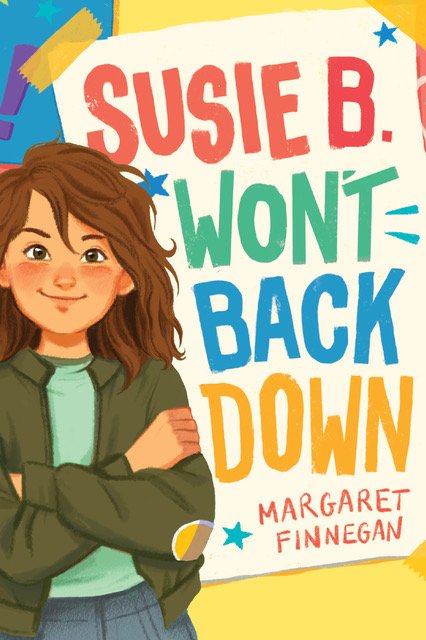
Review & Giveaway!: Susie B. Won’t Back Down by Margaret Finnegan

Share

Susie B. Won’t Back Down
Author: Margaret Finnegan
Published October 5th, 2021 by Atheneum Books for Young Readers

Summary: This funny, big-hearted novel about a young girl’s campaign for student council president is told through letters to her hero Susan B. Anthony.

Susie B. has a lot to say. Like how it’s not fair that she has to be called Susie B. instead of plain Susie. Or about how polar bears are endangered. Or how the Usual Geniuses are always getting picked for cool stuff over the kids like her with butterflies in their brain. And it’s because Susie B. has a lot to say about these very important things that she’s running for student council president.

If she’s president, she can advocate for the underdogs just like her hero and fellow Susie B., Susan B. Anthony. (And, okay, maybe the chance to give big speeches to the whole school with a microphone is another perk.) But when the most usual of Usual Geniuses also enters the student council race, Susie realizes this may be a harder won fight than she thought. Even worse, Susie discovers that Susan B. Anthony wasn’t as great as history makes it seem, and she did some pretty terrible things to try to help her own cause. Soon, Susie has her own tough decisions to make. But one thing is for sure—no matter what, Susie B. won’t back down.

Praise: 

“Susie is energetic, breathless, enthusiastic, and genuinely, charmingly funny.” —Kirkus Reviews

A Junior Library Guild Selection

About the Author: Margaret Finnegan is the author of the middle-grade novels Susie B. Won’t Back Down and We Could Be Heroes. Her writing often focuses on themes on inclusion, hard choices, and being true to yourself. She also makes a really good chocolate cake. To learn more, and to download free discussion guides, visit MargaretFinnegan.com.

Twitter: @FinneganBegin
Instagram: @finneganbegin

Review: Happy book birthday to Susie!!!

This book has so much in it! I was highlighting away as I read–both as a recreational reader and as a teacher (see more in Teachers’ Tools!)! I love that it is an epistolary novel, specifically writing to Susan B. Anthony, because it gives us insight into Susie’s school, home, and her inner thinking. The discussions throughout about heroes, fairness, and history is done in a very age-appropriate way but also doesn’t sugar coat anything. I love that Susie has a “butterfly brain” and went to reading lab but is proud of it. The talk about how all brains are different made my heart sing! And on top of all of this, the story itself is so on point for coming of age and how popularity, personalities, and more really start to affect kids starting in about 5th grade.

Teachers’ Tools for Navigation: I am in love with Mr. Springer’s hero project! The way he made the project cross-curricular, interesting, interactive, and included choice just makes it such an amazing project! And there are definitely parts of the book that will work as mentors/exemplars to share with students if you have them do their own hero project including some of Susie’s letters and the Voting posters. Also, the author created a mock Susie B. News to show one of the activities for the hero project: https://www.margaretfinnegan.com/wp-content/uploads/2021/09/The-Susie-B.-News.pdf.

The author also shares some activities in the publisher-created discussion guide!

Discussion Questions (from the publisher-created discussion guide): 

  • Describe the way that the author organizes the story. How does this format help to connect the worlds of Susie B. at home and at school?
  • Why does Susie B. call Chloe and her three R’s (Rachelle, Rachel, and Rose) “fakey fakes?” In contrast, Susie B. has Joselyn Salazar as her best “spark.” What connects these two as friends?
  • Each of the characters copes with the social scene at school differently. How does Soozee Gupta manage to not be alone at lunch? What is your opinion of her social strategy?
  • Susie B. wrangles with the idea of fairness and justice. She believes that they are two different things. What do you think is the difference between being fair and being just?
  • What do you think is the most important lesson that Susie B. learned in this story? Give reasons for your opinion.

Flagged Passages: Chapter 1

Dear Susan B. Anthony:
I have very bad news for you. You’re dead. Really dead. Like, over one hundred years dead. Like, right now, you are dust and bones in the cemetery of your old hometown, Rochester, New York.

Sorry.

You are probably thinking, What the heck? If I am dead, why are you writing to me?

Congratulations! Even though you are dead, you are not forgotten! You are still remembered for being a brave and determined defender of women’s rights, especially women’s suffrage. That is the fancy name for women voting, even though I think suffrage should be the name for not being able to vote, because it sounds like the suffering you would have to go through if everybody thought your voice didn’t matter one speck.

Since I am also a brave and determined defender of all the rights of all the people, I thought you would like to know that I am thinking about you.

Plus, Mr. Springer is making me.

Mr. Springer is my fifth-grade teacher. Every year he assigns this thing called the Hero Project. All of his students have to choose a personal hero. They can choose anyone they want, as long as the person is dead. Mr. Springer used to let kids choose living heroes, but then the live heroes kept doing horrible things and ruining everyone’s projects. Luckily, dead heroes can’t surprise you like that. We are going to do a bunch of research and assignments on our heroes and basically use them to learn stuff about language arts, history, and even math and science. Mr. Springer is always trying to find sneaky ways to get us interested in what he’s teaching.

Read This If You Love: Twins by Varian Johnson & Shannon Wright, How to Win a Slime War by Mae Respicio, Kids Under the Stairs series by K.A. Holt, Friends Forever by Shannon Hale & LeUyen Pham, Five Things about Ava Andrews by Margaret Dilloway

Recommended For: 

classroomlibrarybuttonsmall 

Giveaway!

a Rafflecopter giveaway

Signature

**Thank you to Blue Slip Media for providing a copy for review and giveaway!**
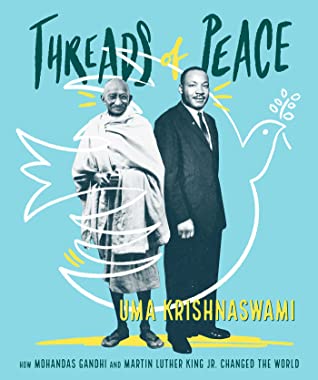
Threads of Peace: How Mohandas Gandhi and Martin Luther King Jr. Changed the World by Uma Krishnaswami

Share

Threads of Peace: How Mohandas Gandhi and Martin Luther King Jr. Changed the World 
Author: Uma Krishnaswami
Published August 17th, 2021 

Summary: Mahatma Gandhi and Reverend Martin Luther King Jr. both shook, and changed, the world, in their quest for peace among all people, but what threads connected these great activists together in their shared goal of social revolution?

A lawyer and activist, tiny of stature with giant ideas, in British-ruled India at the beginning of the 20th century.

A minister from Georgia with a thunderous voice and hopes for peace at the height of the civil rights movement in America.

Born more than a half-century apart, with seemingly little in common except one shared wish, both would go on to be icons of peaceful resistance and human decency. Both preached love for all human beings, regardless of race or religion. Both believed that freedom and justice were won by not one, but many. Both met their ends in the most unpeaceful of ways—assassination.

But what led them down the path of peace? How did their experiences parallel…and diverge? Threads of Peace keenly examines and celebrates these extraordinary activists’ lives, the threads that connect them, and the threads of peace they laid throughout the world, for us to pick up, and weave together.

Praise: “The book’s attractive design, lucid text, and carefully chosen details combine to create an inviting and original treatment of its subjects. History has been carefully intertwined with the present in this engaging and reflective book.” —Kirkus Reviews (starred)

About the Author: Uma Krishnaswami is the author of several books for children including Book Uncle and Me (International Literacy Association Social Justice Literature Award, USBBY Outstanding International Book) and Step Up to the Plate, Maria Singh (Asian Pacific American Librarians Award, FOCAL Award). She was born in New Delhi, India, and now lives in British Columbia, Canada. To learn more, visit her website: umakrishnaswami.org.

Review: First, happy book birthday!!!!!! 🎉 

In the Author’s Note, Krishnaswami notes, “Then, in 2008, I read The End of Empires: African Americans and India by historian and African American studies professor Gerald Horne. It was an eye-opener. I was born in India and I’d lived in the United States for nearly thirty years, but in neither country had I ever learned this history.” As I’ve noted over and over again when I review nonfiction or historical fiction, it is only through brilliant books that I have learned true history as my history classes were so US-centered that we hardly learn anything other than basic history about the world and it is so white-washed that even when slavery or Civil Rights is covered, it very much focuses on the successes. It is because of this that I am so thankful that books like this exist and allow me to share the erased history with students. Because even with Martin Luther King Jr., who all are familiar with, there is so much of him and his journey and point of view that are erased in history books. 

Everything I learned about India’s history was from some books before I read this: The Night Diary by Veera Hiranandani, I am Gandhi (both picture book & graphic novel) by Brad Meltzer, and A Taste of Freedom: Gandhi and the Great Salt March by Elizabeth Cody Kimmel. That was all of my prior knowledge, so I was taken aback by the breadth of India’s history that I was ignorant about. Krishnaswami did a brilliant job telling about Gandhi’s personal life while also teaching about Indian history. In the second half of the book, we switch to Martin Luther King Jr.’s life and the racial injustices happening in the United States. Again, the book focuses not only on King’s personal life but the history of the US at the time as well. I learned so much in this book. It made me think, reflect, get angry, cry, and have purpose for continuing with a focus on anti-racism. 

Uma Krishnaswami does a beautiful job using the imagery of threads figuratively throughout this book to tie Gandhi and King through their views on peace and nonviolence as well as Gandhi and King to the histories they helped shape. 

Teachers’ Tools for Navigation & Discussion Questions: There is so much to discuss in this book! I could see parts of it being used to supplement curriculum, I could see it being used AS the curriculum, I could see it being used as a resource for research, I could see it being an independent reading book for an interested student…. It has endless potential. 

  • Why would the author choose thread to be the figurative imagery in the book? 
  • Although Gandhi and King both were focused on equality and nonviolence, they differed in many ways also–how so? 
  • In both cases, Gandhi and King continued their work despite potentially putting their family in danger. Why would they do this? 
  • How was India’s reach for freedom similar to the Civil Rights Movement in the United States? 
  • Both Gandhi and King had assassination attempts multiple times in their life. They both did not want their attackers charged–why not? What does this tell you about them? 
  • In the end they were both assassinated, how did hatred, fear, and ignorance lead to both of their deaths? 
  • Both had such strong women as wives. How did both women help support their husband’s mission? 
  • Do you believe that Martin Luther King Jr. would have the same beliefs without Gandhi pathing the way? 

Flagged Passages: “Chapter 25: Spinning New Threads of Peace”

To spin thread on a spilling wheel like the one Gandhi designed when he was in jail, you bein with a roll of fluffy, carded cotton. In the Hindi language, this is called pooni. You attach the pooni to a length of thread looped around a small metal spindle. You hold the fluffy cotton loosely in one hand and draw it slowly, outward and upward, to arm’s length. With your other hand, you turn a flat wheel. A few turns clockwise, then a quarter turn counterclockwise, over and over, until the rhythm takes hold of you and you no longer have to link about it. 

It takes patience. It takes time. Each had has to learn to do its work without getting distracted. 

At first, the cotton drifts apart. The yarn is not twisted enough. This it’s twisted too tightly. It breaks. The spindle falls off its course. The cord that drives the spinning wheel slips from its grove. But slowly, slowly, if you keep at it, the thousands of fibers contained within a single handful of cotton begin to twist around one another, becoming one, united and strong enough to endure. The cotton springs to life, and a thread begins to form! Only inches of it, but it is real cotton thread. 

The threads of peace movements are like that. They continue to spin outward over and over, long after they have been created. 

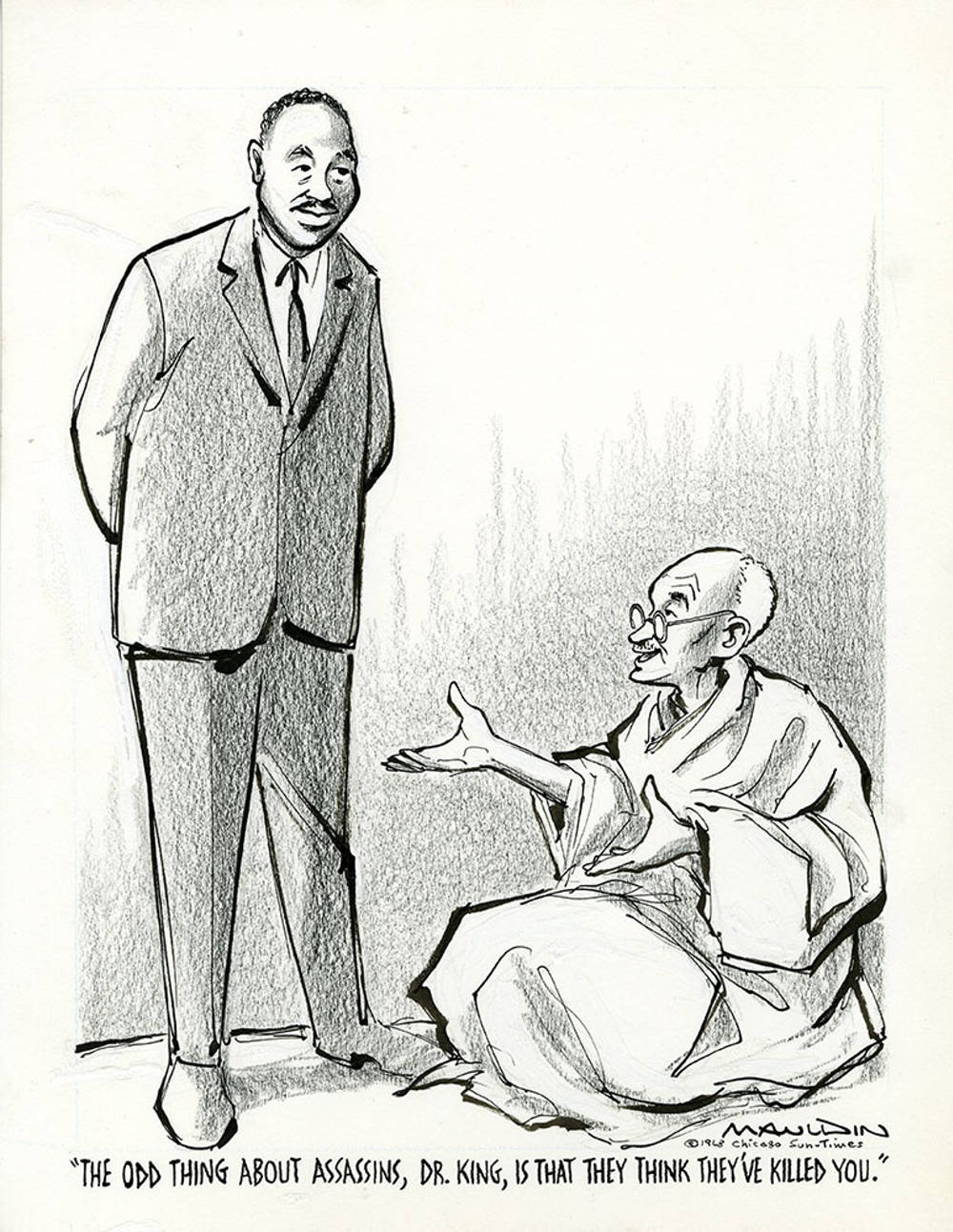
In April 1968, after Dr. King’s assassination, the Chicago Sun-Times published this cartoon: 

Look at Gandhi, seated on the floor, his hand outstretched, making his point to an attentive Dr. King. You’d think they were old friends. There they are in this alternate reality, perhaps even in the artist’s imagined heaven, reminding us that the voices of peacemakers can resonate long after they are gone. 

Although they never met, Gandhi and King were kindred spirits. Gandhi was aware of racial injustice in the United States and hoped that Black American would create their own nonviolent movement. 

Martin Luther King Jr. read books by and about Gandhi. He knew people who had met Gandhi. Gandhi’s teaching supported King’s own beliefs that grew out of the love of family, of community, of Jesus. King integrated Gandhian methods and principles into the work of his life, much as he did with the Christian gospel.”

Read This If You Love: I am Gandhi (both picture book & graphic novel) by Brad Meltzer; A Taste of Freedom: Gandhi and the Great Salt March by Elizabeth Cody Kimmel; Chasing Lincoln’s Killer by James L. Swanson; Martin’s Big Words: The Life of Dr. Martin Luther King Jr. by Doreen Rappaport; Be a King: Dr. Martin Luther King Jr.’s Dream and You by Carole Boston Weatherford; Memphis, Martin, and the Mountaintop: The Sanitation Strike of 1968 by Alice Faye Duncan; March trilogy by John Lewis with Andrew Aydin; A Good Kind of Trouble by Lisa Ramée; The Night Diary by Veera Hiranandani

Recommended For: 

classroomlibrarybuttonsmall 

Signature

**Thank you to Barbara at Blue Slip Media for providing a copy for review!**


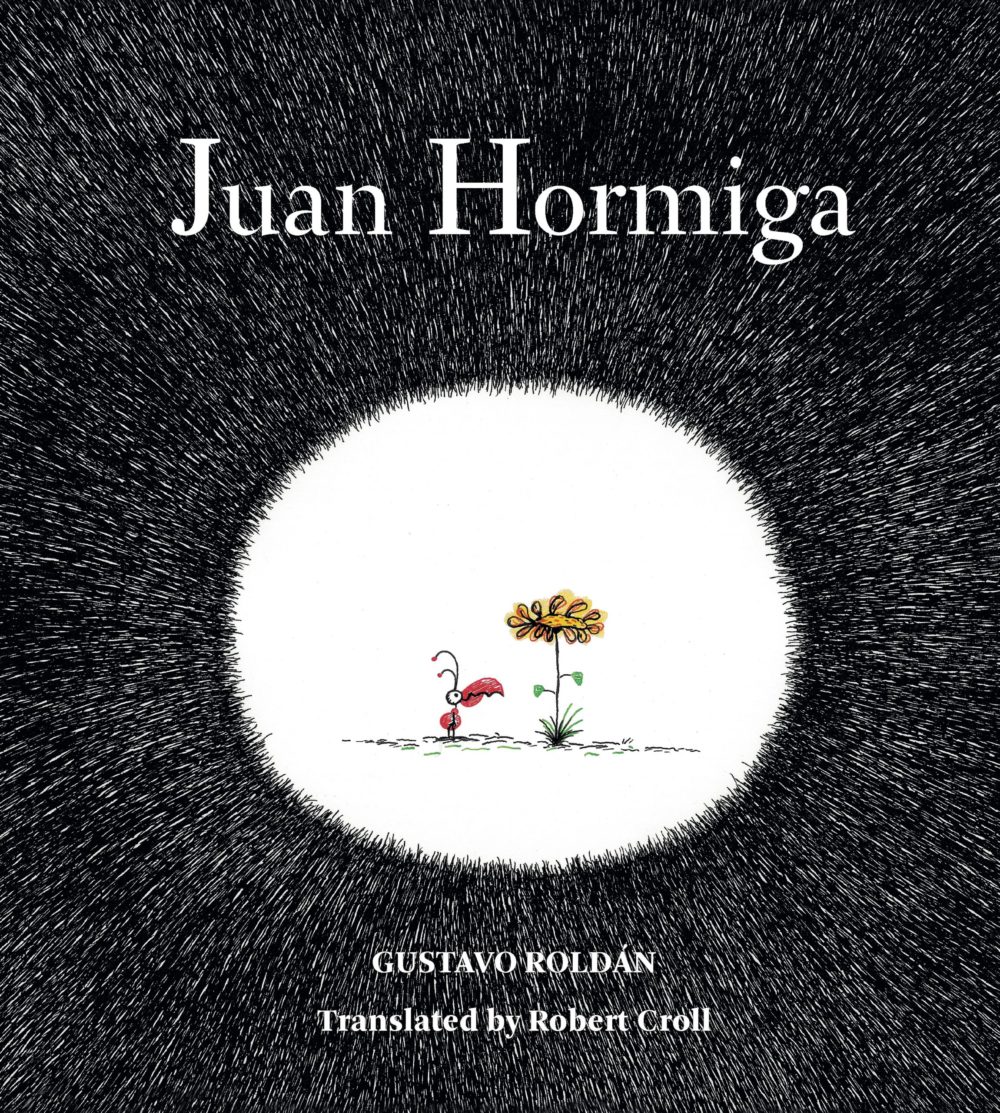
Juan Hormiga by Gustavo Roldán, Translated by Robert Croll

Share

Juan Hormiga
Author & Illustrator: Gustavo Roldán
Translator: Robert Croll
Published Originally in 2013, Translated and Published May 4th, 2021 by Elsewhere Editions

Summary: Juan Hormiga, the greatest storyteller of his entire anthill, loves to recount his fearless grandfather’s adventures. When Juan and his fellow ants gather around for story time, he hypnotizes all with tales of his grandfather’s many exploits – including his escape from an eagle’s talons and the time he leapt from a tree with just a leaf for a parachute. When he’s through telling these tales, Juan loves to cozy up for a nice long nap. He’s such a serious napper that he takes up to ten siestas every day! Though well loved by his ant friends, Juan decides telling tales and sleeping aren’t quite enough for him – it’s time to set off on his own adventure. With whimsical, irresistible illustrations, Juan Hormiga affirms the joys of sharing stories, and of creating your own out in the world.

About the Author: Gustavo Roldán was born in Argentina in 1965. His illustrations are widely published, and he has been exhibiting his work since 1985. His books have been published in numerous countries including Mexico, Belgium, Spain, the Netherlands, Brazil, South Korea, and Switzerland and have earned him recognition from A.L.I.J.A., the Prix Octogone, and inclusion in the White Ravens catalogue created by the Jugendbibliothek. His other books include El señor G and Historias de conejo y elefante, both published internationally. He currently lives in Barcelona, where he is a contributor to several publishing houses.

About the Translator: Robert Croll is a writer, translator, musician, and visual artist from Asheville, North Carolina. He first came to translation during his undergraduate studies at Amherst College, where he focused on Julio Cortázar’s short fiction. His translations include The Diaries of Emilio Renzi by Ricardo Piglia, published by Restless Books.

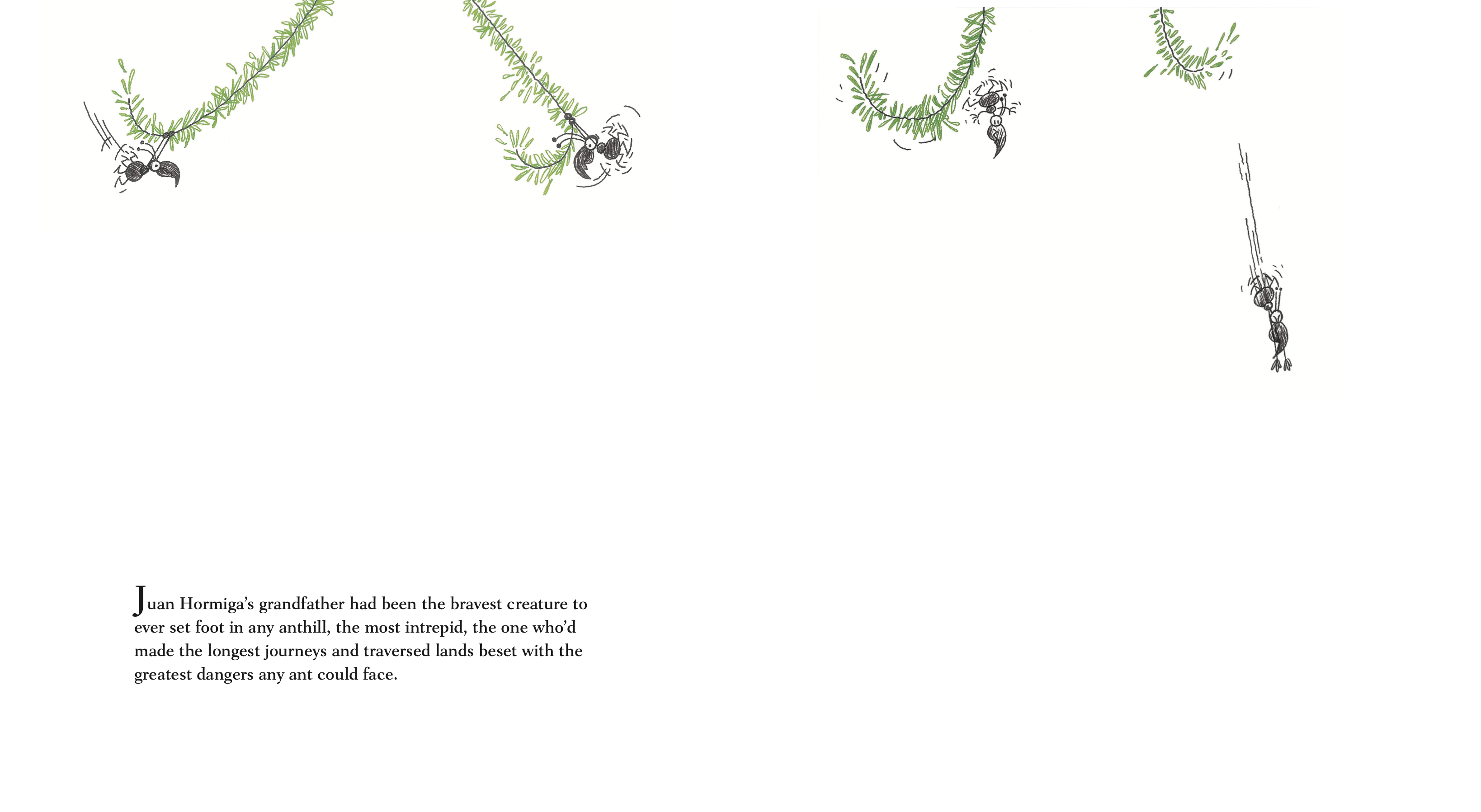
Review: From the first couple of pages when Juan Hormiga napped his way around the spread and showed his curiosity, I fell in love with this little ant. He may not fit what we normally think of when we think of ants, but he is an example of the importance of different types of people in a community: every time Juan Hormiga speaks to tell a story, all of the other ants stop and listen because that is the power of a good story. This message is also one that made my heart happy as I read it.

I also loved that there was no shunning or pushes to be different involved in the story. The ants loved Juan Hormiga for who he was and utilized him for his strengths.

Author Rivka Galchen called Juan Hormiga “magnificent and silly and tender all at once–a perfect book,” and I can attest that all is there: magnificent in the message and stories, silliness in the illustrations and conversation, and tender in the love for each other.

Teachers’ Tools for Navigation: Students will love hearing this book read out loud, and it will lend itself nicely to a creative writing activity where students can create their own adventures for Juan Hormiga’s grandfather–what other adventures did he go on?

Discussion Questions: 

  • How is Juan Hormiga different from his fellow ants?
  • Why is Juan Hormiga so important to his colony even though he doesn’t do the same labor the other ants do?
  • The author shared that this book was inspired by nights when his family camped in the mountains and his mother told them stories. How do you see this inspiration in the story?
  • What do you think the author is trying to portray about the power of storytelling?
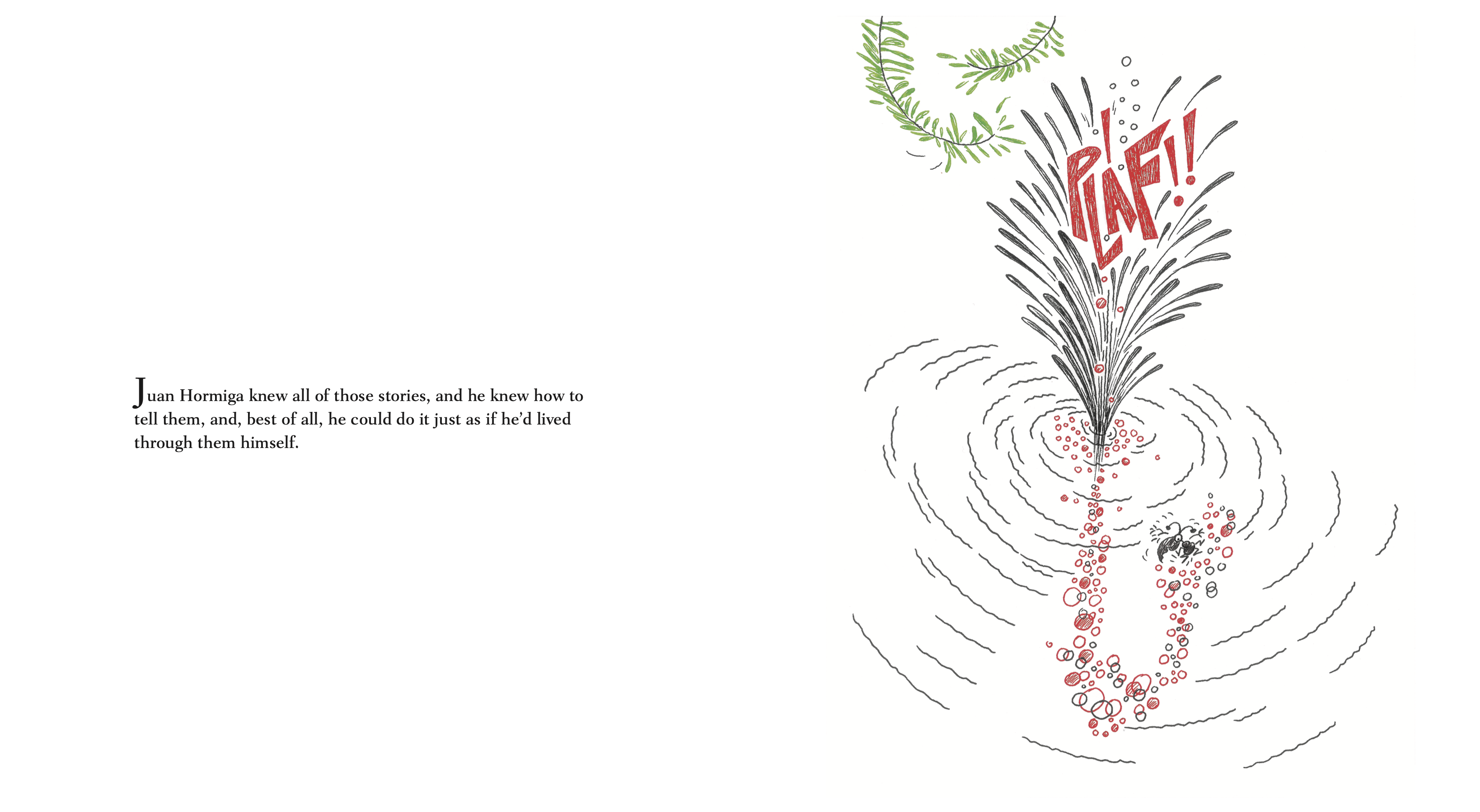
  • How do you think the ants feel when they find Juan in the willow tree?

Flagged Passages: 


Read This If You Love: Little Fox by Edward van de Vendel, Lucy by Randy Cecil, Normal Norman by Tara Lazar

Recommended For: 

classroomlibrarybuttonsmall

Signature

**Thank you to Elsewhere Editions for providing a copy for review!**

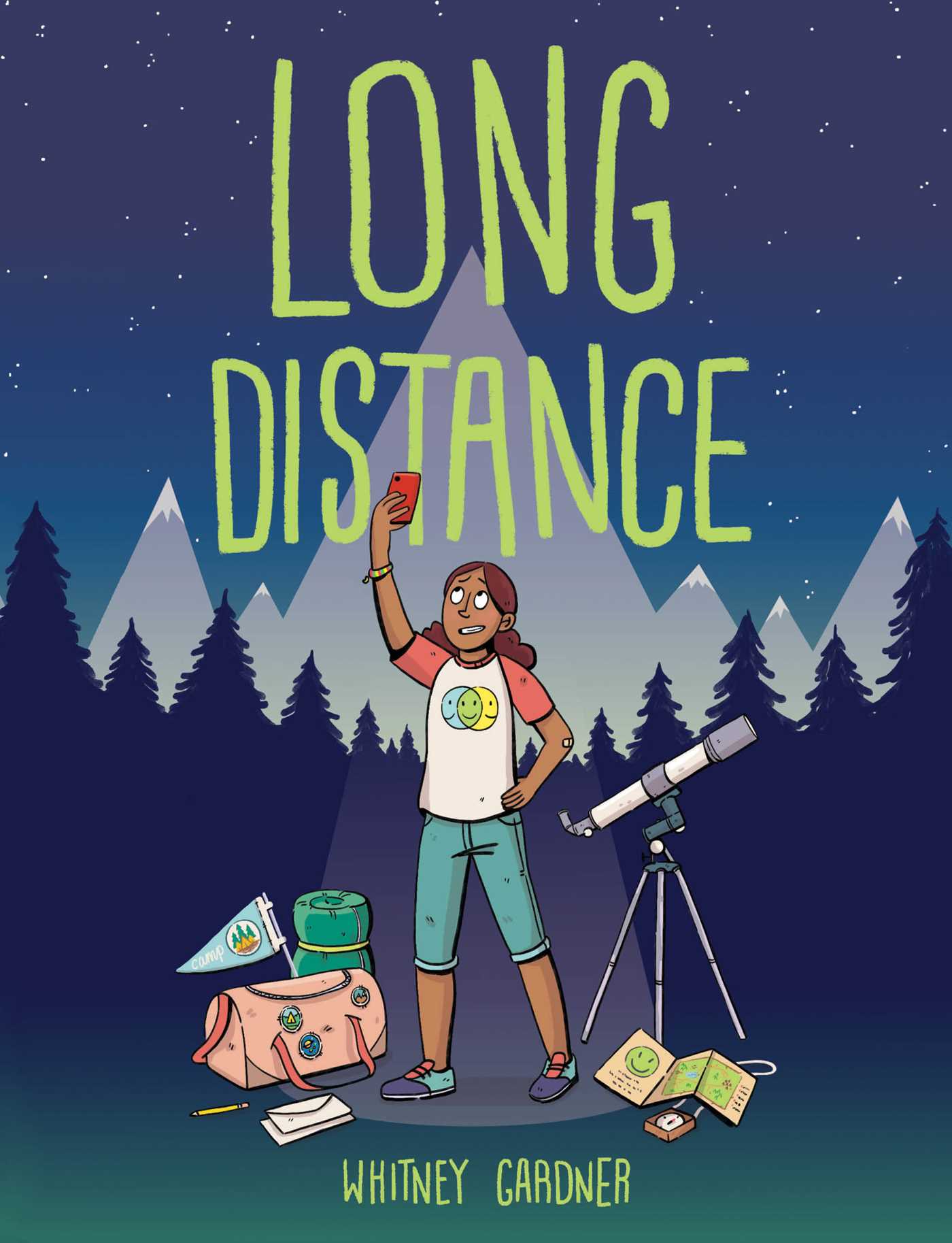
Long Distance by Whitney Gardner

Share

Long Distance
Author: Whitney Gardner
Published June 29th 2021 by Simon & Schuster Books for Young Readers

GoodReads Summary: From the creator of Fake Blood comes another exceptionally charming middle grade graphic novel about friendships both near and far, far away.

Vega’s summer vacation is not going well.

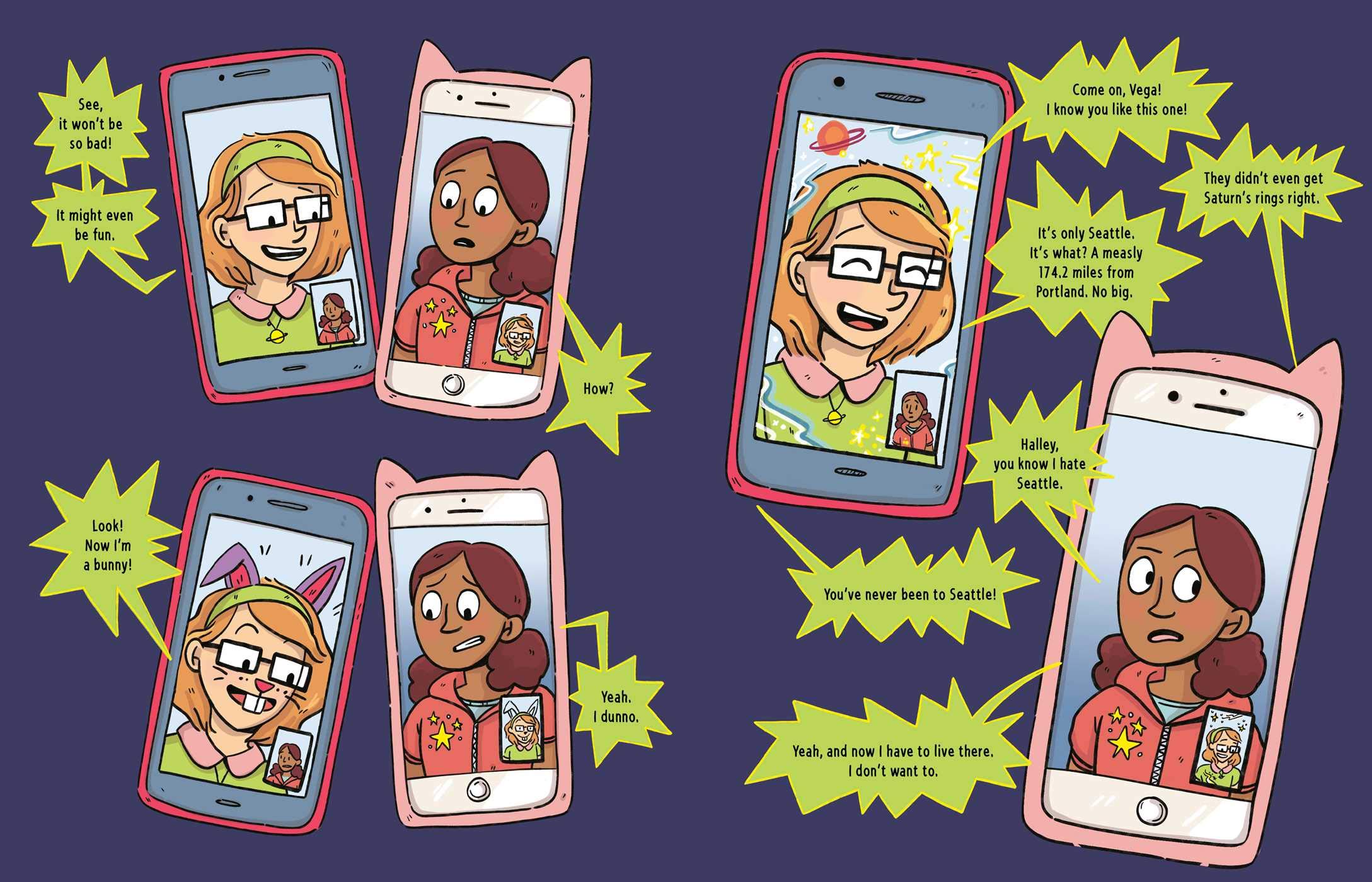
When her parents decide it’s time to pack up and leave her hometown of Portland, Oregon, behind for boring Seattle, Washington, Vega is more than upset—she’s downright miserable. Forced to leave her one and only best friend, Halley, behind, Vega is convinced she’ll never make another friend again.

To help her settle into her new life in Seattle, her parents send Vega off to summer camp to make new friends. Except Vega is determined to get her old life back. But when her cellphone unexpectedly calls it quits and things at camp start getting stranger and stranger, Vega has no choice but to team up with her bunkmates to figure out what’s going on!

Ricki’s Review: I read this book with my 7-year-old (he is not the target audience), and we really enjoyed it. The book has a very drastic twist towards the end of the book that will shock readers. The illustrations are wonderful, and the characters are quirky and fun, and I am glad that I read the book. It teaches about the layers of friendship, and the different ways in which we judge (and don’t judge) humans. Long Distance will offer teachers and students rich opportunities to discuss and consider how we think about others, and how we engage and participate in friendships.

Kellee’s Review: What a fun new graphic novel to add to my library! This book is going to have no trouble finding readers because it has a great mix of realistic (moving, friendship), information (all the science), and sci fi (you’ll see!). Because of these three factors, it is going to have a wide range of readers. The diversity of characters will help with the reach also: Vega is a girl of color, she has two fathers who are both people of color, and the twins at camp are characters of color also. Additionally to the diverse representation of identities, the characters area all quite different personality-wise, so every reader is going to find someone that they are rooting for or connect with. 

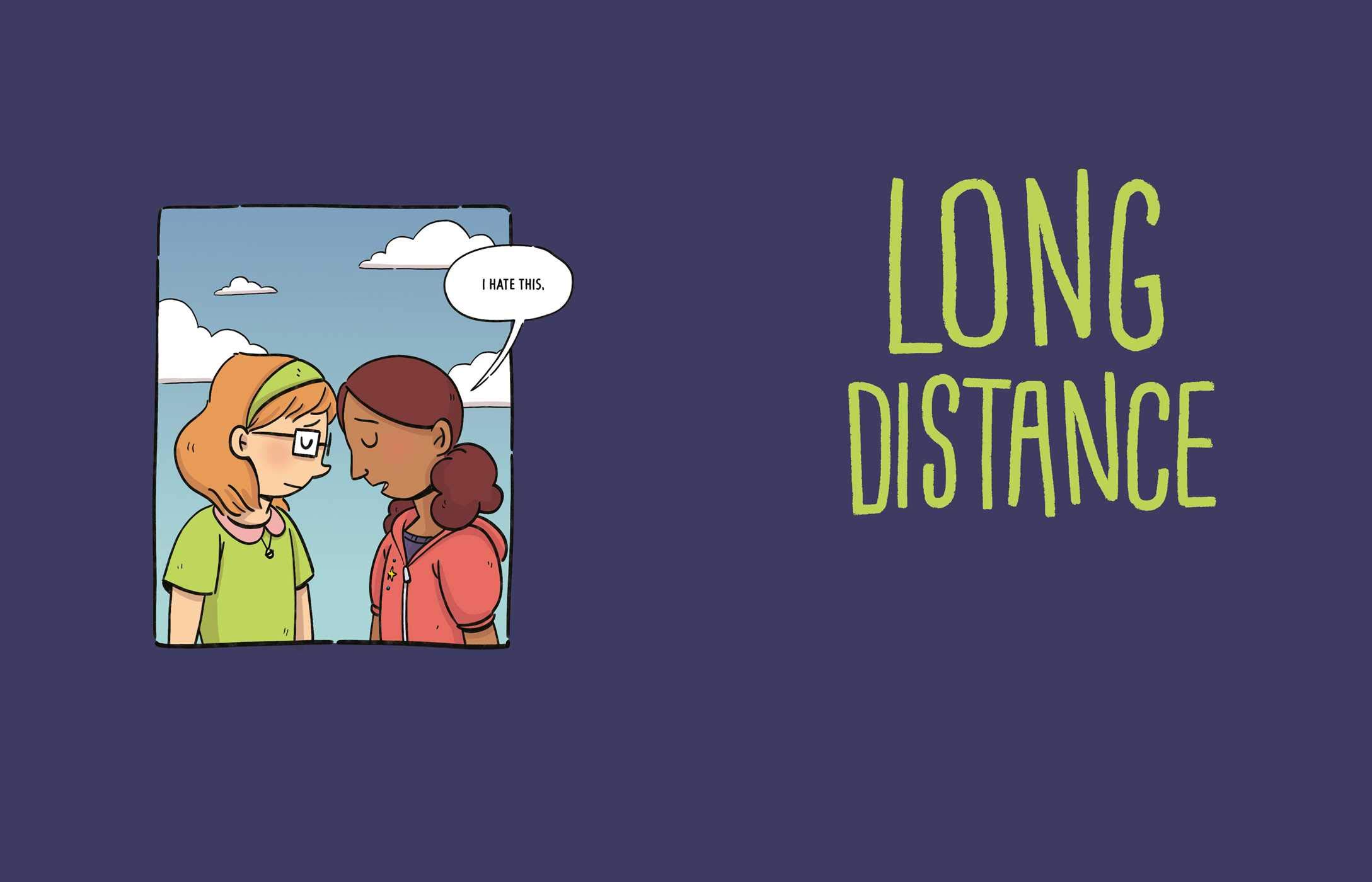
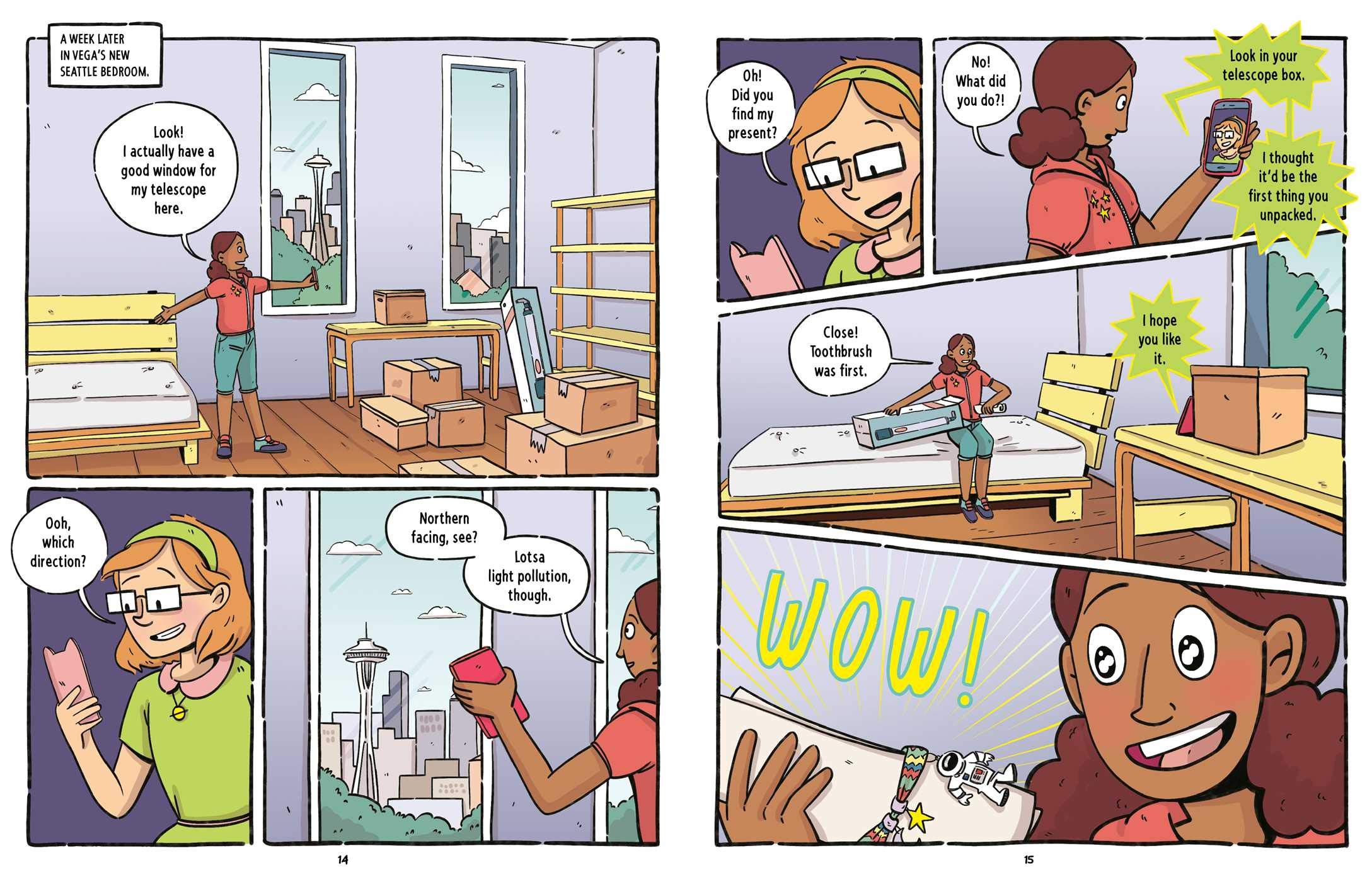
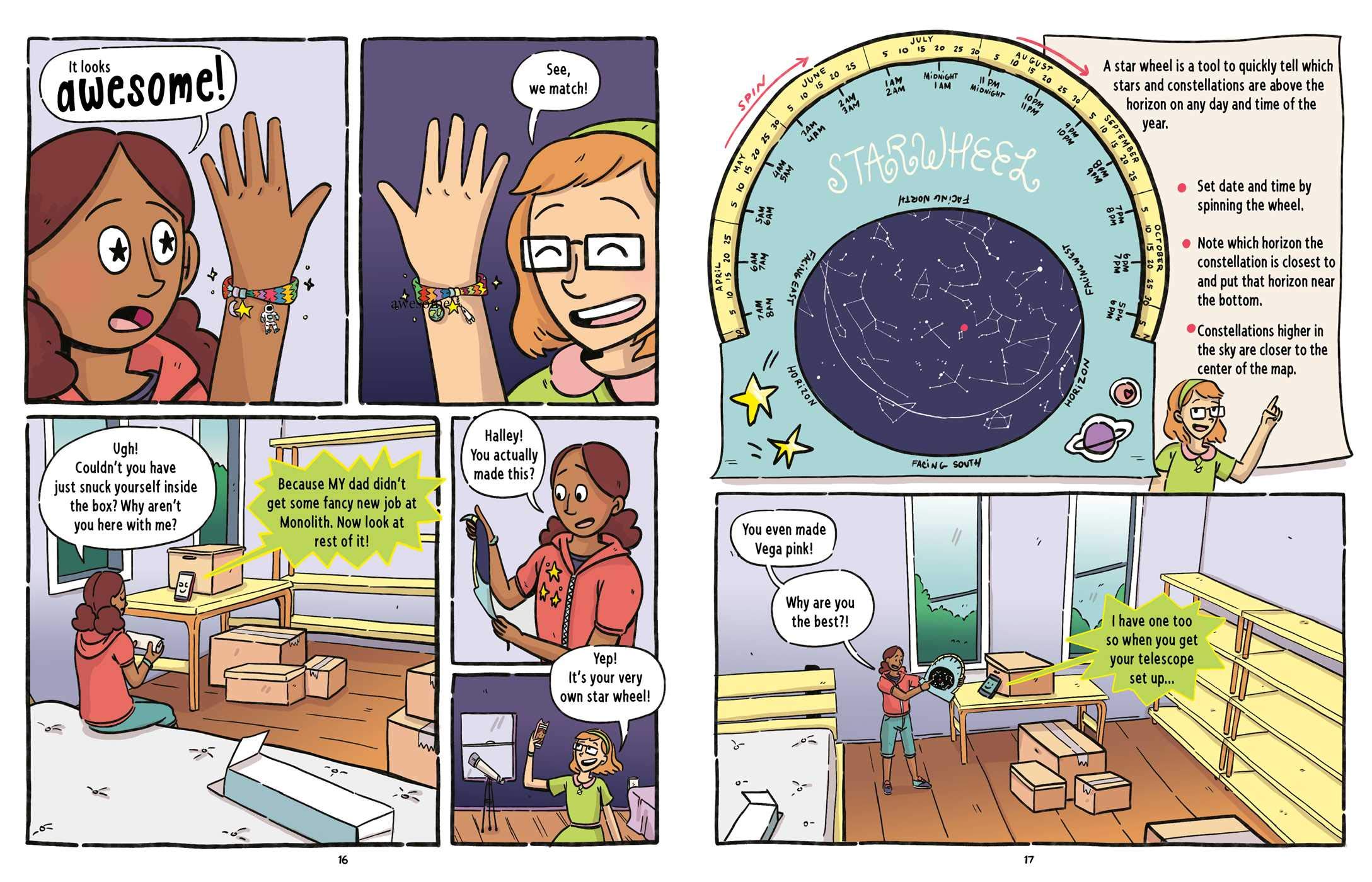
You’ll see below in the “Flagged Passages” that the illustrations are super colorful and eye catching, but not so busy that you lose focus. This is a huge benefit, specifically in middle school, because students love a color-filled graphic novel. 

Teachers’ Tools for Navigation: As described above, the twist in this book drastically shifts the storyline. Teachers might ask students to rewrite the twist to shift the story’s ending in a different direction.

The book also has a great SEL opportunity to look at how to make friends, using George as a great example of how not to. 

The text could also be used for prediction as the reader is as ignorant about the facts of the camp as Vega is but there are clues to something odd going on. As you read, students can look at the clues and try to make guesses about what the truth about the camp is. 

Also, the book has many cross overs with science! If you look at the “Flagged Passages” below, you’ll see that Vega is gifted a star chart by her friend and the author uses the opportunity to talk about what a star chart is. This happens a handful of times within the book with topics including astronomy, geology, and electrical engineering. In addition to the sidebars with info, there is science strewn throughout the narrative! 

Finally, Simon & Schuster has created “Drawn to Reading: A S&S Guide to Using Graphic Novels in the Classroom” which might assist you in utilizing this book with students. 

Discussion Questions: 

  • What does Vega learn about friendship?
  • Which camper was most interesting for you? What did you find interesting about them?
  • Many of the characters have different hobbies. What are your hobbies, and how do they compare with those of the characters in the book?
  • How did the author tie science into this science fiction graphic novel? 
  • How does Vega’s interest in stars and space help her discover the truth about the camp? 
  • If you had been in Vega’s position, would you have stayed with George? 
  • How did Halley figure out where Vega was? 
  • What scientific information that was shared in the book would you like to learn more about? 
  • Do you think we are alone in this universe? 

Flagged Passage: 

Read This If You Loved: Star Scouts by Mike Lawrence, HiLo series by Judd Winick, Katie the Catsitter by Colleen A.F. Venable, Real Friends series by Shannon Hale, Sisters by Raina Telgemeier, Drama by Raina Telgemeier, Fake Blood by Whitney Gardner

Recommended For:
 classroomlibrarybuttonsmall

RickiSigand

**Thank you, Audrey, at Simon & Schuster, for providing copies for review!**

Secondhand Dogs by Carolyn Crimi

Share

Secondhand Dogs
Author: Carolyn Crimi
Illustrator: Melissa Manwill
Published July 6th, 2021 by Balzer + Bray

Summary: Miss Lottie’s home was for second chances.

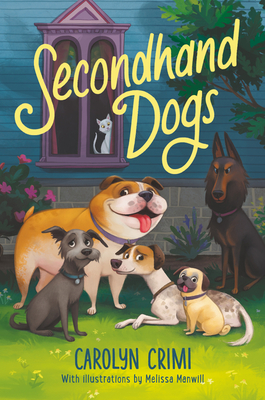
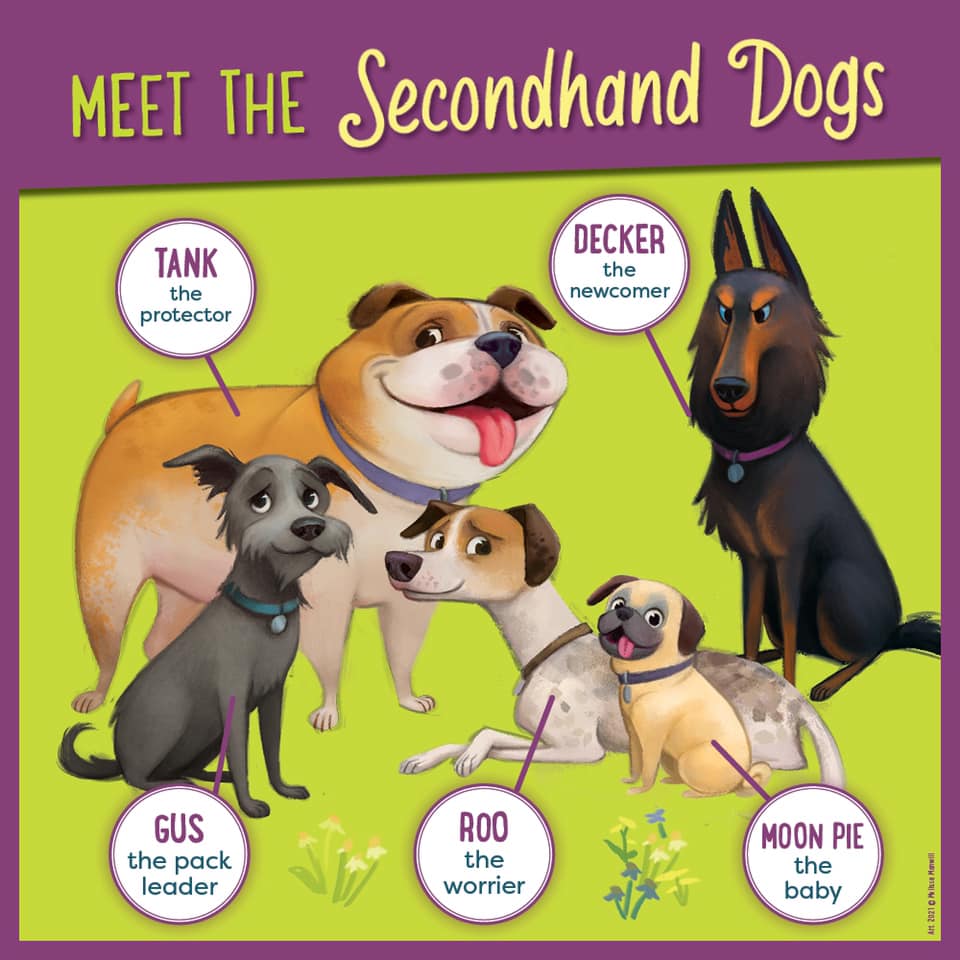
When she adopted Gus, Roo, Tank, and Moon Pie, Miss Lottie rescued each member of the pack—including herself, her helper, Quinn, and her reclusive cat, Ghost—and turned them into a family. But when a new dog, Decker, arrives and tries to hoard Miss Lottie’s heart and home for himself, the pack’s future is threatened.

At first, Gus, the insecure pack leader, only notices little things, like tiny Moon Pie being kicked out of the bed and Ghost acting spooked (then again…Ghost is a cat). But things soon go from bad to worse as Decker’s presence causes disharmony in the group.

When Decker convinces Moon Pie to embark on an impossible journey, it’s up to Gus to gather his courage, rally his splintered pack, and bring Moon Pie home. And with coyotes and cars on the loose, the pack must push through obstacles and dangers to reunite with Moon Pie before he can get hurt—or nearly as bad, get his heart broken.

A heartwarming—and heart-tugging—middle grade novel about love, loyalty, and what to means to be part of a family, featuring a motley pack of rescue dogs—from author Carolyn Crimi, with adorable illustrations by Melissa Manwill. Perfect for fans of A Dog’s Life and Because of Winn-Dixie.

Praise: “Pervading themes of bullying, leadership, loyalty, and family—among humans and canines alike—raise important issues while the comic-style illustrations feature character cameos and highlight key scenes. A sensitive, satisfying, and intriguing canine tale” –Kirkus Reviews

About the Author: Carolyn Crimi received her MFA in Writing for Children from Vermont College in 2000. She has published over 15 books, including Dear Tabby, Don’t Need Friends, Boris and Bella, Henry and the Buccaneer Bunnies, Where’s My Mummy?, and I Am the Boss of this Chair. Her book, There Might Be Lobsters, won The Golden Kite Award in 2018 for Best Picture Book Text, and her middle grade debut, Weird Little Robots, was named a BEA Book Buzz pick. Carolyn has received over thirty state awards and award nominations and was given The Prairie State Award in 2012 for her body of work. You can visit Carolyn at carolyncrimi.com.

Facebook: Carolyn Crimi
Twitter: @crims10

Review: First, I must say: kids are going to love this book. Seriously. Go pick it up for the kid(s) in your life.

I always go hesitantly into dog books because, as I am sure it is with all of you, the emotions when it comes to animal books are on high alert! And please know that your emotions are going to be going on a roller coaster of emotions in this one! 

The first emotion you are going to feel is love. As soon as you hear Gus’s voice, you know that he is a dog you can trust. Then as you meet each of the pack, they automatically go into your heart. Crimi does an amazing job telling the current narrative while also flashing back to show the dogs’ (and Miss Lottie’s, Quinn’s, and Ghost the cat’s) past. This allows you to jump into the story while also learning about how the pack gets together.

The next emotion you are going to feel is anger. Decker is a challenger to the pack. The way he manipulates and bullies, specifically Moon Pie, is devastating. It is true manipulation. You will definitely feel anger. Also, you learn more about Quinn’s life which will definitely make you feel angry.

Then comes the feelings of suspense, sadness, happiness, pride, and more! I can’t get more into the story because I don’t want to spoil! It is a good ride, I promise!

Teachers’ Tools for Instruction: First, this book is going to make an awesome read aloud!! Great topics and themes will lead to wonderful conversations.

But I think a huge asset for this book in the classroom is the different point of views that the author tackles. It is a wonderful mentor text for looking at voice. Each dog, cat, and person, although in 3rd person, had a different distinct tone and voice. It would be a great activity to have your students write a story from a certain POV then rewrite it from a different. Then they can even change 1st person to 3rd or vice versa. 

There is also a publisher-provided curriculum guide that is an awesome resource:

Discussion Questions: 

  • Why did the pack lie to Moon Pie and was it okay?
  • Why was Dexter the way he was?
  • Why did Roo originally side with Dexter?
  • Each of the dogs had a special skill: What would your special skill be?
  • What are some times during the book that shows you Quinn is special?
  • How does Quinn finally stand up to his brother?
  • What does Gus’s choice about what he did with the coyote tell you about him?
  • Why is the book titled Secondhand Dogs?
  • What is the differences between Dexter and Gus as the pack leader?
  • What does Miss Lottie’s choice about what she did with Dexter tell you about her?
  • How did the ending make you rethink Dexter’s character?
  • Who do you think was the hero of the book?

Flagged Passages: Gus: The new dog walked calmly next to Miss Lottie. His ears and his tail were both up. Alert, but not alarmed.

He wasn’t nervous. Not like the other dogs had been when they first approached the pack.

He was sizing them up, Gus decided. Gus didn’t know what to think about that. Usually new dogs pulled back a bit, or wiggled a little too much, or stood their ground and barked.

Not this dog.

Gus sniffed the air again. The scent that wafted off the new dog was bright and cold, like the metal water bowl in Miss Lottie’s kitchen.

Gus had always hated that bowl.” (Chapter 2)

Read a sample: https://preview.aer.io/Secondhand_Dogs-Mzk3MzU1?social=0&retail=0&emailcap=0

Read This If You Love: The One and Only Bob by Katherine Applegate, Good Dog by Dan Gemeinhart, Granted by John David Anderson

Recommended For: 

classroomlibrarybuttonsmall 

Signature

**Thank you to Blue Slip Media for providing a copy for review!!**

Already a Butterfly: A Meditation Story by Julia Alvarez, Illustrated by Raúl Colón

Share

Already a Butterfly: A Meditation Story
Author: Julia Alvarez
Illustrator: Raúl Colón
Published June 16, 2020 by Henry Holt and Co.

Summary: Already a Butterfly is a gentle picture book tale about self-soothing practices and self-confidence beliefs.

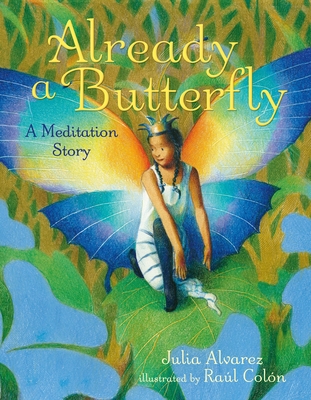
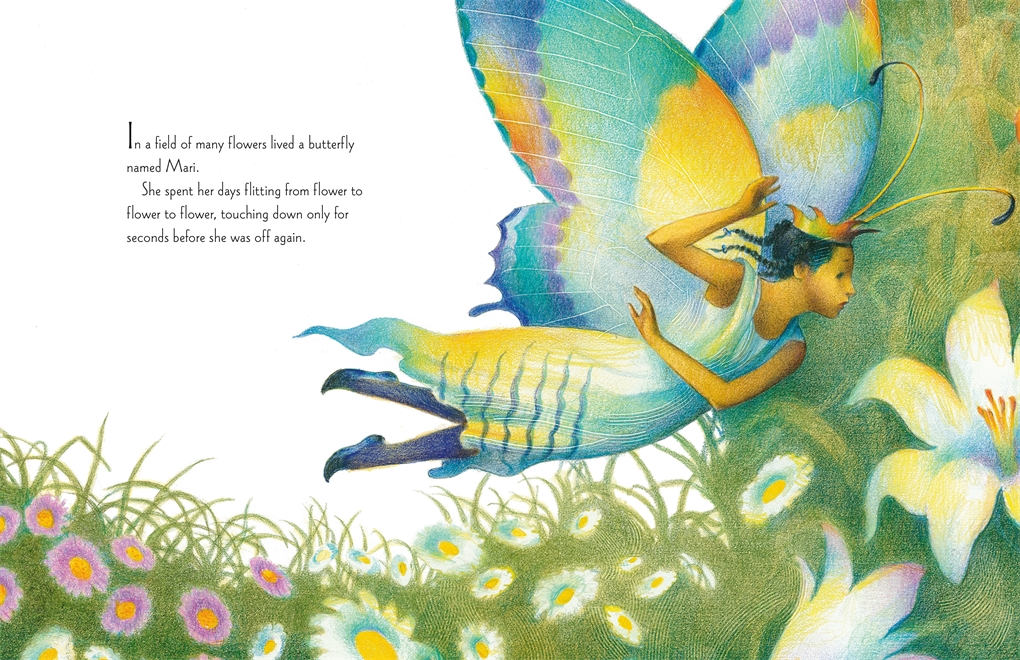
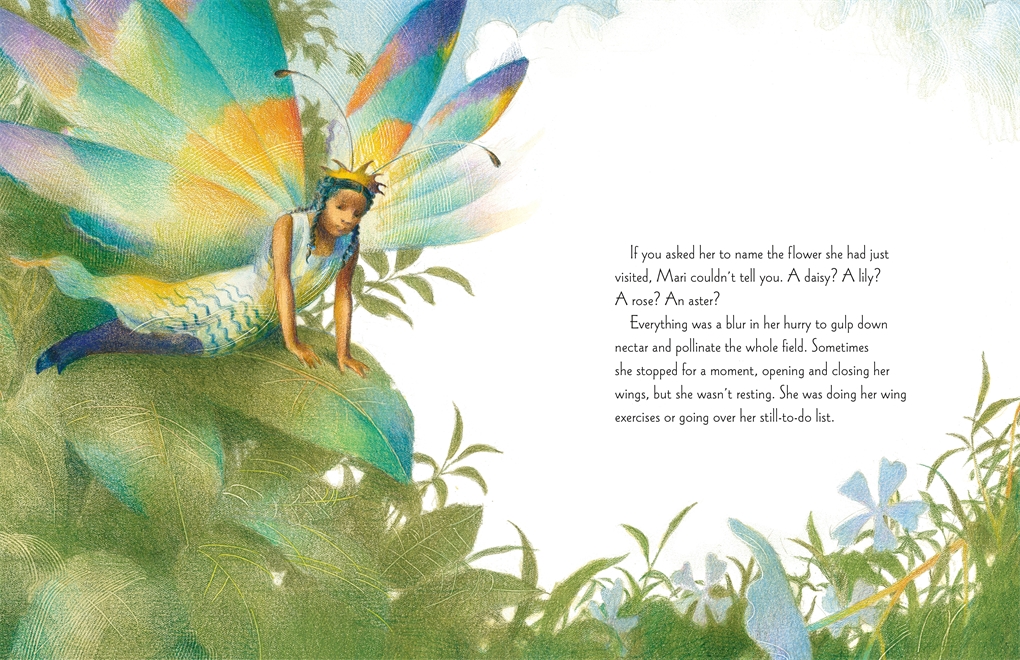
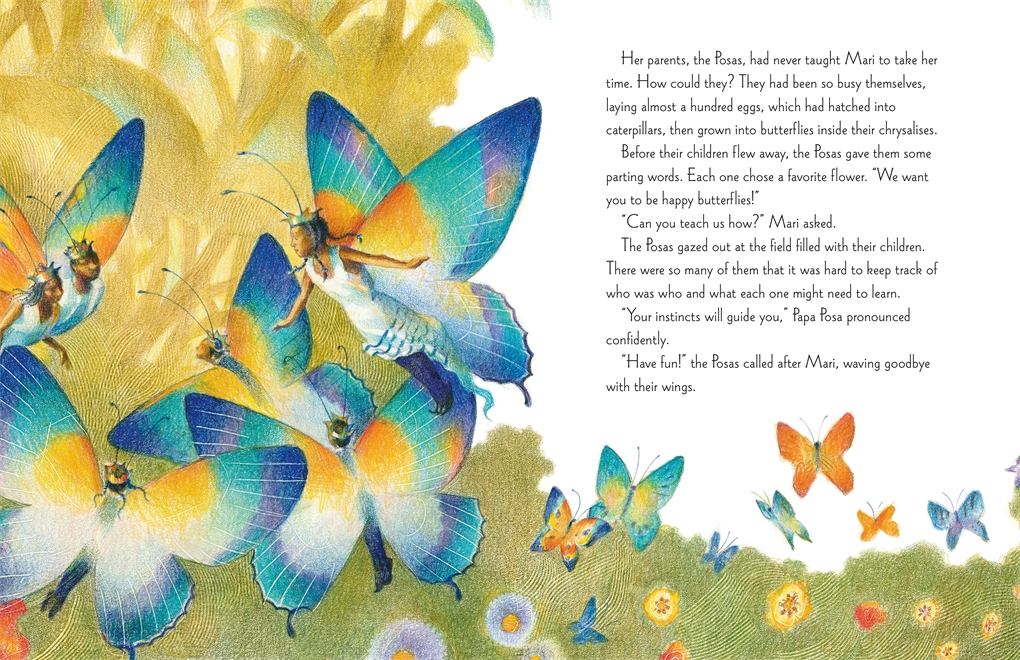
With so much to do in so little time, Mari is constantly on the move, flitting from flower to flower, practicing her camouflage poses, and planning for migration. She’s the busiest butterfly around. But does being productive mean she is happy? Mari couldn’t say. The only way she feels like a butterfly is by acting like one. Little does Mari know, the secret to feeling like herself is simply to focus her breath, find her quiet place, and follow her instincts. With the guidance of a thoughtful flower bud, Mari soon learns to meditate and appreciate that she was a butterfly all along.

Acclaimed author Julia Alvarez extolls the importance of mindfulness, reflection, and self-care for young children in this gratifying picture book, stunningly illustrated by award-winning artist Raúl Colón.

About the Author: 

Julia Alvarez is the author of numerous bestselling and award-winning novels including How the García Girls Lost Their Accents and In the Time of Butterflies, collections of poems, and works of nonfiction as well as picture books. She has won the Pura Belpré Award, the Américas Award, the Hispanic Heritage Award in Literature, the F. Scott Fitzgerald Award for Outstanding Achievement in American Literature, and the National Medal of Arts.

Raúl Colón has illustrated several highly acclaimed picture books, including Draw!; the New York Times-bestselling Angela and the Baby Jesus by Frank McCourt; Susanna Reich’s José! Born to Dance; and Jill Biden’s Don’t Forget, God Bless Our Troops. Mr. Colón lived in Puerto Rico as a young boy and now resides in New City, New York, with his family.

Praise:

“Soft, textured illustrations full of floral elements match the gentle quality of the tale. In a world that can’t seem to slow down, this story reminds readers to trust their instincts and breathe.” —Kirkus Reviews

“This is a tale about learning to be joyful in a world that seems to demand more and more of individuals. Young readers will find the prose and the dreamlike pictures of Mari’s journey soothing—and something to meditate on.” —Booklist

“Alvarez pens this introduction to meditation with advisory zeal, focusing on explanations that will appeal to caretakers who seek to support young meditation practitioners. Jewel-toned spreads by Colón provide scope for dreaming: Mari’s distinctive features—her black braids, her elflike shoes, her golden crown—give readers a fantasy heroine to linger over.” —Publishers Weekly

Review: At first glance, Mari seems like the perfect butterfly. She is beautiful, busy, efficient… but is she happy? She is doing what she things she should do but is she embracing who she is? These are the types of questions that this book is asking.

To be honest, reading this book may have hit home more for me than for Trent. The book is about slowing down and taking the time to be happy. Trent is still young and knows how to enjoy time, but it is important for me to show him that I too have time for the small things and also help him continue to do so. But just like the book made me think about passions, being busy, and how we come off, it will do the same for most readers.

I really loved the backmatter as well, learning how the author was inspired by the Mariposa DR Foundation’s Center for Girls and her granddaughters. It truly brought the book together and shows how the ideas within the book can be used in the real world.

Now, take all of this beautifulness in words and story and add in Colón’s beautiful watercolor illustrations that bring Mari to life, and this book clearly is a must have when discussing mindfulness with all ages!

Teachers’ Tools for Navigation: Use Already a Butterfly and the ideas in the “Growing Your Own Wings” backmatter to bring meditation into your classroom. A great day to introduce this would be World Meditation Day which is May 21st!

An extension reflection activity that would be fun is to have students make their own butterfly wings and write items, moments, people, etc. on their wings that make them truly happy. These wings can be a symbol to remind them to cherish those things.

Tips for Mindful Meditation: 

Discussion Questions: 

  • Why did the author choose Mari as the butterfly’s name?
  • How was the author inspired by her time with the Mariposa DR Foundation’s Center for Girls?
  • How could Mari’s story be compared to your life?
  • What did Bud teach Mari?
  • Why was Mari happier in her chrysalis?
  • Do you think what Bud taught Mari will make her happier?

Flagged Passages: 

Read This If You Love: I am Peace by Susan Verde, Calm with the Very Hungry Caterpillar by Eric Carle, My Magic Breath by Nick OrntnerGood Morning Yoga by Miriam Gates

Recommended For: 

classroomlibrarybuttonsmall 

Signature

**Thank you to Barbara at Blue Slip Media for providing a copy for review!**

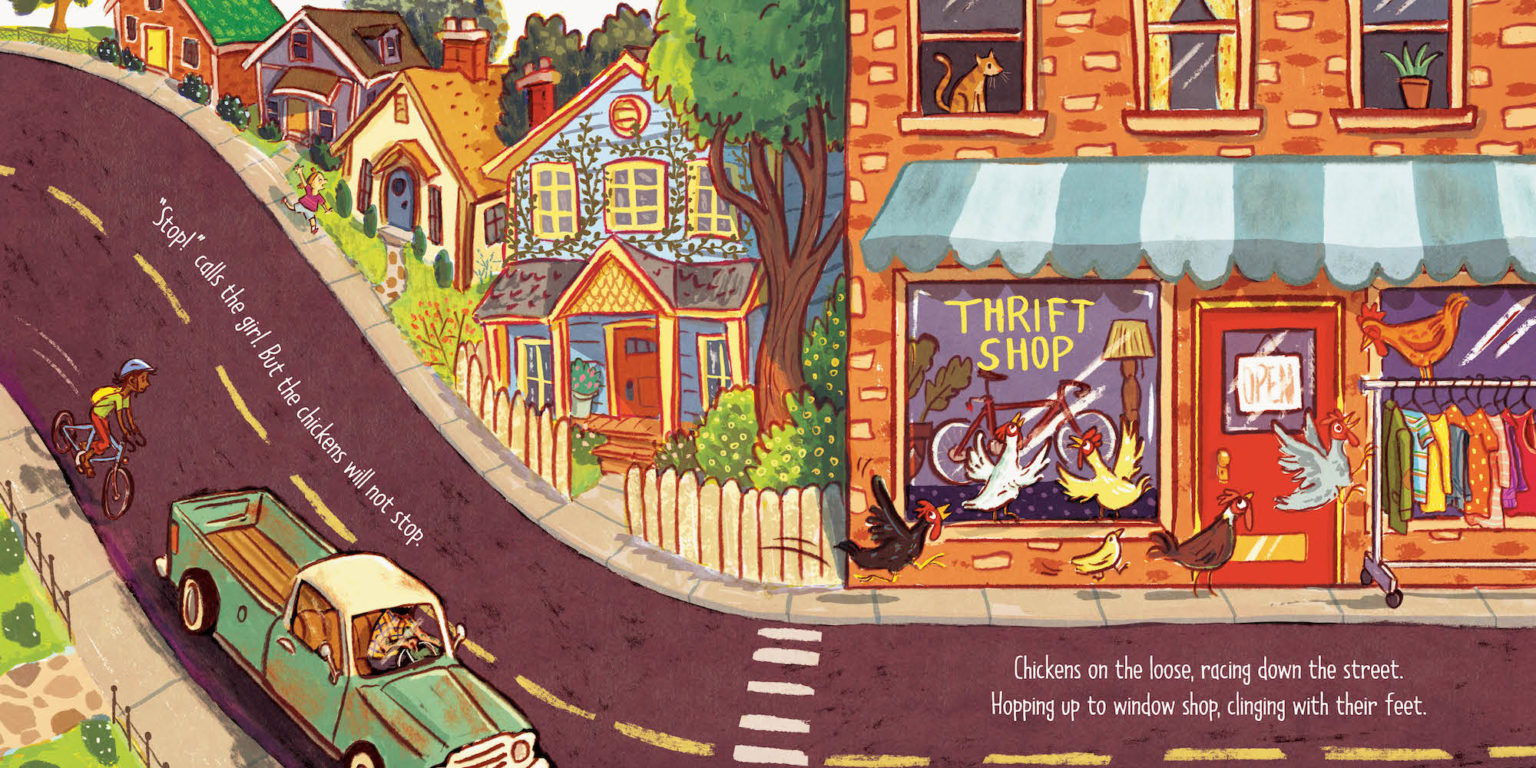
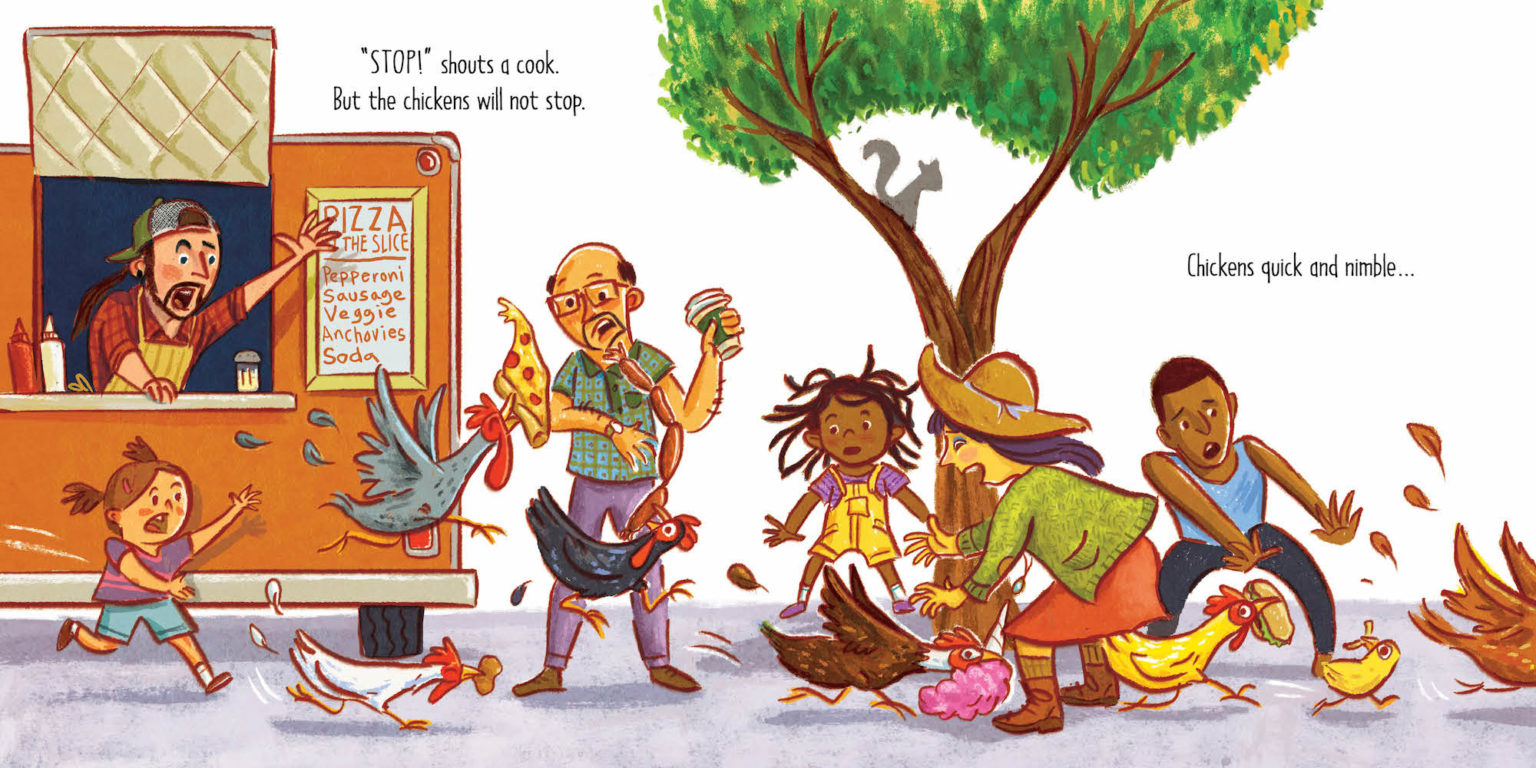
Review and Giveaway!: Chickens on the Loose by Jane Kurtz, Illustrated by John Joseph

Share

Chickens on the Loose
Author: Jane Kurtz
Illustrator: John Joseph
Published May 11, 2021 by West Margin Press

Summary: A happy-go-plucky rhyme adventure of chickens frolicking in an urban environment as they run rampant all around town!

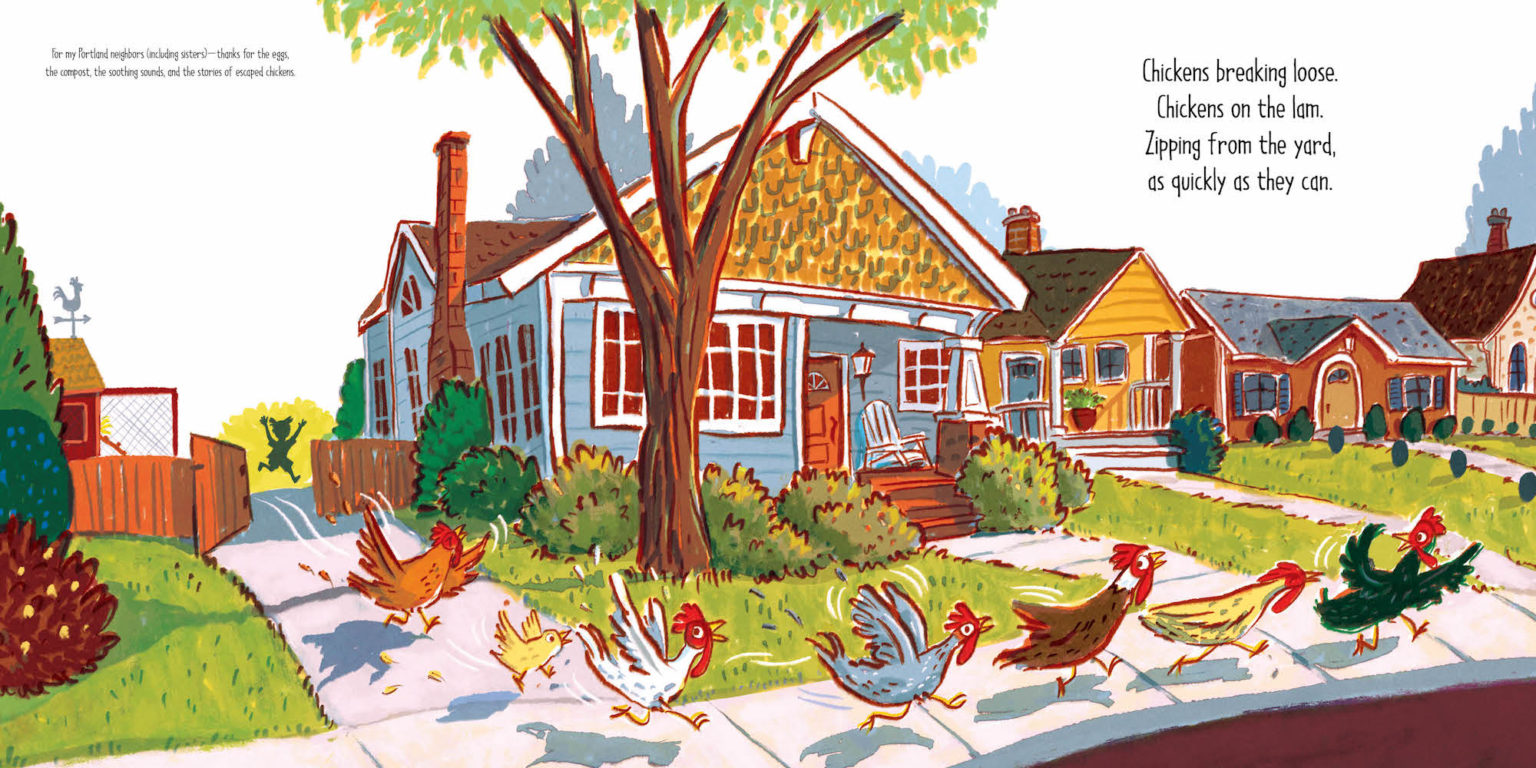
Chickens on the loose.
Chickens on the lam.
Zipping from the yard,
As quickly as they can.

Chickens don’t just live on farms—they’re in the city too! In the store, on the street, they bring mayhem and excitement to all the surprised people. See where these mischievous chickens go in this brightly illustrated picture book told in verse. Also included at the back are fun facts and tips for the urban chicken farmer.

About the Creators: 

Jane Kurtz is an award-winning children’s book author, speaker, educator, and she is on the faculty of the Vermont College of Fine Arts MFA in Children’s and YA Literature. She is a co-founder of the nonprofit Ethiopia Reads, an organization that brings books and literacy to the children in Ethiopia, where Jane grew up. She also heads the creative team of Ready Set Go Books, a project of Open Hearts Big Dreams to create fun, colorful, local language books for people in Ethiopia. She is the author of many books for children, including River Friendly River Wild, winner of the SCBWI Golden Kite award for picture book text, and What Do They Do With All That Poo?, a finalist to the AAAS/Subaru SB&F Excellence in Science Books list; it has also been named to several state reading lists, voted on by children.

Author website

Instagram: @writerjanie

Twitter: @janekurtz

John Joseph is an artist, illustrator, elementary school teacher, avid gardener, and community leader. He earned a degree in visual arts from Colorado State University and a Masters from Lesley University, and has won the ACP Excellence in Publishing Award for Best Picture Book. He lives in Colorado with his wife, two sons, and a German shepherd.

Artist website

Meet Jane Kurtz and learn more about Chickens on the Loose

Praise: 

“Urban backyard chickens go on a madcap tour of the city in this rhyming romp. . . the narrative bounces off the tongue. The marker-bright illustrations are frenetic and filled with humorous details.” ~ Kirkus Reviews

“In jaunty pitch-perfect rhyme and splendiferous, chaotic color, Jane Kurtz and John Joseph combine forces to tell the story of recalcitrant urban chickens who burst forth from forced chicken coopery to explore a lively, diverse neighborhood rich with thrift shops, yoga studios, food carts, pet shops, and street art–all free for the pecking. At the end of an energetic day, the chickens-on-the-loose return to their henhouse, bedraggled but with plans for a rerun! Prepare for a rambunctious reading experience.” ~ Toni Buzzeo, Author of 28 picture books for children, including the 2013 Caldecott Honor Book, ONE COOL FRIEND

Review and Teachers’ Tools for Navigation: I love urban chickens! We have a town nearby (Oviedo) which has chickens that roam in their downtown, Jim has a cousin with chickens, and I have a past student with chickens. I love the idea of mixing farm animals and cities because it adds a bit of whimsy and quietness to the bustle and hustle.

Though in Chickens on the Loose the chickens definitely add whimsy but are not quiet–instead they add a bit of chaos. 😂

Reading this out loud was so much fun! The rhyming and rhythm added a musical element to reading the book. And within the rhymes there are great vocabulary moments, too! For example, some words Trent and I got to talk about were lam, peckish, and plucky.

Also while reading, Trent definitely saw that the book alludes to the gingerbread man story. It was fun listening to him share how the book is similar and different to The Gingerbread Man. There’s also a chicken Mona Lisa at the end that cracked him up! Great way to introduce allusion!

Additionally, the backmatter of the book gives information about keeping urban chickens and some fun chicken facts. It is a great way to connect the story to science.

The publisher also has an activity kit available for the book:

Discussion Questions: 

  • What would you name the painting the chick painted at the end?
  • Where do you think chickens would run to in your town?
  • Write your own rhyme that starts with “Chickens on the loose,…”
  • What new words did you see in the book?

Flagged Passages: 

Book Trailer: 

Read This If You Love: The Gingerbread Man by various; Other chicken picture books like Chicken Butt by Erica S. Perl, Chicken Dance by Tammi Sauer, Little Chicken’s Big Day by Jerry Davis, Blue Chicken by Deborah Freedman, Chicken Story Time by Sandy Asher, Pirate Chicken by Brian Yanish, Interrupting Chicken by David Ezra Stein, Chicken Little by Sam Wedelich; Follow that Frog! by Philip C. Stead; Nibbles series by Emma Yarlett

Recommended For: 

classroomlibrarybuttonsmall 

GIVEAWAY!

a Rafflecopter giveaway

Signature

**Thank you to Barbara at Blue Slip Media for providing copies for review and giveaway!**