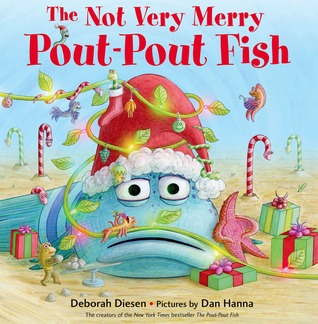
The Not Very Merry Pout-Pout Fish
Author: Deborah Diesen; Illustrator: Dan Hanna
Published: September 8, 2015 byFarrar, Straus and Giroux (BYR)
Summary: Holiday sequel to The New York Times bestselling Pout-Pout Fish series reminds young readers what being merry is all about
The grumpiest fish in children’s literature is back with another case of “the dreary wearies.” This time, Mr. Fish, star ofThe New York Times bestselling Pout-Pout Fish series, is down in the dumps over holiday shopping. With a message for readers of all ages, The Not Very Merry Pout-Pout Fish (Farrar, Straus, & Giroux Books | Macmillan Children’s Publishing Group, Ages 2-6) finds Mr. Fish so consumed with finding that perfect gift for each of his friends that he forgets the true meaning of the holidays.
When Mr. Fish—with his signature Pout-Pout Fish frown—comes up empty-handed, Miss Shimmer intervenes with a plan to make homemade gifts. He soon learns that it’s not about busting the budget or gifting the season’s hottest item, but giving from the heart. Together they experience the joy that comes from giving and sharing—the merriest gifts of all.
Ricki’s Review: Ever since I received this book, my toddler has demanded I read it to him multiple times a day. The story has a wonderful moral that is very important for the gift-giving season. As a mom, I work really hard to try to show my son that material items should not be significant. Not only does this book teach lessons related to this topic, but it prizes friendship. I suspect we will be reading this book again and again in years to come because the need for this lesson will recur as he grows older. He loves the complexity of the illustrations. There is so much to look at on each page!
Teachers’ Tools for Navigation: This book offers opportunities for students to create their own homemade gifts for friends, family, or those in need. It will inspire students to want to create something that will be greatly appreciated by another person.
Discussion Questions: How might you show your love to a family member or friend without buying anything? Do you think they would appreciate it more or less? Why?; How does pout-pout fish learn the value of gift-giving? What do his friends think about his gifts?
We Flagged:
Read This If You Loved: The Pout-Pout Fish by Deborah Diesen; The Giving Tree by Shel Silverstein; Books about Giving and Generosity; Books about Christmas
Giveaway!
a Rafflecopter giveaway
Recommended For:

Q&A with Author Deborah Diesen
How did you come up with the original Pout-Pout fish book in 2008?
The story grew out of an actual pout! One day many, many years ago, when my elder son was a preschooler, he was having a very grouchy afternoon. Hoping to amuse him, I made an exaggerated pouty face at him. He smiled and then pouted right back, which got us both laughing. “We look like fish,” I said. “Like pout-pout fish!” As soon as I said that out loud, it became a story idea. I jotted the idea down and I started writing The Pout-Pout Fish that same day. Years later, I started sending the story to publishers, and in 2005 it was accepted at Farrar, Straus & Giroux Books for Young Readers. The book was published in 2008 and began a series of stories, all featuring Mr. Fish, his friends, and their adventures.
Since the first book, we’ve seen Mr. Fish go to school, learn to smile, face the dark, discover how to dream and play hide-and-seek. What do kids (and their parents) love most about the series?
I think one of the things that makes Mr. Fish an appealing character for many kids and parents is that kids and parents alike can identify with his experiences. Toddlers sometimes pout; so do adults! Preschoolers have things they’re scared of; so do adults! Kindergarteners get nervous about starting something new; so do adults! Mr. Fish’s experiences provide a way for kids and grown-ups to explore those issues together. In addition, the stories have rhyme, repetition, and wordplay, which are fun in a read-aloud book. And Dan Hanna’s illustrations! They’re fantastic. They truly bring the stories to life.
What is Mr. Fish up to now? Does he have a case of the “dreary wearies” in the latest book, too?
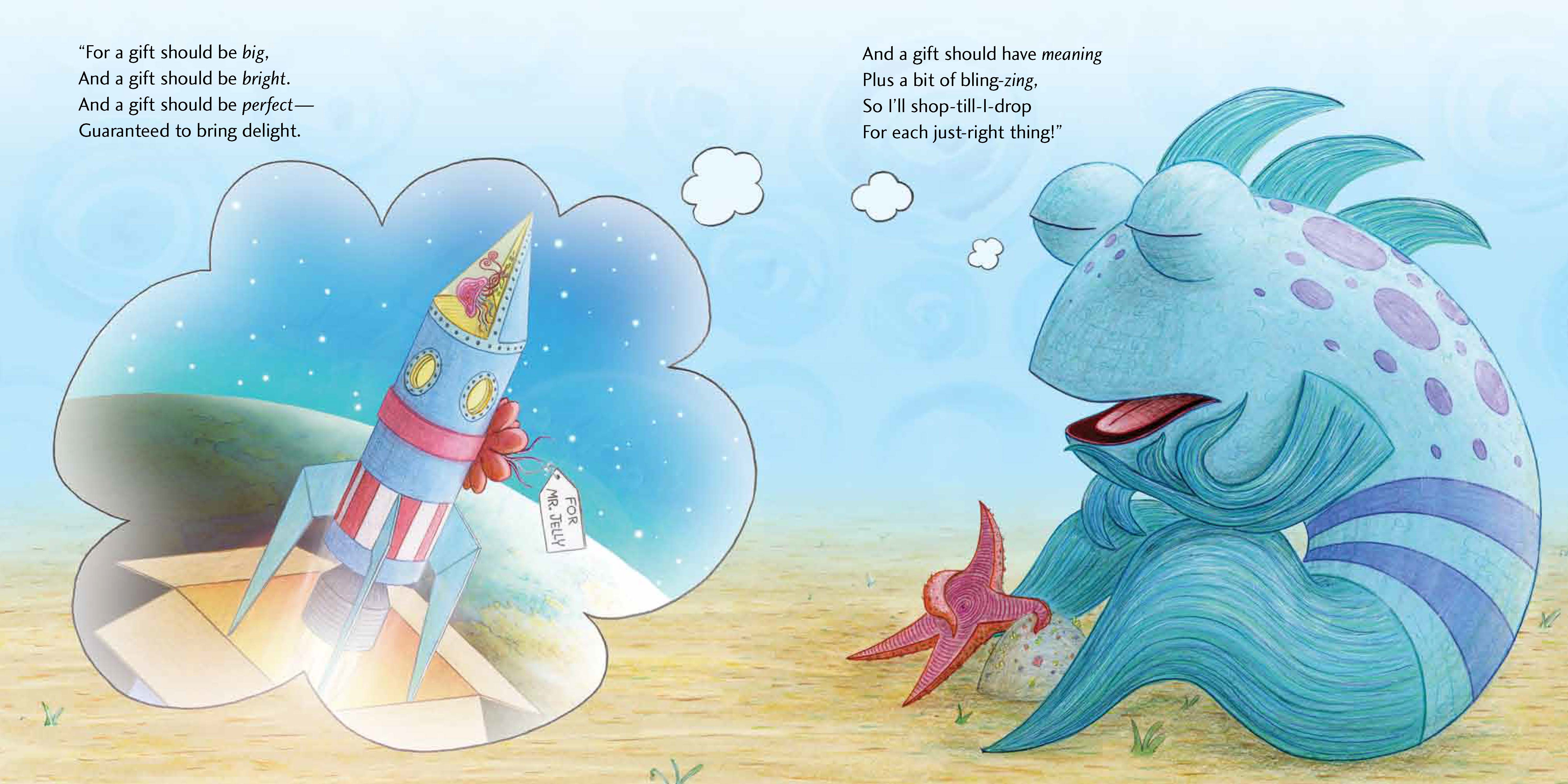
Mr. Fish’s newest adventure is called The Not Very Merry Pout-Pout Fish. In it, Mr. Fish is in a bit of a holiday panic, searching for perfect gifts for all of his friends. His shopping trip is unsuccessful, and Mr. Fish is sure that he’s let all of his friends down. But his friend Miss Shimmer reminds him that the best gifts of all come straight from the heart, and she helps him craft simple and meaningful presents to bring to the holiday party. His friends are delighted with their presents, and together everyone celebrates peace, joy, and love – what a very merry gift!
What do you hope young readers (ages 3-6) will learn from The Not Very Merry Pout-Pout Fish? Is there a message here for grown-ups as well?
I hope that Mr. Fish’s latest tale will help children to realize that presents don’t need to be expensive or complicated or splashy. Simple, heartfelt presents that connect us to one another are the best gifts of all. A drawing; a craft project; time spent together; even just a smile! These sorts of gifts are the most cherished and the most enduring. It’s a lesson we grown-ups have to re-learn periodically as well.
Do you have any tips for parents of toddlers about the joy of giving presents, rather than just receiving them, this holiday season?
Kids love to give presents, and they especially love having an active role in the process of creating the presents. Try a craft idea or project that’s extremely simple and stress-free, and then let your child have at it with a minimum of help. The more messy, lopsided, and imperfect the results the better! Have fun with the process, and as you do you’ll create not just gifts but memories as well.
How do you and the illustrator, Dan Hanna, work together on the books? (Are there any special stories about the illustrations on Not-Very-Merry that you can share?)
I absolutely adore Dan’s art, and I credit it as the reason for the success of the series. We work independently of one another during the creation of the books. I work with our editor on the stories; then, when a story is finished and ready, she passes it along to Dan. Dan moves through the art creation process, from sketches to finished product, working with our editor and with the art director. I do see some of the steps along the way, but during the illustration process the author’s most important task is to stay out of the way! And that’s for the best, because it allows the artist to bring the story to life in the way only an artist can. Dan brings a thousand times more to the illustrations than I could ever begin to imagine – the characters and their expressions; the settings and their details; and all the funny and quirky extras. For instance, in The Not Very Merry Pout-Pout Fish, one of the spreads shows a store full of what I describe in the text as shiny trinkets and handy gadgets. Dan took that description and brought it alive by imagining, drawing, and labeling shelf after shelf in the gift shop with hilarious and unique sea gifts. His creativity is amazing. I feel very grateful and happy to get to make books with Dan!
Any future plans for Mr. Fish? What adventures can we expect to see him in next?
Mr. Fish has a new mini-adventure coming out later this year called Kiss-Kiss, Pout-Pout Fish. This mini-adventure, like the previous mini-adventures Smile, Pout-Pout Fish and Sweet Dreams, Pout-Pout Fish, is a very short board book with just a few words per page, meant for babies and young toddlers. In spring 2016, there will be a touch-and-feel alphabet book and a sticker book. Another mini-adventure, called Trick or Treat, Pout-Pout Fish, will arrive later in 2016. And in 2017, Mr. Fish will be in a new full-length hardcover called The Pout-Pout Fish, Far, Far From Home. He stays pretty busy these days! But he’s enjoying all of his adventures.
As am I!
Q&A with Illustrator Dan Hanna
How long have you been illustrating the Pout-Pout Fish books? What inspired your depiction of the main character, Mr. Fish?
I started illustrating the first book in early 2007 and so it’s been about 8 or 9 years now.
About 15 years ago I was scuba diving in Fiji. There was a huge rusting hulk of a shipwreck about 80 feet down. At the end of a pole extending above the deck was a small metal basket. Resting in that basket was a pudgy fish about the size of my fist. I swam up and looked right into his eyes and he looked right back with a deep, gloomy frown. Years later, when I received the manuscript for The Pout-Pout Fish, that memory bubbled up. I realized, at that moment, that Mr. Fish was an actual fish, living on the other side of the world, 80 feet down on a shipwreck.
When there’s a new Pout-Pout story to illustrate, how do you collaborate with author Deborah Diesen?
It may seem odd but I don’t communicate with Debbie regarding the illustrations. I work with are the Editor (Janine O’Malley) and Art Director (Roberta Pressel). When I initially receive a manuscript I’m given complete freedom to break it down into pages and to illustrate it however I think best. After I complete the first dummy (a mock-up of the book) I send it to Janine and Roberta. That begins a long series of feedback and changes until we get to a version that we’re all happy with. At that point I begin the final art that will eventually be delivered to make the book.
What has been your favorite Pout-Pout book to illustrate? Why?
The first book! Nothing can compare to getting your first book published. Its success paved the way for all the others. The original book was the first for both Debbie and me and that made it extra special. Usually a publisher will team up a first timer with someone who has experience. Fortunately, FSG took a chance on two rookies.
What medium do you use to make the illustrations? What’s your favorite to work with? Tell us about your creative process.
I use the PPPPP approach: Paper, Pencils, Pens, Paint and Photoshop.
My favorite is just pencil and paper. When I start a new book I like to visit a variety of coffee shops in my area. I let my caffeinated mind roam, scribbling out ideas and laughing to myself. If a sketch doesn’t make me laugh then it usually doesn’t make the cut.
What illustration in The Not Very Merry Pout-Pout Fish did you have the most fun creating?
I especially like the one where Mr. Fish imagines giving Ms. Clam the robot body. She just looks so happy and empowered.
The items in the shop and the gifts Mr. Fish imagines in this story are so detailed and quirky. How did you come up with them? Did you have a specific inspiration?
For the imagined gifts, I drew on my own experience as a kid where I would dream up magnificent presents for my family and friends. Eventually, as with Mr. Fish, I would have to confront reality and drastically scale back my plans.
The shop items are based on all the goofy stuff you can find on the shelves of some of the more interesting gift shops.
Of all the items that the Pout-Pout fish dreams up (robot, spaceship, submarine etc.), which one would you love to get this Christmas?
The Submarine! When I was a kid there was an ad in the back of a comic book for a submarine. The ad went something like this:
“Delux Submarine! Life Size! Torpedo Tubes! Absolutely NO Cardboard Parts! Only $10!!
I saved up the money and sent away for it. As I waited for it to be delivered my dreams were filled with visions of underwater adventure. Eventually it arrived and sank my dreams into the abyss. It was just a cardboard box with torpedo tubes made from toilet roll tubes. It was even more depressing than the Sea Monkeys and X-Ray Glasses.
What do you think was your most valuable childhood experience?
Being bored. I firmly believe that having enough free time to sit around and be bored is very important for the development of a healthy imagination.
What kinds of things inspire you to work?
I’m primarily motivated by death. When I contemplate my eventual demise it scares me into action. Although what really gets me going — is death and a cup of coffee.
What do you want the students to get out of your school visits?
That being a writer or illustrator is like being a wizard. Your magic wand is a pencil. Your potions are words and scribbles. And the spells you cast will be the stories you write and the pictures you draw. So pick up a pencil and make some magic happen!
Do you enjoy researching or do you prefer working totally from your imagination?
Initially I let my imagination run wild. Then I knock it out with a tranquilizer dart while I do some research. Finally, my groggy imagination re-awakes, snarls angrily and then runs wild again. I’ve found that this approach works best for me.
Do you have any advice for aspiring picture book illustrators?
Buy one thousand parrots and place them in a room with a looped recording saying something like: “Dan Hanna can sure draw fish!” Then release the parrots, using a helicopter, over each of the major publishing houses. When the editors leave for lunch they’ll hear the parrots in the trees screeching “Aaaaccck, Dan Hanna can sure draw fish!” Now I know this scheme seems rather elaborate, but it worked for me.
How did it feel to have your first book (and author Deborah Diesen’s first book) become so successful?
It feels like a hot air balloon ride. But not like one of those rides where the basket catches on fire or the balloon hits a power line or something.
What do you think will be the ultimate fate of your work?
Five billion years from now, when our sun has blown up and the Earth is a smoldering chunk of charcoal, humanity will hopefully have escaped to another planet. Perhaps, packed away in one of the zillions of moving boxes will be an old, dusty copy of “The Pout-Pout Fish”. Maybe then, some remnant of my wandering soul will smile as a genetically enhanced child stumbles across it and cracks open its ancient spine.
www.BlueBellyLizard.com
www.DanHanna.com

**Thank you to Alessandra for providing a copy for review!**