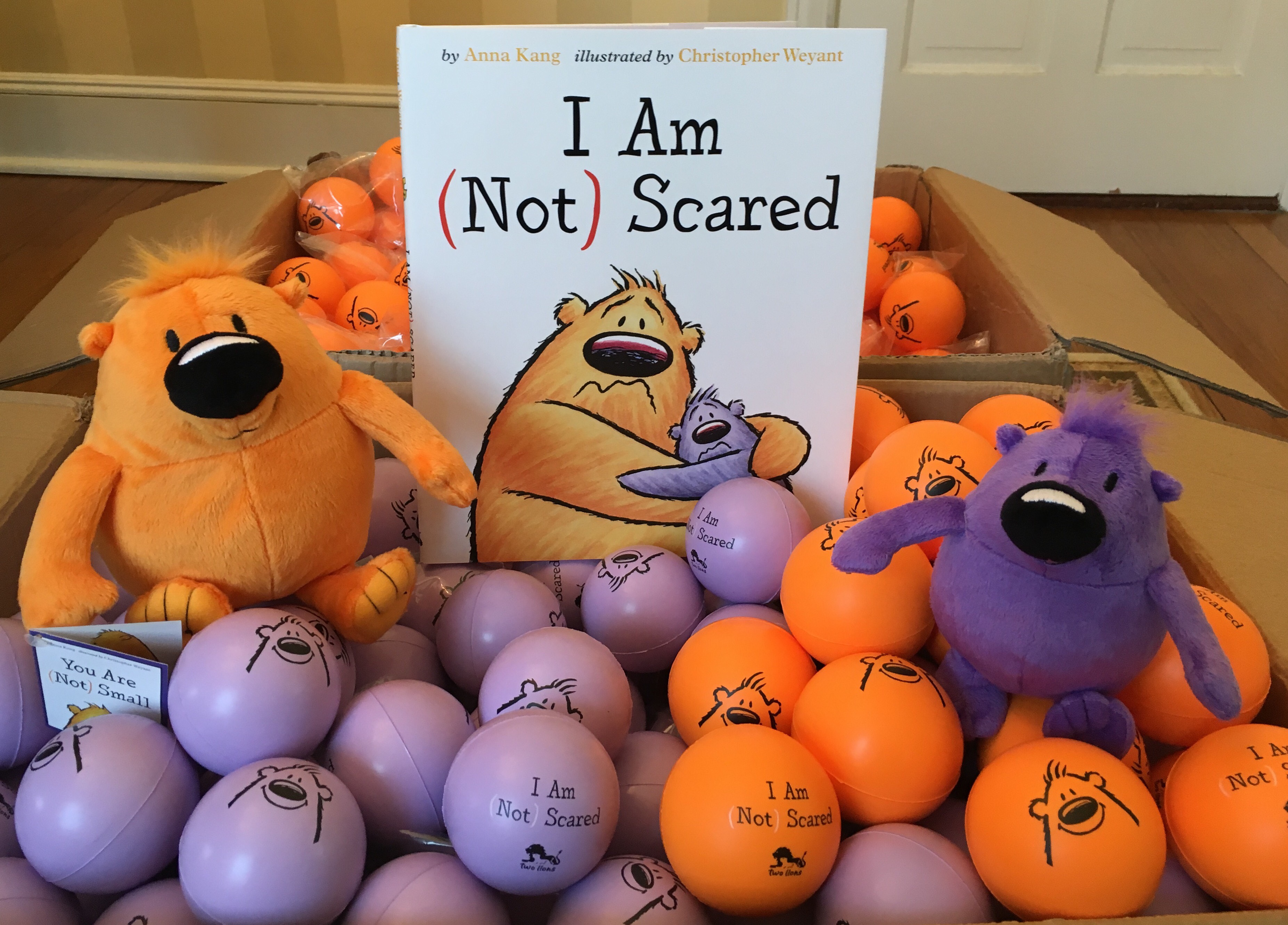
Review and Giveaway!: I Am (Not) Scared by Anna Kang, Illustrated by Christopher Weyant

Share

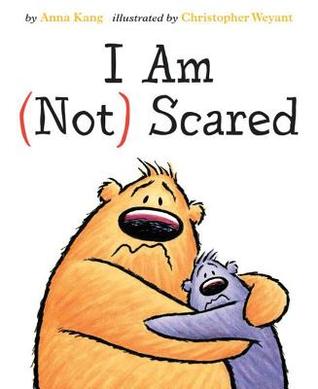
I Am (Not) Scared
Author: Anna Kang
Illustrator: Christopher Weyant
Published March 21, 2017 by Two Lions

Goodreads Summary: Two fuzzy friends go to an amusement park. They try to convince each other that there are much scarier things than the roller coaster. Hairy spiders! Aliens! Fried ants! They soon discover that sometimes being scared isn’t as “scary” as they thought. With expressive illustrations and simple text, this giggle-inducing tale about (not) being scared features the endearing characters from the Theodor Seuss Geisel Award winner You Are (Not) Small.

Ricki’s Review: These books crack me up. I have loved every book in this series, and they all make me giggle and giggle. Each book teaches an important lesson to kids. In this book, readers learn what it’s like to be scared, and why being scared can be transformed into something quite fun! I can’t decide which I like more—the writing or the illustrations. The characterization is beautifully done, and this wife and husband (author and illustrator) team is brilliant. I recommend this series highly to kids, and I also recommend it for use in creative writing classrooms.

Kellee’s Review: We are huge fans of Kang and Weyant books here at the Moye house. Our wall growth chart is from You Are (Not) Small, and I cannot wait to buy the plush fuzzies for Trent! I think that each of their books take on a pretty serious childhood issue (sharing, comparing, now fear) and talk about it in a fun way that still has a pretty clear lesson intertwined with it. This one is going to especially be one I read with Trent because as a three year old, he is just starting to really be scared of things, so it will be a really good discussion to have with him. If you haven’t read any of these books, I highly recommend getting all three–you will not be disappointed. 

Teachers’ Tools for Navigation: Teachers will appreciate these books because they are great for use as beginning readers. Unlike some of the dry, boring beginning readers in classrooms, the books in this series use just the right number of words that will allow kids to read without getting incredibly frustrated. I’d recommend this series to both teachers and parents! I am happy to have all of the books in this series for when my own son begins to learn to read!

For more information, and to download a free activity kit, visit annakang.com, or download at: http://bit.ly/2mKbFWi

Discussion Questions: What are the two fuzzy creatures scared of? How does the writing work together with the illustrations to share the story?; How are the characters feeling on the last page? How do you know?

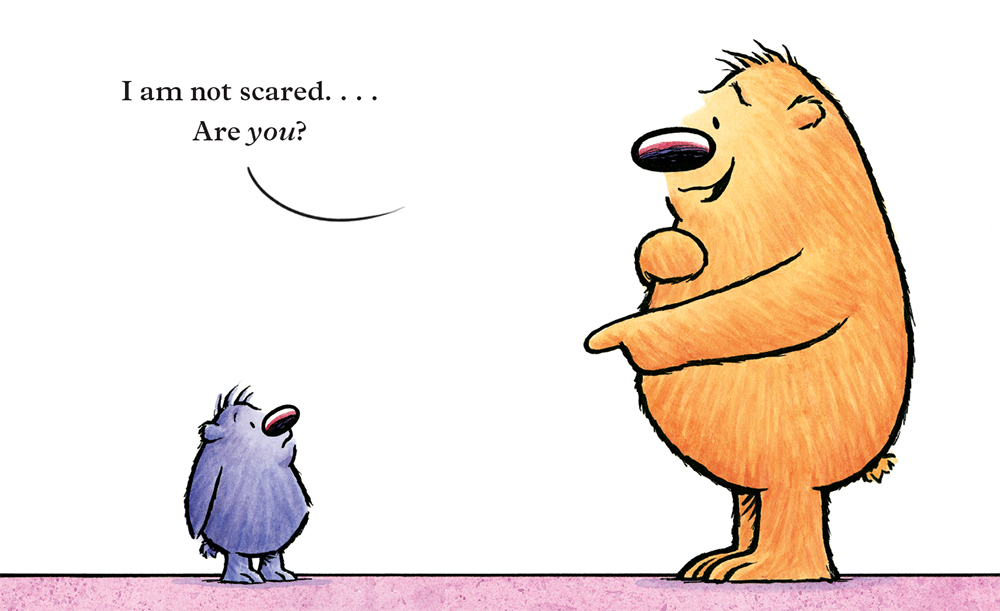
We Flagged: “I am not scared… Are you?

Read This If You Loved: You Are (Not) Small by Anna Kang, That’s (Not) Mine by Anna KangScaredy Squirrel  by Mélanie Watts, The Pigeon Needs a Bath by Mo Willems, Elephant and Piggie books by Mo Willems

Recommended For:

readaloudbuttonsmall classroomlibrarybuttonsmall

Giveaway!:

a Rafflecopter giveaway

About the Authors:

Anna Kang and Christopher Weyant are the creators of two other books featuring these characters: Theodor Seuss Geisel Award winner You Are (Not) Small and That’s (Not) Mine. Christopher’s work can be seen regularly in The New Yorker magazine and his cartoons are syndicated worldwide. This husband-and-wife team lives in New Jersey with their two daughters and their Bich-Poo. Visit them at www.annakang.com and www.christopherweyant.com.
Twitter: @annakang27 @chrisweyant05
Instagram: annakangbooks; christopherweyant
Facebook: Anna Kang – Author; Christopher Weyant


  RickiSigandSignature

**Thank you to Barbara at Blue Slip Media for providing copies for review!**

Author Guest Post and Giveaway: “A Recipe for Storytelling: Take One Real Life, Add a Spoonful of Fantasy, and Stir” by Carter Roy, Author of The Blazing Bridge, the third book in the The Blood Guard series

Share

“A Recipe for Storytelling: Take One Real Life, Add a Spoonful of Fantasy, and Stir”


Late last summer, after I’d turned in the manuscript for the third Blood Guard book, The Blazing Bridge, I mentioned to a longtime friend that I’d finished the trilogy. “That’s great!” she chirped; “now you can write a real book.”

Excuse me?” I replied and made a face like this

She explained. To her mind, fantasy adventure for middle-grade graders is mere “escapist literature,” and it doesn’t count as real—not like stories about normal people. “You had a rough childhood,” she said. “Why not write about that?”

But as far as I was concerned, I was already writing about my childhood. Only in disguise. Because even though fantasy literature on its surface is about another world, at root it is always about this one—the world we live in. Otherwise the stories would have no hold on us at all.

Not to get maudlin, but when I was growing up, my family—like many families—fell apart. There was never enough money; my older brothers were always getting into trouble; my dad turned out to be a not-so-good guy; and my parents divorced—which forced my mom to move us kids around from one home to another to another as she tried to find us an affordable and safe place in the world.

In a very different form, that material made its way into the Blood Guard books. A feud between two parents. A discovery that a father is someone other than who his children thought him to be. A constant need to uproot one’s life and relocate. All of these things were drawn from actual life, but transformed into backstory for an action adventure tale. Why? Because these novels were for the twelve-year-old me as much as anyone, and that kid liked his stories to move. The magic, the action, the jokes—those are the spoonfuls of sugar that make the medicine go down. (The “medicine” in this case being the ugly truth that my dad was, in fact, a very bad guy.)

Twelve-year-old me wouldn’t face the truth about my dad for years. But I might have done so a lot sooner … if only I’d been able to if I’d been able to read about it in a fantasy novel.


About the Book: Ronan Truelove’s best friend, scrappy smart aleck Greta Sustermann, has no idea that she is one of the thirty-six Pure souls crucial to the safety of the world. But Ronan’s evil father has figured it out—and he’s leading the Bend Sinister straight to Greta. If they capture her, she’ll suffer a fate far worse than mere death. But to get to Greta, they’re going to have to go through Ronan first.

Standing with Ronan are plucky hacker Sammy; witty, unkillable Jack Dawkins; and a sharp-tongued woman named Diz, who drives a dangerously souped-up taxi. One breathless close call after another leads to an ugly showdown: Ronan alone against his father, with the fate of Greta, his friends, and the entire world hanging in the balance. Will Ronan be able to rise up and prove once and for all that he has what it takes to join the Blood Guard?

By turns heart-stopping and hilarious, The Blazing Bridge brings the Blood Guard trilogy to a surprising, clever, and altogether thrilling conclusion.


About the Author: Carter Roy has painted houses and worked on construction sites, waited tables and driven delivery trucks, been a stagehand for rock bands and a videographer on a cruise ship, and worked as a line cook in a kitchen, a projectionist in a movie theater, and a rhetoric teacher at a university. He has been a reference librarian and a bookseller, edited hundreds of books for major publishers, and written award-winning short stories that have appeared in a half-dozen journals and anthologies. His first two books were The Blood Guard and The Glass Gauntlet. He lives with his wife and daughter in New York City and can be found at www.carterroybooks.com or on Twitter @CarterRoyBooks.


Giveaway!

Thank you, Carter for this inspirational post! And thank you, Barbara from Blue Slip Media, for connecting us with Carter!

RickiSigandKellee Signature

5 Little Ducks by Denise Fleming

Share

5 Little Ducks
Author: Denise Fleming
Published November 8, 2016 by Beach Lane Books

A Guest Review by Kathryn O’Connor

Summary: Papa Duck and his ducklings go on adventures through the woods and over the hills everyday. Each time Papa Duck yells out “Quack quack quack” to gather his ducklings, but not all of them come back. In fact, with each adventure, one fewer duck returns. Finally on Saturday, Papa Duck went out alone and yelled “Quack, quack, quack”. It was then that all of his ducks came back! When the family woke up together on Sunday, Mama Duck decided it would be best for the family to stay in and rest.

Review: Denise Fleming takes a modern spin on a classic nursery rhyme. It is fun to find out what new adventure the ducklings are taking on throughout the week. Because the ducks meet new people and explore new places each day, the reader is kept engaged. The repetition of the story makes it easy for young readers to follow along with and make predictions. In combination with this, the large text format and bolded numbers allow for easy comprehension.

The lively illustrations bring life to the text, and I love how perspective is used in all of them. Some of the pictures you’ll find to be zoomed out, while some are zoomed in. My favorite part of this picture book is at the end where Fleming has two non-fiction pages based on the animals of the story. This encourages the readers thinking and allows them to explore further.

Although this book is a helpful, entertaining tool for teaching days of the week and numbers 1-5, my only concern is that readers might become worried or anxious thinking about the well-being of the ducks. At some points while reading, I was concentrated on where the ducks were, if they were still alive, and when they were going to return to their family, rather than enjoying the text.

Teachers’ Tools for Navigation: This story can be used at first as a whole class read aloud, and perhaps even in a singing voice. Students will quickly pick up on the pattern of the story due to the repetition. By keeping the book in a classroom library, readers will then be willing to pick up the text and read independently or to a friend for they have already familiarized themselves with it. For beginning readers, this will spark motivation and love of reading. This story is also a helpful aid in teaching and counting numbers 1-5, days of the week, and sequencing text.

Discussion Questions: How many ducks do you think will come back?; What day comes next?; Why does Papa Duck yell “quack, quack, quack” everyday?; Where do you think the ducks are going?; Why do you think the ducks want to explore?; Why is Papa Duck feeling sad?; How do you think Papa Duck felt when his ducks returned?; Why does Mama Duck want all of the ducks to rest on Sunday?

Flagged Page:


Read This If You Loved: 10 Little Rubber Ducks by Eric Carle, Make Way for Ducklings by Robert McCloskey, or The Very Hungry Caterpillar by Eric Carle

Recommended For:
 classroomlibrarybuttonsmall

Thank you, Kathryn!

RickiSig

Review and Giveaway: Mapping My Day by Julie Dillemuth

Share

Mapping My Day
Author: Julie Dillemuth
Illustrator: Laura Wood
Published: March 13, 2017 by Magination Press

GoodReads Summary: Flora loves drawing maps and uses them to tell us about her life! Mapping My Day introduces spatial relationships and representation: where things and places are in relation to other things. This book intends to show readers how maps can convey information, inspire children to draw their own maps, and introduce basic map concepts and vocabulary. Spatial thinking is how we use concepts of space for problem solving and is shown to be a key skill in science, technology, engineering, and math. Includes a “Note to Parents and Caregivers” with extra mapping activities.

Ricki’s Review: As I read this book, I couldn’t help but think about how my husband will enjoy it. I am going to place it in my son’s room to surprise them. Interdisciplinary books are tricky to write, and Julie Dillemuth does a fantastic job making mapping and mathematics fun! While learning about arrows and symbols on a map, the reader also learns that Flora can make her brother snort milk out of his nose. As a bonus, this is a book that features a multiracial family without being a book about a multiracial family. This made me very happy. This is a book that will be appreciated by teachers and readers alike!

Kellee’s Review: Mapping My Day’s Flora loves maps. She thinks in cardinal directions, she maps out where everything is, and she even plays games using maps. It is because of Flora’s enthusiasm that the readers of her story are going to want to play with maps also which will *surprise, surprise* lead to them learning about mapping skills and even some mathematics. I know this book is going to find its place in elementary classrooms and so many kids out there are going to map their days out just like Flora. 

Teachers’ Tools for Navigation: The back of this book features map-making pages that are free for readers to download at www.apa.org/pubs/magination/441B206.aspx. The maps are connected to the story and allow readers to practice their mapmaking skills—very cool!

Discussion Questions: How does the author incorporate maps in a way that is fun and exciting?; What parts of Flora’s day does she map? What other parts of her day could she have mapped?; How might Flora’s brother’s maps look a bit different?

Flagged Passage:

Read This If You Loved: My Map Book by Sara Fanelli; Math Curse by Jon Scieszka; My Life in Pictures by Deborah Zemke

Recommended For:

  classroomlibrarybuttonsmall

Giveaway!:

a Rafflecopter giveaway

About the Author: Julie Dillemuth was mystified by maps until she figured out how to read them and make them, and it was a particularly difficult map that inspired her to become a spatial cognition geographer. She lives with her family and writes children’s books in Santa Barbara, California, where the west coast faces south. Visit her at her website: http://juliedillemuth.com.

RickiSig andKellee Signature

**Thank you to Barbara at Blue Slip for providing copies for review!**

Top Ten Tuesday: Things We Love About ARCs

Share

top ten tuesday

Top Ten Tuesday is an original feature/weekly meme created at The Broke and the Bookish. The feature was created because The Broke and Bookish are particularly fond of lists (as are we!). Each week a new Top Ten list topic is given and bloggers can participate.

 Today’s Topic: Ten Things We Love About ARCs

ARCs = Advanced Readers Copies (also known as galleys)

Ricki and Kellee

1. They scream for us to share them widely.

2. Sections occasionally change in the final version. This adds excitement!

3. The cover might even be quite different. We can either savor the old cover or get excited about the new one.

4. ARCs allow us to spread book love because when we purchase the published copy, we can share the ARC with others.

5. They are raw and might have a few editing errors. Correcting these errors in our heads makes us feel smart. 😉

6. They allow us to look like rock stars to our students because we know about books before they come out!

7. They make beautiful displays on the floors of exhibit halls.

8. Sharing an ARC of a favorite author with a friend is the greatest gift of all (and makes for a lot of warm and fuzzy feelings).

9. They allow us to look at the marketing plans. We can then pretend like we are in the know.

10. They make us feel like we are in on a secret—holding a magical book before its birthday. This certainly excites our students, too!

What do you love about ARCs?

RickiSig and Signature

Author Guest Post: “An Adaptation: Better Than The Original?” by John Powers, Author of Queen of Sky Island

Share

An Adaptation: Better Than The Original? by John Powers

I am not an MG writer. My work is with the stage and movies. My usual arena for subject matter is recent American history and horror. In addition to creating original stories, I have adapted existing texts: speeches; books; transcripts. I had chosen these works because something within them resonated with me, and I felt it would resonate with others.

I am pretty ruthless as an adapter. My first task is to cut away what I consider the unnecessary narrative and to focus on the dramatic and emotional story. I then take a second pass at the text, which at this point is more like surgery. I am focused on creating and sustaining dramatic momentum, the effect of quickly “turning the page.” Once that is done, the challenge begins: focusing relentlessly on what resonates with today’s readers and viewers.

Who should care about the rabble-rousing speeches of Mary Jones (a.k.a. Mother Jones) during a West Virginia coal strike? What do we care about the efforts of poet Amy Lowell to promote the works of then little known writers Carl Sandberg and Robert Frost? Are the doubts and obstacles facing the novice Zane Grey of any importance to us in the age of Instagram and Snapchat?

These are questions that I have asked and answered in adapting existing texts for contemporary audiences. We cannot bring back great people who have passed, but by working closely with their texts we can breathe life into their creations. We can do it in a way that enables contemporary readers and viewers, particularly young ones, to emotionally connect with the values and ideas that these people fought to express.

For example, the Pentagon Papers is a frequently referenced document. But who knows anything about it? In working with the 7000-page text for a stage production, I grew to think that it is the most important work in the American language. I saw how it revealed the American character in depth, as it traced 23 years of a 30-year war. It was our Iliad. Yet who today would read a 7000-page document about a lost war?

In adapting the Pentagon Papers for readers, I sought to tell the story in the most concise and comprehensive manner. I drew excerpts from the four-volume Gravel edition of the Papers, and I grouped them into brief, distinct chapters. The result became a quick page-turning experience that a reader could consume in one or two sittings. In addition, I included links to on-line resources, such as articles and historical videos, to broaden their knowledge.

The key to finding success with the work, however, was in making it resonate with people, particularly young people. I did that by relating this previous “endless war” with the current one. In particular, I directed the adaptation toward millennials, whom I felt would be continually trying to make sense out of the situation we currently are in and would be asking could there ever be an end to it.

In another example, I discovered a little known work by L. Frank Baum when I was creating a solo performance for the stage about his life in early Hollywood. I was struck by the vivid imagery of the world and characters that he created in Sky Island, and I was surprised that it had not been exploited further.

Baum, an early feminist, considered it one of his best stories, and yet it had migrated into the land of forgotten treasures. I had my ideas of why: it was unnecessarily long; the main “earth” characters were no longer relatable; and there was no dramatic momentum.

In my adaptation, I titled the work Queen of Sky Island to give it a central focus and to assert Baum’s feminism; I wanted the reader to know from the outset whose journey this was and what was the desired goal. I also cut the length of the original text in half, eliminating tangential episodes that pulled focus away from the hero. Also, I also drew the hero as an assertive, impulsive girl striving to bring her broken family back together, and I surrounded her with new companions: an almost angel-like boy and a disabled veteran.

I left in place the vivid characters and the key actions that Baum envisioned on his island in the sky. Now, all the elements of the story are working to focus our attention on this young hero’s choices that put her and her companions at risk in this bizarre, unearthly world; and we witness her dig deep within herself to both save their situation and to bring lasting justice to this morally compromised world.

Without question, much of Queen of Sky Island is about visual imagery, but in my adaptation I have found something that will resonate with young readers; they will relate to this contemporary hero who at times is stubborn and violent, but who is also caring and heroic. She grows immensely during a brief course of time, from a selfish child to a selfless queen.

Creations age quickly in our new world, but there are invaluable elements within these creations that should be sought out like precious gems and placed in new jewelry settings. Adaptations are not better than the originals; they are different; they aim to preserve the best and carry it forward to resonate in the hearts and minds of new generations.


About the Author: John Powers (a.k.a. J-Powers) is the author of Queen of Sky Island (Amazon, Smashwords 2014, Audible 2016) and Pentagon Papers: Recently Abridged Edition for the Millennial Generation (Amazon, Smashwords 2012). He lives in the harbor area of Los Angeles with his wife and three millennial stepchildren. Find him at powerplayz.com


About the Book: Queen of Sky Island is a coming of age story charged with fantasy, heroic adventure, and vividly imagined new worlds. It is a 21st century adaptation of a story by L. Frank Baum, the creator of The Wonderful Wizard of Oz.

As reconceived and adapted by John Powers (a.k.a. J-Powers), Queen of Sky Island reveals a young girl, Tara, who in her determined search for her military father becomes trapped on an actual island in the sky where she leads one other worldly army against another. Tara’s faithful companions on this perilous adventure are Bobo, a brave young boy who possesses a flying umbrella, and Sgt. Rik, a resourceful disabled veteran who looks after Tara and her mother at their sea cliff cottage on the Earth. Through miscommunication, Tara and her companions arrive at Sky Island, a bizarre land divided between wildly different pink and blue territories. They are unfairly taken prisoner by the Boolooroo, the selfish and mean-spirited leader of the Blue people. Facing a horrible punishment known as “patching,” Tara and her companions escape and run for a thick fog bank that separates the two territories. With help from an unusual creature, they cross through the dense fog, and they are taken to the queen of the Pinkies. After surviving a near fatal test in this new realm, Tara shows what she is made of and rises to lead the Pinkies against the Blues in an attempt to defeat the Boolooroo.

Thank you, John, for this thought-provoking post!

and

Duck and Hippo in the Rainstorm by Jonathan London (Author) and Andrew Joyner (Illustrator)

Share

Duck and Hippo in the Rainstorm
Author: Jonathan London; Illustrator: Andrew Joyner
Published: March 1, 2017 by Two Lions

GoodReads Summary: Get ready for a rainy-day adventure with Duck and Hippo!

Duck and Hippo may be completely different, but they are best friends. When playful Duck invites careful Hippo to go for a walk in the rain, they have trouble sharing Duck’s umbrella. But Duck and Hippo won’t let that stop them. Soon they are puddle-jumping and sailing down the river! Until…WHOOOSH! A terrible wind sends the umbrella flying up, up, up into the air, with one friend holding on. What will Duck and Hippo do now? Jonathan London’s charming text and Andrew Joyner’s delightful art bring to life two lovable friends in this fun new series.

Our Review: We are huge fans of the Elephant and Piggie series and Frog and Toad series. They are staples in our households, so when we read these books, we were truly delighted! Duck and Hippo show readers that opposites attract—and they make for a wonderfully fun adventure. Ricki read this book with her three-year-old, and he was giggling hysterically at the drawings. It’s a winner.

The charming story will capture readers from beginning to end, and the language is written in a way that will be very helpful for beginning readers. It takes a lot of skill for an author to write text that is humorous and engaging yet also helpful for beginning readers to master language. London does this perfectly.We will be hanging on to these books tightly as we wait for our sons to be a bit older to learn to read. We recommend you get your hands on this book because it will surely be a popular series in classrooms.

Teachers’ Tools for Navigation: We love the concept of opposites attracting. Students might begin by considering other examples of characters in literature who have been paired together. They might form small groups and design their own story of two very opposite characters who might attract. We’d love to be in a classroom on a day that students were sharing these stories!

There’s more fun with Duck and Hippo in the free downloadable activity sheets: https://www.andrewjoyner.com.au/activities/

Discussion Questions: How are Duck and Hippo different? How are they similar? How does that make for a great adventure?; Why do you think the author chose to have Duck and Hippo in a rainstorm? Why does this make for a fun read?

Flagged Passage: 

Read This If You Loved: Elephant and Piggie series by Mo Willems; The Frog and Toad series by Arnold Lobel; Pug Meets Pig by Sue Lowell Gallion

Recommended For:

classroomlibrarybuttonsmall 

Giveaway!
Two Lions is offering a copy of Duck and Hippo to one lucky winner (U.S. addresses).
About the Author and Illustrator:
Jonathan London is the author of more than one hundred children’s books, including the bestselling Froggy series, illustrated by Frank Remkiewicz. Many of his books explore nature, among them Flamingo Sunset, illustrated by Kristina Rodanas, and Little Penguin: The Emperor of Antarctica, illustrated by Julie Olson. He is currently writing a middle-grade series, which started with Desolation Canyon, illustrated by his son Sean London. Jonathan lives in Graton, California. Learn more online at www.jonathan-london.net.
 
Andrew Joyner is an illustrator, author, and cartoonist based in South Australia. He has illustrated a number of picture books, and he wrote and illustrated a chapter book series about a warthog named Boris. He has also illustrated for newspapers and magazines, including the Wall Street Journal, Reader’s Digest, and Rolling Stone magazine, among others. Learn more online at www.andrewjoyner.com.au.

RickiSig andKellee Signature

**Thank you to Barbara at Blue Slip for providing copies for review!**