Moonshot by Brian Floca

Share

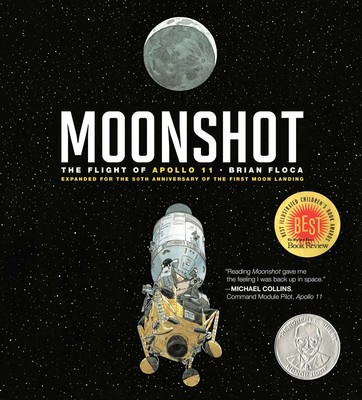
Moonshot: The Flight of Apollo 11
Author: Brian Floca
Published April 7, 2009 by Atheneum

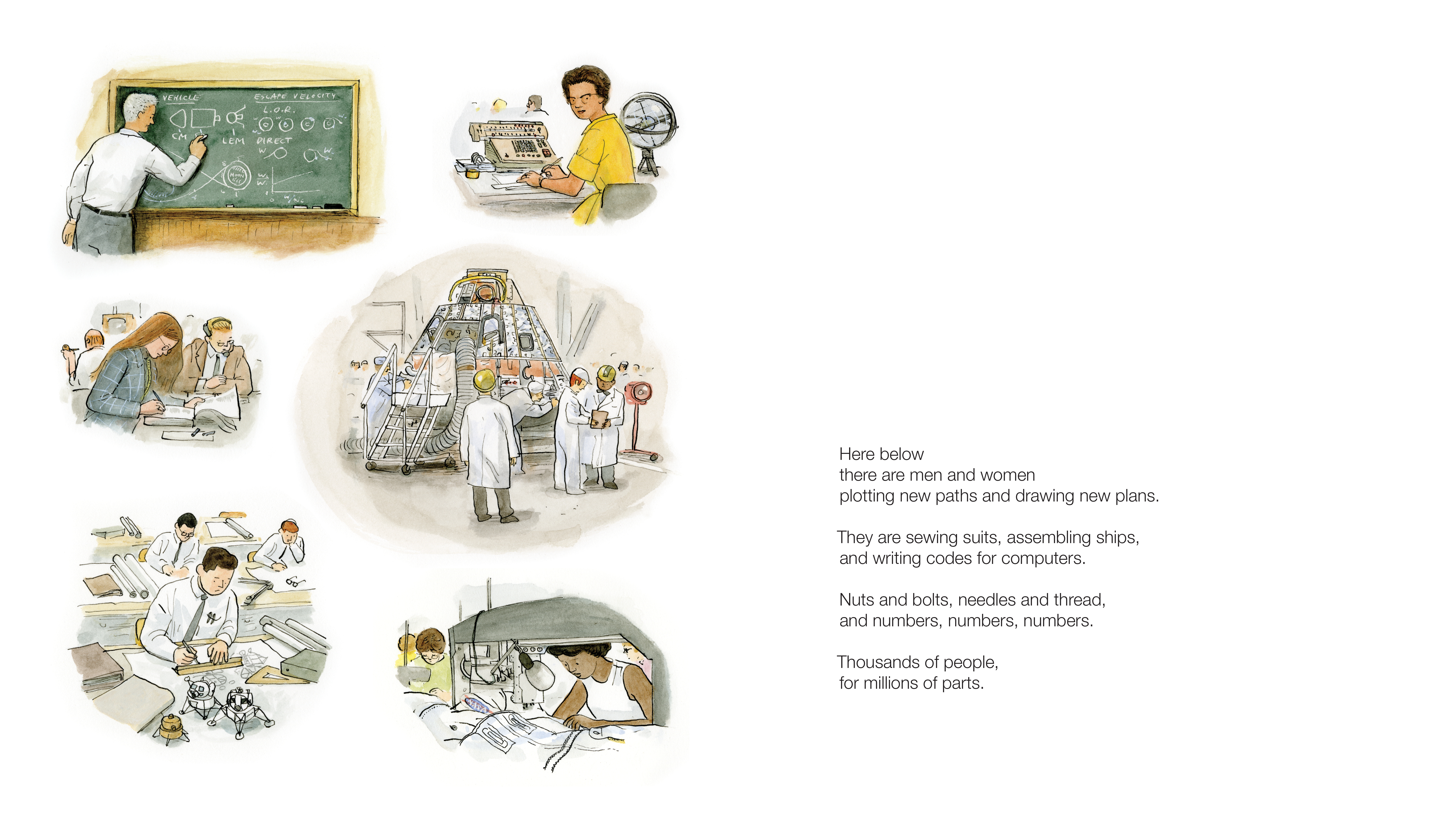
Summary: Simply told, grandly shown, here is the flight of Apollo 11. Here for a new generation of readers and explorers are the steady astronauts, clicking themselves into gloves and helmets, strapping themselves into sideways seats. Here are their great machines in all their detail and monumentality, the ROAR of rockets, and the silence of the Moon. Here is a story of adventure and discovery—a story of leaving and returning during the summer of 1969, and a story of home, seen whole, from far away.

Praise:

“Like the astronauts’ own photographs, [Floca’s] expansive, heart-stopping images convey the unfathomable beauty of both the bright, dusty moon and the blue jewel of Earth.” –New York Times Book Review, July 1, 2019

Ricki’s Review: I thought I knew a lot about the Apollo 11. This book made me realize that I had so much to learn. My sons and I cuddled in one of their beds and read this one together. I whisper-read it because it felt too beautiful to read in a voice that was any louder. My kids followed this model and whisper-asked questions in awe. This book is a masterpiece. There are so many books out there about the Apollo 11, and although I haven’t read them all, I feel confident when I say that this is the best on out there. The illustrations are captivating, the story includes just the right amount of science, and the words dance on the pages.

Kellee’s Review: I love reading about space and have read dozens and dozens of picture books with my son about the topic. This book stands out from the rest. Brian Floca masterfully creates a story that is both engaging and scientifically accurate. This book offers so many possibilities for the classroom for teachers. The words are written in a poetic format which makes the pages easy to read and an excellent balance with the stunning illustrations. If you read just one book about the Apollo 11 this summer, let it be this one. It will knock you off of your feet.

Teachers’ Tools for Navigation: Our minds were buzzing with possibilities after reading this text. Teachers might use this book at the center of a unit on space, or they might use it to catapult students into research studies about any topic of science. We can see this book in classrooms from pre-k through high school. It could be used as a creative writing mentor text or as a text at the start of a high school science unit. It beautifully balances scientific information with narrative, so we think it would be incredibly appealing to teachers of all content areas and grade levels.

 Discussion Questions: 

  • What did you learn about the Apollo 11?
  • How is the information in this book similar or different from what you already knew about the Apollo 11?
  • Why do you think the author chose the poetic format for the words?
  • How do the illustrations add to your understanding of the text?

Flagged Spread: 

Read This If You Love: Moon by Stacy McAnultyThe Sun is Kind of a Big Deal by Nick Seluk, Once Upon a Star by James Carter, Space Encyclopedia by David AguilarYou Choose In Space by Pippa GoodhartA Big Mooncake for Little Star by Grace Lin, Star Stuff by Stephanie Roth Sisson

Recommended For: 

classroomlibrarybuttonsmall 

andSignature

**Thank you to Audrey at Simon & Schuster for providing copies of the book for review!!**

Feral Youth by Shaun David Hutchinson, Brandy Colbert, Suzanne Young, Tim Floreen, Justina Ireland, Alaya Dawn Johnson, Stephanie Kuehn, E.C. Myers, Marieke Nijkamp, Robin Talley

Share

Feral Youth
Authors: Shaun David Hutchinson, Brandy Colbert, Suzanne Young, Tim Floreen, Justina Ireland, Alaya Dawn Johnson, Stephanie Kuehn, E.C. Myers, Marieke Nijkamp, Robin Talley
Published: September 5, 2017 by Simon Pulse

Guest Review by Natalia Sperry

Summary: At Zeppelin Bend, an outdoor education program designed to teach troubled youth the value of hard work, cooperation, and compassion, ten teens are left alone in the wild. The teens are a diverse group who come from all walks of life, and they were all sent to Zeppelin Bend as a last chance to get them to turn their lives around. They’ve just spent nearly two weeks learning to survive in the wilderness, and now their instructors have dropped them off eighteen miles from camp with no food, no water, and only their packs, and they’ll have to struggle to overcome their vast differences if they hope to survive.

Inspired by The Canterbury Tales, Feral Youth features characters, each complex and damaged in their own ways, who are enticed to tell a story (or two) with the promise of a cash prize. The stories range from noir-inspired revenge tales to mythological stories of fierce heroines and angry gods. And while few of the stories are claimed to be based in truth, they ultimately reveal more about the teller than the truth ever could.

Review: This is a complex anthology of traditionally ignored teenaged voices that demand to be heard; I couldn’t put it down! Feral Youth is compelling from the front flap to the final page. The distinct voices of all 10 characters shone through in every part, from their individual stories to the transitional narration, creating an established sense of the full cast that is difficult to attain when juggling so many stories.

In this day and age, it feels more important than ever read book that remind us that all people, even those “troubled kids” traditionally written off by society, have a unique story to tell. Though I initially felt a bit overwhelmed by the number of characters (especially those with similar sounding names!) having such a diverse cast of characters share their stories was really rewarding. Those stories, both those intended to be “factual” and those grounded in fantasy, refuse to go quietly from my mind. In a story centered around teens whose voices have been all but silenced by society, I think that’s a victory.

Teacher’s Tool For Navigation: As the book was inspired by Chaucer’s Canterbury Tales, teachers could have students read the two (or passages from both) and compare and contrast. In particular, looking for thematic parallels could lend itself to discussions about the nature of storytelling and whose voices get told. In that regard, the book could also fit into a unit about “objective truth” in storytelling, perhaps in discussing other narratives or nonfiction.

Even in including the text as a free-reading option, I think it is essential to build empathy through reading diverse stories. Including this text could be not only a way to build empathy, but could provide a starting point for further future reading of a diversity voices as well.

Discussion Questions: What parallels do you find to the Canterbury Tales? Which stories surprised you? Were there any characters you related to that you wouldn’t have anticipated connecting with?  

Flagged: “’They think we’re probably nothing but a bunch of animals, but we showed them who we really are. We showed them that they can’t ignore us’” (287).

Read This If You Loved: The Canterbury Tales by Chaucer, Les Miserables by Victor Hugo, other YA anthologies

Recommended For: 

classroomlibrarybuttonsmall 

RickiSig

The Strange Fascinations of Noah Hypnotik by David Arnold

Share

The Strange Fascinations of Noah Hypnotik
Author: David Arnold
Published: May 22, 2018 by Viking

Guest Review by Natalia Sperry

Summary: This is Noah Oakman → sixteen, Bowie believer, concise historian, disillusioned swimmer, son, brother, friend.

Then Noah → gets hypnotized.

Now Noah → sees changes—inexplicable scars, odd behaviors, rewritten histories—in all those around him. All except his Strange Fascinations . . .

Review: The longer I sit with this book, the more I feel like I’m still it; every time I sit down to think about it, I find new things to consider. If that’s not the sign of a good book,I don’t know what else is. The Strange Fascinations of Noah Hipnotik is a surreal exploration of identity, friendship, and family on the brink of the many changes protagonist Noah Oakman faces (both before and after his hypnotic episode) as he looks to the future beyond high school.

Above all else, I loved the nerdom in this book, both in its literary and historical detail as well as the variety of pop-culture references. In particular, much of the book (including its title) is drawn from musical icon David Bowie, so I’ll admit,  it’s hard to go wrong. The humor also brings some lightness to the moral questions and philosophical questions of self and reality, which helps keep the largely internal narrative afloat.

Through it all, this book captures an important to capture the emotional gamut of someone’s life, especially when it feels like everything is ch-ch-ch-changing around you. Whether you’re looking for fun or serious contemplation of reality, this book will let you escape for a while (and even for a while longer after you’re done!)

Teacher’s Tool For Navigation: Though grounded in humor and pop culture references, this book would make for a really interesting companion to classics like James Joyce’s Portrait of the Artist as a Young Man, or J.D. Salinger’s The Catcher in the Rye. In asking students to compare the latter with Strange Fascinations, there are some really interesting parallels to be made both in the coming of age story and in the respective protagonists’ relationships with their sisters.

Discussion Questions: Do you agree, like Circuit, that genuine conversations are rare in the contemporary world? What do you think of Noah’s “strange fascinations?” Do you have any “fascinations” of your own, in this sense?

Flagged: “Some books are songs like that, the ones you go back to, make playlists of, put on repeat” (page 108).

Read This If You Loved: Mosquitoland by David Arnold, Everybody Sees the Ants by A.S. King, Ready Player One by Ernest Cline

Recommended For: 

classroomlibrarybuttonsmall 

RickiSig

Call for Middle and High School Teachers of YAL

Share

Do you teach a young adult literature course, or do you integrate YAL in your classroom?

I am currently working on a book project that explores the different ways in which middle and high school teachers structure their YAL courses (elective or required). I am also looking at how teachers infuse YAL into their regular education courses. I’ve seen great classroom designs and course projects, and I am looking for others. I’d love to capture them and acknowledge the great work happening in classrooms. If you might be interested in being included in the book, please send me an email at ricki[DOT]ginsberg[AT]colostate.edu or message me on Facebook! Participation would involve the sharing of a course project, classroom activity/activities, and/or course syllabus.

If you know someone who might be interested, please share this post with them. Thank you! 


Thunderhead by Neal Shusterman

Share

Thunderhead
Author: Neal Shusterman
Published: January 9, 2018 by Simon & Schuster

Guest Review by Natalia Sperry

Summary: Rowan and Citra take opposite stances on the morality of the Scythedom, putting them at odds, in the second novel of the chilling New York Times bestselling series from Neal Shusterman.

Rowan has gone rogue, and has taken it upon himself to put the Scythedom through a trial by fire. Literally. In the year since Winter Conclave, he has gone off-grid, and has been striking out against corrupt scythes—not only in MidMerica, but across the entire continent. He is a dark folk hero now—“Scythe Lucifer”—a vigilante taking down corrupt scythes in flames.

Citra, now a junior scythe under Scythe Curie, sees the corruption and wants to help change it from the inside out, but is thwarted at every turn, and threatened by the “new order” scythes. Realizing she cannot do this alone—or even with the help of Scythe Curie and Faraday, she does the unthinkable, and risks being “deadish” so she can communicate with the Thunderhead—the only being on earth wise enough to solve the dire problems of a perfect world. But will it help solve those problems, or simply watch as perfection goes into decline?

Review: Thunderhead packs a punch as a conceptually compelling and action-packed follow up to award-winning Scythe. While at times it moves slowly and teeters on the precarious edge of “middle book syndrome.” Its expansion of the world of the Scythdome helps the book feel more well-rounded. Despite the action, Thunderhead shines most in its explorations of democracy and the implications of AI technology.

Citra’s questioning of identity, though immediately rooted in her struggle between her civilian past and scythedom, provides a good example of identity searching for teen readers. For Citra and Rowan, the stakes are high– despite the novel’s focus on the guiding AI of the Thunderhead, the fate of the world rests not on the shoulders of the political technology or the Scythe’s government, but on the teenage protagonist’s shoulders. Though Thunderhead didn’t invent the trope of teens saving the world, in 2018 it feels all the more prevalent.

Teacher’s Tool For Navigation: As a sequel, Thunderhead will primarily be useful in addition to classroom libraries. However, in discussing the Arc of a Scythe series as a whole, Thunderhead raises interesting questions of power dynamics in politics, democracy, and the role of AI technology. If Scythe is already a text you’ve considered using in literature circles, a discussion about the themes raised in the sequel could provide an interesting supplement to the unit.

Discussion Questions:  Is the Thunderhead justified? Is the Scythedom?  In what ways is the world of the Scythes in MidMerica and beyond a dystopia or utopia?

Flagged: “You may laugh when I tell you this, but I resent my own perfection. Humans learn from their mistakes. I cannot. I make no mistakes. When it comes to making decisions, I deal only in various shades of correct.” (Chapter 4).

Read This If You Loved: Scythe by Neal Shusterman, Illuminae by Amie Kaufman, Jay Kristoff, This Savage Song by Victoria Schwab

Recommended For: 

classroomlibrarybuttonsmall 

RickiSig

Nice Try, Jane Sinner by Lianne Oelke

Share

Nice Try, Jane Sinner
Author: Lianne Oelke
Published: January 9, 2018 by Clarion

Guest Review by Natalia Sperry

Summary: The only thing 17-year-old Jane Sinner hates more than failure is pity. After a personal crisis and her subsequent expulsion from high school, she’s going nowhere fast. Jane’s well-meaning parents push her to attend a high school completion program at the nearby Elbow River Community College, and she agrees, on one condition: she gets to move out.

Jane tackles her housing problem by signing up for House of Orange, a student-run reality show that is basically Big Brother, but for Elbow River Students. Living away from home, the chance to win a car (used, but whatever), and a campus full of people who don’t know what she did in high school… what more could she want? Okay, maybe a family that understands why she’d rather turn to Freud than Jesus to make sense of her life, but she’ll settle for fifteen minutes in the proverbial spotlight.

As House of Orange grows from a low-budget web series to a local TV show with fans and shoddy T-shirts, Jane finally has the chance to let her cynical, competitive nature thrive. She’ll use her growing fan base, and whatever Intro to Psychology can teach her, to prove to the world—or at least viewers of substandard TV—that she has what it takes to win.

Review: I’ll admit, I’m always a sucker for a strong, sarcastic, and somewhat troubled YA protagonist, and Jane Sinner did not disappoint. Nice Try, Jane Sinner is psychological and philosophical, a little crass and silly, sometimes downright strange, and always full of tremendous heart—but then, isn’t that college? It was refreshing to read an older YA: Jane is right on that cusp of “not really a teenager anymore, but definitely not a full a full-fledged adult.” As she navigates her senior year in high school, taking classes at the local community college, I felt that, even beyond its obvious and intentional quirks, Jane’s story is startlingly unique in how it captures the whirlwind of  emotions felt during that transitional time. It also offered a healthy balance of relationships, featuring Jane’s loving yet tense parents, adoring but annoying little sister, and a cast of friends too diverse to affix any one guiding set of adjectives to.

Written in diary-format, the book is told exactly as Jane wants it to be, which adds an interesting dimension of questionability to her narration. Dialogue is captured in script format, which prompts readers to question at times what’s reality and what’s for show, on House of Orange and beyond. What Jane does and doesn’t tell the narrator about her past, her genuine feelings, and her motivation leads to some interesting twists.  In particular, Jane’s “Doctor/Self” internal dialogues were really compelling. Like the eponymous Jane Sinner herself, however, the book at times deflects the greater thematic issues at hand through its sarcasm and humor. Jane’s story revolves around a personal crisis—one that I wish the book would have delved in deeper to by the end. I did enjoy Jane’s exploration of religion and the expectations young people are sometimes held to, which is a topic I’ve yet to see be fully explored in YA.

For all its quirks and flaws, Jane Sinner has a heart of gold. It conjures up all the emotions of a teen on the brink of “adulthood,” while still maintaining a sarcastic yet thoughtful spark throughout. It’s refreshing to remember that being a young adult doesn’t end at high school, and life doesn’t have to either.

Teacher’s Tool For Navigation: I’ll admit, I’m always a sucker for a strong, sarcastic, and somewhat troubled YA protagonist, and Jane Sinner did not disappoint. Nice Try, Jane Sinner is psychological and philosophical, a little crass and silly, sometimes downright strange, and always full of tremendous heart — but then, isn’t that college? It was refreshing to read an older YA: Jane is right on that cusp of “not really a teenager anymore, but definitely not a full a full-fledged adult.” As she navigates her senior year in high school, taking classes at the local community college, I felt that, even beyond its obvious and intentional quirks, Jane’s story is startlingly unique in how it captures the whirlwind of  emotions felt during that transitional time. It also offered a healthy balance of relationships, featuring Jane’s loving yet tense parents, adoring but annoying little sister, and a cast of friends too diverse to affix any one guiding set of adjectives to.

Written in diary-format, the book is told exactly as Jane wants it to be, which adds an interesting dimension of questionability to her narration. Dialogue is captured in script format, which prompts readers to question at times what’s reality and what’s for show, on House of Orange and beyond. What Jane does and doesn’t tell the narrator about her past, her genuine feelings, and her motivation leads to some interesting twists.  In particular, Jane’s “Doctor/Self” internal dialogues were really compelling. Like the eponymous Jane Sinner herself, however, the book at times deflects the greater thematic issues at hand through its sarcasm and humor. Jane’s story revolves around a personal crisis–one that I wish the book would have delved in deeper to by the end. I did enjoy Jane’s exploration of religion and the expectations young people are sometimes held to, which is a topic I’ve yet to see be fully explored in YA.

For all its quirks and flaws, Jane Sinner has a heart of gold. It conjures up all the emotions of a teen on the brink of “adulthood,” while still maintaining a sarcastic yet thoughtful spark throughout. It’s refreshing to remember that being a young adult doesn’t end at high school, and life doesn’t have to either.

Discussion Questions:  Even in the context of the book, Jane is quite the controversial character to those around her — did you “like” Jane? How might this shape your perception of the book as a reader? Does “likability” matter in protagonists? Think about if Jane was gender-swapped: would this change how we view some of her more questionable decisions or characteristics?

Flagged: “I need to psychoanalyze myself for Intro Psych. I’m not sure how that’s possible; the prof was rather vague on the specifics in class today. I was also caught up in a doodle of my hand. I outlined my hand on my notes because the notes were ugly and otherwise useless. I layered the inside with different-colored gel pens until the outline was fairly thick. In the middle of the hand I drew toasters and toast. The whole thing came together really well. One of my better efforts. But I’m not sure how to psychoanalyze myself. I suppose I’ll have to be both the doctor and patient. Maybe the two of me can come up with some profoundly insightful insight.

A middle-aged man with thinning brown hair and a cozy sweater vest motions for Jane to lie down on the sofa. He takes a seat on the overstuffed leather armchair and crosses his legs like a girl.

THE DOCTOR

Hello, Ms. Sinner.

JS

                          Hi.” (Page 46-47).

Read This If You Loved: Anything by John Green (Turtles All the Way Down in particular),  Highly Illogical Behavior by John Corey Whaley, Fangirl by Rainbow Rowell, The Hunger Games by Suzanne Collins

Recommended For: 

classroomlibrarybuttonsmall 

RickiSig

The Forest Queen by Betsy Cornwell

Share

The Forest Queen
Author: Betsy Cornwell
Published: August 7, 2018 by Houghton Mifflin Harcourt

Guest Review by Rachel Krieger

Summary: When sixteen-year-old Sylvie’s brother takes over management of their family’s vast estates, Sylvie feels powerless to stop his abuse of the local commoners. Her dearest friend asks her to run away to the woods with him, and soon a host of other villagers join them. Together, they form their own community and fight to right the wrongs perpetrated by the king and his noblemen.

Review: Anyone familiar with the tale of Robin Hood likes the idea of stealing from the rich and giving to the poor. Betsy Cornwell’s twist on this idea changes it just enough to give the story some flavor and novelty. The characters were compelling and the relationships were truly touching, but everything felt a little too convenient to me. There were several times when characters all but died and ended up making it out without a scrape. In a world where all of the favorable characters are on the lamb, there was a fair amount of luck and inaction that saved nearly every one of them. As a gender bent twist on a fairytale and a lively retelling of an old story, this novel had merit, but there wasn’t quite enough to it to call it a masterpiece.

However, as far as representation goes, Betsy Cornwell hit it on the head. The Forest Queen, as the title lets on, has a female leading things. The role of Robin Hood was usurped by a woman and amplified by the fact that the woman is stealing from her own family to give to the poor. The other females in the novel show strength in the face of things like rape and a shocking lack of agency. There are even LGBTQ characters that add to the sense that women in this world are the epitome of overcoming their circumstances.

Teacher’s Tool For Navigation:This novel is a great outlet in which to discuss rape culture. Although it is not the most prominent part of the story, it plays a part and is represented in an ideal way in relation to discussion. Because this subject is extremely difficult to discuss in general, let alone in a classroom, talking about it within the realm of this fantastical society may make it a bit easier. It would be interesting to reflect upon the similarities between the culture in the novel and our own culture in this society. It is so incredibly important to discuss difficult subjects in the classroom, but when it is in reference to a novel like The Forest Queen, it can be looked at in a more academic way.

Discussion Questions: 

  • Did Sylvie have a right to encourage the village people to rebel against her brother?
  • What do the ties to the story of Robin Hood do for this novel?
  • How do women take power in this story and how does that differ from classic fantasy?

Read This If You Loved: Cinder by Marissa Meyer, Six of Crows by Leigh Bardugo, Shadow and Bone by Leigh Bardugo, The Paper Magician by Charlie N. Holmberg

Recommended For: 

classroomlibrarybuttonsmall 

RickiSig