Top Ten Tuesday: Top Ten Books If You Like _________.

Share

top ten tuesday

Top Ten Tuesday is an original feature/weekly meme created at The Broke and the Bookish. The feature was created because The Broke and Bookish are particularly fond of lists (as are we!). Each week a new Top Ten list topic is given and bloggers can participate.

 Today’s Topic: Top Ten If You Like ______. 

Ricki

Ten books you will like if you enjoy Reality TV (like me!).

1. It’s Kind of a Funny Story by Ned Vizzini

There is no drama in this novel. It is an honest portrayal of depression and inspired by the author’s own hospitalization. Unlike reality TV, this book feels very real.

2. The Glass Castle by Jeanette Walls

This stunning text has cooky characters and very real situations. It is the best memoir I have ever read, and I think lovers of Reality TV will appreciate the Walls’ complex characterization.

3. Reality Boy by A.S. King

This book shames us for loving Reality TV, as it destroyed Gerald Faust’s life. It teaches us that this type of television has very real consequences.

4. Looking for Alaska by John Green

The characters of this book are beautifully described and they feel like real people. Their escapades will surely hook readers.

5. Drama by Raina Telgemeier

Do you like Reality TV for its drama? Try this one instead. 🙂

6. Jumping Off Swings by Jo Knowles

Do you like Sixteen and Pregnant? This book has much more depth and will teach many more lessons than those you will learn on the television show.

7. The First Part Last by Angela Johnson

What about Teen Mom? Try this book about a teen dad. He is an incredible role model.

8. The Perks of Being a Wallflower by Stephen Chbosky

Charlie is a character who reflects the reality of many teens in high schools everywhere. To me, he represents reality.

9. Somebody Everybody Listens To by Suzanne Supplee

I love singing shows, but they certainly lack depth. Retta Lee Jones will entertain you much more than any singing show will.

10. Threatened by Eliot Schrefer

Do you like survivor? Luc’s story is a much more entertaining survival story. Trust me on this one.


Kellee

Ten books you will like if you are a fan of superhero movies, TV, and comics.

1. Sidekicked by John David Anderson

Meet Andrew Bean and his friends. They are all part of H.E.R.O., a secret organization training sidekicks for superheroes.

2. Sidekicks by Dan Santat

When Captain Amazing needs a sidekick, all of his pets decide to vie for the job.

3. NERDS (series) by Michael Buckley

Read as a group of elementary school students with incredible talents who have formed a spy network fight off villains.

4. Battling Boy by Paul Pope

When a town’s vigilante dies, they have no one to turn to. Then Battling Boy, a demigod, shows up to help defend Arcopolis.

5. Daniel Boom AKA Loud Boy by David Steinberg

Daniel Boom cannot control the volume of his voice. Doesn’t sound like much of a super power, but Daniel makes it work.

6. The Extraordinary Adventures of Ordinary Boy by William Boniface

In a town where everyone is a super hero and has super powers, what is it like to be the only ordinary one?

7. Lunch Lady (series) by Jarrett Krosoczka

When bad guys come snooping around, Lunch Lady is there to defend her school and town.

[These last three are more spy than superhero, but still super cool books.]

8. Stormbreaker (series) by Anthony Horowitz

After Alex Rider’s uncle dies, he finds himself taking over his MI6 mission and soon becoming a spy.

9. Alfred Kropp (series) by Rick Yancey

After Alfred Kropp helps get a super powerful weapon into the hands of a man with evil plans, he decides he is the one that has to stop him.

10. Young James Bond (series) by Charlie Higson

How did James Bond become James Bond? Now you’ll know.

Which books would you recommend to lovers of reality TV and/or superheroes? 

RickiSigand Signature

It’s Monday! What Are You Reading? 4/28/14

Share

IMWAYR

It’s Monday! What Are You Reading? From Picture Books to YA!

It’s Monday! What are you Reading? is a meme hosted by Sheila at Book Journeys. It is a great way to recap what you read and/or reviewed the previous week and to plan out your reading and reviews for the upcoming week. It’s also a great chance to see what others are reading right now…you just might discover the next “must-read” book!

Jen Vincent, of Teach Mentor Texts, and Kellee decided to give It’s Monday! What Are You Reading? a kidlit focus. If you read and review books in children’s literature – picture books, chapter books, middle grade novels, young adult novels, anything in the world of kidlit – join us! We love this meme and think you will, too.

We encourage everyone who participates to support the blogging community by visiting at least three of the other book bloggers that link up and leave comments for them.

Last Week’s Posts

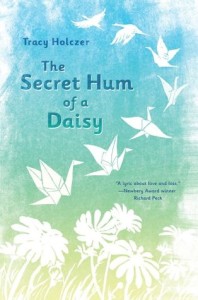
top ten tuesday thrive the fox in the library hum

Tuesday: Top Ten Characters Who Are Smart

Wednesday: Thrive Blog Tour and Author Guest Post

Friday: Tracy Holczer, author of The Secret Hum of a Daisy, Guest Post

**Click on any picture to view the post**
 Last Week’s Journeys

Kellee: A pretty good reading week here at the Moye house. I was able to finish both Rose Under Fire and P.S. Be Eleven. They are very different books, but both so good. I am still reeling about Rose. It was almost perfection. P.S. Be Eleven was a great follow up to One Crazy Summer.

Trent and I read 7 picture books again this week (though there were a couple #bookaday hiccups which we had to remedy by reading 2 books in a day):

  • Happy Easter, Mouse! by Laura Joffe Numeroff (Trent received this in his Easter basket from his grandparents. Just as cute as all the other Mouse stories.)
  • Time for Bed by Mem Fox (Mem Fox writes books as if they are songs. Beautiful.)
  • My Very First Book of Shapes by Eric Carle (This book is bilingual and interactive. It’ll be a fun way to learn shapes and Spanish when Trent gets older.)
  • Jabberwocky by Jennifer Adams (We read this on Poem in your Pocket Day and also in honor of National Poetry Month. I love the Baby Lit adaptations!)
  • Moo, Baa, La La La by Sandra Boynton (I remember reading this when I was a kid now that I’ve reread it. Sandra Boynton is SO MUCH FUN!)
  • Llama Llama Zippity Zoom by Anna Dewdney (With all of the Llama Llama talk, I had to get the board book from the library, and we really enjoyed it. A simple text, but one that is fun and a child could easily memorize.)
  • How to Cheer Up Dad by Fred Koehler (My parents know Fred from Lakeland, and they got us a signed copy for Jim and Trent. They read it together this week, and it is such a perfect father/son read.)

Ricki: It is the last week of school, and with all of the term papers, my reading has suffered! I’ve been reading The Lion, the Witch, and the Wardrobe to Henry every night, but we haven’t finished yet. He tends to fall asleep, and I don’t want him to miss any of it. For Easter, we read There Was an Old Lady Who Swallowed a Chick by Lucille Colandro (very fun!). And for school, I finished Culturally Responsive Teaching by Geneva Gay. I highly, highly recommend this book to teachers. It taught me so much about the learning styles of students of all different cultures. I am in awe of Geneva Gay’s intelligence and thoughtfulness. I plan to blog about it soon (after I finish my paper and have thought it through).

This Week’s Expeditions

Kellee: I am going to start In the Shadow of Blackbirds by Cat Winters tonight and hope to finish it this week then I’ll start Brother, Brother by Clay Carmichael. My goal is to finish them both this week although I am starting work again today, so we’ll see how reading goes this week. Trent will continue his #bookaday though his dad may read some with him without me since he is home with him during the day now. I know I do want to read Trent’s other Easter books this week: All in a Day by Cynthia Rylant and Guess How Much I Love You by Sam McBratney.

Ricki: Baby Henry and I reserved two books from other libraries: Unicorn Thinks He’s Pretty Great by Bob Shea and And Tango Makes Three by Justin Richardson. I have always wanted to read both of these, and I think Henry will enjoy them. I am done with PD books for my doctoral degree this semester (phew!), but I may get a head start in a few weeks. For now, I am going to finish the rest of Love Letters to the Dead by Ava Dellaira. I have been working on it for a few weeks, but now that school is coming to a close, I am going to devour the rest. 🙂

Upcoming Week’s Posts

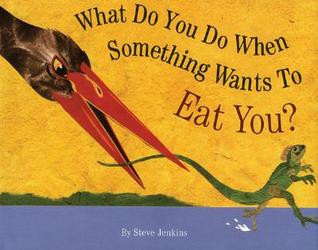
top ten tuesday eatyou 50

Tuesday: Top Ten Books If You Like Superheroes/Reality TV

Thursday: Ricki’s Bookish Bucket List

Friday: Kellee’s Bookish Bucket List

 So, what are you reading?

Link up below and go check out what everyone else is reading. Please support other bloggers by viewing and commenting on at least 3 other blogs. If you tweet about your Monday post, tag the tweet with #IMWAYR!

 Signature andRickiSig

Author Guest Post!: The Sum of Our Parts by Tracy Holczer, author of The Secret Hum of a Daisy

Share

“The Sum of Our Parts” by Tracy Holczer

I’ve been thinking a lot lately as to how I became a writer. I used to have it down. I was a writer because I read Little Women and had the run of the library, both at just the right age. But I have come to realize those are just two of many pieces. Once I really reflected, I found so much more, both light and dark. I feel we try so hard to focus on the light, especially those of us who write for kids. But we are who we are because of both. There is no contrast without darkness, and contrast, I believe, is where we find the answers for ourselves. So here is a very incomplete list of the parts of this writer:

  • Loneliness. I was a lonely kid. An only child born at the tail end of the “children should be seen and not heard” era, I had tremendous space to read books and otherwise look to inanimate objects for comfort and camaraderie. I didn’t have any experience with other kids until I went to Kindergarten and was hugely surprised and disappointed when no one wanted me to teach them how to tell time in Roman numerals. I mean, we were there to learn, right? Even the nuns treated me like I was a little off my nut.
  • Sensitivity. I took things hard. Like in second grade when Ms. Parsons got married and would become Mrs. Harrison half way through the year (I abhorred change), or in third grade when Sister Michael Anne read us Martin Luther King, Jr.’s “I Have a Dream” speech. There were several times over my school career that I thought I would die from sadness.
  • Librarians. After my parents told me I couldn’t read anymore because reading was “anti-social”, we moved across the street from a library when I was twelve. I snuck over there every weekend as though my life depended on it. Because it did. Those librarians took me under their wing and always had books to recommend as well as knew when I needed to be left alone to my imaginings. A piece of the writer I have become was conceived in the smelly bean bag chair in the Cupertino Public Library, most likely while reading The Hobbit.
  • Flightiness – otherwise known as Creativity. I was a flighty kid. If one of my teachers read us a book about plants, maybe talking about photosynthesis, but there was a bug on one of the leaves of the plant, and it had strange spots, I would be that kid asking why the bug had spots. My mind never seemed to travel down the right channels. At least not the ones my teachers wanted it to travel down. Every report card I ever received in elementary school pointed out my flightiness and “if she would only apply herself”. I never quite understood what that meant. I get it now, but I so wish they had pointed out my creativity, too. Maybe it wouldn’t have taken me so long to recognize it in myself.
  • Stubbornness.  Holy tamales but I am stubborn. Because I wasn’t a brilliant student, and didn’t finish college, I never really fell into anyone’s spotlight. Teachers liked me, but no one ever singled me out. I floated down the stream of public school with my mostly B’s, sometimes A’s, not causing any trouble. No one expected very much of me and I didn’t expect very much of myself. It wasn’t until I decided I would teach myself to write that I truly found my stubbornness to be useful.
  • BOOKS. All the books.

As a writer for children, I find myself in the incredible position to be able to possibly, maybe, in my wildest dreams, make a difference. I hope my books will bring both light and dark to kids so they get the whole spectrum of what it feels like to be alive and in charge of their destinies. I hope to be able to share my journey with those children so they really get the fact that they are a work in progress and even the most lonely, sensitive, and flighty of us can do great things if we set our stubborn minds to it. We are the sum of our parts in the best possible way.


tracy

About the Author: At eleven years old, Tracy Holczer read Little Women, and decided she wanted to be a writer. Feathered ball-point pen in hand, she wrote short blood-curdling stories and long, angst-ridden poems through the rest of her childhood. When she was a teen, her family moved to Grass Valley, California where she convinced her mother to get her glasses, even though she didn’t need them, so she would look smart. This is where Tracy decided she would be the next John Steinbeck and write about the glory of trees.

When she grew up, she took a few detours and worked as a sales clerk, a credit analyst, and a waitress in a honky-tonk bar. Somewhere in there, single momhood happened, so she added impersonating Santa Claus and Spider Assassin to her list of jobs. Eventually, she ended up in Southern California, married a General Contractor and lived happily ever after where she doesn’t have to sell ties, crunch numbers or wear a long white beard. Instead, Tracy gets to raise her three daughters from home, plan things like the Halloween Carnival for the PTA, and write stories.

Tracy Holczer is the author of The Secret Hum of a Daisy due out May 1, 2014. Hum was written in praise of both the imperfection of family, the perfection of nature and all that can be found if you’re willing to learn from your detours.

Tracy’s blog: http://tracyholczer.wordpress.com/
Tracy’s website: http://tracyholczer.com/

Exciting News!
The Secret Hum of a Daisy is an ABA 2014 Indies Introduce New Voices pick for Summer/Fall!
“Holczer presents a tender, transformative exploration of family, loss and reconciliation. The phrasing and the images are beautiful and rich.”—Kirkus Reviews
Starred Review —Publisher’s Weekly

This is definitely a MUST READ this summer!

Signature

**Thank you to Tracy Holczer for her amazing guest post!!**

Blog Tour, Review, and Author Guest Post!: Thrive by Meenoo Rami

Share

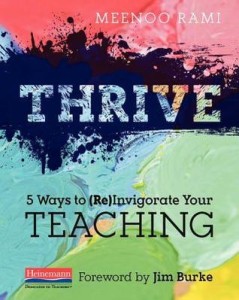
thrive

Thrive: 5 Ways to (Re)Invigorate Your Teaching
Author: Meenoo Rami
Published March 5th, 2014 by Heinemann Educational Books

Goodreads Summary: As a novice teacher, Meenoo Rami experienced the same anxieties shared by many: the sense of isolation, lack of self-confidence, and fear that her work was having no positive impact on her students. In Thrive, Meenoo shares the five strategies that helped her become a confident, connected teacher. From how to find mentors and build networks, both online and off, to advocating for yourself and empowering your students, Thrive shows new and veteran teachers alike how to overcome the challenges and meet the demands of our profession.

Praise for Thrive:
-“Whether you are entering your first year of teaching or your 40th, Thrive feels as if it were written just for you. At a time in our profession when many of us are feeling stretched thin, Meenoo Rami offers strategies to reignite our passions and rediscover why we chose to teach.” -Christopher Lehman, coauthor of Falling in Love with Close Reading
-“Teaching is a profession that eats its young. Meenoo Rami offers guidelines for surviving the challenges of the classroom as well as the faculty room.” -Carol Jago, author, teacher, and past president of NCTE
-“Thrive includes a mosaic of dynamic teacher voices from many grade levels and content areas. Reading their stories deepened my thinking about the immense untapped potential of our profession. Meenoo Rami’s vision of teaching and learning can sustain us all.”-Penny Kittle, author of Book Love

Join the conversation on Twitter at #edthrive.

About the Author: Meenoo Rami is a National Board Certified Teacher who teaches her students English at the Science Leadership Academy in Philadelphia, PA. Mixing moments of joy, laughter, risk and encouragement, Meenoo pushes her students to think critically about their connection to the word and the world. Meenoo did her undergraduate work at Bradley University in Illinois in areas of Philosophy and English and completed her Master’s degree in Secondary Education at Temple University.  Meenoo also contributes to the work of school-wide events and professional learning communities at SLA. Meenoo works as a teacher-consultant for the Philadelphia Writing Project. She has shared her classroom practice at various conferences  such as: NCTE, ISTE, ASCD, EduCon, Urban Sites Conference for National Writing Project, and #140edu. Meenoo also runs a weekly twitter chat for English teachers called #engchat which brings together teachers from around the country to discuss ideas related to teaching of English. Her first book, THRIVE  from Heinemann will be out in March 2014. In her free time, Meenoo can be found on her bike, on her yoga mat or in her kitchen tinkering with a vegetarian recipe.

To connect with Meenoo, you can find her on these social media networks:
Thrive
meenoorami.org
Twitter
Facebook
Google Plus

Kellee’s Review: In this modern day of education where CCSS and testing seems to have become the most important priority and we’re being attacked in the media for having an easy job and are failing our students, it is very difficult to stay positive—much less thrive. Meenoo Rami says that there is definitely a way to overcome all of these hardships, and she lies it all out in 5 “steps.” Although some of what you might find in this book may seem like common sense, it may not be to other teachers, specifically new teachers. It is also important to get reminders about how to stay true to ourselves. I think this is a book that each teacher needs to read and own so they can read it whenever they need a reminder that there is a way to thrive in this profession that we love.

Ricki’s Review: Meenoo Rami hits the nail on the head with her suggestions to teachers. With as many as 56% of teachers leaving the profession (Rami 3), we need to make a change. Beginning teachers must be prepared for the difficulties they will encounter on the job. This book is cleverly crafted with a variety of text features that are sure to engage readers (QR codes, tweets, figures, etc.). I teach pre-service teachers and am very particular about the texts I use. Too many professional texts are watered down and chockfull of obvious information, and I don’t want my students to purchase a book that will be a waste of their time. Rami achieves the perfect balance of narratives and information, and I will be ordering this book for my students next year. I love how she emphasizes that we, as educators, must constantly hone our art of teaching. I strongly believe that we need to practice what we preach, and we, too, must be lifelong learners.


Guest Post: Meenoo’s Tips for Dealing With Negativity and Other Issues That Keep Many of Us From Staying Positive and Thriving in our Profession

There is a common refrain I often hear when I talk to teachers these days. In hushed tones, they admit that they are tired, weary, and depleted by what they face in the their schools everyday. There are some repeated themes amongst the things they tell me:
 
I am being asked to deliver a prescribed curriculum, not create my own:
If you find yourself in the position where you’re required to use a prepackaged curriculum, consider how to balance it by incorporating the authentic inquiry that your students bring to your classroom, for example:
 
In an Environmental Science class, invite your local government representative to answer questions prepared by your students regarding how local policy is impacting local ecology.
 
The focus on testing has taken the joy out of my classroom:
Try to find the balance between teaching with the inquiry stance and test-prep is you are up against the constant pressures of testing in your school. Can you bring inquiry to this task by having your students actually create the test that they will be asked to take? See my colleague Larissa’s thinking around this here .
 
I have to sit through mind-numbing, inauthentic professional development every week:
What would it look like if you or your colleagues offered to prepare professional development in your school. Our administrators are often at a loss when it comes to finding creative ways to meet teachers’ professional development needs. What if there was a balance between what needs to be on the agenda and what teachers would like to see on the agenda. Perhaps, your faculty can form personal learning communities and take turns providing professional development to the rest of the faculty. Yes, this will be more work but it can meet the actual needs teachers have in terms of professional development. 
 
I am surrounded by negative colleagues:
Try to listen if you can, persistent complaining might be a cry for help and support. If you cannot do that, offer your support to share resources, ideas, and problem-solve. 


 Thank you to Jen Vincent for hosting this blog tour, thank you to Meenoo Rami for her amazing guest post, and thank you to Heinemann for proving us copies for review. 

Signature andRickiSig

Make sure to check out the other stops in the Thrive blog tour: 

4/9/14|
Jen Vincent at Teach Mentor Texts
http://www.teachmentortexts.com/

4/10/14
Franki Sibberson and Mary Lee Hahn at A Year of Reading
http://readingyear.blogspot.com/

4/11/14
Alyson Beecher at Kid Lit Frenzy
http://www.kidlitfrenzy.com/

4/12/14
Kira Baker Doyle at Kira J Baker-Doyle, Ph.D.
http://kbakerdoyle.wordpress.com/blog/

4/13/14
Sarah Mulhern Gross at The Reading Zone
http://thereadingzone.wordpress.com/

4/14/14
Christina Cantrill at Digital Is (National Writing Project)
http://digitalis.nwp.org/

4/15/14
Kate Roberts and Maggie B. Roberts at Indent
http://kateandmaggie.com/

4/16/14
Beth Shaum Use Your Outside Voice
http://useyouroutsidevoice.blogspot.com/

4/17/14
Linda Baie at Teacher Dance
http://www.teacherdance.org/

4/18/14
Troy Hicks at Hickstro
http://hickstro.org/

4/19/14
Joy Kirr at Genius Hour
http://geniushour.blogspot.com/

4/20/14
Tara Smith at The Teaching Life
http://ateachinglifedotcom.wordpress.com/

4/21/14
Antero Garcia at The American Crawl
http://www.theamericancrawl.com/

4/22/2014
John Spencer at Education Rethink
http://www.educationrethink.com/

Top Ten Tuesday: Characters Who Are Smart

Share

top ten tuesday

Top Ten Tuesday is an original feature/weekly meme created at The Broke and the Bookish. The feature was created because The Broke and Bookish are particularly fond of lists (as are we!). Each week a new Top Ten list topic is given and bloggers can participate.

 Today’s Topic: Top Ten Characters Who Are _Smart_. 

We decided to share some of the most intelligent characters. Note: We use the word nerd respectfully and endearingly. We are nerds, and being a nerd is something anyone should be proud of.

Ricki

1. Pudge from Looking for Alaska by John Green

I had to limit myself to one John Green character. Pudge is one of my favorite nerds. He can spout off the last words of famous folks. That takes a lot of brain power!

2. Auggie from Wonder by R.J. Palacio

Auggie is wise beyond his years. Instead of describing his deformities to readers, he says, “I won’t describe what I look like. Whatever you’re thinking, it’s probably worse.” The way Auggie handles his appearance shows immense bravery, confidence, and intelligence.

3. Tyrell from Tyrell by Coe Booth

With a deadbeat dad and loser mother, Tyrell is guaranteed to fail, right? But he isn’t the average kid. Instead of giving up, Tyrell uses his brains to make money to survive.

4. Amber Appleton from Sorta Like a Rockstar by Matthew Quick

Amber is a total nerd, and I greatly admire how she handles the hellish situations that slam into her life. When confronted with tragedy, she still manages to spread kindness to others.

5. Pierre Anthon from Nothing by Janne Teller

Pierre Anthon is, perhaps, too intelligent for his own good. He teaches his young peers: “From the moment we are born, we begin to die.” While his statement takes a depressing outlook of life, Pierre Anthon can definitely be categorized as an extremely intelligent child.

Kellee

1. Alaska from Looking for Alaska by John Green

You can’t have a list of smart characters without a John Green character. Alaska loves books and is wise beyond her years. Some of my favorite quotes from a book ever are about or by Alaska

2. Sam from Life From Outer Space by Melissa Keil

Sam is a big old nerd. Is he ashamed of it? Nope. He’s proud of his friends, movie knowledge, and World of Warcraft. Even when a sassy young lady enters his life, he never strays from his ways.

3. Tatum from Audition and Subtraction by Amy Fellner Dominy

Tatum  represents a population of middle schoolers that are not usually found in literature- a smart, math & music “nerd” thus making it so another group of girls will see themselves reflected in a book.

4. Matilda from Matilda by Roald Dahl

The first book worm I ever found in books. I finally saw myself reflected in someone although to a crazy extreme (I am not a genius, but Matilda was). It is great to have a main character who loves to read and learn.

5. Mal from Mal & Chad by Stephen McCranie

Mal is a genius and no one knows it. I mean he made his dog talk and has built time machines! He is one cool kid!

Who are some of the smartest characters you know? 

RickiSig andSignature

It’s Monday! What Are You Reading? 4/21/14

Share

IMWAYR

It’s Monday! What Are You Reading? From Picture Books to YA!

It’s Monday! What are you Reading? is a meme hosted by Sheila at Book Journeys. It is a great way to recap what you read and/or reviewed the previous week and to plan out your reading and reviews for the upcoming week. It’s also a great chance to see what others are reading right now…you just might discover the next “must-read” book!

Jen Vincent, of Teach Mentor Texts, and Kellee decided to give It’s Monday! What Are You Reading? a kidlit focus. If you read and review books in children’s literature – picture books, chapter books, middle grade novels, young adult novels, anything in the world of kidlit – join us! We love this meme and think you will, too.

We encourage everyone who participates to support the blogging community by visiting at least three of the other book bloggers that link up and leave comments for them.

Last Week’s Posts

top ten tuesday locomotive 16143347

Tuesday: Top Ten Bookish Things We’d Like to Own

Friday: Amulet Graphic Novels: Teaching Guide

**Click on any picture to view the post**
 Last Week’s Journeys

Kellee: I love Rose Under Fire. This week has been quite busy, and I have not been able to finish it yet; however, I am so enjoying it. I wish I was reading it right now! I am also reading an e-book called Coyote Summer by J.S. Kapchinske which I am also really liking. I knew nothing about it, and it is quite surprisingly a good book.

Also, we visited Barnes and Noble on Saturday, and I decided to partake in a couple of picture books I’ve been wanting to read: Pigeon Needs a Bath by Mo Willems and Warning: Do Not Open This Book! by Adam Lehrhaupt. Um, I definitely need to own both of these books. I was laughing in the middle of the store. So good.

Trent and I continued our picture #bookaday and read some really great ones this week:

  • Global Babies by Global Fund for Children (A great introduction to diversity!)
  • Little You by Richard Van Campt (A beautiful poem and a loving message. I also liked the style of illustrations.)
  • A Bedtime for Chester Raccoon by Audrey Penn (A Kissing Hand tale that is just as sweet.)
  • Owen and Mzee: Best Friends by Isabella Hatkoff (I LOVE Owen and Mzee, and I am so glad there is a board book version of their story.)
  • Me Hungry! by Jeremy Tankard (This was the surprise of the week. It cracked me up! Told from the POV of a caveboy, it is quite funny.)
  • The Tale of Peter Rabbit by Beatrix Potter (On Easter. Classic.)
  • Little White Rabbit by Kevin Henkes (I just adore everything Kevin Henkes writes.)

Ricki: This week, I finished the professional development text, The Shame of the Nation by Jonathan Kozol. It made me look at schooling in an entirely different light. For example: Why is it that schools named after MLK Jr. are filled with black students? Wasn’t MLK Jr.’s message about integration? This is just one of the many questions the Kozol poses. I am still pondering some of the ideas that Kozol presents.

Henry and I enjoyed some great picture books this week. My two favorites were: Library Lion by Michelle Knudsen and Noodle by Munro Leaf. These two will be going on Henry’s wish list. The other books we read were: Wild About Books by Judy Sierra, Never Play Music Right Next to the Zoo by John Lithgow, On Our Way Home by Sebastien Braun, Love is a Handful of Honey by Giles Andreae, Heart in the Pocket by Laurence Bourguigon, Go Dog Go by P.D. Eastman, and Sometimes I Forget You’re a Robot by Sam Brown.

This Week’s Expeditions

Kellee: I am going to finish Rose Under Fire and begin (and hopefully finish!) P.S. Be Eleven. I’ll also continue Coyote Summer. This is my last week of maternity leave, so I am going to cherish it by spending as much time as I can with my son and reading.

Ricki: I am still reading Love Letters to the Dead by Ava Dellaira, and I just started the professional development text, Culturally Responsive Teaching by Geneva Gay. Henry and I are still reading our graphic novel book of classic fairy tales called Fairy Tale Comics, which is edited by Chris Duffy, and we are also still reading The Lion, the Witch, and the Wardrobe by C.S. Lewis.

Upcoming Week’s Posts

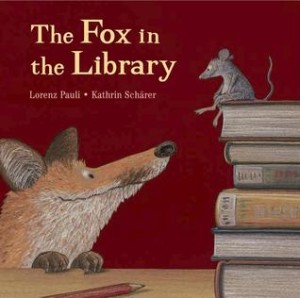
top ten tuesday thrive the fox in the library hum

Tuesday: Top Ten Characters Who Are Smart

Wednesday: Thrive Blog Tour and Author Guest Post

Friday: Tracy Holczer, author of The Secret Hum of a Daisy, Guest Post

 So, what are you reading?

Link up below and go check out what everyone else is reading. Please support other bloggers by viewing and commenting on at least 3 other blogs. If you tweet about your Monday post, tag the tweet with #IMWAYR!

 Signature andRickiSig

Amulet Books Graphic Novel Teaching Guide

Share

abrams

In January, I was contacted by a publicity and marketing associate from Abrams Books/Amulet Books out of the blue. In this email, I was asked to work on a teaching guide about their graphic novels: The Misadventures of Salem Hyde, Nathan Hale’s Hazardous Tales, Hereville, and the Explorer series.

1729025518405488 

13591161135911621729026018405492

1283377017290285

I was beyond honored! And, of course, I said that I would definitely love to do it as I had read all of the graphic novels, and I am a huge fan of them.

First, they asked me to write an introduction about graphic novels and their importance in the classroom. I am a huge advocate for using graphic novels in schools, so I immediately began researching and writing. Here is the introduction:

What are graphic novels? The easiest way to describe graphic novels is to say that they are book-length comic books. However, a more complex definition that educators and librarians use is “book-length narratives told using a combination of words and sequential art, often presented in comic book style” (Fletcher-Spear, 37). Graphic novels are not written in just one genre; they can be in any genre, since graphic novels are a format/medium. Graphic novels are much like novels, but they’re told through words and visuals. They have all narrative elements, including characters, a complete plot, a conflict, etc.

Middle grade and young adult graphic novels cover a wide spectrum of themes and topics. Some common themes found in graphic novels for this age include the hero’s journey; overcoming hardship; and finding one’s identity. For example, in Hereville, we meet Mirka, an everyday girl who learns to use her brains and brawn to overcome her foes. In The Misadventures of Salem Hyde, Salem is working on finding out just who she is (both as a witch and as a person) with the help of her friend Whammy. Graphic novels can cross curricular lines. One example is the Nathan Hale’s Hazardous Tales series—comical nonfiction that takes historical events and presents them in interesting ways, using graphics and humor that will make students want to learn even more about the historical time periods. In the Explorer series, stories include topics such as animal adaptation, volcanic eruptions, and the fate of humanity. Like novels, graphic novels offer opportunities in all subject areas to extend students’ thinking.

Over the past few years, graphic novels have become a hot topic, growing in popularity with both children and educators. While many teachers are beginning to include them in the classroom, there are still teachers, administrators, and librarians who struggle with including this format in their schools. So, why should you use them in your classroom and have them available for students?

  • Graphic novels can make a difficult subject interesting and relatable. (Cohen)
  • Students are visual learners, and today’s students have a much wider visual vocabulary than students in the past. (Karp)
  • Graphic novels can help foster complex reading skills by building a bridge from what students know to what they still have to learn. (NCTE)
  • Graphic novels can help with scaffolding when trying to teach higher-order thinking skills or other complex ideas.
  • For students who struggle to visualize while they read, graphic novels provide visuals that shows what good readers do. (NCTE)
  • Many graphic novels rely on symbol, allusion, satire, parody, irony, and characters/plot and can be used to teach these, and other, literary devices. (Miller; NCTE)
  • Often, in between panels (called the gutter), the reader must make inferences to understand how the events in one panel lead to the events in the next. (McCloud)
  • Graphic novels can make differentiating easier. (Miller)
  • Graphic novels can help ELL (English Language Learners) and reluctant and struggling readers since they divide the text into manageable chunks, use images (which help students understand unknown vocabulary), and are far less daunting than prose. (Haines)
  • Graphic novels do not reduce the vocabulary demand; instead, they provide picture support, quick and appealing story lines, and less text, which allow the reader to understand the vocabulary more easily. (Haines)
  • Research shows that comic books are linguistically appropriate reading material, bearing no negative impact on school achievement or language acquisition. (Krashen)
  • Students love them.

Although you can find graphic novel readers at all reading levels, graphic novels can truly be a gateway to the joys of reading for reluctant and struggling readers. Reluctant readers often find reading to be less fun than video games, movies, and other media, but many will gravitate toward graphic novels because of the visuals and the fast pace. Struggling readers will pick up graphic novels for these reasons as well but also because the graphic novel includes accommodations directly in the book: images, less text, etc.

All in all, graphic novels can interest your most reluctant and struggling readers and also extend all of your readers, including your most gifted.  

Resources

  • Cohen, Lisa S. “But This Book Has Pictures! The Case for Graphic Novels in an AP Classroom.” AP Central. CollegeBoard.
  • Fletcher-Spear, Kristin, Merideth Jenson-Benjamin, and Teresa Copeland. “The Truth About Graphic Novels: A Format, Not a Genre.” The ALAN Review Winter (2005): 37­–44.
  • Haines, Jennifer. “Why Use Comics in The Classroom?” Comic Book Daily. N.p., 20 Mar. 2012.
  • Karp, Jesse. “The Case for Graphic Novels in Education.” American Libraries. N.p., 1 Aug. 2011.
  • Krashen, Stephen. The Power of Reading. Englewood, CO: Libraries Unlimited, Inc. 1993.
  • McCloud, Scott. Understanding Comics. Northampton, Mass.: Kitchen Sink, 1993. 
  • Miller, Andrew. “Using Graphic Novels and Comics in the Classroom.” Edutopia. N.p., 11 Jan. 2012.
  • NCTE, comp. “Using Comics and Graphic Novels in the Classroom.” The Council Chronicle September (2005) http://www.ncte.org/magazine/archives/122031.

 I then began reading and rereading the graphic novels and planning activities and discussion questions that could go along with each book. I was asked to come up with activities for all subjects, so this pushed me out of my comfort zone a bit; however, I loved trying to figure out how these amazing books could be used throughout all classes.  Some examples:

  • Salem Hyde [Science]: At the end of Spelling Trouble, Salem and Whammy have to rescue a whale, but it is done in a very unconventional way. How would real scientists rescue a whale in distress?
  • Hazardous Tales [Language Arts/History]: The Provost (a British soldier) and Nathan Hale disagree about the cause of the Revolutionary War. Based on One Dead Spy, what events caused the Americans to revolt? Do you agree with the Provost or with Nathan Hale about the causes of the war? (This could also be used as a debate question in class.)
  • Hereville [Math]: On pages 31–32 [of Hereville 1], Mirka is given a math problem: Three people are splitting a cake, so they cut it into thirds. But then a fourth person shows up. How can they cut the cake so that each person gets an equalamount of cake? (Mirka comes up with a solution, but are there others?) What if two more people had shown up? Three more? Four more? 
  • Explorer [History]: On page 84 [of The Mystery Boxes], in The Soldier’s Daughter, the man says, “War is a dark power.” Where in history have we seen war consume someone? Have there been wars that did not need to be fought? Research past wars and determine if a war was started because of the need for power or if there was a legitimate reason for it. 

These are just some examples.

I am happy to share the entire teaching guide with you. It can be found at http://www.abramsbooks.com/academic-resources/teaching-guides/ along with other teaching guides. The direct link to the PDF is http://www.abramsbooks.com/pdfs/academic/GraphicNovels_TeachingGuide.pdf.

I hope you find it useful as I am very proud of it,

Signature