Searching for Lottie by Susan L. Ross

Share

Searching for Lottie
Author: Susan L. Ross
Publication Date: February 26th, 2019 by Holiday House

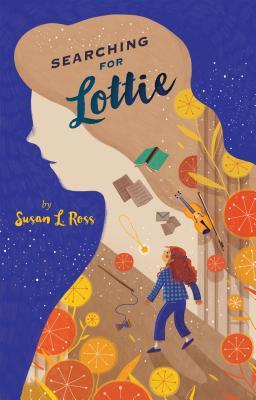
Summary: Lottie, a talented violinist, disappears during the Holocaust. Can her grand-niece, Charlie, discover what happened?

A long-lost cousin, a mysterious locket, a visit to Nana Rose in Florida, a diary written in German, and a very special violin all lead twelve-year-old Charlie to the truth about her great-aunt Lottie in this intriguing, intergenerational mystery. 12-year-old middle schooler Charlie, a budding violinist, decides to research the life of her great-aunt and namesake for a school ancestry project. Everyone in Charlie’s family believes Great-Aunt Charlotte (Lottie), a violin prodigy, died at the hands of the Nazis, but the more Charlie uncovers about her long-lost relative, the more muddied Great-Aunt Lottie’s story becomes. Could it be that Lottie somehow survived the war by hiding in Hungary? Could she even still be alive today? In Searching for Lottie, Susan Ross has written a highly personal work of historical fiction that is closely inspired by her own family members whose lives were lost in the Holocaust.

About the Author: Susan Ross grew up in Lewiston-Auburn, Maine, and divides her time between Connecticut and Maine. She attended Brown University and NYU School of Law.

After practicing law, Susan taught legal writing in Brooklyn and in Budapest, and creative writing to kids and adults in Connecticut. She especially loves author visits. There is nothing Susan enjoys more than hanging out in a classroom talking to students about her books and teaching kids about writing and literature!

Kiki and Jacques was inspired by the experience of Somali refugees who moved to Susan’s hometown in Maine. Susan worked with refugee teenagers in writing the book and was greatly moved by their amazing positive energy and hopeful determination.

Searching for Lottie was inspired by stories from members of Susan’s family, whose lives were forever changed by the Holocaust.

Susan teaches writing at Westport Writers Workshop and is a trustee at the Westport Library.

Review: I think historical fiction is one of the most important genres because it makes us relive history in ways that we never could without story. Searching for Lottie is interesting because it is contemporary but also includes a historical narrative as Charlie learns more and more about Lottie. This makes it a great choice for students who may not like historical fiction but are interested in history.

I am also a fan of Susan Ross’s writing because she does a fabulous job taking a tough subject and writing a middle grade novel that gives an introduction to the topic without being too mature but also while not sugar coating it. It is so important to have middle grade books for our students that show the real world in an appropriate yet real way.

And it really helps that the stories are interesting and many kids will connect with the conflicts and events the characters take part in.

Teachers’ Tools for Navigation: Searching for Lottie is inspired by true events, specifically those of Susan’s family. She shares much on her website including this background information:

Charlotte Kulka (called Lotte — in English, “Lottie”) was my mother’s teenage cousin. She lived in Prague with her father, a doctor. Her mother passed away when she was little. Tragically, Charlotte and her father both perished, but her beloved aunt, my Cousin Vally Szemere, survived with false papers in Budapest. Vally boarded with a Catholic family who protected her and they became lifelong friends. My middle name was given in Lotte’s memory.

Another relative, Magda Szemere, was a famous young violin soloist in Europe before she, too, was arrested and forever disappeared. I wrote about my bittersweet delight at finding her music in the essay, “Sweet Strings of Sorrow.”

In doing the research for this book, I discovered to my astonishment that her music had been preserved on gramophone recordings and remains available in music archives.

My mother’s cousin, Magda Krizan, survived the war posing as a model and nanny in Hungary — and was a member of the resistance. She escaped from Communist Czechoslovakia with her husband in 1968 and came to America.

My mother, Erika Lencz, escaped Vienna in 1938 with her brother, Erwin. She was twenty years old. My grandparents and nearly all of the rest of her family were lost. Mom worked in a pillow factory in Brooklyn and as a nanny before settling down in Maine with my father, where she ran our family wedding gown shop and had five children.”

Visit http://www.authorsusanross.com/about-searching-for-lottie/ to listen to the recording and view photos.

This information along with Charlie’s project in the book makes me want to ask students to learn about their family (remember to have a plan for any adopted, foster, or other kids with no access to family history!).

Parts of the story also would be a great addition to an orchestra classroom as Charlie and Lottie write about different pieces, specifically the music journal that Lottie kept.

Finally, as with most historical fiction novels, this story would be a fantastic jumping off point for inquiry in the classroom about our world’s past.

Discussion Questions: 

  • After listening to the pieces that Charlie and Lottie share in the book, which piece is your favorite?
  • What other ways did Jews and other ostracized humans escape Nazi-occupied territory during World War II?
  • What traits did Charlie show when researching her namesake?
  • How did the research change her relationship with her brother?
  • Using evidence from the text, how can you tell that Charlie loves music?

Flagged Passages: “‘Lottie was Nana’s sister, right?’

‘Yes, Lottie was several years older. Your nana told me how clever she was; how determined…just like you.’ Mom smiled. ‘And here’s another thing you two have in common–Lottie played the violin. In fact, Lottie played so beautifully that she performed with the Vienna Philharmonic when she was a teenage.’

‘Seriously?’ That was a weird coincidence. Violin was her thing, too. Charlie had begged her parents for lessons when she was still in kindergarten. She’d always loved music, and she liked pop and hip-hop as much as any kid at Hillmont Middle School…but there was something about classical that made her heart skip. She could lose herself in a symphony in a strange way that she never tried to explain to her friends. Only her best friend, Sarah, understood that feeling, but Sarah had moved to Boston over the summer…

‘What else do you know about Lottie?’

‘Well, the family was from Vienna, the capital of Austria. Her father was a math professor at the university.’

‘And…what exactly happened to them.’

Mom hesitated, then let out a long sigh. ‘Honestly, I’m not entirely certain. When the Germans invaded Austria, the Jews were at the mercy of the Nazis. I know that Lottie was lost, along with my grandfather. My grandmother and Nana Rose were lucky to escape. They came to America on a ship.’

‘So Lottie died…right?’ Charlie swallowed hard.

‘Yes, I guess she must have.’ Mom looked uncomfortable.

‘You guess? You don’t know for sure?’ Charlie sat up straight. She searched her mother’s blank face and glanced down at the photo. Lottie’s eyes were bright, with long dark lashes, and they were staring back up at her.

‘The truth is that nobody knows exactly what happened to Lottie…'” (p. 7-9)

Read This If You Love: Music, World War II historical fiction novels, History, Family

Recommended For: 
classroomlibrarybuttonsmall 

Signature

**Thank you to the author for providing a copy of the book for review!!**
Carlos Santana: Sound of the Heart, Song of the World by Gary Golio

Share

Carlos Santana: Sound of the Heart, Song of the World
Author: Gary Golio
Illustrator: Rudy Gutierrez
Published: September 4, 2018 by Henry Holt

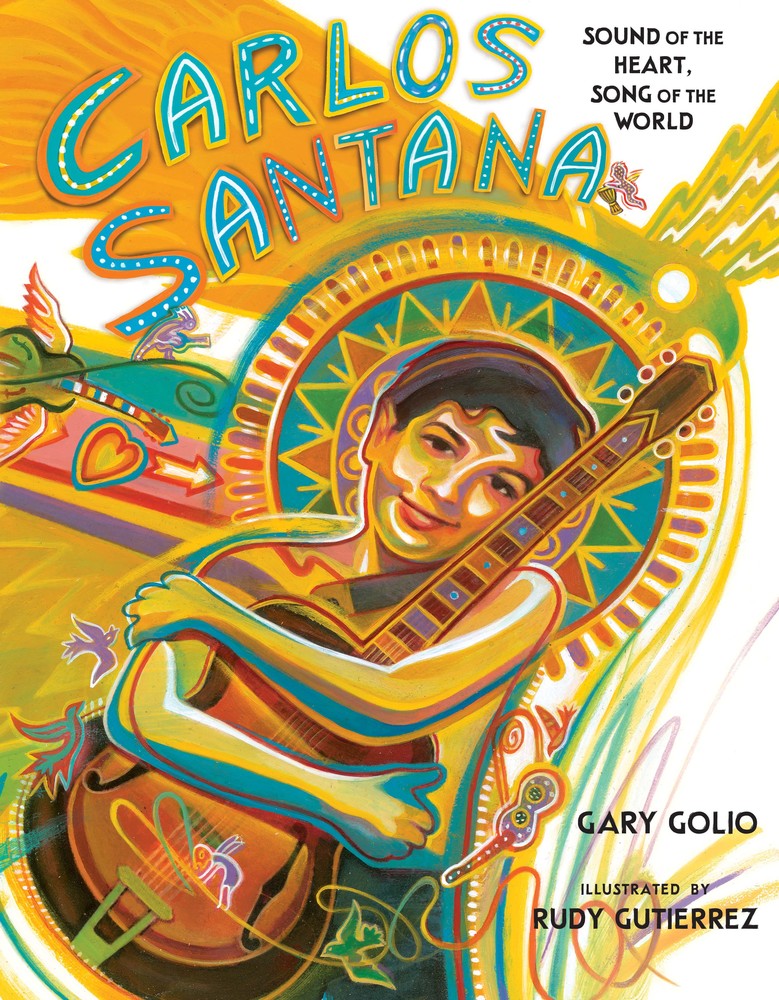
Summary: Discover the childhood story of Carlos Santana in Gary Golio’s Sound of the Heart, Song of the World, featuring illustrations by Rudy Gutierrez,the internationally celebrated artist who created the iconic Carlos Santana Shaman CD cover.

Carlos Santana grew up surrounded by music. His father, a beloved mariachi performer, teaches his son how to play the violin when he is only six years old. But when Carlos discovers American blues, he is captivated by the raw honesty of the music. Unable to think of anything else, he loses all interest in the violin. When Carlos finally receives his first guitar, his whole life begins to change.

From his early exposure to mariachi to his successful fusing of rock, blues, jazz, and Latin influences, here is the childhood story of a legendary musician.

My Review: I absolutely loved this book. My son and I had so much fun reading it, and then he asked to listen to some of Carlos Santana’s music. A few days later, we heard a Carlos Santana song on the radio, and my husband excitedly reminded my son about the book. It feels good to connect him with such a powerful man in our history. He shaped music in powerful ways. The book is beautifully written. I liked how it focused predominantly on Santana’s childhood. This kept my son’s interest and helped him connect with Santana. The art flows beautifully and looks like visual music on the page.

Teachers’ Tools for Navigation: I would love to use this book in literature circles with kids. Students could each read a picture book about a famous person in our history of music (see some of the options below). They could share out to their peers and play a clip from the music. These interdisciplinary activities would make for a warm, powerful learning environment.

Discussion Questions: 

  • Describe Carlos Santana’s childhood.
  • What inspired Santana?
  • What was Santana’s relationship with his parents? How do you think this may have shaped his life? What did working beside his father teach him about himself?
  • Describe Santana’s journey into music. What influenced him?

Flagged Passage: Check out the beautiful interiors on the book’s Macmillan page.

Read This If You Love: How Pete Seeger Got America Singing by Leda Schubert; Stand Up and Sing! by Susanna Reich, When Bob Met Woody by Gary Golio, Jimi: Sounds Like a Rainbow by Gary Golio

Recommended For: 

classroomlibrarybuttonsmall 

**Thank you to Madison at Macmillan for providing the book for review!**

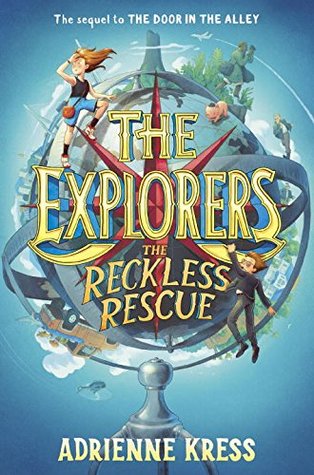
Blog Tour with Review!: The Reckless Rescue (The Explorers #2) by Adrienne Kress

Share

The Reckless Rescue (The Explorers #2)
Author: Adrienne Kress
Published April 24th, 2018 by Delacorte Books for Young Readers

Summary: More mystery, more bravery, more danger, and one amazingly reckless rescue await in the second book in the Explorers series! The perfect read for fans of The Name of This Book Is a Secret and The Mysterious Benedict Society!

Reader! Your attention is greatly needed. We have left things unresolved! What began as your average story of a boy stumbling upon a pig in a teeny hat and a secret international explorers society has turned into an adventure of epic proportions.

* The bad news: The boy (Sebastian) has been kidnapped by a trio of troublesome thugs.
* The good news: His new friend Evie has promised to rescue him!
* The bad news: Sebastian has been taken halfway around the world.
* The good news: Evie has famous explorer and former Filipendulous Five member Catherine Lind at her side!
* The bad news: There’s still the whole matter of Evie’s grandfather (and the leader of the Filipendulous Five) somewhere out there in grave danger.
* The good news: Pursuing Sebastian will lead Evie and Catherine to another member of the Filipendulous Five, who might be able to help!

This missive is a call to action and an invitation to join in mystery, bravery, and danger. There will be new people to meet, new places to see, and some dancing along the way. And one amazingly reckless rescue.

About the Author: Adrienne Kress is a writer and an actress born and raised in Toronto. She is the daughter of two high school English teachers, and credits them with inspiring her love of both writing and performing. She also has a cat named Atticus, who unfortunately despises teeny hats. She is the author of The Explorers: The Door in the Alley, The Explorers: The Reckless Rescue,and The Explorers: The Quest for the Kid. To find out more about Adrienne, visit AdrienneKress.com and follow @AdrienneKress on Twitter and Instagram.

Review: This book starts RIGHT up where the first left off–like, actually! Mid-sentence! And I’m so glad because the cliffhanger in the first one was so intense! But here we are, right where we left off: Sebastian is kidnapped, and Evie has to figure out how to save him (hence the title…). Like the first book, I found that the snarky narrator, silly footnotes, and ridiculous situations was humor that is right up my alley, causing many laugh out loud moments, but let’s not forget that the story is also a nerve-racking adventure story also! Other than the humor and adventure, I also really like the characters in this story. Evie and Sebastian complement each other so well, and we really get to see them shine in this book as individuals since they are separated.

Teachers’ Tools for Navigation: This series would be a perfect mentor text when teaching dramatic irony, breaking the 4th wall, and footnotes. Even reading the first chapter will cover these three literary elements and will also get a lot of kids excited to read the story. Because the other place this book belongs is in libraries and classrooms–it is going to be a big hit with adventure and humor fans!

Discussion Questions: 

  • How does the narration style the author chose change the tone of the story?
  • Why do you think the author chose to include footnotes in the story?
  • How does the author use dramatic irony to keep the reader reading?
  • What is the “Lost Boys” K-Pop group an allusion to?
  • How do Sebastian and Evie complement each other?
  • How did some good or bad things in the story end up being the opposite of what you thought?

Flagged Passages: “Chapter 1: In which we resume our story.

There is a difference between fact and opinion. It’s hard to tell sometimes because opinions like to dress up as facts, and their costumes have gotten quite impressive lately.¹ There is a way, however, to easily tell the difference between them. You have to weigh them. Because, you see, facts have more substance. So they’re heavier. This is how one can know for a fact, for example, that being kidnapped for your brain is scary. Because when this fact is placed on the scale, man, does it ever tip the balance.

There are other facts one can be certain of. Like that private jets are cool. That traveling long distances get boring. And that not knowing where you are going or what’s going to happen to you is exhaustingly stressful.

And if you don’t believe me, just ask Sebastian, who is sitting in his seat and staring out the window of the private jet, feeling precisely all of those things.

It is odd to feed bored. Not that feeling bored is a rare or weird feeling. It’s a very common part of life, after all. But it just felt strange to feel bored in his particular situation. He should have been feeling terrified, possibly even a little excited. And he knew this because he’d felt those things initially when he’d been snatched out of the Explorers Society headquarters and held captive in a helicopter. But that felt like forever ago now.

¹I once saw an opinion wearing the most spectacular curly mustache that distracted me so much, I totally let him into my head, even though I found his footwear suspicious.”

Read This If You Love: The first Explorers book: The Door in the Alley, Emily and the Spellstone by Michael Rubens, Guardians of the Gryphon’s Claw by Todd Calgi Gallicano, Cucumber Quest series by Gigi D.G., Alex Rider series by Anthony Horowitz, The Lightning Thief by Rick Riordan

Recommended For: 

classroomlibrarybuttonsmall closereadinganalysisbuttonsmall

Signature

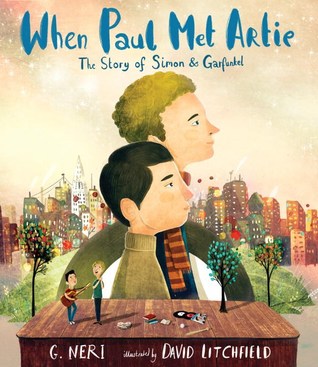
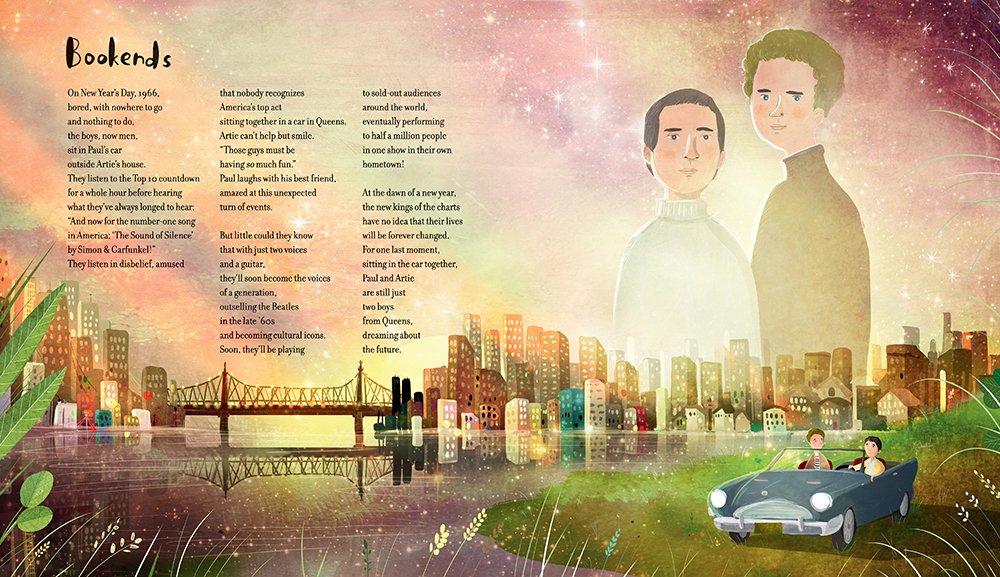
When Paul Met Artie: The Story of Simon & Garfunkel by G. Neri

Share

When Paul Met Artie: The Story of Simon & Garfunkel
Author: G. Neri
Illustrator: David Litchfield
Expected Publication on March 20th, 2018 by Candlewick Press

Summary: From childhood friendship to brief teenage stardom, from early failures to musical greatness — the incredible story of how Simon & Garfunkel became a cherished voice of their generation.

Long before they became one of the most beloved and successful duos of all time, Paul Simon and Art Garfunkel were just two kids growing up in Queens, New York — best friends who met in a sixth-grade production of Alice in Wonderland and bonded over girls, baseball, and rock ’n’ roll. As teens, they practiced singing into a tape recorder, building harmonies that blended their now-famous voices until they sounded just right. They wrote songs together, pursued big-time music producers, and dreamed of becoming stars, never imagining how far their music would take them. Against a backdrop of street-corner doo-wop gangs, the electrifying beginnings of rock ’n’ roll, and the rise of the counterculture folk music scene, G. Neri and David Litchfield chronicle the path that led two young boys from Queens to teenage stardom and back to obscurity, before finding their own true voices and captivating the world with their talent. Back matter includes an afterword, a discography, a bibliography, and a fascinating list of song influences.

Review: Wow. G. Neri and David Litchfield have captured the story of Simon & Garfunkel and released it into the world in a way that oozes the same beauty that their music does. Neri’s lyrical narrative flows and is perfect for a biography of one of the most beloved duos ever while Litchfield’s illustrations have the tone and coloring that just fit Simon & Garfunkel’s music–a bit dreamy yet raw and colorful. Their two pieces of artwork put together make for a beautiful picture book biography.

P.S. Make sure you take off the cover and look at the book design. BEAUTIFUL!

Teachers’ Tools for Navigation: While I’m not sure if such a class exists, this text would be perfect for a history of rock and roll class. It really goes through how the time period was changing when it came to music and how each artist influenced each other. If this class doesn’t exist, I wish it did, and I wish I could take it!

The structure of the text also lends to a great lesson looking at both why the author chose verse instead of prose as well as why he chose the timeline that he did. What was his purpose?

Discussion Questions: 

  • How did the author structure the book?
  • Why do you believe that the author chose to write the narrative in verse?
  • Paul and Artie, as children, are both different and similar. Explain.
  • How did Artie use his interest in math to help the duo?
  • How did music around Paul and Artie affect their music?
  • Why is this time period so important for the history of rock and roll?
  • What other artists does the author and illustrator highlight during the book as influences for Simon & Garfunkel?
  • What would have happened if Paul and Artie had given up after all of the rejection?
  • How did the duo go from rejection to success?
  • What clues can the musical connections give to us about the duo’s musical journey?

Flagged Passages: 

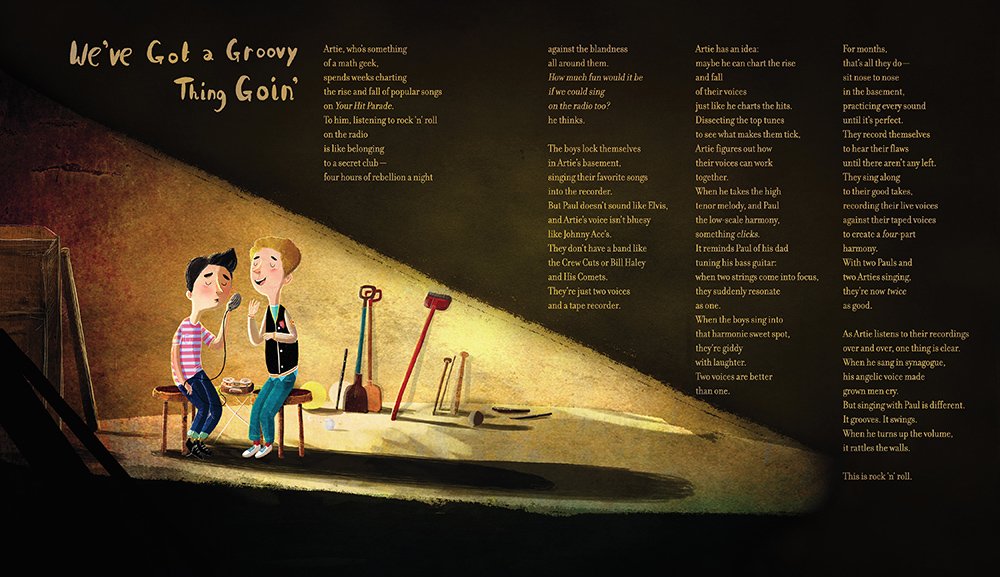
“We’ve Got a Groovy Thing Goin’

…When he takes the high
tenor melody, and Paul
the low-scale harmony,
something clicks.
It reminds Paul of his dad
tuning his bass guitar:
when two strings come into focus,
they suddenly resonate
as one…”

“Bookends

…At the dawn of a new year,
the new kinds of the charts
have no idea that their lives
will be forever changed.
For one last moment,
sitting int he car together,
Paul and Artie
are still just
two boys
from Queens
dreaming about
the future.”

Read This If You Love: Music, the 60s, Rock and Roll, biographies

Recommended For: 

classroomlibrarybuttonsmall closereadinganalysisbuttonsmall 

Signature

**Thank you to Raquel at Candlewick for providing a copy for review!!**

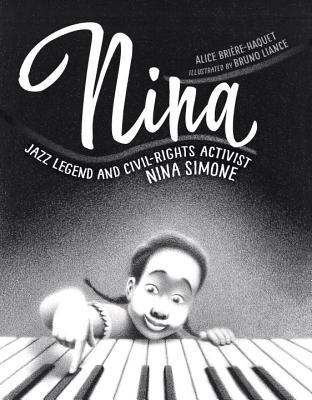
Nina: Jazz Legend and Civil-Rights Activist Nina Simone by Alice Brière-Haquet

Share

nfpb2017

Nonfiction Wednesday

Nonfiction Picture Book Wednesday is hosted by Kid Lit Frenzy and was started to help promote the reading of nonfiction texts. Most Wednesdays, we will be participating and will review a nonfiction text (though it may not always be a picture book).
Be sure to visit Kid Lit Frenzy and see what other nonfiction books are shared this week!

Nina: Jazz Legend and Civil-Rights Activist Nina Simone
Author: Alice Brière-Haquet
Illustrator: Bruno Liance
Published December 5th, 2017 by Charlesbridge Publishing

Summary: “To be young, gifted, and black.”

A stunning picture-book biography of the High Priestess of Soul and one of the greatest voices of the 20th century.

With evocative black-and-white illustrations and moving prose, readers are introduced to Nina Simone, jazz-music legend and civil-rights activist. Shared as a lullaby to her daughter, a soulful song recounts Simone’s career, the trials she faced as an African American woman, and the stand she took during the Civil Rights Movement. This poignant picture book offers a melodic tale that is both a historic account of an iconic figure and an extraordinary look at how far we’ve come and how far we still need to go for social justice and equality. A timeless and timely message aptly appropriate for today’s social and political climates.

Review: Although Nina is just a taste into who Nina Simone was as it only introduces her talent as a pianist and shares her beliefs in regards to civil rights. Set up as a lullaby that Nina is singing to her child, the story recounts her love of music and learning about the racism within our nation as well as a story where she stood up to inequality at one of her piano concerts. The lyrics and illustrations are dreamy and perfectly fit the purpose of the story: to introduce and intrigue the reader when it comes to Nina Simone.

Teachers’ Tools for Navigation: I do wish that there had been back matter that went more in depth into Simone’s contribution to jazz and civil rights; however, without them existing, this nonfiction picture book allows for a perfect change for inquiry. Now that students have been introduced to Nina, have stations/centers focusing on different parts of her life, jazz, or the Civil Rights Movement.

Discussion Questions: 

  • How does the illustration on the bus use the idea of the piano to symbolize the relationship between White and Black citizens in the early 1900s?
  • What techniques do the author and illustrator use to make the book seem lullaby-eque?
  • How did the imagery of the single black chair symbolize the racism that occurred at Simone’s concert?
  • How does the author tie in Martin Luther King, Jr. and the Civil Rights Movement?

Flagged Passages: 

“‘The white keys are whole notes and the black keys are flats, or half notes,’ my teacher explained.

I asked why.

‘Because that’s just the way it is.’

Yes, that’s the way it was. White was whole. Black was half. It was that way everywhere and for everyone.

I could have held it against people. Or worse, I couldn’t believed I was worth less than other people.

Black people were nothing but half notes on a huge ivory keyboard.

But no. I did not agree with this.

The notes had to mingle and dance together in the air so these lies would disappear.”

Read This If You Love: Andrea Davis Pinkney picture book biographies, Jazz, Learning about the Civil Rights Movement

Recommended For: 

classroomlibrarybuttonsmall closereadinganalysisbuttonsmall  

Signature

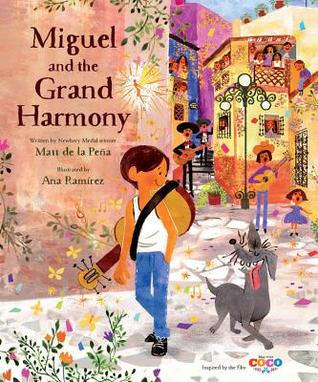
Miguel and the Grand Harmony by Matt de la Peña

Share

Miguel and the Grand Harmony
Author: Matt de la Peña
Illustrator: Ana Ramírez
Published: October 10, 2017 by Disney

Summary: This jacketed picture book pairs Newbery Winner Matt de la Peña and Pixar artist Ana Ramírez with the highly anticipated Pixar Studios film, Coco. Featuring a beautiful original story based on the characters of the film, as well as vibrant stylized artwork, this title is sure to appeal to readers of all ages.

Disney*Pixar’s Coco is the celebration of a lifetime, where the discovery of a generations-old mystery leads to a most extraordinary and surprising family reunion. Directed by Lee Unkrich (Toy Story 3) and produced by Darla K. Anderson (Toy Story 3), Disney*Pixar’s Coco opens in U.S. theaters November 22, 2017.

Review: Matt de la Peña. Let me count the ways I love this man. He writes stories that come alive and dance off of the pages. This story is no different. This story beautifully depicts the power of music. It reminds readers to pause and listen to the music around them. This would be a beautiful book to pair with Last Stop on Market Street. Both books remind children to slow down and look at their surroundings. We can find beauty all around us.

Teacher’s Tool For Navigation: This text reads like an extended poem. I would use this book at any age level to teach students about poetry. High schoolers would find beauty in its complexity, and younger readers might use the book as a mentor text to form their own poetry.

Discussion Questions: How does the author use words with intention?; What do you notice about the ways in which the phrases work together on each page?; How does Miguel grow?; Where do you see music in your everyday life?

We Flagged:

Read This If You Loved:  Last Stop on Market Street by Matt de la Peña, Each Kindness by Jacqueline Woodson, A Bus Called Heaven by Bob Graham

Recommended For: 

readaloudbuttonsmall classroomlibrarybuttonsmall 

RickiSig

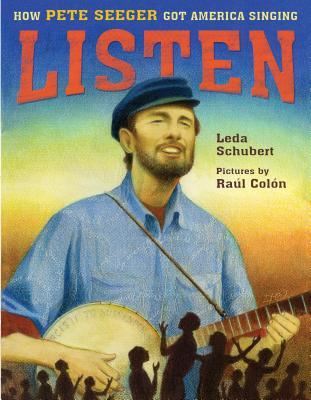
Review and Giveaway!: Listen: How Pete Seeger Got America Singing by Leda Schubert

Share

Listen: How Pete Seeger Got America Singing
Author: Leda Schubert
Illustrator: Raúl Colón
Published June 13th, 2017 by Roaring Brook Press

Summary: 

Listen.
There was nobody like Pete Seeger.
Wherever he went, he got people singing.
With his head thrown back
and his Adam s apple bouncing,
picking his long-necked banjo
or strumming his twelve-string guitar,
Pete sang old songs,
new songs,
new words to old songs,
and songs he made up.

In this tribute to legendary musician and activist Pete Seeger, author Leda Schubert highlights major musical events in Mr. Seeger’s life as well important moments of his fight against social injustice. From singing sold-out concerts to courageously standing against the McCarthy-era finger-pointing, Pete Seeger’s life is celebrated in this book.

Praise for Listen: 

★“Schubert and Colón ably demonstrate one of their book’s final assertions: ‘there really was nobody like Pete Seeger.’”—Kirkus Reviews (starred)

“A rousing tribute to a singular musician and activist who ‘walked the talk.’” —Publishers Weekly

“This inspiring picture book biography about one of America’s greatest folk heroes is sure to get a new generation of children singing.” —School Library Journal

“An inspiring and heartfelt tribute to, as Schubert calls him, a ‘true American hero.’” —Horn Book

About the Creators: 

Leda Schubert holds an MFA from Vermont College of Fine Arts in the Writing for Children and Young Adults and was a core faculty member until 2012. She is the author of many award-winning titles, including The Princess of Borscht, Ballet of the Elephants, and Monsieur Marceau, winner of the Orbis Pictus Award for Outstanding Nonfiction. Leda lives in Plainfield, Vermont, with her husband and two dogs. To learn more, and to download a curriculum guide, visit ledaschubert.com.

Raúl Colón has illustrated several highly acclaimed picture books, including Draw!; the New York Times-bestselling Angela and the Baby Jesus by Frank McCourt; Susanna Reich’s José! Born to Dance; and Jill Biden’s Don’t Forget, God Bless Our Troops. Mr. Colón lived in Puerto Rico as a young boy and now resides in New City, New York, with his family.

Kellee’s Review: Schubert’s narrative of Seeger’s life is so lyrical and poetic–it is a song accompanied by beautifully textured, light illustrations that bring the biography to life. I can tell that Schubert is a fan of Seeger because she told his story with gentleness and love honoring a man that is truly an American hero.

The more I read about Pete Seeger, the more I am intrigued. I have heard about Pete Seeger my whole life, but it wasn’t until I read Stand Up and Sing by Susanna Reich that I truly learned about HIM outside of just knowing his music. I truly wish that Pete Seeger was still around to help us in our current time. His story has shown me that one person can make a difference, that good can win and be honored, and that music can bring people together. I loved learning even more about Seeger through Schubert’s picture book.

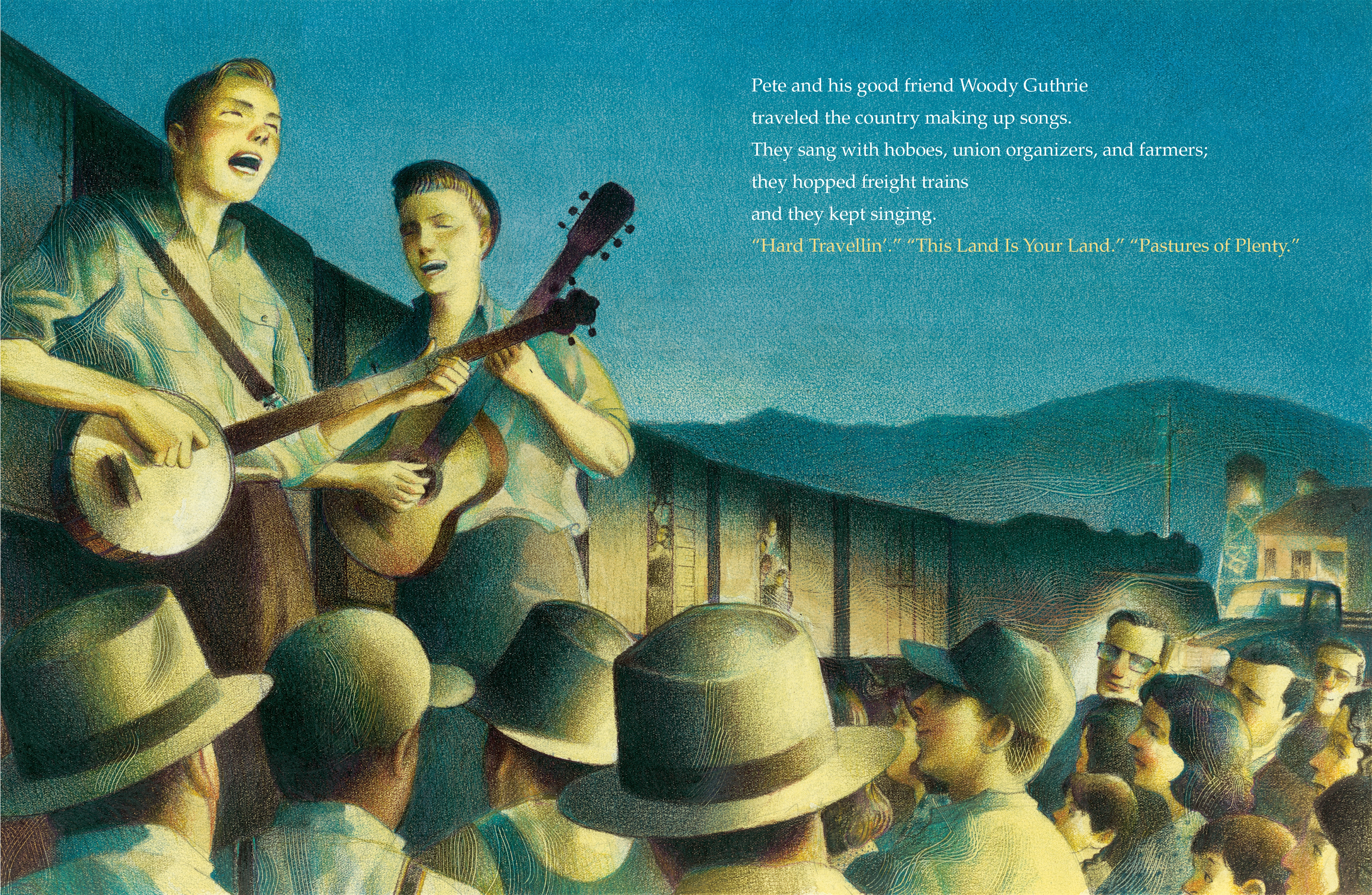
Ricki’s Review: Like Kellee, I didn’t know a lot about Pete Seeger until I read this book. I love reading texts that teach me more about a person. I didn’t realize that he traveled with Woody Guthrie! Too cool! Pete Seeger was a social activist, and his songs urge us to take action. This book will encourage readers to learn more about the singers that they listen to.

The author and illustrator bring great life to this book. It is very clear that they were inspired by his music, and the book truly comes alive. This is a book that teaches kids about an important man in our history and the power of music. It also reveals a lot of information about American History. I highly recommend this book to parents and teachers.

Teachers’ Tools for Navigation & Discussion Questions: A fabulous curriculum guide can be found here created by Leigh Courtney, Ph.D. and includes discussion questions and activities.

Example discussion questions:

  • Pete Seeger said, “Participation. That’s what’s gonna save the human race.” What do you think that means?
  • Pete Seeger found himself in trouble with the government at one point in his life. Which group questioned him? Why were they interested in him?
  • Encourage students to study the illustrations in Listen paying particular attention to the drawings of people in the story. Discuss what the people’s actions and expressions tell you about Pete Seeger’s impact on those who listened to his music.
  • Many view Pete Seeger as an American hero. Discuss why people might regard Seeger as an important figure in American history. Read aloud President Obama’s statement about Pete Seeger, made upon the musician’s death, found in the final timeline entry at the back of the book.

Some examples of activities include cause and effect, research, vocabulary, and some fun music activities.

Resources: Leda Schubert provides some great links to recordings and videos of Pete Seeger here.

Flagged Passages: 

Read This If You Love: Stand Up and Sing! by Suanna Reich, When Bob Met Woody by Gary Golio, Jimi: Sounds Like a Rainbow by Gary Golio

Recommended For: 

classroomlibrarybuttonsmall 

GIVEAWAY!

a Rafflecopter giveaway

Signatureand 

**Thank you to Barbara at Blue Slip Media for providing the book for review!**