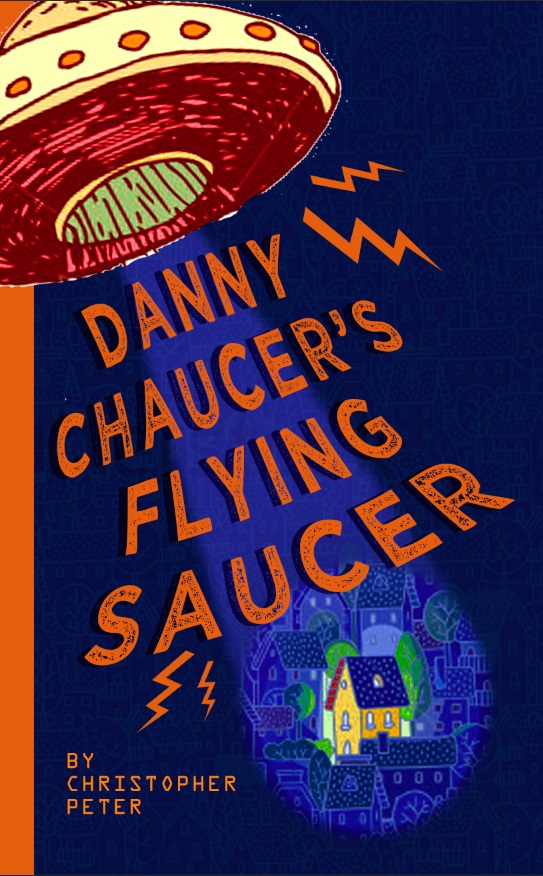
Author Guest Post: “Space: The Next Frontier in Children’s Books?” by Christopher Peter, Author of Danny Chaucer’s Flying Saucer

Share

“Space: The Next Frontier in Children’s Books?”

As a kid I loved science fiction. My imagination was fired by stories set in space, a place of boundless possibilities; tales of future worlds, stunning galaxies, brave human colonists, exotic aliens.

As I began writing the Danny Chaucer’s Flying Saucer series, I renewed my interest in all things space-y, particularly books aimed at 8-12-year-olds / middle grade. But sci-fi isn’t exactly in vogue in children’s literature right now, or at least not space-set books specifically. It got me thinking, why not?

Fashions come and go of course. But I also wonder whether it’s because, space-wise, the future turned out to be a bit of a, well, disappointment really. I mean, I’m too young to remember the Apollo moon missions of the 1960s and 1970s, but I did fall in love with books in the years soon after, and it was a time very much influenced by those heady lunar-treading days when anything seemed not only possible but also within imminent reach.

Look back at movies like 2001 and Blade Runner and TV shows like Space 1999. Back then, dates like 1999, 2001 – and certainly 2015 – seemed impossibly futuristic. Surely we’d have flying cars, moon bases, men on Mars, and charismatic yet slightly sinister AI computers by then, right? Well – um – not exactly … but hey, we do have very cool phones …

(And by the way, what happened to that army of robots that were supposed to gift us all carefree lives of leisure and pleasure??)

I’m not dismissing NASA by the way, nor the other research agencies and institutions with all their talented and dedicated people. Nor have I forgotten the space shuttle. And yes, space exploration is mind-numbingly expensive. It’s just that – I don’t know – as amazing as the International Space Station is, it’s not exactly a Martian colony. (And speaking of Mars, disappointingly it turned out not to be home to little green aliens after all.) I can’t help thinking the child of 1970 would be asking, ‘Is that it?’

And yet I believe things are changing. In 2019 we’ll be celebrating the 50th anniversary of Neil Armstrong’s historic first step on the moon, and we’ll be reminded again of what a galactically awesome achievement that really was (especially with 1960s technology!). Meanwhile there’s much excitement about a manned mission to Mars, with some even predicting it could happen in the next 10-15 years, with a permanent colony not long after.

The amazing pictures of Pluto recently sent back by the New Horizons probe have come after the steady stream of incredible images of deep space from the Hubble space telescope.

We’ve got the eagerly-awaited new Star Wars movie coming soon, and that’s following some pretty amazing sci-fi cinema in recent years – think Moon, Gravity, Ex Machina and Interstellar. Meanwhile sci-fi continues to thrive on the small screen too.

So why not children’s books?

The whole concept of space has the incredible ability to feed the imaginations of the young (and old). The possibilities are literally endless. We’ve already been to the moon and sent unmanned spacecraft to Mars and far beyond. What will the human race have achieved in another fifty years? A hundred? Five hundred?

And what about life on other worlds? Of course we haven’t come across aliens yet (or so we’re told …) but that mind-bending prospect remains.

Writing about space and sci-fi is also a brilliant opportunity to encourage kids’ interest in science. Space is an amazing, huge, fascinating place, about which we’re finding out more and more incredible things all the time. Just take a look at some of the dazzling Hubble images. Consider for example the famous picture of the Pillars of Creation in the Eagle Nebula. How dizzyingly huge it is, how unimaginably far away … and how it’s a place where stars are made! It’s almost beyond words (though I’ve had a crack at describing it in Danny Chaucer. I simply had to include it).

And of course (on a clear night at least) you can look up and see space for yourselves! Well part of it anyway.

I want kids today to discover the power of stories, especially boys who generally less inclined to read than girls and so may need more encouragement. And the 8-12 age group is a vitally important time for fostering a love of books, an age when children start to read more independently and develop their own tastes.

I wrote Danny Chaucer partly for my own sons, the older of whom is now 11 and hasn’t been getting into books very much. He doesn’t particularly like the fantasy, paranormal or dystopian themes which seem to dominate children’s fiction these days. He does however like science and gadgets and is into Doctor Who, so space is right up his street.

To finish, I’d like to highlight a small selection of kids’ sci-fi books – some old favourites, some new, but all have the power to launch young imaginations into the great beyond … all ideal for 8-12-year-olds, depending on reading ability, though the last two might be less suited to younger readers.

  • Doctor Who and the Daleks, by David Whitaker. A classic Who adventure, launching an ordinary man from his humdrum earth-bound existence to a distant alien world with distinctly unfriendly inhabitants. And if this goes down well, there are dozens of other Doctor Who books including a series aimed especially at younger readers (the Young Reader Adventures).
  • Cosmic, by Frank Cottrell Boyce. A young boy gets to go on a mission to the moon! Slightly slow build-up so it takes a long time to take off (literally), but it’s worth sticking with. The writing is great – funny and moving in places, with strong likeable characters. Quite educational too – the reader really gets a feel of what it would be like in space.
  • Jacob Wonderbar and the Cosmic Space Kapow, by Nathan Bransford. In contrast to Cosmic, this book makes no pretence to be educational, but it’s fun, fast-moving and wonderfully imaginative, and may appeal to younger readers in particular.
  • The Lotus Caves, by John Christopher. On the moon, two bored teenagers go off in a lunar rover and discover something amazing. A classic from a renowned YA sci-fi author.
  • Futuretrack 5, by Robert Westall. More YA (probably 11+ I’d say) with some adult themes, this is actually an earth-bound dystopian thriller, but I had to include it because it’s brilliant and by one of my all-time favourite authors. Dark, witty, compelling and with an unexpected ending.
  • Galactic Warlord, by Douglas Hill. Again, may be better for 10/11+ as there’s some violence, though nothing too gratuitous or graphic. I read this when I was about 10 and loved it. Set in distant space, a lone survivor of an attack on his planet broods and plans revenge … the first book in a series of five.

DCFS cover

Danny Chaucer’s Flying Saucer Summary:

One night Danny Chaucer, a lonely eleven-year-old boy, sees a strange light and hears odd sounds in his garden – and the next day there seems to be something there but he can’t quite see it. His Uncle Colin, who works at the mysterious Ganymede Institute, reveals that something top-secret has gone missing from there. Danny teams up with the new girl in his class, Nat Ford, to dodge the school bullies and investigate what’s going on. They encounter the sinister Captain Frost who is also on the trail of the mysterious missing object. Danny works out how to make the thing in his garden become visible, and it is revealed to be a flying saucer. Inside Danny and Nat meet the computer, BOB, who controls the saucer. Meanwhile Captain Frost is close to tracking down the saucer too, and she manages to get on board. They all take off and into space and then on a virtual reality journey to the Pillars of Creation in the distant reaches of the galaxy. Captain Frost intends to sell the saucer for her own profit, but Danny outwits her, and then the saucer terrifies the school bullies back on Earth. Finally BOB wipes Captain Frost’s memory to foil her plans, and then the saucer takes off leaving Danny and Nat to keep their adventure a secret.

Book Passage:

What would you do if a flying saucer landed outside your home?

Danny Chaucer is lonely. Life’s boring since his best friend moved away. Nat Ford is the new girl in class and spends half her time trying to dodge the school bullies.

Nothing interesting ever happens in their dead-end village. Nothing that is until one still, starry night when something lands in the trees behind Danny’s house. And then the sinister Captain Frost arrives…

There might be only one way to escape—and that’s up…


Christopher Peter author pic

About the Author: Christopher lives near Oxford, UK and is married with three children. He has always loved writing but only began to write more seriously after he turned 40 (a kind of mid-life crisis perhaps?). He self-published two YA novels (Falling Girl and BASIC Boy), before writing Danny Chaucer’s Flying Saucer. He has always leaned towards writing for children and teenagers because he feels strongly that good stories are very important to help the younger generation fall in love with the written word; this will enrich their whole lives; and also because he has such fond memories of the books he loved which shaped him when he was younger.

Thank you so much to Christopher for his reflections on space as the next frontier! 

RickiSigandSignature

Guest Post!: 20 Desserts Inspired by Your Favorite Books

Share
Nothing is as intriguing as a well-written novel—it can take you to a new adventure with each flip of a page. The detailed descriptions of scenery, relationships, characters and desserts! Yes, desserts! Can you imagine sitting at a table and drinking Harry Potter’s Butterbeer? Or a basket full of tea biscuits and jam inspired by Alice In Wonderland? Well, now you can.
Shari’s Berries created a visual that pairs 20 great books with iconic desserts from their pages. We hope these delicious treats inspire your next read and cooking adventure. 

Shari


Thank you to Shari’s Berries for the yummy pairings!

Signature andRickiSig

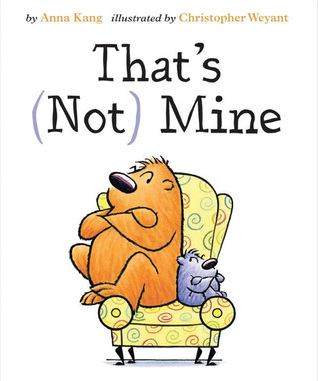
Review, Giveaway, and Author Guest Post! That’s (Not) Mine by Anna Kang, Illustrated by Christopher Weyant

Share

that's not mine

That’s (Not) Mine
Author: Anna Kang
Illustrator: Christopher Weyant
Published September 1st, 2015 by Two Lions

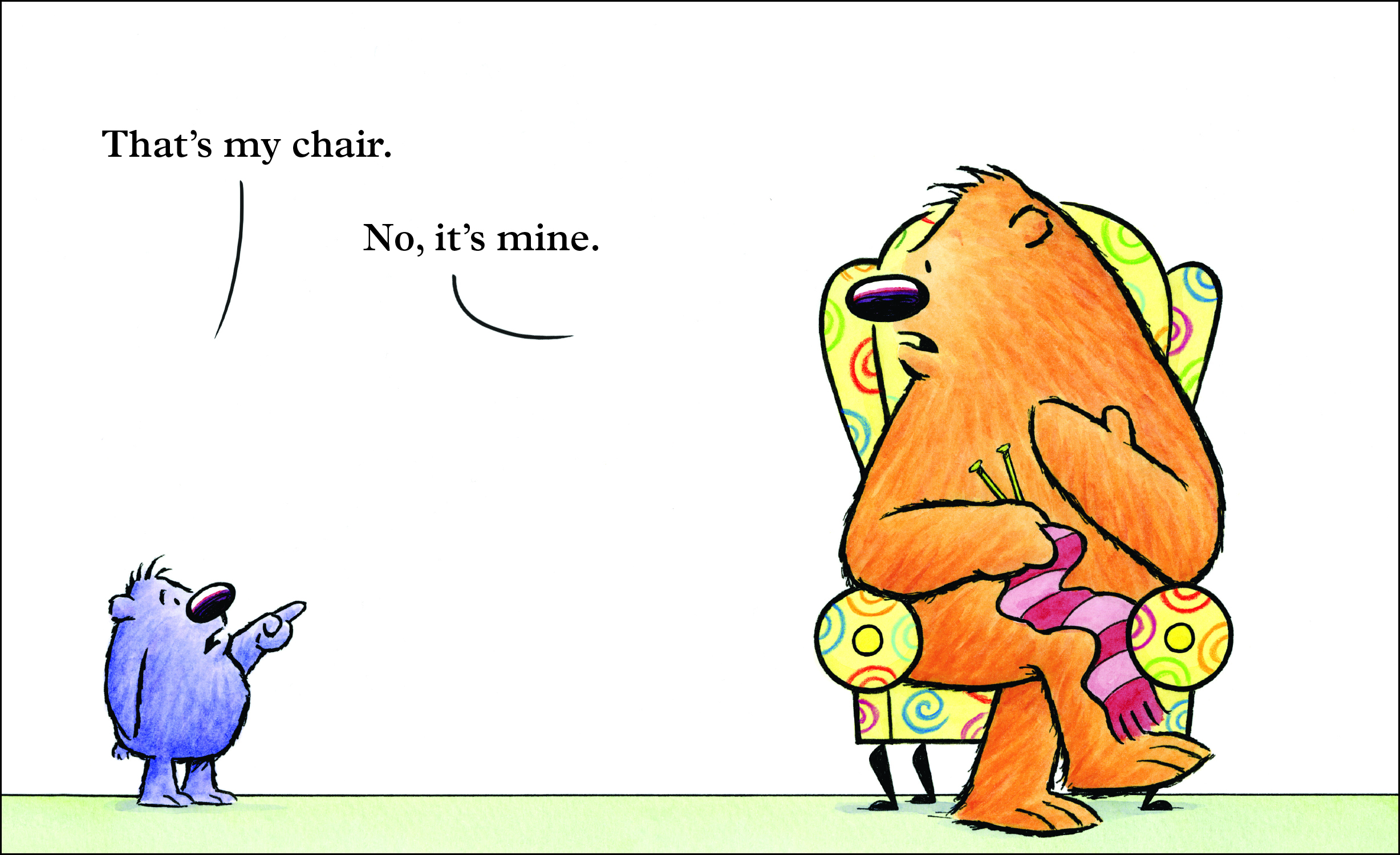
Goodreads Summary: Two fuzzy creatures both want to sit in the same comfy chair. The trouble is, they can’t agree who it belongs to. They get madder and madder, until…

With expressive illustrations and simple text, this giggle-inducing tale about (not) sharing and (not) being a good friend features the endearing characters from Theodor Seuss Geisel Award winner You Are (Not) Small.

Kellee’s Review: Our two fuzzy friends from You Are (Not) Small are at it again! Although they seem to be friends, every time we encounter them they seem to be having a disagreement that will definitely make their readers laugh. This text isn’t about identity and differences like the first text. Instead, it focuses more on sharing, friendship, wanting what others have, and also dealing with losing what you wanted. These are all really big (and tough!) lessons for kids. By sharing this book with your child or your class, it becomes a very entertaining way to talk about these issues and topics. 

Ricki’s Review: About three days before I received this book in the mail, my husband and I were discussing our concerns with our son’s new affinity for the word: “mine.” Like most toddlers, he has become obsessed with the concept that everything is “mine” (and by “mine,” I mean his). We don’t support this new “anti-sharing” movement that has become a hot topic in parenting groups and blogs. We want to raise our son to understand that, yes, some things can be his, but he should work hard to share as much as he can with others. I want to raise him to value his peers, respect adults, and give back to his community. So when this book came in the mail, I was extremely pleased. I read it aloud as my husband listened. His response? “This is the perfect book for him right now.” These two fuzzy creatures are teaching my son a lot of great lessons—it is okay for him to be short (my son’s destiny), and in this new text, not everything has to be “mine.” I am looking forward to the next installation from this husband-and-wife duo!

Teachers’ Tools for Navigation: Curriculum guide for That’s (Not) Mine

Sharing is a concept that goes beyond childhood. Teachers might facilitate a discussion about the different ways that sharing can relate to many contexts and situations in life—for people of all ages.

Discussion Questions: Why did each of the characters want the others’ chair?; Who do you think won in the end?; What type of friends do you think the two characters are?; Have you ever thought you wanted something, but then didn’t really want it once you got it?

We Flagged:

Kang-ThatsNotMine-interior_Illustration copyright © 2015 by Christopher Weyant

Read This If You Loved: You Are (Not) Small by Anna KangLady Pancake and Sir French Toast by Josh Funk, Your Alien by Tammi Sauer, The Pigeon Needs a Bath by Mo Willems, Elephant and Piggie books by Mo Willems

Recommended For:

readaloudbuttonsmall classroomlibrarybuttonsmall

Giveaway!

a Rafflecopter giveaway


Author and Illustrator’s Guest Post:

Our inspiration behind the book:

The inspiration behind THAT’S (NOT) MINE was growing up with my brother. As anyone with siblings will attest, we were forced to learn to how share almost everything with each other—food, toys, attention, space, and in the days before computers and smart phones, whose turn it was to choose the television show or radio station. Sharing is tough, even for adults, and I must admit, I was not good at sharing with my brother (sorry, Emil). Lucky for me, he was a really kind older brother and let me have my way more often than I deserved (thank you, Emil). Now that I have two daughters, I see them battle over the same things. I’ve realized that for a child, possessions are precious—they shape their identity. My kids and their friends will say that the “best” part of their day was that they “got a turn” playing with a certain toy or reading a favorite book at school, or that they were “first to use the best swing,” etc. And conversely, they will report how devastated they were because they “didn’t get a turn” with a coveted item. It requires a certain amount of emotional maturity to see someone else’s perspective and to let go of an object you value.

How we work collaboratively:

Anna: I write something, Chris reads it, gives me notes, we discuss the notes, I rewrite it, we discuss it again, and then when we both like the text, we discuss the illustrations and visual style. Chris begins to sketch some ideas, I give him feedback, he revises, and we discuss them again, etc. It is a constant back-and-forth collaboration. I’m very fortunate to have him as a sounding board.

Chris: One of the things I like most about our collaborative process is the ongoing conversation Anna and I have as the book goes from early concept to final art. Along the way, we will discuss what’s working and what could be stronger, continually making changes, large and small, until we feel the book is what we envisioned. Many times we’ll have a quick talk while doing the dishes or in the car. It feels like a very natural process that has become a part of our everyday lives.

About the Authors: Husband-and-wife team Anna Kang and Christopher Weyant are the creators of You Are (Not) Small, which won the Theodor Seuss Geisel Award and was named a Notable Children’s Book by the American Library Association. They live in New Jersey with their two daughters, Kate and Lily, a guinea pig named Athena, and a hermit crab named Olaf.

Anna, a native New Yorker, grew up believing everything was hers until one day she realized it was her brother’s, too. She received a master’s degree in fine arts from the USC School of Cinematic Arts, where the visual storyteller in her was awakened, forever changing the way she saw art, life, and everything in between. In addition to writing, Anna loves to read, travel, laugh, eat, and nap. Visit her online at www.annakang.com.

Christopher is a cartoonist and illustrator. His work can regularly be seen in the New Yorker. His cartoons are syndicated worldwide and have been featured on the Today Show, Meet the Press, and World News Tonight. Christopher likes to share everything but his personal space on the subway. Visit him online at www.christopherweyant.com.

Twitter: @annakang27     @chrisweyant05

Follow the Tour

Mon, Aug 31 Watch.Connect.Read. http://mrschureads.blogspot.com/
Tues, Sept 1
Happy book birthday!!!
Jean Little Library http://jeanlittlelibrary.blogspot.com/
Wed, Sept 2 Teach Mentor Texts http://www.teachmentortexts.com/#axzz3fo9y9pNf
Thurs, Sept 3 Kid Lit Frenzy http://www.kidlitfrenzy.com/
Fri, Sept 4 Unleashing Readers http://www.unleashingreaders.com/
Mon, Sept 7 The Children’s Book Review http://www.thechildrensbookreview.com/
Tues, Sept 8 proseandkahn http://proseandkahn.blogspot.com/
Wed, Sept 9 The Library Fanatic http://www.thelibraryfanatic.com/
Thurs, Sept 10 Sharpread https://sharpread.wordpress.com/
Fri, Sept 11 Bluestocking Thinking http://bluestockingthinking.blogspot.com/

  SignatureRickiSig

**Thank you to Barbara at Blue Slip Media for providing copies for review and to Anna and Chris for their guest post!!**

Extra Special Author Top Ten Tuesday!: Favorite Fictional Picture Book Educators by Josh Funk, Author of Lady Pancake and Sir French Toast

Share

top ten tuesday

Top Ten Tuesday is an original feature/weekly meme created at The Broke and the Bookish. The feature was created because The Broke and Bookish are particularly fond of lists (as are we!). Each week a new Top Ten list topic is given and bloggers can participate.

 Today’s Topic: Favorite Fictional Picture Book Educators

First off, I’d like to thank Kellee & Ricki for inviting me to guest post on my favorite of days, #TopTenTuesday (which coincides with release day for my debut picture book Lady Pancake & Sir French Toast – available NOW – finally!). I’d also like to thank them for allowing me to pick my own topic. As it’s the beginning of the school year, and Kellee and Ricki are two of my favorite educator-bloggers, I thought I’d share my favorite educators from picture books (just picture books … I know there are many fabulous educators in middle-grade and up, too).

In a very particular order…

1. Miss Lila Greer, Iggy Peck’s teacher in Iggy Peck, Architect (also, Rosie Revere’s teacher in Rosie Revere, Engineer) by Andrea Beaty & David Roberts

iggy peck Rosie Revere

Iggy Peck, Architect is one of four books that inspired me to be a writer. I can’t wait to see if Miss Lila Greer has any other students destined for greatness.

2. Vashti’s Teacher in The Dot by Peter H. Reynolds

the dot

One of the most inspirational teaching moments in picture book history, all stemming from one unnamed teacher’s dare.

3. Ms. Raymond, Ida’s teacher in Dotty by Erica S. Perl & Julia Denos

dotty

From The Dot to Dotty. In this great back to school book with the theme of giving up imaginary friends, Ms. Raymond will surprise you.

4. Mrs. Delphinium Twinkle, Chrysanthemum’s teacher in Chrysanthemum by Kevin Henkes

Chrysanthemum

I waffled between Mrs. Twinkle and Mr. Slinger (of Lily’s Purple Plastic Purse), but ultimately, the name put her over the top. (I’ve read enough #TopTenTuesday posts to know how to cheat and get more than 10 in, too, Kellee & Ricki … hee hee)

5. Tortoise in Back to School Tortoise by Lucy M. George & Merel Eyckerman

back to school tortoise

So, I just ruined the twist ending, but this one is adorable.

6. Miss Kirby, Bobby’s teacher in My Teacher Is a Monster (No I am Not) by Peter Brown

my teacher

I’ve been a huge fan of Peter Brown since I first encountered The Curious Garden, and the relationship between Bobby and Miss Kirby is hilarious.

7. Mrs. Quirk, from My Teacher’s Secret Life by Stephen Krensky & JoAnn Adinolfi

my teacher's secret life

Before teachers were monsters, they lived in school with all the other teachers, of course.

8. Mr. Falker, Trisha’s teacher in Thank You, Mr. Falker by Patricia Polacco

Thank you Mr.

While it’s semi-autobiographical, it’s technically fiction. And wow is it emotional!

9. David’s teacher in David Goes to School by David Shannon

david goes to school

Anyone that can give a child like David a star after a day like that deserves about 5 million stars.

10. Miss Viola Swamp, Miss Nelson’s substitute in Miss Nelson Is Missing! by Harry Allard & James Marshall

miss nelson

No list of fictional picture book teachers would be complete without an entry from Harry Allard and James Marshall’s Miss Nelson series. For some reason, I’ve always had a love-hate relationship with Miss Swamp. Yes, I’m afraid of her, but there’s just something about her that works for me…

Who are your favorite fictional picture book educators?

(and thanks again to Kellee & Ricki for letting me celebrate with them today)

About the Author: Josh Funk is the author of Lady Pancake & Sir French Toast (Sterling) which releases TODAY, September 1, 2015.

lady pancake and Sir

Josh is also the author of the forthcoming picture books Dear Dragon (Viking/Penguin 2016), Pirasaurs! (Scholastic 2017), & more. Josh was born and raised in Boston and graduated from UMass Amherst with a degree in Computer Science. When not writing Java code or Python scripts, he drinks Java coffee and writes picture book manuscripts, alongside his wife, children, and assorted pets & monsters. Josh is a board member of The Writers’ Loft in Sherborn, MA and the co-coordinator of the 2016 and 2017 New England Regional SCBWI Conferences. Find out more about Josh, his books, his schedule for public appearances, and more at www.joshfunkbooks.com and on twitter at @joshfunkbooks.

Thank you Josh for your guest list! We loved hosting you!

RickiSig and Signature

Author Guest Post and Giveaway!: “Why We Still Need Coming Out Stories in YA Fiction” by Emily O’Beirne, Author of A Story of Now

Share

“Why We Still Need Coming Out Stories in YA Fiction”

A friend of mine recently complained that the LGBT literary market seems to be dominated by coming out stories. “Why do all the gay stories have to be about people coming to terms with their sexual identity?” she asked. This focus is limiting and narrow, she argues.

I have seen this sentiment in many Goodreads reviews of LGBT stories, too, ya fiction included. And I see the point. I do. It is based in the argument that as much as we need diversity in the kinds of people we tell stories about, we also need diversity in the kinds of stories we tell about them. In this modern and increasingly tolerant world there should now be a place for books where the sexuality of gay characters need not be the focus of the story, but simply an element of character.

Sure, that sounds great, but coming from the perspective of someone who both teaches and writes for young people, I would argue (and did) that coming out narratives still have a vital role in the realm of ya fiction. And it doesn’t surprise me that those arguing for less focus on coming out stories on Goodreads are often adult readers and reviewers of ya fiction, not the primary audience.

I think we’d be pretty misguided to think we are living in a world so progressive that stories about realizing your sexuality aren’t still vital for young people who are in the process of discovering who they are. Because that’s growing up, isn’t it? It’s the experience of becoming yourself in the world. And it is a time when questions of your sexual identity have suddenly become psychologically and hormonally urgent.

Coming out stories give ya readers an opportunity to see how other young people negotiate these uncertain terrains, and to give perspective to an experience they are going through. And as anyone who has been through the war zone that is puberty can attest, it’s hard enough to go through the uncertainty of adolescence. But it’s even harder to discover you are different from most of those around you. And if you are gay, that is statistically likely to be the case. And difference, sadly, must always be made known, and it is always there to be noticed.

As a young gay person, you are asked to recognise and announce yourself in terms of your difference from others, and at a time of life when there is so much pressure to socially conform. For some this is difficult and stories about negotiating and surviving these pressures are vital. For example, in Kelly Quindlen’s Her Name in the Sky, Hanna and Baker both try to ignore their feelings for each other in order to conform to their religious and heteronormative environment, but ultimately realise they cannot. They slowly discover they do not need to fit into tightly prescribed social categories to be accepted and happy.

Coming out is also a jarringly public process. Few heterosexual girls will ever have to announce, ‘Hey, I’ve decided I want to make out with boys!’ In fact, it’s expected. But if it’s a teenage boy, he’s probably going to have to say it out aloud at least once. For some young people, the scrutiny this declaration invites can be awkward. For example, in A Story of Now, Mia is not uncomfortable about realising she is gay, but with the fact that her newfound identity is something she must announce to the world, rendering her private life immediately public.

Another point where I think my friend has really missed the importance of coming out stories is that coming out is as much about coming out to yourself as it is to the world. Coming out is also about a person figuring out who they mean when they say ‘I’, and where this places them in the world.

For some young gay people, accepting and embracing their sexual identity can be the most difficult part of coming out. A perfect example of a story that sympathetically depicts this struggle is A.S. King’s Ask the Passengers. For the reader, it might seem like the job of coming out is half-done at the start of the novel: Astrid has a girlfriend and she has gay friends. But Astrid is not yet ready to accept who she might be. And while everyone around her tries to push her toward certainty, she stubbornly takes her own sweet time to come to terms with her sexual identity.

How can books that shows readers how negotiate these experiences not just be good, but be necessary? George Gerbner describes storytelling as the process that makes us recognize ourselves. And as ya writers it remains our responsibility to pass down the kind of stories where young people have the opportunity to think, ‘Hey I feel like that too.’ We do this so they can recognize themselves at a crucial time in their lives. It. So I am sorry, my friend, you are wrong. There is one domain at least where coming out stories are still sorely needed.


a story of now

A Story of Now

About the Book: Nineteen-year-old Claire Pearson knows she needs a life. And some new friends. But brittle, beautiful, and just a little bit too sassy for her own good sometimes, she no longer makes friends easily. And she has no clue where to start on the whole finding a life front, either. Not after a confidence-shattering year dogged by bad break-ups, friends who have become strangers, and her constant failure to meet her parents sky-high expectations.

When Robbie and Mia walk into Claire’s work they seem the least likely people to help her find a life. But despite Claire’s initial attempts to alienate them, an unexpected new friendship develops.

And it’s the warm, brilliant Mia who seems to get Claire like no one has before. Soon, Claire begins to question her feelings for her new friend.

Author’s Note: The characters are university aged and thus the story contains elements like drinking and mild sexual content.

a Rafflecopter giveaway

About Emily O’Beirne

Author website: http://emilyobeirne.com/

Goodreads: https://www.goodreads.com/author/show/13543645.Emily_O_Beirne

Tumblr: http://it-used-to-be-fun.tumblr.com/

Excerpt of A Story of Now: http://emilyobeirne.com/2015/06/18/excerpt-a-story-of-now/


 Thank you so much to Emily for allowing us to host this giveaway and for writing about something we genuinely believe in. 

RickiSig and Signature

Author Guest Post: “When Things Aren’t Perfect” by Laurie McKay, Author of The Last Dragon Charmer Series

Share

“When Things Aren’t Perfect”

A long time ago, in this galaxy and not so far away, I was in an English class. My teacher returned my paper and there was a blue ninety-nine scribbled on the top corner. I looked over my work to see where I lost that one point, and found no marks, no grammatical mistakes, no misspelled words. So, of course, I asked about it.

My teacher raised her brows and told me, “Writing can’t be perfect.”

Well. Isn’t that the entire problem right there? If writing is never perfect, when is it good enough?

After working on my debut novel Villain Keeper, I found that it was good enough for the publisher after three content edits, one copy edit, and at least one proof pages pass. And these by no means were the first revisions I’d done.

When my agent first sold the book series to HarperCollins, I’d already revised book one myself over and over again. Also, my critique partners (from here on known as my mom and my sister) had made suggestions and my agent had given me feedback, all of which I’d applied.

What surprised me the most, however, was how much better the book became after listening to each person’s (my mom’s, my sister’s, my agent’s, my editor’s) critiques, reading their comments, and thinking – with as open a mind as possible – about those editorial suggestions.

Somewhere in the midst of all these revisions, my manuscript got in pretty good shape. I was proud of it at least. It still benefited from additional revisions.

This has changed the way I view criticism. Instead of thinking of it as censure, I think of it as analysis. It’s not meant to condemn my work, it’s meant to benefit it.

There is this phrase I see on writing sites sometimes:

Give yourself permission to write badly.

Or, as I prefer it, Give yourself permission to write not good – at least at first.

It helps me when I get stuck. I remind myself it’s alright for things not to be perfect. I’ve got to start somewhere. Write something down. Practice. Revise. Get feedback. Then write some more. I try not to put the pressure of instant perfection on myself. It’s counterproductive. The idea is to first get something written.

Nora Roberts once said, “I can fix a bad page, I can’t fix a blank one.” She’s written over two hundred books in thirty years. That’s an astounding six to seven novels per year.  She’s a NY Times bestselling author. She still has to give herself permission to write bad pages and fix them.

When it comes to fixing pages, I’ve probably applied about ninety percent of feedback I’ve received on my writing. But not all criticisms are equal.

There is another quote, this one attributed to Neil Gaiman, which inspires me when it comes to sorting good criticism from not-so-good criticism. He said, “Remember: when people tell you something’s wrong or doesn’t work for them, they are almost always right. When they tell you exactly what they think is wrong and how to fix it, they are almost always wrong.”

With my mom and sister, my agent, and my editor, the criticism I’ve gotten has been overwhelmingly wonderful. Writing is subjective, though. Occasionally, I don’t agree with them. When that happens, I make myself consider their opinion as carefully as possible. Sometimes, I decide they’re right. Their suggestion is better than what I have. Other times, I decide they’re not, and that’s okay.

When I see the results of applying those analyses and suggestions, I’m wowed. And appreciative. It’s probably important to note, giving good feedback is hard work, too.

I’m also a teacher. I’ve taught some combination of biology, chemistry, and math for the last ten years. Many of my students are like I was. They don’t want a mark of ninety-nine. They want a perfect hundred. They often don’t want to revise, either. And I understand. It’s almost like they think if it needs improvement, it’s a failure. Or, if they think it’s good already, it can’t be improved.

But I think it’s a better idea to think of writing not in terms of ‘good’ and ‘bad’, but it terms of a ‘work-in-progress’.  The goal isn’t to hit perfection. It’s to hone skills. Improve. And criticism and revision are essential. They are part of the process. Once I’ve been over the same piece of work many times, there comes a point where I decide I’m happy with it, and move on to the next thing.

I just finished editing the second book Quest Maker in my series. I went through several rounds of feedback and revisions on it as well. I hope, and believe, my skills keep improving. I’m happy with book two, too.

Besides, there is something wonderful about always having room for improvement, always having something to strive for. Who knows? Maybe that was what my English teacher was trying to tell me way back when with that blue ninety-nine.

VillainKeeperLastDragon_CVR

Villain Keeper Summary: All his life, Prince Caden has dreamed of slaying a dragon. But before he has the chance, he is ripped from his home in the Great Winterlands of Razzon and finds himself in Asheville, North Carolina—a land with no magic and no dragons.

Or so he thinks. The longer Caden spends in Asheville, the more he comes to realize that there is unexpected and dangerous magic in this strange land. There just may be dragons here, too. But what if Caden’s destiny isn’t to slay a dragon, after all?

Quest Maker Cover

Quest Maker (Book 2)
Expected Publication February 2nd, 2016 by HarperCollins

About the Author: Laurie McKay is an author and biology instructor who lives in Durham, NC. When she’s not working, she spends time with her family and her two elderly dogs. Her debut MG fantasy novel, VILLAIN KEEPER (The Last Dragon Charmer #1), is available now, and her second book QUEST MAKER (The Last Dragon Charmer #2) will be available Feb. 2, 2016. To learn more about her or to see pictures of her dogs (and her family) follow her at lauriemckay.net or on Twitter or Facebook. You can find her book at GoodreadsIndieboundAmazonBN, and wherever books are sold.

Thank you so much to Laurie for her reflections on revision and critique! Such a great lesson for students (and adult writers!)

Signature andRickiSig

Author Guest Post!: “In This Place: An Imagery Writing Activity” by Kate Ormand, Author of The Wanderers

Share

“In This Place…” 

Exploring the five senses allows your reader to feel like they’re there inside your story. Expanding from visual description by bringing in other senses adds layers and makes it more real. Readers can relate more to the atmosphere of a place if relatable description is given.

Obviously, this can be overwhelming if done too much, but small details really make a scene, so this is a task I like to set myself sometimes:

In this place, I see…
In this place, I touch…
In this place, I smell…
In this place, I hear…
In this place, I taste…

I got the original exercise from ACID author, Emma Pass, who uses it in her writing workshops.

The Wanderers is set in a circus environment, which is so much fun to explore in this way. Here are some quotes from the book that support each of these, which started off as notes alongside the prompts:

In this place, I see… The sparkly blue bows around their necks catch the light, dazzling. Well, they’re supposed to dazzle. And maybe they would if everything wasn’t so cheap.

In this place, I touch… Outside, it’s more plastic and crinkles when I touch it.

In this place, I smell… The smell of hot pastry and the tang of ale fills the air, adding to the comfort.

In this place, I hear… The sound of cellos pours softly from the speakers, so low that I can hear the rustling of popcorn bags and hot dog wrappers coming from the audience.

In this place, I taste… The smell of grease and salt and so many bodies packed into the tent is overwhelming. I can almost taste it on my tongue.

Thanks so much for having me!

kate ormandtw

About the author: Kate Ormand is YA author of DARK DAYS and THE WANDERERS. She lives in the UK with her family, her partner, and a cocker spaniel called Freddie. She graduated from university with a first class degree in Fine Art Painting. It was during this course that Kate discovered her love of reading YA books, prompting her to try a new creative angle and experiment with writing. Kate is also member and co-creator of an online group of published writers and illustrators called Author Allsorts. And she writes children’s picture books under the name Kate Louise. Kate is represented by Isabel Atherton at Creative Authors Ltd. You can see more about Kate and her writing by visiting her website (www.kateormand.wordpress.com) or on Twitter (@kateormand).

wanderers
Expected publication: September 1st, 2015 by Sky Pony Press

About The Wanderers: Flo lives an eccentric life—she travels with a popular circus in which the main acts star orphaned children with secret shape-shifting abilities. Once Flo turns sixteen, she must perform, but she’s not ready. While practicing jumping a flaming hurdle in a clearing beside the circus, she spots a dark figure in the trees and fears he saw her shift. The news sends the circus into a panic.

In Flo’s world, shifters are unknown to humans with the exception of a secret organization—the EOS, referred to as “hunters.” Hunters capture and kill. They send some shifters to labs for observation and testing—testing they don’t often survive—and deem others useless, a danger to society, and eliminate them. To avoid discovery, shifters travel in packs, constantly moving and keeping themselves hidden. Up until now, the circus was the perfect disguise.

Believing she has brought attention to the group, Flo feels dread and anxiety, causing her to make a mistake during her performance in front of the audience—a mistake that triggers a violent attack from the hunters.

Flo manages to flee the torched circus grounds with Jett, the bear shifter who loves her; the annoying elephant triplets; and a bratty tiger named Pru. Together they begin a new journey, alone in a world they don’t understand and don’t know how to navigate. On the run, they unravel secrets and lies that surround the circus and their lives—secrets and lies that all point to the unthinkable: Have they been betrayed by the people they trusted most?

Thank you to Kate for her post! What a great activity to expand the imagery in writing!

Signature andRickiSig

**Thank you to Cheryl at Skyhorse Publishing for connecting us!**