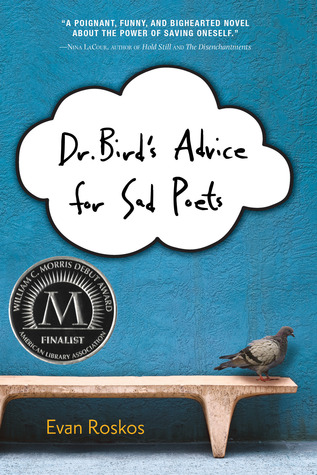
Dr. Bird’s Advice for Sad Poets by Evan Roskos

Share

dr bird's advice for sad poets

Dr. Bird’s Advice for Sad Poets
Author: Evan Roskos
Published: March 5, 2013 by Houghton Mifflin Harcourt

Summary: “I hate myself but I love Walt Whitman, the kook. Always positive. I need to be more positive, so I wake myself up every morning with a song of myself.” 

Sixteen-year-old James Whitman has been yawping (à la Whitman) at his abusive father ever since he kicked his beloved older sister, Jorie, out of the house. James’s painful struggle with anxiety and depression—along with his ongoing quest to understand what led to his self-destructive sister’s exile—make for a heart-rending read, but his wild, exuberant Whitmanization of the world and keen sense of humor keep this emotionally charged debut novel buoyant.

Ricki’s Review: Dr. Bird’s Advice for Sad Poets is such an important book. It captures depression and anxiety in a way that is both authentic and heart-wrenching at the same time. I wanted to reach into the pages of the book to give James a big hug. Similarly to It’s Kind of a Funny Story by Ned Vizzini, this book employs humor without detracting from the very realness of James’ struggles with loneliness and isolation. Teens (and adults) will find themselves in James because he is depicted in a sympathetic way that is very human. This novel is brilliant and should be in every classroom library.

Kellee’s Review: I concur with everything that Ricki said. Dr. Bird’s is a very special book. On a Top Ten Tuesday list, I wrote that I wished there were more books about kids with chemical imbalances, and Dr. Bird’s is the closest I’ve read yetEvan Roskos captures the feeling of a manic depressive state. The energy of the writing actually changes as James’s state of mind changes: anxious, manic, depressed. However, what makes it truly special is that even in the end, there is optimism. Although James is fighting his own chemical imbalance, he keeps doing just that—fighting.

Another thing I adored about this book is the idea of art and writing as therapy. James finds solace in photography and poetry, which is a positive lesson for teens because it shows the power of art, writing, and poetry.

Teacher’s Tools for Navigation: It would be interesting for teachers to do literature circles with texts that concern mental health. Students might read this book along with titles like: Forgive Me, Leonard Peacock by Matthew Quick, It’s Kind of a Funny Story by Ned Vizzini, The Perks of Being a Wallflower by Stephen Chbosky, Twisted by Laurie Halse Anderson, Everybody Sees the Ants by A.S. King, and 13 Reasons Why by Jay Asher. I imagine that reading these titles would foster incredibly rich discussions about depression, anxiety, and suicide. In my opinion, we must have these conversations with our students.

Also, Walt Whitman is a huge part of James’s life, and Whitman is mentioned throughout the book. The Whitman references (and James’s poetry emulating Whitman) would great to be examined in a classroom.

Discussion Questions: If James didn’t have abusive parents, do you think his life would be the same? Do you think depression is genetic in his family?; How does James show bravery?; What role does Walt Whitman play in James’ life?

We Flagged: “People in the world suffer from greater calamities than I do. I eat, I have clothes, I have a house. I read about people around the world who survive on less than a dollar a day. I read about how there are hundreds of millions of widows living in poverty. I see ads for kids who are born with ragged lips and jagged teeth. I don’t have anything like that. I just wake up with a deep hatred of myself. How selfish is that?” (p. 115)

“Later, as my father drives me to the pizzeria, his gassy, grumpy body reeking of judgment and anger and disappointment, I can’t help but wonder how little he knows about the depth of my sadness. The depth of my very being. Will he be upset to find me dead, or relieved?” (p. 214)

Read This If You Loved: (Many of these are listed above.) Forgive Me, Leonard Peacock by Matthew Quick, It’s Kind of a Funny Story by Ned Vizzini, The Perks of Being a Wallflower by Stephen Chbosky, Twisted by Laurie Halse Anderson, Everybody Sees the Ants by A.S. King, Reality Boy by A.S. King, Dear Life, You Suck by Scott Blagden, 13 Reasons Why by Jay Asher, Leaves of Grass by Walt Whitman

Recommended For:

 closereadinganalysisbuttonsmall litcirclesbuttonsmall classroomlibrarybuttonsmall

RickiSig andSignature

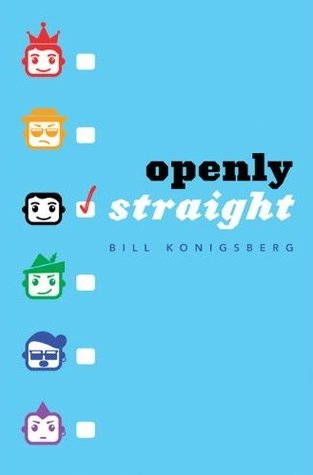
Openly Straight by Bill Konigsberg

Share

openly

Openly Straight
Author: Bill Konigsberg
Published May 28th, 2013 by Arthur A. Levine Books

Goodreads Summary: A funny, honest novel about being out, being proud . . . and being ready for something else.

Rafe is a normal teenager from Boulder, Colorado. He plays soccer. He’s won skiing prizes. He likes to write.

And, oh yeah, he’s gay. He’s been out since 8th grade, and he isn’t teased, and he goes to other high schools and talks about tolerance and stuff. And while that’s important, all Rafe really wants is to just be a regular guy. Not that GAY guy. To have it be a part of who he is, but not the headline, every single time.

So when he transfers to an all-boys’ boarding school in New England, he decides to keep his sexuality a secret — not so much going back in the closet as starting over with a clean slate. But then he sees a classmate breaking down. He meets a teacher who challenges him to write his story. And most of all, he falls in love with Ben . . . who doesn’t even know that love is possible.

This witty, smart, coming-out-again story will appeal to gay and straight kids alike as they watch Rafe navigate being different, fitting in, and what it means to be himself

Review and Teachers’ Guide to Navigation: This is such a great book! It is written well, very funny, smart, and has an important theme. What blew me away the most is how it was so humorous when dealing with a tough subject, but never lost its maturity and importance. Sometimes if you add humor to a novel, it becomes slap stick or more of a novelty, but Bill Konigsberg does it perfectly in Openly Straight.

As a teacher, what I immediately find myself connecting to was the journal entries from Rafe followed by Mr. Scarborough responses. Mr. Scarbourgh becomes quite an important person in Rafe’s life, and I feel that only through these journals, reflections, and responses that Rafe was able to make it at the new school. I think much of what Mr. Scarborough does with Rafe could be transferred directly into most classrooms.

Discussion Questions: Why did Rafe feel like he needed to hide who he was?; Have you ever felt like you couldn’t be who you really are?; How does Mr. Scarborough play a role in Rafe’s life?; How would you react if you were Ben?

We Flagged: “‘It’s hard to be different,’ Scarborough said. ‘And perhaps the best answer is not to tolerate differences, not even to accept them. But to celebrate them. Maybe then those who are different would feel more loved, and less, well, tolerated.'”

Read This If You Loved: Paper Towns by John Green, The Beginning of Everything by Robyn Schneider, Two Boys Kissing by David Leviathan, Will Grayson, Will Grayson by John Green and David Leviathan, Life in Outer Space by Melissa Kiel

Recommended For: 

readaloudbuttonsmall closereadinganalysisbuttonsmall classroomlibrarybuttonsmall

Signature

Top Ten Tuesday: Top Ten Favorite Classics AND Top Ten Classics We Want To Read

Share

top ten tuesday

Top Ten Tuesday is an original feature/weekly meme created at The Broke and the Bookish. The feature was created because The Broke and Bookish are particularly fond of lists (as are we!). Each week a new Top Ten list topic is given and bloggers can participate.

 Today’s Topic: Top Ten Favorite Classics AND Top Ten Classics We Want To Read

Ricki

Favorites

1. To Kill a Mockingbird by Harper Lee

This is my all-time favorite book. I read it as a freshman in high school and thought it was okay. When I reread it as an adult, I fell in love with it. I made my dad read it, and he was just as enamored with the book.

2. Of Mice and Men by John Steinbeck

I love all things John Steinbeck. This is my favorite classic to teach. My students and I read it like a play, and they love it.

3. Wuthering Heights by Emily Brontë

This book takes me to a different land. It is beautiful. I own an old copy with illustrations. As I write about the book right now, I am compelled to reread it.

4. 1984 by George Orwell

1984 is an incredible book to teach. It took awhile for my students to get into it, but they really enjoyed it once they got over the initial hump. This book is a winner (and there are so many modern-day connections for students to appreciate).

5. One Flew Over the Cuckoo’s Nest by Ken Kesey

I read this book the summer before college. I was blown away by how good it was. This is a classic worth reading.

Want to Read

1. Pride and Prejudice by Jane Austen

I am embarrassed that I haven’t read this book yet! I love all of the movies. I know that doesn’t count!

2. East of Eden by John Steinbeck

This book has been on my to-read list for a very long time. I think I own three copies of it.

3. Frankenstein by Mary Shelley

I’d love to read this text. I opened the first few pages during a break in my teaching schedule, but somehow, I lost the copy.

4. Catch-22 by Joseph Heller

This is a book that I probably won’t enjoy, but I would love to try it out.

5. Beloved by Toni Morrison

I read The Bluest Eye as a freshman in high school (and was very confused), and then when I had the option to see the play, I ordered copies of it. I enjoyed it so much that I ended up teaching it the following year.


Kellee

Favorites

1. Hemingway’s Sun Also Rises, Old Man and the Sea, and A Farewell to Arms

I love how Hemingway writes! And although I haven’t read everything by him yet, everything I have read I thoroughly enjoy.

2. Siddhartha by Hermann Hesse

This is a book that truly makes you look at the world differently.

3. To Kill a Mockingbird by Harper Lee

Perfection. The courtroom scene will never leave me. And if you haven’t listened to the audio book, it is a must. Sissy Spacek is amazing.

4. Of Mice and Men by John Steinbeck

This is such a powerful novel. And the ending! Wow. It is also an amazing audio book read by Gary Sinise.

5. Fahrenheit 451 by Ray Bradbury

One of the first dystopians and a frightening and scary world it is.

Want to Read

1. Catch-22 by Joseph Heller

I want to see where the phrase came from. Also, I have heard it is quite enjoyable.

2. 1984 by George Orwell

I have started this book a handful of times, and I. Am. Going. To. Finish. It!

3. Lord of the Flies by William Golding

Too often this is brought up, and I haven’t read it.

4. Grapes of Wrath by John Steinbeck

Everyone’s favorite, and I am enthralled with the Dust Bowl.

5. One Flew Over the Cuckoo’s Nest by Ken Kesey

The premise just seems like it is going to be fun to read.

What classics are your favorite?
What classics do you still want to read?

Signatureand RickiSig