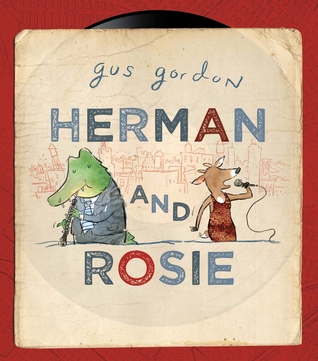
Herman and Rosie by Gus Gordon

Share

herman

Herman and Rosie
Author and Illustrator: Gus Gordon
Published October 15th, 2013 by Roaring Brook Press

Goodreads Summary: Once upon a time in a very busy city, on a very busy street, in two very small apartments, lived…
 Herman and Rosie. Herman liked playing the oboe, the smell of hot dogs in the winter, and watching films about the ocean. Rosie liked pancakes, listening to old jazz records, and watching films about the ocean. They both loved the groovy rhythm of the city, but sometimes the bustling crowds and constant motion left them lonely, until one night …

My Review: This book is a love note to music and for finding a friend to share your love. This wonderful story is told in a way that makes you fall in love with the characters immediately and feel every up and down with them. Also, the illustrations in this picture book are probably some of my favorite ever. I love the cartoony style mixed with some mixed media. Beautiful.

Teachers’ Tools for Navigation: I think this book will find its most love as a read aloud and as a wait to promote music and other passions; however, the book could definitely be used in other ways in the classroom. The tone and mood of the book takes a drastic turn about halfway through and would be a good introduction to these two narrative elements. It is interesting to look at how the illustrations helped drive the change. Also, there are onomatopoeias throughout that add to the imagery of the book.

Discussion Questions: How does music bring Herman and Rosie together?; Would Herman and Rosie every had become friends without the bad event happening to them?; How are Herman and Rosie similar? Different?

We Flagged: 

“Herman lived on the seventh floor. He liked potted plants, playing the oboe, wild boysenberry yogurt, the smell of hot dogs in the winter, and watching films about the ocean.”

Read This If You Loved: Marvin Makes Music by Marvin Hamlisch, Jazz ABZ by Wynton Marsalis, Ella Fitzgerald and Duke Ellington by Andrea Davis Pinkney, The Fantastic Undersea Life of Jacque Cousteau by Dan Yaccarino

Recommended For: 

readaloudbuttonsmall classroomlibrarybuttonsmall

Signature

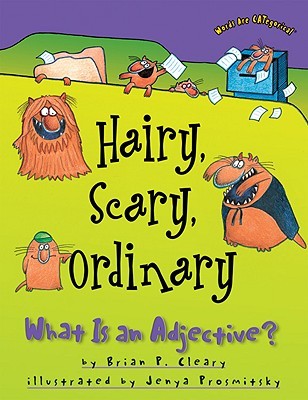
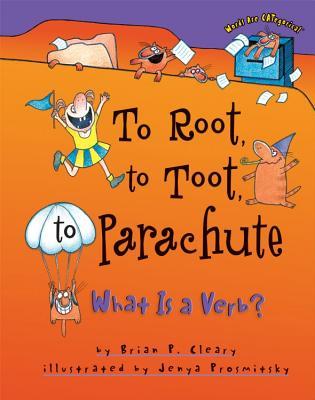
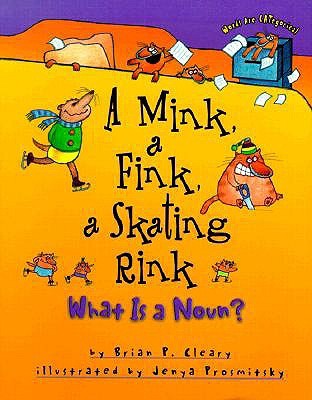
Hairy, Scary, Ordinary; To Root, to Toot, to Parachute; & A Mink, a Fink, a Skating Rink by Brian P. Cleary

Share

NF PB 2014

Nonfiction Picture Book Wednesday

Nonfiction Picture Book Wednesday is hosted by Kid Lit Frenzy and was started to help promote the reading of nonfiction texts. Most Wednesdays, we will be participating and will review a nonfiction text (though it may not always be a picture book).
Be sure to visit Kid Lit Frenzy and see what other nonfiction books are shared this week!

adjective verb noun

Hairy, Scary, Ordinary: What Is an Adjective? 
Published September 1st, 2001 by Carolrhoda Books

To Root, to Toot, to Parachute: What Is a Verb? 
Published April 1st, 2001 by Carolrhoda Books

A Mink, a Rink, a Skating Rink: What Is a Noun?
Published September 1st, 1999 by Lerner Publishing Group

Author: Brian P. Cleary
Illustrator: Jenya Prosmitsky

Hairy, Scary, Ordinary Goodreads Summary: Simple, rhyming text and colorful cartoon cats help children expand their vocabularies and gain an appreciation for the rhythm of language in this lighthearted book of rhyming verse. Adjectives like frilly, silly, polka-dotted, fizzy, and spunky are printed in color, and all the words will tickle you pink!

To Root, to Toot, to Parachute Goodreads Summary: What is a verb? It’s easier to show than explain! In this fun and animated introduction to grammer, rhyming verse is used to creatively clarify the concept of verbs. Chock-full of colorful, lively examples, the playful rhymes and illustrations of comical cartoon cats combine to hightlight key words in the sentences. Verbs like toss and tumble, jump and jam, jog and juggle, jig and leap are printed in color for easy identification.

A Mink, a Fink, a Skating Rink Goodreads Summary: “Words are Categorical” is a series which explores some of the basic principles of English grammar in a fun way. The books each deal with a different part of language, using playful and ingenious rhymes to make them easy to remember. In “What is a Noun?” children are introduced to one of the essential building blocks of the English language. It includes sections on both common and proper nouns. The nouns are highlighted in color to make them easy to identify.

My Review and Teachers’ Tools for Navigation: Teaching parts of speech is one of the hardest things to teach students, and it is even harder to teach them in a fun and interesting way. These books make it so that both of these things are possible. I like that each of the books focuses on only one part of speech instead of trying to teach multiple grammatical concepts thus making the chance of mastery much more likely. I also found the rhyming and silliness of the books just so endearing, and it would definitely help with the knowledge sticking.

Discussion Questions: What is a noun/adjective/verb? What are some examples? What are some nouns/adjectives/verbs that rhyme with each other?

We Flagged: 
Hairy, Scary, Ordinary: “Adjectives are words like hair, scary, cool, and ordinary. They describe like tan and tall, funny, frisky, smooth and small.”

To Root, to Toot, to Parachute: “Whether you scale a wall or a fish, make a design on a cup or a dish, take out the garbage, or sharpen your knife—verbs are a part of your everyday life.”

A Mink, a Fink, a Skating Rink: “Hill is a noun. Mill is a noun. Even Uncle Phil is a noun.”

Read This If You Loved: Eat, Shoots, and Leaves, Twenty-Odd Ducks, & The Girl’s Like Spaghetti by Lynne Truss, Other Words are CATegorical books by Brian Leary, Basher Basics: Grammar by Simon Basher, and other grammar books

Recommended For: 

readaloudbuttonsmall closereadinganalysisbuttonsmall

Signature

Baseball Is… by Louise Borden

Share

NF PB 2014

Nonfiction Picture Book Wednesday

Nonfiction Picture Book Wednesday is hosted by Kid Lit Frenzy and was started to help promote the reading of nonfiction texts. Most Wednesdays, we will be participating and will review a nonfiction text (though it may not always be a picture book).
Be sure to visit Kid Lit Frenzy and see what other nonfiction books are shared this week!

baseball

Baseball Is…
Author: Louise Borden
Illustrator: Raul Colon
Published February 18th, 2014 by Margaret K. McElderry Books

Goodreads Summary: The ultimate celebration of an all-American sport, this picture book captures the joy and the history of baseball;and knocks it out of the park!

Don’t wait for Opening Day to start your baseball season! Crack open Baseball Is…; and revel in the fun of this all-American game! Perfect for the stats-counting superfan and the brand-new little leaguer,Baseball Is…; captures the spirit of this cherished pastime, honoring its legendary past, and eagerly anticipating the future of the sport that is stitched into our history.

My Review: I am a huge baseball fan, have been for over 24 years now, so I am a sucker for baseball books. This one is special though. It captures the beauty of the baseball stadiums around the country, the intricacies of the sport, and the amazing history that baseball holds. I also love the choice of telling baseball’s story in verse. It made it rhythmic like the sport.

Teachers’ Tools for Navigation: This book is a wonderful mentor text for free verse. The poetry is very rhythmic, but has  no rhyme. The book also has some amazing vocabulary: craftsman, poise, spectators, finesse, etc. It captures the sport through imagery: “the crack of the bat,” “slow stride of the manager,” “groans or boos,” etc.

On top of the poetic aspects of the book, you can learn so much about baseball and history from the book. It discusses greats like Babe Ruth and Jackie Robinson. Also talks about the Negro and Women’s Leagues. All parts of history in general, not just baseball.

Discussion Questions: How did Jackie Robinson change the game?; Why was their a Women’s League?; What sounds would you hear at a baseball game?

We Flagged: 
“Baseball is our game…
the sport of America.
Its stories are stitched
through our nation’s history.
Its teams and its heroes
we carry in our heart.” (p. 1-2)

Read This If You LovedBarbed Wire Baseball by Marissa Moss, Chin Music by Lee Edelstein, Something to Prove: The Great Satchel Paige vs. Rookie Joe DiMaggio by Robert Skead, Brothers at Bat: The True Story of an Amazing All-Brother Baseball Team by Audrey Vernick, Silent Star: The Story of Deaf Major Leaguer William Hoy by Bill Wise, The Legend of the Curse of the Bambino by Dan Shaughnessy

Recommended For: 

closereadinganalysisbuttonsmall classroomlibrarybuttonsmall readaloudbuttonsmall

Signature

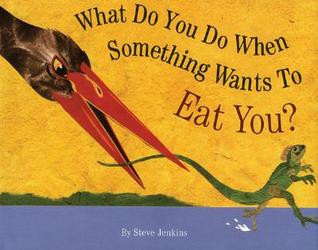
What Do You Do When Something Wants To Eat You? by Steve Jenkins

Share

NF PB 2014

Nonfiction Picture Book Wednesday

Nonfiction Picture Book Wednesday is hosted by Kid Lit Frenzy and was started to help promote the reading of nonfiction texts. Most Wednesdays, we will be participating and will review a nonfiction text (though it may not always be a picture book).
Be sure to visit Kid Lit Frenzy and see what other nonfiction books are shared this week!
eatyou

What Do You Do When Something Wants To Eat You?
Author and Illustrator: Steve Jenkins
Published October 27th, 1997 by HMH Books for Young Readers

Goodreads Summary: What would you do if something wanted to eat you? Walk on water? Stick out your tongue? Play dead? Animals in the wild use all kinds of methods to protect themselves from their enemies. Using dynamic and intricate cut-paper collages, Steve Jenkins explores the many fascinating and unique defense mechanisms creatures use to escape from danger.

My Review: Steve Jenkins just has a way of making nonfiction more interesting than other authors, and this book is no different than his others. This book takes different animals and shows the different ways they protect themselves: from squirting ink to camouflage.  The illustrations are done in Steve Jenkins’s paper-cut style and are done as well as his other books. The text, though simple, is full of information and definitely makes the reader want to learn more.

Teachers’ Tools for Navigation: This book can definitely be used in reading and science class. It is a good introduction to animal defenses and animal adaptations. It can lead to inquiry and research of each of these animals. It would be a great first research project for students to choose one of the animals and learn more about them. It is also a good introduction to cause and effect. What causes _____ to need to defend themselves? What is the effect of ____ being attacked?

Discussion Questions: What type of defenses do animals use to keep themselves from being harmed?; How does camouflage work?; What causes animals to need to defend themselves? What are the effects of them being attacked?

We Flagged: “A flying fish escapes danger by leaping from the water, spreading its winglike fins, and gliding as far as a thousand feet.”

Read This If You Loved: Any Steve Jenkins book, Any Seymour Simon animal book, Lifetime by Lola M. Schaefer, Frog Song by Brenda Z. Guiberson

Recommended For: 

readaloudbuttonsmall closereadinganalysisbuttonsmall
classroomlibrarybuttonsmall litcirclesbuttonsmall

Signature

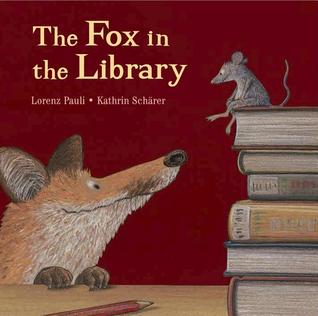
The Fox in the Library by Lorenz Pauli

Share

the fox in the library

The Fox in the Library
Author: Lorenz Pauli
Illustrator: Kathrin Schaerer
Published August 1st, 2013 by NorthSouth

Summary: Fox didn’t come to the library to read a book–he came to catch a mouse! But  Mouse offers the fox a book, Fox gets all sorts of creative new ideas.  Like eating chickens!  Until Chicken points out that chicken bones are dangerous. But then all the animals must band together when the chicken eating, hating-Farmer walks into the library.

Review: I am a sucker for books about bookstores, books, and libraries. I imagine this is the same for all book lovers. The illustrations in this book are bright, and it was very fun to read it to my son. I don’t think you can read too many books about books to kids. They need to understand that there is a world of books out there, and going to the library is cool! Some books lend themselves to silly voices—and this is certainly one of those books. The mouse even mocks the fox for calling the library a “lie-berry.” I suspect that kids won’t ever forget the pronunciation after hearing this book.

Teacher’s Tool For Navigation: This would be a great book to read to children before a trip to the library. It would stir their imaginations and make them excited to discover all of the creatures that may lurk while they visit.

Discussion Questions: How does Mouse outsmart the fox?; What do the animals learn in their trip?; What kinds of books appeal to each of the animals?


We Flagged: “‘Nothing here belongs to you,’ Mouse said with a giggle. ‘You can only borrow things here. And I’ll never be yours. This isn’t the forest; this is the library'” (6).

Read This If You Loved:  Library Lion by Michelle Knudsen, Wild About Books by Judy Sierra, The Boy who was Raised by Librarians by Carla Morris, Tomas and the Library Lady by Pat Mora

Recommended For: 

readaloudbuttonsmall classroomlibrarybuttonsmall

RickiSig

Locomotive by Brian Floca (Kellee’s Review)

Share

NF PB 2014

Nonfiction Picture Book Wednesday

Nonfiction Picture Book Wednesday is hosted by Kid Lit Frenzy and was started to help promote the reading of nonfiction texts. Most Wednesdays, we will be participating and will review a nonfiction text (though it may not always be a picture book).
Be sure to visit Kid Lit Frenzy and see what other nonfiction books are shared this week!

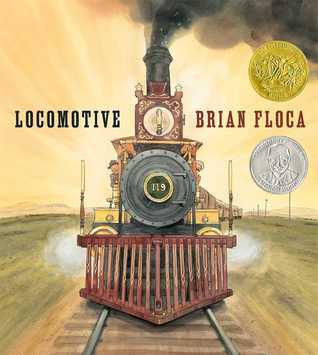
locomotive

Locomotive
Author and Illustrator: Brian Floca
Published September 3rd, 2013 by Atheneum Books for Young Readers

Goodreads Summary: The Caldecott Medal Winner, Sibert Honor Book, and New York Timesbestseller Locomotive is a rich and detailed sensory exploration of America’s early railroads, from the creator of the “stunning” (Booklist)Moonshot.

It is the summer of 1869, and trains, crews, and family are traveling together, riding America’s brand-new transcontinental railroad. These pages come alive with the details of the trip and the sounds, speed, and strength of the mighty locomotives; the work that keeps them moving; and the thrill of travel from plains to mountain to ocean.

Come hear the hiss of the steam, feel the heat of the engine, watch the landscape race by. Come ride the rails, come cross the young country!

My Review: Rhythm. Onomatopoeias. (Well-researched) History. Gorgeous (and historically accurate) illustrations. Lyrical narrative. Unique point of view. This book has everything.

YOU (second person POV!) are a passenger on a train cross America with your family in 1869. Throughout the book, you will encounter many different landmarks, experience things on a train very few had at this time in history, and learn about the intricacies of the train. So fascinating! And all told in rich, beautiful language. It is hard to even share much more about the book because it is such an experience.

Check out Ricki’s review of Locomotive as well HERE.

Teachers’ Tools for Navigation: I would LOVE to read this to kids. There are so many places to stop and discuss and research and learn, but never without an enthralling story accompanying.  It would be a great book to use across subjects. There are definitely opportunities for all subjects: social studies (trans-continental travel, history, trains); science (the science of steam engines); math (travel); reading/writing (onomatopoeia, point of view, rhythm).

Also, and this is fresh on my mind because I just read it, but I would love to read this and The Donner Dinner Party and then look at the two journeys. How long did each take? Dangers? It would be an interesting look at how trains truly changed transportation.

Discussion Questions: How does having the book in 2nd point of view make it more enthralling?; What onomatopoeias were used in the book? How did these words help suck you into the story?; How did the author’s rhythm make you feel like you are actually on the train?; What are the landmarks that were passed on the trans-continental railroad? Why are these landmarks significant?; How does a steam engine work? What are the jobs of all of the different people on board?

We Flagged:
“Here is how this road was built,
with a grunt and a heave and a swing,
with the ring of shovels on stone,
the ring of hammers on spikes:

CLANK CLANK CLANK!

Men came from far away
to build from the East,
to build from the West,
to meet in the middle.

They cleared the rocks
and dug the tunnels.
They raised the hammers
and brought them down—

“Three strokes to the spike,
ten spikes to the rail!”

CLANK CLANK CLANK!”

Read This If You Loved: The Donner Dinner Party by Nathan Hale, Train by Elisha Cooper

Recommended For: 

readaloudbuttonsmall closereadinganalysisbuttonsmall classroomlibrarybuttonsmall

Signature

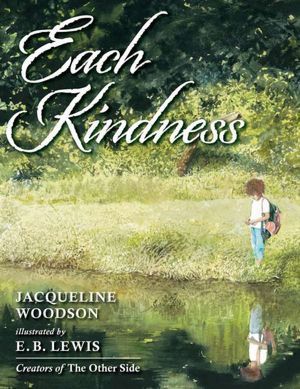
Each Kindness by Jacqueline Woodson (Ricki’s Review)

Share

Each Kindness

Each Kindness
Author: Jacqueline Woodson
Illustrator: E.B. Lewis
Published October 2nd, 2012 by Nancy Paulsen Books

Summary: Each kindness makes the world a little better

Chloe and her friends won’t play with the new girl, Maya. Maya is different–she wears hand-me-downs and plays with old-fashioned toys. Every time Maya tries to join Chloe and her gang, they reject her. Eventually, Maya plays alone, and then stops coming to school altogether. When Chloe’s teacher gives a lesson about how even small acts of kindness can change the world, Chloe is stung by the lost opportunity for friendship, and thinks about how much better it could have been if she’d shown a little kindness toward Maya.

This unforgettable book is written and illustrated by the award-winning team that created The Other Side and the Caldecott Honor winner Coming On Home Soon. With its powerful message and striking art, it will resonate with readers long after they’ve put it down.

Review: This is a beautiful story that would be FANTASTIC for the classroom. Students of any age can learn from this book, and I would read it to my class on the very first day of school. It is easy to get caught up in drama and gossip, and Jackie Woodson reminds us how hurtful this can be. I am so glad that I own a copy of this book. I plan to read it to my son very often because the lessons are so important, and the story is simply stunning. Usually, I don’t review a book that Kellee has also reviewed on Unleashing Readers, but I couldn’t help but share my thoughts about this incredible text.

Teacher’s Tool For Navigation: I would be remiss if I didn’t direct you to Kellee’s post about this book. She did a fantastic activity with her class that used multi-flow maps.

One of my favorite parts about this book is that it doesn’t have a happy ending. I would love to discuss this with students–why might this be? Is Woodson teaching us something? Then, we might explore other books that don’t have happy endings and discuss why authors might do this intentionally and how it might impact readers’ feelings about the books. Students are notorious for disliking sad endings, so I think this would provoke much discussion.

This book can be both preventative and reactionary to bullying issues in the classroom/school community. While I would read it at the beginning of the school year, I could also see it as an effective tool for teachers who are having issues with bullying during the school year.  This book makes us want to be better people.
Discussion Questions: Why is Chloe so mean to Maya?; What do we know about Maya? Why do you think Woodson characterizes her this way?; Why does this book end in an unhappy way? What does it teach us?; How might we spread kindness?

We Flagged: “And on that first day, Maya turned to me and smiled. But I didn’t smile back. I moved my chair, myself and my books a little farther away from her. When she looked my way, I turned to the window and stared out at the snow” (6).

Read This If You Loved:  Unicorn Thinks He’s Pretty Great by Bob Shea, Endgame by Nancy Garden, Thirteen Reasons Why by Jay Asher,  The Silver Linings Playbook by Matthew Quick, Burn by Suzanne Phillips, The Perks of Being a Wallflower by Stephen Chbosky, Twisted by Laurie Halse Anderson, Everybody Sees the Ants by A.S. King, The Spectacular Now by Tim Tharp, Inexcusable by Chris Lynch

Recommended For: 

readaloudbuttonsmall classroomlibrarybuttonsmall 

RickiSig