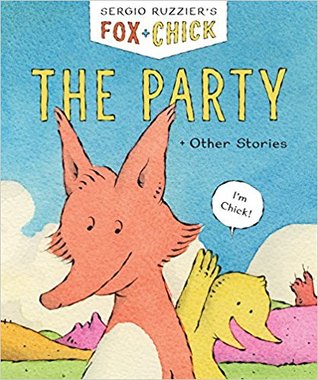
Fox + Chick: The Party and Other Stories Author and Illustrator: Sergio Ruzzier Published April 17th, 2018 by Chronicle Books
Summary: Fox and Chick don’t always agree. But Fox and Chick are always friends. With sly humor and companionable warmth, Sergio Ruzzier deftly captures the adventures of these two seemingly opposite friends. The luminous watercolor images showcased in comic-book panel form will entice emerging readers, while the spare text and airiness of the images make this early chapter book accessible to a picture book audience as well.
Teachers’ Tools for Navigation: Activities for The Party and Other Stories include:
How to Read a Graphic Novel
Reading a graphic novel differs from reading prose text because readers must infer everything outside of the dialogue they are given and what is presented in the illustrations.
First, using Fox + Chick discuss the differences with your class between a picture book, a chapter book, and a graphic novel. Make sure to point out the parts of a graphic novel like speech bubbles show what the characters are saying, panels (each square), and the gutter (the space between panels). Then discuss how to read a graphic novel (typically read left to right, top to bottom).
Extension activity: Discuss with students why an author would choose to write their story as a graphic novel versus a chapter book or picture book.
Then, to show how inferences have to be made between panels, use pages 2/3 to page 4. As a reader you can infer that Chick continued walking to the house shown on page 2/3 even though the illustrations don’t show each little step. Also, between the first two panels on page 4, the reader can infer that Chick had to wait a bit even though the panels don’t show it.
After reading the story, have students show how they use inferring to comprehend the story by:
K-1st: Retell the story including inferences made between panels and what the illustrations show.
2nd-3rd: Rewrite the story as a narrative including inferences made between panels and what the illustrations show.
Conflict and Resolution
Conflict is the problem with a story or part of a story while the resolution is how that problem is solved. In each of the chapters in Fox + Chick, there is a conflict and a resolution. Each chapter gives an opportunity to learn these narrative elements.
For chapter 1, “The Party,” as a class, determine the conflict and the resolution.
For chapter 2, “Good Soup,” have students determine the conflict and resolution in pairs.
For chapter 3, “Sit Still,” have students determine the conflict and resolution independently.
Character Traits
Character traits are all the aspects of a character’s behavior from how they act to what they think.
Before reading: As a class, list the character traits the students assume a fox and a chick are going to have. How will they act? What type of personality will they have? How are they going to interact with each other?
After reading: Independently or as a class, have students complete a character trait activity on each character. Have students answer the following questions then place their answers into a graphic organizer:
How did the character act in the story?
What feelings did the character portray in the story?
What words would you use to describe the character’s personality?
See the Teaching Guide Created by me (Kellee) for even more activities and discussion questions!
You can also access the teaching guide through Chronicle’s website here.
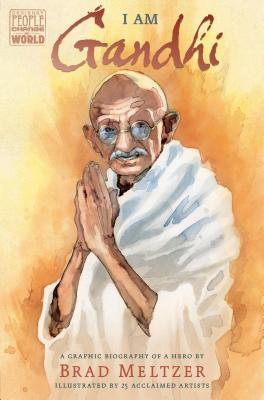
I Am Gandhi
Author: Brad Meltzer
Illustrator: 25 Acclaimed Artists
Published May 8th, 2018 by Dial Books
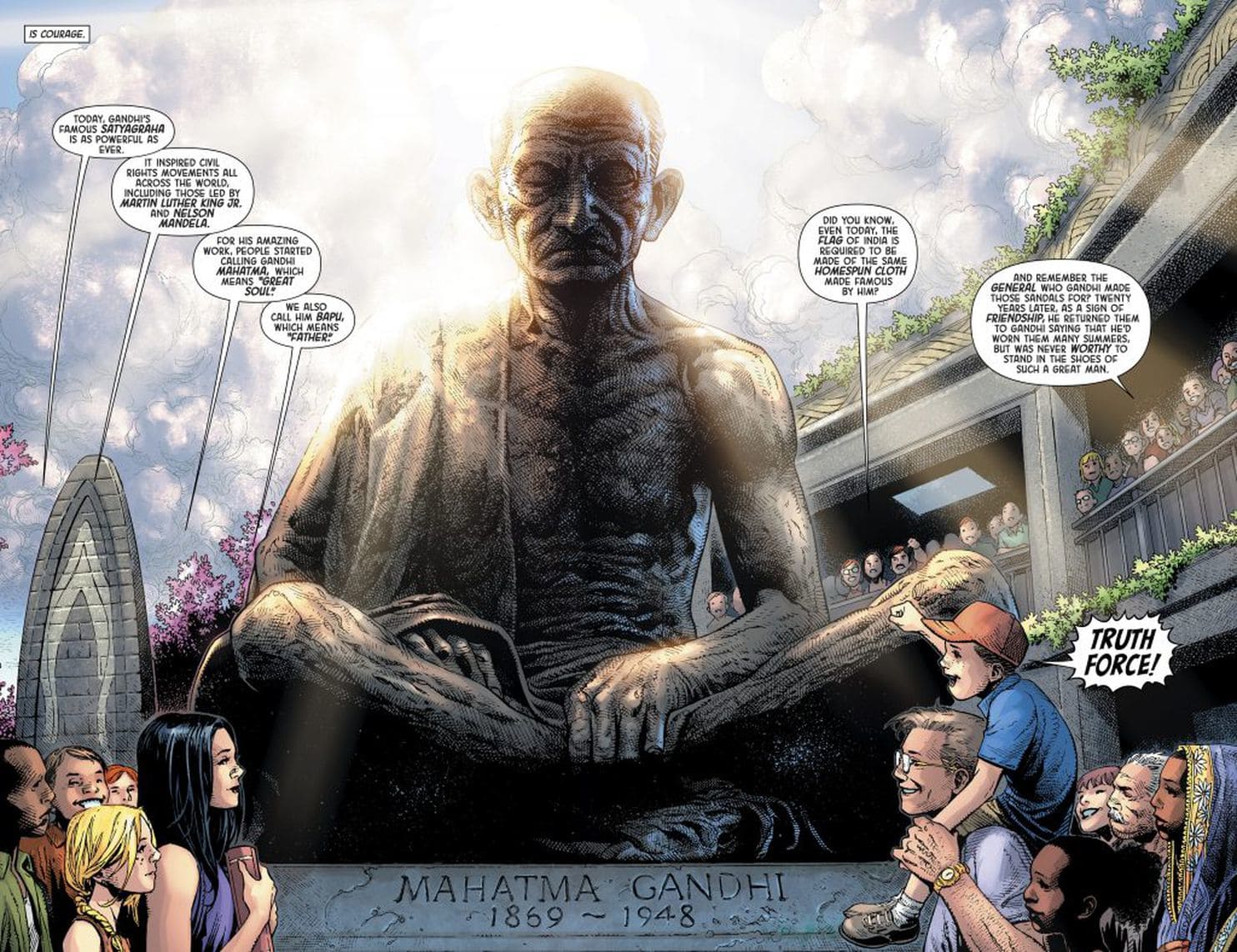
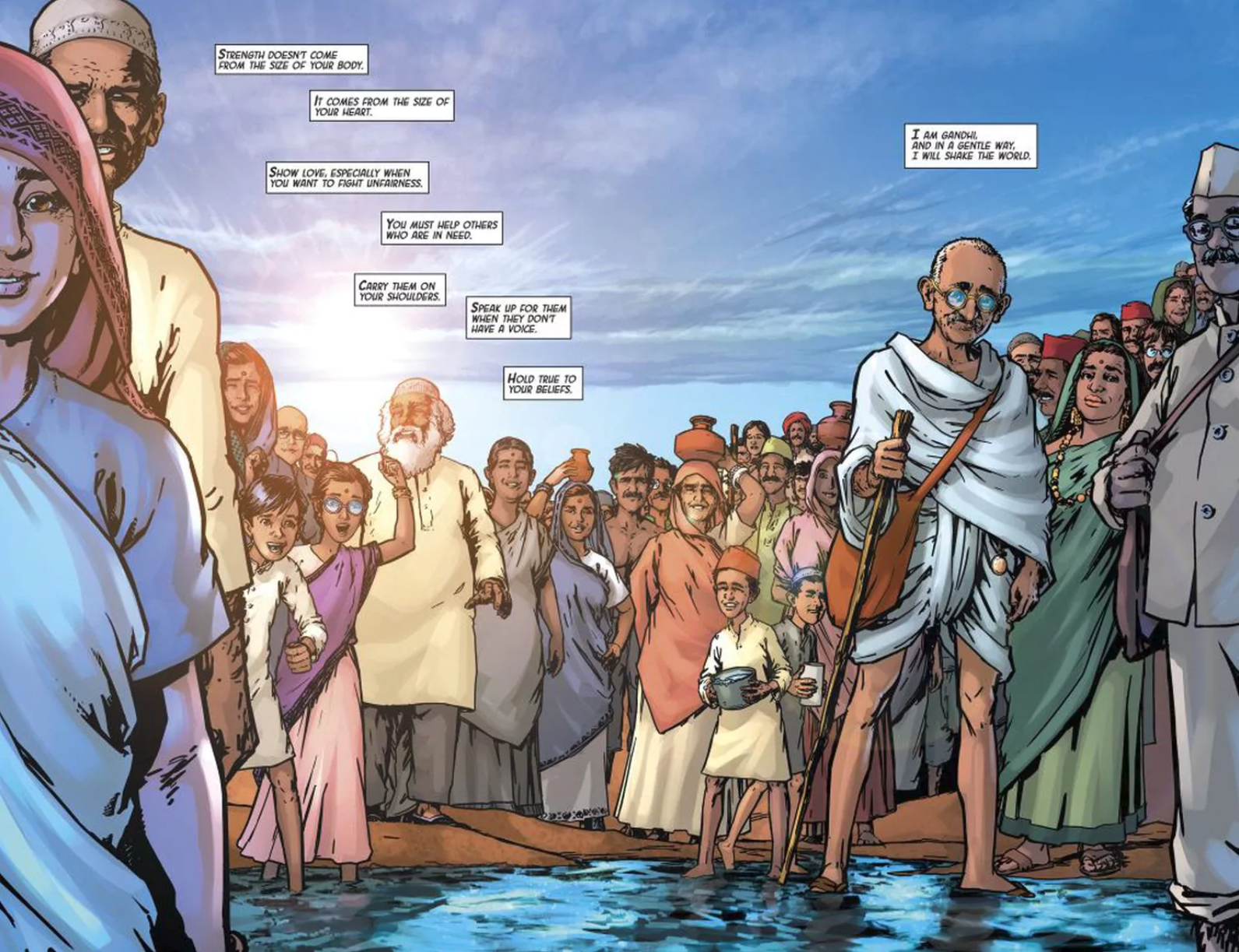
Summary: Twenty-five exceptional comic book creators join forces to share the heroic story of Gandhi in this inspiring graphic novel biography.
As a young man in India, Gandhi saw firsthand how people were treated unfairly. Refusing to accept injustice, he came up with a brilliant way to fight back through quiet, peaceful protest. He used his methods in South Africa and India, where he led a nonviolent revolution that freed his country from British rule. Through his calm, steady heroism, Gandhi changed the lives of millions and inspired civil rights movements all over the world, proving that the smallest of us can be the most powerful.
Galvanized by Gandhi’s example of gentle, peaceful activism, New York Times bestselling author Brad Meltzer asked his friends in the comic book world to help him make a difference by creating this philanthropic graphic novel. Twenty-four illustrators–including many of the most acclaimed artists in comics today–enthusiastically joined the project, agreeing to donate their work so that their royalties can go to Seeds of Peace, a non-profit organization that inspires and cultivates new generations of global leaders. This extraordinary biography is a glorious team effort that truly exemplifies Gandhi’s selflessness and love for humanity.
The illustrators included are: Art Adams, John Cassaday, Jim Cheung, Amanda Connor, Carlos D’Anda, Michael Gaydos, Gene Ha, Stephanie Hans, Bryan Hitch, Phil Jimenez, Siddharth Kotian, David LaFuente, David Mack, Alex Maleev, Francis Manapul, David Marquez, Steve McNiven, Rags Morales, Saumin Patel, Nate Powell, Stephane Roux, Marco Rudy, Kamome Shirahama, Bill Sienkiewicz, and Abhishek Singh.
Kellee’s Review: I’ll be honest–when I first read on the cover that 25 different artists illustrated this graphic biography, I was worried that the stagnation of illustration styles would hinder the narrative of Gandhi’s life, but I was so wrong. Instead, by allowing each illustrator to give us their interpretation of Gandhi, his spirit instead flowed through the pages as it was obvious that his story had touched each and every artist, and the author, taking part in this graphic biography.
While reading, it was clear to me that Meltzer wanted Gandhi’s message of equality, peace, and kindness to scream at the reader, and this was confirmed when I read the Washington Post article about Meltzer’s inspiration. I believe Meltzer did a beautiful job not only telling Gandhi’s story but also showing that peace is possible in a time of tumultuous relationships but that the only way to truly achieve it is through similar activism as Gandhi.
Ricki’s Review:I read this graphic novel twice to myself and twice with my son. Further, I’ve read portions of it to my students. I can’t stop sharing it! I was blown away by the amalgamation of the 25 graphic novelists—it made for an absolutely stunning text. I appreciate the historical perspective that extends throughout the graphic novel, and I loved that the illustrations really make Ghandi’s story come alive. This is a book that I will share often and widely. If you haven’t read it, I recommend it highly—even if you already know a lot about Ghandi’s life.
Teachers’ Tools for Navigation: Have students connect Gandhi’s philosophies to those who influenced him and those he influenced. For example, in one of my literature classes, one person picked an author who was influenced by another (for example, Woody Guthrie was influenced by Walt Whitman) then the next student built on that (for example, Bob Dylan was influenced by Woody Guthrie OR Ralph Waldo Emerson influenced Walt Whitman) until a complete chain of influences were made. Then each student wrote an analysis paper showing how they were influenced then presented their findings (in order of influences) to the class. This same idea could be done here: Henry David Thoreau influenced Gandhi who influenced Martin Luther King, Jr. who influenced Barack Obama who influenced Cory Booker, etc. This idea could also be used just to look at the idea of peaceful protests that have changed the course of history: Gandhi, MLK, Black Lives Matter, Never Again, etc.
Discussion Questions:
What is the theme of Meltzer’s story of Gandhi?
How did Gandhi change the course of history for Indians in South Africa and India?
How did the 25 different artists illustrating the graphic novel affect the reading of the biography?
How did Thoreau influence Gandhi? Can you infer how Gandhi influence Martin Luther King, Jr.?
What was the importance of Gandhi’s march to the sea to hold salt?
Why do you believe Meltzer chose the specific quotes he included in the back matter of the book?
Tsu and the Outliers
Author: E. Eero Johnson
Published May 8th, 2018 by odod books
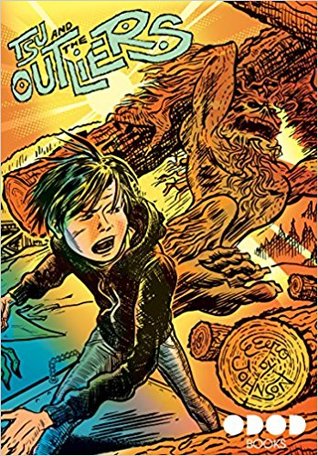
Summary: Tsu and the Outliers is a graphic novel about a non- verbal boy whose rural existence appears unbearable until rumors of a monstrous giant upend his mundane life. Tsu finds himself at the center of the mystery, as his strange metaphysical connection with the creature is revealed.
As the dragnet closes in, Tsu is forced to choose between a dangerous path leading beyond the periphery of human perception or a life without his only friend.
About the Author: E. Eero Johnson (Erik T. Johnson) is a Minneapolis-based illustrator, graphic designer, and comic book artist. His illustrations have appeared in GQ, The New Yorker, Newsweek, Wired, and The New York Times, and on several book covers. His comic book projects, The Outliers and Kozmo-Knot, have gained a growing interest from the indie comic world. He lives with his wife, Tammy, sons, Emmett and Eilif, and a crazy Boston terrier.
Review: Tsu and the Outliers is an interesting look at a new type of superhero: a young non-verbal boy who is able to communicate with a creature that his world is afraid of. There are some interesting discussion points when it comes to bullying since Tsu is judged by his classmates because of his disability. This is a big theme during the beginning of the book as we get to know Tsu. The creature also ends up being a Sasquatch and they are being chased by a chupacabra-like creature which introduces North American folklore. Overall, the story is pretty crazy (in a good way), and the end of the book sets up for a definite sequel which I NEED because Tsu makes a crazy decision at the end of the book with no explanation.
Teachers’ Tools for Navigation: Use the scene where Tsu is bullied by Jespers to start a dialogue about bullying. Discuss why the scene makes them angry and uncomfortable and what could have been done by others to help Tsu. Have students create anti-bullying advertisements to share in your school.
When mythology and folklore are discussed, the focus is primarily on Greek, Roman, and Egyptian. Use Tsu and the Outliers to discuss North American folklore including the Sasquatch and chupacabra. Have them research the tales about these creatures and create their own myth with them in it. Also, as a class, discuss the difference between the characters is Tsu and traditional folklore.
Discussion Questions:
What foreshadowing was there to show that Tsu was more than what everyone assumed?
Tsu’s lack of verbal communication in the end of the book ended up not being a disability. What do you think caused it?
Why do you think Tsu made the choice he did at the end of the book?
Why do you think Tsu’s mother made the claim she did at the end of the book covering up for Tsu?
Why does the Chimpanzee-professor want Tsu?
Flagged Passages:
Read This If You Love: Superpowers, Folklore, Superhero comics
Recommended For:
**Thank you to odod books for providing a copy for review!**
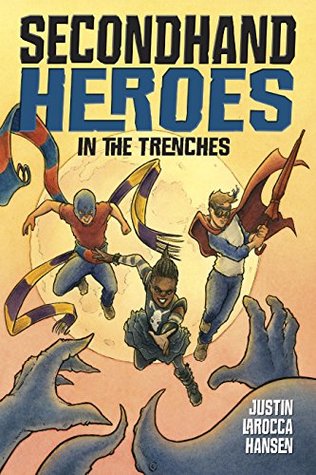
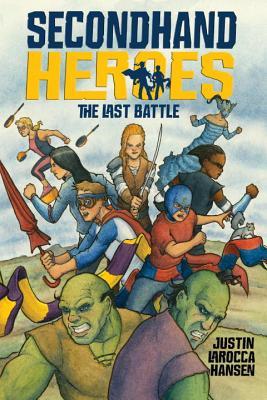
Secondhand Heroes: Brothers Unite [July 5th, 2016] In the Trenches [February 7th, 2017] The Last Battle [April 10th, 2018]
Author: Justin LaRocca Hansen
Published by Dial Books
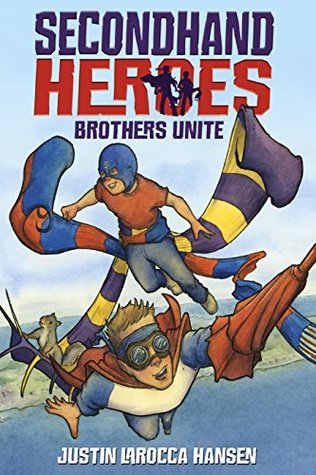
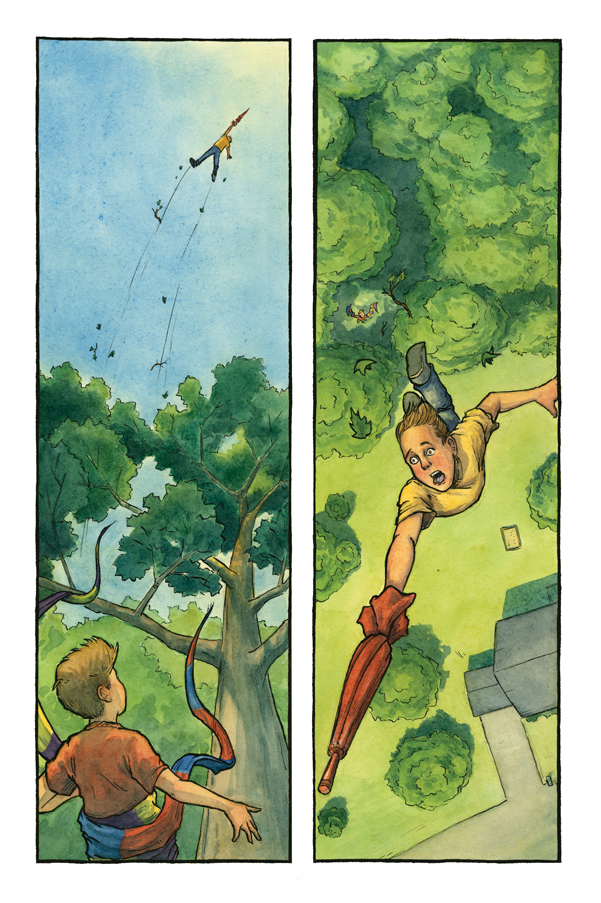
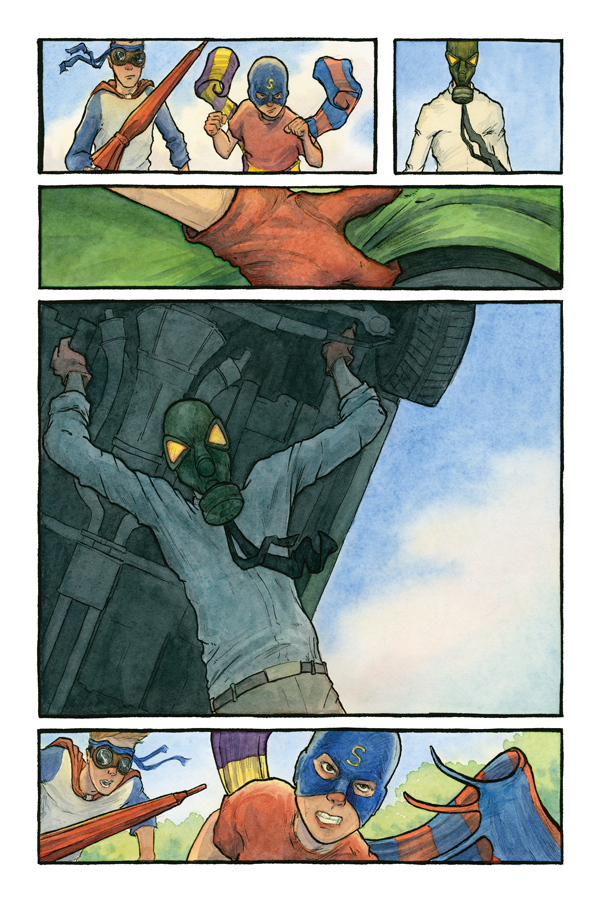
Brothers Unite Summary: Perfect for fans of Amulet, Sidekicks, and Zita the Spacegirl, this graphic novel series debut introduces Stretch and Brella, a pair of ordinary brothers whose extraordinary yard sale discovery turns them into superheroes.
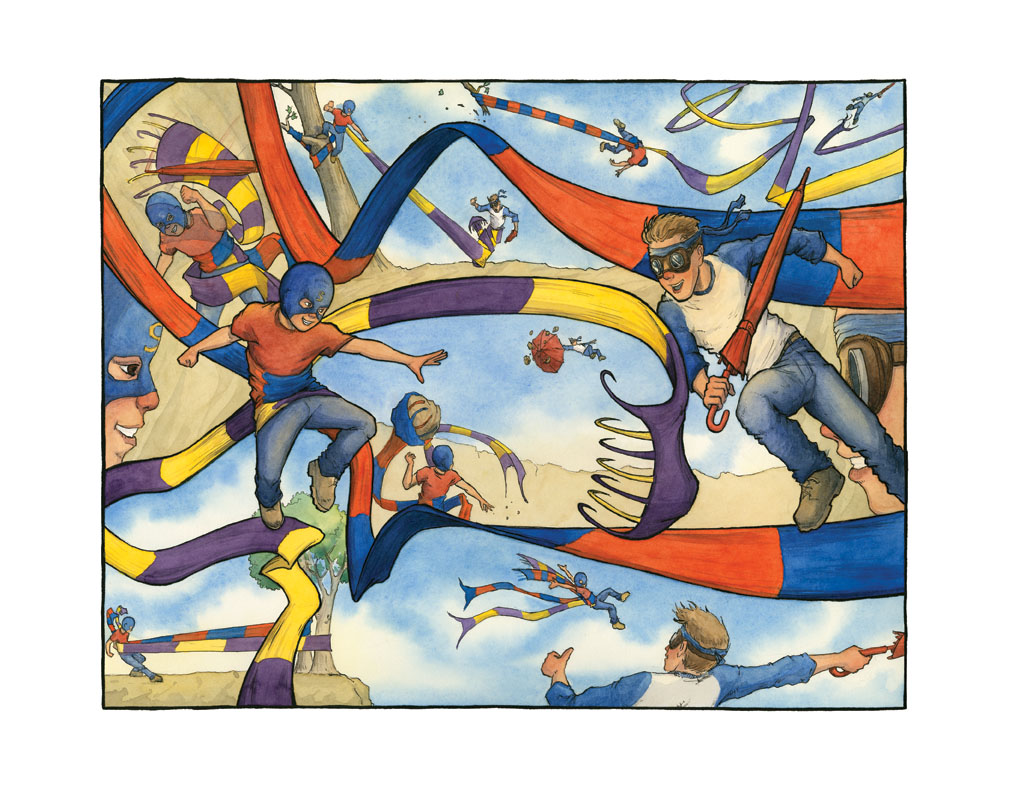
Tuck and Hudson are just two average suburban brothers—until their mother buys them a scarf and an umbrella at a yard sale. Quickly, the brothers realize that these ordinary-looking objects are full of magic, and that, with the help of their squirrel sidekick, they can use that magic to fight evil. As the boys move from fighting their neighborhood nemesis to facing bigger foes, they become Stretch and Brella, the unstoppable brother superhero duo. Soon, Stretch and Brella find themselves in another realm, where they take on enormous dragons and an evil knight in an incredible graphic novel adventure.
In the Trenches Summary: [Mild Brothers Unite SPOILERS!] Two ordinary objects turned a pair of brothers into superheroes. Now they must fight the evil Trench right in their own neighborhood.
When Tuck and Hudson return from their first adventure as the superheroes Stretch and Brella, they’re still reeling from the shock of their newfound powers. But there’s no time to slow down. Trench, a supervillain whose powers came from the very same garage sale where Tuck and Hudson found their magic scarves and umbrella, lives around the corner—and he’s out to get the brother superhero duo. With help from their squirrel companion, Steen, and another newly minted superhero, a neighborhood girl named Elvira, the brothers keep fighting the good fight, with plenty of action and adventure along the way.
The Last Battle Summary: [Mild Brothers Unite & In the TrenchesSPOILERS!]Two ordinary objects turned a pair of brothers into superheroes. Now they’re banding together with their neighbors to take down the evil Trench once and for all in the final volume of this graphic novel trilogy.
Tuck and Hudson have figured out how to wield the superpowers they got when their mom bought them an ordinary-looking pair of scarves and an umbrella at a yard sale. But Trench, their supervillain archnemesis, is only getting more powerful. Slowly, the brothers have discovered the others in their town who have superpowered objects from that same yard sale. Now Tuck and Hudson, along with their friend Elvira and their squirrel sidekick, Steen, are leading a band of heroes in the fight against Trench. This final volume of the graphic novel adventure series features the heroes’ last stand, with plenty of twists and turns along the way.
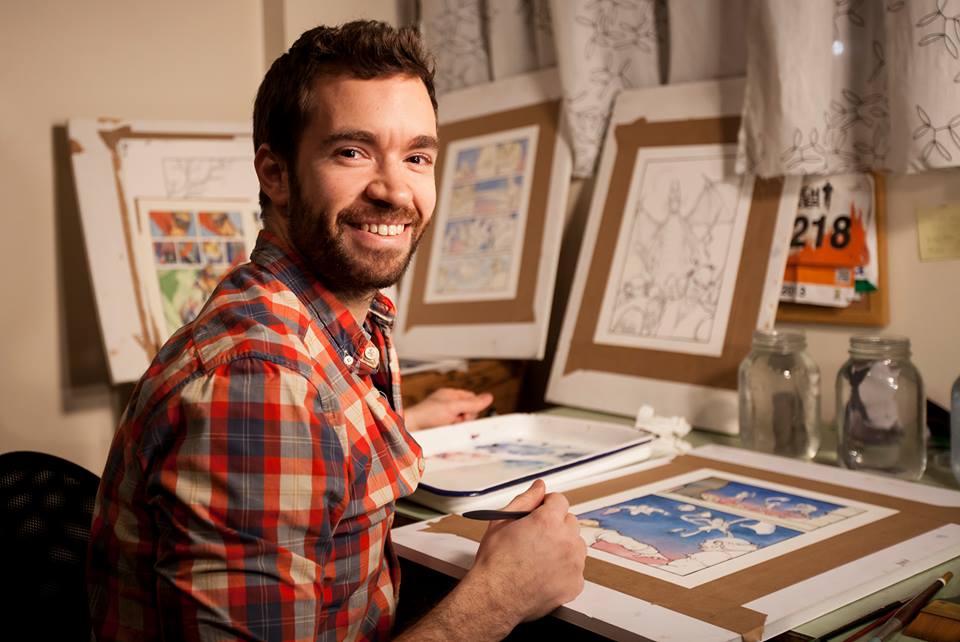
About the Author: [From http://www.justinlaroccahansen.com/] I grew up in the tiny town of Millis Massachusetts but spent most summers in a tinier village called Cataumet in Cape Cod and it is there I feel most at home. Comic books, cartoons and toys captivated me as a child and I would constantly create my own characters and stories. I went to college at Ringling College of Art and Design where I got a BFA in Illustration. Shortly after I moved to New York City to try and “make it” as an illustrator. It was a long journey with plenty of odd jobs (including a birthday party host and paper airplane teacher), lots of rejections (we’re talkin’ LOTS), and all the ups and downs that come with chasing a dream. I finally sold my first picture book Monster Hunter in 2012 to Sky Pony Press. The next few years would be consumed by a graphic novel trilogy that had been kicking around in my head for some time called Secondhand Heroes. The first book of that trilogy, Secondhand Heroes: Brothers Unite was published by Dial Books for Young Readers, an Imprint of Penguin Random House, in 2016. Part two, Secondhand Heroes: In the Trenches came out in 2017 and last summer I finished work on part three, Secondhand Heroes: The Last Battle which will be out on April 10th, 2018. I live in Brooklyn with my most amazing wife and my collection of Springsteen records.
Kellee’s Review: One of my students named Lucas is a huge graphic novel fan, and earlier this school year, he introduced a new series to me: Secondhand Heroes. He had read the first books in the series and wanted BADLY for me to read them and could not wait for the third book in the series. Well he does not need to wait any longer! This is a crazy series! I’ll be honest, in the first book, a twist in the plot happens, and the reader is not sure why, but I promise: TRUST THE AUTHOR! It epically comes together throughout the series. This series is definitely a perfect reading ladder up from younger middle grade series like Zita and Amulet. The bit of romance and realistic violence pushes its age range further into teens which, as a middle school reading teacher, I am always looking for! I also am in love with the artwork. It is different than other series because of its softer undertones and touches which makes it so unique.
Ricki’s Review: I am so glad that I read this series and have it to recommend to students. While it is definitely above his age range, my son really enjoyed this series. Each night, we read it together, and he imagined that the brothers were him and his younger brother. It’s quite a clever series—the main characters, two brothers, get items from a second-hand shop that prove to be magical. They turn into superheroes. At first, they question whether they should use the superpowers, but they quickly realize how they can use these superpowers for good. I particularly like how the boys slowly discover others in their town who have also gained superpowers. It was fun to read all of the different powers that characters had. The illustrations are eye-catching and engaging. The books in this series were ones that I looked forward to reading each night with my son. I’d put it more at the upper elementary/middle school level and agree with Kellee that these books books make a wonderful ladder for middle schoolers. I’ll be recommending these books often.
Teachers’ Tools for Navigation: Graphic novels are such an important format to have available for students in school and classroom libraries.
“While many teachers are beginning to include [graphic novels] in their classrooms, there are still teachers, administrators, and librarians who struggle with including this format in their schools. So, why should you use them in your classroom and have available for students?
• Graphic novels can make a difficult subject interesting and relatable. (Cohen)
• Students are visual learners, and today’s students have a much wider visual vocabulary than students in the past. (Karp)
• Graphic novels can help foster complex reading skills by building a bridge from what students know to what they still have to learn. (NCTE)|
• Graphic novels can help with scaffolding when trying to teach higher-order thinking skills or other complex ideas.
• For students who struggle to visualize while they read, graphic novels provide visuals that show what good readers do. (NCTE)
• Many graphic novels rely on symbol, allusion, satire, parody, irony, and characters/plot and can be used to teach these, and other, literary devices. (Miller; NCTE)
• Often, in between panels (called the gutter), the reader must make inferences to understand how the events in one panel lead to the
events in the next. (McCloud)
• Graphic novels can make differentiating easier. (Miller)
• Graphic novels can help ELL (English Language Learners) and reluctant and struggling readers since they divide the text into manageable chunks, use images (which help students understand unknown vocabulary), and are far less daunting than prose. (Haines)
• Graphic novels do not reduce the vocabulary demand; instead, they provide picture support, quick and appealing story lines, and less text, which allow the reader to understand the vocabulary more easily. (Haines)
• Research shows that comic books are linguistically appropriate reading material, bearing no negative impact on school achievement or language acquisition. (Krashen)
• Students love them.
In the first book, why did the author change settings?
How did the boys’ behavior in this new setting affect the end of the series?
How did the superpowers bring the brothers together?
How did Brella’s interest in Isabella cause him to struggle with being a superhero?
How did Trench use Brella and Stretch’s “weaknesses” as a good person filled with love to manipulate them?
How did Trench set up Brella and Stretch?
How would you compare/contrast the boys’ character traits from the first book to the last book?
Flagged Passages: [From Brothers Unite]
(p. 24)
“1. *whup* 2. HUH…HUH…HUH. 3. THIS IS MY HOME. TUCKER WAS RIGHT. THIS. IS. 4. AWESOME!” (p. 26)
(p. 50-51)
“2. VERY WELL. 5. Brella: TUCK! Stretch: FLY! I GOT IT! (p. 74)”
Read This If You Love: Amulet series by Kazu Kibuishi, Zita the Spacegirl series by Ben Hatke, Ghostopolis by Doug TenNapel, Sidekicks by Dan Santat, 5 Worlds series by Mark Siegel, Cleopatra in Space series by Mike Maihack, HiLo series by Judd Winick, West series & Battling Boy series by Paul Pope, Chronicles of Claudette by Jorge Aguirre
Recommended For:
and
**Thank you so much to Justin for providing copies for review and goodies for Kellee’s students!**
I read so many wonderful books this year, that I decided that I needed two posts to highlight them!
Today’s post will focus on middle grade and young adult novels that I read this year and loved.
Each title will have a publication date listed as these are all favorites I READ in 2017 though they may have been published before or are coming out in 2018.
I read so many wonderful books this year, that I decided that I needed two posts to highlight them!
Today’s post will focus on picture books and early readers that I read this year and loved.
Each title will have a publication date listed as these are all favorites I READ in 2017 though they may have been published before or are coming out in 2018.
Favorite Fifteen Fiction Picture Books
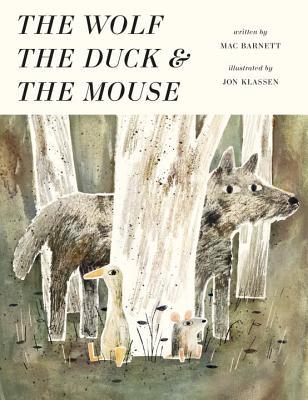
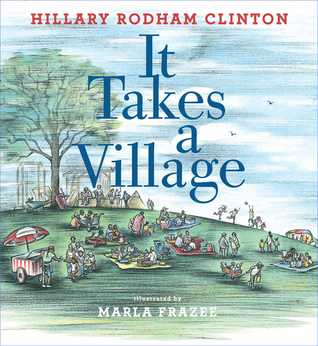
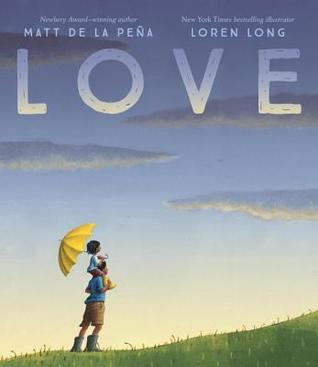
The Wolf, The Duck, & The Mouse by Mac Barnett, illustrated by Jon Klassen (2017) It Takes a Village by Hillary Rodham Clinton, illustrated by Marla Frazee (2017) Love by Matt de la Peña, illustrated by Loren Long (2018)
Musnet series
1. The Mouse of Monet 2. Impressions of the Master 3. The Flames of Limelight 4. The Tears of the Painter
Author: Kickliy
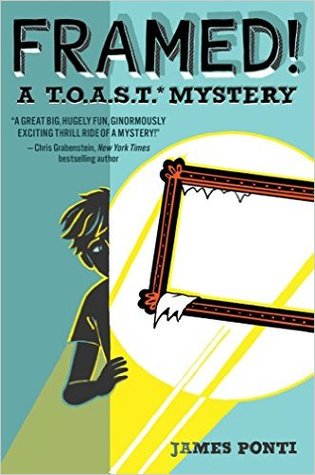
Published August 2nd, 2016; November 1st, 2016; April 11th, 2017; October 10th, 2017 by odod books
Summary: A young boy mouse travels the country side looking for work and happens upon the Monet’s garden. He takes on a job and becomes inspired to learn to paint. Will he paint in the classical ways, or in the new style of the impressionist? Which way will his brush sway?
Musnet wants to be the best mouse painter that ever was. But, he’s caught between two worlds. On one paw, Musnet loves the classical style of his old teacher, the squirrel Remi. On the other paw, Musnet can’t help to be drawn to the fresh and new art of the human master, Monet. Which path will the Mus choose?
It’s dark season in Musnet’s world. His adoptive family faces eviction, his Master Remi is deathly ill, he’s chased by snakes, cats, and vampire bats, and—on top of all that—Musnet faces the most challenging painting commission of his life! Can he rise to challenges and brush them all away?
As snow and ice chill Monet’s garden, even colder things await Musnet this winter season. Mya, Musnet’s best friend, gets her own adventure. Chiby, the Japanese spider, gets in a tangle with a certain muscular rat. Is there even any room left for our vagabond mouse? Drama, action, adventure, abound in the final volume of the award nominated series.
Musnet is drawn and painted in a beautiful, lush and inky style popularized by Paul Pope and French comics masters such Blutch and Christophe Blain.
“It’s a really enjoyable story that brings Monet’s paintings to life through some incredibly sweet and memorable characters. It’s challenging and imaginative, and I’m sure it will spark an obsession with painting (and maybe also mice).”—Girls Like Comics
“This new series revolves around a painting mouse found in Monet’s famous gardens in Giverny: the nameless, orphan mouse is befriended by Mya and her mouse family, who live inside the artist’s house. Introduced to painting after he begins working for Remy, an old squirrel painter, he is enchanted by Monet’s work. Beautifully painted […] charming tale of humour, art, and adventure, as the little mouse grows to find his meaning and place in the world.”—The Guardian
“Musnet: The Mouse of Monet is a gorgeous and friendly story about a mouse discovering his calling in life and also what he wants to be called. Take a friendly and likable orphaned mouse, place him in a beautifully rendered watercolor and ink medium with miniature Monet masterpieces and you get a stunning and engaging story of a mouse learning to become an artist. He makes friends, finds a mentor, and even gets to sneak a peek inside Monet’s studio. It’s incredibly well executed, entertaining, informative, and absolutely absorbing. It is one of the best books I’ve read this year.” —The Picture Book Review
Review: After I read book one of this series, I could not wait to share it with everyone I talked to: “I love when books include art history in them because it makes me feel at home since I grew up in art museums as a museum director’s daughter. Musnet is no different. As soon as I realized that Musnet had ended up in Monet’s famous garden, I was fascinated with Musnet’s story and his journey to becoming an artist. Kickliy’s artwork pays perfect homage to Monet’s work and is a beautiful backdrop to Musnet’s story.” And I was really excited to read the rest of the books in the series.
Luckily they did not disappoint! Book one was just an introduction to the characters who continued to mature throughout the arc of the story. Musnet’s situation fluctuates causing the reader to quickly move from relief to panic which ensures the reader wants to keep going through the series. Although the series begins with Musnet just looking for a home, it ends with Musnet looking for what life has in store for him as an artist.
But what makes this series even more unique is the level of graphics. Kickliy’s ink, watercolor, and oil illustrations are reminiscent of the period in which Monet lived–it is like reading art. Kickliy even paints little oil paintings for the book for whenever a Musnet or Monet work is shown.
Teachers’ Tools for Navigation: “Musnet lives in Monet’s garden. Was there a roach under Van Gogh’s bed? Or a fish behind Munch’s Scream? If so, what would their story be like?” Have students create stories of animals that ‘live’ in the background of famous paintings. They’d need to research the art styles for illustrations and the time period/place of the painting for their setting, so this activity would be a perfect cross-curricular for writing, reading, art, and history.
Parts of the book would also be really great assets for engagement and information in art classrooms. Remi, Monet, and Musnet are talented artists who share insight throughout the series.
Discussion Questions:
After book one, did you think Musnet was going to become a successful artist?
How does Kickliy’s illustrations fit the period of the book’s setting?
Which conflict in Musnet’s story affected Musnet’s conclusion the most?
Why do you think Kickliy chose Monet as the artist inspiration for his book?
What artist would you want to meet?
How did meeting Mya change Musnet’s life? Remi? Chiby?
Flagged Passages:
Read This If You Love: Art, Graphic Novels, Monet, Mira’s Diary by Marissa Moss, The Museum by Susan Verde, Babymouse series by Jennifer and Matthew Holm, The Tale of Despereaux by Kate DiCamillo, Redwall by Brian Jacques, The Museum by Susan Verde