Love in English by Maria E. Andreu

Share

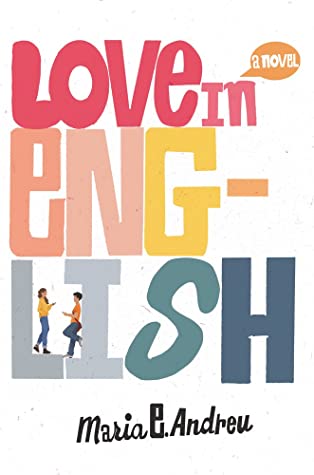
Love in English
Author: Maria E. Andreu
Published: February 2, 2021 by Balzer + Bray

Summary: Sixteen-year-old Ana has just moved to New Jersey from Argentina for her Junior year of high school. She’s a poet and a lover of language—except that now, she can barely understand what’s going on around her, let alone find the words to express how she feels in the language she’s expected to speak.

All Ana wants to do is go home—until she meets Harrison, the very cute, very American boy in her math class. And then there’s her new friend Neo, the Greek boy she’s partnered up with in ESL class, who she bonds with over the 80s teen movies they are assigned to watch for class (but later keep watching together for fun), and Altagracia, her artistic and Instagram-fabulous friend, who thankfully is fluent in Spanish and able to help her settle into American high school.

But is it possible that she’s becoming too American—as her father accuses—and what does it mean when her feelings for Harrison and Neo start to change? Ana will spend her year learning that the rules of English may be confounding, but there are no rules when it comes to love.

With playful and poetic breakouts exploring the idiosyncrasies of the English language, Love in English tells a story that is simultaneously charming and romantic, while articulating a deeper story about what it means to become “American.”

Ricki’s Review: I read this book and immediately thought of the many people who would love reading it. It does a beautiful job offering a lived experience of a young girl who is finely attuned to language acquisition. I have been meeting regularly with two students who have shared similar experiences to those of Ana, and I plan to share this book with them. For many, this book will act as a mirror, window, and sliding glass door. I understand fully the criticism this book has received–Maria E. Andreu writes in the opening that she was born in Spain, and her grandparents moved from Spain to Argentina as toddlers. She grew up in the US, traveled to Argentina at age 6 and then was not allowed to return to the US. She was undocumented at age 8 in the US. She talks about her experiences with this and with White privilege in powerful ways in The Secret Side to Empty. My thoughts about this controversy are not as valuable as those of a person with Latinx descent. In the end, I do wish that the character more closely matched Maria E. Andreu’s story rather than that of a native Argentinian. I loved the book and appreciated all that it taught me about Maria E. Andreu’s experiences with language, and there simply aren’t enough books available that explicitly discuss the linguistic diversity within our schools. this book is one that I will remember for quite some time.

Kellee’s Review: One of the things I love most about my school is the amount of diversity and the acceptance and inclusion of all in the school; we do not care where you are from or what language you speak–you are welcome with open arms!  While reading Love in English, I found myself being so upset with the students and some of the teachers in Ana’s school. Why was her ethnicity and language acquisition something that anyone would find funny or bully-worthy?! But then I remember that other places are not like my school… 

I also found myself connecting with Mr. T the ELL teacher! When I first started working at my school, I was intimidated with teaching ELL students because I didn’t think I would be of any help with someone learning English when it was the only language I knew. But throughout my first few years there, I began to learn that teaching ELL students is one of my favorite honors of being a teacher. My 7th year teaching, I taught a class much like Mr. T’s class, and it is one of my favorite classes I’ve ever taught. Mr. T shows how an ELL class, done correctly, can truly become home at school. 

Also, as a reading teacher & librarian at a school with a large Latinx population, primarily from South America, I found that it is so hard to find books that truly reflect my students’ experiences, but Love in English is a mirror for so many of them! It made me so happy while reading because I know that Ana’s experience is one that they will connect with. 

Overall, this story looks at language acquisition in a way that I have not seen in another book and it does so during a wonderful story with some amazing poetry woven throughout. I also love that the language acquisition aspect is based on the author’s experiences.

Teachers’ Tools for Navigation: We would love to use this book to teach about language and translanguaging. We’d group texts that help us think about the power of discussions related to the nuances of language.

Ana, throughout the novel, focuses on aspects of English in her journal. Use Ana’s journals to guide activities on some of the more challenging and, some would say, nonsensical parts of English, like idioms, similar looking words that are pronounced differently, and more.

Ana’s journals are written in beautiful poetry! Use Ana’s poetry for a mentor text to have students write poetry about similar topics to Ana.

Many of Mr. T’s activities that he implemented in his classroom are amazing activities to work with students acquiring a new language. If you are in a language-focused classroom, they would be assets to your classroom.

Discussion Questions:

  • How does language influence the ways in which Ana moves in the world?
  • How do Ana’s relationships with family and friends impact her life?
  • What is the significance of the title of the book?
  • How might the author’s perspective have influenced her work?
  • Why does Mr. T recommend Ana and Neo watch movies as part of their language acquisition?
  • What is the impact of the author’s use of ### since Ana is the narrator?
  • What is a part of the English language that you find confusing?
  • How did the year that Ana and her dad were apart affect their current relationship?
  • Why was Ana so drawn to a relationship with Harrison at first?
  • How was Altagracia’s friendship lifechanging for Ana?

Flagged Passage: 

“‘We don’t have to speak English,’ I tell her. I think–

We don’t have to do it this way.

We don’t have to make it so hard.

We don’t have to erase everything about us. At least not all at once.

—but I do not say it” (Advanced Reader Copy p. 35).

Recipe for Disaster

How do you get an apple in your eye?
Just how easy is pie? 

Who would eat crow or eat their heart out? 
Or how could anyone eat enough hay to eat like a horse? 
How can a potato sit on the couch?
In a world where so many thins are confusing, even food, 
I dream of a day when it is a piece of cake.” (Digital Review Copy Loc 1125)

Read This Book If You Loved: The Secret Side to Empty by Maria E. Andreu, Return to Sender by Julia Alvarez, Ask Me No Questions by Marina Budhos, Girl in Translation by Jean Kwok, Illegal by Bettina Restrepo

Recommended For: 

classroomlibrarybuttonsmall litcirclesbuttonsmall

  RickiSig and

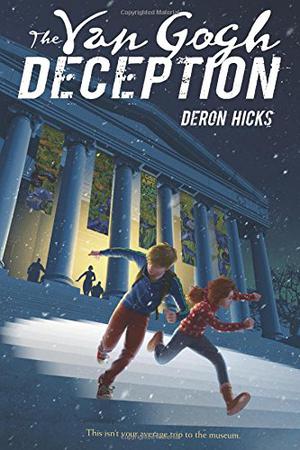
Sofia’s Kids’ Corner: The Van Gogh Deception by Deron Hicks

Share

Sofia is an 9-year-old brilliant reader who aspires to be a book reviewer. On select Saturdays, Sofia shares her favorite books with kids! She is one of the most well-read elementary schoolers that we know, so she is highly qualified for this role!

Dear readers,

This book is something I have never seen before in my life, a different type of book. This book, The Van Gogh Deception by Deron Hicks, has QR codes! These QR codes, more about them later, show famous paintings that are being described on the page that the QR code is on. Most of the paintings are by Van Gogh but some are by other artists like Hans Holbein the Younger and Leonardo Da Vinci. This book is recommended for ages 10-12!

The book is about a boy. The boy had lost his memory, meaning he didn’t know who he was, where he lived or who his parents were. He was found in the National Gallery of Art, Gallery number 83 and was sitting on a bench there for most of the day. When the security guard comes to check on him because he finds his behavior suspicious, he finds out that he has lost his memory. The boy gets sent to the police station and then they realize he has amnesia which is when you lose your memory because of a blow or a traumatic event. They ask him questions about who he is and where he lives but he doesn’t know the answers to any of these questions. They send him to foster care and he ends up with a woman named Mary Sullivan and her ten-year-old daughter, Camille. The police also put an ad in the newspaper about the boy.

Meanwhile a man, who the book leaves in the dark at first, breaks into a person’s house and takes their phone and looks through their computer. The man has a whole team of grown-ups who are the best in their field in the whole world. This person, I will say no more about because everything needs to stay a surprise.

I love this book because of its amazing feature that I have never ever come across before, QR codes! It’s something extraordinary! I love how the QR codes bring you to different sites that show those paintings and let you experiment a bit with them, meaning you can sometimes watch a video about the painting or zoom it in and out and rotate the painting or, of course, the virtual painting. On one of the sites, while zooming in, I could even find a bristle of the paintbrush that Van Gogh himself used! If you do not know what a QR code is, then I can tell you. A QR code is a code which you have to scan using your mobile phone or tablet. You would enter the camera app and then hold the mobile device closeish to the QR code as if you were about to take a picture of it. Then after holding it there a while you would see a website pop up on the top of your screen. You would have to click on that link to the website on the top and then voilá! You’ve done it! If it doesn’t work maybe your phone or tablet is too old and does not have the technology in it to recognize the QR code. If you want to find out more about them, then do what I told you to do and scan this QR code! This one goes to Wikipedia’s page about QR codes!

Another reason that I love this book is the author’s style of writing. I love when they do different perspectives but I love even more when one of the perspectives is, figuratively speaking, “left in the dark”! Get your paint brushes out and get ready to read to them!

**Thanks so much to Sofia for this review! We love those books that are so, so difficult to put down!**

Sloth Wasn’t Sleepy by Kate Messner, Illustrated by Valentina Toro

Share

Sloth Wasn’t Sleepy
Author: Kate Messner
Illustrator: Valentina Toro
Published: January 12, 2021 by Sounds True

Goodreads Summary: For any child having trouble getting to sleep, the most lovable animal in the rain forest is here to help.

One night at bedtime, Sloth wasn’t sleepy.
“What if I worry when I try to fall asleep?” Sloth said.
“Ah … worries,” Mama said. “We will have to let them go.”

A tough day, a bad dream, a scary noise … these are just a few of the things that can keep kids wide awake and frightened after dark. But Mama Sloth knows the secrets for calming worried minds and getting to sleep—and as she shares them with her daughter, young readers will learn valuable relaxation skills that last a lifetime.

Sloth Wasn’t Sleepy does more than provide a sweet bedtime story—kids will join Sloth to learn mindfulness practices such as “shrinking down” fears in their mind and calming their body through breath and simple visualizations. Kate Messner’s beautiful book helps parents and kids relax into dreamland with a sense of peace, safety, and belonging.

Ricki’s Review: This book is simply magical. Since moving to Colorado, I have understood the value of mindfulness. My kids do meditation at night, and it has really helped their sleep. This book is going to be so helpful to facilitate the process. The charming illustrations drew my attention immediately, and my kids were giggling as we read the book. The words feel carefully and intentionally placed, and they soothed me, as the reader, too! I plan to gift this book to my younger sons’ teachers to use before naptime.

Kellee’s Review: My son is definitely afflicted with a large imagination, specifically when it comes to bedtimes and fears. Reading about Sloth’s worries and her mom’s advice on how to overcome this anxiety is something I will definitely be bringing up whenever these fears erupt at bedtime. I think many kids will find solace in these routines that Mama Sloth set up for Sloth in the story–between the relaxing onomatopoeias, the deep breathing, and the visualization, the story definitely brings a calm over the reader. And to add to this feeling is the adorable and cool-colored illustrations that just tie it all together.

Teachers’ Tools for Navigation: Implicit in this book is a description of anxiety. A common manifestation of anxiety comes with nighttime worrying. I’d love to use this book in literature circles centered around mental health, or in a way that allows children to think about the ways in which they negotiate feelings of worry and anxiety.

Discussion Questions: 

  • What interrupts Sloth’s desire to rest?
  • How does Sloth work to go to sleep?
  • How can you adjust your own habits to improve your sleep?
  • What worries do you have? Shrink them, lay it on a leaf, and set it free.
  • When else could you use a breathing technique like the one Mama Sloth taught Sloth?

We Flagged: “‘Sometimes,” Mama said, “I like to pretend I’m a tree. Drinking up breath from my roots to my crown, from my toes to the top of my head. Would you like to try that, too?'”

You can also check out:

Read This If You Loved: Sloth Wasn’t Sleepy by Frann Preston-Gannon; Sparky by Jenny Offill, “Slowly, Slowly, Slowly” Said the Sloth by Eric Carle, Dinosaur Farm by Frann Preston Gannon

Recommended For: 

RickiSigandKellee Signature

**Thank you to Samantha at Sounds True for providing copies for review!**

Author Guest Post by Vivian McInerny, Author of The Whole Hole Story

Share

Typically, I think of reading as a way to settle and quiet my mind. I hope The Whole Hole Story has the opposite effect on readers. I wrote the story with the opposite intention. I hope the story and illustrations  spark and excite young minds to consider the infinite possibilities of their own imaginations.

In The Whole Hole Story, young Zia discovers a hole in her pocket. She imagines all the things a hole might be, from a swimming hole to an elephant trap, and even a tunnel to the other side of the world. It’s a simple concept that allows room for imagination. 

The idea is similar to the kind of “constraint” prompts often used in writing workshops such as, write about two strangers on a bus or write about this particular object for ten minutes —go! The paradox is that rigid constraints incite rather than stifle imagination.

I took several Massive Open Online Courses (MOOCS) through the University of Iowa taught by leaders of their famous Iowa Writers Workshop. (Highly, highly recommend —and they are free.) One class suggested writing a short story in which every sentence contained a number. Some participants created clever lists. Others wrote stories in which the numbers were more or less buried, and might even go unnoticed by an unsuspecting reader.

I’m one of those annoying workshop participants who initially dismissed such “tricks,” convinced they wouldn’t work on me. It was a delight to discover constraints useful for jumpstarting ideas. It occurred to me later that as a staff journalist for a daily newspaper, I routinely wrote with rigid constraints. Facts were a kind of constraint. (Despite opinion of the media to the contrary, most journalists really do rely on facts!) Looming deadlines were a form of time constraint. 

I think young children often feel discouraged by a world of which they have little control. I hope Zia prompts them to consider imaginative thinking as an ultimate form of autonomy.

Classroom discussion suggestions from author Vivian McInerny and illustrator Ken Lamug.

  •  Imagine the possibilities of an ordinary object such as a crochet hook or colander. Like Zia, they can imagine the object bigger, smaller, rigid, flexible, bent, filled, turned this way or that, multiplied, etc. (As a past volunteer coach with The Odyssey of the Mind program, I found this prompt useful.) 
  •  Consider how the imaginative illustrations of Ken Lamug further the story. When the elephant is trapped in the hole, Lamug imagines Zia with a rope to help him out. When Zia digs the hole deeper, Lamug imagines buried treasure, dinosaur bones, and a busy mole. And when the hole falls on top of Zia for two whole pages, Lamug adds the element of time with day turning to night. None of those things are mentioned in the text but come from the unleashed imagination of the artist.

From illustrator Ken Lamug

  •  Draw what you think could come out of the hole.
  • Talk about India and what kind of outfits the elephant might wear. Significance of those outfits. clothes.
  • Consider the different kinds of animals that go to the watering hole. Significance of water as a finite resource. How would you preserve water?
  • Playful things you can make with mud? 
  • What are cool things to collect that fit in your pocket?

Published January 12, 2021 by Versify

About the Book: In Vivian McInerny’s playful debut, readers will fall in love with wonder again as Zia imagines what might happen if the hole in her pocket became big enough to fall right through. The Whole Hole Story is perfect for readers looking for a fresh take on the classic Harold and the Purple Crayon.

Zia is used to the hole in her pocket—she frequently fills it with frogs and other objects. And as it gets bigger and bigger, she starts to wonder what might happen . . . if she fell right through. Would she cover it with a blanket to catch an elephant, or dig a tunnel to the other side of the world? The possibilities are endless, and readers will love following Zia’s adventurous imagination from beginning to end.

With hilarious wordplay paired with Ken Lamug’s bright and colorful illustrations, The Whole Hole Story will appeal to kids’ divine sense of silliness. Perfect for fans of Du Iz Tak?, and They All Saw a Cat.

Video Interview with publisher Kwame Alexander, illustrator Ken Lamug & author Vivian McInerny:

Vivian McInerny is a journalist and fiction writer. Her short stories are published in several literary magazines including 805 Lit+Art, Dunes Review, and Literature for Life. The Whole Hole Story is her first children’s book.  Vivian McInerny TwitterFacebook  Ello

Illustrator Ken Lamug is an award-winning professional dabbler. He was born in the Philippines and moved to the US with his entire family during his teenage years. Currently, he enjoys his life as an author/illustrator of picture books and graphic novels for middle-graders to middle-agers.

In his past life he was a beekeeper, race car driver, filmmaker and chicken herder. He currently lives in Las Vegas (although he doesn’t gamble) where he spends time with his family and two dogs.

Ken is the Illustrator Coordinator for Nevada Chapter of SCBWI (Society of Children’s Book Writers and Illustrators). He also teaches graphic novels for Storyteller’s Academy and a team member of #KidLitGN Pitch event.

Thank you, Vivian, for sharing about the book!

Sofia’s Kids’ Corner: Beyond the Bright Sea by Lauren Wolk

Share

Sofia is an 9-year-old brilliant reader who aspires to be a book reviewer. On select Saturdays, Sofia shares her favorite books with kids! She is one of the most well-read elementary schoolers that we know, so she is highly qualified for this role!


Dear readers,

If you are looking for a book that takes place maybe 100 years ago then this is the book for you. The book, Beyond the Bright Sea by Lauren Wolk takes place in 1925! It is an amazing historical fiction adventure about a girl, named Crow, who is curious about where she came from and who her parents are. I recommend this book for 10-13 year olds. By the way, when I started reading this book I was a bit confused, but after maybe the thirtieth page I understood everything. I am saying this so you don’t get discouraged in the first few pages.

When Crow was a newborn baby she got sent off on a skiff and landed on a beach where a person nicknamed Osh took her in and cared for her. Osh’s neighbour, Miss Maggie, came over every day to help him with Crow and bring her gifts. As Crow grew older she began to wonder more about her background, where she came from and who her parents were. Ever since she lived on the island everybody avoided her except for Miss Maggie and Osh. Due to her mysterious appearance a lot of people thought she was from Penikese, an island where a few years before people sick with leprosy, a bad sickness that can kill people, were sent to live in. She gets even more curious about her background when a mysterious fire appears on Penikese. She tells Osh about it and tells him that she wants to go there. Osh says that is just the old bird keeper and that all is ok on the island but she convinces him to go there anyway. If you were wondering, Penikese is burnt down when he says that. A few days later when they go to the island they meet a big mad man. He claims to be the bird keeper, but Crow heard a clunk before he came to greet them that makes her suspicious. Do you think something is wrong with that acclaimed bird keeper and the clunk or do you think that it was nothing?

I love this book because of the different lifestyle she lives. She basically lives in a cottage made of pieces of ships that got shipwrecked. She also lives a different life because she is homeschooled and because she helps out on a farm anytime she wants for fun. I also love this book because no matter how weird it seems, a lot of people can relate to Crow! For example I related to Crow when she sees the fire on Penikese island and wants to investigate it, I would do that too. Enjoy the ride!

If you liked this book then you might want to check out The Remarkable Journey of Coyote Sunrise by Dan Gemeinhart, which I wrote a review about last week! The characters are alike in the way that they both don’t really live a normal life.

**Thanks so much to Sofia for this review! We love historical fiction, and we are excited to feature this one on the blog!**


Sofia’s Kids’ Corner: The Remarkable Journey by Coyote Sunrise by Dan Gemeinhart

Share

Sofia is an 9-year-old brilliant reader who aspires to be a book reviewer. On select Saturdays, Sofia shares her favorite books with kids! She is one of the most well-read elementary schoolers that we know, so she is highly qualified for this role!


Dear readers,

Presenting: The Remarkable Journey of Coyote Sunrise by Dan Gemeinhart!!! This is a story of a brave girl who is determined to get a memory box which she buried with her mom and sisters before they got killed in a car crash. She made a promise to get that box and she isn’t the type to break promises! This book is recommended for ages 9-12.

Coyote’s mother and her two sisters died five years ago in a car crash so Coyote’s dad, Rodeo, is the one who takes care of her. After the death of his wife and two daughters he bought a school bus and named it Yager. The bus, Yager, would now be their new home. Coyote’s dad forbids her to say anything related to her family which includes the words mom, dad, sister, Ava, Rose and many more. He also tells her not to think of her sisters and mom. And that’s why, for five years, Coyote and Rodeo have been traveling around the country, avoiding their home because it gave them too many memories. Coyote talks on the phone with her grandma every Saturday to catch up. One time when they talk her grandma tells her that the park that she used to play in was going to be destroyed on Wednesday! Coyote remembers that that is where her mom and sisters had buried a time capsule back when they were still alive. She devises a plan to dig up the time capsule before the park is destroyed. That is pretty complicated for two reasons, one the park is in Washington and she is in Florida which means they would have to drive about 3,600 miles to get there and two, the second that she told her dad about it he was going to say it was a no-go. It takes a lot of planning but finally Coyote comes up with a plan. I can’t tell you the plan but I can say that after a bit of time on the road they pick up a man named Lester and even later when they are bickering about a map they drive off and forget Coyote! Will they come back for her or will they forget about her?

I absolutely love this story because this story is unusual. Think about it, a twelve year old who lives in a school bus named Yager. Most stories start with girls living a normal-ish life but Coyote is a more interesting and different character. The name Coyote Sunrise even sounds exciting! She lives differently than other people, is just simply different in her characteristics and has things that she can’t say or think about without getting into trouble. Not every character in a book can do and does what Coyote Sunrise does in this book. The second reason I love this book is because the front cover illustration is amazing! For this I have to say that the cover illustrator did a great job and that the cover gives the book a nice feel to it when you are reading it. I usually don’t do this but while reading this book sometimes I just flipped to the front cover and started staring at it and then I got back to reading. Another reason I love this book is because once I started it I could not put it down. Well unless of course I had to, like when I had to eat or sleep or go to school. But still! I really hope that you love this book as much as I do!

**Thanks so much to Sofia for this review! We love those books that are so, so difficult to put down!**


Eyes that Kiss in the Corners by Joanna Ho, Illustrated by Dung Ho

Share

Eyes that Kiss in the Corners
Author: Joanna Ho
Illustrator: Dung Ho
Published: January 5, 2021 by HarperCollins

Summary: This lyrical and stunning picture book tells a story about learning to love and celebrate your Asian-shaped eyes, in the of spirit of Hair Love by Matthew A. Cherry

A young Asian girl notices that her eyes look different from her peers’. They have big, round eyes and long lashes. She realizes that her eyes are like her mother’s, her grandmother’s, and her little sister’s. They have eyes that kiss in the corners and glow like warm tea, crinkle into crescent moons, and are filled with stories of the past and hope for the future.

Drawing from the strength of these powerful women in her life, she recognizes her own beauty and discovers a path to self love and empowerment.

This powerful, poetic picture book will resonate with readers of all ages and is a celebration of diversity.

Ricki’s Review: This book is beautiful and poetic. You could give it to any reader of any age, and they would be captivated by how beautifully it is conceived, constructed and delivered. The lyrical lilt of the words as it is read aloud are captivating. I found myself pausing at the end of reading each page to take in the beauty of the author’s language. Ahh, and the illustrations! The cover is just a teaser for the stunning pictures within this book. I am really excited to gift this book to friends and family. It exemplifies the beauty and power of pictures books. I plan to read it aloud to my YAL class next semester. This book just hit the shelves, and I expect it to be very popular.

Teachers’ Tools for Navigation: Teachers can use this book to offer students examples of figurative language. Often, figurative language can feel forced, but here, it flows magically with the storyline. I found that reading this book inspired me to want to write!

“Mama’s eyes that kiss in the corners and glow like warm tea

crinkle into crescent moons…”

Discussion Questions: 

  • How does the author use figurative language effectively?
  • What do you believe to be the author’s and illustrator’s message? How do they convey this message?
  • Who does the main character draw strength from? Who do you draw strength from?

Flagged Spread:

Image from: https://www.joannahowrites.com/eyes-that-kiss

Read This If You Love: Hair Love by Matthew A. Cherry; Fry Bread: A Native American Family Story by Kevin Noble Maillard; A Big Mooncake for Little Star by Grace Lin

  classroomlibrarybuttonsmall

**Thank you, Keely, from SparkPoint Studio for sending a copy for review!**