Stop Asian Hate: Anti-Racist Strategies

Share

Asian Americans: We hear you, we see you, and we condemn the violent hate crimes against you that are happening, and have happened, in the United States.

Anti-Asian violence has been on the rise over the last year here in the United States, but the recent murders are not isolated incidents, and are instead part of a legacy of racism again AAPIs.

As we shared in our Black Lives Matter post: Racism is a long-standing virus in our country. This virus is not new—it is engrained in our history. And what is happening in our country now (and throughout our time as a nation) is motivated by the White systemic racism that permeates structures and motivations of this country.

There is no in-between safe space of  being not racist, and thus we must be anti-racist. As a reminder, here are some key resources to working towards an anti-racist society for all BIPOCs:

First, educate yourself on the racism faced by AAPIs today and the history of this racism: 

Educators: Also, educate your students: 

Then, it’s time to start doing. Remember: educating ourselves is critical, but it is only the first step. Action must follow:

Share posts from AAPI activists or organizations that inform about, fight against anti-Asian racism and support—through volunteering and financially, if you can—the organizations however you can: 

Support works produced by AAPI artists and creatives, support AAPI businesses, and participate in Asian American Pacific Islander Heritage Month: 

Highlight the history and contributions of the AAPI community. One way this can be done is by reading and sharing books by AAPI authors and about AAPI characters with our students, kids, family, etc. 

Continue to listen to AAPI voices and do not stop educating yourself. Only through ongoing work will we work our way towards an anti-racist society. 

and

**Please note: Many of these links have been widely shared on social media, and we curated them here and added many others, particularly connected to reading, to give them a concrete place. This is shared work.**
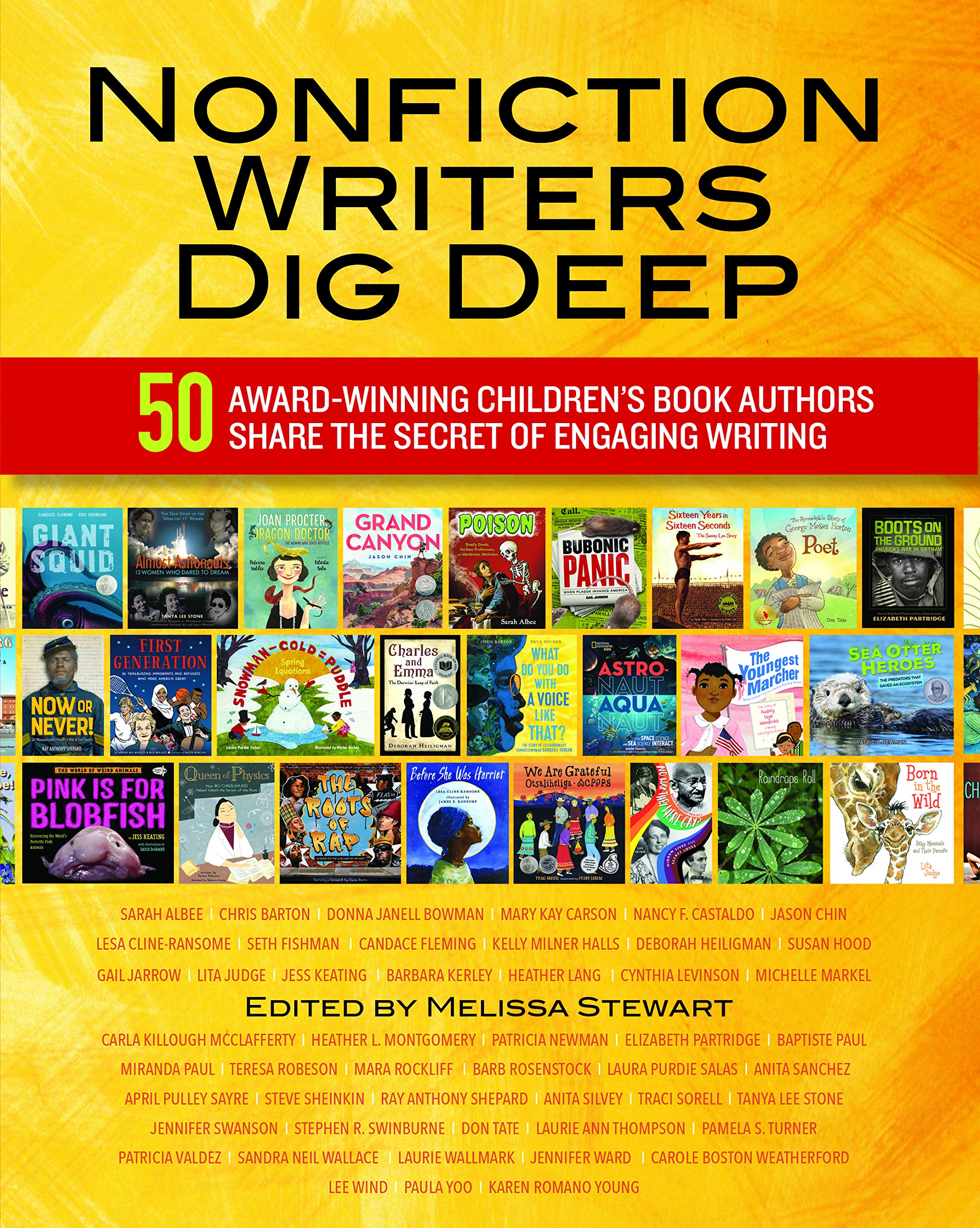

Nonfiction Writers Dig Deep: 50 Award Winning Children’s Book Authors Share the Secret of Engaging Writing Edited by Melissa Stewart

Share


Nonfiction Writers Dig Deep: 50 Award Winning Children’s Book Authors Share the Secret of Engaging Writing
Editor: Melissa Stewart
Published November 2020 by National Council of Teachers of English

Summary: In Nonfiction Writers Dig Deep: 50 Award-Winning Children’s Book Authors Share the Secret of Engaging Writing, some of today’s most celebrated writers for children share essays that describe a critical part of the informational writing process that is often left out of classroom instruction.

To craft engaging nonfiction, professional writers choose topics that fascinate them and explore concepts and themes that reflect their passions, personalities, beliefs, and experiences in the world. By scrutinizing the information they collect to make their own personal meaning, they create distinctive books that delight as well as inform.

In addition to essays from mentor authors, Nonfiction Writers Dig Deep includes a wide range of tips, tools, teaching strategies, and activity ideas from editor Melissa Stewart to help students (1) choose a topic, (2) focus that topic by identifying a core idea, theme, or concept, and (3) analyze their research to find a personal connection. By adding a piece of themselves to their drafts, students will learn to craft rich, unique prose.

100 percent of the proceeds will be divided among the National Council of Teachers for English (NCTE), We Need Diverse Books (WNDB), and the Society of Children’s Book Writers and Illustrators (SCBWI)

About the Author: Melissa Stewart has written more than 180 science books for children, including the ALA Notable Feathers: Not Just for Flying, illustrated by Sarah S. Brannen; the SCBWI Golden Kite Honor title Pipsqueaks, Slowpokes, and Stinkers: Celebrating Animal Underdogs, illustrated by Stephanie Laberis; and Can an Aardvark Bark?, illustrated by Caldecott Honoree Steve Jenkins. She coauthored 5 Kinds of Nonfiction: Enriching Reading and Writing Instruction with Children’s Books (forthcoming) and grades K-2 and 3-5 editions of Perfect Pairs: Using Fiction & Nonfiction Picture Books to Teach Life Science. Stewart maintains the award-winning blog Celebrate Science and serves on the Society of Children’s Book Writers and Illustrators board of advisors. Her highly regarded website features a rich array of nonfiction writing resources.

Contributors: Sarah AlbeeChris BartonDonna Janell BowmanMary Kay CarsonNancy CastaldoJason ChinLesa Cline-RansomeSeth FishmanCandace FlemingKelly Milner HallsDeborah HeiligmanSusan HoodGail JarrowLita JudgeJess KeatingBarbara KerleyHeather LangCynthia LevinsonMichelle MarkelCarla Killough McClaffertyHeather L. MontgomeryPatricia NewmanElizabeth PartridgeBaptiste PaulMiranda PaulTeresa RobesonMara RockliffBarb RosenstockLaura Purdie SalasAnita SanchezApril Pulley SayreSteve SheinkinRay Anthony ShepardAnita SilveyTraci SorellTanya Lee StoneJennifer SwansonStephen R. SwinburneDon TateLaurie Ann ThompsonPamela S. TurnerPatricia ValdezSandra Neil WallaceLaurie WallmarkJennifer WardCarole Boston WeatherfordLee WindPaula YooKaren Romano Young

From Melissa Stewart: “Behind the Book”

The idea for this book traces back to the 2017 National Council of Teachers of English (NCTE) Annual Convention in St. Louis, Missouri, when I was fortunate to participate in a panel titled ‘The Secret of Crafting Engaging Nonfiction’ with two of the most talented children’s nonfiction authors of our time—Candace Fleming and Deborah Heiligman.

During our discussion, moderated by educator and children’s nonfiction enthusiast Alyson Beecher, we dove deeply into what fuels our work and why we routinely dedicate years of our lives to a single manuscript. As we compared our thoughts and experiences, we came to realize something critically important—each of our books has a piece of us at its heart. And that personal connection is what drives us to keep working despite the inevitable obstacles and setbacks.

Several other nonfiction authors attended our presentation, and afterward they praised our insights. That conversation helped us all understand our creative process in a new and exciting way. And it eventually led to the essays in this anthology, which are our way of sharing an important—and often unrecognized and underappreciated—aspect of nonfiction writing with educators and students.

Review and Teachers’ Tools for Navigation: I was star struck seeing all of the authors who had contributed! I was lucky enough to be at the presentation that this book’s seed of an idea started, so when I heard about this book, I knew it would be a book I would need!

This book is all about moving nonfiction writing to an authentic experience. The book is broken into 3 sections to help guide writing instruction:

  • Choosing a Topic
  • Finding a Focus
  • Making is Personal

Within each section there are essays by mentor authors focusing on different aspects of the topic. I loved reading the essays that ranged from a look at how to take an idea and make it grow, about complexities within nonfiction, about the bumps along the way, about the writing process, and everything else you can think of.

Then the last part of the chapter is In the Classroom which helps tie the essays all together with how to take it to our students.

This book is written specifically with teachers in mind–it is such an amazing resource!

Video about the Book: https://melissa-stewart.com/books/teachers/bk_nonfiction_writers_dig_deep.html

Read This If You Love: Teaching authentic nonfiction writing

Recommended For: 

Signature

Educators’ Guide for A Stone Sat Still by Brendan Wenzel

Share

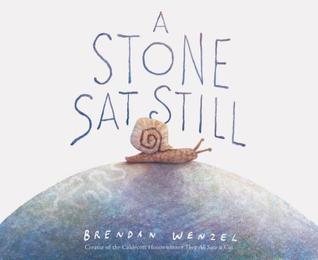
A Stone Sat Still
Author & Illustrator: Brendan Wenzel
Published: August 27th, 2019 by Chronicle Books

Summary: The brilliant follow-up to the Caldecott Honor-winning and New York Times bestselling picture book They All Saw a Cat by Brendan Wenzel!

A Stone Sat Still tells the story of a seemingly ordinary rock—but to the animals that use it, it is a resting place, a kitchen, a safe haven…even an entire world.

This is a gorgeous exploration of perspective, perception, and the passage of time, with an underlying environmental message that is timely and poignant.

• Filled with stunning illustrations in cut paper, pencil, collage, and paint
• Soothing rhythms invite reading aloud and bedtime snuggles
• Introduces concepts like color, size, function, and time in a way that is easily understandable and teachable for children

With a rhythmic, calming narrative about the stone and its place in the world—and the changing environment—A Stone Sat Still proves Brendan Wenzel’s mastery of the picture book form.

Teachers’ Tools for Navigation and Discussion Questions: 

Please view and enjoy the official educators’ guide for A Stone Sat Still (created by me!):

You can also access the teaching guide here.

You can learn more about A Stone Sat Still here.

Recommended For: 

readaloudbuttonsmall classroomlibrarybuttonsmall litcirclesbuttonsmall closereadinganalysisbuttonsmall

Kellee Signature

Educators’ Guide for A Girl, a Raccoon, and the Midnight Moon by Karen Romano Young, Illustrated by Jessixa Bagley

Share

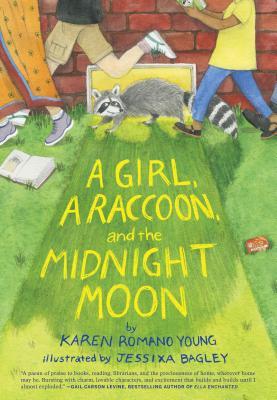
A Girl, a Racoon, and the Midnight Moon
Author: Karen Romano Young
Illustrator: Jessixa Bagley
Published: January 7th, 2020 by Chronicle Books

Summary: In a slightly fantastical New York City, one very special library branch has been designated for possible closure. Bookish, socially awkward Pearl, the daughter of the librarian, can’t imagine a world without the library—its books, its community of oddballs, its hominess. When the head of their Edna St. Vincent Millay statue goes missing, closure is closer than ever. But Pearl is determined to save the library. And with a ragtag neighborhood library crew—including a constantly tap-dancing girl who might just be her first friend, an older boy she has a crush on, and a pack of raccoons who can read and write—she just might be able to.

With an eclectic cast of richly drawn characters, a hint of just-around-the-corner magic, footnotes, sidebars, and Jessixa Bagley’s classic illustrations throughout, this warm-hearted, visually magnificent tale of reading and believing from beloved author Karen Romano Young tells of a world where what you want to believe can come true.

Teachers’ Tools for Navigation and Discussion Questions: 

Please view and enjoy the official educators’ guide for A Girl, a Racoon, and the Midnight Moon (created by me!):

You can also access the teaching guide here.

You can learn more about A Girl, a Raccoon, and the Midnight Moon here.

Recommended For: 

readaloudbuttonsmall classroomlibrarybuttonsmall litcirclesbuttonsmall closereadinganalysisbuttonsmall

Kellee Signature

Educators’ Guide for AstroNuts Mission Two: The Water Planet by Jon Scieszka, Illustrated by Steven Weinberg

Share

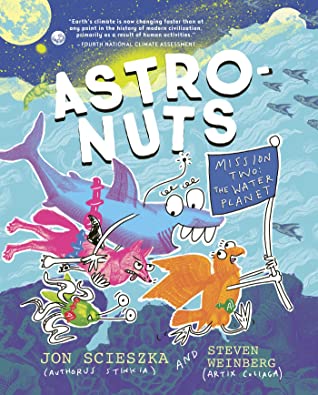
AstroNuts Mission Two: The Water Planet
Author: Jon Scieszka
Illustrator: Steven Weinberg
Published: August 25th, 2020 by Chronicle Books

Summary: AstroNuts Mission Two: The Water Planet is the second book in the laugh-out-loud series by children’s literature legend Jon Scieszka.

The book follows a new mission, where AstroWolf, LaserShark, SmartHawk, and StinkBug must find a planet fit for human life after we’ve finally made Earth unlivable.

After they splash-land on the Water Planet, they find power-hungry clams, a rebellious underwater force, and a world full of too-good-to-be-true. Can this aquatic world really be humans’ new home? And why are these clams so eager to swap planets?

• Features full-color illustrations and an out-of-this-world book jacket
• A can’t-put-it-down page-turner for reluctant readers
• Complete with how-to-draw pages in the back

AstroNuts Mission Two is full of laugh-out loud humor with a thoughtful commentary on the reality of climate change at the core of the story.

Eager and reluctant readers alike ages 8 to 12 years old will be over the moon about this visually groundbreaking read.

• Creatively illustrated, full-color action-packed space saga
• Perfect for fans of Dog Man, Big Nate, Wimpy Kid, and Captain Underpants
• Great gift for parents, grandparents, teachers, librarians, and educators who are looking to introduce STEM and environmental topics to children
• Add it the the shelf with books like The Bad Guys in Superbad by Aaron Blabey, The 104-Story Treehouse: Dental Dramas & Jokes Galore! by Andy Griffiths, and The Stinky Cheese Man and Other Fairly Stupid Tales by Jon Scieszka

Teachers’ Tools for Navigation and Discussion Questions: 

Please view and enjoy the official educators’ guide for AstroNuts Mission Two (created by me!):

You can also access the teaching guide here.

You can learn more about AstroNuts Mission Two here.

You can see information about AstroNuts Mission One and its Educators’ Guide here.

Recommended For: 

readaloudbuttonsmall classroomlibrarybuttonsmall litcirclesbuttonsmall closereadinganalysisbuttonsmall

Kellee Signature

Educators’ Guide for Leave It to Abigail: The Revolutionary Life of Abigail Adams by Barb Rosenstock, Illustrated by Elizabeth Haddeley

Share

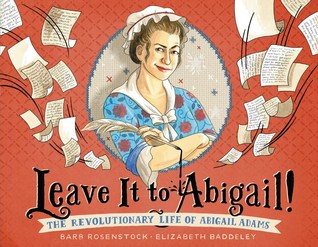
Leave It to Abigail!: The Revolutionary Life of Abigail Adams
Author: Barb Rosensock
Illustrator: Elizabeth Haddeley
Published: February 4th, 2020 by Little, Brown and Company

Summary: In this inspiring tribute, award-winning author Barb Rosenstock and New York Times bestselling artist Elizabeth Baddeley tell the true story of one of America’s greatest founding mothers: Abigail Adams.

Everyone knew Abigail was different.

Instead of keeping quiet, she blurted out questions. Instead of settling down with a wealthy minister, she married a poor country lawyer named John Adams. Instead of running from the Revolutionary War, she managed a farm and fed hungry soldiers. Instead of leaving the governing to men, she insisted they “Remember the Ladies.” Instead of fearing Europe’s kings and queens, she boldly crossed the sea to represent her new country. And when John become President of the United States, Abigail became First Lady, and a powerful advisor.

Leave it to Abigail–an extraordinary woman who surprised the world.

Teachers’ Tools for Navigation and Discussion Questions: 

Please view and enjoy the official educators’ guide for Leave It to Abigail (created by me!):

You can also access the teaching guide here.

You can learn more about Fight of the Century here.

Barb Rosenstock also created two other resources for educators:
A Pinterest Board
A Text Set

Recommended For: 

readaloudbuttonsmall classroomlibrarybuttonsmall litcirclesbuttonsmall closereadinganalysisbuttonsmall

Kellee Signature

K-2 Teachers: Indigenous Peoples Day and Thanksgiving

Share

My son’s phenomenal elementary school teacher, started the first week of school reading Fry Bread: A Native American Family Story by Kevin Noble Maillard. Children volunteered to share their tribal membership and lineage. They talked about family and what fry bread meant to them and their families. From the first day of school, I noticed the beauty of her instructional approach as she read different picture books aloud which invited the children to share their stories. She doesn’t limit books to designated months and is sharing year-round and her pedagogies are culturally sustaining in so many ways (but this is not the purpose of this post, so I’ll stop there).

Recently, two K-2 teachers asked me specifically: What can I do for Indigenous Peoples Day and Thanksgiving? These are two teachers who I didn’t need to say: first, don’t make this a single day or a month. They knew this. I shared with them some of the resources from good sources that I know, and I am sharing them here in case others find them useful. My expertise is in 6-12 teacher education, but I know others who do research/writing in this area or write books for K-2 (and beyond), and they are cited among the resources below. There are so many resources outside of this post, so if this is your first go at it, please don’t limit yourself to this post here. If you are grades 6-12, this is not really the post for you, and on another day, I might venture into recommendations for this age level, which I feel are even more bountiful (which include publications by some of the people cited on the list below, among other brilliant authors and scholars). If you are K-2 and have more suggestions, lay them out in the comments section.

First, I recommend Debbie Reese and Jean Mendoza’s Tips for Teachers: Developing Instructional Materials about American Indians (which is K-12). This just offers grounding knowledge that is imperative. If you will read nothing else on this page, read this (and their two comments below the post, which include resources that primarily feature resources for grades 4 and up but are very good).

Indigenous Peoples Day

Every family celebrates Indigenous Peoples Day differently. With my relatives and (non-school) community, growing up, we most often talked about the truth about Columbus on this particular day because it was such a glaring holiday on our school calendar. Looking back, this centers Whiteness in many ways because we were so keenly focused on that day. But it was a reality for us as I would come home with worksheets from school coloring in his face. It is still celebrated as “Columbus Day” in the school district that I grew up in as a student. This made school very confusing to me, where Columbus was revered. It wasn’t until I was in middle school that I felt like my relatives shifted to more of a Indigenous Peoples Day conception and celebration (although they have no problem talking about some of the absurdities of who is revered in holidays—such as Columbus). I don’t know if others celebrated it this way growing up, but this was my experience as a child in K-6.

When these K-2 teachers asked me how they might talk about Indigenous Peoples Day this coming Monday, I recommended that they start by ensuring that their 5- and 6-year-old students knew that Indigenous people are still alive. I know this feels like a basic thing, but young kids are often taught about Indigenous people as a thing in the past, and they don’t seem to connect this past and present connection at this age. The way Native Americans are depicted in history and books, they are frozen in time. If you want to show them that Indigenous people are not a thing of history, you could, for instance, show the Project 562 gallery or you could show this video of an elementary school which offers a bilingual Ojibwe program and bilingual Cree program. Celebrate famous Indigenous people in the news, sports, etc. today. These are quick suggestions, and I am sure others have more.

You might also talk with kids about the land that they live on. I like the Native Land Digital website a lot. This gets complicated because territories are a Western notion, but this site offers a starting point. You can talk about the nations that exist in your area and their present day issues (rather than solely focusing on historical) and look at the nations’ websites.

Native Knowledge 360 offers ideas for instruction (sortable by grade). Beyond the K-2 suggestions, you might offer a modified version of this project about environmental challenges for your students.

Focus on reading stories by Indigenous authors. The American Indian Youth Literature Award is a great place to start.


Thanksgiving

This holiday is associated with a lot of hard experiences for me—and the holiday is inextricably tied to experiences in my schooling. It is these schooling experiences that compelled me to decide to go into teaching. There’s a lot to unpack and it’s beyond this post, so instead, I can offer a brief list of don’ts for teaching: Thanksgiving plays/feasts, dressing up as Indians/Pilgrims, stereotypical images of Indians and pilgrims, Indian names (and while we are at it, spirit animals), Native American craft time, and paper headdresses or fake feathers.

When I was younger, we did a harvest dinner, and our family talked about what this day meant (and it wasn’t a happy pilgrims/Indians thing). As a starting point, Teaching Tolerance offers age-appropriate ideas for teachers, Oyate has a website about myths about Thanksgiving, and you might check out the blog post “Do American Indians celebrate Thanksgiving?” There is also an “interactive historian” website that works against myths about the holiday.

For our family, when we sit down to dinner on that Thursday that is revered by many, we do take the time (and we do this every day) to talk about the food that we are eating and honoring where it came from; the land that we reside on and the original habitants and the cost at which it came to us; and those for whom we are grateful. Along this line, I especially recommend We Are Grateful: Otsaliheliga by Traci Sorrell. She has another book coming out in April 2021 that is available for pre-order.

I debated not writing this post because I am not a K-2 teacher, and I am not someone who specializes in representation. But I am a parent. And I was a K-2 child once, and this age carries a lot of weight for me, primarily because of how I struggled in school. When these teachers asked me for help, they asked me genuinely, and they were earnest in their goals of doing what is in the best interest of kids. If your expertise falls more in this area and you have recommendations, comment below. If you have questions, comment below. I’ll come back on another day with more 6-12 books, but as I noted, there are so many great resources in this area, that I felt it best to start with K-2.