Author Guest Post: “Point-of-View Flip as a Way into Creative Writing” by Shirley Reva Vernick, Author of Ripped Away

Share

“Point-of-View Flip as a Way into Creative Writing”

I’m a big fan of the “point-of-view flip” activity for young writers. That’s where students are asked to retell an existing story (or scene or chapter) from a POV other than the one presented in the original. This exercise can be done with a short and simple tale like The Three Little Pigs (e.g., the wolf’s first-person POV) or with more advanced texts. I like this literary workout because, besides being just plain fun, it can help writers grow their skills. Here’s my thinking:

It’s hard to write creatively, from blank, on demand. That’s why I always hated assignments like, “Write a story from this week’s spelling words.” It’s why I’ve never gone to writers’ retreats, where I’d be put up for a random week not of my own choosing and expected to produce. I can no sooner schedule my creative juices than I can schedule the rain. I suspect that many students feel the same way.

With the POV flip exercise, students don’t have to pull characters or plots out of thin air. Those elements are already there, freeing students to focus on the craft of show-not-tell, dialogue, pacing, etc.

POV flipping shows writers how much hinges on POV when telling a story. After publishing four novels and several short stories, I’m more certain than ever that POV is among the most pivotal—and challenging—determinations to make in the writing process.

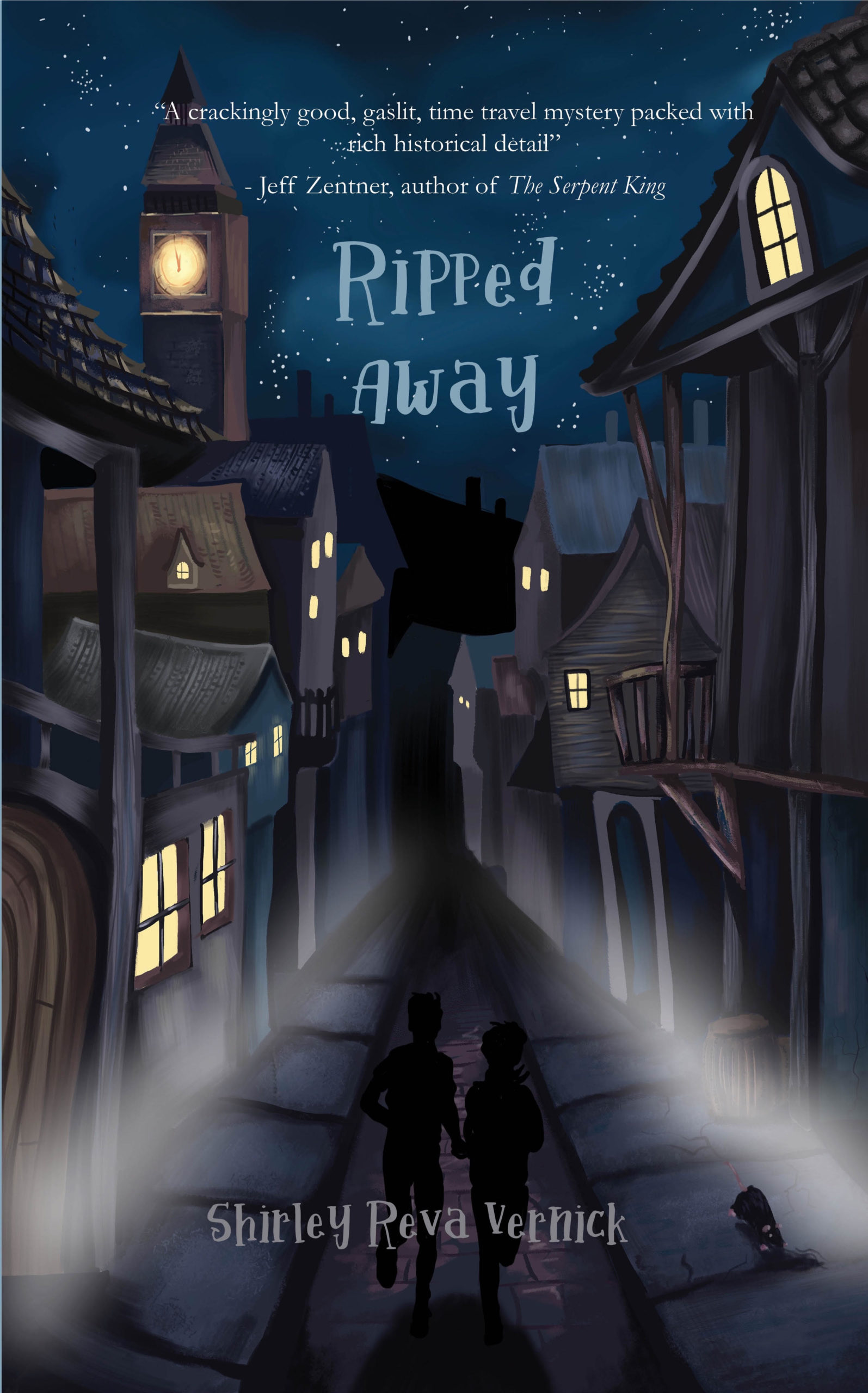
Take, for instance, my new upper-MG/early-YA novel, Ripped Away, which is set in Victorian London during the Jack the Ripper spree. I wrote my first draft in the third-person perspective of a boy growing up in London during that time. Something wasn’t right though. This POV didn’t feel immediate enough, intimate enough. So I rewrote the book in the first-person POV of that same character. It was an improvement, but I still wasn’t satisfied. Something was missing.

Eventually, I understood that the book wanted a narrator with a modern voice and contemporary sensibilities, because that’s how the tale would best resonate with readers. So I re-wrote it again, and that’s how Ripped Away became a time-travel fantasy.

When I think about how different the book would be if told from yet a different viewpoint—that of another character, or several other characters, or even an omniscient narrator—I see that Ripped Away could have been many stories. It took time and effort to discover the best POV for the story I wanted to tell, and it was well worth the investment. If students get the chance to experiment with viewpoint through the POV flip exercise, I think it will help them choose the right POV when they do create their own original text.

The flip activity keys students into POV in their reading. You can’t play around with viewpoint in your writing without it seeping into your awareness of what you read. I know several readers who actually use POV as a guide to selecting their leisure reading. Some insist on female first-person POV, others on third-person limited, yet others on multiple points of view. My own daughter goes for first-person stories that are told from the distance of time—an older adult looking back on his or her youth. I, for one, am drawn to the first-person peripheral narrator, like The Great Gatsby’s Nick Carraway. Throw in a dash of unreliability, and I’m hooked. I also like books that skillfully mix it up—part first-person, part third-person, and a sprinkling of second-person for added intensity.

So who knows? Maybe we can get kids to read more by guiding them to stories with the POV they prefer. And kids who read more—anyone who reads more—will be a better writer for it.

Coming February, 2022

About the Book: Ripped Away is based on the real experiences of Jewish immigrants to London during the Jack the Ripper spree, when xenophobia ran high.

In the story, a fortune teller reveals that classmates Abe and Mitzy may be able to save someone’s life…and then she sweeps them to the slums of Victorian London in the middle of the Jack the Ripper spree. To get back home, they’ll have to figure out how the fortune teller’s prophecy is connected to one of history’s most notorious criminal cases. They’ll also have to survive the outpouring of hate toward Jewish refugees that the Ripper murders triggered.

Vernick’s purpose in writing Ripped Away is to illuminate this episode in history, as well as to inspire readers to contemplate possible responses to intolerance. National Jewish Book Award-winning author Anne Blankman calls Ripped Away “an engrossing adventure. From the moment Abe and Mitzy are swept back in time to the infamous Jack the Ripper, readers will clamor to find out what happens next.”

Book Trailer: 

About the Author: Shirley Reva Vernick is the author of four novels for young readers. The Blood Lie is an American Library Association Best Fiction for Young Readers pick and a Sydney Taylor Book Award honoree. Remember  Dippy won the Dolly Gray Literature Award from the Council for Exceptional Children. The Black Butterfly is a Junior Library Guild selection. Ripped Away will be released February 8, 2022 by Regal House Publishing.

Shirley is a graduate of Cornell University and an alumna of the Radcliffe Writing Seminars. When not creating stories, she mentors incarcerated individuals with their writing via the Prisoner Express program.

Please see www.shirleyrevavernick.com for more.

Thank you, Shirley, for your wonderful creative writing activity and for sharing your book–we cannot wait until it is published!

Author Guest Post: “Tech Timeout, a Playwriting Lesson” by Joy Jones, Author of Jayla Jumps In

Share

“Tech Timeout, a Playwriting Lesson”

An irritated parent accosted me in the parking lot. “Don’t make my son do that assignment,” she pleaded.

Some years ago I taught playwriting to middle schoolers. The class was an elective so all of them had chosen to be there. Yet when it came time to start writing, all I heard was “I can’t think of anything.” or “I don’t have any ideas.”

That’s when I came up with an idea to help them come up with ideas. Prior to beginning the playwriting process, their homework was to ‘Just say no.’ to electronic entertainment. No broadcast or cable television viewing. No computer games or internet browsing. However, using the computer for responding to email, using the internet for teacher-assigned projects and attending movies or plays at a theater were permitted. (This was before cell phones became so pervasive.) And that’s why this mother grabbed me in the parking lot. “You’re punishing the whole family,” she said. “To prevent him from doing it, we have to not do it, too.”

This mother was a lady I liked. She knew I was an author and had aspirations for writing fiction herself but hadn’t gotten around to it. Life in the big city keeps you pretty busy, after all. I would try to encourage her to sit down and write but somehow her schedule would never allow for it.

Despite her impassioned objections to the no TV, no internet rule, I held firm. The assignment required students to abstain for four consecutive days. They could use the computer for homework in other classes, but not for fun. Parents had to sign a sheet documenting that their children had complied. I also sent home a list of things they could do besides watch television or play video games. Among the things I suggested: practice a musical instrument, go to a friend’s house, ride a bicycle, fix that thing that’s been broken forever, sort out a closet, play outdoors. The first item on the list was: start writing your play.

After the experiment, they also had to write about the experience. Some of their comments:

It was okay living without TV. I dont really watch a lot of television anyway, except on weekends. I went outside for bike rides, went for some ice cream, and played sports…   I also read a lot, and wrote e-mails, letters, essays and poems.  —Alicia K.

It was a nightmare going without TV… I thought I was going to die. Living without TV for four days was not as bad as I thought it was but it was still a little boring. Life went on and I and everybody around me lived.This might sound a little abnormal but I held it in. The temptation was there… I mean once in awhile I felt like getting up and turning on the TV.  —Colby J.

Going without [technology] was not hard. It was actually kind of fun. I got all of my homework done (that is not usual.) I was able to read a book and enjoyed it. I had free time to myself. I was able to work on all my projects and turn them in on time. —Jamela S.

After this period of abstinence, students ‘magically’ had great story ideas to put down on paper. It was easier for them to get their plays underway. Emptying their minds of electronic clutter seeded and strengthened their imaginations.

Although I, too, am guilty of spending too much time bouncing between You Tube and the boob tube, sometimes I actually act on my own advice.

I distinctly remember an occasion when I jumped in the car and reflexively reached for the radio. But before my hand could make contact with the tuner, that still, small voice said “No.”

I stifled the urge to fill the car with noise and stayed silent. As I drove in the quiet, I began thinking about my MG novel JAYLA JUMPS IN, which was still in progress. As I mused about my plot, I was able to work out several scenes. Being willing to put the tech in check enhanced my creative process.

Julia Cameron, creativity guru and author of THE ARTIST’S WAY, calls this practice ‘media deprivation’ when you deliberately call a time-out from consuming all forms of artificial amusement to give your brain a re-set.

Not long after the assignment to temporarily go screen-free so that her son could write a play, that same mom stopped me again in the parking lot. This time she wasn’t angry, she was bubbling over with excitement. “Guess what!” she said. “I finally started my short story!”

Would your students benefit from a technology break?

Would you?

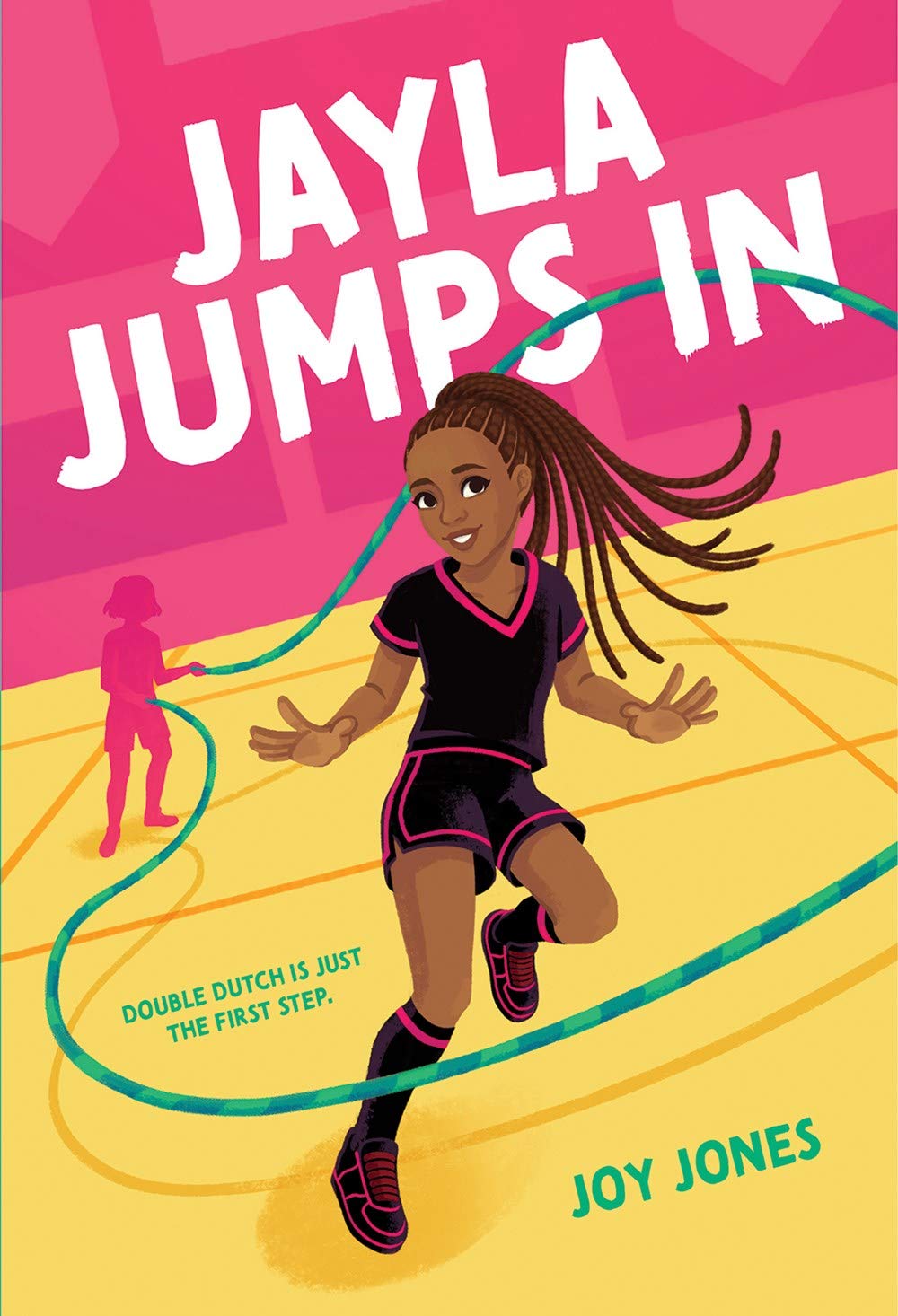
Jayla Jumps In
Author: Joy Jones
Published September 1st, 2020 by Albert Whitman & Company
Paperback releasing Fall, 2021

About the Book: When eleven-year-old Jayla finds out that her mother used to be a Double Dutch champion, she’s stunned. Her mom, who’s on doctor’s orders to lower her blood pressure, could move like that?!? Jayla decides to follow in her mom’s footsteps, thinking that maybe double Dutch can make her stand out in her big, quirky family. As she puts together a team at school and prepares to compete, Jayla finds that Double Dutch is about a lot more than jumping rope–and it just might change her life in ways she never imagined. Full of hilarious family dynamics and plenty of jump rope action, Jayla Jumps In follows one girl’s quest to get her mom healthy and find her place in her community.

Positive review by School Library Journal
STARRED review by Booklist

About the Author: Joy Jones is an author, trainer, and playwright.  Her play, Outdoor Recess, won the Promising Playwrights’ Competition by the Colonial Players in Annapolis, MD. Among her children’s books are the acclaimed picture book, Tambourine Moon, and Fearless Public Speakinga how-to for teens. Her newest bookJayla Jumps In, an MG novel, will be released in paperback Fall, 2021.Jayla Jumps In was inspired by the multi-generational double Dutch program she founded, DC Retro Jumpers. Visit her on the web at: http://www.joyjonesonline.com.

Kindly, Joy Jones has offered readers of Unleashing Readers a gift!

If they enter this code on my website, they can download these free ebooks:

For kids – the Jayla Jumps In Activity Book – http://joyjonesonline.com/freebies/ In order to complete the download, they need to enter the code  895$230

For adults – Not Everybody Likes to Exercise, But Everybody Likes to Play –  http://joyjonesonline.com/freebies/. In order to complete the download, they need to enter the code 248#795.

Thank you, Joy, for this awesome activity and for your generous gifts! We are thankful for you!

Author Guest Post: “Spread Hope and Optimism with STEM Picture Books” by Linda Zajac, Author of Robo-Motion: Robots That Move Like Animals

Share

“Spread Hope and Optimism with STEM Picture Books”

Last year was a challenging year for children. The pandemic disrupted familiar routines associated with school, play, and family life. Kids were thrust into a world with masks, Zoom, and isolation that have taken a toll on their social, emotional, and academic well-being. While news outlets reported grim statistics, students struggled to focus. For some families, basic needs like food and shelter were challenges. Mental-health related visits to pediatric emergency departments increased 24 percent for children aged 5–11 from mid-March 2020 to October 2020.

When the situation seems insurmountable, it’s hope and optimism that help us deal with the stress. Researchers from the University of Minnesota and the National and Kapodistrian University of Athens, Greece studied the qualities that make kids resilient to disasters like pandemics. They wrote that hope and optimism in families, schools, and communities contribute to resiliency.

In these extraordinary times, hope and optimism can brighten a world that seems dark. They can temper feelings of anger, worry, loneliness, anxiety, and despair. Hope and optimism in STEM books can educate, illuminate, and inspire while shining a light on science.

In STEM books, hope is a promising discovery, a new method, a novel solution, or an advancement in technology that benefits society. In addition to educating readers, STEM books with visions of a better tomorrow inspire them. In a time of rising seas, raging covid variants, and racist tensions, hopeful books can help a child cope and inspire them to action.

They are many benefits in giving kids hope. Hopeful children have better health and less anxiety. Studies show hope improves academic and athletic performance. It builds resilience and lessens stress in challenging times. Hope can motivate a child to take action towards a long-term goal.

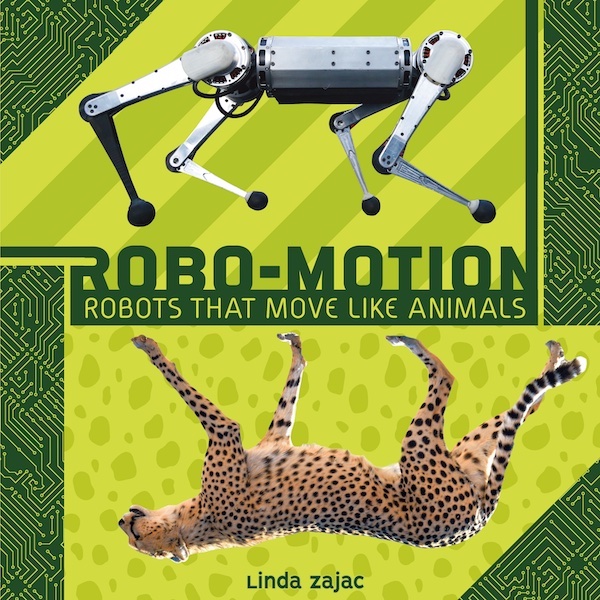
In my book, Robo-Motion: Robots That Move Like Animals, (Millbrook, 9/7/2021) the design team at Millbrook Press took my words and made them richer by surrounding them with color, intrigue, and hope. On each spread, in strikingly similar poses, animals are paired with the robots that mimic their motion,. Robo-Motion, a book about biomimicry, has action verbs on every page. Like animals in the wild, robots in the lab skitter, scuttle, grip, and glide. If we could move like animals, we could jump without getting tired, squeeze into tight spaces, and climb up glass. By building robots that mimic animal motion, we can move like them. Robo-Motion is a hopeful book about how robots can benefit society. A portion of the proceeds will be donated to charity.

With the following exercises, you can use Robo-Motion to boost hope and optimism in your classroom:

EXERCISE 1 – Gratitude

Ask children to pick the robot they are most thankful for. Have them write down the robot name and why they picked it.

EXERCISE 2 – Boost optimism

Have children close their eyes and spend some time thinking about the robot they picked. Ask them to imagine a scene where the robot is doing its job. The robot could be saving a life, cutting costs, gathering information, or making work more efficient.  Have them imagine that everything works out for the best.

EXERCISE 3 – Writing skills

Ask children to write an optimistic story about the robot they picked and how it helped society.

EXERCISE 4  – Spread optimism

Ask children to share their optimistic stories with the class.

You can also bring hope and optimism into your classroom with these recent STEM nonfiction picture books:

  • Crossings by Katy Duffield (Beach Lane, 2020) is a unique STEM book about structures built to protect wildlife from traffic. Although the vehicles that make crossings dangerous for animals are never mentioned in the main text, they appear in nearly all the illustrations. The book takes a fascinating look at manmade structures created to help various animals avoid traffic in the United States and abroad. The common thread is the desire to help wildlife and the hope that they will survive and flourish.
  • The Brilliant Deep by Kate Messner (Chronicle, 2018) is another book with a hopeful message. First, readers meet Ken Nedimyer, a diver. Then, in a wordless full-page spread, readers see the effect of one hotter-than-normal summer—bleached coral. Nedimyer and the Coral Restoration Foundation are farming corals and transplanting them to restore reefs. They’ve planted thousands of coral stalks off the Florida Keys and they’re working with other countries to help their threatened reefs. The book gives readers hope something can be done to regenerate corals damaged by warming ocean waters from climate change.
  • Mario and the Hole in the Sky by Elizabeth Rusch (Charlesbridge, 2019) is a story about Mario Molina discovering and helping to solve a global problem. In the 1980s, scientists discovered a huge hole in the ozone layer over Antarctica. When countries came together and agreed to stop making the CFC’s that were in everything from aerosols to air conditioners, the ozone layer began to recover. By comparing the ozone problem with climate change, readers see that by working together countries can solve global problems. We’ve done it before, we can do it again.
  • A leaking oil pipeline can wreak havoc on the environment. In We Are Water Protectors by Carole Lindstrom (Roaring Brook, 2020), the Ojibwe tribe fights to protect the ecosystem. A black snake symbolizes the oil pipeline that’s never mentioned in the text. The last page gives readers the opportunity to sign a pledge to protect the Earth. With gorgeous illustrations, this book is a rallying cry to action. It leaves the reader feeling hopeful that the tribe, along with others, will not give up their fight to protect water, land, plants, and animals.

STEM books with hope and optimism have power. They can broaden a child’s horizons, expand a child’s mind, and brighten a child’s world. In Emily Dickinson’s poetry collection, hope is the thing with feathers. In a post-pandemic classroom, hope is the thing with pages.

Resources:

Published September 7th, 2021 by Millbrook Press

About the Book: Like animals in the wild, robots in the lab skitter, scuttle, grip, and glide. In this STEAM title about biomimicry, crisp color photographs of animals are paired with the robots that mimic their motion. Action verbs and literary devices introduce each animal on the left, while details about each robot and its purpose grace the opposite page. This nonfiction picture book is a hopeful look at how robots can benefit society. Back matter includes a glossary and information about biomimicry. The book will appeal to young readers interested in animals, engineering, technology, and science. A portion of the proceeds will be donated to charity.

About the Author: Linda Zajac is an award-winning science writer. She’s a former computer programmer, systems analyst, and consultant who would have jumped at the chance to program a robot. Linda writes about cutting-edge science, technology, and biotechnology and how they’re used to save wildlife, advance medicine, and protect the environment. Linda is a Tassy Walden winner and a recipient of the PEN New England Susan P. Bloom Children’s Book Discovery Award. Her published works include six Minecraft books for kids along with many magazine articles in Highlights, MUSE, ChemMatters, and more. Robo-Motion: Robots That Move like Animals was published September 7, 2021 by Millbrook Press.

Thank you, Linda, for this post focusing on the social and emotional learning our students need to do in addition to academic and a way to combine the two!

Author Guest Post: “The Case for Graphic Novels and Chapter Books” by Dusti Bowling, Author of Aven Green Baking Machine

Share

“The Case for Graphic Novels and Chapter Books”

I have always been a huge reader. At some point during third grade, I discovered my love of stories and have never looked back. Third grade through sixth grade was such a formative time for me as I developed this lifelong love of reading, and some of the books I enjoyed the most were comic books or shorter stories with illustrations. I gobbled up as many Archie comics as I could, read all of The Far Side by Gary Larson, and shuddered in fear at the creepy illustrations in Scary Stories to Tell in the Dark. I honestly couldn’t tell you if I’d be the reader and writer I am today without books like these, and now that my own children are of reading ages, I’ve actively encouraged them to read anything and everything they enjoy. Yes, that has meant a lot of graphic novels and illustrated books. It has also meant them reading the same books over and over and over again, just as I did when I was a kid.

The first thing my ten year old fell in love with was Diary of a Wimpy Kid. She was five when she picked up the first book, and I still remember her coming to me every minute or so to ask me to explain a word. Then she’d read the story again and come to me maybe every couple of minutes. Then she’d read it again. And again. After she’d read that first book probably about a dozen times, she no longer had to ask me to explain any of the words. It was through this rereading of the same book that she developed great reading fluency, confidence, and comprehension skills, and I’m very grateful to Jeff Kinney for teaching her how to read. Would she have naturally gone through this same process on her own with a book without pictures? Without the silly jokes and goofy humor that kept her so engaged? I doubt it.

Being homeschoolers, we’ve spent a lot of time at the library, and my ten year old has always gravitated toward the graphic novel section. We would frequently come home with stacks of graphic novels nearly as tall as she was, and she would read every single one of them. I would make a lot of recommendations, try to introduce her to other styles of books, play longer audiobooks for her, and suggest we try reading new books together, but all she wanted were graphic novels all the time, so I didn’t push it. She loved to read, and I never wanted to interfere with that in any way. After all, her love of reading has always been the end goal.

Then something interesting began happening after a few years of nonstop graphic novels—she decided on her own to try a great big book without illustrations called Wings of Fire, which she found in a little free library at a park. Did she get through it and enjoy it? Let’s just say she’s eagerly anticipating book fifteen right now. Would she have gotten to the point in her love of reading that she’d be willing to read fourteen lengthy books if I hadn’t always allowed her to read and reread the graphic novels she adores so much? Again, I doubt it.

Now that my six year old is reading, she loves my Aven Green chapter books. She brings the books to me over and over for help with the words and to show me the illustrations so we can laugh together (she seems to think I’ve never seen them before). She also loves Junie B. Jones, Puppy Place, Wedgie and Gizmo, and many other chapter books with illustrations. I know one day soon, she’ll probably also fall in love with graphic novels. She’ll probably want to read the same books over and over again (actually she already does that). And then, eventually, she’ll probably also be ready to pick up longer books. When that happens, I’ll be ready for it every step of the way.

Expected publication: August 17th, 2021 by Sterling Children’s Books

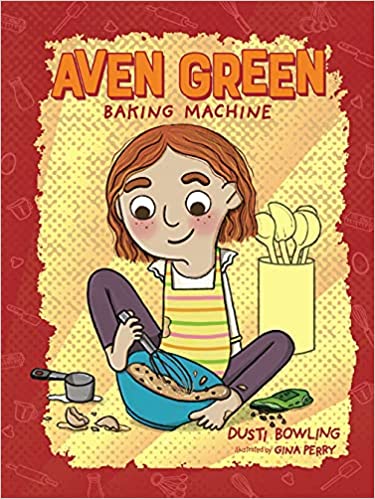
About the Book: Aven Green Baking Machine is the sequel to Aven Green Sleuthing Machine which Kellee reviewed in April.

Aven is an expert baker of cakes and cookies. She’s been baking with her mom for a really long time. Since she was born without arms, Aven cracks eggs and measures sugar and flour with her feet. Now, she has her eye on the prize: a beautiful blue ribbon for baking at the county fair. So she teams up with her friends Kayla, Emily, and Sujata. But It turns out they all have very different tastes and a lot of opinions about baking. Talk about a recipe for disaster!

About the Author: Dusti Bowling grew up in Scottsdale, Arizona, where, as her family will tell you, she always had her nose in a book. She released her first middle grade novel in 2017 and hasn’t stopped writing since.

Dusti’s books have won the Reading the West Award, the Sakura Medal, a Golden Kite Honor, the William Allen White Children’s Book Award, and have been nominated for a Cybil and over thirty state awards. Her books are Junior Library Guild Gold Standard Selections and have been named best books of the year by the Chicago Public Library, Kirkus, Bank Street College of Education, A Mighty Girl, Shelf Awareness, and many more. Dusti currently lives in New River, Arizona with her husband, three daughters, a dozen tarantulas, a gopher snake named Burrito, a king snake name Death Noodle, and a cockatiel named Gandalf the Grey.

Thank you, Dusti, for this post that we definitely agree with! Like you said, “ove of reading has always been the end goal!”

Author Guest Post: “Using Anthologies to Teach Writing” by Rochelle Melander, Author of Mightier than the Sword: Rebels, Reformers, and Revolutionaries Who Changed the World Through Writing

Share

“Using Anthologies to Teach Writing”

When I was growing up, our family had an Anthology of Children’s Literature. (No doubt one of my mom’s college textbooks!) Even though we regularly checked out books from the library, I spent a lot of time browsing through that book. I loved that I could find stories from all over the world. In that volume, I discovered new tongue twisters, Lewis Carroll’s “Jabberwocky,” and James Weldon Johnson’s “The Creation.”

Today, biographical anthologies have become popular in the children’s literature market. You can find anthologies on a wide range of topics like sports, science, technology, math, and more. They provide young people with an easy way to access stories about people who overcame obstacles to achieve success.

Because anthologies collect the stories of people around a theme, they offer many ways for readers to engage with the stories. Readers can take a treasure hunt through the essays in search for someone that interests them. Students might seek someone who:

+Champions a cause that matters to them.

+Overcame difficulties in school.

+Plays their favorite sport.

+Works in a career that interests them.

+Did something brave.

But how do you get young people to engage with these stories? When I wrote Mightier Than the Sword, an anthology of stories about people who used their words to change the world, I chose people from many disciplines because I wanted young people to see that many people write, not just storytellers. I added interactive writing exercises so that young people could write to change their own worlds.

I’ve been an artist educator since 2001, teaching in classrooms, libraries, and museums. I often use mentor texts and anthologies to engage young people in learning history and inspire their writing. Here are three writing exercises—and an art exercise—I use with historical texts:

Writing Exercise #1: Social Media Profile

Sei Shonagon (965-1010) captured court life in her writing, a genre known as zuihitsu that combined lists, advice on conversation and letter writing, observations about events, and suggestions on how priests should preach and dress. Had Sei Shonagon lived today, she might have developed a social sharing site like Instagram or Twitter.

Try this: Invite students to create a social media profile and several posts for the person they’ve chosen. This will especially fun when working with historical people. Maybe George Orwell would write a status update like: “Big brother? This whole platform is sus.”

Note: You can use any social media site that your students can relate to. There are several kid-friendly social media sites that might work, like GromSocial and PopJam.

Writing Exercise #2: Protest Song

The Afghan rapper and activist Sonita Alizadeh was angry about her parents’ plan to sell her into marriage, partly to help raise money to purchase a bride for her brother. To protest this, she wrote and performed the song “Brides for Sale” and posted it on YouTube. Alizadeh’s song saved her from an arranged marriage and paved the way for her to go to school.

Try this: Invite students to write a protest song for a cause that they care about.

Writing Exercise #3: Letter Campaign

Young Sophie Cruz wrote a letter to the Pope, asking him to fight for the rights of immigrants in the United States. Martin Luther King, Jr. wrote “Letter from a Birmingham Jail” to protest the advice to “wait” for justice. His letter became a sermon and then was published in newspapers and magazines across the country.

Try this. Ask students to write a letter to encourage change. Perhaps several students will want to create a letter-writing campaign to challenge an organization, government agency, or a government official.

Bonus Exercise: Protest Art!

To protest the lack of women’s works of art at the Metropolitan Museum of Art in New York City, the Guerilla Girls plastered posters on New York City buses asking: “Does a woman have to be naked to get into the Met. Museum?” The poster featured a reproduction of the nude in Jean-Auguste-Dominique Ingres’ La Grande Odalisque, with her face hidden by the group’s signature gorilla mask. The poster educated readers on the statistics: “Less than 5 percent of the artists in the Modern Art Sections are women, but 85 percent of the nudes are female.”

Try this: Invite students to create an art poster or social media meme to support their favorite cause.

Choosing Anthologies

The library is full of many kinds of anthologies on a wide range of topics like sports, science, technology, math, and more. Check out a big stack and let your students browse. The more they read, the better chance they will have of finding a role model who matters to them.

Published July 27th, 2021 by Beaming Books

About the Book: Mightier Than the Sword: Rebels, Reformers, and Revolutionaries Who Changed the World through Writing is a middle grade social justice book that tells the stories of historical and contemporary writers, activists, scientists, and leaders who used writing to make a difference in their lives and the world. The stories are accompanied by writing and creative exercises to help readers discover how they can use writing to explore ideas and ask for change. Sidebars explore types of writing, fun facts, and further resources.

Download the free activity pack: https://ms.beamingbooks.com/downloads/Activity_Packet_MightierThanTheSword.pdf

About the Author: Rochelle Melander wrote her first book at seven and has published 11 books for adults. Mightier Than the Sword: Rebels, Reformers, and Revolutionaries Who Changed the World through Writing is her debut book for children. She’s a professional certified coach, an artist educator and the founder of Dream Keepers, a writing workshop for young people. She lives in Milwaukee, Wisconsin with her husband, children, and two dogs. Visit her online at writenowcoach.com or rochellemelander.com

Thank you, Rochelle, for your book and for this incredible post with such useful classroom ideas! 

Don’t miss out on other stops on the Mightier than the Sword Blog Tour!

Student Voices: “Recommended Mangas” by Sabrina Kayat and Lisa Wojciechowski, 9th Graders

Share

“Recommended Mangas”
by Sabrina Kayat and Lisa Wojciechowski, rising 9th Graders and Kellee’s students 2020-2021 & 2018-2020 respectively

Spy Family by Tatsuya Endo
Recommended manga series by Sabrina

Preview: Spy family is about a master spy that goes by the name Twilight. When it comes to the dangerous missions he is assigned to, he always gets the job done. Him being a master of disguise, he wants to make the world a better place. When he finishes up his current mission, he gets a particular job that requires him to find a spouse and a kid, he just might have hit a dead end. When he does procure both a wife and a child for his mission to infiltrate an elite private school, he has yet to know the child he adopted is a telepath and his wife is an assassin.

Review: Having read the first volume of this manga, I can honestly say that this is a must read. This manga has a lot of dramatic irony, and uses it to make a hilarious story. Each character in this story (the spy, the assassin, and the telepath), all complement each other very well. When one character might be lacking in an area, another steps up and aids them. This story also has a lot of family themes and action. Overall, I recommend this manga to older teens.

Demon Slayer by Koyoharu Gotouge
Recommended manga series by Sabrina

Preview: Demon Slayer is about Tanjiro Kamado, a boy who regularly goes to a local village to sell coal and make money for his family. One day, he heads out to the village, where his life takes a turn for the worse. At his home, a demon killed his whole family, in the process turning his little sister Nezuko into a demon. Tanjiro decided he would do whatever it takes to turn his sister back to a human, and get revenge on the demon.

Review: Though I have not read the whole series, I recommend this manga to teens. This series has a straightforward story, and the artstyle is amazing. The characters are excellent, each having an interesting story and are likeable in their own ways. In the beginning, I had a hard time getting into it, but eventually it really picks up. All in all, I recommend this series.

Naruto by Masashi Kishimoto
Recommended manga series by Lisa

Preview: Naruto is about a kid named Naruto who is in the Ninja Academy and is really struggling. He wants to be the leader of his village called a Hokage but there may be more to his destiny than that.

Review: The Naruto manga has some really great moments and is a great addition to the fandom. You don’t need to watch the anime to read the books which is also good. The dialogue is very fun, and the designs are really good for the most part. There’s not one time where I asked myself what was going on in the book; everything is very clear and well described.

Thank you so much, Sabrina & Lisa, for the recommendations!! As my Unleashing Readers readers and students know, I have been trying to get some good manga reading in, so I appreciate knowing which to move to the top of my to be read list!

Student Voices: “Favorite Books” by Addy Brantley and Bianca Teixera, 9th Graders

Share

“Favorite Books”
by Addy Brantley and Bianca Teixera, rising 9th graders and Kellee’s students 2020-2021

Caraval by Stephanie Garber: Very unique type of story. Loved how it had so many twists and turns and you never expected what happened next. The rest of the series was also enticing and flowed very smoothly from one book to the next.

Market of Monsters by Rebecca Schaffer: Never read anything like it. The main character is fierce and smart and could think on her feet. Made us think “what’s gonna happen?” many times that kept us reading them for a long time. Could not put it down, it was so action packed.

Red Queen by Victoria Aveyard: This whole series was filled with so many “did not see that coming” moments. Loved how they connected all different parts of the story together so nicely. The characters had so much personality and you can connect to them so easily.

Cinder by Marissa Meyer: Definitely our top retelling series! Puts a unique spin on classic stories. Connects all the characters and stories in a way no one could think of. Most of the characters are relatable and make you sympathetic towards them.

The Cruel Prince by Holly Black: Took place in a world unimaginable. The main character is definitely not one you read about often. Loved how strong and determined she was. Though personally for us, the first book was good, but the second and third? We could not put them down.

Renegades by Marissa Meyer: One of our favorite superhero series. We really liked how we got a perspective from both a “hero” and a “villain”. Enjoyed seeing how they both are not as they seem and why they became what they are.

The Giver by Lois Lowry: Very heartwarming and makes you think about the world differently. Loved the different characters and how they tie all the stories together in the end.

It’s Trevor Noah: Born a Crime by Trevor Noah: Foreign and familiar at the same time, this book shows you how no matter where you come from or what you look like, your life could end up a masterpiece. It’s extremely funny and witty and you can relate to all the stories.

Shadow and Bone by Leigh Bardugo: Takes place in a warring country divided by a swath of darkness filled with monsters. Funny enough I liked the side characters more than the main character. This world is utterly immersive and picturesque.

Six of Crows by Leigh Bardugo: This book has it all. An impossible heist, amazing characters, magic, an unpredictable plot, and so much more. It’s impossible to put down, this is what fantasy is for.

Raybearer by Jordan Ifueko: A fight for freedom, family, and justice at all costs. It’s not your typical fantasy, it’s very unique and fresh. This book definitely deserves more love.

Heartless by Marissa Meyer: An amazing backstory for the queen of hearts. I loved how you know what’s going to happen in the end but have no idea how that can happen. It’s the best slow burn book we’ve read.

Thank you so much, Addy & Bianca, for the recommendations!!