Review and Giveaway: Mapping My Day by Julie Dillemuth

Share

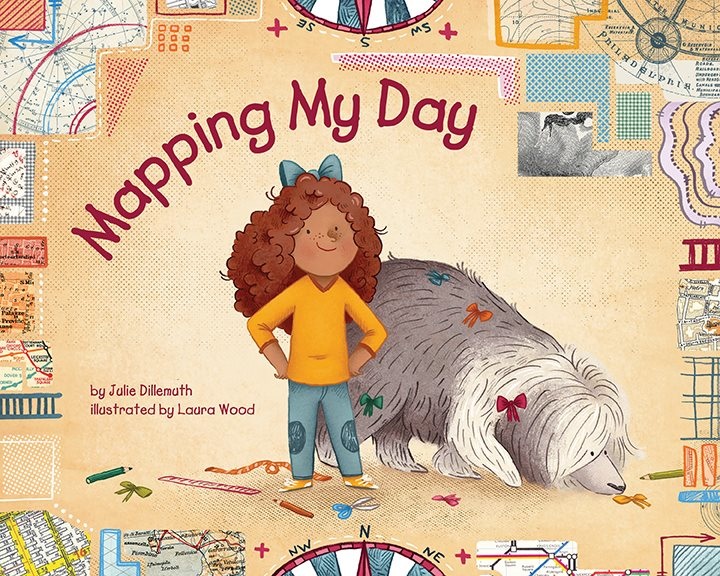
Mapping My Day
Author: Julie Dillemuth
Illustrator: Laura Wood
Published: March 13, 2017 by Magination Press

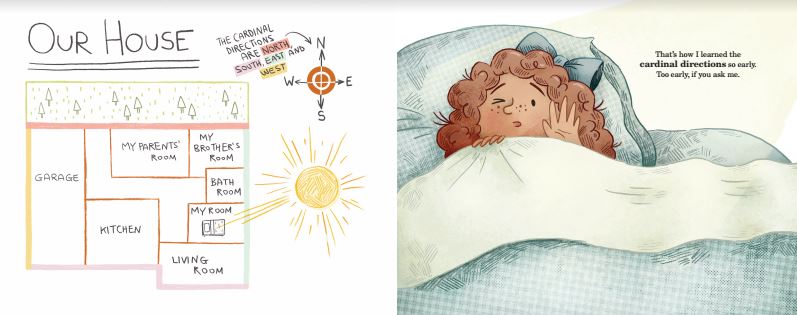
GoodReads Summary: Flora loves drawing maps and uses them to tell us about her life! Mapping My Day introduces spatial relationships and representation: where things and places are in relation to other things. This book intends to show readers how maps can convey information, inspire children to draw their own maps, and introduce basic map concepts and vocabulary. Spatial thinking is how we use concepts of space for problem solving and is shown to be a key skill in science, technology, engineering, and math. Includes a “Note to Parents and Caregivers” with extra mapping activities.

Ricki’s Review: As I read this book, I couldn’t help but think about how my husband will enjoy it. I am going to place it in my son’s room to surprise them. Interdisciplinary books are tricky to write, and Julie Dillemuth does a fantastic job making mapping and mathematics fun! While learning about arrows and symbols on a map, the reader also learns that Flora can make her brother snort milk out of his nose. As a bonus, this is a book that features a multiracial family without being a book about a multiracial family. This made me very happy. This is a book that will be appreciated by teachers and readers alike!

Kellee’s Review: Mapping My Day’s Flora loves maps. She thinks in cardinal directions, she maps out where everything is, and she even plays games using maps. It is because of Flora’s enthusiasm that the readers of her story are going to want to play with maps also which will *surprise, surprise* lead to them learning about mapping skills and even some mathematics. I know this book is going to find its place in elementary classrooms and so many kids out there are going to map their days out just like Flora. 

Teachers’ Tools for Navigation: The back of this book features map-making pages that are free for readers to download at www.apa.org/pubs/magination/441B206.aspx. The maps are connected to the story and allow readers to practice their mapmaking skills—very cool!

Discussion Questions: How does the author incorporate maps in a way that is fun and exciting?; What parts of Flora’s day does she map? What other parts of her day could she have mapped?; How might Flora’s brother’s maps look a bit different?

Flagged Passage:
Read This If You Loved: My Map Book by Sara Fanelli; Math Curse by Jon Scieszka; My Life in Pictures by Deborah Zemke

Recommended For:

  classroomlibrarybuttonsmall

Giveaway!:

a Rafflecopter giveaway

About the Author: Julie Dillemuth was mystified by maps until she figured out how to read them and make them, and it was a particularly difficult map that inspired her to become a spatial cognition geographer. She lives with her family and writes children’s books in Santa Barbara, California, where the west coast faces south. Visit her at her website: http://juliedillemuth.com.

RickiSig andKellee Signature

**Thank you to Barbara at Blue Slip for providing copies for review!**
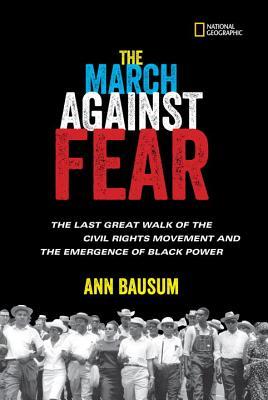
The March Against Fear: The Last Great Walk of the Civil Rights Movement and the Emergence of Black Power by Ann Bausum

Share

nfpb2017

Nonfiction Wednesday

Nonfiction Picture Book Wednesday is hosted by Kid Lit Frenzy and was started to help promote the reading of nonfiction texts. Most Wednesdays, we will be participating and will review a nonfiction text (though it may not always be a picture book).
Be sure to visit Kid Lit Frenzy and see what other nonfiction books are shared this week!

The March Against Fear: The Last Great Walk of the Civil Rights Movement and the Emergence of Black Power
Author: Ann Bausum
Published January 3rd, 2017 by National Geographic Society

Summary: James Meredith’s 1966 march in Mississippi began as one man’s peaceful protest for voter registration and became one of the South’s most important demonstrations of the civil rights movement. It brought together leaders like Martin Luther King Jr. and Stokely Carmichael, who formed an unlikely alliance that resulted in the Black Power movement, which ushered in a new era in the fight for equality.

The retelling of Meredith’s story opens on the day of his assassination attempt and goes back in time to recount the moments leading up to that event and its aftermath. Readers learn about the powerful figures and emerging leaders who joined the over 200-mile walk that became known as the “March Against Fear.”

Thoughtfully presented by award-winning author Ann Bausum, this book helps readers understand the complex issues of fear, injustice, and the challenges of change. It is a history lesson that’s as important and relevant today as it was 50 years ago.

About the Author: Ann Bausum writes about U.S. history for young people, and she has published eight titles with National Geographic Children’s Books including, most recently, Marching to the Mountaintop (2012) and Unraveling Freedom (2010). Ann’s books consistently earn prominent national recognition. Denied, Detained, Deported (2009) was named the 2010 Carter G. Woodson Book Award winner at the secondary school level from the National Council for the Social Studies. Muckrakers (2007) earned the Golden Kite Award as best nonfiction book of the year from the Society of Children’s Book Writers and Illustrators. Freedom Riders (2006) gained Sibert Honor designation from the American Library Association and With Courage and Cloth (2004) received the Jane Addams Children’s Book Award as the year’s best book on social justice issues for older readers. In addition, Ann has written about the nation’s chief executives and their spouses—Our Country’s Presidents (2013, 4th edition) and Our Country’s First Ladies (2007)—as well as the intrepid explorer Roy Chapman Andrews (Dragon Bones and Dinosaur Eggs, 2000).

Review: Ann Bausum’s text is a suspenseful story of the last Civil Rights march from Memphis, TN to Jackson, MS told in chronological order with captioned photographs that help the reader feel like they are present at the time of this march and the social, racial tension that filled America. I am having a very hard time reviewing this book, not because I don’t have nice things to say, but because this timely story is tough because although it is history, it seems like we haven’t come far from where the story takes place (which is terrifying).

Teachers’ Tools for Navigation: I believe that now is the most important time to teach resilience to our children as rights of many people are being threatened. Much of this education can come from conversation and amazing fictional stories, but I think it is vital to teach the history of diverse people within our nation that fought for rights. Children need to learn about women’s history, Black American history, Native American/American Indian history, Asian American history, LBGTQIA history, Irish American history, Jewish history, and so many more–all diverse populations that were prejudiced against and fought. Ann Bausum’s text (and her bibliography!) is a must-read in this education of our future.

Discussion Questions: Why was this march the last of the Civil Rights Movement?; This book is being called “timely” by many reviewers. Why do you think that timely is being used to describe the book?; Why would Bausum choose this march as the topic of her book?; How do the photographs and quotes throughout the book change the experience of reading the text?

Flagged Passages: “A cornerstone of this social justice movement became the willingness of people to put their lives on the line in the fight for change, much as Meredith had done during the integration of Ole Miss. Volunteers in the movement countered the violence of segregationists with tremendous acts of courage. They stood their ground peacefully in the midst of racist attacks, confident that love was a more powerful emotion than hate. Year after year, they persevered, whether it meant walking to work instead of riding segregated buses during the Montgomery bus boycott of 1955 and 1956, or braving violent mobs during the freedom rides of 1961, or enduring police attacks with high-pressure fire hoses during the Birmingham campaign of 196.

Such efforts drew on what movement leaders called the power of nonviolence. Some viewed nonviolence as a strategy, a series of tactics that forced reluctant foes to submit to change; others saw it was a way of life. For nonviolence to work, people had to be willing to remain peaceful, but determined, in the face of any level of violence. They had to outmaneuver their violent oppressors and step in and complete a protest whether their comrades had been arrested, injured, or even killed.” (p. 12-13)

Read This If You Love: To learn about the history of Civil Rights Movement

Recommended For: 

classroomlibrarybuttonsmall closereadinganalysisbuttonsmall

Signature

**Thank you to Karen at Media Masters Publicity for providing a copy for review!**

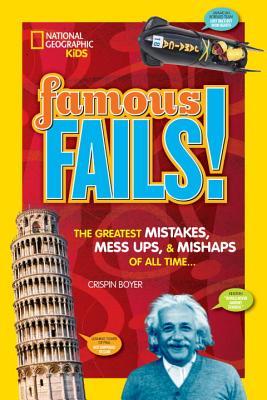
Famous Fails!: Mighty Mistakes, Mega Mishaps, & How a Mess Can Lead to Success! by Crispin Boyer

Share

nfpb2017

Nonfiction Wednesday

Nonfiction Picture Book Wednesday is hosted by Kid Lit Frenzy and was started to help promote the reading of nonfiction texts. Most Wednesdays, we will be participating and will review a nonfiction text (though it may not always be a picture book).
Be sure to visit Kid Lit Frenzy and see what other nonfiction books are shared this week!

Famous Fails!: Mighty Mistakes, Mega Mishaps, & How a Mess Can Lead to Success!
Author: Crispin Boyer
Published October 25th, 2016 by National Geographic Children’s Books

Summary: This fun book of quirky failures and famous flops will keep kids laughing while they learn the importance of messing up in order to get it right. Science, architecture, technology, entertainment — there are epic fails and hilarious goof-ups from every important field. Silly side features help to analyze the failures: “Lesson Learned,” “It Could be Worse!,” “Losing Combinations,” and a “Fail Scale” to help readers navigate the different kinds and scope of the mistakes made. The stories will include what went wrong, what went right, and what kids can learn from each failed attempt.

Review: I think one of the greatest lessons for children to learn is that failure doesn’t always equal failure. So many inventions and success began as what many would consider a failure when in actuality it was the beginning of a great thing. Giving up after a failure means you didn’t learn anything from it when failure is one of the best learning experiences. This text goes through hundreds of examples of famous people who failed or failures that became successes–wonderful stories for young people to read.

Teachers’ Tools for Navigation: As I read more and more of National Geographic’s new books like this one, Awesome 8, Book of Heroes/HeroinesReal or Fake?, and others, I’m coming to realize that these texts are made for project-based learning. These books make me question and inquire so many things within them. As I read, I find myself Googling and thinking and wanting to learn more–and I know they’ll do the same for kids.

Discussion Questions: Which famous inventions did you learn that was from a “failure?”; What famous person did you learn about that surprised you with their “failure?”; When is a time that you “failed” and stopped but now you wish you could go back and keep trying?

Flagged Passages: 

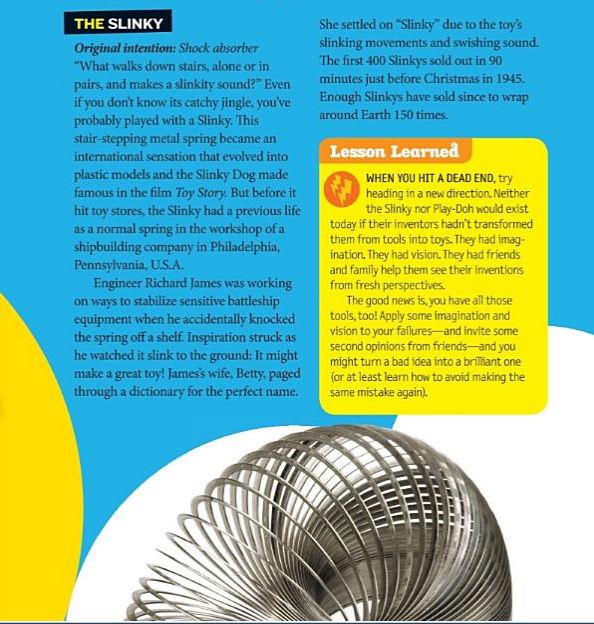
Read This If You Loved: The Marvelous Thing That Came from a Spring: The Accidental Invention of the Toy That Swept the Nation by Gilbert Ford, Earmuffs for Everyone!: How Chester Greenwood Became Known as the Inventor of Earmuffs by Meghan McCarthy, and other books about inventions; The Book of Heroes by Crispin Boyer & The Book of Heroines by Stephanie Warren Drimmer; and other nonfiction texts about inventors, heroes, failures then successes, and history

Recommended For: 

classroomlibrarybuttonsmall

Signature

**Thank you to Karen at Media Masters Publicity for providing a copy for review!**

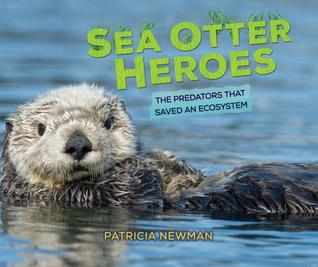
Sea Otter Heroes: The Predators That Saved an Ecosystem by Patricia Newman

Share

nfpb2017

Nonfiction Wednesday

Nonfiction Picture Book Wednesday is hosted by Kid Lit Frenzy and was started to help promote the reading of nonfiction texts. Most Wednesdays, we will be participating and will review a nonfiction text (though it may not always be a picture book).
Be sure to visit Kid Lit Frenzy and see what other nonfiction books are shared this week!

Sea Otter Heroes: The Predators That Saved an Ecosystem
Author: Patricia Newman
Published by January 1st, 2017 by Millbrook Press

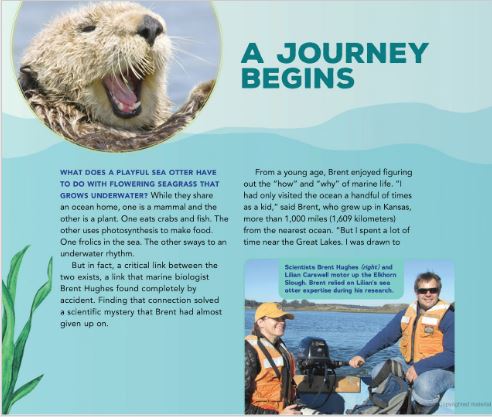
Summary: Marine biologist Brent Hughes didn’t think sea otters and sea grass had much in common. But his research at Elkhorn Slough, an estuary on Monterey Bay in northern California, revealed a new and surprising connection between the two. The scientist expected this estuary to be overrun with algae due to the fertilizer runoff from surrounding fields. But it wasn’t. Why?

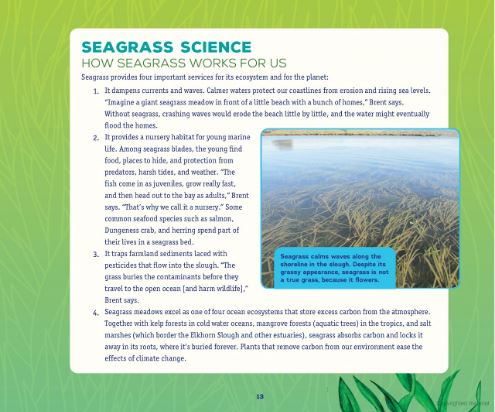
Review: As someone who struggled with biology when in school, I love narrative nonfiction about nature because it helps me fill in education gaps. Sea Otter Heroes looks at trophic cascade (cause and effect relationships within a food chain) and how it affects an ecosystem–so interesting! This information along with the beautiful photographs make this book a scientific journey.

Teachers’ Tools for Navigation: Patricia Newman’s books (Plastics, Ahoy! and Ebola included) are made for classrooms. This text includes not only the cause-effect relationship between otters and sea grass, but also has experiments, information about careers, a glossary, and an afterword about rethinking our relationship with nature giving the reader real ways they can make a difference. This book would be perfect to use in a life science unit or class.

Discussion Questions: What is the “critical link between” sea otters and flowering sea grass?; Finding the link was an accident, what was Brent Hughes studying when he found the connection? What was the proof that the connection existed?; How does the Elkhorn Slough exist?; What are Hughes’s 7 steps to think like a scientist? Observe nature and go through the 7 steps yourself.; What part did sea hares play in Brett Hughes’s experiment?; What is a trophic cascade?; How are what was discovered about the otters similar to the situations with wolves and sperm whales Newman shared?

Flagged Passages: 

Read This If You Love: Scientists in the Field books, National Geographic and Animal Planet books about animals 

Recommended For:

  readaloudbuttonsmall classroomlibrarybuttonsmall 

Kellee Signature

**Thank you to Lerner and Patricia for providing a copy for review!**

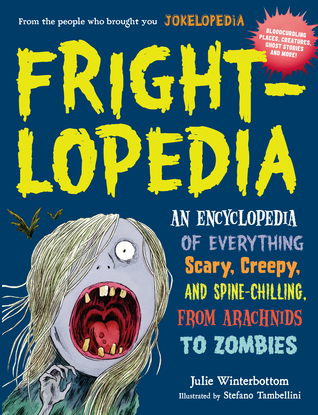
Frightlopedia by Julie Winterbottom

Share

nfpb2017

Nonfiction Wednesday

Nonfiction Picture Book Wednesday is hosted by Kid Lit Frenzy and was started to help promote the reading of nonfiction texts. Most Wednesdays, we will be participating and will review a nonfiction text (though it may not always be a picture book).
Be sure to visit Kid Lit Frenzy and see what other nonfiction books are shared this week!

frightlopedia

Frightlopedia: An Encyclopedia of Everything Scary, Creepy, and Spine-Chilling, from Arachnids to Zombies
Author: Julie Winterbottom
Illustrator: Stefano Tambellini
Published August 23rd, 2016 by Workman Publishing Company

Summary: Here’s the book for kids who love scary stuff, whether it’s telling ghost stories around a campfire, discovering the origins of various vampires, monsters, and witches, or reading creepy tales under the covers with a flashlight.

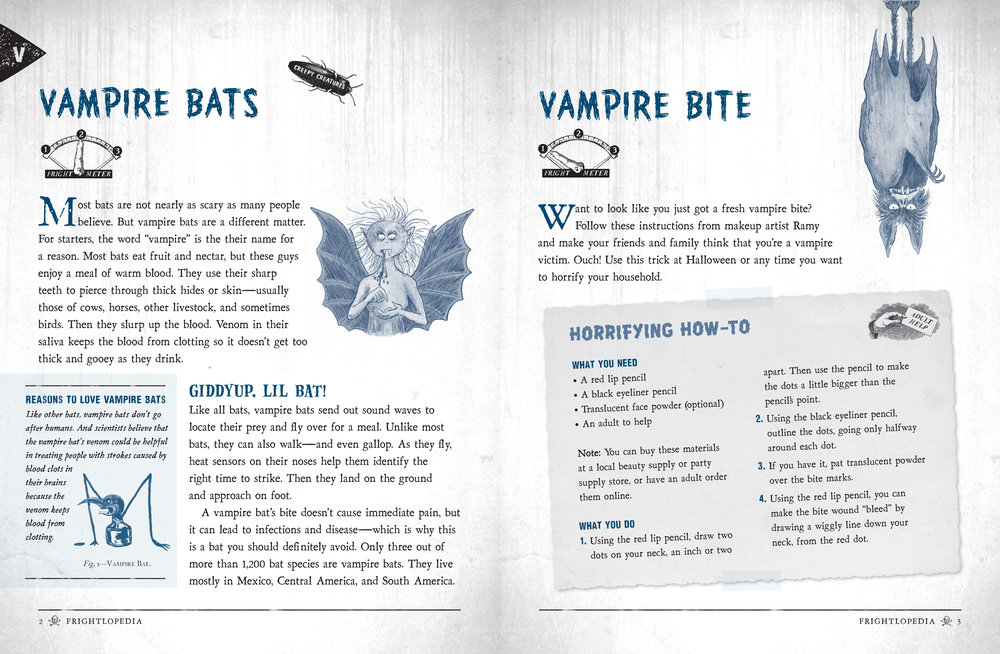
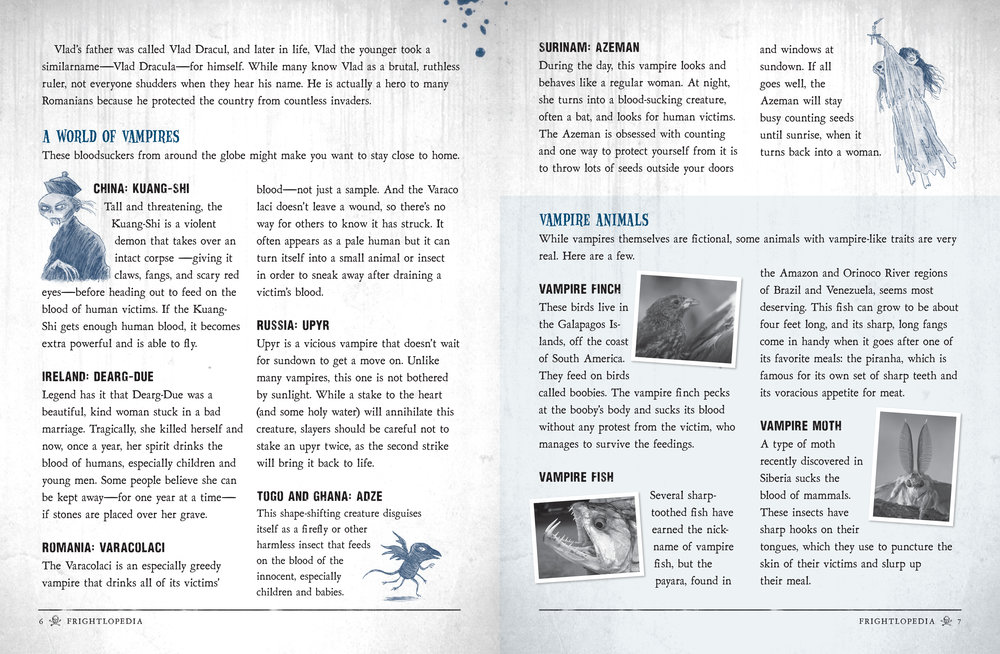
Combining fact, fiction, and hands-on activities, Frightlopedia is an illustrated A-Z collection of some of the world’s most frightening places, scariest stories, and gruesomest creatures, both real and imagined. Discover Borneo’s Gomantong Cave, where literally millions of bats, cockroaches, spiders, and rats coexist—in pitch darkness. Learn about mythical creatures like the Mongolian Death Worm—and scarily real ones like killer bees, which were accidentally created by scientists in the 1950s. Visit New Orleans’s Beauregard-Keyes house, where Civil War soldiers are said to still clash in the front hall. Plus ghost stories from around the world, a cross-cultural study of vampires, and how to transform into a zombie with makeup. Each entry includes a “Fright Meter” measurement from 1 to 3, because while being scared is fun, everyone has their limit.

Review: I loved the structure of this text, and students and other teachers will as well. Different than a traditional encyclopedia, the Frightlopedia mixes fact, fiction, traditional literature, and hands-on activities which makes this a perfect classroom text as it will suck in readers in so many different ways, and it will also work in such a variety of classroom activities as well.

Teachers’ Tools for Navigation: Like I shared above, this text has a really nice mix of genres along with hands-on activities. For example, parts of the text could be used during lessons on mythology, literary standards, traditional literature, science, or history. There is just so much, it is hard to actually share it all. Go into MONSTERS, if you want include mythological creatures; SHARKS or JELLYFISH during biology; CAPUCHIN CATACOMBS or MUMMIES in history; XYLOPHOBIA or CLAUSTROPHOBIA during word students of affixes; WRITE YOUR OWN GHOST STORY during creative writing; and so much more!

Discussion Questions: Which section did you find the most frightening? Why? The most interesting? Why?; Do you believe in ghosts?; How were mummies made in different cultures?; Which animal is the most frightening to you?

Flagged Passages: 

frightlopedia-vampire

frightlopedia-vampire-2

Read This If You Love: Ghost stories, mythology, being scared, learning about weird animals, learning about scary history

Recommended For: 

classroomlibrarybuttonsmall closereadinganalysisbuttonsmall

Signature

Exclusive Reveal!: Teaching Guide for Charlie and Mouse by Laurel Snyder

Share

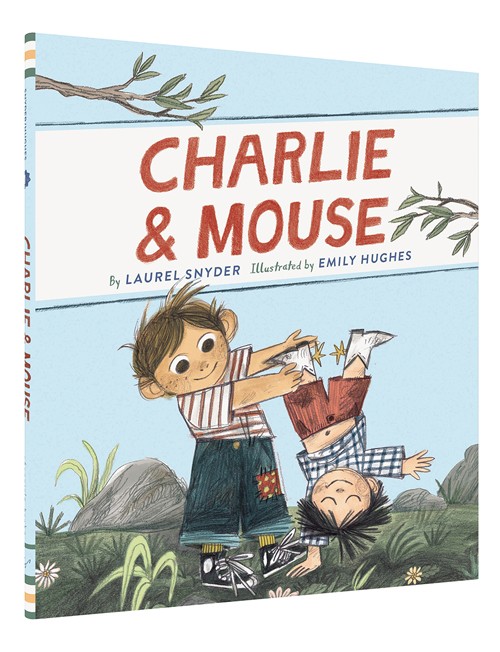
charlie-and-mouse-cover

Charlie & Mouse
Author: Laurel Snyder
Illustrator: Emily Hughes
Expected Publication April 11th, 2017 by Chronicle Books
http://www.chroniclebooks.com/charlie-mouse.html

Yesterday we revealed the Barkus teaching guide, today we get to share another new guide I wrote for another must-get early chapter book from Chronicle Books for all of my early elementary friends!

About the Book: Meet Charlie and Mouse! Join these irresistible and irrepressible sibs in their quest to talk to some lumps, take the neighborhood to a party, sell some rocks, and invent the bedtime banana. With imagination and humor, beloved author and illustrator team Laurel Snyder and Emily Hughes paint a lively picture of brotherhood in four irresistible stories that readers will relish.

About the Author: Laurel Snyder is the author of many books for children. She lives and writes in a small yellow house in Atlanta, Georgia, which she shares with her husband and two sons. She would like to state for the record that while none of these stories are exactly true, none of them are exactly untrue either.

About the Illustrator: Emily Hughes is an illustrator (and sometimes writer) who lives in windy Brighton, England, while thinking fondly of her hometown in Hilo, Hawaii. When making books she uses pencils, her tablet, and a very, very generous stack of paper.

About the Guide: This guide consists of discussion opportunities and classroom extension activities designed for use by Pre-K through first grade students in classroom, small group, or individual assignments. Charlie & Mouse allows children to exercise a variety of reading comprehension strategies, from gaining information about a story from the illustrations and text to retelling, describing, building vocabulary, and comparing and contrasting. Additionally, Charlie & Mouse helps young readers develop foundational reading skills such as learning to recognize sight words and text features.

You can also access the teaching guide here.

Update (11/10/17): I have completed the guide for the sequel to Charlie and Mouse as well! Check it out: https://www.unleashingreaders.com/?p=14584

Recommended For: 

readaloudbuttonsmall classroomlibrarybuttonsmall closereadinganalysisbuttonsmall

Don’t miss out on this one!

Kellee Signature


Supercars (Mean Machines Series) by Kane Miller Books

Share

NFPB2016

Nonfiction Wednesday

Nonfiction Picture Book Wednesday is hosted by Kid Lit Frenzy and was started to help promote the reading of nonfiction texts. Most Wednesdays, we will be participating and will review a nonfiction text (though it may not always be a picture book).
Be sure to visit Kid Lit Frenzy and see what other nonfiction books are shared this week!

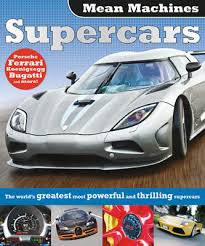
supercars

Supercars
Published: March 2016 by Kane Miller Books

Kane Miller Summary of the Mean Machine Series: Sure to get your young car enthusiast revved up, the Mean Machines series is pedal-to-themetal, fast and furious fun … from the comfort and safety of your living room! Which customized car has a top speed of 252 mph? Which engine has a nitrous oxide injector? Which car’s nickname is the Black Bat? Which car has a plasma TV inside the truck?! Find out!

Ricki’s Review: My favorite aspect of this book (and the series) is that readers of all levels will enjoy it. My toddler absolutely loves the pictures and can’t get enough of them. This book has not left our house since we received it a few weeks ago. He says, “What’s this, Mama?” to every picture on every page. My husband has also enjoyed this book, and I love to watch the two of them engrossed in the pictures and text. This is a book that reminds me that there is so much that I don’t know about cars. I may not be able to pronounce some of the terms in the book, but I most certainly have fun trying! I suspect this book will remain on our couch for several more weeks (if not months), and I am quite all right with that. 

Teachers’ Tools for Navigation: This would be a great book to spark research projects. Teachers might give students a copy of one of the books in this series and ask them to research cars that would fit into the other texts of the series. They might also investigate why certain cars are included while others aren’t.

Discussion Questions: Which car is the fastest? Which is the largest? Which has the most power?; What differences do you see between the cars? What similarities do you see?; What makes these cars “super”?; Which car would you most want to own and why?

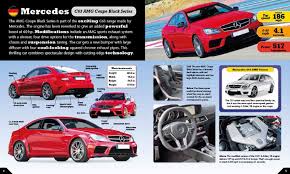
We Flagged a spread from the Performance Cars book, which looks similar to Supercars (but with different cars):

url-1

Read This If You Love: Cars!

Recommended For: 

classroomlibrarybuttonsmall

RickiSig

**Thank you to Lynn for providing a review copy!**