Blog Tour and Review!: Monster Needs to Go to School by Paul Czajak

Share

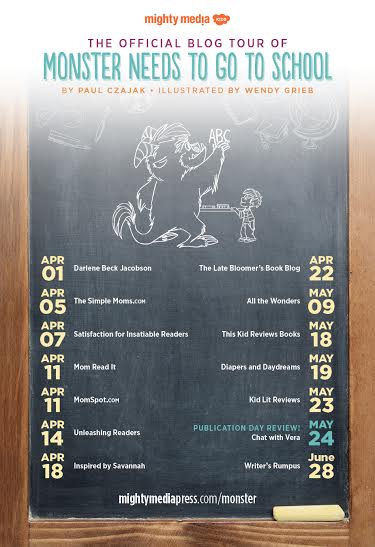
monster banner

Interactive Monster Needs to go to School Banner

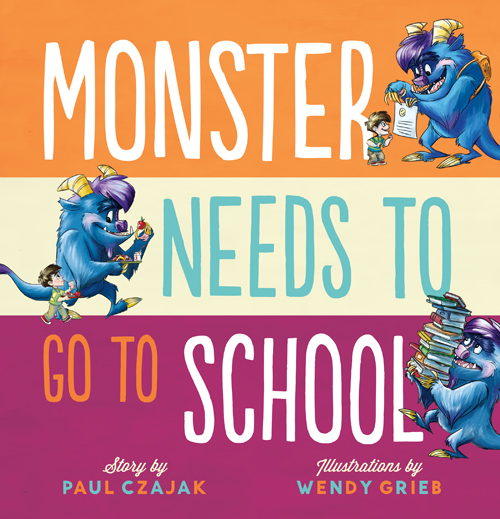
Monster School Cover

Monster Needs to Go to School
Author: Paul Czajak
Illustrator: Wendy Grieb
Anticipated Publication June 28, 2016 by Mighty Media Kids
(Please note the new publication date!)

Goodreads Summary: Monster is dreading his first day of school. But his classroom is full of new friends and so many fun things to learn that Monster forgets his fears in no time…until he catches his friends bullying. What will Monster do?

Another exuberant addition to the award-winning Monster & Me series, addressing back-to-school jitters and the difficulty of dealing with bullies—especially when they’re friends.

Ricki’s Review: The Monster books rank up there as one of my favorite series. I absolutely love reading these books because the monster always make me laugh. My son giggles as we look at the big monster squeezing into a tiny classroom seat. My son is starting preschool in the fall, so it was great to use this book as a teaching tool to discuss his first day of school with him. He became more excited about going to school after reading this book. I also enjoy the lessons that these books teach. Monster sees bullying and isn’t a silent bystander. He speaks out for what he believes is wrong. As a mom, I plan to talk about bullying often. I want my son to stand up for his peers when he sees bullying, and it is great to have this book as a resource to start these conversations.

Kellee’s Review: I love the Monster motto: “Teach kids what matters! After all, they are our future.” This is something I truly believe as well, and I think the Monster books do a great job teaching our children about being a good citizen and human. My first Monster book was Monster Needs Your Vote, and I was really impressed with how Czajak dealt with teaching about politics. Monster Needs to go to School is a bit different because it doesn’t as much teach about a topic but focuses on the importance of education and for kindness. This book will be great to read right before school starts, at the beginning of school, if someone is struggling with school, or when bullying is a problem. I think it would equally work for any of these situations because Monster’s story is fun and one that the reader will connect with. 

Teachers’ Tools for Navigation: This would be an excellent book to start off the school year. I’d read this book on the very first day. It would calm students’ nerves to see a giant monster who is afraid of school. Further, it would jumpstart conversations about bullying to tackle the issue before it might begin.

Discussion Questions: What is monster afraid of? What kinds of things make us afraid? Why is this okay?; What does monster do when he sees bullying? Why is it important to stand up for what is right? What is a bystander? Would you be strong and speak up against bullying?

We Flagged: “When Monster hopped onto the bus, his nerves were at their peak. He crumpled in the nearest seat, afraid to even speak.”

Read This If You Loved: Each Kindness (Kellee’s Review; Ricki’s Review) by Jacqueline Woodson, Unicorn Thinks He’s Pretty Great by Bob Shea, the rest of the books in the Monster & Me series

Recommended For: 

readaloudbuttonsmall classroomlibrarybuttonsmall

RickiSigand Kellee Signature

**Thank you to Carolyn at Mighty Media Press for providing copies for review!**

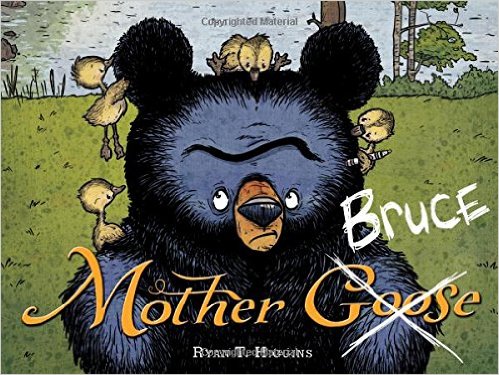
Mother Bruce by Ryan T. Higgins

Share

Mother Bruce

Mother Bruce
Author: Ryan T. Higgins
Published November 24, 2015 by Disney-Hyperion

Goodreads Summary: Bruce the bear likes to keep to himself. That, and eat eggs. But when his hard-boiled goose eggs turn out to be real, live goslings, he starts to lose his appetite. And even worse, the goslings are convinced he’s their mother. Bruce tries to get the geese to go south, but he can’t seem to rid himself of his new companions. What’s a bear to do?

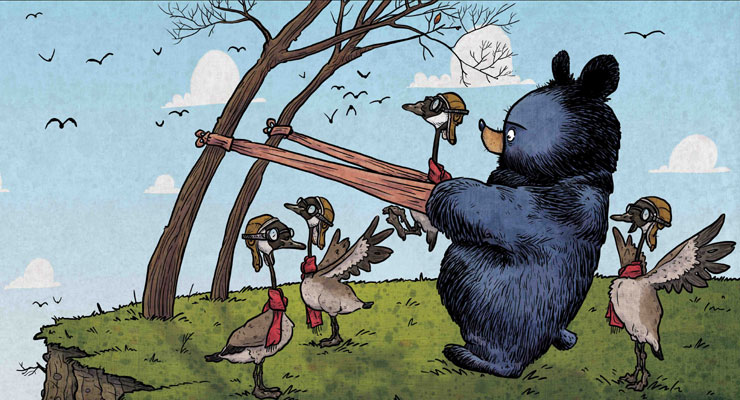
Ricki’s Review: I dare you to try reading this book without smiling. I had so much fun reading this book with my son. It tells the story of a grumpy bear who accidentally hatches goslings instead of hard-boiled eggs for his newest recipe. The goslings imprint on him, and he can’t get rid of them! As you can see below, the illustrations are hilarious. The author is very clever. I will be reading more of his work!

Teachers’ Tools for Navigation: It is always fun to look at original fairy tales and the ways they compare to fairy tale retellings. This book is a bit different because Mother Goose is the imaginary author of fairy tales. The title of this book is a pun on the Mother Goose name. ‘d love to hear the ways that kids can compare this story to other fairy tales. I imagine they would come up with some really clever ideas!

Discussion Questions: What strategies does Bruce use to try to get rid of the goslings?; How does Bruce change throughout the story?; In what ways does the author add humor to the story in both the language and illustrations?; What does the title mean?

We Flagged: 

Mother-Bruce-2

**Image from: http://www.modernmom.com/mother-bruce-giveaway-100-visa-gift-card-116459.html. **

Read This If You Loved: Wilfred by Ryan T. Higgins, Wolfie the Bunny by Ame Dyckman, No Fits, Nilson by Zacharia Ohora, Sylvester and the Magic Pebble by William Steig, This Is Not My Hat by Jon Klassen

Recommended For: 

readaloudbuttonsmall classroomlibrarybuttonsmall

RickiSig

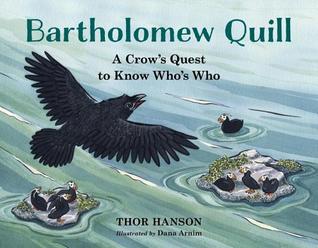
Bartholomew Quill: A Crow’s Quest to Know Who’s Who by Thor Hanson

Share

bartholomew quill

Bartholomew Quill: A Crow’s Quest to Know Who’s Who
Author: Thor Hanson
Illustrator: Dana Arnim
Expected publication April 5th, 2016 by Little Bigfoot

Goodreads Summary: Bartholomew Quill is clever and curious, but he doesn’t know who or what he is. He has feathers not fur, so he can’t be a moose; he is black like a puffin but his beak is the wrong color. This determined bird won’t stop asking questions until he discovers what the reader knows–Bartholomew Quill is a crow!

Acclaimed biologist Thor Hanson takes us on a journey through the animal kingdom, and Dana Arnim’s exuberant watercolor and ink illustrations add to the magic.

About the Author: Thor Hanson is a biologist and author renowned for his adult books about nature (The Impenetrable Forest, The Triumph of Seeds, and Feathers). He won a PNBA Award and The John Burroughs Medal for Feathers, which was also a finalist for the Washington State Book Award. Hanson is a Guggenheim Fellow, a Switzer Environmental Fellow, and sought-after public speaker.

About the Illustrator: Dana Arnim, a northwest native, earned her art degree from the University of Washington. She lives with her husband and family in Seattle and helps lead the Society of Children’s Book Writers and Illustrators (SCBWI) Western Washington chapter.

Kellee’s Review: Bartholomew Quill’s journey is a bit different than other books because the reader already knows the answer to the question the protagonist seeks. I can see reading this with students and students shouting answers and information to Bartholomew as he goes about his journey. What I think is quite wonderful about this book is that although the book is anthropomorphic, the animal information is still factual since it was written by a biologist. Arnim did a beautiful job with the illustrations as well, bringing the animals to life. 

Ricki’s Review: This book touched me in the way that it reminded me of the Native American creation myths my grandfather used to tell when I was a young child. He’d pull me onto his lap and tell me how the river became a river or why the wind whistles. I am sure that these myths made me the reader I am today. Bartholomew Quill is a beautiful story that will leave children to dream about other fictional connections with Mother Nature. It inspires me to get outside and look for animals like Bartholomew in order to learn their stories, too.

Teachers’ Tools for Navigation: Throughout the book, Bartholomew compares and contrasts himself with other animals to help figure out what animal he is. This book would be a great introduction to compare and contrast using the conversations Bartholomew has as well as the illustrations of the different animals.

Students could also use this book as a jumping off point for an animal study of one of the animals within the book. Each animals is quickly discussed, so students could pick the animal that interests them and complete an inquiry project about the animal.

Discussion Questions: How does Bartholomew determine that he is a crow?; How is he different from ______?; How is he the same as ______?

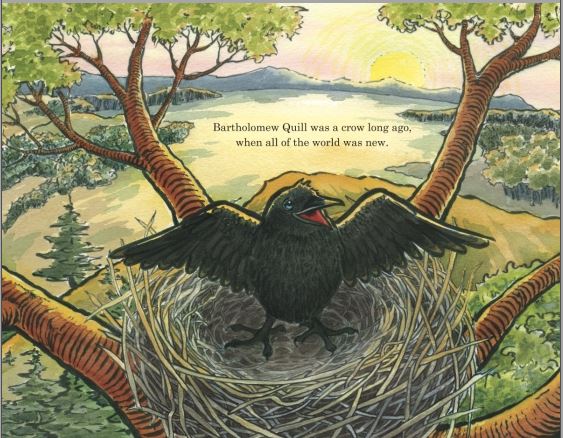
We Flagged: 

bartholomew quill illustration

Read This If You Loved: Frozen Wild by Jim Arnosky, Winter Bees by Joyce Sidman, Feathers by Melissa Stewart

Recommended For: 

readaloudbuttonsmall classroomlibrarybuttonsmall

Kellee Signature andRickiSig

**Thank you Nicole at Sasquatch Books for providing copies for review!**

Finding Winnie: The True Story of the World’s Most Famous Bear by Lindsay Mattick

Share

NFPB2016

Nonfiction Wednesday

Nonfiction Picture Book Wednesday is hosted by Kid Lit Frenzy and was started to help promote the reading of nonfiction texts. Most Wednesdays, we will be participating and will review a nonfiction text (though it may not always be a picture book).
Be sure to visit Kid Lit Frenzy and see what other nonfiction books are shared this week!

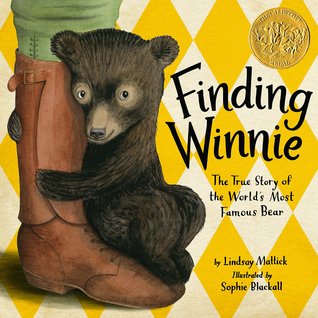
finding winnie

Finding Winnie: The True Story of the World’s Most Famous Bear
Author: Lindsay Mattick
Illustrator: Sophie Blackall
Published October 20, 2015 by Little, Brown Books for Young Readers

Goodreads Summary: Before Winnie-the-Pooh, there was a real bear named Winnie.

In 1914, Harry Colebourn, a veterinarian on his way to tend horses in World War I, followed his heart and rescued a baby bear. He named her Winnie, after his hometown of Winnipeg, and he took the bear to war.

Harry Colebourn’s real-life great-granddaughter tells the true story of a remarkable friendship and an even more remarkable journey–from the fields of Canada to a convoy across the ocean to an army base in England…

And finally to the London Zoo, where Winnie made another new friend: a real boy named Christopher Robin.

Here is the remarkable true story of the bear who inspired Winnie-the-Pooh.

Ricki’s Review: Many of my blogger friends raved about this book. I knew I needed to read it, but my library hold list was very long. When I saw it won the Caldecott Award, I took action. I drove my son to the bookstore and read the book to him while he sat on my lap. My aunt came with me, and she cried through the entire book.

When we reached the end, we just stared at each other and she said, “Ricki, you have to buy this book. Henry needs to have this special story.” And this is how I broke my rule about buying books. Finding Winnie sits elegantly on my son’s bookshelf, and I don’t regret breaking my rule. We love reading it together. The story is captivating from the beginning to the end, and the author and illustrator paint the scene in a remarkable way that readers will be unable to put the book down. Depicting history in picture books is very difficult, and Mattick and Blackall nail it. I highly recommend this charming book if you haven’t read it yet. It will stay close to your heart.

Kellee’s Review: One of the things I particularly loved about Finding Winnie, that Ricki didn’t mention in her beautiful review above, was that the book was written by the great-granddaughter of Captain Coleburn, the serviceman who owned Winnie originally. Having Lindsay Mattick’s close knowledge of the story helped her delve into the story and transport the reader into Winnie’s stories. The backmatter filled with photos and other primary documents also make it feel like we are peaking into the family’s scrap book.

I also want to praise Sophie Blackall’s illustrations. I love Sophie’s soft style with what seems like pencil and paints just is angelic and brings Mattick’s story to life. Although they both would shine separately, they are stellar together.

Teachers’ Tools for Navigation: As a teacher, I’d love to do two things with this book. First, I’d want to compare it to the Winnie the Pooh stories by A. A. Milne. It would be great to compare and contrast the stories to make connections about how Milne might have been inspired. Then, I’d put this book in semi-literature circles. Students might read all of the books (in the “Read This If You Loved” section below) in small groups, and rotate the books across groups. Then, they could discuss the topic and depiction of animals during wars throughout literature. They could compare and contrast the stylistic choices of the authors and also delve into potential ways that animals might be symbolic of each particular war.

Discussion Questions: How do the author and illustrator depict Winnie? How does Winnie’s story evolve?; What does Harry’s friendship with Winnie teach us about human nature?; How might this story have inspired the fictional Winnie the Pooh story?; Why do you think it won the Caldecott? What qualities make it an award winner?

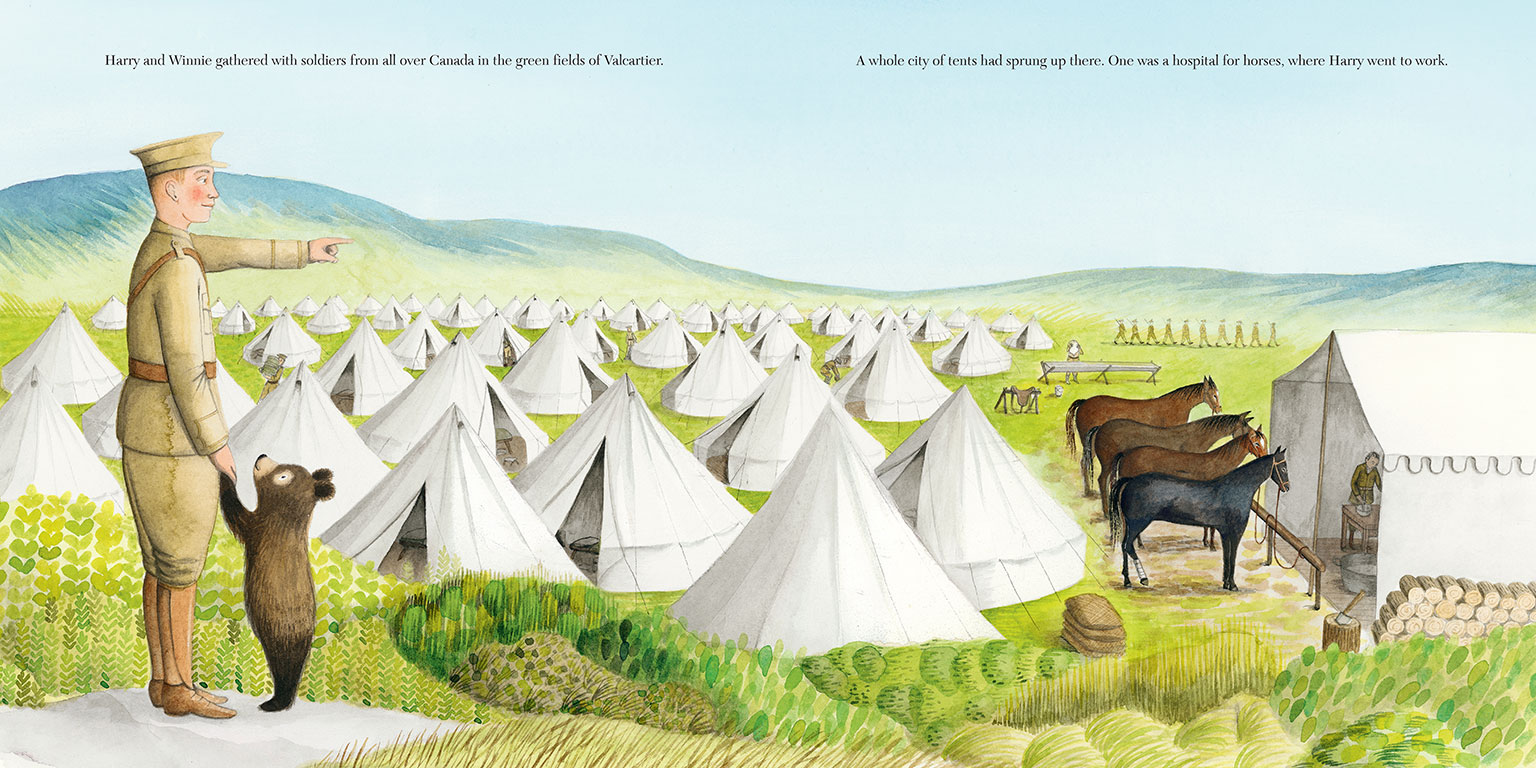
We Flagged: 

Finding WInnie Spread

**Image from: https://thewalrus.ca/finding-winnie/. We recommend this site, which includes many great images related to the text!**

Read This If You Loved: Winnie: The True Story of the Bear That Inspired Winnie-the-Pooh by Sally M. Walker, Winnie the Pooh  by A. A. Milne, Midnight, A True Story of Loyalty in World War I by Mark Greenwood, Stubby, the War Dog by Ann Bausum, Dogs of War by Sheila Keenan, Faithful Elephants by Yukio Tsuchiya

Recommended For: 

readaloudbuttonsmall classroomlibrarybuttonsmall litcirclesbuttonsmall

RickiSigandSignature

Blog Tour, Giveaway, and Review!: Twenty Yawns by Jane Smiley and Lauren Castillo

Share

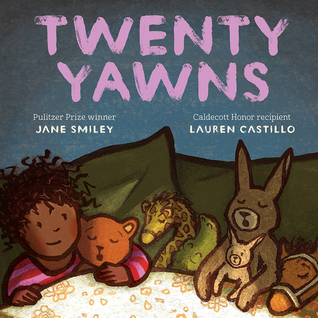
Twenty Yawns

Twenty Yawns
Author: Jane Smiley; Illustrator: Lauren Castillo
Published April 1, 2016 by Two Lions

Goodreads Summary: Featuring lyrical text and beautiful illustrations, this bedtime tale from Pulitzer Prize winner Jane Smiley and Caldecott Honor recipient Lauren Castillo evokes the splashy fun of the beach and the quietude of a moonlit night, with twenty yawns sprinkled in for children to discover and count.

As her mom reads a bedtime story, Lucy drifts off. But later, she awakens in a dark, still room, and everything looks mysterious. How will she ever get back to sleep?

Ricki’s Review: My son asks me to read this book every single night. (I’m not kidding. Imagine his sweet voice asking, “Twenty Yawns, please, Mama?”) My favorite part about this book is that there are many interactive sections that we can read together. He can’t read yet, but he is slowly learning sight words and loves reading the “Flap! Flap! Flap! Flap!” of the umbrella and each of the twenty “yawns.” He also tells me what Lucy is doing on each page. There are a lot of bedtime books out there, but this book truly makes me sleepy. I’m getting sleepy as I think about it right now! My son and I both yawn as we see each character yawn. Parents, READ: This book will make your child(ren) tired! I’d be remiss if I didn’t mention that the illustrations are breathtaking. The drawings of Lucy’s stuffed animals capture my attention every time I read this book. I feel lucky to have this book in my bedtime arsenal. My son is falling asleep more quickly. Could it be the twenty yawns?

Kellee’s Review: I love Ricki’s story of how Henry has imprinted on this book! Trent and I read it, and he said “Night, night!” on each of the pages where someone was going to sleep. And like Ricki said, in addition to having beautiful illustrations and a sweet story, this book will definitely make your child sleepy! I cannot help but yawn when I am reading it.

One other thing Trent loves is a promotional piece we received with the book (and you could win below!): a door hanger. One side says, “Shhh…we’re yawning.” And the other side says, “Come in. We’re ready to play.” It is hanging on his door, and we have to flip it back and forth depending on if he is getting up or going to bed. And on the “Shhh” side, he says goodnight to the little girl.

Teachers’ Tools for Navigation: Teachers might use this book to teach figurative language. Kids will enjoy the bold print of onomatopoeias. The illustrations feature aspects of the story that aren’t always present in the text. I love with authors and illustrators don’t match the illustrations and text perfectly because it provides such great opportunities for students to compare and contrast the story and pictures. They might talk about why the text doesn’t include all of the information from the illustrations and how this enhances the narrative. Also, kindergarten teachers and daycare providers can use this book right before nap time! I would have loved to have listened to this book as a child. Check out the Activity Kit!

Discussion Questions: Why doesn’t the author number the twenty yawns? How does this make the story more interesting to read?; What does Lucy do when she is frightened? How might you learn to soothe yourself when you are scared?; What activities do Lucy and her parents do together? What activities do you enjoy doing with family?

We Flagged: “Lucy started to carry Molasses back to her bed. But the other toys were looking at her, even Leonard, the baby Kangaroo. They seemed lonely.”

Read This If You Loved: Goodnight Moon by Margaret Wise BrownGoodnight Songs by Margaret Wise Brown

Recommended For: 

readaloudbuttonsmall classroomlibrarybuttonsmall

  Follow All of the Stops on the Tour, and Don’t Forget to Enter the Giveaway!:

About the Authors:
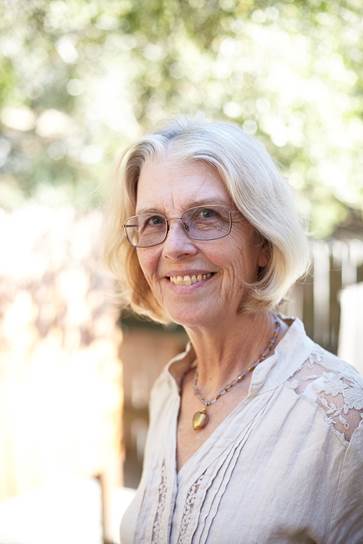
Jane Smiley photo
Jane Smiley is the author of numerous novels, including A Thousand Acres, which was awarded the Pulitzer Prize, as well as five works of nonfiction and a series of books for young adults. In 2001 she was inducted into the American Academy of Arts and Letters, and in 2006 she received the PEN USA Lifetime Achievement Award for Literature. This is her first picture book. She lives in Northern California.
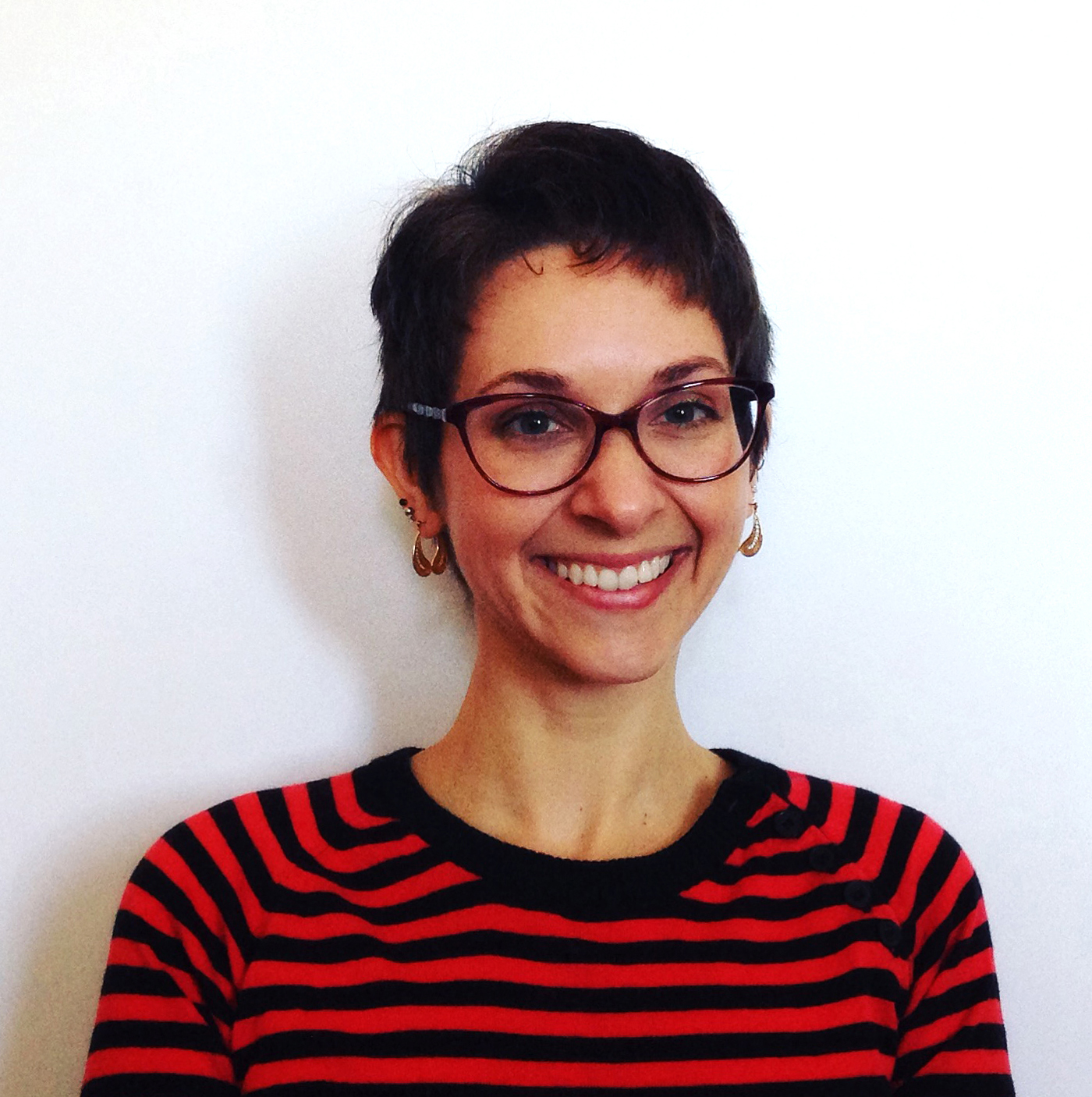
laurencastillo_headshot (2)
Lauren Castillo is the illustrator of many books, including The Reader by Amy Hest. She has also written and illustrated several books, including Caldecott Honor book Nana in the City and The Troublemaker. She lives in Harrisburg, Pennsylvania. To learn more, visit www.laurencastillo.com.
Twitter: @studiocastillo.

RickiSigand Kellee Signature

**Thank you to Barbara Fisch for sending us this book and for allowing us to host the giveaway!**

National Geographic Kids: Celebrate Easter by Deborah Heiligman

Share

NFPB2016

Nonfiction Wednesday

Nonfiction Picture Book Wednesday is hosted by Kid Lit Frenzy and was started to help promote the reading of nonfiction texts. Most Wednesdays, we will be participating and will review a nonfiction text (though it may not always be a picture book).
Be sure to visit Kid Lit Frenzy and see what other nonfiction books are shared this week!

easter

Holidays Around the World: Celebrate Easter with Colored Eggs, Flowers, and Prayer
Author: Deborah Heiligman
Photographs from National Geographic
Published February 9th, 2016 by National Geographic Children’s Books

Goodreads Summary: The joyous celebration of Easter is seen through a global perspective in this National Geographic volume featuring over 25 vibrant photographs. Witness the holiest day on the Christian calendar as it is celebrated throughout the world: from the famous Easter Egg Roll at the White House to the traditional bonfires throughout Europe, to colorful customs, to the universally popular dying of eggshells worldwide.

The first-person narrative leads young readers through the origins and traditions of this springtime festival of rebirth and hope. Reverend George Handzo gives parents and teachers a historical and cultural background in his informative note.

Kellee’s Review: This text is a wonderful informative introduction to Easter. It goes through not only the religious aspects of the holiday but also the traditions and secular parts. Although I think it could have gone into more detail about where the traditions came from (answered the WHY a bit more), it did a very good job of sharing all the different things that go along with Easter. I also loved the diversity within the book. The photos were from all over the world. And I am excited about the series Holidays Around the World because that means there are others within the series that will touch on holidays of other religions. This will help with understanding of holidays and religions that the reader may not be. 

Ricki’s Review: I completely agree with Kellee’s review! This book taught me a lot, and I enjoyed reading it. I would have loved to have read more about the WHY, but I found this to be quite a fun and interesting read, overall. Kids will really enjoy reading it, and it will be a resource for parents. Readers travel to many places in this single text, and it teaches an international appreciation. Like Kellee, I am really excited to see where this series goes, and I plan to read more books that National Geographic publishes! I love learning about international traditions and diverse cultures, so I appreciated all of the information in this book.

Teachers’ Tools for Navigation: I think it would be a powerful activity in a classroom to have many Holidays Around the World books and use them in both social studies, reading, and writing. Students could read about all of the different holidays, and they could then choose one to further research and share. Then there could be a walk-about in the classroom where different groups would have displays highlighting the different holidays.

Discussion Questions: What is the basis of Easter?; If you celebrate Easter, what are some traditions your family has?; What are some traditions around the world?; Why do you think the author chose to write the text in first person?

We Flagged: “Easter mornings brings special treats, too. Could it be the Easter Bunny was here? We get baskets of eggs–colored, decorated, and chocolate! Yummmm. In Germany, it’s the Easter Hare who brings us eggs. Bunnies, chicks, and eggs are symbols of new life.” (p. 16)

Read This If You Loved: Learning about religions, traditions, and holidays; Happy Easter, Mouse! by Laura Joffe Numeroff; Pete the Cat: Big Easter Adventure by Kimberly Dean

Recommended For: 

classroomlibrarybuttonsmall litcirclesbuttonsmall

Happy Easter to all who celebrate!

Signatureand RickiSig

**Thank you to Karen at Media Masters Publicity for providing copies for review!**

National Geographic Kids: Farm Animals & Rascally Rabbits!

Share

NFPB2016

Nonfiction Wednesday

Nonfiction Picture Book Wednesday is hosted by Kid Lit Frenzy and was started to help promote the reading of nonfiction texts. Most Wednesdays, we will be participating and will review a nonfiction text (though it may not always be a picture book).
Be sure to visit Kid Lit Frenzy and see what other nonfiction books are shared this week!

farm animals

Farm Animals
Author: Catherine D. Hughes
Photographs from National Geographic
Published February 9th, 2016 by National Geographic Children’s Books

Goodreads Summary: Young readers will meet their favorite farm animals and learn more about them through simple, age-appropriate language in this colorful board book.

rascally

Rascally Rabbits! And More True Stories of Animals Behaving Badly!
Author: Aline Alexander Newman
Photographs from National Geographic
Published February 9th, 2016 by National Geographic Children’s Books

Goodreads Summary: These bunnies may look adorable, but there’s more than meets the eye! In Rascally Rabbits, meet some rabbits that cause nothing but trouble, a rescue pup who will eat ANYTHING, and a sneaky bear with a taste for treats. Readers won’t stop laughing as they read these hilarious–and completely true!–stories. Filled with engaging photos, fast facts, and fascinating sidebars, readers won’t want to put this book down.


Kellee’s Review: What I like so much about National Geographic Kids books are that they really do take nonfiction to the next level. First, they have nonfiction for all ages. The Look & Learn series are for kids ages 1-4 then move to their Readers Series which is an early reader then to Chapters that is primary level. Each level adds more text but continue to include interesting facts and photographs. Once you get up to Chapters, the text even includes sidebars, an index, and a bibliography. 

Farm Animals was a favorite with Trent immediately. One of his stations at school is all about animals and they spend their time there talking about the different animals, what color they are, and what sound they made, so Trent loved telling me all of the animals’ names and the sound they make. I loved that there were animals facts and sidebars in addition to just the animal photographs and sounds.

Rascally Rabbits! is a perfect first chapter book because it is quite funny (these animals do some crazy things), it is educational because it teaches about the animals as well, and it splits up the stories into nice sections.

Ricki’s Review: I completely agree with Kellee. I much prefer narrative nonfiction, so I always hesitate to pick up informational nonfiction. The National Geographic books remind me just how wrong my assumptions are. I am not crazy about leveling, particularly with nonfiction, but I think that some parents really like it. And I think the leveling in these books is far more accurate than in fiction texts. 

I knew Henry would love Farm Animals the second we got it in the mail. Like most kids, he loves animals. He immediately began singing “Old McDonald” as we started reading the book, and he was bouncing up and down as we went through each of the brightly colored pictures.

Rascally Rabbits! is a bit challenging for him, but he loved the pictures. I opted to read selected text to him aloud, and I read the entire book on my own. Kids who are interested in rabbits will absolutely adore these books. I still remember reading dozens of books about poodles when I was younger. Because I was so interested in the content, I didn’t realize how much I was learning! The book is organized very well, and they did a really nice job with this one.

Teachers’ Tools for Navigation: National Geographic Kids’ books should be a go to for a teacher’s informational nonfiction section. Students will love reading and learning from these texts. Farm Animals and other Look & Learn books are perfect for read alouds and helping young children learn about different parts of our world. Rascally Rabbits! and other chapter books can be used for read aloud, independent reading, or even within a lit circle/jigsaw. For example, with Rascally Rabbits! each group could read about each of the different animals who made a mistake then go group with one person from each of the other groups to share what they read.

Discussion Questions: (Farm Animals) What product do each of these animals give to us?; What other farm animals do you know? What sounds do they make?; (Rascally Rabbits!) What are some things that Babbity does to make Flopsy’s life tough?; What makes bears get near humans?; Why was Neil afraid something bad might happen with Moose? Did something bad happen? Was it Neil’s fault?

We Flagged: “Moo! Cows eat grass. A group of cows is called a herd. People drink milk that comes from cows. Guess What? One cow can give enough milk in a day to fill 400 glasses.” (Farm Animals)

“Did You Know? The best way to pet a rabbit is to gently scratch its forehead and between its eyes.” (Rascally Rabbits!, p. 9)

“A young black dog ran without purpose along a forest road in Lewis County, New York, U.S.A. Rain was pouring down and freezing on the ground. Tiny icicle hung from the dog’s ears and chin. He had a wild-eyed look on his face.” (Rascally Rabbits!, p. 71)

Read This If You Loved: Nonfiction animals books

Recommended For: 

classroomlibrarybuttonsmall readaloudbuttonsmall litcirclesbuttonsmall

Signatureand RickiSig

**Thank you Karen from Media Masters Publicity for providing copies for review!**