The Noisy Paint Box: The Colors and Sounds of Kandinsky’s Abstract Art by Barb Rosenstock

Share

NF PB 2014

Nonfiction Picture Book Wednesday

Nonfiction Picture Book Wednesday is hosted by Kid Lit Frenzy and was started to help promote the reading of nonfiction texts. Most Wednesdays, we will be participating and will review a nonfiction text (though it may not always be a picture book).
Be sure to visit Kid Lit Frenzy and see what other nonfiction books are shared this week!

noisy

The Noisy Paint Box: The Colors and Sounds of Kandinsky’s Abstract Art
Author: Barb Rosenstock
Illustrator: Mary Grandpré
Published February 11th, 2014 by Alfred A. Knopf

Goodreads Summary: In this exuberant celebration of creativity, Barb Rosenstock and Mary Grandpre tell the fascinating story of Vasily Kandinsky, one of the very first painters of abstract art. Throughout his life, Kandinsky experienced colors as sounds, and sounds and colors–and bold, groundbreaking works burst forth from his noisy paint box.

Review: I love the visual arts. Growing up with a father that ran an art museum, going to visit museums and learning about art was part of my life. Throughout all of this exploration, I found that I loved modern art more than any other: Seurat, Rauschenberg, Picasso, etc. Kandinsky is one of the artists whose art I really enjoyed. This book let me see into Kandinsky’s mind, and see how abstract art came to be through his synesthesia. Fascinating!

Teachers’ Tools for Navigation: This is a perfect introduction to Kandinsky and abstract art. Abstraction is a hard concept to understand (though kids seem to get it more than kids), and this book helps explain how abstract art came to be. I can see this book being used in a lit circle/jig saw type fashion where kids learn about different creative people through narrative nonfiction biographies and research, write an evidence-based biography, and then share them with the other groups.

Discussion Questions: How did Kandinsky change art?; Have you ever had teachers/parents who didn’t understand you? What happened?; What is synesthesia? How did it affect the art Kandinsky made?

Book Trailer: 

We Flagged: “His artist friends understood. They too were tired of painting pretty landscapes and pretty ladies. They thought art needed to change.
‘Art should make you feel,’ Vasya told them. ‘Like music.’
‘Exactly!’ said his friends. But none of them knew how to paint feelings…
until the day Vasya grew brave enough…
and invited the world to see the paintings roaring from his noisy paint box.”

Read This If You Loved: Linnea in Monet’s Garden by Christina Björk, Sky Color by Peter H. Reynolds, Sandy’s Circus: A Story About Alexander Calder by Tanya Lee Stone, Art by Patrick McDonnell, Art & Max by David Wiesner, Concerning the Spirituality in Art by Wassily Kandinsky

Recommended For: 

readaloudbuttonsmall classroomlibrarybuttonsmall litcirclesbuttonsmall

Signature

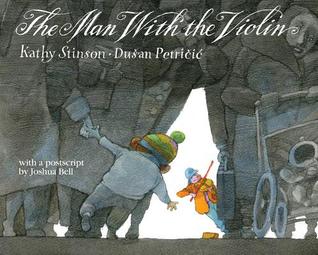
The Man with the Violin by Kathy Stinson (Ricki’s Review)

Share

the man with the violin

The Man with the Violin
Author: Kathy Stinson
Illustrator: Dusan Petricic
Published August 8th, 2013 by Annick Press

Goodreads Summary: This gorgeous picture book is based on the true story of Joshua Bell, the renowned American violinist who famously took his instrument down into the Washington D.C. subway for a free concert. More than a thousand commuters rushed by him, but only seven stopped to listen for more than a minute. In The Man With the Violin, bestselling author Kathy Stinson has woven a heart-warming story that reminds us all to stop and appreciate the beauty that surrounds us.

Dylan is someone who notices things. His mom is someone who doesn’t. So try as he might, Dylan can’t get his mom to listen to the man playing the violin in the subway station. But Dylan is swept away by the soaring and swooping notes that fill the air as crowds of oblivious people rush by. With the beautiful music in his head all day long, Dylan can’t forget the violinist, and finally succeeds in making his mother stop and listen, too.

Vividly imagined text combined with illustrations that pulse with energy and movement expertly demonstrate the transformative power of music. With an afterword explaining Joshua Bell’s story, and a postscript by Joshua Bell himself.

Review: My aunt bought my son this book when she heard people raving about it in the bookstore. It is an absolutely wonderful story. People pay hundreds of dollars to hear Joshua Bell play his violin, yet few stopped to listen when he played in the subway. It begs the question—just what are we missing each day, as we pass through our lives bustling about, blind to the beauty in the world around us? I can’t wait until my son is a bit older, as I think this would be a fantastic book to read together and then head out into the world, stopping and noticing.

Teacher’s Tools for Navigation: This would be a great book to read before a field trip or an outdoor walk. I also love that the author turned a news article into a picture book. It would be really fun for students to choose a news article to transform.

Discussion Questions: Just what are we missing each day?; Why do you think children noticed Joshua Bell more often? What does this say about people, in general?

We Flagged: “Who is playing that beautiful music in the subway? And why is nobody listening?”

Read This If You Loved: Walden by Henry David Thoreau, Little Bobo by Serena Romanelli, Little Rat Makes Music by Monika Bang-Campbell

Recommended For: 

readaloudbuttonsmall classroomlibrarybuttonsmall

RickiSig

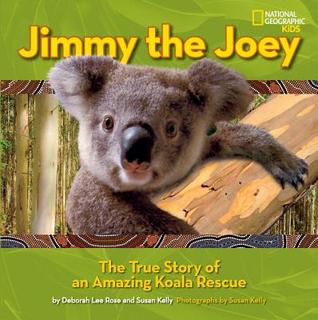
Jimmy the Joey by Deborah Lee Rose and Susan Kelly

Share

NF PB 2013

Nonfiction Picture Book Wednesday

Nonfiction Picture Book Wednesday is hosted by Kid Lit Frenzy and was started to help promote the reading of nonfiction texts. Most Wednesdays, we will be participating and will review a nonfiction text (though it may not always be a picture book).
Be sure to visit Kid Lit Frenzy and see what other nonfiction books are shared this week!

jimmy

Jimmy the Joey: The True Story of an Amazing Koala Rescue
Authors: Deborah Lee Rose and Susan Kelly
Photographer: Susan Kelly
Published July 9th, 2013 by National Geographic Children’s Books

Goodreads Summary: This warm and inspirational photographic picture book for ages 4 to 8 is a compelling and uplifting true story, with a sweet message about coping with loss that draws attention to an important and threatened wild animal.

Jimmy is an adorable baby koala whose tender tale is sure to strike at the heartstrings of every animal lover. Readers will marvel at Jimmy’s new life at Koala Hospital, being raised by loving human caregivers and interacting with other koalas healing from injury. The book also introduces young readers to the need for conservational awareness: Through Jimmy’s life story readers will come to understand the many obstacles koalas and other species face today.

My Review: So I must warn you. This book is full of adorable. You fall in love with Joey instantly and will love every second of his story. Joey’s story is combined with information about koalas as well as information about conservation. However, it never gets preachy; it is just the facts of Jimmy’s story. Oh, and did I say ADORABLE?!?!

Teacher’s Tools for Navigation: This will be a favorite read aloud in elementary classrooms. How can you not love reading about this adorable koala. The read aloud cold easily move into cause and effect discussions about how the environmental changes are effecting animals. Jimmy would be a great introduction to deforestation.

Discussion Questions: How did the tearing down of forests effect Jimmy’s life?; Why does the Koala Hospital let the koalas go after they are better?

We Flagged: “Many trees in the forest had been cut down to make room for roads and people’s houses. The mother koala needed to find a new tree with plenty of fresh leaves to eat. One starry night, with her joey holding tight to her fur, the mother koala climbed slowly to the ground.” (p. 6)

Read This If You Loved: Seymour Simon animal nonfiction books, Let’s Make a Difference: We Can Help Orangutans by Gabriella Francine, Can We Save the Tiger? by Martin Jenkins, Seabird in the Forest by Joan Dunning

Recommended For: 

readaloudbuttonsmall classroomlibrarybuttonsmall

Signature

**Thank you to Tracey at Media Masters Publicity for providing a copy for review!!**

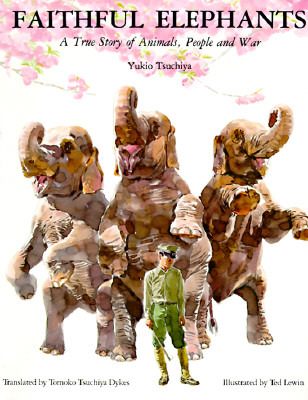
Faithful Elephants by Yukio Tsuchiya

Share

NF PB 2013

Nonfiction Picture Book Wednesday

Nonfiction Picture Book Wednesday is hosted by Kid Lit Frenzy and was started to help promote the reading of nonfiction texts. Most Wednesdays, we will be participating and will review a nonfiction text (though it may not always be a picture book).
Be sure to visit Kid Lit Frenzy and see what other nonfiction books are shared this week!

faithful

Faithful Elephants: A True Story of Animals, People, and War
Author: Yukio Tsuchiya
Translator: Tomoko Tsuchiya Dykes
Illustrator: Ted Lewin
Published October 30th, 1997 by HMH Books for Young Readers

Goodreads Summary: A zookeeper recounts the story of John, Tonky, and Wanly, three performing elephants at the Ueno Zoo in Tokyo, whose turn it is to die, and of their keepers, who weep and pray that World War II will end so their beloved elephants might be saved.

My Review: I picked up this book as soon as I read that  Jillian Heise thought that it’d be a good companion to Endangered. I read aloud Endangered with my 8th graders last year, and I trusted that Jillian knew what she was talking about. The subtitle warned me that this picture book would definitely not be a cheery one, but I could not have prepared myself for how emotional the book actually was. The lyrical writing and soft, watercolor illustrations add to the intensity of the story. Be warned: tears will happen.

Teacher’s Tools For Navigation: This book not only would be a perfect companion to Endangered, it is definitely a wonderful picture book to lead to deep discussions in the classroom. Children are always very emotional about books pertaining to animals, so I know they will have an intense opinion about what happens in this book. As the zookeepers kill the animals to protect the city in case of a bombing, students will definitely disagree with this decision and this will lead to a great debate. The story also lends itself towards discussions about animal emotions and abuse as well as cause and effect discussions.

Discussion Questions: In what ways is the story of the elephants in Faithful Elephants similar to the story of the bonobos in Eliot Schrefer’s Endangered?; Was there an alternate solution that the zookeepers could have considered for the elephants?

We Flagged: “Not far from the cheerful square, there stands a tombstone. Not many notice this monument for the animals that have died at the Ueno Zoo. It is quiet and peaceful here, and the sun warms every corner.” (p. 8)

Read This If You Loved: Endangered by Eliot Schrefer, The One and Only Ivan by Katherine Applegate, The Outside of a Horse by Ginny Rorby

Recommended For: 

readaloudbuttonsmall closereadinganalysisbuttonsmall classroomlibrarybuttonsmall

Signature

Anubis Speaks! by Vicky Alvear Shecter

Share

Halloween

NF PB 2013

Nonfiction Picture Book Wednesday

Nonfiction Picture Book Wednesday is hosted by Kid Lit Frenzy and was started to help promote the reading of nonfiction texts. Most Wednesdays, we will be participating and will review a nonfiction text (though it may not always be a picture book).
Be sure to visit Kid Lit Frenzy and see what other nonfiction books are shared this week!

anubis

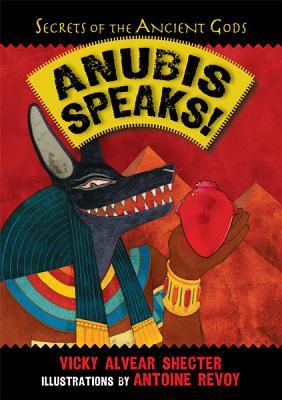
Anubis Speaks! A Guide to the Afterlife by the Egyptian God of the Dead
Author: Vicky Alvear Shecter
Illustrator: Antoine Revoy
Published October 1st, 2013 by Boyd Mills Press

Goodreads Summary: Anubis, the ancient Egyptian god of death and mummification, takes the reader on a personal tour of the “Dark Lands”–the Egyptian afterworld. While touring, Anubis explains ancient Egyptian death practices and escorts the reader onto Ra’s “Night Boat,” where they must battle the evil demon of destruction, Apophis, so that Ra can be reborn in the morning as the sun disk.

Based on Egyptology research–particularly the Book of the Dead, The Book of Apophis, the Book of Caverns and others–Anubis Speaks gives middle-grade readers a fun yet factual look at ancient Egyptian beliefs, rituals and practices.

My Review: I was introduced to Vicky Alvear Shecter when I read Cleopatra’s Moon and was struck by her way to intertwine fact, mythology, and fiction into a fascinating story. I’ve recently (once I started teaching it) become a very hug fan of mythology though mostly Greek and Roman; however, with my reading of Cleopatra’s Moon (then the Kane Chronicles by Rick Riordan), I jumped into Egyptian mythology head first and began learning more and more thus realizing how fascinating all mythology is.

Now to Anubis Speaks! What I enjoyed most about this book was how it was put together. It isn’t just another nonfiction book that lists facts and myths and hope that students find it interesting. Instead Shecter made sure to make the book entertaining and different and intertwined myths with a fun narrative from the Egyptian god of the dead. (YES! The whole book is told from the point of view of Anubis making it quite hilarious at points and making it more interesting than just an informational nonfiction book.)

Teacher’s Tools for Navigation: This book fits perfectly into a mythology unit. It can be used as a whole or parts taken out. It is a great resource for any teacher teaching Egypt or Egyptian mythology. Also, because it is written so entertainingly, it can definitely be used as a read aloud.

Discussion Questions: Which other Egyptian god/dess’s point of view would you like to read a book by?; Which myth that Anubis shared was your favorite?; What part of Egyptian history that Anubis shared did you find to be the most interesting?

We Flagged: “Allow me to introduce myself. I am Anubis—the Egyptian god of the “Mysteries of Embalming,” the “Guardian of the Veil of Death,” “Opener of the Ways of the Dead,” and if you are “bad” . . . Your. Worst. Nightmare.

But do not fear. I will not snatch your beating heart from your chest and toss it to my good friend, crocodile-headed Amut the Destroyer for a squishy snack . . . not today anyway. Instead, I will guide you through my world of deep magic, strange gods, and gruesome monsters. I will show you how my people, the ancient Egyptians, prepared the dead for eternal and evil—every night—to keep you safe.” (p. 8)

Read This If You Loved: The Kane Chronicles (series) by Rick Riordan, Percy Jackson and the Olympians (series) by Rick Riordan, Cleopatra’s Moon by Vicky Alvear Shecter, Aphrodite the Diva by Joan Holub, Who Was King Tut? by Roberta Edwards and other nonfiction King Tut books, Athena’s Son by Jeryl Schoenbeck, The Gruesome Truth about the Egyptians by Jillian Powell and other nonfiction Egyptian books

Recommended For: 

classroomlibrarybuttonsmall readaloudbuttonsmall closereadinganalysisbuttonsmall

Signature

**Thank you to Vicky Alvear Shecter and Teresa Rolfe Kravtin for sending me a copy!**

The Mary Celeste: An Unsolved Mystery from History by Jane Yolen and Heidi Elisabet Yolen Stemple

Share

NF PB 2013

Nonfiction Picture Book Wednesday

Nonfiction Picture Book Wednesday is hosted by Kid Lit Frenzy and was started to help promote the reading of nonfiction texts. Most Wednesdays, we will be participating and will review a nonfiction text (though it may not always be a picture book).
Be sure to visit Kid Lit Frenzy and see what other nonfiction books are shared this week!

122102

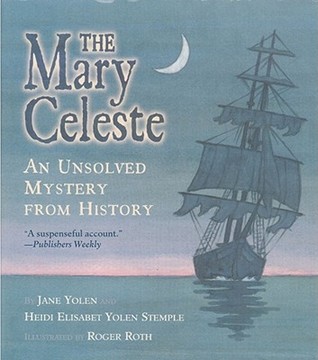
The Mary Celeste: An Unsolved Mystery from History
Author: Jane Yolen and Heidi Elisabet Yolen Stemple
Illustrator: Roger Roth
Published July 1st, 2002 by Simon & Schuster Books for Young Readers

Goodreads Summary: The Mary Celeste was discovered adrift on the open sea by another ship in 1872 — with no sign of captain or crew. What happened? Did the crew mutiny? Were they attacked by pirates? Caught in a storm? No one ever found out.

Inside this book are the clues that were left behind and the theories of what people think happened aboard that ship. Become a detective, study the clues, and see if you can help solve this chilling mystery from history.

My Review: This is the final book in the Unsolved Mystery from History series and I think it may be my favorite yet. Like The Wolf Girls, I had not heard about the Mary Celeste before this book, but this mystery was just so enthralling! A crew that just disappears?!?! How?!?! After reading the book, I spent hours online reading about the Mary Celeste and it is so interesting. There are so many websites and opinions and theories—all which would be so much fun to share with students.

Teacher’s Tools for Navigation: Like the other books in this series, I would love to see these books used in classrooms (history or language arts/reading). These books promote studying history, asking questions, inquiry, and vocabulary. Each book begins with an introduction about a young girl who enjoys unsolved mysteries from history and then the books are set up like her case notebook. Each page of the case notebook includes a narrative nonfiction section, an informational nonfiction section where facts about the story are explained even more in detail, and then there are vocabulary words from the two sections defined for the reader. Finally, in the back of the books the different theories about what could be the answer to the unsolved mystery are shared and briefly discussed. The set up of this book leads to infinite possibilities of being used in the classroom. Students could debate, write research papers, could do their very own case notebook about a different mystery, etc. Another option is to get all of the Unsolved Mystery from History books and have students get into lit circle groups and have each group read a different mystery then research and share. The other books in the series are about the Salem Witch Trials, the Wolf Girls, and Roanoke.

Discussion Questions: Which of the theories do you think happened?; Do you trust Captain Morehouse? Why or why not?; One theory mentions a kraken. Do you think sea monsters exist?; Study the weather of the Pacific during the time period the ship disappeared. Is weather an option for the crew’s disappearance?

We Flagged: Narrative Nonfiction “The last place the men looked was in the ship’s hold where her cargo- 1,700 barrels of raw alcohol- was well stowed. Not a single barrel had been opened. All in all, Deveau and Wright looked around the Mary Celeste for over half an hour. They found no sign of anyone on board, no signs of struggle.”

Informative Nonfiction “The cargo was alcohol stored in red oak barrels. Red oak is a porous wood that lets alcohol fumes escape. When the barrels were examined, some of the alcohol was found to be gone, but that was entirely due to evaporation. According to reports, the barrels were “in good order” and not “in any way injury.” Besides, the alcohol was was raw alcohol which was to be used for fortifying Italian wines. Anyone drinking it unprocessed would not become drunk, but would rather lapse into a coma or die. Only one hatch was found open, but there was no sign of smoke damage or an explosion in the unventilated hold.”

Vocabulary “Hold: the area inside the ship where cargo is stored; Cargo: the goods being transported by the ship” (p. 20-21)

Read This If You Loved: The other Unsolved Mystery from History books

Recommended For: 

closereadinganalysisbuttonsmall readaloudbuttonsmall

classroomlibrarybuttonsmall litcirclesbuttonsmall

I’m so sad that I am done reviewing the Unsolved Mystery from History series, but I hope you have enjoyed learning about them as I enjoyed reading them. 

Signature

The Wolf Girls: An Unsolved Mystery from History by Jane Yolen and Heidi Elisabet Yolen Stemple

Share

NF PB 2013

Nonfiction Picture Book Wednesday

Nonfiction Picture Book Wednesday is hosted by Kid Lit Frenzy and was started to help promote the reading of nonfiction texts. Most Wednesdays, we will be participating and will review a nonfiction text (though it may not always be a picture book).
Be sure to visit Kid Lit Frenzy and see what other nonfiction books are shared this week!

wolf

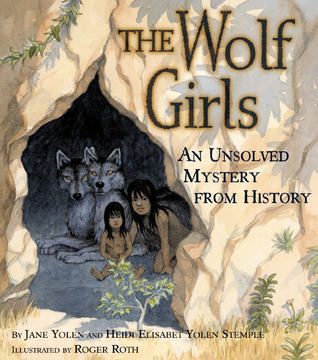
The Wolf Girls: An Unsolved Mystery from History
Authors: Jane Yolen and Heidi Elisabet Yolen Stemple
Illustrator: Roger Roth
Published August 1st, 2000 by Simon & Schuster Books for Young Readers

Goodreads Summary: In 1920 a missionary brought two young girls to an orphanage in India. The girls didn’t know how to talk, walk, or eat from a plate. Some people thought the girls had been abandoned by their parents. Some people said the girls were brought up by wolves in the wild. Still others thought that the missionary who ran the orphanage made up the story about the girls. No one knows for sure.

Become a detective as you read this true story, study the clues, and try to figure out the fate of the wolf girls of Midnapore. The Unsolved Mystery from History series is written by acclaimed author Jane Yolen and former private investigator Heidi Elisabet Yolen Stemple. Read carefully and check your clues. You might be the first to solve a puzzle that has baffled people for years.

My Review: This story was fascinating as I had never heard of the wolf girls and came in with no prior knowledge about the mystery. It was so much fun to be full on submerged in the mystery and following the clues that are given throughout the “case notebook”.

Teacher’s Tools for Navigation: This book is set up just like the Salem Witch Trials: An Unsolved Mystery from History and could be used the same way in the classroom: This book promotes studying history, inquiry, and vocabulary. The book begins with an introduction to a young girl who enjoys unsolved mysteries from history and then the book is set up like her case notebook. Each page of the case notebook includes a narrative nonfiction section, an informational nonfiction section where facts about the story are explained even more in detail, and then there are vocabulary words from the two sections defined for the reader. Finally, in the back of the book the different theories about what could be the answer to the unsolved mystery are shared and briefly discussed. The set up of this book leads to infinite possibilities of being used in the classroom. Students could debate, write research papers, could do their very own case notebook about a different mystery, etc. Another option is to get all of the Unsolved Mystery from History books and have students get into lit circle groups and have each group read a different mystery then research and share.

What I like particularly about this one is that there is so much to debate as there aren’t many clues given throughout the story. Many of the eye witnesses are unreliable and there aren’t many facts shared throughout the book. I think this book would lead to a great discussion about primary and secondary sources as well as reliability.

Discussion Questions: Which theory do you believe about the wolf girls?; Do you think a journal written a year after an incident is reliable?; Many of the scientific facts and theories shared are from the 18th and 19th century, are these facts still what science believes?; Why do you think the missionary’s wife never spoke of the wolf girls?; Why do you think that Singh’s accounts were different than his daughter’s?; Singh said he did not want to exploit the girls yet he let people come to see her – is this exploitation? Do you think what he did was wrong?

We Flagged: Narrative nonfiction “After nursing the two girls back to health, the Reverend Singh loaded them into the cart and drove them for eight days to his orphanage in Midnapore. But the wolf girls were so weak and emaciated, they could not move about, so at first no one outside of the orphanage saw them. Singh wrote in his journal, ‘They were accepted simply as neglected children.’

Informational Nonfiction Singh wrote in his journal that the girls were mud-covered, with scratches, scars, and fleas. The heels of their hands were callused from running on all fours. Their ears trembled like a dog’s when they were excited. Their brows were bushy and long. Each had arms almost reaching their knees. Their teeth were close-set, uneven, with fine, sharp edges, the canines longer and more pointed than is usual in humans. However, Singh took no scientific measurements and invited no scientists to examine the girls. He took photographs that were fuzzy and indistinct. Years later, his own daughter, when interviewed, did not remember the distinctive teeth or exceptional ears or terrifically bushy brows.

Vocabulary Emaciated: thin and feeble due to disease or poor food; Neglected: not take proper care of” (p. 20-21)

Read This If You Loved: Yolen’s other Unsolved Mystery from History books

Recommended For: 

classroomlibrarybuttonsmall litcirclesbuttonsmall

closereadinganalysisbuttonsmall readaloudbuttonsmall

What mystery from history do you wish Jane Yolen had written about? 

Signature