2017 Nonfiction Picture Book Biographies: The Youngest Marcher by Cynthia Levinson, Balderdash! by Michelle Markel, and Shark Lady by Jess Keating

Share

nfpb2017

Nonfiction Wednesday

Nonfiction Picture Book Wednesday is hosted by Kid Lit Frenzy and was started to help promote the reading of nonfiction texts. Most Wednesdays, we will be participating and will review a nonfiction text (though it may not always be a picture book).
Be sure to visit Kid Lit Frenzy and see what other nonfiction books are shared this week!

A couple of weeks ago at ALA, my friend Michele Knott of Mrs. Knott’s Book Nook, was kind enough to show me some of her favorite nonfiction picture book biographies published in 2017, and I am so happy to share them with you all.

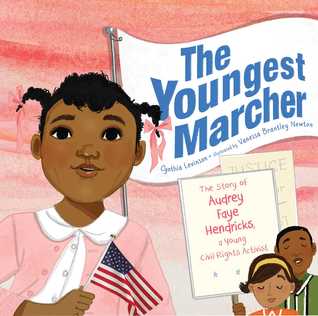
The Youngest Marcher: The Story of Audrey Faye Hendricks, a Young Civil Rights Activist
Author and Illustrator: Cynthia Levinson
Published January 17th, 2017 by Atheneum Books for Young Readers

Summary: Meet the youngest known child to be arrested for a civil rights protest in Birmingham, Alabama, 1963, in this moving picture book that proves you’re never too little to make a difference.

Nine-year-old Audrey Faye Hendricks intended to go places and do things like anybody else.

So when she heard grown-ups talk about wiping out Birmingham’s segregation laws, she spoke up. As she listened to the preacher’s words, smooth as glass, she sat up tall. And when she heard the plan—picket those white stores! March to protest those unfair laws! Fill the jails!—she stepped right up and said, I’ll do it! She was going to j-a-a-il!

Audrey Faye Hendricks was confident and bold and brave as can be, and hers is the remarkable and inspiring story of one child’s role in the Civil Rights Movement.

My Thoughts: This book was a perfect picture book companion while I was reading the March trilogy by John Lewis, and reading it and the trilogy made me realize I need to update my Civil Rights text set with all of the amazing titles I’ve read recently, including this one. Audrey Faye Hendricks’s story is a story of a young girl that was so gutsy and stood up for what she believed in– equality because she wanted to be able to do whatever she put her mind to when she grew up. This story also gave another angle to the Civil Rights Movement showing the inclusiveness of all aspects of the Black community in the fight for equal rights.

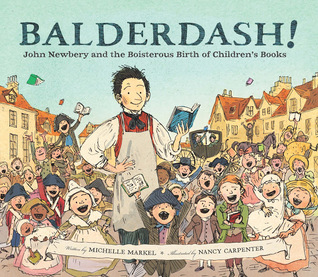
Balderdash!: John Newbery and the Boisterous Birth of Children’s Books
Author and Illustrator: Michelle Markel
Published April 4th, 2017 by Chronicle Books

Summary: A picture book biography about John Newbery pioneering author and publisher for whom the prestigious Newbery medal is named and the revolution in children s books that he led This rollicking and fascinating picture book biography chronicles the life of the first pioneer of children s books John Newbery himself While most children s books in the 18th century contained lessons and rules John Newbery imagined them overflowing with entertaining stories science and games. He believed that every book should be made for the reader’s enjoyment Newbery for whom the prestigious Newbery Medal is named became a celebrated author and publisher changing the world of children’s books forever This book about his life and legacy is as full of energy and delight as any young reader could wish.

My Thoughts: This was the perfect book for me to read after attending ALA and the Newbery-Caldecott-Wilder banquet because, although I knew Newbery was a children’s book publisher, I didn’t know much at all about him or his life. Markel’s biography of him is a perfect introduction! Newbery knew that children needed books that were made specifically for them, a philosophy that we all know is correct and true! I loved how Newbery fought the norms of society and put his money where his mouth is and opened a children’s bookstore which led to the world of children’s books we have today! No wonder the Newbery was named after him!

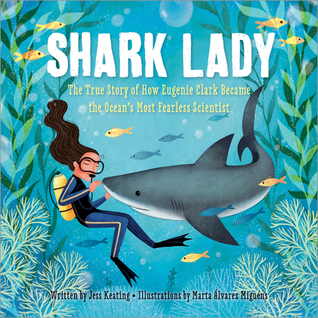
Shark Lady: The True Story of How Eugenie Clark Became the Ocean’s Most Fearless Scientist
Author: Jess Keating
Illustrator: Marta Álvarez Miguéns
Published June 6th, 2017 by Sourcebooks Jabberwocky

Summary: At 9 years old, Eugenie Clark developed an unexpected passion for sharks after a visit to the Battery Park Aquarium in New York City. At the time, sharks were seen as mindless killing machines, but Eugenie knew better and set out to prove it. Despite many obstacles in her path, Eugenie was able to study the creatures she loved so much. From her many discoveries to the shark-related myths she dispelled, Eugenie’s wide scientific contributions led to the well-earned nickname “Shark Lady.”

My Thoughts: I had not heard of Eugenia Clark until I read Heather Lang’s Swimming with Sharks and now with Shark Lady we have a second amazing biography about her! I am so glad that she is getting the attention that her amazing story and career deserves! I love that her story shows that inquiry from a young age can lead to a successful and fulfilling career. It also teaches us that nature is something we need to keep questioning and learning from because assumptions are how beautiful things in nature get misunderstood.


All Books Recommended For: 
classroomlibrarybuttonsmall closereadinganalysisbuttonsmall 

Signature

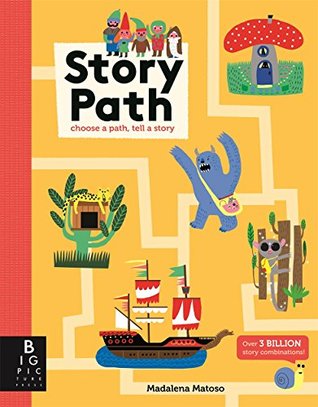
Story Path: Choose a Path, Tell a Story by Madalena Matoso

Share

Story Path: Choose a Path, Tell a Story
Author/Illustrator: Madalena Matoso
Published March, 2017 by Kane Miller EDC Publishing

Summary: Where you go, whom you meet, what you do next — it’s all up to you…

Travel along the story path and discover an enchanted world where princess battle with hairy monsters and vampire cats zoom through the galaxy on silver unicorns!

This innovative picture book allows you to choose your own characters, settings, and plots at every turn. With quirky illustrations by the award-winning Madalena Matoso, this is an imaginative storytelling experience for children of all ages.

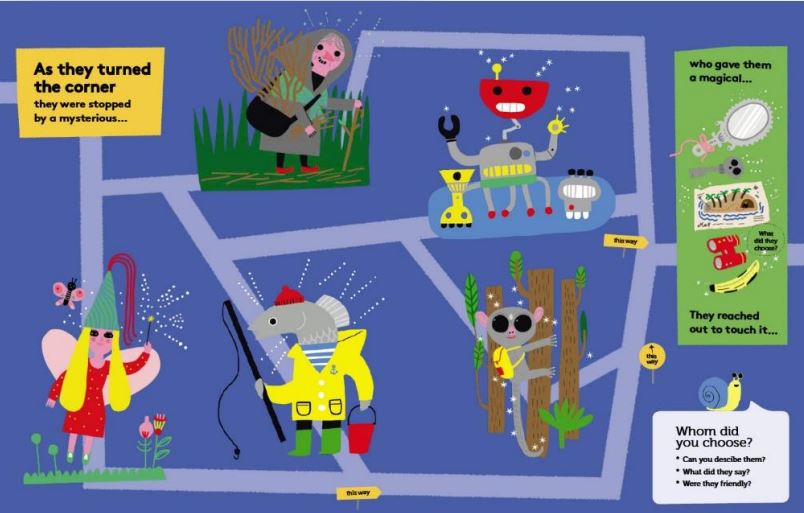
Review: I loved Choose Your Own Adventure books when I was younger because it made you part of the story to an extent that other books didn’t because you get to be the actual creator of the plot. Story Path does just this but for a younger audience! The author set up the book in a very friendly way that gives lots of options but also is easy to follow. On each page, the story continues with a beginning of a sentence like “One day, they were riding along on their…” and the reader then gets to pick from a set of illustrations. This spread includes options like a two-headed dragon, rocket ship, horse, boat, or an elephant. Then after the choice is made, the author included guiding questions to ask the reader like “What did you choose? What noise did it make? How fast was it? Where were they going?” This helps add even more to the story that the reader is creating. 

Teachers’ Tools for Navigation: This book could take narrative writing to a new level in the early elementary classroom! As students are first learning how to write stories, Story Path can help guide the writers through characters, setting, and plot yet each writer would have a different story.

Discussion Questions: What story did you create? Why did you pick what you did? What can you add to your story?

Flagged Passages: 

Read This If You Loved: Choose Your Own Adventure books, Journey trilogy by Aaron BeckerHenri Mouse by George Mendoza

Recommended For:
classroomlibrarybuttonsmall 

**Thank you to Lynn at Kane Miller for providing a copy for review!!**

Busy Builders: Construction Site by Katherine Sully

Share

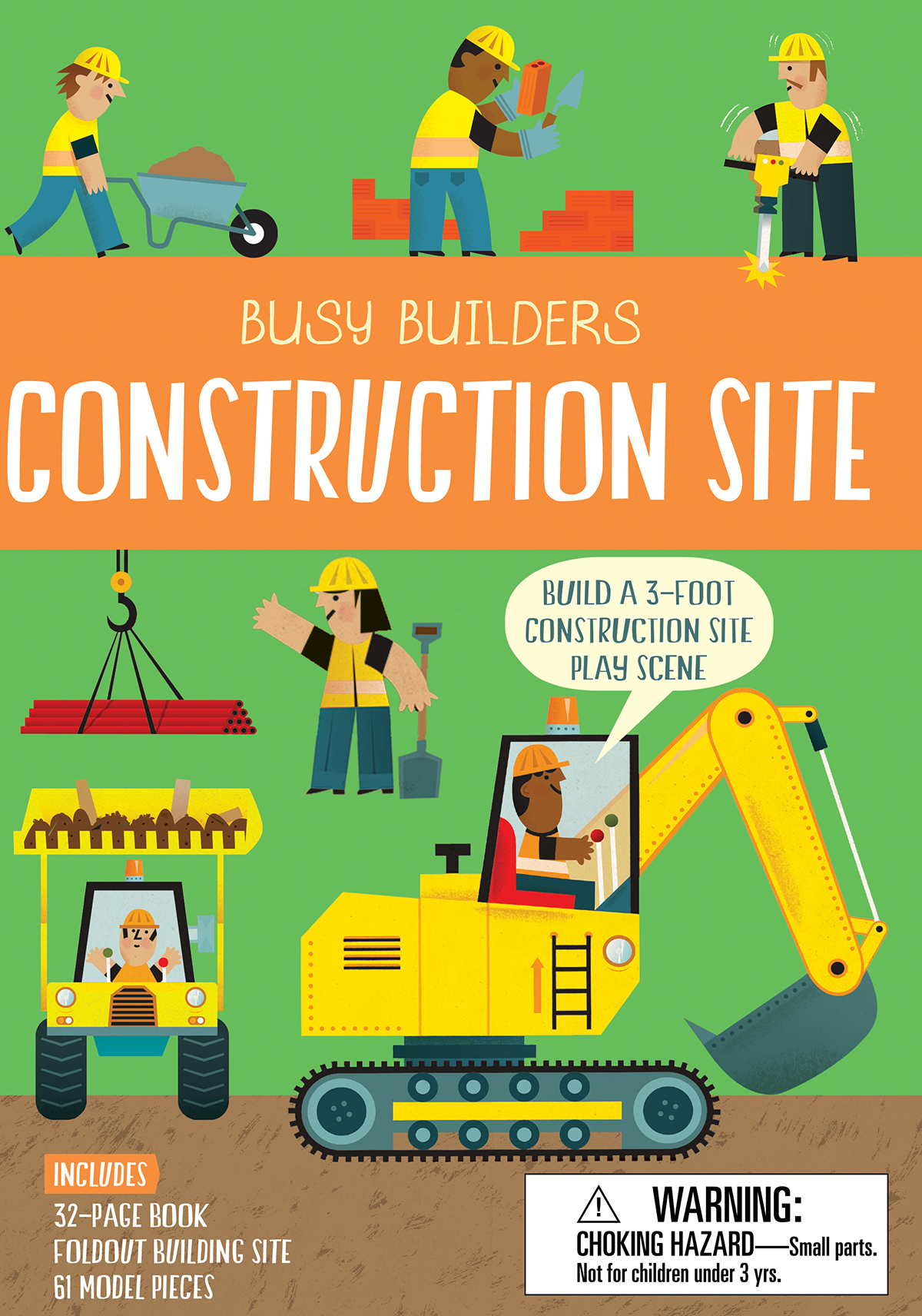
Busy Builders Construction Site
Author: Katherine Sully
Illustrator: Carles Ballesteros
Published December 20, 2016 by Silver Dolphin

Summary: Dig in and get ready to work in Busy Builders: Construction Site. This three-dimensional interactive kit will bring young children to a busy building site, where they will meet the construction crew at work on a new school. The fact book introduces kids to the people and machines at a construction site, using colorful illustrations and simple text. Plus, the box folds out to form a school under construction, complete with model pieces for the building, vehicles, and construction workers.

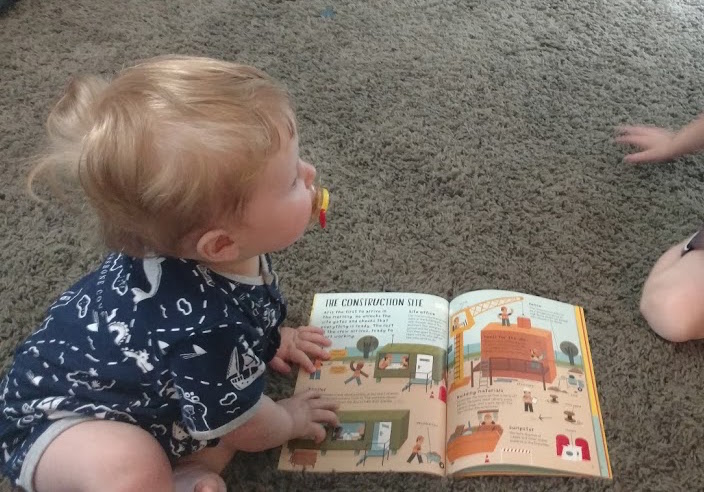
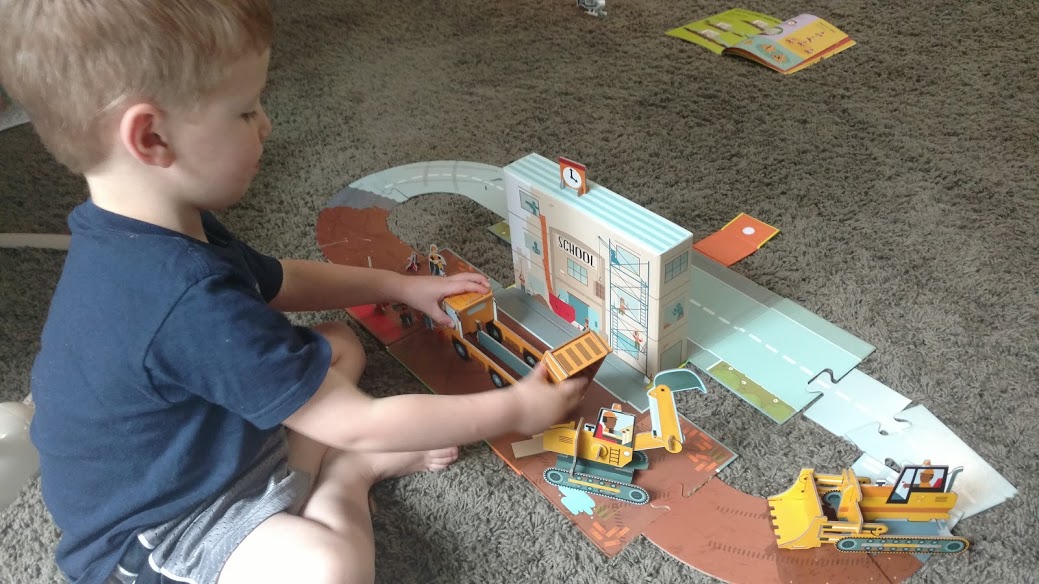
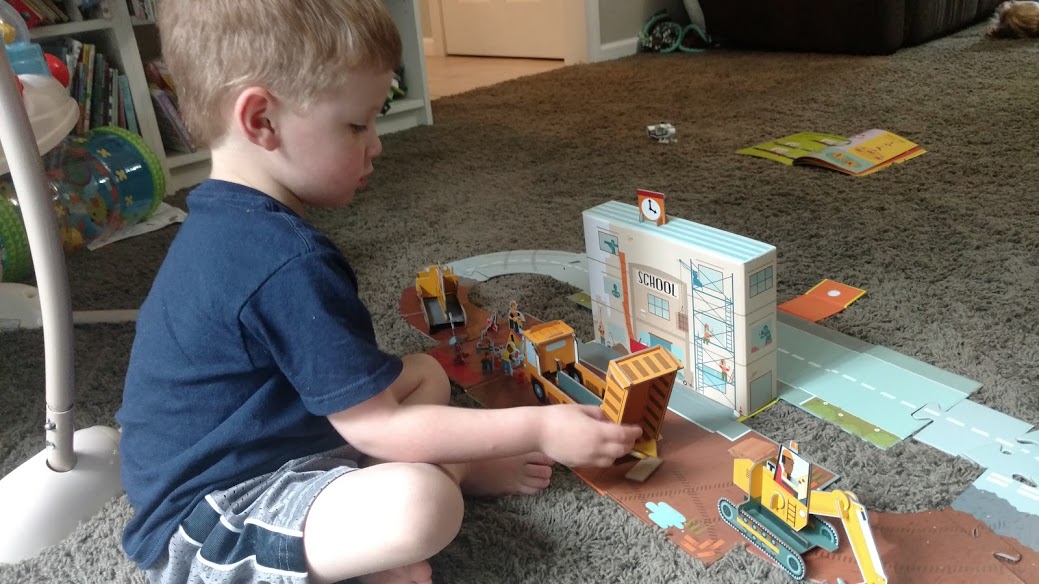
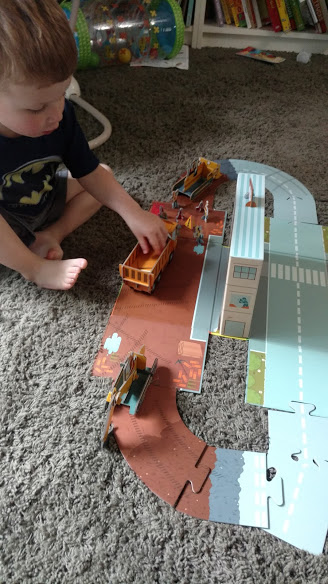
Review and Teachers’ Tools for Navigation: This book/kit was such a joy. I saved it for a gathering of kids at a lake house. Six kids (a 9 mo, 2 yo, 2.5 yo, 3.5 yo, 5 yo, and 7 yo) worked together to read the book and build the construction site. The two oldest kids were the best at putting the pieces together, and the parents helped. The directions were very easy to follow, and the construction vehicles swivel and move!

I didn’t remember to take pictures of the group effort in action, but I did take a few pictures of my two sons reading the book and playing with the kit the next day (see below). It was so fun to read about all of the construction workers and to have the figures in hand to place them on the construction site. This book would make a wonderful gift and would be great for a learning station in a class. My son is 3.5 years old, and I built most of the vehicles, but he helped with the smaller figures. Early elementary school students would be able to build this kit together with assistance, and the picture book is clear and easy to follow. For a learning stations, the kit can easily be disassembled between groups, or each group of students can build a different vehicle.

We are very excited to assemble the airport and fire station kits next!

Discussion Questions: Where do all of the crew members work? How do they work together to build the school?; How do you think the author and illustrator worked together to craft this book?

Fun Moments: 

An Hour Later (No Lie):

Read This If You Love: Building Models, Vehicles, Interactive Play, Engaging Reading Activities

Recommended For:

  classroomlibrarybuttonsmall

Can an Aardvark Bark? by Melissa Stewart

Share

nfpb2017

Nonfiction Wednesday

Nonfiction Picture Book Wednesday is hosted by Kid Lit Frenzy and was started to help promote the reading of nonfiction texts. Most Wednesdays, we will be participating and will review a nonfiction text (though it may not always be a picture book).
Be sure to visit Kid Lit Frenzy and see what other nonfiction books are shared this week!

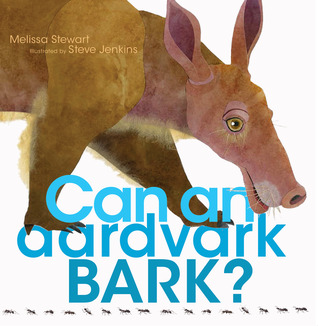
Can an Aardvark Bark?
Author: Melissa Stewart
Illustrator: Steve Jenkins
Published June 13th, 2017 by Beach Lane Books

Summary: From award-winning author Melissa Stewart and Caldecott honoree Steve Jenkins comes a noisy nonfiction exploration of the many sounds animals make.

Can an aardvark bark? No, but it can grunt. Lots of other animals grunt too…

Barks, grunts, squeals—animals make all kinds of sounds to communicate and express themselves. With a growling salamander and a whining porcupine, bellowing giraffes and laughing gorillas, this boisterous book is chock-full of fun and interesting facts and is sure to be a favorite of even the youngest animal enthusiasts.

Review: This book came at a perfect time for my family! Trent had a doctor appointment last week and he was in the jungle room. While in the room, he started saying the noises for each animal and asking me what the ones he didn’t know make. I promptly found an app for that, and we’ve been exploring the app ever since listening to the sounds of all sorts of animals from chimpanzees to ibex to anteaters that live in the jungle to the farm to the mountains. And then we received Can an Aardvark Bark? in the mail, and it was such a happy coincidence! The book is a perfect addition to my new animal sound obsessed kid.

But in addition to my personal story of why we’re excited about this book the text is also filled with animal facts, fun to read, and illustrated by one of my favorite illustrators, Steve Jenkins.

Teachers’ Tools for Navigation: In an elementary classroom, Melissa Stewart’s work  is such a wonderful way to bring science into reading time and reading into science time. This one is no exception. The book includes a wide variety of animals and interesting information about each one. It also has a fun rhythmic and rhyming text that lends itself to read alouds. The book could also be a jumping off point for an animal inquiry project focused around either an animal in the book or a new animal.

Discussion Questions: What are different ways animals communicate?; What animal makes a sound that surprised you?; How did the author structure the book?; What are some animals not in the book? What sound do they make? Where would they fit in in the text structure? Or would they be in their own category?; What can animal sounds tell you about the animal?

Book Trailer: 

Read This If You Love: Nonfiction picture books about animals, Melissa Stewart’s work or Steve Jenkins’s work

Recommended For: 

classroomlibrarybuttonsmall closereadinganalysisbuttonsmall 

Signature

Blog Tour with Review and Giveaway!: Two Truths and a Lie: It’s Alive! by Ammi-Joan Paquette and Laurie Ann Thompson

Share

nfpb2017

Nonfiction Wednesday

Nonfiction Picture Book Wednesday is hosted by Kid Lit Frenzy and was started to help promote the reading of nonfiction texts. Most Wednesdays, we will be participating and will review a nonfiction text (though it may not always be a picture book).
Be sure to visit Kid Lit Frenzy and see what other nonfiction books are shared this week!

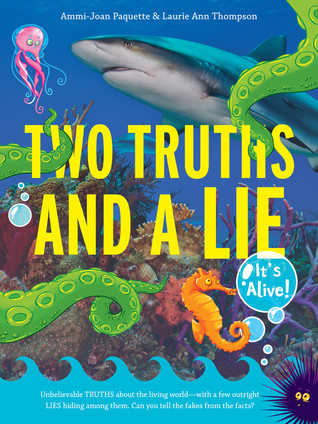
Two Truths and a Lie: It’s Alive!
Author: Ammi-Joan Paquette & Laurie Ann Thompson
Published June 27th, 2017 by Walden Pond Press

Summary: Two Truths and a Lie is the first book in a fascinating new series that presents some of the most crazy-but-true stories about the living world as well as a handful of stories that are too crazy to be true—and asks readers to separate facts from the fakes!

Did you know that there is a fungus that can control the mind of an ant and make it do its bidding? Would you believe there is such a thing as a corpse flower—a ten-foot-tall plant with a blossom that smells like a zombie? How about a species of octopus that doesn’t live in water but rather lurks in trees in the Pacific Northwest?

Every story in this book is strange and astounding. But not all of them are real. Just like the old game in this book’s title, two out of every three stories are completely true and one is an outright lie. Can you guess which? It’s not going to be easy. Some false stories are based on truth, and some of the true stories are just plain unbelievable. And they’re all accompanied by dozens of photos, maps, and illustrations. Amaze yourself and trick your friends as you sort out the fakes from the facts!

Acclaimed authors Ammi-Joan Paquette and Laurie Ann Thompson have teamed up to create a series of sneaky stories about the natural world designed to amaze, disgust, and occasionally bamboozle you.

About the Authors:


Ammi-Joan Paquette has traveled to twenty-four countries, has the ability to wake herself up at a given time without an alarm clock, and once climbed Mt. Everest. (Not all of these are true!) Joan is the author of the novels Rules for Ghosting, Paradox, and Nowhere Girl, as well as the picture books Petey and Pru and the Hullabaloo, Ghost in the House, The Tiptoe Guide to Tracking Mermaids, and The Tiptoes Guide to Tracking Fairies. She lives outside Boston, Massachusetts, where she balances her own writing and her day job as a literary agent. You can visit her online at www.ajpaquette.com.

Laurie Ann Thompson has ridden a pig, gotten stuck in an elevator overnight, and jumped out of a perfectly good airplane. (One of these facts is not true; can you guess which?) She is the author of Be a Changemaker: How to Start Something That Matters, My Dog Is the Best, and Emmanuel’s Dream, a picture book biography about Emmanuel Ofosu Yeboah, which was the recipient of the Schneider Family Book Award and was named an ALA Notable Book, a CCBC Choice, and a Bank Street College Best Book of the Year, among dozens of other accolades. She lives outside Seattle with her family. You can visit her online at www.lauriethompson.com.

Review: Walden Pond, as far as I know, hasn’t published a nonfiction text other than the Guys Read: True Stories, and I can definitely see why this is one they chose to add to their publication catalog. One of the greatest educational obstacles right now is that students have access to such a wide variety of information, some that is anything but reliable and valid, so it is up to parents and educators to show how to filter through all of the information and check the validity of what they find. Paquette and Thompson’s Two Truths and a Lie take that to a fun level giving the reader three stories, all the seem as crazy yet possible, but it gives kids the opportunity to use the internet to research each story to determine what is the truth and what is the lie. But the book doesn’t seem like it is for teaching, though it would work perfectly in the classroom, because the stories are just so crazy and fun to read from zombie-making fungi to an unlikely chicken, the stories are just all so unbelievable!

Teachers’ Tools for Navigation: Like I shared above, these stories would be a perfect way to practice digital literacy and learn about reliable and valid sources.

A teaching guide is also available from the publisher here!

Discussion Questions: Which is a lie? Why do you think so? Where could you check to find out? Which of the true stories do you want to learn more about?

Flagged Passages: “Part 1: Preposterous Plans and Fungi–Crazy, Creepy, Cool

Ah, nature. A green meadow. Wind rustling through the leaves.
Mushrooms growing on the side of a fallen log. What could be more peaceful, more predictable, more ordinary?
To that we say: ha! The plants and fungus we spotlight in this section are full of surprises. They completely defy those common stereotypes and misconceptions
Intrigued? We hope so! Because once you’ve read these, going green will never mean quite the same thing…

A. Underground Miracle Root
B. Pandomonium
C. The Secret Lives of Plants.” Chapter 1, Part 1

Read This If You Love: Learning interesting and new facts about nature

Recommended For: 

classroomlibrarybuttonsmall closereadinganalysisbuttonsmall

Follow the Blog Tour!

June 5th   Librarian’s Quest
June 7th   Flowering Minds
Pragmatic Mom
June 11th  Geo Librarian
June 13th Smack Dab in the Middle
June 14th Bluestocking Thinking
June 15th Novel Novice
Library Lions Roar
June 16th Archimedes Notebook
June 18th Nerdy Book Club
June 19th Cracking the Cover
June 20th Writers Rumpus
The Hiding Spot
June 21st  Maria’s Melange
June 23rd Unleashing Readers
June 24th This Kid Reviews Books

Enter the Giveaway!

a Rafflecopter giveaway

Signature

Review and Giveaway!: Grace Hopper: Queen of Computer Code by Laurie Wallmark

Share

nfpb2017

Nonfiction Wednesday

Nonfiction Picture Book Wednesday is hosted by Kid Lit Frenzy and was started to help promote the reading of nonfiction texts. Most Wednesdays, we will be participating and will review a nonfiction text (though it may not always be a picture book).
Be sure to visit Kid Lit Frenzy and see what other nonfiction books are shared this week!

Grace Hopper: Queen of Computer Code
Author: Laurie Wallmark
Illustrator: Katy Wu
Published May 17th, 2017 by Sterling Children’s Books

Summary: Do you know who Grace Hopper was?

A software tester, workplace jester, cherished mentor, ace inventor, avid reader, and naval leader! Acclaimed picture book author Laurie Wallmark (Ada Byron Lovelace and the Thinking Machine) once again tells the riveting story of a trailblazing woman in Grace Hopper: Queen of Computer Code (Sterling Children’s Books, May 16, 2017).

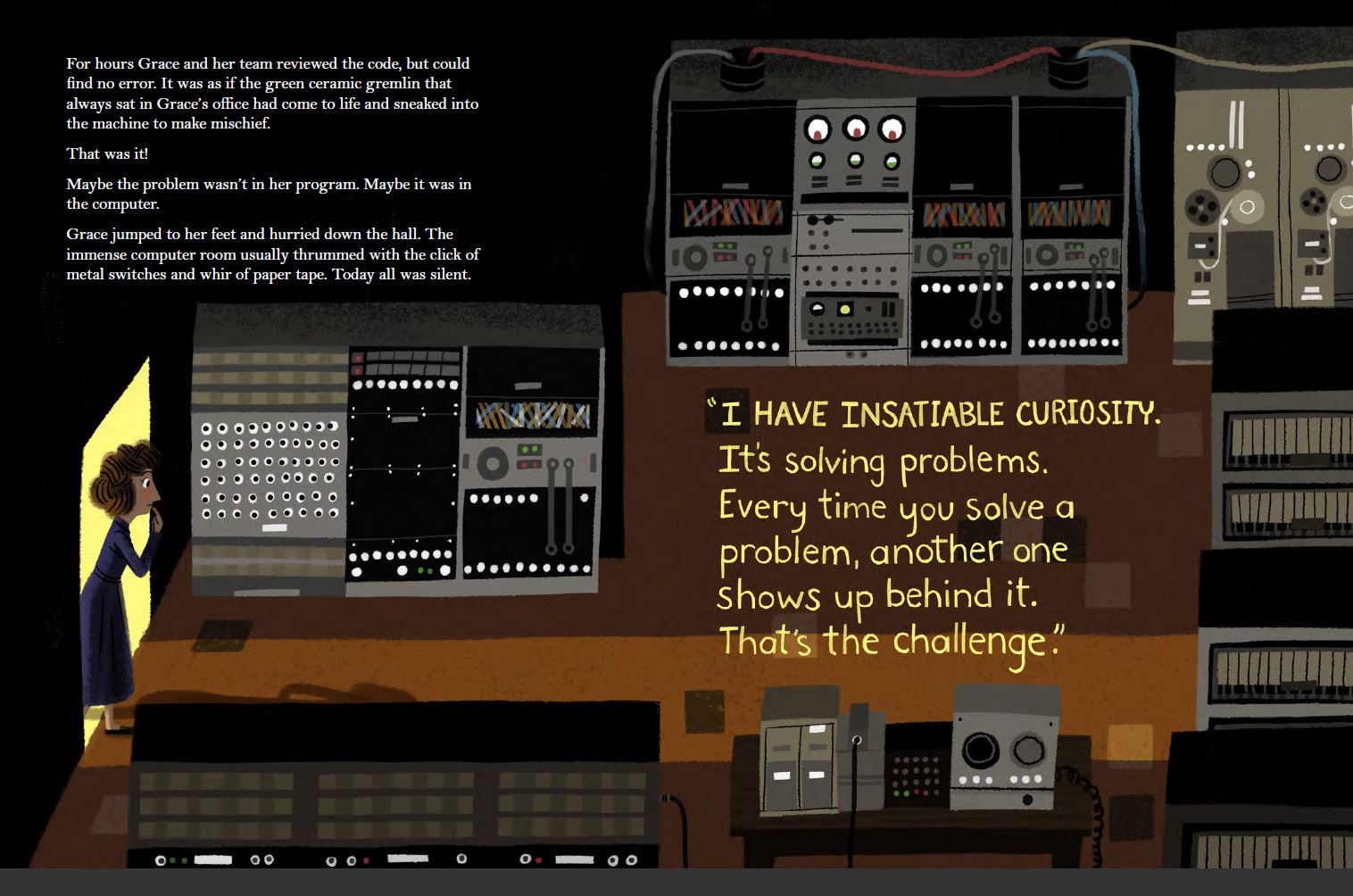
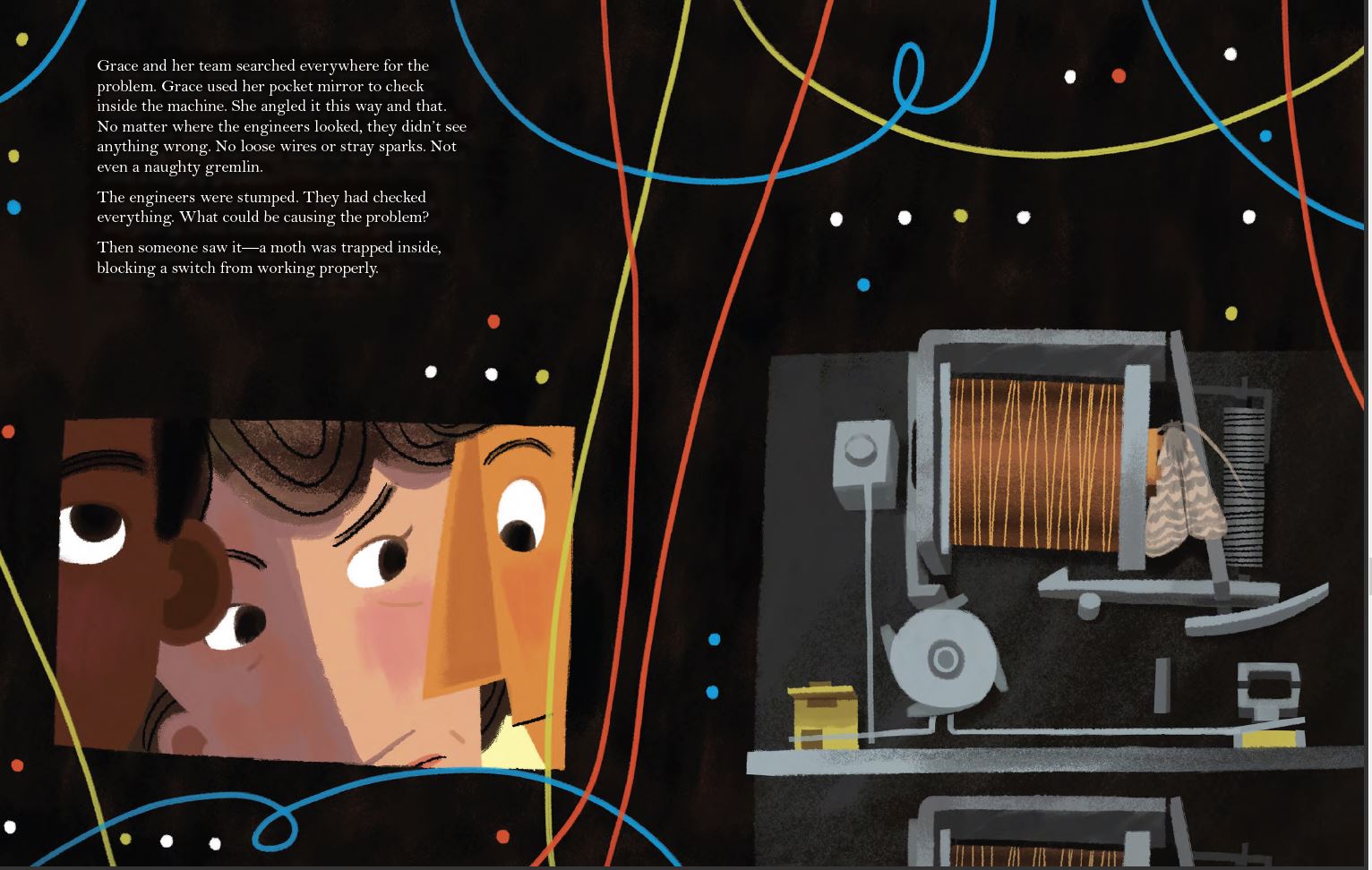
Grace Hopper coined the term “computer bug” and taught computers to “speak English.” Throughout her life, Hopper succeeded in doing what no one had ever done before. Delighting in difficult ideas and in defying expectations, the insatiably curious Hopper truly was “Amazing Grace” . . . and a role model for science- and math-minded girls and boys. With a wealth of witty quotes, and richly detailed illustrations, this book brings Hopper’s incredible accomplishments to life.

“If you’ve got a good idea, and you know it’s going to work, go ahead and do it.”  The picture book biography of Grace Hopper—the boundary-breaking woman who revolutionized computer science.

Who was Grace Hopper? A software tester, workplace jester, cherished mentor, ace inventor, avid reader, naval leader—AND rule breaker, chance taker, and troublemaker. Grace Hopper coined the term “computer bug” and taught computers to “speak English,” and throughout her life succeeded in doing what no one had ever done before. Delighting in difficult ideas and in defying expectations, the insatiably curious Hopper truly is “Amazing Grace” . . . and a role model for science- and math-minded girls and boys.

About the Author: Laurie Wallmark has degrees in Biochemistry from Princeton University, Information Systems from Goddard College, and Writing for Children and Young Adults from the Vermont College of Fine Arts. Her debut book  Ada Byron Lovelace and the Thinking Machine (Creston Books) received four starred reviews, praise in The New York Times, and numerous awards. Laurie lives in New Jersey. Follow her on Twitter: @lauriewallmark.

About the Illustrator: With a BFA in Illustration and Entertainment Arts from Pasadena Art Center College of Design in 2007, Katy Wu has worked for Google, Laika, Pixar, CinderBiter, and Simon & Schuster. Grace Hopper is her first picture book. Having worked on such projects as the feature film Coraline, and various shorts (La LunaCar Toons) as well as CG, 2D, stop motion, online games, and content for social media platforms, Katy is an incredible talent. She lives and freelances in New York City. Follow her online at katycwwu.tumblr.com.

Review: Each time I learn about a new woman in history that made such a tremendous contribution yet is a name I didn’t know, I am flabbergasted by the lack HERstory in HIStory. Grace Hopper is a phenomenal individual! I love how much her story promotes imagination and STEM. Her stories of rebuilding clocks and building a doll house from blueprints with an elevator shows how building a strong mathematical and scientific mind begins from youth, and it is all about teaching kids to mess around, use their imagination, tinker, and learn through trying. Wallmark’s biography of Grace Hopper does a beautiful job of combining a message of rebellion (in the name of science), creativity, imagination, and education with Grace’s biography. In addition to the narrative, Wu’s illustrations and formatting of the novel adds humanity and color to her story.

Teachers’ Tools for Navigation: Grace Hopper is one example of a female scientist that should be a name that everyone knows yet she is not taught in schools. Luckily there are so many wonderful nonfiction picture book biographies being published showcasing woman who made a difference (some listed below). One way I picture this text being used in the classroom is by using these picture books in a lit circle or even like a jig saw type activity. Each group reads a different nonfiction picture book and shares what they learned with the class.

Grace Hopper could also be used in a computer classroom because it has such a wonderful introduction to the beginning of computers. Grace was part of very early computer programming and computer science, and her story would be perfect to share during a technology class looking at the history of computers.

Discussion Questions: How did Grace Hopper’s legacy continued to the computers and technology we use today?; How did Grace Hopper stand out from what was expected of woman at the time?; What hardships did Grace probably face because of gender prejudice?; Choose one of Grace’s quotes shared in the book and share what it meant for Grace and how it could it be taken as inspirational for your life?

Flagged Passages: 

Read This If You Love: Ada’s Ideas by Fiona Robinson, Maya Lin by Susan Rubin, I Dissent by Debbie Levy, Fearless Flyer by Heather Lang, Dorothea’s Eyes by Barb Rosenstock, Women Who Broke the Rules series by Kathleen KrullLiberty’s Voice by Erica SilvermanJosephine by Patricia Hruby Powell, Swimming with Sharks by Heather Lang, The Book of Heroines from National Geographic Kids

Recommended For: 

classroomlibrarybuttonsmall closereadinganalysisbuttonsmall  

Giveaway: 

a Rafflecopter giveaway

Signature

**Thank you to Ardi at Sterling for providing a copy for review and giveaway!**

Author Skype Visits with Kellee’s 7th Grade Lunch Book Club

Share


A lunch book club meeting in the library one day

After we finished our Mock Newbery experience, my lunch book club needed a new direction. My students said they definitely wanted to continue the book club.

  • I liked having lunch book club because we all read the same book. We could support each other through the sad parts, and share the happy memories when something good happened. -Maria
  • I liked book club very much because I got to talk to other kids in the school who were reading the same book as I am. -Ashley
  • My favorite part of lunch book club is being able to talk with other people who have already read a book or are currently reading it. You get to talk with people and discuss it, which makes me understand the book even more. -Emily

We discussed three options to continue:

  1. Everyone just reads whatever and we talk about books in general.
  2. HARRY POTTER! There are so many students in the group that are reading his books for the first time.
  3. Author Skype Visits

After much discussion, we decided on #3 (though some students did choose to only continue reading Harry Potter).
We then looked through Kate Messner’s so helpful list of authors that are kind enough to do free school Skype visits. From this list, we chose four authors we were really interested in reading more of and chatting with:

  • Dan Gemeinhart because The Honest Truth was on our state list for 2016-2017 and Some Kind of Courage had been on our Mock Newbery list, so most of the kids in the club have already read his books, but there was also his newest, Scar Island, we could read.
  • August Scattergood because one student adored Glory Be that she read in elementary school and shared with the group how much she liked it. I also pushed for them to pick a historical fiction author to get all of the genres covered in the four visits.
  • John David Anderson because Ms. Bixby’s Last Day had been on our Mock Newbery list and had been a favorite, and I am a huge fan of his other books which I book talked, and they were interested in them.
  • Kristen Kittscher because The Wig in the Window had been a HUGE hit in my classroom last year and many of them had read it in my class last year, and they shared it with the students who hadn’t read it, and they definitely had to know how the mystery ended.

And we were so lucky that ALL OF THEM were available at some point before the end of the year, and it even worked out to one per month February through May. I then went about purchasing all of the books using a grant I received for middle school book clubs, and we began reading one author a month.

If you have ever been part of an author Skype visit, it is so amazing to see what wonderful questions the students come up with and equally fascinating to hear how the authors answer them. Some examples: With Dan Gemeinhart, we discussed “the parent problem” in middle grade and young adult literature as well as how he crafted his chapters in The Honest Truth; with Augusta Scattergood, we discussed the inclusion of diverse characters as well as her choice to add quirky exclamations in Making Friends with Billy Wong; with John David Anderson, we discussed the hero’s journey including Star Wars and Harry Potter and how he’s written so many different genres; and with Kristen Kittscher, we discussed her planning (or lack thereof) and her characterization.

Each Skype visit was different and after each one the students raved about the opportunity, and I want to second their excitement: We are so lucky to be able to spend any amount of time, much less almost an hour, with each of these authors!

  • My favorite part of Skype visits is that we got our burning questions answered. Many readers have questions and they can only speculate, but we love reading so much that we get to talk with them. I feel as if we have become friends with the authors. -Emily
  • I enjoyed Skyping with the different authors and learning how each of them wrote and planned a story. I loved reading the books and seeing the difference between the types of styles and genres each author wrote in. -Sarah