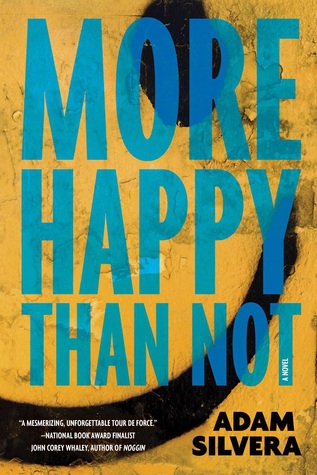
More Happy Than Not by Adam Silvera

Share

more happy than not

More Happy Than Not
Authors: Adam Silvera
Published: June 2, 2015 by Soho Teen

GoodReads Summary: In his twisty, gritty, profoundly moving debut—called “mandatory reading” by the New York Times—Adam Silvera brings to life a charged, dangerous near-future summer in the Bronx.

In the months after his father’s suicide, it’s been tough for 16-year-old Aaron Soto to find happiness again–but he’s still gunning for it. With the support of his girlfriend Genevieve and his overworked mom, he’s slowly remembering what that might feel like. But grief and the smile-shaped scar on his wrist prevent him from forgetting completely.

When Genevieve leaves for a couple of weeks, Aaron spends all his time hanging out with this new guy, Thomas. Aaron’s crew notices, and they’re not exactly thrilled. But Aaron can’t deny the happiness Thomas brings or how Thomas makes him feel safe from himself, despite the tensions their friendship is stirring with his girlfriend and friends. Since Aaron can’t stay away from Thomas or turn off his newfound feelings for him, he considers turning to the Leteo Institute’s revolutionary memory-alteration procedure to straighten himself out, even if it means forgetting who he truly is.

Why does happiness have to be so hard?

Review: After Aaron’s father commits suicide, he finds it difficult to find his place in the world, and the smile-shaped scar on his wrist is just one reminder of this struggle. Aaron considers turning to an institute that has the capability to alter his memory—because he wants to forget that he is gay. The text is heart-wrenching, emotionally profound, and deeply moving. Weeks after I read it, I found that I was still referencing it in daily conversations with teacher friends. I also designed a conference proposal based on a concept from this book. This is an important book that belongs in classrooms.

Teachers’ Tools for Navigation: Students will enjoy debating the ethics of the Leteo Institute’s procedure. My book club had a heated debate, and at the end, I still didn’t know where I stood! Teachers might bring in other examples from the media of people who have experienced trauma and ask students—would it be okay for this person to have the procedure done? When is it ethically okay (if ever)?

Discussion Questions: How does the author unfold the plot for the reader? How does this impact the telling of the story?; Which of Aaron’s friends are loyal? Why?; What does this procedure say about humanity? Do you think people would undergo the procedure? Who might be most likely to undergo the procedure?; How does the author end the novel? What does this teach us?

We Flagged: “Memories: some can be sucker punching, others carry you forward; some stay with you forever, others you forget on your own. You can’t really know which ones you’ll survive if you don’t stay on the battlefield, bad times shooting at you like bullets. But if you’re lucky, you’ll have plenty of good times to shield you.”

Read This If You Loved: Simon vs. the Homo Sapiens Agenda by Becky Albertalli, None of the Above by I. W. Gregorio, Aristotle and Dante Discover the Secrets of the Universe by Benjamin Alire Sáenz

Recommended For:

litcirclesbuttonsmall classroomlibrarybuttonsmall

RickiSig

Top Ten Tuesday: Historical Settings We Love

Share

top ten tuesday

Top Ten Tuesday is an original feature/weekly meme created at The Broke and the Bookish. The feature was created because The Broke and Bookish are particularly fond of lists (as are we!). Each week a new Top Ten list topic is given and bloggers can participate.

 Today’s Topic: Top Ten Historical Settings We Love

Ricki

In reverse order. 🙂

1. 1950s-1960s

the lions of little rock Rock and River x brown girl freedom summer

This is another time period that we can’t read about enough. The issues are still relevant today, and understanding the historical context is important to foster change.

2. 1940s

rose under fire between shades hidden like anne frank salt to sea Holocaust berlin boxing club nazi

I feel it might be inappropriate when I write that I love reading about this time period, which is a time of war and suffering. We can learn so much for the mistakes of this time, and books teach us these lessons.

3. 1890s-1900s

evolution jungle Northern Light audacity alligator bayou

I will read anything from this time period. There is something about the turn of the century that is quite compelling to me.

4. 1700s

copper chains revolution

This is another time period that teaches us very much. Similarly to the Civil Rights books, I think books about slavery are incredibly important to read. I also enjoy reading about other countries during this time, such as Jennifer Donnelly’s Revolution, which is set in a contemporary time period and in France in the 1700s.

5. 1600s

girl with a pearl earring crucible scarlet letter

There is so much fire, brimstone, and witchery in the literature of this time period. I love it!

Kellee

Some of my time periods overlap with Ricki’s, and I tried not to double post books from her list though she did include so many that I love!

Civil Rights (1950s and 1960s) 

revolution call me silence of our friends one crazy summer watsons

I believe that everyone should read about the Civil Rights Movement because it is so important to learn from our past to fix our present and future.

World War II (1939 to 1945)

hidden once terezin requiem book thief

code name verity hunt for the bamboo playing for the man overboard

World War II is such a terrifying time, but I love reading about those who overcame and those who stood up.  

The Titanic, The Dust Bowl, Prohibition, and The Great Depression (1912-1939)

i survived titanic Titanicat watch that ends Storm in the barn all the earth dust bowl

moon over manifest song of the trees Bud not Buddy Black Duck

I know this one is a bit of a stretch date-wise, but the 20th century America just truly fascinates me!

American Pioneers, Wild West, and Turn of the Century (1850 to 1910)

cure for dreaming Hattie 1 Hattie 2 May Amelia 1 May Amelia 2 donner

This was such an important time for women, technology, development, and America.

Ancient Greece (8th-6th Century BC to c. 600 AD) 

zeus gn the odyssey aphrodite pandora greeks

I love Greek art, culture, and mythology, so I love reading about this time period.

Which historical settings are your favorite?

RickiSig and Signature

This is my Anti-Lexile, Anti-Reading Level Post.

Share

Say No to Lexiles and Reading Levels

UPDATE: Because this post has gotten a lot of attention, and we receive a lot of emails about it, we thought we’d share a slightly different version with more updated Lexile scores here at the Washington Post. 

This is my anti-lexile, anti-reading level post. I get it. Well-intentioned parents want to challenge their children. Well-meaning teachers want to be sure that students are advancing in their reading levels. Maybe this is okay in first or second grade (although some commenters of this post argue that even this isn’t okay). Beyond these beginning grade levels, let’s stop this madness. We can do better. We cannot calculate the complexity of a text using a mathematical equation.

A few words from Mike Mullin, author of Ashfall: “Try taking this comment, and running it through the Lexile analyzer. Then replace every other period in this comment with ‘and,’ and run it again. The problem will be instantly apparent–the Lexile level will change by 400 – 600 points. You cannot accurately quantify something as complex as reading with simplistic sentence and word counts that fail to take into account the most important variable: the child” (Posted to http://mikemullin.blogspot.com/2012/10/how-lexiles-harm-students.html).

So why do we use Lexiles for older kids? Perhaps it is based on fear. We worry we aren’t challenging our students, so the Lexile numbers give us the confidence and assurance to move forward. It appeases the nagging worry that maybe we aren’t challenging our children enough. Because if the number/letter on the child’s book is higher than the number/letter on the last book the student read, I am doing my job as a parent, as an educator, as an administrator, right?

Even worse, some parents/teachers make students internalize levels. A child will tell me, “I am a G reader.” How does this G reader feel when the G reader is surrounded by J reader peers? What does this do for reader confidence? If we must use reading levels, let’s tell kids that they are reading G books and aren’t G readers. Reading levels shouldn’t define them.

Unshelved

(A great graphic from Unshelved)

I cringe when I hear about parents or teachers who strictly adhere to reading levels alone and won’t let children read books that are “too high/low in their Lexile number.” I watched a mother tell her son that he couldn’t get the train book that he wanted so badly because the number on the back cover was too high for him. He was disappointed, and he was even more disappointed when his mom selected a book that was not interesting to him. It really sucks the fun out of reading when you have to pick a book within your required sentence length instead of within your interests.

Unshelved 2(Another great graphic from Unshelved. They really nail this topic, don’t they?)

line

Let’s take a look at the Lexile Bands by grade level:

Grade             Lexile Band – Text Demand Study 2009

6                        860L to 920L

7                        880L to 960L

8                        900L to 1010L

9                       960L to 1110L

10                    920L to 1120L

11 and 12       1070L to 1220L

(from the Common Core State Standards for English, Language Arts, Appendix A [Additional Information], NGA and CCSSO, 2012)

line

When we look at the Lexile levels of books, many of the typical texts taught in these grades meet these standards. But so many don’t, and this is quite problematic. If we take Lexiles as fact, these are the grades we should be teaching the following texts (Lexiles are in parentheses):

2nd Grade

  • Night – Wiesel (570)

3rd Grade

  • The Sun Also Rises – Hemingway (610)
  • Twisted – Anderson (680)
  • Incarceron – Fisher (600)

4th Grade

  • Grapes of Wrath – Steinbeck (680)
  • The Color Purple – Walker (670)

5th Grade

  • For Whom the Bell Tolls – Hemingway (840)
  • Kite Runner – Hosseini (840)
  • A Farewell to Arms – Hemingway (730)
  • Cat’s Cradle – Vonnegut (790)

6th Grade

  • As I Lay Dying – Faulkner (870)
  • The Sound and the Fury – Faulkner (870)
  • To Kill a Mockingbird – Lee (870)
  • Fahrenheit 451 – Bradbury (890)

7th Grade

  • Extremely Loud and Incredibly Close – Foer (940)

8th Grade

  • Les Miserables – Hugo (990)
  • Huck Finn – Twain (990)

9th Grade

  • Harry Potter Half-Blood Prince – Rowling (1030)
  • Diary of a Wimpy Kid – Kinney (1060)

line

We cannot assign a number to a book. Further, we cannot assign a book to a number. But the Common Core says we should. No, actually, it doesn’t. Direct quote from the Common Core: “The following text samples primarily serve to exemplify the level of complexity and quality that the Standards require all students in a given grade band to engage with. Additionally, they are suggestive of the breadth of texts that students should encounter in the text types required by the Standards. The choices should serve as useful guideposts in helping educators select texts of similar complexity, quality, and range for their own classrooms. They expressly do not represent a partial or complete reading list.” The CCSS actually remind us to look at quantitative, qualitative, and reader/task aspects. (See page 8, Appendix A of the CCSS for a gold mine of reasons we shouldn’t rely solely on these quantitative measures.) So why do so many people think that complexity and quality can only be measured with this quantitative measure? Perhaps this is due to the emphasis on numbers and standardized testing.

Many of the readers of this blog are avid readers themselves. They understand the problematic nature of Lexiles (or other quantitative measures). But others might react with, “Well, if I can’t use these numbers, what do I use?”

line

How do we challenge readers?

To start, if you haven’t read it yet, I highly recommend you get your hands on a copy of Teri Lesesne’s Reading Ladders. She uses reading ladders in ways that address complexity without numbers. She writes, “Reading levels and Lexiles are not the way to determine the rigor of a text. Instead, rigor should be determined by sophistication of thought, depth of character development, stylistic choices, and mastery of language on the part of the author. These are present in the best of YA literature” (p. 6). In her book, Lesesne shows us how we can be better and do better than reading levels.

The key to knowing how to challenge our students/children is to read, read, read. This allows us to make recommendations when they finish books. If you don’t have the time to read or this feels outside of your field of study, ask someone who does read widely. There are many bloggers, teachers, librarians, and parents who read widely and are very willing to give recommendations if you can provide reading background and interests of the student.

Head to the library or bookstore. Have your child pick a book based on interest. Open the book and read the first page together. (This can be done online by opening up the preview/”look inside” pages of a book, too.) Ask the child if it feels too difficult to the point that it is frustrating. We want to challenge our children, but we don’t want them to dislike reading because it feels much too difficult. If the book is too easy for the child, ask yourself, “Will this be harmful?” I am a parent. My son is still in preschool and is a beginning reader, but often, I picture him in elementary school. If he reads thirty books below his “reading level,” is this a bad thing? If these books propel him to read thirty more books (some above and some below) his reading level, I think this is quite all right. I want to feed his hunger to read. And telling him that he is a level 320 reader or even that he is reading a level 320 book is going to do nothing but make reading feel foreign, scientific, and boring. Let’s teach kids to read critically and be critical of these levels.

RickiSig

Update: I want to highlight the words within Carlos’ comment on this thread (below).

“Im a 6th grader and when i took a lexile test for my grade, i got stuck with books i hate so much. We had to search for books in my lexile. I as so bored of those books. I want to read whatever i want to.”

Carlos, we hear you, and we will try harder.

Top Ten Tuesday: Books that Were Honored at the ALA Youth Media Awards that We Want to Read

Share

top ten tuesday

Top Ten Tuesday is an original feature/weekly meme created at The Broke and the Bookish. The feature was created because The Broke and Bookish are particularly fond of lists (as are we!). Each week a new Top Ten list topic is given and bloggers can participate.

 Today’s Topic: Top Books that Were Honored at the ALA Youth Media Awards that We Want to Read

Every year at the ALA Media Awards, books are honored that we missed reading! Here are the top ones we want to read that were honored this year!

Ricki

1. Bone Gap by Laura Ruby
Printz Award

bone gap

2. The War That Saved My Life by Kimberly Brubaker Bradley
Newbery Honor   |   Schneider Middle School Award    |   Odyssey Award

war that saved

3. All American Boys by Jason Reynolds and Brendan Kiely
Coretta Scott King (Author) Honor

All American Boys

4. Out of Darkness by Ashley Hope Pérez
Printz Honor

out-of-darkness

5Fish in a Tree by Lynda Mullaly Hunt
Schneider Family Book Award

fish

6. Finding Winnie: The True Story of the World’s Most Famous Bear by Lindsay Mattick, Illustrated by Sophie Blackall
Caldecott Medal

finding winnie

7. Voice of Freedom: Fannie Lou Hamer, Spirit of the Civil Rights Movement by Carole Boston Weatherford, Illustrated by Ekua Holmes
Caldecott Honor

voice of freedom

8. Echo by Pam Muñoz Ryan
Newbery Honor |   Odyssey Honor

echo

9. Mango, Abuela, and Me, written by Meg Medina and illustrated by Angela Dominguez
Pura Belpré Illustrator Honor |  Pura Belpré Author Honor

mango abuela and me

10. Gone Crazy in Alabama by Rita Williams-Garcia
Coretta Scott King (Author) Award

Gone Crazy in Alabama

Kellee

These are the award winners that I am so excited to get to!

1. Echo by Pam Muñoz Ryan
Newbery Honor     |   Odyssey Honor

echo

2. The War That Saved My Life by Kimberly Brubaker Bradley
Newbery Honor   |   Schneider Middle School Award    |   Odyssey Award

war that saved

3. Gone Crazy in Alabama by Rita Williams-Garcia
Coretta Scott King (Author) Award

Gone Crazy in Alabama

4. All American Boys by Jason Reynolds and Brendan Kiely
Coretta Scott King (Author) Honor

All American Boys

5. The Boy in the Black Suit by Jason Reynolds
Coretta Scott King (Author) Honor

boy in the black suit

6. Bone Gap by Laura Ruby
Printz Award

bone gap

7. The Unlikely Hero of Room 13B by Teresa Toten
Schneider Young Teen Award

unlikely hero of room

8. Finding Winnie: The True Story of the World’s Most Famous Bear by Lindsay Mattick, Illustrated by Sophie Blackall
Caldecott Medal

finding winnie

9. Voice of Freedom: Fannie Lou Hamer, Spirit of the Civil Rights Movement by Carole Boston Weatherford, Illustrated by Ekua Holmes
Caldecott Honor

voice of freedom

10. The Book Itch: Freedom, Truth, & Harlem’s Greatest Bookstore by Vaunda Micheaux Nelson, Illustrated by R. Gregory Christie
Coretta Scott King (Illustrator) Honor 

book itch

Which books that were honored in the ALA Youth Media Awards caught your eye?

RickiSig and Signature

The House of Purple Cedar by Tim Tingle

Share

house of purple cedar

House of Purple Cedar
Author: Tim Tingle
Published: February 18, 2014 by Cinco Puntos Press

GoodReads Summary: “The hour has come to speak of troubled times. It is time we spoke of Skullyville.”

Thus begins Rose Goode’s story of her growing up in Indian Territory in pre-statehood Oklahoma. Skullyville, a once-thriving Choctaw community, was destroyed by land-grabbers, culminating in the arson on New Year’s Eve, 1896, of New Hope Academy for Girls. Twenty Choctaw girls died, but Rose escaped. She is blessed by the presence of her grandmother Pokoni and her grandfather Amafo, both respected elders who understand the old ways. Soon after the fire, the white sheriff beats Amafo in front of the town’s people, humiliating him. Instead of asking the Choctaw community to avenge the beating, her grandfather decides to follow the path of forgiveness. And so unwinds this tale of mystery, Indian-style magical realism, and deep wisdom. It’s a world where backwoods spiritualism and Bible-thumping Christianity mix with bad guys; a one-legged woman shop-keeper, her oaf of a husband, herbal potions, and shape-shifting panthers rendering justice. Tim Tingle—a scholar of his nation’s language, culture, and spirituality—tells Rose’s story of good and evil with understanding and even laugh-out-loud Choctaw humor.

My Review: It took Tingle fifteen years (and many experiences with a Choctaw storyteller) to write this story, and the thoughtfulness of the story makes this feel very true. While this book is marketed for adults, it most certainly has a young adult crossover audience. I was swept away by the lyrical beauty of the words. The book is quite magical. As I think back on the book, vivid scenes replay in my head. I had difficulty putting the book down because the characters were so real. I was wrapped in all of the subplots and did not want to leave the characters. It reminded me much of a John Steinbeck book—East of Eden, in particular. The evilness of Hardwicke in this book reminded me much of Cathy in East of Eden. When I came to the end of The House of Purple Cedar, I felt as if I’d read an epic—or something enormously important. The themes are left to the reader, they are varied, and they pour from the text. This complex story will remain with me for a long time.

Teachers’ Tools for Navigation: Most obviously, teachers could teach this book along with cultural stories from the Choctaw. They might look at reincarnation and its evolution in history and culture, too. Alternatively, teachers could ask students to examine age. What role does age play in this story, and how does it impact character? Teachers might have students read more about the Indian Boarding Schools and their impact on the Native American community.

Discussion Questions: What does Amafo teach us? Would you do the same in his position? How do his lessons impact the rest of the story?; How does Tingle vividly depict characters in ways that make this story come alive? What makes these characters feel so real?; What is Maggie’s purpose in the story? What does she teach us?; What role does family play in this text?

We Flagged: I am choosing a quote that shows just how beautiful Tingle’s language is: “His hand gripped her shoulder and strong fingers seized her upper arm. He flung her on her back and a hot river of strength surged through her. He was massive and his figure blocked the sky.”

Read This If You Loved: Books by Sherman Alexie, House Made of Dawn by M. Scott Momaday, Books by Louise Erdrich, East of Eden by John Steinbeck,

Recommended For:

 closereadinganalysisbuttonsmall litcirclesbuttonsmall classroomlibrarybuttonsmall

RickiSig

Top Ten Tuesday: Top Ten Most Anticipated Releases For The First Half of 2016

Share

top ten tuesday

Top Ten Tuesday is an original feature/weekly meme created at The Broke and the Bookish. The feature was created because The Broke and Bookish are particularly fond of lists (as are we!). Each week a new Top Ten list topic is given and bloggers can participate.

 Today’s Topic: Top Ten Most Anticipated Releases for the First Half of 2016

The first half of 2016 is rocking!

Ricki

1. Salt to the Sea by Ruta Sepetys (2/2/16)

salt to sea

Okay, I’ve already read it. But I can’t wait for others to read it, so we can talk about it!

2. Underwater by Marisa Reichardt (1/12/16)

underwater

The cover just sucks me in! I’ve heard this book is excellent.

3. The Key to Extraordinary by Natalie Lloyd (2/23/16)

Key to extraordinary

Gosh, I love Natalie Lloyd. I am extremely excited to read this book and am jealous of some of my friends who have read it already!

4. Rescued by Eliot Schrefer (4/26/16)

rescued

Readers of this blog know that Kellee and I love Eliot Schrefer. I am pumped to read his next book. I wouldn’t miss it!

5. Finding Marvin Gardens by A.S. King (2017)

No cover

I am cheating. But A.S. King’s first middle grade novel? Uh, YES!

Kellee

1. Booked by Kwame Alexander (4/5/16)

booked

Crossover was brilliant and students loved it, so I cannot wait for the newest. Also, there are such few soccer books (and my kids are always asking), so I am even more excited for that reason!

2. Amulet Vol. 7: Firelight by Kazu Kibuishi (2/23/16)

amulet 7

I love this series (and so do my students)! If you haven’t read them, go pick them up now!

3. Raymie Nightingale by Kate DiCamillo (4/12/16) 

raymie

Kate DiCamillo is brilliant.

4. The Key to Extraordinary by Natalie Lloyd (2/23/16)

Key to extraordinary

I cannot wait to see what Natalie Lloyd writes after Snicker of Magic. She is such a beautiful writer!

5. Rescued by Eliot Schrefer (4/26/16)

rescued

Yay yay yay yay! Can you hear my fangirling excitement? I love Schrefer’s Endangered and Threatened (and I love Eliot too!), and I cannot wait for this one.

Extras. (Sorry Ricki!)

Dear Dragon by Josh Funk (?/?/16) 

dear dragon

I am sure this is going to be hilarious if his debut picture book has anything to say about Josh’s humor.

 The Tiara on the Terrace by Kristen Kittscher (1/5/16) 

tiara on the terrace

I already read and loved this one, but I wanted to make sure to remind you about it!

What books are you looking forward to in 2016?

RickiSig and Signature

Salt to the Sea by Ruta Sepetys

Share

salt to the sea

Salt to the Sea
Author: Ruta Sepetys
Published: February 2nd, 2016 by Philomel Books

GoodReads Summary: The author of Between Shades of Gray returns to WWII in this epic novel that shines a light on one of the war’s most devastating—yet unknown—tragedies.

In 1945, World War II is drawing to a close in East Prussia, and thousands of refugees are on a desperate trek toward freedom, almost all of them with something to hide. Among them are Joana, Emilia, and Florian, whose paths converge en route to the ship that promises salvation, the Wilhelm Gustloff. Forced by circumstance to unite, the three find their strength, courage, and trust in each other tested with each step closer toward safety.

Just when it seems freedom is within their grasp, tragedy strikes. Not country, nor culture, nor status matter as all ten thousand people aboard must fight for the same thing: survival.

My Review: This is a book about humanity. Each voice serves a unique purpose to foster a complete picture of this great tragedy in history. The characters feel real, and their stories and perspectives are so different that readers are able to fully understand a diversity of experiences toward the war. Wow, wow, wow. I don’t feel that summarizing or reviewing this book will even do it justice. I felt like I couldn’t eat or sleep until I finished it. Salt to the Sea takes readers on an epic adventure and throws them for an emotional tailspin. After I closed the cover, I was reeling.  The language is powerful and the story is captivating.

Ruta Sepetys holds a special place in my heart. She is a powerful force in historical fiction, and this book is no exception. Several years ago, I was fortunate to be sharing a drink with Ruta at the ALAN cocktail party. When I asked her what she was working on, her eyes glinted as she talked about the concept of this book. She felt a connection to this tragedy, and while nothing had been written at the time, I knew it would be a remarkable novel. For the next several years, I thought about the way Ruta described the historical event, and I consistently checked her pages to see if I would see any further information about its progress. Several years later, I would (fortunately) receive this book in the mail. Boy was it worth the wait.

Teachers’ Tools for Navigation: The teaching opportunities for this book are endless. I would love to use this book to teach the theme: What does it mean to be human? or What does it mean to be a good person? Then, I might pair other texts (e.g. Kite Runner by Khaled Hosseini) and create a text set to consider these themes. The perspective and voice of these characters are strong, and I imagine rich classroom discussions about the ways these four characters show us a slice of humanity. (One of the four main characters is debatably evil, and this would offer excellent, critical conversations). Beyond these four characters, readers might consider the minor characters of this text (or tangential war figures, such as Hitler or Stalin). Are humans innately selfish? Are the innately good? Are we all flawed? Are there any universal characteristics amongst these characters, or are they too different?

Discussion Questions: How does the author balance historical information and story? What tools does she use to do this?; Why do you think the author chose to feature four points-of-view rather than one? Does it add or detract from the story? What similarities do you see across these voices? What differences?

We Flagged: “Survival had its price: guilt.”

*Quote taken from an advanced reader copy. It may change after publication.*

Read This If You Loved: Between Shades of Gray by Ruta Sepetys; The Watch that Ends the Night by Allan Wolf; The Book Thief by Markus Zusak; A Night to Remember by Walter Lord; The Guernsey Literary and Potato Peel Pie Society by Mary Ann Shaffer; Schindler’s List by Thomas Keneally; Code Name Verity by Elizabeth Wein

Recommended For:

 closereadinganalysisbuttonsmall litcirclesbuttonsmall classroomlibrarybuttonsmall

RickiSig