Teaching Tuesday: Things I Wish I’d Known as a Beginning Teacher

Share

Teaching is hard. I don’t pretend that I am an expert. I operate under Tom Newkirk’s idea that each year, we should change at least 5% of our teaching, and after several years, these changes are exponential. I am always trying to do better and be better. In the section below, I share a few of the things that I learned as a beginning teacher. However, I want to emphasize that I am always learning and growing.

*Let me start by saying that I learned many of the items below in my teacher preparation program. Many of them didn’t quite sink in until I had been teaching for at least a few months.*

1. Initiation and Closure are very important.

Getting students into the mood of your class is important to frame their thinking. Further, I learned quickly that closing class quickly with the homework assignment isn’t enough. Students will leave class unsure of what they learned. I dedicate at least five minutes (ten to fifteen, if possible) to frame and close class and ask students, “So What?” I try to make this as student-centered as possible.

2. Learning Targets (or Objectives) are critical. Posting them is helpful.

I try to start and end each class by asking a student to read the learning targets posted on the board aloud. This allows me to talk about the day’s objective and how we will meet (or how we met) it.

3. Every Learning Target (or Objective) should have a matching assessment.

Even if it means walking around and informally checking in with students, I learned that it is important to measure whether the students met the learning target by providing an (SMALL) assessment each day. Often, this came in the form of an exit slip or an artifact that emerged from classwork.

4. Differentiation is Easier than We Imagine It To Be

Differentiation seems scary. I imagined this dark day where I was creating 5 forms of every test and assignment. But differentiation is really about student-centeredness. It’s allowing students choice in process and product, it’s allowing students to choose texts that match their learning needs and interests, it’s grouping students purposefully, it’s creating a classroom environment that supports individualized learning.

5. When We Need To Get Students’ Attention, Talking Louder Is Not the Answer

I respect students’ voices. If a student is talking, I ask students to stop talking and listen. The same goes for me. If I am giving directions, it is important to wait until everyone is focused. Everyone should respect those who are speaking (and hopefully, this isn’t me, most of the time!).

6. Write Everything on the Board

Directions, homework, etc. Working with a co-teacher, I learned that if I am saying it out loud, it helps students to have it written on the board, too. This is particularly helpful for students with special needs and for students who are emergent bilinguals.

7. Ask for Help

I always tell students, “If you feel it, steal it. (And cite it.)” Teaching is about sharing, so we learn and grow together. Ask colleagues for ideas and search the internet. Adapt ideas to become your own.

8. Take Home a Few Papers at a Time

If you take them all, they will likely remain in your teacher bag. Taking home small chunks makes grading feel less overwhelming.

9. Stagger Your Assignments

Don’t assign the same due date for all of the essays and projects for all of your classes.

10. Ask for Student Feedback

And be open-minded to their criticism. This is how I grow.

11. Find Your Personal Learning Community Online and Find the Positive Energy within Your School

Find your people. Feed off of each other’s positive energy. Ignore the negativity within your school.

12. Keep a Drawer of Happy Things

If a lesson doesn’t go well, open the drawer and eat the chocolate and read the thank you notes from students.

13. Be Flexible

As much as I may have loved my pre-planned lesson plan, I often have to adapt it to fit students’ needs. I learned that it was important to pay close attention to them and adapt the lesson as it occurred.

14. Student-Centered Learning

While I might want to do a unit on a theme, my students might not be interested. As I learn from them, I try to shape unit themes and topics to meet their interests.

15. Learn About Students

I start the year by asking students about themselves, and I ask them to share dialogic journals to stay connected with them and show them how much I value their voices and learning needs. In my calendar, I make notes about their sports games or activities, so I am reminded to ask them how it went. I care deeply about my students, and I try to remind them of this through my attention to their lives.


What have you learned that you wish you knew as a beginning teacher?

A Secret About Close Reading

Share

Teachers, I have a secret to tell you. Come closer…. clooooser…

CLOSE READING ISN’T ANYTHING NEW!

Phew! It is so good to get that off my chest.

My district has been focusing on close reading this year through a District Professional Learning Community, and this is something I’ve realized the more I learn about close reading.

Before I continue, let me define close reading as I see it:

  • Close reading has to happen with a short piece of complex text.
    • Complex text is defined as any text where you are having students critically think. It DOES NOT mean only Lexile. Even Common Core who started this specific terminology states that you need to look at different components of the text as well as the task being completed and the reader completing the task. Almost any text can be complex.
    • Texts are inclusive of visuals, music, multimedia, and anything else that can be analyzed.
  • Close reading then has the reader look at the same text multiple times to help them get a deeper understanding of the text.
    • Each read (or view) of the text should have a different purpose with the final read ending in a final task.
    • The final task is standards-based task.

And let’s clear up some some misconceptions of close reading:

  • A whole novel should never be close read.
    • So if we label a novel as “Close Read/Analysis” that means we feel there are aspects of the novel that could be pulled out to used for a close read, not the whole novel.
  • Close reading doesn’t need to take multiple days.
    • It just depends on the text, task, and readers.
  • Close reading can be done with independent reading.
    • A complex task can be given that can be applied to multiple texts.
  • Close reading doesn’t have to kill the fun or love of a text.
    • My students actually like close reading (in small doses) because it makes them feel like they understand the text better and better. Think about when you read a poem multiple times with a teacher until you finally “get it.” That is how my students feel about close reading.
  • It can only be done with an article or poem.
    • It is done with every piece of music that a musician gets. It is done with athletes when they watch game tape to analyze their playing. It is done when looking at artwork to truly understand its meaning. It is done every time a student breaks down a math word problem to truly understand what it is asking. And these are just a few examples.
  • It is only for English class.
    • See above ^
  • Close reading should be done every day.
    • Oh man, no! Please. That’ll just completely kill it. Close reading, in my opinion, is for the end of a unit as you get to a standards-based final task. However, that is not the only time it can be used.

That’s it. Close reading is something that if you are teaching students to think deeply about a text with a focus on one task or standard, you’re already having students close read. It is just a name for this best practice.

Now, is close reading important? Absolutely! Should teachers consciously plan close reads? Definitely! But should students hate it and teachers avoid it? NO! If this is happening, then some close reading remediation needs to happen because without close reading, in my opinion, students are not deeply thinking about text.

Please continue being the kick butt teachers you are without the fear of the term close reading!

Teacher Appreciation Week: Teachers Who Inspired Us #ThankATeacher

Share

Teachers Who Inspired Us

Kellee

I’m very lucky to have many graduate level teachers that helped give me such a solid foundation during my first few years of teacher. Then, when I started teaching I couldn’t have asked for a better mentor who would never answer my questions, only would question me back, teaching me to reflect and learn. And now I am surrounded by so many teachers that mold and shape and inspire me. But it is my high school senior high school English teacher that means more to me than any other teacher I’ve had. I originally shared my story about her here on Unleashing Readers in June, 2016, but I cannot not share it enough.

Ms. Haley

I was a straight A student in middle school, but when I moved to Lakeland, FL a month into 9th grade, I struggled with much, including school work. I just didn’t find joy in school any more. I’m just glad that teen Kellee kept a goal in mind (I WAS going to college!), so I kept my GPA enough to still be doing okay. But I definitely wasn’t a stand out student; however, I was still a bit cocky because I knew I didn’t have to work hard to get by. But then I entered Ms. Haley’s classroom.

Let me give you a bit of a background on Ms. Haley. By the time I had her, she was 82 years old and had been teaching for over 60 years. She was teaching in a building named after herself. She was Lawton Chiles’s English teacher. She didn’t get married because she was “too smart” to be a wife. She took off two weeks in December every year to travel to an international destination. She showed the “Romeo & Juliet” movie that had a breast in it. She meant everything she said and said anything she wanted to. She was a legend.

Right away, Ms. Haley and I butt heads. She was not going to put up with what I’d been giving my other teachers. For some reason, she decided to not ignore me, to not put up with my C+ work, and to challenge me. And I took her challenge. I don’t remember exactly what happened (I was probably passing a note or talking in class), but I got in big trouble, and I remember her talking to me and telling me that I wasn’t dumb, and that I had a chance to be something. That I was an excellent reader and writer. That I had a real future. I’d always known I’d go to college, because that’s what you do…, but I’d never had a high school teacher tell me that I was exceptional at something. This easy statement from her to me changed everything. I let her TEACH me instead of just talk at me. And that woman could teach; I am forever lucky to have spent a year with her, and I chose English as a degree because of her. There is a chance that I would have continued down a very different path without her.

(To learn more about Hazel Haley, visit The Ledger article about her, the NPR segment about her, and her obituary.)

Ricki

Wendy Glenn

This woman inspires me personally and professionally. Before I entered the teaching program at the University of Connecticut, I knew about Wendy. Her positive reputation was far-reaching. My peers and I were, quite simply, enamored with her pedagogical prowess. She taught in ways that were inspirational. Wendy showed she cared deeply for us, and we cared deeply for her. Several of us joked that Wendy was “Mama Glenn.” She was fiercely protective of our needs and helped us throughout the program in anything that we needed.

When I became a high school teacher, I thought of her daily. After speaking with other graduates, I realized that I was not alone. We agreed that we were constantly “channeling Wendy” as we worked to develop responsive, engaging lessons. She welcomed us to join her during presentations at local and national conferences, and we all gathered to learn and grow through professional development. It didn’t matter which cohort we came from. We’d all had her as a professor, and we felt a sense of unity because of this. After six years of teaching, I realized that I wanted to go back to school for my doctoral degree. After asking Wendy a few hundred questions, I took a big gulp and applied.

In the four years that I worked toward my Ph.D., Wendy met with me weekly. She listened to every concern and question I had, she wrote with me, she helped me learn about the world of academia, and she taught me so much more than I could name in a blog post. I would not have gone back to earn my doctoral degree if Wendy hadn’t been so wildly inspirational to me. It was the best decision I have made, and I am so grateful for this woman’s impact on my life.

I hit the jackpot, and we both work in Colorado at different universities. This means that I am fortunate to be able to continue working with this woman by my side. I recognize that this makes me the luckiest woman alive!

Who is a teacher who inspired/inspires you?
And remember, say thank you to teachers. It means more than anything else.  

 and

Teaching Tuesday: Random Thoughts From a Teacher Circulating During Testing

Share

Approximately 480 minutes of my life over the last couple of weeks has been circulating a room while students took their standardized tests. I not only accumulated approximately 20,000 steps, I had many random thoughts. Here are some of them:

Exercise

  • Does circulating a room in a regular circle or a zig-zag pattern give more steps in one lap? (Zig-zag.)
  • What ways could I get extra exercise while circulating and not being distracting?
    • Answers: Toe raises/calf raises, squats, glut squeezes, wall sit, standing crunches, seated leg raises, standing leg curl, lunges, and I’m sure there are more!
  • Do I get more steps on testing days than on normal days now that we have Lanschool to monitor computers instead of having to circulate our rooms as much? (Yes.)

Technology

  • Since the world is so technologically embedded, is testing students on a computer the best even though some studies have found that reading paper-based texts is still more efficient?
  • Are these studies ignoring the future? Isn’t it counter productive to focus on how the past may have been better when the world is moving in a forward, not a backwards, direction?
  • Instead of saying that one-on-one or technology isn’t as good as ____, couldn’t we instead just teach students how to use new tools as well as we were taught to use the old? For example, there are many complaints about kids not knowing how to take notes; why don’t we teach them? Or kids not knowing how to research; why don’t we teach them? We were taught to do those things. Just because kids are technology natives doesn’t mean they don’t need to be taught the best ways to use the tools.

Change

  • So many adults say things about “kids these days,” but weren’t we “kids these days” at some point? Doesn’t every generation complain about the changes in the next generation?
  • Isn’t change what makes the world get better?
  • Just because things are done differently doesn’t mean they are bad.
  • For example, the SAT is now more text-based instead of random vocabulary and analogies–that is pretty awesome! And I wish it was like that when I took it.
  • Some change isn’t necessary though. Was our education system so bad when I went through it? The push for “rigor” is so intense now pushing kids into AP classes as early as 8th grade, but I feel like that takes away the growing up part and doesn’t give kids the foundation needed to be successful.
  • And what happened to kids having the chance to be kids?!

Disney

  • The Little Mermaid came out when I was 7 which was 29 years ago. Hundred and One Dalmations came out about 28 years before The Little Mermaid, so how old 101 Dalmations seemed to me is how old The Little Mermaid seems to them.
  • Frozen came out when these kids were 7. Elsa and Anna are their Ariel. These girls had princesses that were pretty kick butt to look up to their whole life while Ariel changed EVERYTHING about her for a man.
  • Or it could be looked at as Ariel had a dream and wouldn’t give up until she attained it and wouldn’t let others tell her she couldn’t do it.
  • Belle changed Disney princesses though. Except for Pocahontas, ever since Beauty and the Beast, the princesses are more than just someone looking for a man.
  • Was the book that Belle was reading during the song “Belle” her own story and the song writers were putting in dramatic irony for the audience?

Science and Pop Culture

  • If we now know that dinosaurs are more related to birds than reptiles and it is pretty common-scientific knowledge, why hasn’t the look of dinosaurs in pop culture changed? For example, a new Jurassic Park is coming out, but the dinosaurs still look like how we thought they looked before.
  • Though I do know that it takes a very long time for pop culture to catch up with science. For example, Curious George is still called a monkey even though in the 1940s or so the distinction between apes and monkeys were found, and scientifically I think everyone would agree that he is an ape.
  • Monkeys and apes are different animals and people can just not figure out the difference. We don’t get pachyderms or canines or felines or other groups of animals confused, why do we get primates confused?
  • But I wish big companies and movies wouldn’t help spread the ignorance. For example, Coca-Cola should be ashamed of themselves for spreading the ignorance that penguins and polar bears live in the same area. (P.S. They don’t! Not even the same hemisphere!)
  • This must be how Neil Degrasse Tyson feels about, well, everything.

What random thoughts do you have while monitoring testing (or any other time)? 

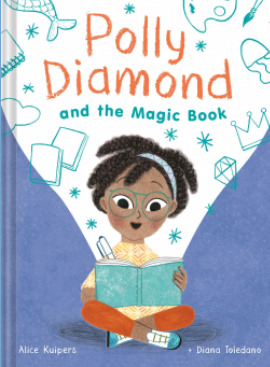
Teaching Guide with Activities and Discussion Questions for Polly Diamond and the Magic Book by Alice Kuipers

Share

Polly Diamond and the Magic Book
Author: Alice Kuipers
Illustrator: Diana Toledano
Expected Publication May 1st, 2018 by Chronicle

Summary: Polly loves words. And she loves writing stories. So when a magic book appears on her doorstep that can make everything she writes happen in real life, Polly is certain all of her dreams are about to come true. But she soon learns that what you write and what you mean are not always the same thing! Funny and touching, this new chapter book series will entertain readers and inspire budding writers.

Teachers’ Tools for Navigation: Activities for Polly Diamond include:

Color Poem

On page one, Polly says that her teacher said her color poem was fantastic.

Have your students use the Read. Write. Think. template to create their own color poem.

Template

Finish her perfect house story

On page 3, Polly is interrupted while writing her perfect house story.

Finish her story with what your perfect house would include.

Wishes

When Polly realizes her book is magical, she thinks of many things she can wish for such as a cell phone, not frizzy hair, more books, a flat screen TV, and world peace.

Using a brainstorming graphic organizer, have your students think of all the things they wish for.

After brainstorming all of their wishes, have them circle your top three.

Using the five-paragraph format for informative essays, have students write explaining their three wishes.

Measuring

For Polly’s grandmother’s recipe for pancakes called for a cup of flour and a cup of milk. Many times, when baking, you do not have what you need to make the recipe, and not just ingredients—you may not have the right measuring cup.

Bring in one cup measuring cups along with 1/4, 1/3, 1/2, 3/4, tablespoon, and teaspoon measuring cups/spoons. Break students into groups and give each group one of each measuring cup/spoon as well as something to measure (water, rice, flour), and have them answering the following questions:

  • If you only had 1/4 cup, how could you get one cup of flour?
  • If you only had 1/3 cup, how could you get one cup of flour?
  • If you only had 1/2 cup, how could you get one cup of flour?
  • If you only had 3/4 cup, how could you get one cup of flour?
  • If you only had a tablespoon, how could you get one cup of flour?
  • If you only had a teaspoon, how could you get one cup of flour?

Favorite words

Polly has a lot of favorite words: words with double letters like doozy and mutli-meaning words like basil.

Have students make a list of three words that they really like.

For each word, they should define it and also explain why they like the word.

When finished, students should do a word meet and greet. Using clock buddies or some other buddy system, have students meet with other students in the classroom and learn about their favorite words. They should add the favorite words they learn about to their list.

Paint names

On page 29, Polly makes up names for paint that describes the color such as muddy pond, lunch bag, and baboon butt.

First, have students look at the colors Polly described on page 29 and find the corresponding color in either a crayon box or a color exploration site online.

Then, have students create color names using imagery. Either have them use the color exploration site online or the colors from Microsoft Word.

Affixes

Show students how there are different word parts (affixes) that can be put together to make new words. They are like puzzle pieces! Share with them the different types of word parts (prefix, suffix, root, and base) and how they fit together.

On page 56, Polly explains how adding un- to the beginning of a word gives it an opposite meaning. The word she uses as an example is unobservant. Share with your students that un- is a prefix that means NOT which does make a word the opposite. Have student brainstorm a list of words with un- at the beginning and define them using NOT as the definition for un.

Extension: dis-, il-, im-, in-, and ir- also mean NOT. Students can also explore words with these
prefixes.

Extension: On page 57, Polly also talks about adding –fully to the end a word to make it bigger,
but it does more than that. Share with your students that –fully is actually a combination of ful, a root word that means full of, and –ly, a suffix that turns an adjective to an adverb, so her example of sorrowfully means full of sorrow (adv).

After showing students how words break apart and how affixes help with word meanings, give students words with un- and –ful (or any other affix you taught) and have them mark the different word parts and define the word.

Coloring Sheets

Coloring sheets can also be downloaded from Chonricle’s website here.

See the Teaching Guide Created by Me (Kellee) for even more activities! 

You can also access the teaching guide through Chronicle’s website here.

Recommended For: 

readaloudbuttonsmall classroomlibrarybuttonsmall closereadinganalysisbuttonsmall

Kellee Signature

Teaching Tuesday: Grading is Complicated: Ruminations of an English Teacher Educator

Share

“Grading is Complicated: Ruminations of an English Teacher Educator”

My students (future secondary English teachers) have a lot of questions about grading. They wonder if effort should count. They wonder if an emergent bilingual who works dang hard on three drafts of an essay should receive the same grade as another student’s essay, which is better. They wonder if in the grading process, after looking at other student work, it is fair to go back and change a previous student’s rubric evaluation. They wonder if we need to use rubrics for everything. They wonder if rubrics are too limiting of intellectual freedom.

My students are brilliant, and they ask complex questions that don’t have definite answers.

Let’s take them one-by-one. I invite readers to push back on any of the comments. I don’t have the answers, and I am often wondering if I need to reimagine my conceptualizations of grading.

Should effort count?

I believe that effort should count. The book that we read (Wormeli’s Fair Isn’t Always Equal) argues that effort shouldn’t count. For me, that’s conceiving of grades in simplistic ways. English language arts, as a subject area, cannot be quantified. I think that multiple drafts should count. If we are to accommodate the varying needs of students in our classrooms, we need to consider effort. A student who has a learning disorder who works dang hard and produces draft after draft to improve an essay should get some credit. Not counting effort standardizes grades in ways that might be harmful to learners. I argue that we need to individualize students’ learning progress. We need to know our students, and then we can evaluate whether the paper earns the A. Does this dilute grading systems? It sure does. But are we in this field to actually help students improve their writing or reading, or are we in this field to calculate GPAs and circle the grade of an 81 on a written essay (something that can hardly be quantified)?

Let’s complicate it even more:

Emergent bilinguals. If we don’t include effort and don’t focus on students’ personal improvement in their reading and writing, wouldn’t emergent bilinguals who are just learning a new language fail repeatedly? For me, this is an easy-to-see example of why effort does need to factor into the grading process.

Rubrics

I hate them, but I also recognize their importance. I think it’s critical that students know how they are going to be evaluated. We need to show them rubrics before they start brainstorming. On the other hand, rubrics are wildly limiting on creativity and intellectual freedom. By creating rubrics, we automatically tell students exactly what they are looking for. I know that folks argue that they create rubrics that are very open. No matter how open a rubric is, it limits students’ creativity to go in a wildly different (and potentially incredible) direction. They are teacher-focused rather than student-focused. My solution to this is the provision of rubrics that are student-generated (as a whole class, most often) and as open as possible. I continually remind my students that I would excitedly invite a different approach to the assignment, and I invite them to see me if their vision seems to conflict with criteria on the rubric. The students and I collaboratively develop expectations, and it is my hope that this process will not restrict their visions.

Grading with Rubrics

A student asked the smart question—if I grade a student’s work according to a rubric and then read other students’ work and realize that I evaluated the first student’s work wrong, can I redo the rubric? I am very conflicted about this issue. If you didn’t even know how to evaluate the first student, how would they know how to earn an “A.” For me, this means that the assignment expectations weren’t clear enough. I told my students that they are welcome to go back and redo the grading process, but they might rethink how students might be more firmly aware of the assignment expectations. The solution here, in my opinion, is that students always need to be given the opportunity to revise. No summative assessment should ever be a definitive final grade, and students should always be able to revise their work to improve their reading and writing skills. An argument against this might be, “But an employer wouldn’t allow a worker to revise their writing!” My response to this is, “Classrooms aren’t businesses. Classrooms are designed to foster learning.”

What complications do you have with grading? 

Author Guest Post!: “Digging into Fantasy and SciFi: An Anthropological Approach” by Darby Karchut, Author of Del Toro Moon

Share

“Digging into Fantasy and SciFi: An Anthropological Approach”

Like many authors, I came to writing via a circuitous route. A childhood obsession with The Lord of the Rings led to a fascination with history and other cultures, which led to an undergraduate degree in anthropology, which led to teaching 7th grade social studies, which led to writing middle grade and YA fantasy. See? Circuitous.

This is particularly true with my upcoming book, Del Toro Moon, a tale about a boy and his family—descendants of Spanish knights and aided by talking Andalusian war horses—who hunt monsters in the modern-day American Southwest. Del Toro Moon incorporates all my feels: fantasy, horses, the history and legends of the Southwest (I’m a proud New Mexican native now living in Colorado), and powerful familial bonds, especially between fathers and sons.

Since I write mostly fantasy, my school visits often focus on reading and writing in that very popular genre. One writing trick I share with upper elementary and middle/high school students is to have them scrutinize literary worlds as an anthropologist would—another cross-curriculum tool between literature and social studies.

Part One

I begin by reviewing the eight elements or universals found in all human cultures. I do include this caveat: if a group of people does not have all eight elements, then it is probably a social group, not a culture as an anthropologist would define it:

Elements of Cultures

Religion

  • Religion answers basic meanings about life
  • Can be formal and elaborate or informal and peripheral to the culture

Language

  • One of the strongest unify forces of a culture
  • Variation of a language is called a dialect (local form of a language that may have a distinct vocabulary and pronunciation)
  • Idioms, metaphors, sayings, and cuss words – so fun for writers!

History

  • Actual as well as mythical
  • Shapes how a culture views itself and the world
  • Stories about the challenges and successes of a culture support certain values and help people develop cultural pride and unity
  • Cultural holidays mark important events and enable people to celebrate their heritages

Daily Life (Food/Clothing/Shelter)

  • Secular and holy meals
  • Clothes and weapons or tools, including information technology
  • Housing, including the building, furniture, gardens, etc.

Social Groups

  • People can belong to more than one social group based on age, gender, interests, etc.
  • The family is the most important social group
  • People act differently in different groups (socialization)
  • Ethnic group: a group that shares a language, history, religion, and sometimes, physical traits

Arts & Crafts

  • Expresses what people think is beautiful and meaningful
  • Can also tell stories about important figures and events in the culture
  • Music, visual arts, dance, performing arts, literature, crafts

Government

  • People need rules in order to live together without conflict
  • Limited Governments (restricts the power of its leaders)
  • Unlimited Governments: (leaders are all-powerful)

Economy

  • A system that determines what goods and services are produced, how to produce them, and who will receive them
  • Four main types of economic systems:
    • Traditional: barter and trade
    • Market: capitalism
    • Command: communism
    • Mixed: a blend of two or more

Part Two

Next, the students divide into teams of two or three. Using a simple web graphic organizer (I’ve included an example—feel free to use it), each team takes apart a favorite book, movie, or TV show and determines if that book/movie/show/etc. has those eight elements. Some common favorites are:

Star Wars                                Harry Potter                 Star Trek         Percy Jackson

The Lord of the Rings            The Hunger Games        Warriors          Others?

The students must include a justification. For example, if a team is examining Star Wars and puts “Jedi” in the Religion circle, they must explain why they placed it there as opposed to History or Government.

Part Three

Finally, I have them complete the same exercise with their own work-in-progress. This is also a useful tool to aid in plotting a story prior to writing the first draft. I’ve had some pretty amazing discussions during this activity. One of my favorite was a debate focused on whether information technology should be listed under “Tools” or “Religion.”

I’d enjoy hearing about other ways teachers and librarians are connecting various disciplines, especially between the humanities and STEM. Please share with me and thank you!

About the Author: Darby Karchut is a multi-award winning author, dreamer, and compulsive dawn greeter.  A proud native of New Mexico, she now lives in the foothills of the Rocky Mountains, where she runs in blizzards and bikes in lightning storms. When not dodging death by Colorado, Darby is busy at her writing desk. Her books include the best selling middle grade series: THE ADVENTURES OF FINN MacCULLEN. Best thing ever: her YA debut novel, GRIFFIN RISING, has been optioned for film. Her latest book, DEL TORO MOON, releases Fall 2018 from Owl Hollow Press. Visit the author at www.darbykarchut.com

Del Toro Moon
Author: Darby Karchut
Publishing September 2018 by Owl Hollow Press

Summary: Bad enough Matt Del Toro is the greenest greenhorn in the family’s centuries-old business: riding down and destroying wolf-like creatures, known as skinners. He must also learn how to match his father’s skills at monster hunting. Odds of doing that? Yeah, about a million to one. Because Matt’s father is the legendary Javier Del Toro—hunter, scholar, and a true caballero: a gentleman of the horse.

Now, with the skinners multiplying, both in numbers and ferocity, Matt is desperate to keep his father and hot-tempered older brother from killing each other, prevent his new friend, Perry—a horse-crazy girl who recently moved to their small town of Huerfano, Colorado—from discovering the true nature of his odder-than-oddball family, and save a group of paleontologists from getting skinner-ed.

Luckily, Matt has twelve hundred pounds of backup in his best friend—El Cid, an Andalusian war stallion with the ability of human speech, more fighting savvy than a medieval knight, and a heart as big and steadfast as the Rocky Mountains.

Serious horse power.

Those skinners don’t stand a chance.

www.darbykarchut.com

www.owlhollowpress.com

https://www.goodreads.com/book/show/35183477-del-toro-moon?from_search=true

Thank you Darby for sharing this look at writing from a cross-curricular viewpoint!