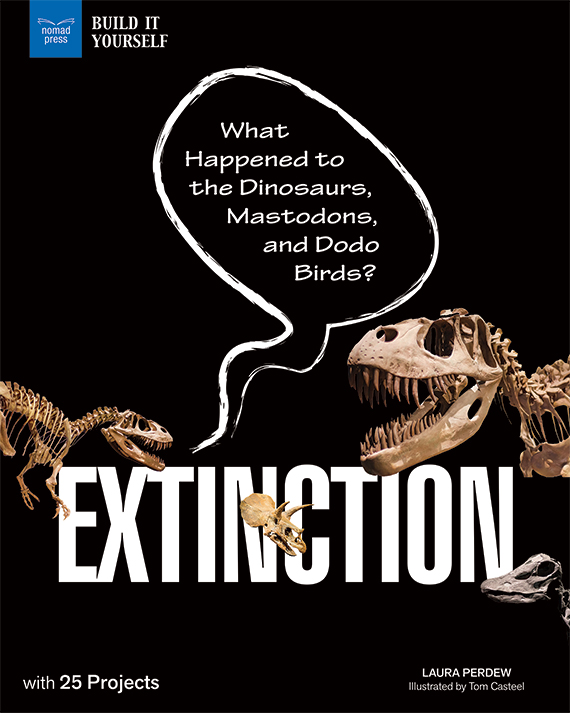
Author Guest Post!: “Talking to Kids about the Sixth Mass Extinction” by Laura Perdew, Author of Extinction: What Happened to the Dinosaurs, Mastodons, and Dodo Birds?

Share

“Talking to Kids About the Sixth Mass Extinction”

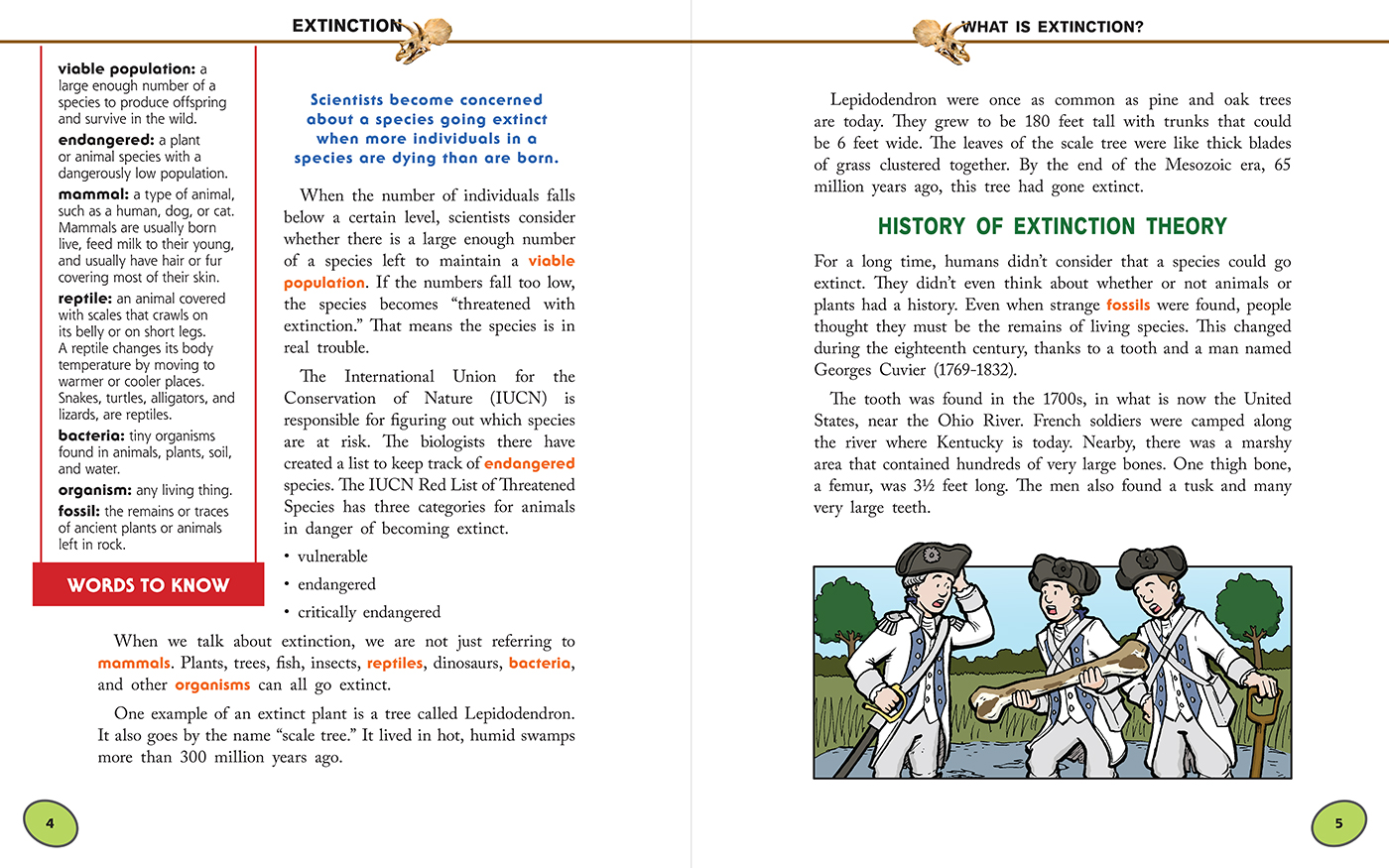
I think that when most people hear the word ‘extinction,’ dinosaurs come to mind first. But the truth is, billions of species have gone extinct in Earth’s 4.5-billion-year history.

Many of these were background extinctions, a normal part of life on this planet. There have also been five mass extinctions—events that wiped out more than 50 percent of species at one time. Perhaps the most well-known of these is the asteroid that hit the earth 66 million years ago and wiped out those dinosaurs.

What is not well-known, however, is that there is a sixth mass extinction currently underway.

The normal background extinction rate for mammals is one extinction every 100 years. But in the past 100 years, there have been more than 40 extinctions. Looking at all species on Earth, everything from the smallest microbes to the largest mammals, scientists estimate that the current extinction rates are 1,000 to 10,000 higher than normal. But unlike the previous five extinctions, this one is our fault.

We spend a lot of time talking about climate change, but we also need to pay more attention to the species that are dying off because of that and other human-related causes.

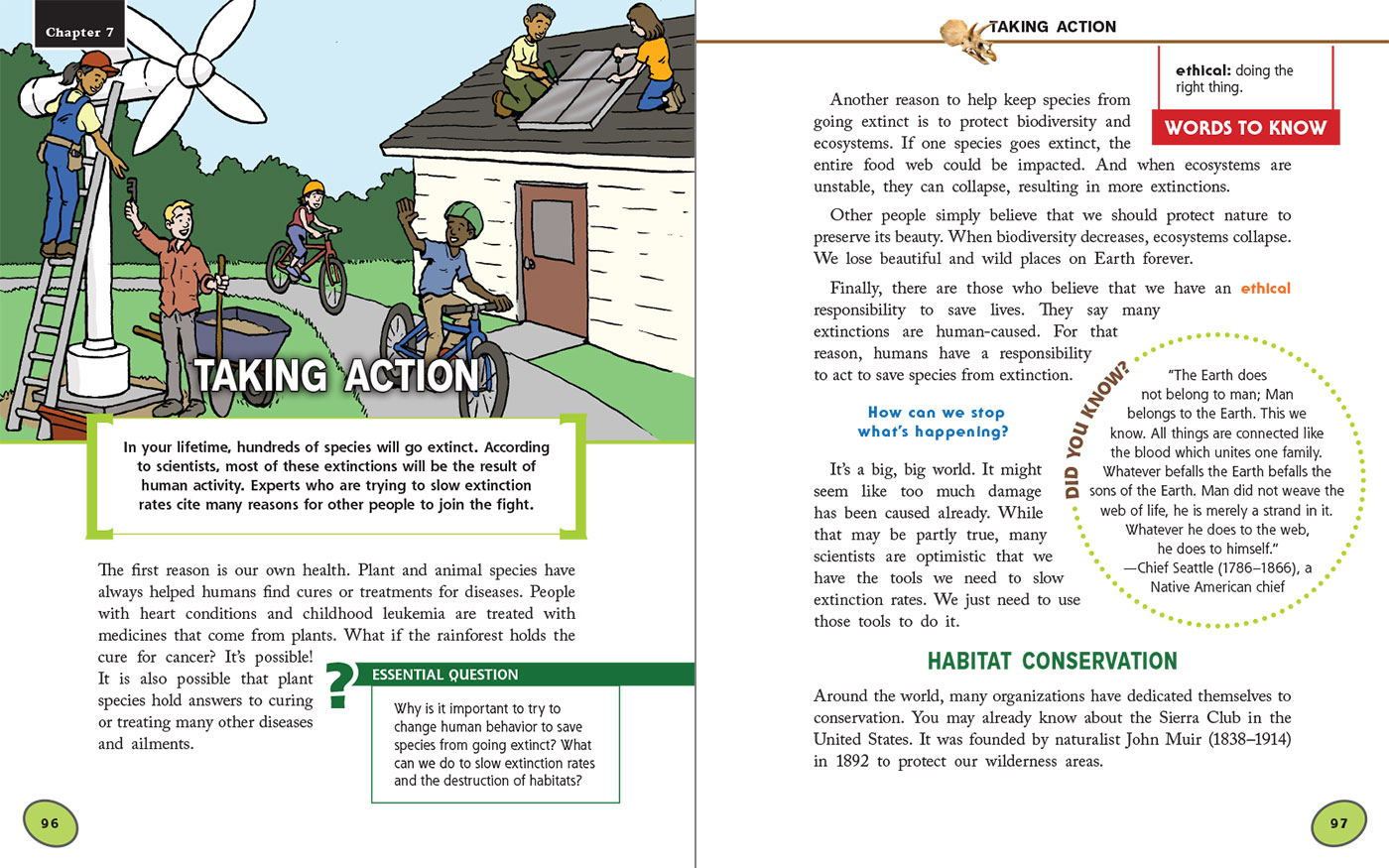
It’s time to spread the word. Before I wrote Extinction: What Happened to the Dinosaurs, Mastodons, and Dodo Birds?, there weren’t any books for kids that talked about the sixth extinction or what they can do to help slow this trend. Kids need to know what’s happening to the planet they are inheriting. And they need to be empowered to take action. In some ways, it seems a daunting task to stop extinctions. But history has proven that one person can make a difference in the world, and that together we can do even more.

It’s important to start the discussion with kids and to show them that even at their age, there are things they can do to create positive change. Here are some ideas!

Activity: Start the Discussion

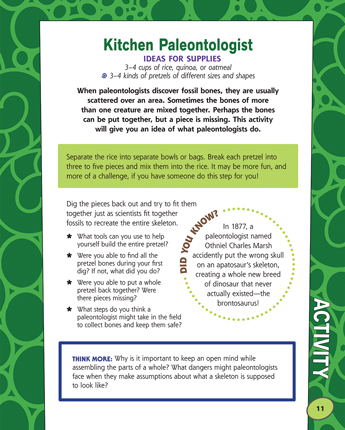
If the scientists’ predictions are right, three out of four species will go extinct over the next few hundred years. What will the world be like? Take students outside so they can get a better understanding of this prediction. Have students list the different species they observe. Encourage them turn over rocks, crawl in a garden, think about what is underground, or look in a tree. Remind them to include insects, mammals, reptiles, amphibians, birds, trees, and plants. Can they find 10? 20?

Once they have a list, ask students to cross out three out of every four of those species on it. For this activity, those crossed off species are the ones that will become extinct.

Questions for discussion:

  • Are the extinct species part of the food chain? What will happen to the other species that rely on that species for food or shelter?
  • What will happen to species when their main predators die off?
  • Can the ecosystem can be healthy, even with those missing species? Why or why not?
  • Can some of the surviving species adapt? What adaptations would they need to survive?

 Activity: Taking Action

Another way to get kids thinking about extinction is to have them think about their own carbon footprint. Start with a discussion of the terms “carbon footprint” and “carbon emissions.” Then, discuss and list the things humans do that require burning fossil fuel. Each of these activities contributes to global warming and ocean acidification, and ultimately to increased extinction rates. But there are things we can do to reduce carbon emissions.

There are many online resources that can help students research this, including NASA’s Climate Kids website (https://climatekids.nasa.gov/), and other carbon footprint calculators. The purpose of the activity is to have students identify their own actions that contribute to carbon emissions and what actions they can take to reduce their carbon footprint.

Questions for discussion:

  • What can you do in your home or community to reduce your carbon footprint?
  • Will making changes in how you live be easy or difficult?
  • Calculate the carbon emission reduction if everyone in the class took one step to reduce their carbon footprint. What would the savings be if each student could also convince three other families to do the same thing? How about if 1,000 families in the community took steps to lower emissions?

Activity: Planning for the Future

Tell students they are a team of engineers for a new town that’s going to be built. All that’s there right now is a mix of prairie and forest. Their job is to make it as green as possible. They must find a way to balance the need of humans and the needs of the environment and the species that live there.

Start by researching what makes a city green. Also, students must consider all the things in a town that people need—homes, schools, food stores, etc. They can even discuss their own town or city as an example of things you want to include (or omit) in the town they design and build. Possible activities include collages, models, dioramas, or drawing. The focus should be on the green details.

Questions for discussion:

  • What was easy about creating a green city? Difficult?
  • What was difficult about balancing the needs of the environment with the needs of people?
  • What can be done in their own town or city to move it towards being more green?

Discussions and research lead to awareness. Awareness leads to action. And action creates change!

Extinction: What Happened to the Dinosaurs, Mastodons, and Dodo Birds? (with 25 Projects)
Published September 15th, 2017 by Nomad Press

About the Book: Have you seen a dodo bird recently? Do you have mastodons playing in your back yard? Not likely—these species are extinct. In Earth’s 4.5-billion-year history, more than 5 billion species have gone extinct, some of them at the same time. In Extinction: What Happened to the Dinosaurs, Mastodons, and Dodo Birds? readers ages 9 to 12 learn about the scientific detective work scientists perform to find the culprit behind mass extinctions, including the present-day, sixth mass extinction.

About the Author: Laura Perdew is an author, writing consultant, and former middle school teacher. She has written more than 15 books for the education market on a wide range of subjects, including the animal rights movement, the history of the toilet, eating local, and the Great Pacific Garbage Patch. She is a long-time member of the Society of Children’s Book Authors and Illustrators. Laura lives in Boulder, Colorado.

Thank you, Laura, for pushing us to start this conversation with our students!

 and

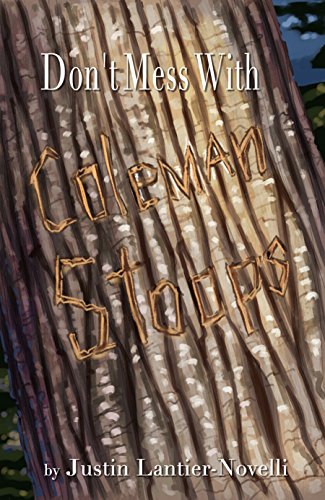
Author Guest Post!: “There’s No Such Thing as Pantsers” by Justin Lantier-Novelli, Author of Don’t Mess with Coleman Stoops

Share

“There’s No Such Thing as Pantsers”

Like every other profession and hobby, creative writing has developed its own lingo or jargon writers share with each other; these are phrases that non-writers would neither understand nor care about. Thank NanoWrimo – the month-long writing contest that takes place every November – for coining one of these terms a few years ago to describe writers who never do any planning for their stories. Imagine deciding to compose your very own novel or short story, sitting down at your favorite typewriter or laptop, starting on a blank screen and just going. No thought. No worry. Perhaps not even a developed idea…

That is the essence of being a Pantser: a writer who doesn’t think, he just writes. Maybe the inspiration came from a dream, or a conversation.  Maybe there was nothing but a “Once upon a time.” This theory begs to know where the greatest stories of humanity actually come from: the head or the heart? My theory, however, is that Pantsers don’t exist. Even if a writer cracks his knuckles and begins with nothing, once he’s finished his first draft and knows the story and characters a bit, he’s invariably going to proofread, re-tool, and revise his work. Any narrative needs drafting as part of its process. Whether or not you, as a writer, plan at the very beginning (before you start on page one, line one), or you start planning using your first draft as the catalyst, none of us can write without it. Everyone’s a Plotter (the opposite of a Pantser).

Why is planning so important? 

There are many reasons. To compose a story that could speak to millions of people isn’t an easy task. It takes a very delicate blend of art and science. The art, comes from the heart, but the science… science is the product of the mind. I would say that 80-90% of my time is spent in the pre-writing phase. I am a plotter with a capital P. I’m also a drafter, as much as I wish I could crank out that flawless first draft (nobody can). Planning can take many forms and has many benefits, some of which will seem obvious to you and some not-so-much. The type of planning you do is also a direct correlation to what you intend your final product to be.

My personal background is in writing for the screen. I went to college for audio/video production and minored in screenwriting. There are some really great ‘how to’ books I can recommend to teach novelists how to craft that perfect character arc or story arc or secondary plot thread – all of which have their roots in motion picture writing. Let’s face it: screenplays were born out of novels, but that doesn’t mean that novelists can’t learn a thing or two from screenwriters.

Which brings me to my first point about planning. Planning gives the writer the ability to stand back and see the story as a god would, as one big picture. Screenwriters are taught to use corkboards and notecards in their planning. Each card is a scene and the board is divided up into the typical (and formulaic) three-act structure: set-up, rising action, resolution. This simple exercise, which I have used for both my screenplays and novels, helps the writer to visualize the arcs. Where will this scene fit best in telling my tale? Is that scene even needed? Once he’s staring at his board with all the scenes displayed, a writer can ask himself: does this scene advance the plot, subplot, or character development at all? If the answer to any of those questions is yes, then the scene is kept. If it’s no, then it can be scrapped (and to use an industry term: to the cutting room floor).

Planning your story arcs is essential in creating the emotional and logical experience that writers want, need, and expect their audience to get. It doesn’t matter if that audience is sitting in a dark room watching the screen, or curled up in their bed turning pages. But what is a story arc? If you know, great. If you don’t, a story arc is comprised of beats, or plot points. Different events throughout the course of a story have to happen to move the plot forward, or drive the character onto becoming the protagonist the writer – and reader – want him to be. And by planning, the writer can see all possible scenes, brainstorming as many as he wants before choosing the perfect one.

The first plot point is also known as the inciting incident (at least in the screenwriting world). No story – in literature or on film – is complete without one.

Would Luke Skywalker been able to destroy the Death Star without R2-D2 and C-3PO taking that escape pod to Tatooine?

Would Romeo and Juliet have ended up dead (to add a bit of high culture to this mix) if Romeo had never crashed the Capulet’s party?

Of course, the inciting incident is only one instance where planning is needed, but each act in the three (or five) act story structure has major plot points. Writers must plan them to do their stories justice and take the reader along on a wondrous journey.

Planning is important in a single, stand-alone novel, however it couldn’t be more essential when writing a series. Series contain multiple story and character arcs, A plot threads, B plot threads, even C plot threads (truly they can be infinite) that span each book individually, but also continue strands across multiple books. Two great examples of writers who plant seeds for future books as part of their pre-writing stage planning are Stephen King and J.K. Rowling – and it’s no accident that they are two of the most successful authors of all time. If you want to see how to plant ideas for future books in a series, just read Harry Potter and The Dark Tower (in fact, King literally has been planting seeds in all his books, even the non-DT works, for decades).

Still not convinced that planning is important? Think about the horcruxes in the Wizarding World… The very first one was revealed in the second book in a seven book series. Rowling didn’t wing her writing. Her seeds were intentionally planted. She knew what horcruxes were before she started typing line one, page one. The rest of us, her loyal readers, didn’t find out until book six! But we didn’t need to know. She did.

The second reason to plan is more about spring cleaning. The more ideas you get out of your system early in your drafting, the more bad ideas you get out of your system. You can easily put together a dozen versions of the same scene, chapter, or character sketch. And all that brainstorming churns the waters of ideas. Sooner or later, the writer will hit the nail on the proverbial head, and get the perfect idea for some aspect or another of his work.

So if you want to clear away bad ideas, take a step back and look at your book(s) from a 3rd person omniscient perspective, then I cannot recommend planning more. Pre-writing is necessary to crafting a well thought out, logical, and emotional story filled with three-dimensional characters that your audience can relate to and keep them furiously flipping pages until the wee hours of the morning.

You can follow Justin Lantier-Novelli on Twitter: @jlnovelli. Find him on Goodreads, Facebook, and Amazon. His debut middle grade fiction novel, Don’t Mess with Coleman Stoops, is available in paperback and for Amazon Kindle.

About the Book: Coleman Stoops just had his twelfth birthday, but he’s not getting popular anytime soon. The kids in his grade call him “Stoopy”. He hates the cruel nickname almost as he hates himself for always managing to accidentally play into it. The clothes he wears, the hobbies he loves, and the way he behaves in school all contribute to his eternal low ranking as the butt of everyone’s jokes. Coleman’s a dork, a dweeb, a nerd. He’s the fool of the school.

So when the most popular kid in his class, B. Bradford Woffington III, approaches him with a proposition and a potential girlfriend, Coleman can’t help ignoring his instincts as they tell him not to trust “Trey”. He accepts the boy’s offer and begins the social and physical grooming that will make him fit for dating – gasp! – a real, live girl. No matter what happens though, Coleman can’t shake the sneaking suspicion that there’s something Trey isn’t being completely forthcoming about. What isn’t the most popular kid in school telling him?

Thank you, Justin! Planning is something all teaches struggle with students understanding, so this post is going to be so helpful!

 and


Author Guest Post and Giveaway!: “The Power of Imaginative Play” by Dian Curtis Regan, Author of the Space Boy series

Share

“The Power of Imaginative Play”

“Imagination is more important than knowledge.”  ~ Albert Einstein

I grew up without digital devices.

I was the child with my nose in a book, or out in the yard slaying dragons, reigning over my kingdom, or teaching school—if I could round up a “student” or two.

Here is how I entered an imaginary world from my backyard: when the wind gusted against bed sheets on the clothesline, I knew if I ran beneath them at the proper moment, I’d find myself in another land. And that was before I’d read about the wardrobe leading to Narnia.

In my Space Boy books, if Niko, in his imagination, has fashioned a spaceship out of a cardboard box, then of course the ship is going to blast off into outer space.

And of course excitement and danger will follow. Luckily, Niko can rely on his loyal crew: Tag, his dog, and Radar, his copilot.

Robert Neubecker’s illustrations depict Radar as a toy robot who morphs into a full-sized partner, overcoming the bad guys with Niko and Tag. Plus, Radar smartly knows how to navigate a spaceship. Makes perfect sense in Niko’s pretend world.

Today, children are entertained too often by their devices, with fewer opportunities to get lost in their imaginations. As a former elementary teacher, I know that pretend play is essential to cognitive and social development, as well as creativity. One of the best exercises in imagination is reading–or being read to. A story’s ups and downs are vividly played out in a young reader’s mind.

In backyard role-playing games, children can try on various roles: a fighter pilot, a parent, a puppy. All they need is a cardboard box, maybe a stuffed toy, and perhaps even a sibling. Then off goes their imagination.

Illustrator friend Doug Cushman shared this with me: During school programs, I’d ask a child to scribble something on my drawing pad in front of the class. Then I’d turn the scribble into a character and create a fun background.

The class would brainstorm a story to go with the images. Their collective imaginations were incredible. The exercise showed that ideas can come from anywhere, even a mere scribble.”

One of the nicest bits of feedback I’ve received about the Space Boy books is from a mom who told me that her kids don’t just read Niko’s stories—they act them out. Bingo—pretend play! Which is exactly what Space Boy is doing in his story within a story.

Here’s to limiting device time for our children, and sending them outside to create their own adventures in imaginary worlds, on other planets like Niko–or at least to lose themselves in a good book.

About the Author: Dian Curtis Regan is the author of more than 60 books for young readers, ranging from picture books to YA novels.  Her books have received many honors, including Best Books for Young Adults, Children’s Choice Awards, Junior Library Guild selections, Los Angeles Times Recommended Book, and New York Public Library’s Best Books.  Space Boy and the Space Pirate was a 2017 finalist for the Colorado Book Award, and the winner of a 2017 Crystal Kite Award from the Society of Children’s Book Writers & Illustrators. Space Boy and the Snow Monster is brand new this fall. Dian lives in Colorado Springs, Colorado.  To learn more, and to download a curriculum guide, visit diancurtisregan.com and spaceboybooks.com.

About the Illustrator: Robert Neubecker is the award-winning author-illustrator of Wow! City!, Wow! America!, and Wow! School!, and the illustrator of The Problem with Not Being Scared of Monsters and its companion The Problem with Not Being Scared of Kids. He lives in Park City, Utah. Visit neubecker.com.

About the Book: Niko and his crew are digging their spaceship out of a snowdrift when Radar, Niko’s robot copilot, disappears. Oh, no! Was he captured by a Snow Monster? They blast off on a rescue mission to Planet Ice, only to find the Snow Monster building an army of scary snowmen. Then they get tricked by a Killer Bunny! Can Niko rescue Radar, flee the Snowmen Army, outwit the Killer Bunny, and fly his crew back to Planet Home in time for hot cocoa?

Click here to read our review of the first Space Boy book, Space Boy and his Sister Dog.

GIVEAWAY!!

Get ready to blast off–one lucky winner will receive SPACE BOY AND THE SNOW MONSTER (U.S. addresses).

 a Rafflecopter giveaway

Thank you Dian for helping us continue to promote imagination!
Thank you also to Barbara at Blue Slip Media for today’s post and giveaway!

 and

Author Guest Post and Giveaway!: “I Have a Confession” by Laura Gehl, Author of Peep and Egg

Share

“I Have a Confession” 

I have a confession to make. I’m a skimmer. When I read a book, my eyes fly over the page. People watching me don’t think I am actually reading, because I turn the pages so quickly. I’ve read this way since I was a kid. When I am reading a particularly beautiful book, I do force myself to slow down. But most of the time, I skim.

As a skimmer, my brain focuses on just the very most important words on any page. It turns out this is good practice for writing picture books. Because every single word in a picture book should be the most important word on the page.

When I am writing a picture book, I try to…

  • Make sure every word is necessary.
  • Make sure every word is the best possible word.
  • Make sure I am not wasting words describing anything that is best shown in art.

Copy-editing page then a final interior spread:

This means I spend lots of time reading my words out loud, rearranging them, changing them, cutting them, and reading out loud again. So I am definitely not the kind of writer who can work in a coffee shop. I can’t even work on the same floor of the house as my husband! But if I do my job right, I can create a book filled with heart and humor that has only the best, most essential words…a book that nobody like me will even be tempted to skim!

About the Author: Laura Gehl is the author of popular picture books books, including the Peep and Egg series and One Big Pair of Underwear, illustrated by Tom Lichtenheld. Laura has four children, who always love getting dirty and sometimes love taking baths. She and her family live in Chevy Chase, Maryland. Visit Laura online at lauragehl.com and www.facebook.com/authorLauraGehl

About the Illustrator: Joyce Wan is the author and illustrator of many popular board books, including You Are My Cupcake, We Belong Together, and The Whale in my Swimming Pool. She is also the illustrator of Sue Lowell Gallion’s Pug Meets Pig. Joyce lives in Ridgewood, New Jersey. For more info, visit wanart.com

Check out the adorable Peep and Egg coloring sheets and more at http://www.lauragehl.com/free-activity-sheets/

GIVEAWAY!
TWO giveaway opportunities!!

  1. One grand-prize winner will receive a signed copy of Peep and Egg: I’m Not Taking a Bath, Peep and Egg stickers, and a complete bath time fun collection that includes a giant hooded frog towel, duck water spray bath toy, rubber duckies, natural bubble bath, and a colorful assortment of made-in-USA fizzy bath balls.
  2. Ten lucky winners runners-up will receive a copy of Peep and Egg: I’m Not Taking a Bath.
Enter here!

Thank you Laura for everything! And also to Barbara at Blue Slip Media for setting this post up!

 and


Author Guest Post and Giveaway!: “Inspiring Stories” by David Kelly, Author of Ballpark Mysteries

Share

Inspiring Stories

As a freelance business and technology writer I spent many years writing about the latest software or tech gadget. It was profitable and sometimes interesting work. But it wasn’t inspiring. It was a job. A job I needed to help support my family—my wife Alice and my two sons, Steven and Scott.

Then a funny thing happened. I became inspired by my sons to do something different. To try something new that has led me to completely change my career.

More specifically, I became inspired by my sons’ love of baseball and their desire to read mystery stories. Growing up, I wasn’t a great reader. I lagged behind classmates in learning to read, as did my first son, Steven. As parents, Alice and I tried all types of tricks to interest our kids on reading. But it wasn’t until they started reading Ron Roy’s A-TO-Z MYSTERIES that they both became hooked—and desperate for more mysteries. Fortunately for me, that happened at the same time they became enthralled with baseball: playing baseball, talking about baseball trading baseball cards, watching baseball. If it had anything to do with baseball, they were interested.

Since my sons loved baseball and mysteries, I looked around for children’s books that featured both sports and mysteries. But I didn’t find many that fit the bill. There were sports books and there were mystery books, but there weren’t many sports mysteries. That’s when I realized that there was something missing in the market—mysteries that were set in the dozens of really cool cities and ballparks around North America.

And like that, I had the inspiration for my BALLPARK MYSTERIES series of chapter books from Random House. The BALLPARK MYSTERIES are adventure/mystery books where the main characters (Kate and Mike) visit different major league ballparks to see a game, but end up solving a mystery. So far, they’ve been to fourteen of the thirty major league stadiums. The latest book in the series, CHRISTMAS IN COOPERSTOWN, is a Super Special that takes place at the National Baseball Hall of Fame in Cooperstown, New York.

The BALLPARK MYSTERIES books are great for boys and girls in second, third, and fourth grades and are well-suited for reluctant readers. Though the books are set in ballparks, readers don’t have to like sports or even know about baseball to enjoy them. Readers learn a little bit about each team, stadium, or city, as well as some of the quirky things that make baseball so popular (like the super-secret rubbing mud that’s used on each major-league baseball).

If you can forgive the pun, I’m having a ball writing sports mystery books for children, and I’m thrilled that my sons inspired me to take a chance to try something completely new.

About the Author: DAVID A. KELLY is a former Little League right fielder. These days, he can often be found enjoying a game at a major-league park. He is also the author of the MVP series and Babe Ruth and the Baseball Curse. For adults, he has written about travel and technology for the New York Times, the Boston Globe, the Chicago Sun Times, and many other publications. He lives near Boston’s Fenway Park with his family. For more information, visit davidakellybooks.com and find him on Twitter at @davidakelly.

The World Series Curse
Christmas in Cooperstown
Author: David A. Kelly
Published September, 2017 by Random House Books for Young Readers

The World Series Curse Summary: It’s the BIGGEST baseball mystery yet—at the WORLD SERIES!

Red Sox versus Cubs. Game five. It looks like Mike and Kate are about to watch the Cubs win it all. But then someone starts messing with the team—ruining equipment, getting Cubs players in trouble, and even stirring up an old baseball curse. Now the Red Sox are coming back! Who will win the ultimate baseball trophy? And can Mike and Kate make sure it’s won fair and square?

Ballpark Mysteries are the all-star matchup of fun sleuthing and baseball action, perfect for readers of Ron Roy’s A to Z Mysteries and Matt Christopher’s sports books, and younger siblings of Mike Lupica fans. Each Ballpark Mystery also features Dugout Notes, with amazing baseball facts.

Christmas in Cooperstown Summary: Mike and Kate get the BEST Christmas present ever–a mystery at the Baseball Hall of Fame!

After volunteering to wrap presents for charity, Mike and Kate get a special thank-you: a sleepover at the Baseball Hall of Fame! But when they’re sneaking around the museum late at night, their flashlight reveals that one of the famous baseball cards on display is a fake! Can they find the real card, catch the crook, and get the presents to the charity’s Christmas party on time? It’s up to Mike and Kate to turn this Christmas mess into a Christmas miracle!

Ballpark Mysteries are the all-star matchup of fun sleuthing and baseball action, perfect for readers of Ron Roy’s A to Z Mysteries and Matt Christopher’s sports books, and younger siblings of Mike Lupica fans. Each Ballpark Mystery also features Dugout Notes, with amazing baseball facts.

GIVEAWAY! 

a Rafflecopter giveaway

Thank you for sharing how your series came to be! 

 and

Author Guest Post!: “Teaching Kids Hope” by Carla Mooney, Author of Terrorism: Violence, Intimidation, and Solutions for Peace

Share


Terrorism: Violence, Intimidation, and Solutions for Peace
Author: Carla Mooney
Expected Publication November 15th, 2017 by Nomad Press

Summary: Why did terrorists attack the World Trade Center on September 11, 2001? The answer to that question is ancient, complicated, and crucial to a perceptive understanding of the global community we live in today. In Terrorism: Violence, Intimidation, and Solutions for Peace, readers ages 12 to 15 explore the history, causes, psychology, and potential solutions to the problem of terrorism in an objective way that promotes comprehension and empowerment.

  • Investigating previous events in the world’s history can help students understand the causes and effects of current events.
  • Activities encourage the development of important skills, including comparing and contrasting, looking for detailed evidence, making deductions, and applying critical analysis to a wide variety of media.

Teacher’s Tools for Navigation and Discussion Questions: 

“Teaching Kids Hope” by Carla Mooney

There’s a lot of bad news out there. There’s a lot of good news, too! But unless kids are living in a soundproof room with no cell service or internet access, they’re going to hear at least some of the depressing, no matter how much the adults in their lives try to protect them.

Some of this bad news concerns terrorism. While terrorism has been around since ancient times, the struggle between different ideologies has become far more visible in recent years because of the ease and speed of communication. We all know about attacks happening all around the world, almost as soon as they happen. Kids included.

When the bombing at the Ariana Grande concert in Manchester, England, happened last spring, the audience was full of young teens, fans of the singer, and it was teenagers who were watching events unfold via texts and posts from other kids around the world. Just about every elementary school has a ceremony of some kind on September 11—children who weren’t even alive when the Twin Towers fell spend time recognizing the victims and honoring their memories.

Terrorism is all around us, even when we live in what we consider safe societies that have not yet been touched directly.

How do we—as educators, parents, and mentors—support children as they grow up in a world where terrorism is a regular occurrence? How do we teach them to think critically and creatively about potential solutions? How do we create that balance between knowing the issues and not letting that knowledge cause fear and anxiety, when the reality is the vast majority of citizens will not experience a terrorist attack in their lifetime? How do we get kids to see themselves as part of the solution and empower them to make wise choices, learn about the issues, and work to find solutions?

This might sound like a tall order for kids, but maybe they are the generation that will solve the problems of terrorism.

I wrote my book Terrorism: Violence, Intimidation, and Solutions for Peace specifically with the intent of providing kids with not just the history of terrorism (which is an important part of recognizing its role in today’s world), but also as a jumping off point to start thinking about how to curb terrorism.

Here are three activities I came up with to help kids understand that while terrorism is a very real part of life, it’s not a problem that can’t be solved. I hope you find them useful, and remember, never give up hope.

ASSASSINATIONS—AN ACT OF TERROR?

Throughout history, assassination is one tactic used by terror groups to achieve certain goals. However, not every assassination is an act of terror. When should murders of political figures be considered acts of terror or when are they simply horrible crimes? What separates terrorism from criminal activity?

  • Choose a political leader who was assassinated or who survived an assassination attempt. Some leaders to consider researching include:
    • Abraham Lincoln
    • William McKinley
    • Czar Alexander II of Russia
    • Indira Gandhi
    • Benazir Bhutto
  • Research the assassination attempt on your chosen Consider the following questions.
    • Who was the leader? Where were they from? What country did they lead?
    • What political or social views did the leader have that were controversial?
    • Who was the perpetrator?
    • What was the perpetrator’s objective? Did they succeed?
    • Did their actions affect history in the short-term? In the long-term?
    • Was the assassination attempt an act of terror? Explain your point of view.

THE PROCESS OF RADICALIZATION

The process of radicalization is different for every individual. While the path each person takes toward adopting extremist views is different, are there some similarities? By studying the radicalization of several different individuals, you can look for common themes in their stories.

PREVENTING TERROR ATTACKS

While successful terror attacks make headlines around the world, there are dozens of plots that have been thwarted by counterterrorism efforts. You can read about some of these plots here.

  • Select three or four thwarted terror plots to research. Find and read newspaper or magazine articles about the foiled attacks.
  • Create a chart to categorize the plots.
    • What types of attacks were planned?
    • What methods did terrorists use?
    • Who was involved?
    • What targets did they choose?
    • What was the objective?
    • How was the plot stopped?
    • What counterterrorism methods were used?
    • What was the outcome?
  • Does the number of thwarted terror plots make you feel more or less secure? Explain.

About the Author: Carla Mooney is the author of many books for young readers including Globalization: Why We Care About Faraway Events, The Holocaust: Racism and Genocide in World War II, Forensics: Uncover the Science and Technology of Crime Scene Investigation, The Industrial Revolution: Investigate How Science and Technology Changed the World and Explore Rivers and Ponds! With 25 Projects from Nomad Press. Her work has appeared in many magazines including Highlights, Faces, and Learning Through History. Carla lives in Pittsburgh, Pennsylvania.

Thank you to Carla for her important post with so many useful tools and to Andi from Nomad Press for introducing us to this book!

and 

Author Guest Post!: Giving Kids a Break: What’s so normal about “normal”? Or, in other words, is it OK to be “average”? by J.L. Powers (with M.A. Powers), Authors of Broken Circle

Share

Giving Kids a Break: What’s so normal about “normal”?  Or, in other words, is it OK to be “average”?

A few years ago, I started writing books with my “little” brother (he’s younger but much taller…and a whole lot cooler!).

Broken Circle is the first book in a series that examines cultural concepts of death through teen characters who serve as “soul guides”—that is, the entities charged with ushering recently departed souls from this world to the next. Modern day Charons, rowing patrons across the River Styx. Each teen soul guide belongs to a particular family of psychopomps—from the Reaper family to the Angel of Death family to the La Muerte family, etc. And each soul guide teen brings to the table a little bit of cultural reference in how they understand death and the process of dying. In the first book, however, our main character 15-year-old Adam doesn’t even realize that he’s a soul guide. He doesn’t know that his father is the Grim Reaper and he’s about to inherit the family business.

When I called Matt to talk about writing this blog post, we spent some time trying to figure out what we could say that would be useful to teachers and readers. After all, “death” is not an everyday topic for teachers! (As an aside, maybe it should be. We all die someday….shouldn’t we prepare for it rather than avoid it? That is, by the way, part of the impetus for writing this book…. The series is an extended philosophical meditation about death via fast-paced fantasy novels. Why, as a culture, are we so afraid of something we all must do someday?)

As we thought about this, we explored the following questions: Why did we write this book about a kid who’s just trying to live a so-called “normal” life and who discovers that he’s anything but normal—that he is, in fact, the personification of something everybody fears? How would he cope with that? How should we, as people, cope with the way other people perceive us or the ways we feel we aren’t “normal”? Can the things we fear most become our friend? Can we learn to embrace what is “abnormal” because it is healthier for us than what is “normal”?

Matt and I did not grow up “normal,” although it certainly felt “normal” to us because it was what we knew. We lived in a neighborhood on the U.S.-Mexico border, where half our neighbors and friends were “undocumented” immigrants, and many of them refugees fleeing the violence of Central America. Our mother homeschooled us before homeschooling was trendy—in fact, for the first few years, we kept it secret because the state of Texas was actively prosecuting parents who were homeschooling. My parents always tried to stay out of debt so we drove old clunkers, like the 1972 sky-blue Montego that embarrassed us so much whenever we went to church, where other families drove nice cars. (In our neighborhood, though, that 1972 Montego was COOL….low-rider material!) We wore hand-me-down clothes. Our mom cut our hair. We lived in a decrepit old perpetually-remodeling house. We were the antithesis of cool.

Today, both Matt and I are live on opposite sides of the country—Matt in Maine and me in California, the “Left Coast.” We are both trying—hard—not to get caught up in what our current culture regards as “normal,” whether that’s the most recent trend or the rat race of trying to keep up with the Joneses. Of trying to live up to some standard of what others deem “success.” And one of the things that worries both of us about modern childhood is the extreme stress society and families place on kids in order to make them achieve some predetermined notion of “success.” From preschool to college, we expect not just perfection in grades and school but we seem to pressure our kids to fill every moment of their lives with some activity that will help them “achieve” some undetermined level of greatness. It’s not enough to just enjoy soccer—you have to be so good at soccer that you can earn a scholarship. It’s not enough just to enjoy karate—you need to earn a black belt. And so on and so forth. It’s a terrible cycle that never ends—and to what purpose? What are our kids supposed to achieve? Couldn’t it be enough to live a good life, fall in love (or not), go to a “mediocre” school (is it really necessary to go to Yale?) or learn a trade, have kids (or not), travel a little bit, and generally be happy?

“We need T-shirts,” Matt said, “that say, ‘Celebrating the Average!’”

This doesn’t mean, by the way, that we think people and kids shouldn’t strive to achieve their dreams—only that our modern vision of what that should look like or how to get there is fundamentally problematic.

In Broken Circle, Adam is forced to leave his regular public school and attend a special boarding school. There will be no college for him, so this isn’t an expensive prep school designed to get him into Harvard or Yale.  Instead, he must learn the skills necessary to help newly departed souls cross a world we named “Limbo” to reach the “other side.”

And what are those skills exactly? What does Adam need to know in order to fulfill the obligations of this very different kind of profession?

Actually, he doesn’t need to KNOW anything. But he does need a skill set, one we think all people would benefit from.

In the world of Broken Circle, each departed soul enters a world called “Limbo.” If they don’t pass through Limbo to the other side, they remain stuck in Limbo forever. Limbo, as we constructed it, is a world each person experiences differently. It represents the emotional apex of a person’s life—their obsessions or fears or loves or desires. A soul guide must help each soul solve the problem of their life so they can pass peacefully on. So for example, a person who has spent much of his life pushed and pulled between the competing whims of a manipulative parent or spouse may have to endure a monstrous exaggeration of that world in Limbo and learn to stand up for himself before he can pass on to the other side. Or a mathematician might find herself stuck in a difficult, seemingly impossible math equation that she must solve. Or a librarian might find himself facing a stack of books he must shelve but they all lack their Dewey classification numbers. Or an electrician faces a live wire and a body of water she must somehow cross. You get the point…

These soul guides can’t possibly “know” everything they need in order to do this job! How do you prepare for something that is impossible to prepare for? Every soul these teens will guide across Limbo will have a different world they must navigate—a different emotional or literal problem they must solve. As a result, at the School for Soul Guides, these teens are allowed to learn whatever interests them. If they want to cook, they can learn to cook. If they want to learn karate, learn karate. If they want to build a pyramid, let them build a pyramid—figuring out mathematical proportions, soldering, and everything else required to create a pyramid. School in this case isn’t made up of required subjects that they have to master. They don’t all need to progress through rote systems of knowledge. Instead, whatever interests them, they pursue.

In our book, a soul guide in training must learn skills that helps them adapt to different situations and different people’s needs. A soul guide must learn how to be a good friend and mentor so he or she can help souls navigate the complexity of their emotional world. In other words, a “good” soul guide is one who is curious, flexible, judicious, and non-judgmental.

In the end, as teachers and parents, what are the skills we should impart to our kids to prepare them for a rapidly changing world? Do we need them to be so stressed, to cram every minute full of learning? Is it knowledge they need—or something else? Can we give them more space and time to grow as people in these fundamentally necessary skills of curiosity, flexibility, sagacity, and acceptance of others?

In the book, when he realizes that he is allowed to learn whatever he wants and nobody will stand in his way by requiring him to learn something else, one of our characters jokes, “Are we becoming jacks of all trades, masters of none?” The answer is no. They are learning to pursue learning for the sake of learning. They are learning to be people.

I have spent twenty years teaching college English. Yes, I like my students to be better writers, thinkers, and readers when they leave my classroom. But more important than that , I hope that when they leave my classroom, they have grown as people….that they have become better, kinder citizens of an increasingly globalized world. In my students and my own kid, and especially in myself, I hope I celebrate this kind of growth rather than cultural and financial and educational markers of “success”…..

J.L. POWERS is the award-winning author of three young adult novels, The Confessional, This Thing Called the Future, and Amina. She is also the editor of two collections of essays and author of a picture book, Colors of the Wind. She works as an editor/publicist for Cinco Puntos Press, and is founder and editor of the online blog, The Pirate Tree: Social Justice and Children’s Literature. She  teaches creative writing, literature, and composition at Skyline College in California’s Bay Area, served as a jurist for the 2014 NSK Neustadt Prize for Children’s Literature, and is launching Catalyst Press in 2017 to publish African writers.

M.A. POWERS is J.L.’s “little” (but much taller) brother. He has a PhD in the oncological sciences from the Huntsman Cancer Institute at the University of Utah in Salt Lake City. He is currently a stay-at-home dad and lives in Maine.

For young Adam Jones, inheriting the family business is more than a rotten hand. It’s downright skeletal.

PRAISE FOR BROKEN CIRCLE

“Adam’s ‘nightmares’ are so amped up that they begin to reveal to him truths about his parentage, and the mantle that has been placed upon his shoulders by his father, a grim reaper. There are so many other questions he wants answered and consequentially, he is shipped off to a ‘rehab’ which is actually the citadel for ‘soul guides.’ Teen and adult fans of the Sookie Stackhouse novels and the Mortal Instruments [series] will find Broken Circle a tight competitor for the new most addictive paranormal read.”

—Jilleen More, Square Books (Oxford, MS)

“Adam can’t even grow a man beard yet, but he can do something his friends can’t do—go to Limbo and back. Prepare to root for him as he makes new friends, discovers who he is, and saves a few souls in the process. This is a fast-paced, page-turning story!”

—Skila Brown, author of Caminar

“With a perfect balance of real-world and mythical, Adam’s story explores life, death, and everything in between. Anyone looking for a thoughtful take on life’s big questions will find it here, paired with fresh details, a fastmoving story, and bold world building.”

—Amy Rose Capetta, author of Entangled

ABOUT BROKEN CIRCLE

Adam wants nothing more than to be a “normal” teen, but his reality is quickly leaking normal. Afraid to sleep because of the monster that stalks him in his dreams, Adam’s breakdown at school in front of his crush Sarah lands him in the hospital. As he struggles to cope with his day-to-day life, Adam can only vaguely comprehend some sort of future. His mother died when he was only four and his eccentric father—who might be an assassin, a voodoo god, the reincarnation of the Buddha, or something even stranger—is never available when Adam really needs him. Even his paranoid grandfather, who insists that people are “out to kill the entire family,” is no help.

Adam’s life takes an even stranger turn when a fat man with a gold tooth and a medallion confronts his father regarding Adam’s supposed “True Destiny.” Adam is soon headed toward a collision with life, death, and the entities charged with shepherding souls of the newly dead, all competing to control lucrative territories where some nightmares are real and psychopomps of ancient legends walk the streets of North America.

Thank you for this guest post! It is so important for each kid to find their own path. 

and