Guest Review: All the Way to the Top by Annette Bay Pimental, Illustrated by Nabi H. Ali

Share

Guest Reviewer: Alicia, UCF Elementary Education Student
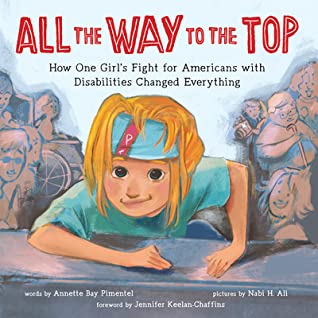
All the Way to the Top
Author: Annette Bay Pimental
Foreword by Jennifer Keelan-Chaffins
Illustrator: Nabi H. Ali
Published March 10th, 2020 by Sourcebooks Explore

Summary: This is the story of a little girl who just wanted to go, even when others tried to stop her.

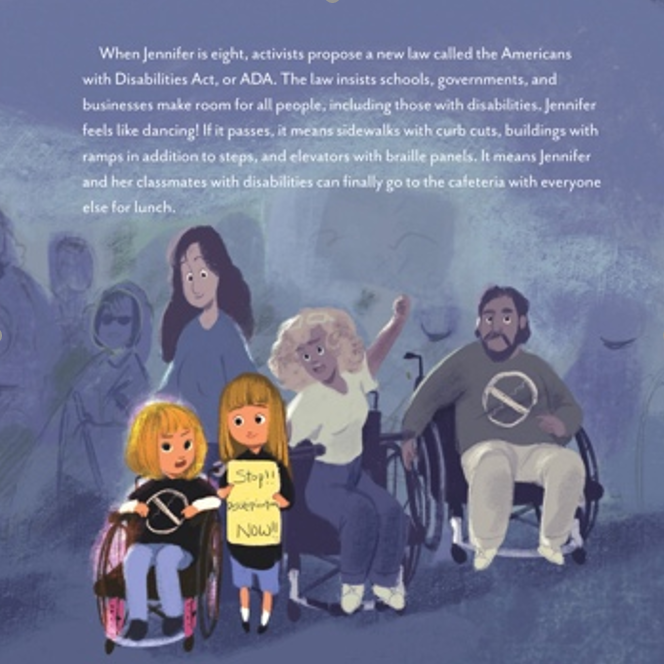
Jennifer Keelan was determined to make a change―even if she was just a kid. She never thought her wheelchair could slow her down, but the way the world around her was built made it hard to do even simple things. Like going to school, or eating lunch in the cafeteria.

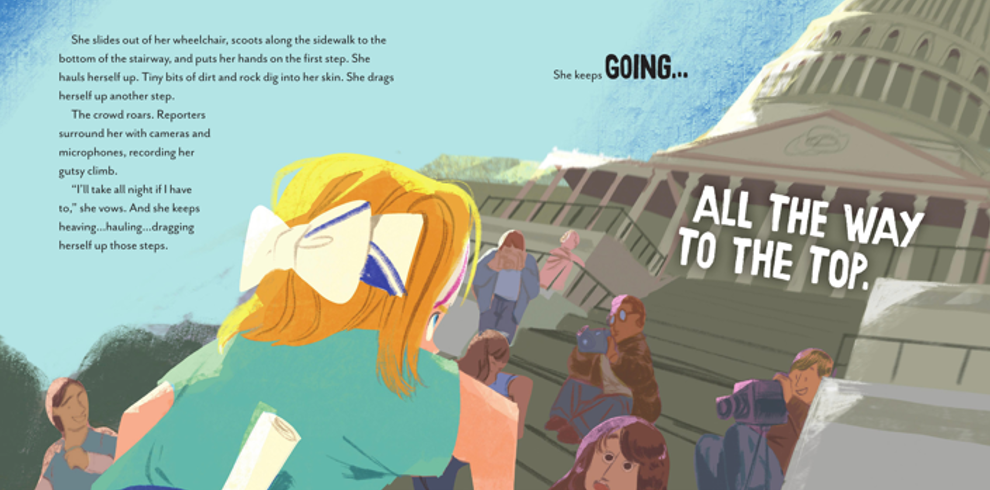
Jennifer knew that everyone deserves a voice! Then the Americans with Disabilities Act, a law that would make public spaces much more accessible to people with disabilities, was proposed to Congress. And to make sure it passed, Jennifer went to the steps of the Capitol building in Washington DC to convince them.

And, without her wheelchair, she climbed.

ALL THE WAY TO THE TOP!

Praise: 

“A powerful, empowering story!” – Washington Parent

“A necessary testament to the power of children’s voices.” –Kirkus Reviews

“Clear, accessible prose accompanied by Ali’s creamily textured digital illustrations…a jumping-off point for conversations.” –Publishers Weekly

“Pimentel’s compelling, present-tense narrative gives the story great immediacy, helping children connect with Jennifer’s reactions to physical barriers and social injustice…Still an activist, Jennifer Keelan-Chaffins offers a thought-provoking foreword to this inspiring picture book.” –Booklist

“Pimentel offers a great look at a young activist creating change and a better understanding of the importance of the ADA.” –School Library Journal

About the Creators: 

Annette Bay Pimentel has published two picture book biographies: Mountain Chef (Charlesbridge, 2016) about a Chinese American who helped inspire the creation of the National Park Service which won the Carter G. Woodson Award, and Girl, Running (Nancy Paulson, 2018) about the first female to run the Boston Marathon, which was a JLG pick and received a starred review.

​Jennifer Keelan-Chaffins joined the disability rights movement at the age of six and has been a passionate advocate ever since. In 1990, she received the Americans With Disabilities Act Award. She earned her B.S. in Family and Human Development. She really wants to help children with disabilities.She lives in Colorado with her mother , and her service dog Mya.

​Nabi H. Ali is an illustrator of Tamil descent based in Orange County, California. He really likes to be part of things that bring inclusivity into art and media. His hobbies include painting, researching South Asian culture, and writing poetry.

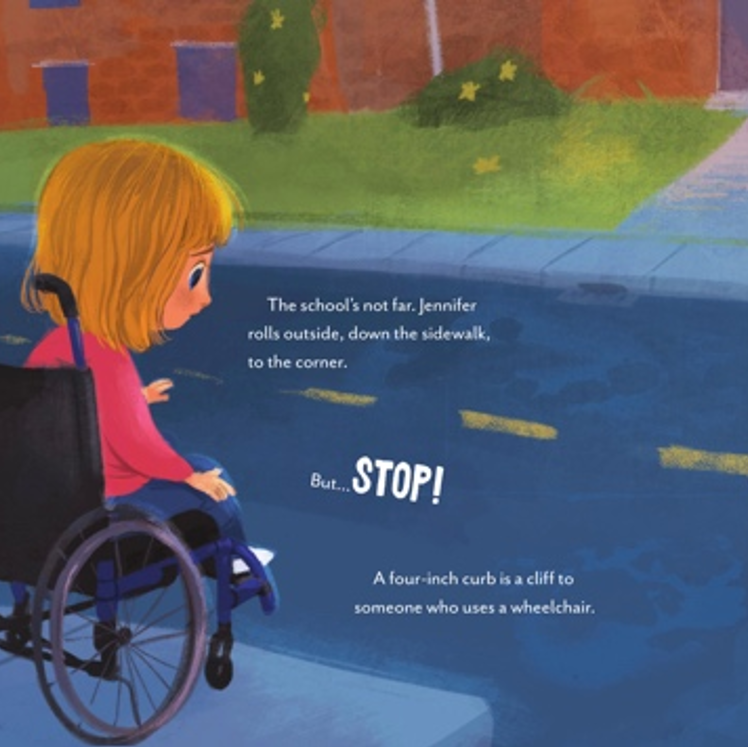
Review: This story is about a young girl named Jennifer. She suffers from Cerebral Palsy and uses a wheelchair. The story follows her as she first struggles to go around town when the sidewalks don’t have ramps, to get into the school where there is only stairs, and the teachers say she can’t come in–all because she is in a wheelchair. She learns to find her voice and works in groups to fight for equality. She goes to multiple protests around the states to fight for the ADA (Americans with Disabilities Act). When Congress denies the act, there is a rally in Washington, D.C. and because of the stairs, protestors in wheelchairs could get into the House; the older protesters left their chairs and climbed the stairs. When Jennifer tried, she was told she was too young and couldn’t do it. This did not stop her; she did it anyway. The bill was passed soon after.

I love this book so much as it shows students that everyone can do anything, and it’s something that they all should read about everyone regardless of how they look. One of my favorite things is that this book is based on a true story and in the back of the book it goes into more details as to why the ADA was such an important thing. It also has a timeline and milestones for legislation for those with disabilities.

Teachers’ Tools for Navigation: This book will be fantastic to use in the classroom in multiple ways:

Of course you can use it with history. This will teach students about important events with in our countries history. Teach them about how much the ADA changed the lives of many people.

This will also be used to teach students about inclusion and diversity and they are important tools to have in life. Making sure everyone feels included is not only good it’s important.

Discussion Questions: 

  • Why did Jennifer’s family let her protest?
  • Why was the ADA so important for Jennifer and her family?
  • How does the adaptation of the ADA impact the lives of those that needed it?
  • Why do you feel Jennifer wanted to climb the steps?
  • Why did it take them climbing the steps to actually pass the ADA?
  • How does the Illustrations paint the picture of how Jennifer struggled to feel included?
  • What is one thing you can do to make sure inclusion is part of your life?

Flagged Passages: 
Recommended For: 

classroomlibrarybuttonsmall

Thank you, Alicia, for your review!
Interview with Justin Richardson and Peter Parnell, Authors of And Tango Makes Three

Share

I am happy to start Pride Month with this interview as books with representations of all families need to be shared with all students as “mirrors, windows, and sliding glass doors” (Sims-Bishop, 1990). As an educator in Florida, we are being challenged as are the books we love and students need. Sharing diverse representation, of race, culture, sexual & gender identity, and more, will only lead to empathy and a safer more happy world.

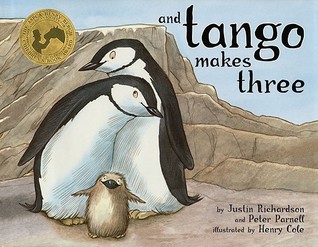
And Tango Makes Three
Authors: Justin Richardson & Peter Parnell
Illustrator: Henry Cole
Published: June 1st, 2005 by Simon & Schuster Books for Young Readers

Summary: In the zoo there are all kinds of animal families. But Tango’s family is not like any of the others. This illustrated children’s book fictionalizes the true story of two male penguins who became partners and raised a penguin chick in the Central Park Zoo.

Introduction from Simon & Schuster: Florida’s new law, to take effect in July, prohibits classroom “discussion” and “instruction” about “sexual orientation” and “gender identity” in grades K-3, as well as any discussion or instruction about these topics that would be considered not age appropriate in the eyes of the State in grades 4-12. And Tango Makes Three, a multiple award-winning picture book, tells the simple and true story of two male penguins in the Central Park Zoo who pair-bonded, built a nest, and with the help of a kind zoo-keeper, together hatched an egg.

The book is written for children ages 4 to 8, but the new Florida law may prevent their teachers from sharing or discussing it with them. Teachers use And Tango Makes Three and books like it to help children with same-sex parents feel welcome in their school and to help their classmates understand the different family structure of their classmates. Lessons like these are invaluable to children of same-sex parents. Censorship of facts about gay families and lives, like that required by the new law, threatens the mental health of children with same-sex parents as well as that of LGBTQIA+ children themselves.

Since its initial publication, And Tango Makes Three has been challenged and banned countless times. The American Library Association has reported that it was the most frequently challenged book between 2006-2010, and the second most frequently challenged in 2009. It was also the fourth-most banned book between 2000 and 2009, and the sixth-most banned book between 2010 and 2019.

Interview: 

Kellee: How did you first learn about Tango and her family? And why did you choose to tell their story? 

Peter Parnell & Justin Richardson: We first read about the penguins over breakfast one Saturday in a New York Times article by Dinitia Smith entitled “Love That Dare Not Squeak Its Name.”  Justin said, “Peter, you have to listen to this,” and there was just something about hearing the story read aloud that made us think of a children’s book.

As prospective parents ourselves, we knew that there was an unmet need among the children of gay parents for stories involving families like ours.  And we knew that while many parents who are not gay might wish to introduce their children to the subject of gay families, many felt unsure as to how to approach the topic, what language to use, how specific to get, and so on.  This story seemed to us a perfect way for them to open a discussion of about queer families with the confidence of knowing that they were doing it in an age-appropriate way.

K: What was your hope in sharing Tango’s story?

PP & JR: Like any author, we hoped the book would find an audience. We wanted kids to be moved by the story, and to expand their understanding and awareness of different kinds of families. We are most gratified when we hear the book has been a part of a child’s bedtime routine or a family’s life for years.

K: When you first heard about And Tango Makes Three being challenged, what were your first emotions? Reaction? 

PP & JR: We did anticipate that there would be some resistance to the book when we wrote it. But we could never have imagined then the extent of the challenges it would face or the strength of the support it would get around the world.

I think you never forget the first challenge. For us, that was in Missouri, when a library director who had received complaints moved our book from the fiction to the (less browsed) nonfiction section in order not to ‘blindside’ parents. The story got picked up by the AP (much thanks to a local news reporter who read library’s log looking for stories). We heard about it on a Saturday night, and were like, “Okay, this is happening…”  The story literally travelled around the world. Stephen Colbert held up the book on “The Colbert Report,” and proclaimed it the Number Two Threat to the American Way of Life (the number one threat was people who are not blond).

We have a coffee mug at home that we stumbled across in a toy store with our daughter a few years ago. On it are displayed a dozen or so banned book titles. There’s Animal Farm, 1984, and The Origin of Species. And our title is snuggled in there amongst the rest of them. We thought the juxtaposition of our book with these great works was kind of hilarioius. But we’d by lying if we said we weren’t also proud. In the years that we read TANGO aloud at the ALA’s Banned Books Week Readout in Chicago, we did so alongside folks like Steven Chbosky, Robie Harris, and Judy Blume. It’s an honor to be in such great company. But in truth, being banned is painful and infuriating. Any pleasure one can squeeze out of it is worth holding onto, if it softens the blow.

K: The “Don’t Say Gay” bill does not allow any sexual orientation or gender identity instruction in grades K-3. I would argue that And Tango Makes Three is not INSTRUCTION of either listed things; do you agree?

PP & JR: The law is purposely written to be vague, leaving terms like “instruction” and “sexual orientation” undefined. We recently lampooned that aspect of the law in the Washington Post, showing that banning discussion or instruction about sexual orientation and gender identity means there can be no talk about men and women marrying or indeed any book that depicts characters as having a gender.

We wouldn’t recommend going down the rabbit hole of arguing what does or doesn’t qualify as instruction. The law should be attacked for its discriminatory intent, it’s manipulation of parent fears to stoke the political careers of its authors, and the damage it will do to children and families in Florida.

K: If someone tried to state that And Tango Makes Three is not age appropriate for K-3, what would your counterargument be? 

PP & JR: The book actually grew out of Justin’s experience as co-author of a book about the very real challenges parents face when trying to address sexual topics with their children–Everything You Never Wanted Your Kids To Know about Sex (But Were Afraid They’d Ask). It’s hard to imagine that anyone who actually read Tango could consider it as not age appropriate; however, we would place the burden on anyone who made such a claim to explain it. Parents who hold negative views about gay families may object to the book, because it presents one such family in a positive light. But that’s quite a different matter than describing it as inappropriate for all children based on their age. Explaining that sometimes two people of the same sex form a couple and make a family is appropriate at any age.

Kellee Signature