Who Wins?: 100 Historical Figures Go Head-to-Head and You Decide the Winner! by Clay Swartz

Share

NFPB2016

Nonfiction Wednesday

Nonfiction Picture Book Wednesday is hosted by Kid Lit Frenzy and was started to help promote the reading of nonfiction texts. Most Wednesdays, we will be participating and will review a nonfiction text (though it may not always be a picture book).
Be sure to visit Kid Lit Frenzy and see what other nonfiction books are shared this week!
who-wins

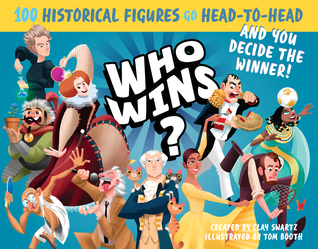
Who Wins? 100 Historical Figures Go Head-to-Head and You Decide the Winner!
Created by Clay Swartz
Illustrated by Tom Booth
Published July 12th, 2016 by Workman Publishing Company

Summary: Who would rock the mic at karaoke night? Abraham “The Great Emancipator” Lincoln or Jane “Lady Persuasion” Austen? How about a hot dog eating contest between Harry “Mr. Magic” Houdini and Mary “Mother of Frankenstein” Shelley? What about a pie contest? A staring contest? And who has a better chance of sneaking into Area 51, Isaac “Gravity Guy” Newton or Sacagawea aka “The Pathfinder”?

In Who Wins?: History, you decide the winner in over 50 head-to-head challenges between 100 of history’s most illustrious characters. But choosing the victor isn’t arbitrary. Readers must justify their answers using each of the historical figures’ six 0-10 category rankings in bravery, leadership, artistry, wealth, wisdom, and fitness; as well as facts from short biographies.

As funny as it is informative, the book is uniquely formatted so readers can match up each and every character in any of the head-to-head battles. History has never been so much fun!

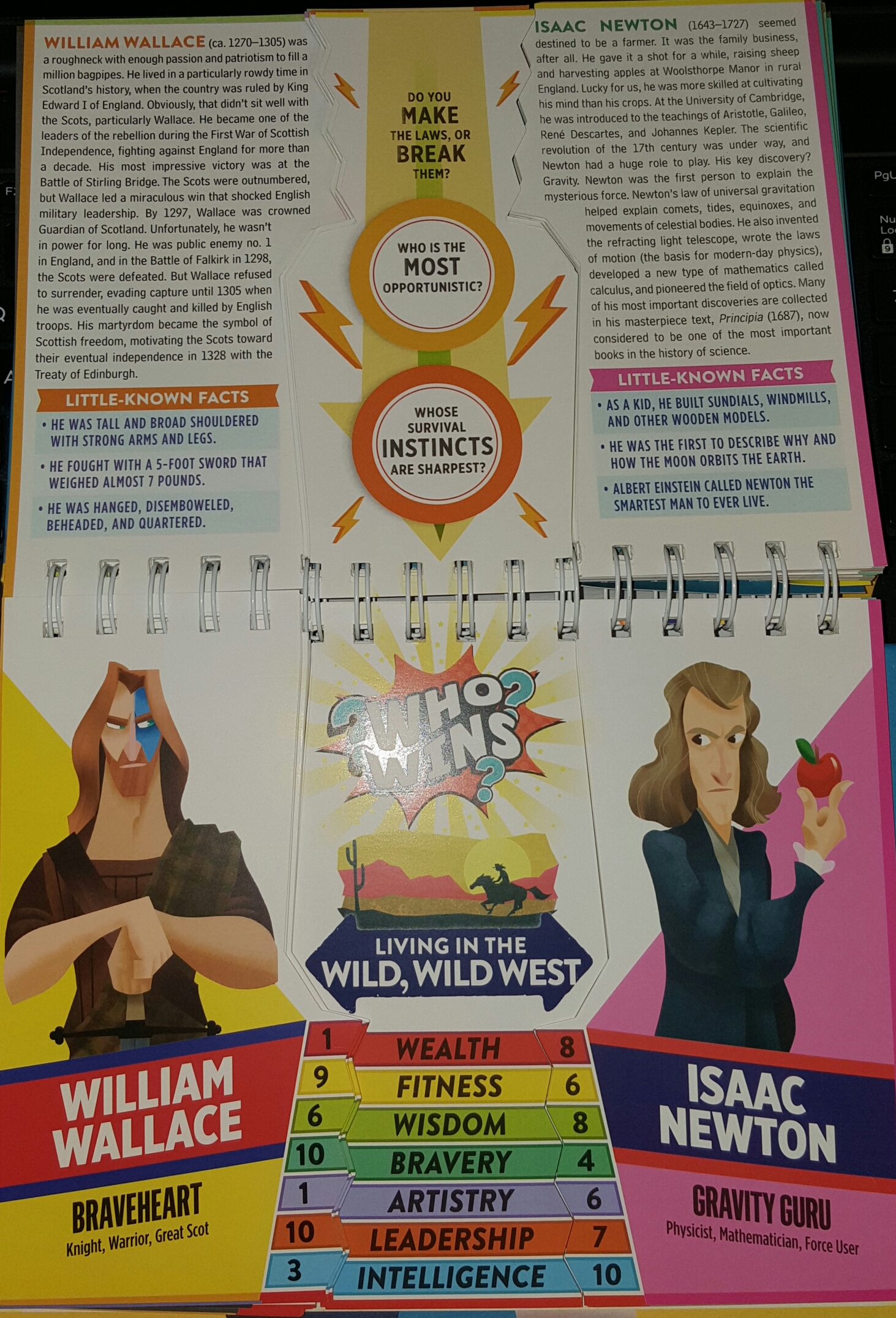
Kellee’s Review: Who Wins? is informative, funny, and so cleverly formatted that it is going to be a star in homes and classrooms. I love how the book gives each historical figure a nickname (either one they already were given, like Satchmo, or made up, like Gravity Guru for Isaac Newton) to add a bit of humor to the book; however, still makes sure to include a plethora of information about each figure including a bio then 3 little-known facts. Each head-to-head situation also helps guide your decision by giving some example questions to think about. Let’s look at a head-to-head, so you can really see how clever it is!

William Wallace “Braveheart” vs. Isaac Newton “Gravity Guru”
Who Wins Living in the Wild, Wild West?

20161008_221140-1

Ricki’s Review: What a clever concept! This spiral-bound book will be a staple for car rides. I could also see it being a great book for fast finishers in the classroom. The book consists of three columns that are split. So, for example, I randomly flipped to three pages (one of each column). At the far right, there is a short summary of Louis Armstrong’s biography and picture. Then, in the middle, the column I flipped to is the “talent show” and asks “Who is the most well-rounded? Who has the most experience entertaining?” Then on the far right, I flipped to Abraham Lincoln. While this one seems like a clear winner for Louis Armstrong, I think we could conceivably argue for either person for the two questions. I’ll be hanging on to this book. It will be a great book to give to my kids in the backseat. Fun family debates are the best!

Teachers’ Tools for Navigation: Are you an elementary school teacher or a social studies teacher or a language arts teacher? Then buy this. It is a perfect bell work or paper prompts or discussion starter or debate topic creator or whatever else you can think of!

Discussion Questions: Who wins?

Read This If You Love: History, Historical Figures, Debates 

Recommended For: 

closereadinganalysisbuttonsmall classroomlibrarybuttonsmall

Signatureand RickiSig

**Thank you to Estelle at Workman’s for providing copies for review!**

Teaching Guide for Ada Twist, Scientist by Andrea Beaty

Share

ada twist

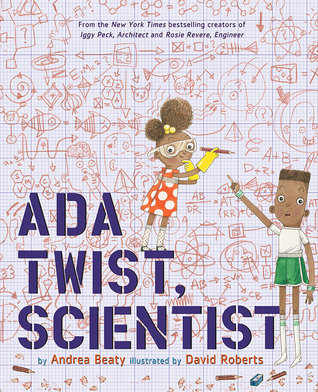
Ada Twist, Scientist
Author: Andrea Beaty
Illustrator: David Roberts
Published September 6th, 2016 by Abrams Books for Young Readers

Summary: The creators of the New York Times bestselling picture books Rosie Revere, Engineer and Iggy Peck, Architect are back with a story about the power of curiosity in the hands of a child who is on a mission to use science to understand her world. Ada Twist, Scientist, from powerhouse team Andrea Beaty and David Roberts, is a celebration of STEM, perseverance, and passion.

Like her classmates, builder Iggy and inventor Rosie, scientist Ada, a character of color, has a boundless imagination and has always been hopelessly curious. Why are there pointy things stuck to a rose? Why are there hairs growing inside your nose? When her house fills with a horrific, toe-curling smell, Ada knows it’s up to her to find the source. Not afraid of failure, she embarks on a fact-finding mission and conducts scientific experiments, all in the name of discovery. But, this time, her experiments lead to even more stink and get her into trouble!

Inspired by real-life makers such as Ada Lovelace and Marie Curie, Ada Twist, Scientist champions girl power and women scientists, and brings welcome diversity to picture books about girls in science. Touching on themes of never giving up and problem solving, Ada comes to learn that her questions might not always lead to answers, but rather to more questions. She may never find the source of the stink, but with a supportive family and the space to figure it out, she’ll be able to feed her curiosity in the ways a young scientist should.

Iggy Peck and Rosie Revere have earned their places among the most beloved children’s characters, and they have inspired countless kids and adults to follow their dreams and passions. Now in her own charming and witty picture book, determined Ada Twist, with her boundless curiosity for science and love of the question “Why?,” is destined to join these two favorites.  The book is the perfect tool to remind both young girls and women that they have the intelligence and perseverance to achieve their dreams.

Teaching Guide: 

Beaty and Roberts’s books promote creativity, scientific thinking, and identity, so I was so happy and proud to be able to write the guide for Ada Twist.

You can also view the teaching guide here. Guides for Ada Twist‘s companion books, Iggy Peck and Rosie Revere, can be found here.

Recommended For: 

classroomlibrarybuttonsmall readaloudbuttonsmall closereadinganalysisbuttonsmall litcirclesbuttonsmall

Signature

Never Insult a Killer Zucchini! by Elana Azose & Brandon Amancio

Share

NFPB2016

Nonfiction Wednesday

Nonfiction Picture Book Wednesday is hosted by Kid Lit Frenzy and was started to help promote the reading of nonfiction texts. Most Wednesdays, we will be participating and will review a nonfiction text (though it may not always be a picture book).
Be sure to visit Kid Lit Frenzy and see what other nonfiction books are shared this week!

zucchini

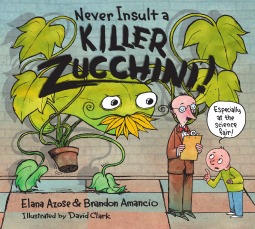
Never Insult a Killer Zucchini!
Authors: Elana Azose and Brandon Amancio
Illustrator: David Clark
Published February 9th, 2016 by Charlesbridge

Goodreads Summary: This is one science fair you’ll never forget!

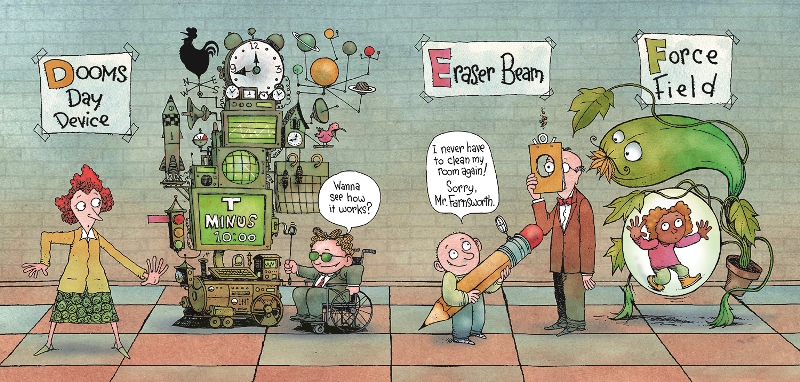
When Mr. Farnsworth, the science-fair judge, declares that he loves zucchinis, the Killer Zucchini is smitten. As the judge makes his way through the exhibits alphabetically—A (antimatter), B (bionic limb), C (cloning)—the Killer Zucchini tries to show his affection. But when Mr. F gets to K and admits he likes to eat zucchini with ranch dressing, the Killer Zucchini gets steamed and attempts to exact his revenge on the snack-loving judge using the other science-fair projects as his means to an end.

Hilarious havoc ensues as the entire science fair is destroyed by his wrath.

Engaging backmatter provides the science behind the science fair entries created by the characters in the story.

Review: My favorite part of this book isn’t even the Killer Zucchini found in the title but all of the supporting science fair experiments. While they all seem like mad science, in the back of the book, the authors have back matter explaining how each of the science fair experiments are based on real science. For example, even though Killer Zucchinis aren’t real, carnivorous plants are, a laser that erased ink was invented in 1968, and Florida’s Mag Lab can shrink a quarter! 

Teachers’ Tools for Navigation: What a great STEM resource! This text will be a perfect read aloud and science text before starting science fair experiments. It can get the brain turning and even give some ideas (though some are quite extreme science!). Hopefully your science fair will not end up anything like this one though!

You could also have students choose one of the experiments to learn more about instead of reading the back matter. It would be a good science/language arts cross curricular research assignment.  (The book is also in alphabetical order!)

Discussion Questions: Which of the experiments is the most dangerous?; Why does the girl win the fair?; Which of the experiments would you like to learn more about?

Flagged Passages: 

zucchini spread

Read This If You Loved: Science texts and picture books

Recommended For: 

classroomlibrarybuttonsmall readaloudbuttonsmall

Signature

**Thank you to Elana for providing a copy of the text for review!**

National Geographic Kids: Real or Fake? Far-Out Figs, Fishy Facts, and Phony Photos to Test for the Truth by Emily Krieger

Share

NFPB2016

Nonfiction Wednesday

Nonfiction Picture Book Wednesday is hosted by Kid Lit Frenzy and was started to help promote the reading of nonfiction texts. Most Wednesdays, we will be participating and will review a nonfiction text (though it may not always be a picture book).
Be sure to visit Kid Lit Frenzy and see what other nonfiction books are shared this week!

real or fake

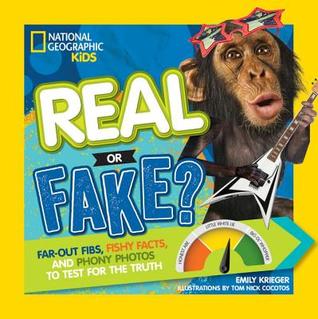
Reeal or Fake? Far-Out Fibs, Fishy Facts, and Phony Photos to Test for the Truth
Author: Emily Krieger
Illustrator: Tom Nick Cocotos
Published May 10th, 2016 by National Geographic Children’s Books

Goodreads Summary: Can you tell the truth from a tall tale? Spot a phony photo a mile away? Figure out a fib in five second flat? Then Real or Fake? is the book for you! Put your amateur detective skills to work in this fun and wacky book and see if the truth triumphs as you encounter suspicious stories, fishy facts, lying lists, and more. You’ll even play interactive games that will leave you second-guessing everything you’ve ever read. Complete with awesome photos and hilarious collage art, this is one book that you have to read to believe . . . or disbelieve.

Kellee’s Review: This National Geographic text was really fascinating! I loved reading the little synopsis then trying to guess if the scenario is true or not. Although some were quite obvious to me, I best many of them will trick students! As a teacher, I also think this book will be a great addition to research units because it will begin a discussion about reliability and validity.

Ricki’s Review: This book would be a fabulous choice for a road trip. I can imagine reading the pages aloud to my kids as they guessed “Real!” or “Fake!” I also like how the facts aren’t all silly and pointless. There is a lot of good learning that happens in these pages–and as an adult, the facts weren’t obvious to me, either, so I would have fun on the car ride, too! I completely agree with Kellee’s smart suggestion that this would be a great book to introduce reliability and validity. With the political campaigning and the sharing of memes that are completely false (from both sides), I have been thinking about reliability and validity a lot lately!

Teachers’ Tools for Navigation: In addition to being an instant favorite in classrooms, Real or Fake? will definitely make anyone who reads it want to either research some of the real/fake information shared (Was Teddy Roosevelt shot but continued with his speech? and Did a chimp’s song became #19 on the European billboard charts?) or want to go research things they think they know! Real or Fake? will be a great book to use when talking about research and would be a fun introduction to Snopes.

We Flagged: “Plants make music: Real or Fake? It may sound crazy, but plants can play tunes. A new device converts electrical currents moving across a plant’s surface into synthesizer sound in real time. (Though the sound of the converted currents may not be music to your ears.) The device works in much the same way a lit-detector test does, only the probes are placed on leaves instead of on skin and the currents are translated into audio. What does this ‘music’ tell us about the secret life of plants? The inventors aren’t quite sure yet. They are, however, hoping the ‘biofeedback’ will eventually be revealing an help us learn more about the natural world. In the meantime, rest easy knowing that one day soon your houseplants could play a tune: An online fund-raising campaign to make the device available to people interested in purchasing it has reached its goal.”

Real! With its far-out sounds, the MIDI-sprout (‘MIDI’ stands for ‘musical instrument digital interface’) is changing the way people perceive plants. Scientists have known that plants send chemical and light signals to one another. Plants can even send chemical distress signals to get insects to come to their rescue! A study published in 2012 suggests that plants also may be able to use sound to communicate with one another, so why not talk to their human caretakers.

Fun Fact!: The MIDI Sprout can even be hooked up to humans! The electrical signals humans give off reportedly tell a lot about emotional states.” (p. 82-83)

*Disclosure: This quote cannot share the entire feeling of the book without the illustrations/photos. See the published book to see the complete experience.

Read This If You Loved: National Geographic’s 100 Things to Know Before You Grow UpMastermind by National Geographic, Weird but True series by National Geographic, National Geographic’s Awesome 8

Recommended For:

classroomlibrarybuttonsmall closereadinganalysisbuttonsmall readaloudbuttonsmall

Kellee Signature andRickiSig

**Thank you to Karen at Media Masters Publicity for providing copies for review!**

125 Wacky Roadside Attractions by National Geographic Kids

Share

NFPB2016

Nonfiction Wednesday

Nonfiction Picture Book Wednesday is hosted by Kid Lit Frenzy and was started to help promote the reading of nonfiction texts. Most Wednesdays, we will be participating and will review a nonfiction text (though it may not always be a picture book).
Be sure to visit Kid Lit Frenzy and see what other nonfiction books are shared this week!

125 Wacky Roadside Attractions

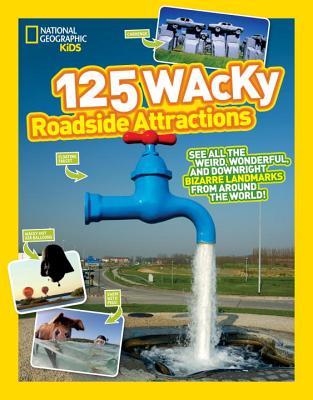
125 Wacky Roadside Attractions: See All the Weird, Wonderful, and Downright Bizarre Landmarks from Around the World!
Published May 10, 2016 by National Geographic Children’s Books

Goodreads Summary: Going on a road trip? See the silly side of travel as you explore the wackiest landmarks from around the world — a place where you can walk in real dinosaur tracks, a hotel where you sleep in an igloo, a crazy beard festival, a UFO museum, and so much more. You won’t believe our world is full of so many bizarre and wonderful places!

My Review: I’ve become a huge fan of the National Geographic books. My toddler is obsessed with them, even though he is much younger than the intended audience. He loves telling us all about the things he learns in the books, and the pictures give us so much to talk about. For this book, we loved talking about all of the different places in the world and what we might see on a road trip. For older kids, this book is great to inspire them to want to travel and to visit all of these neat landmarks! I particularly liked the variety in this text. I can’t imagine that anyone could finish reading this text without adding places they want to visit to their bucket lists. There was a good balance between drivable places and also locations that are across the world. This book will keep a traveler quite busy!

Teachers’ Tools for Navigation: It would be so much fun to place these attractions on the map. Readers might examine how the authors balanced the locations. It also provides students with a good visual concept of where they want to travel next! Students might also be inspired to find a weird or wacky attraction that isn’t in the book. They can share these ideas with the class!

Discussion Questions: Which attraction was most interesting to you? Why?; Which of the closer attractions might you want to visit soon? Which is the farthest attraction that you are interested in visiting?; What neat themes did you see across different attractions?; What might inspire people to create weird and wacky attractions like these?

Read This If You Loved: National Geographic’s 100 Things to Know Before You Grow UpMastermind by National Geographic, Weird but True series by National Geographic, Animal Atlas, Almanacs, Travel Books

Recommended For: 

classroomlibrarybuttonsmall

RickiSig

**Thank you to Karen at Media Masters Publicity for providing a copy for review!**

What a Beautiful Morning by Arthur A. Levine

Share

what a beautiful morning

What a Beautiful Morning
Author: Arthur A. Levine;  Illustrator: Katie Kath
Published TODAY!: August 9, 2016 by Running Press Kids

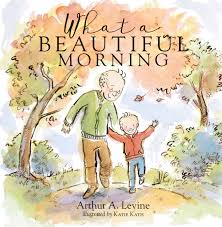
Goodreads Summary: Every morning is beautiful when Noah visits his Grandparents. When Grandpa and Noah wake up, they take off singing and hardly stop: walking the dog, splashing through puddles, and eating French toast with cinnamon. But one summer Grandpa seems to have forgotten how to do the things they love. Does he even know who Noah is? Grandma steps in energetically, filling in as best she can. But it is Noah who finds the way back to something he can share with Grandpa. Something musical. Something that makes the morning beautiful again. This is a story about how love helps us find even what we think is lost.

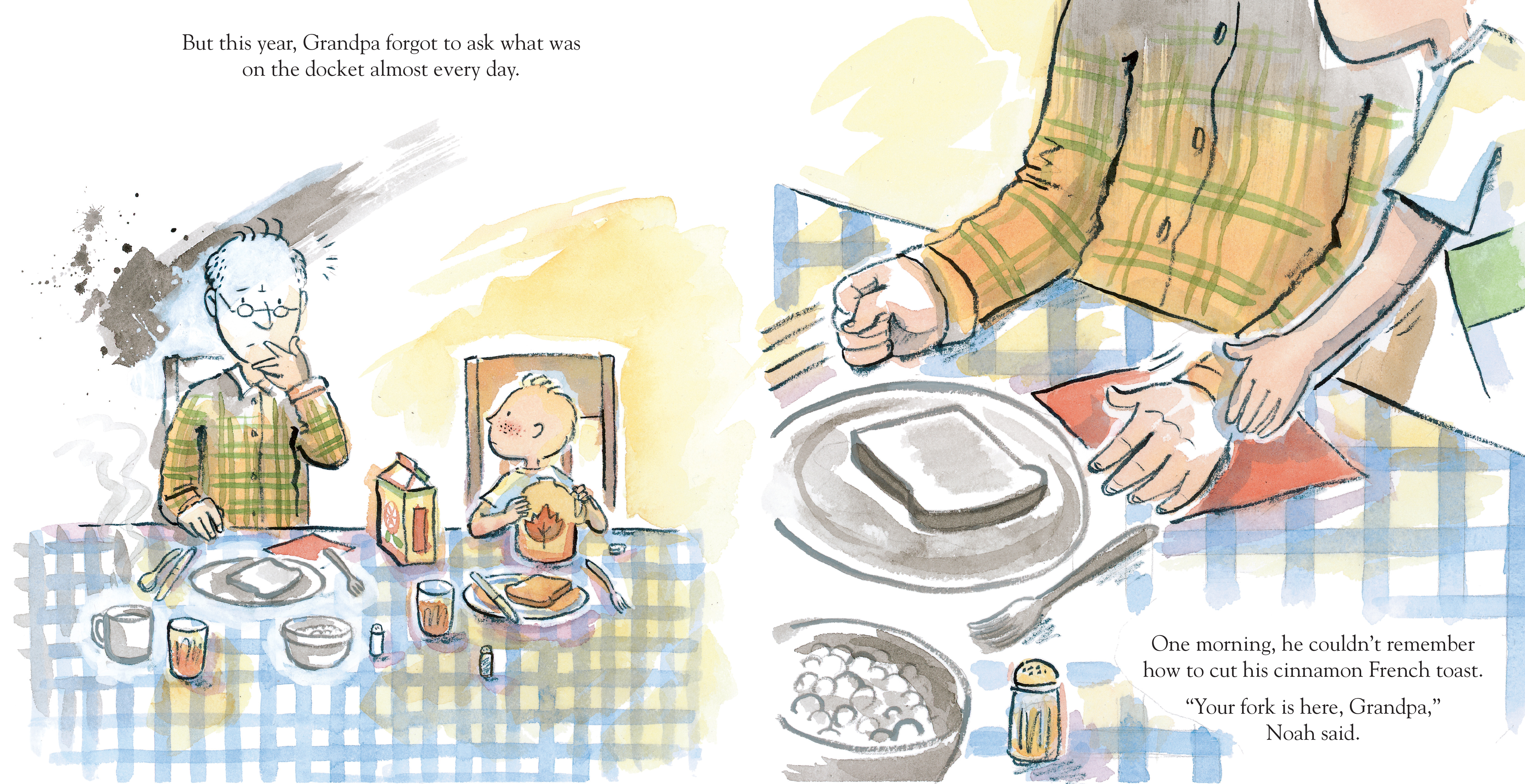
My Review and Teachers’ Tools for NavigationThis is a beautiful story—from cover to cover. I was enveloped by the watercolor images and words that took me inside Noah and Grandpa’s story. My toddler sat beside me and pointed to the images as I read aloud to him. While he may not have understood the story, he most certainly understood the love between Noah and his grandfather. Elementary school children will develop knowledge of the scary truths of Alzheimer’s disease. While it may feel more comfortable to shield children from these truths, the disease is very much a reality for millions of families, and this book will bring them comfort as they discuss the development of this disease in our loved ones.

Teachers might consider teaching a unit about diseases or disabilities. Texts such as these are very important for students to learn from, and this book is no exception. This might lead into a research unit where students explore and learn more about the diseases or disabilities they find within the books the teacher discusses. However, I most appreciated that this isn’t a book about Alzheimer’s Disease. This is a book is truly about the love between a child and his grandfather.

Discussion Questions: When does Noah first notice that Grandpa is having trouble remembering things? How does he react? How does Grandma react?; How does the illustrator use color to help readers better understand the story?; How does the book end? Did you like the ending? How does it connect to the beginning of the story and the overall message?

Flagged Spread: 

WABM_int.indd

Read This If You Loved: Forget Me Not by Nancy Van Laan; The Memory Box by Mary Bahr, Still My Grandma by Veronique Van Den Abeele, Really and Truly by Emilie Rivard, Wilfrid Gordon McDonald Partridge, written by Mem Fox, What’s Happening to Grandpa? by Maria Shriver

Check Out the Other Stops on the Blog Tour:

8/2 Flowering Minds

8/3 MomReadIt

8/4 Unpacking the POWER of Picture Books

8/5 Stacking Books

8/6 #Kidlit Book of the Day

8/8 Enjoy Embrace Learning

8/9 Unleashing Readers

8/10 Two Writing Teachers

8/11 Bildebok

8/12 Geo Librarian

8/13 Randomly Reading

Recommended For: 

readaloudbuttonsmall classroomlibrarybuttonsmall

RickiSig

The Dino Files: A Mysterious Egg by Stacy McAnulty

Share

Dino Files 1

The Dino Files #1: A Mysterious Egg
Author: Stacy McAnulty
Illustrator: Mike Boldt
Published: January 19, 2016 by Random House Kids

Summary: What if a fossil in your backyard . . . came to life?!

Frank’s grandma is a famous paleontologist (that’s a dinosaur scientist). But she’s also an adult who makes up rules. Rules like: no digging for dinosaur bones when you have a sunburn. That means Frank is stuck playing inside with his annoying cousin, Samantha. But then Grandma finds a fossil of an egg! And when Frank and Sam sneak into the dino lab late at night, they find something even more amazing. . . .

The hilarious Dino Files chapter book series follows a nine-year-old dinosaur expert, his paleontologist grandparents, a cat named Saurus, and fossils that might not be so extinct!

About the Author: Stacy McAnulty is the author of several children’s books including Excellent Ed, illustrated by Julia Sarcone-Roach; The Dino Files series, illustrated by Mike Boldt;  and 101 Reasons Why I’m Not Taking a Bath, illustrated by Joy Ang. Stacy grew up outside of Albany, New York and received my B.S. in Mechanical Engineering from the University at Buffalo. A career opportunity brought her to central North Carolina in 1998. She currently lives in Kernersville, NC with her husband, their three children and two dogs.

Also, Stacy offers FREE Skype interviews and signed bookmarks to any class reading The Dino Files!

Ricki’s Review: This is a hilariously fun series that is sure to be a hit in classrooms. I see it working best in grades 1-4. As a child, I was disappointed when my chapter books no longer had pictures, and this book is a great transitional book because it has the best of both worlds—a great story and pictures to go along with it! Frank reminds me of many kids. He is frustrated by all of the rules set out for him, and he just wants to have fun. He manages to sneak around a bit and something awesome happens with that dinosaur egg (I’ll let you guess)! I also want to put in a plug for the fact that Frank is a cat lover. My son loves cats, and I hate how books/shows always feature males as dog lovers and females as cat lovers. I loved Saurus the cat!

Kellee’s Review: I plowed through this and the sequel because I loved the premise and the characters so much! I love that Frank and Sam represent such different types of kids within each of them and between each of them; I think so many readers will relate to their personalities. I also really liked how dinosaurs are introduced throughout the book without making the book didactical in any way. Instead it is educational and funny! This series is a wonderful introduction to early chapter books also because it is very engaging and will appeal to all kinds of readers. 

Teacher’s Tools for Navigation: This book is a great jump start to researching about dinosaurs! I know a lot of early elementary schools have a big dinosaur unit, and I think this book would appeal to readers of all ages. The book might also work well for a fossil unit, too! It would be interesting to investigate whether it would be possible to hatch a fossilized dino egg. Then, the class could have a discussion about whether this book might be considered realistic fiction or fantasy. Further activities and information is available at: www.thedinofiles.com.

Discussion Questions: What good choices does Frank make? What bad choices does he make? What are the outcomes of his choices?; What words would you use to describe Frank? How is he different or similar to you?; What rules is Frank forced to follow? Do you think these rules are fair?; How do the illustrations enhance your reading experience?

Flagged Passage: “I need to be at that dig site! Instead, I’m stuck inside the museum with PopPop. The good thing is I got my own name tag. Finally.”

Read This If You Loved: Dinosaur Cove by Rex Stone; Dinosaur Trouble by Dick King Smith; Dinosaur Pox by Jeremy Strong

Recommended For:

litcirclesbuttonsmall classroomlibrarybuttonsmall readaloudbuttonsmall

Check Out the Other Books in the Series!:
dino files 2 dino files 3

RickiSigand Kellee Signature

**Thank you to Stacy for providing copies for review!!**