Author Guest Post: “Journey” by Michael Cottman, Author of Shackles from the Deep

Share

“Journey” by Michael Cottman

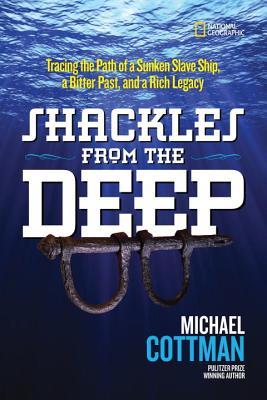
My journey to write Shackles From The Deep started when I was a boy growing up in Detroit and watching a popular television show called Sea Hunt, a 1960s adventure program about an underwater detective.

From the time I was a kid, I wanted to scuba dive and explore the ocean’s depths. And because National Geographic embraces adventure tales like no other company, this was a perfect publishing partnership.

I wrote Shackles From The Deep in a conversational way for young readers to share the story of the Henrietta Marie, a sunken 17th century slave ship. This is more than just the story of one ship – it’s the untold story about millions of African people taken as captives to the New World.

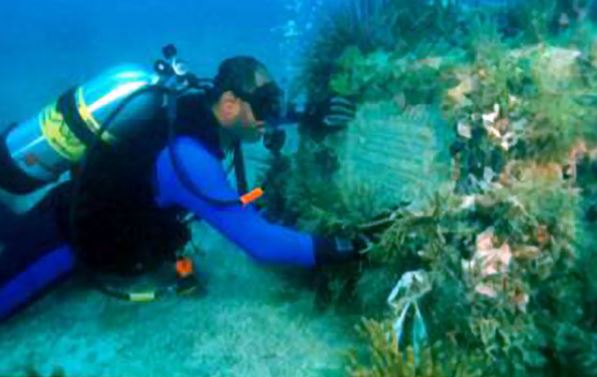
I traveled to three continents to piece together a trans-Atlantic puzzle. I reviewed shipping records and slave-ship captain’s logs in London. I retraced the route of the Henrietta Marie slave ship and scuba-dived the ship’s ports of call in Jamaica, Barbados, and West Africa.

During my research, I learned amazing things:  Today, the Henrietta Marie is believed to be the world’s largest source of tangible objects from the early years of the slave trade.

The Henrietta Marie is the only slave ship in America that has been scientifically documented and where more than 20,000 artifacts were recovered, including the largest collection of slave-ship shackles ever found on one site.

I also learned the shackles were discovered in 1973 by Moe Molinar, a black underwater treasure hunter who was searching for the Atocha, a Spanish galleon that had sunk nearly 400 years ago filled with gold, silver and $400 million worth of jewels.

Treasure hunters didn’t know what to make of these relics. Then in 1983, maritime archaeologists, intrigued by the mystery, revisited the site and came upon a ship’s bell. As they chipped away at the limestone encrustation a name and a date emerged: Henrietta Marie, 1699.

Beneath the sea, on the wreck of the Henrietta Marie, I ran my hands through the sand and held the tiny glass trade beads that were used by the Henrietta Marie’s crew to trade for African people.

The story of Shackles From The Deep also introduces young readers to the unprecedented partnership between members of The National Association of Black Scuba Divers (I’m a lifetime member) and white maritime archaeologists who explored the Henrietta Marie together for a common purpose and forged lifelong friendships along the way.

After all, the global institution of slavery is our collective history.

But because of slavery, it is nearly impossible for African Americans to pinpoint the origins of our ancestors.

We cannot always identify a country in Africa where they were born, let alone a city or village. We can only know they came from somewhere on the west coast of the enormous continent.

Are my people Ibo from Nigeria, or Fulani from Mali, or Wolof from Senegal, or Ashanti from Ghana? I may never know.

What’s important, however, is my appreciation for the African culture — my culture, too — and my need to draw strength from the African people who came before me and survived.

And we continue to honor them.

In 1993, I joined members of The National Association of Black Scuba Divers to place a one-ton concrete memorial on the site of the Henrietta Marie shipwreck.

The bronze inscription on the memorial is a powerful testament to the human spirit: “In memory and recognition of the courage, pain and suffering of enslaved African people. Speak her name and gently touch the souls of our ancestors.”

Shackles from the Deep: Tracing the Path of a Sunken Slave Ship, a Bitter Past, and a Rich Legacy
Author: Michael Cottman
Published January 3rd, 2017 by The National Geographic Society

Summary: A pile of lime-encrusted shackles discovered on the seafloor in the remains of a ship called the Henrietta Marie, lands Michael Cottman, a Washington, D.C.-based journalist and avid scuba diver, in the middle of an amazing journey that stretches across three continents, from foundries and tombs in England, to slave ports on the shores of West Africa, to present-day Caribbean plantations. This is more than just the story of one ship it’s the untold story of millions of people taken as captives to the New World. Told from the author’s perspective, this book introduces young readers to the wonders of diving, detective work, and discovery, while shedding light on the history of slavery.

Critical Praise: 

“The idea of identity is at the center of this fascinating narrative nonfiction book…This truly multidisciplinary volume….engagingly explores a wide scope of topics, including the history of slavery, marine archaeology, and contemporary racial discrimination, culminating in a dive down to the wreck itself. Every bit of this concise, detailed book feels personal, and Cottman’s exploration and investigation of the wreck is rich with intrigue and poignant, thought-provoking questions.” -Booklist (STARRED REVIEW)

“Cottman weaves his personal story of discovery with history of the slave trade, helping readers understand why a sunken slave ship from the 1700s still matters. His emotional attachment to the artifacts, including child-sized shackles, deepens the storytelling in this highly readable narrative.” –Kirkus

“Accessible and very personal account….(a) chilling exploration of the slave trade.” -Publishers Weekly

“Cottman’s personal journey, fraught with reminders of the trials and injustice his own enslaved ancestors must have endured, is compelling” -BCCB

About the Author: Michael H. Cottman, Pulitzer Prize-winning journalist and author, is a former political reporter for the Washington Post. Cottman has appeared on National Public Radio’s (NPR) “Tell Me More” with Michel Martin and also the Oprah Winfrey Show in 2000 to discuss his (adult) book The Wreck of the Henrietta Marie. Cottman also serves as a special consultant to the National Oceanic Atmospheric Administration (NOAA) for a national multimedia project, “Voyage to Discovery,” an education initiative that focuses on the African-American contribution to the maritime industry spanning 300 years and efforts to teach students of color about careers in marine biology and oceanography. Visit his website at http://www.michaelhcottman.com/.

Thank you to Michael for his post and to Barbara from Blue Slip Media for providing the resources!

 and

Author Guest Post and Giveaway: “A Recipe for Storytelling: Take One Real Life, Add a Spoonful of Fantasy, and Stir” by Carter Roy, Author of The Blazing Bridge, the third book in the The Blood Guard series

Share

“A Recipe for Storytelling: Take One Real Life, Add a Spoonful of Fantasy, and Stir”


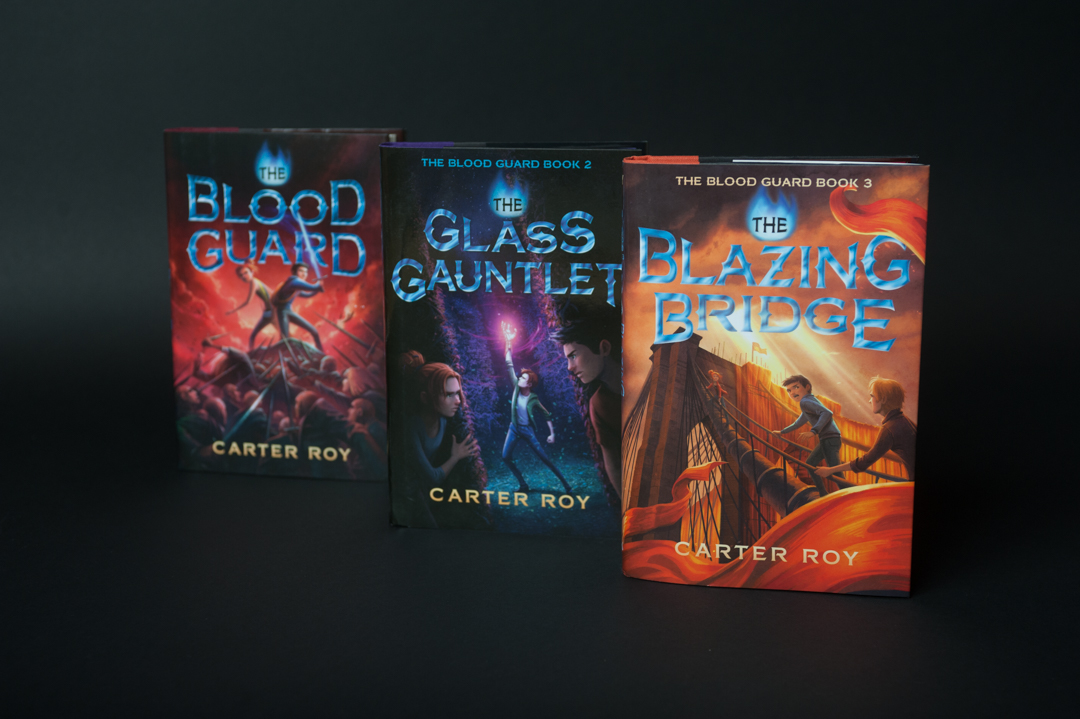
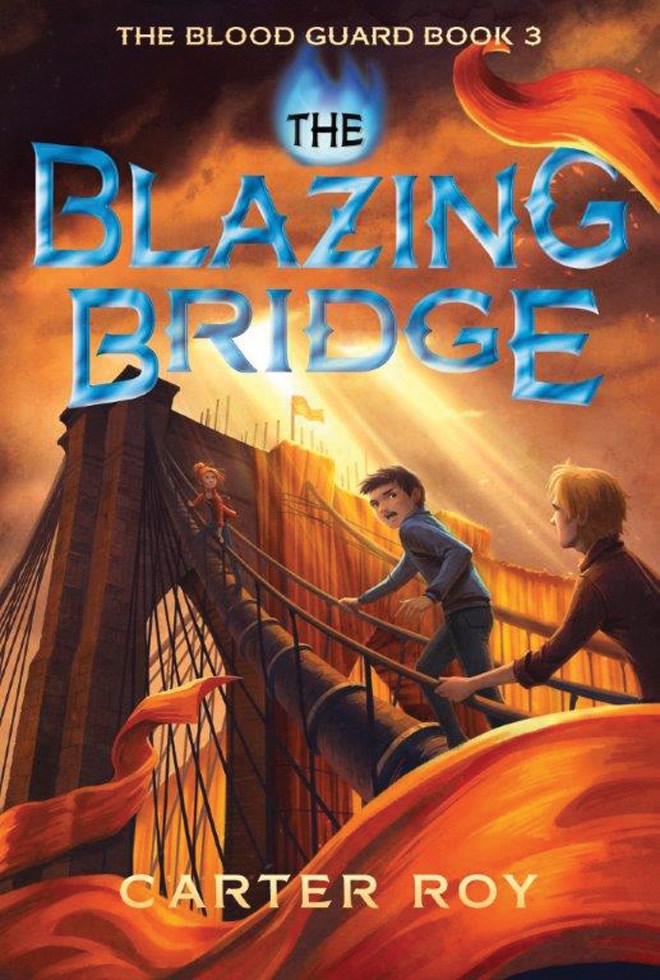
Late last summer, after I’d turned in the manuscript for the third Blood Guard book, The Blazing Bridge, I mentioned to a longtime friend that I’d finished the trilogy. “That’s great!” she chirped; “now you can write a real book.”

Excuse me?” I replied and made a face like this

She explained. To her mind, fantasy adventure for middle-grade graders is mere “escapist literature,” and it doesn’t count as real—not like stories about normal people. “You had a rough childhood,” she said. “Why not write about that?”

But as far as I was concerned, I was already writing about my childhood. Only in disguise. Because even though fantasy literature on its surface is about another world, at root it is always about this one—the world we live in. Otherwise the stories would have no hold on us at all.

Not to get maudlin, but when I was growing up, my family—like many families—fell apart. There was never enough money; my older brothers were always getting into trouble; my dad turned out to be a not-so-good guy; and my parents divorced—which forced my mom to move us kids around from one home to another to another as she tried to find us an affordable and safe place in the world.

In a very different form, that material made its way into the Blood Guard books. A feud between two parents. A discovery that a father is someone other than who his children thought him to be. A constant need to uproot one’s life and relocate. All of these things were drawn from actual life, but transformed into backstory for an action adventure tale. Why? Because these novels were for the twelve-year-old me as much as anyone, and that kid liked his stories to move. The magic, the action, the jokes—those are the spoonfuls of sugar that make the medicine go down. (The “medicine” in this case being the ugly truth that my dad was, in fact, a very bad guy.)

Twelve-year-old me wouldn’t face the truth about my dad for years. But I might have done so a lot sooner … if only I’d been able to if I’d been able to read about it in a fantasy novel.


About the Book: Ronan Truelove’s best friend, scrappy smart aleck Greta Sustermann, has no idea that she is one of the thirty-six Pure souls crucial to the safety of the world. But Ronan’s evil father has figured it out—and he’s leading the Bend Sinister straight to Greta. If they capture her, she’ll suffer a fate far worse than mere death. But to get to Greta, they’re going to have to go through Ronan first.

Standing with Ronan are plucky hacker Sammy; witty, unkillable Jack Dawkins; and a sharp-tongued woman named Diz, who drives a dangerously souped-up taxi. One breathless close call after another leads to an ugly showdown: Ronan alone against his father, with the fate of Greta, his friends, and the entire world hanging in the balance. Will Ronan be able to rise up and prove once and for all that he has what it takes to join the Blood Guard?

By turns heart-stopping and hilarious, The Blazing Bridge brings the Blood Guard trilogy to a surprising, clever, and altogether thrilling conclusion.


About the Author: Carter Roy has painted houses and worked on construction sites, waited tables and driven delivery trucks, been a stagehand for rock bands and a videographer on a cruise ship, and worked as a line cook in a kitchen, a projectionist in a movie theater, and a rhetoric teacher at a university. He has been a reference librarian and a bookseller, edited hundreds of books for major publishers, and written award-winning short stories that have appeared in a half-dozen journals and anthologies. His first two books were The Blood Guard and The Glass Gauntlet. He lives with his wife and daughter in New York City and can be found at www.carterroybooks.com or on Twitter @CarterRoyBooks.


Giveaway!

Thank you, Carter for this inspirational post! And thank you, Barbara from Blue Slip Media, for connecting us with Carter!

RickiSigandKellee Signature

Author Guest Post: “The Story of Family and Frog! Haggadah” by Rabbi Ron Isaacs and Karen Rostoker-Gruber, Author of The Family and Frog! Haggadah

Share

“The Story of Family and Frog! Haggadah” by Rabbi Ron Isaacs and Karen Rostoker-Gruber, as Frog!

Make your seder different than all other seders!

Start with a traditional Haggadah text, add artwork, your favorite songs and fun facts, then add a hopping frog to its pages and you’ll get. . .

The Family and Frog! Haggadah

The Story

The Family and Frog! Haggadah came about in a board room at Behrman House, a Jewish publishing company, based in Springfield, NJ.  Our book, Farmer Kobi’s Hanukkah Match, was just named a National Jewish Book Award Finalist, and the editorial staff at Behrman House wanted to know if Ron and I would like to work on a Haggadah together.  The stipulation was that the Haggadah was to be like no other:  It had to be traditional in content, but fun! for the whole family—ages 3-90.  That was a tall order.

Ron wrote the Haggadah, because he is a Rabbi, and I decided to add a character that would liven up the seder.  Dena, the Executive Editor, suggested a frog, which was brilliant!

That night I went home, read Ron’s whole Haggadah, and started letting my character, Frog, comment on everything—similar to things that someone might say at an actual seder—under their breath or otherwise.

Every time I thought that I was done, and spoke with Dena, the Executive Editor, or Ann, the Art Director, they pushed my creativity more and more.  I was allowed to do anything that I wanted to do with Frog, so I did.  I have Frog interacting with the Haggadah in ways that were never done before.

Frog is 5 years old and gender neutral.  Frog spills things, makes a matzah mess, plays guitar, runs away from Pharaoh’s army and even eats a locust during the seder.  The sky was the limit.

I gave Ann and Dena three times the amount of material for Frog, so that they could take things away and still be left with a whole lot of fun! 

This Haggadah was one of the hardest, most challenging manuscripts I have ever worked on.  It changed daily as Ron was still editing while I was getting Frog to comment on things that he was working on at the time.  Plus. . . there was the deadline.  🙂

The printed Haggadah was more than I ever expected it to be.  It’s beautiful!  Ann designed it to look like a very traditional Haggadah, from the typefaces and colors that she chose, to the background that resembles a piece of papyrus.  She also selected gorgeous pieces of art and artifacts for each page–and then. . .popping out of corners, through the pages and jumping to different sections, is a cartoon amphibian—Frog.  It’s unexpected and fun!  Not only is there a cartoon frog bursting through the binding, singing songs and breaking matzah, but there are also “Fun Facts,” “Did You Know” and “Try This,” parts of the Haggadah, which elevates this Haggadah even higher and encompasses so many different age groups that there is literally something for everyone.

I am so proud of this project.  And the finished product came out beyond my wildest expectations.  Plus, Frog LOVES it!  And that was important to me.

I do LOVE it!
I do LOVE it!
It’s toadily awesome!

–Frog

Author Bios

Karen Rostoker-Gruber is an award-winning children’s book author. Her first children’s book, Food Fright, was published in 2003 by Price Stern Sloan. Her second children’s book, Rooster Can’t Cock-a-Doodle-Doo, was published in 2004 by Dial Books for Young Readers.  It was nominated for the Missouri Show Me Award in 2005.  Bandit, Bandit’s Surprise, and Ferret Fun came out from Marshall Cavendish and all received starred reviews in School Library JournalTea Time, her first board book, came out from Marshall Cavendish in 2010.  Bandit was nominated for the South Carolina Book Award and both Bandit and Bandit’s Surprise were featured on “Celebrity Apprentice,” and Ferret Fun was preliminarily nominated for the Missouri Show Me Award.  Both Rooster Can’t Cock-a-Doodle-Doo (in 2005) and Bandit (in 2009) were listed as International Reading Association—Children’s Book Council Children’s Choice Award recipients.  In the spring of 2017, Maddie the Mitzvah Clown, will be published by Apples and Honey Press, a division of Behrman House.

Rabbi Ron Isaacs has served Temple Sholom in Bridgewater, New Jersey, as its spiritual leader since 1975. He has a doctorate in educational technology from Columbia University’s Teachers College. An adjunct lecturer at the Jewish Theological Seminary of America, he is the author of more than 100 books, including Ascending Jacob’s Ladder: Jewish Views of Angels, Demons, and Evil Spirits; Ask the Rabbi: The Who, What, When, Where, Why, and How of Being Jewish; and Kosher Living: It’s More than Just the Food. He is the first rabbi in New Jersey to receive the United Synagogue’s Keter Torah award for outstanding lifetime achievement and rabbinical excellence. He is known as the “teaching rabbi.”

Thank you for the guest post!

 and


Their book, “Farmer Kobi’s Hanukkah Match,” was a National Jewish Book Award Finalist, and won the 2016 Outstanding Children’s Literature Award from the Church and Synagogue Library Association.

Author Guest Post: “An Adaptation: Better Than The Original?” by John Powers, Author of Queen of Sky Island

Share

An Adaptation: Better Than The Original? by John Powers

I am not an MG writer. My work is with the stage and movies. My usual arena for subject matter is recent American history and horror. In addition to creating original stories, I have adapted existing texts: speeches; books; transcripts. I had chosen these works because something within them resonated with me, and I felt it would resonate with others.

I am pretty ruthless as an adapter. My first task is to cut away what I consider the unnecessary narrative and to focus on the dramatic and emotional story. I then take a second pass at the text, which at this point is more like surgery. I am focused on creating and sustaining dramatic momentum, the effect of quickly “turning the page.” Once that is done, the challenge begins: focusing relentlessly on what resonates with today’s readers and viewers.

Who should care about the rabble-rousing speeches of Mary Jones (a.k.a. Mother Jones) during a West Virginia coal strike? What do we care about the efforts of poet Amy Lowell to promote the works of then little known writers Carl Sandberg and Robert Frost? Are the doubts and obstacles facing the novice Zane Grey of any importance to us in the age of Instagram and Snapchat?

These are questions that I have asked and answered in adapting existing texts for contemporary audiences. We cannot bring back great people who have passed, but by working closely with their texts we can breathe life into their creations. We can do it in a way that enables contemporary readers and viewers, particularly young ones, to emotionally connect with the values and ideas that these people fought to express.

For example, the Pentagon Papers is a frequently referenced document. But who knows anything about it? In working with the 7000-page text for a stage production, I grew to think that it is the most important work in the American language. I saw how it revealed the American character in depth, as it traced 23 years of a 30-year war. It was our Iliad. Yet who today would read a 7000-page document about a lost war?

In adapting the Pentagon Papers for readers, I sought to tell the story in the most concise and comprehensive manner. I drew excerpts from the four-volume Gravel edition of the Papers, and I grouped them into brief, distinct chapters. The result became a quick page-turning experience that a reader could consume in one or two sittings. In addition, I included links to on-line resources, such as articles and historical videos, to broaden their knowledge.

The key to finding success with the work, however, was in making it resonate with people, particularly young people. I did that by relating this previous “endless war” with the current one. In particular, I directed the adaptation toward millennials, whom I felt would be continually trying to make sense out of the situation we currently are in and would be asking could there ever be an end to it.

In another example, I discovered a little known work by L. Frank Baum when I was creating a solo performance for the stage about his life in early Hollywood. I was struck by the vivid imagery of the world and characters that he created in Sky Island, and I was surprised that it had not been exploited further.

Baum, an early feminist, considered it one of his best stories, and yet it had migrated into the land of forgotten treasures. I had my ideas of why: it was unnecessarily long; the main “earth” characters were no longer relatable; and there was no dramatic momentum.

In my adaptation, I titled the work Queen of Sky Island to give it a central focus and to assert Baum’s feminism; I wanted the reader to know from the outset whose journey this was and what was the desired goal. I also cut the length of the original text in half, eliminating tangential episodes that pulled focus away from the hero. Also, I also drew the hero as an assertive, impulsive girl striving to bring her broken family back together, and I surrounded her with new companions: an almost angel-like boy and a disabled veteran.

I left in place the vivid characters and the key actions that Baum envisioned on his island in the sky. Now, all the elements of the story are working to focus our attention on this young hero’s choices that put her and her companions at risk in this bizarre, unearthly world; and we witness her dig deep within herself to both save their situation and to bring lasting justice to this morally compromised world.

Without question, much of Queen of Sky Island is about visual imagery, but in my adaptation I have found something that will resonate with young readers; they will relate to this contemporary hero who at times is stubborn and violent, but who is also caring and heroic. She grows immensely during a brief course of time, from a selfish child to a selfless queen.

Creations age quickly in our new world, but there are invaluable elements within these creations that should be sought out like precious gems and placed in new jewelry settings. Adaptations are not better than the originals; they are different; they aim to preserve the best and carry it forward to resonate in the hearts and minds of new generations.


About the Author: John Powers (a.k.a. J-Powers) is the author of Queen of Sky Island (Amazon, Smashwords 2014, Audible 2016) and Pentagon Papers: Recently Abridged Edition for the Millennial Generation (Amazon, Smashwords 2012). He lives in the harbor area of Los Angeles with his wife and three millennial stepchildren. Find him at powerplayz.com


About the Book: Queen of Sky Island is a coming of age story charged with fantasy, heroic adventure, and vividly imagined new worlds. It is a 21st century adaptation of a story by L. Frank Baum, the creator of The Wonderful Wizard of Oz.

As reconceived and adapted by John Powers (a.k.a. J-Powers), Queen of Sky Island reveals a young girl, Tara, who in her determined search for her military father becomes trapped on an actual island in the sky where she leads one other worldly army against another. Tara’s faithful companions on this perilous adventure are Bobo, a brave young boy who possesses a flying umbrella, and Sgt. Rik, a resourceful disabled veteran who looks after Tara and her mother at their sea cliff cottage on the Earth. Through miscommunication, Tara and her companions arrive at Sky Island, a bizarre land divided between wildly different pink and blue territories. They are unfairly taken prisoner by the Boolooroo, the selfish and mean-spirited leader of the Blue people. Facing a horrible punishment known as “patching,” Tara and her companions escape and run for a thick fog bank that separates the two territories. With help from an unusual creature, they cross through the dense fog, and they are taken to the queen of the Pinkies. After surviving a near fatal test in this new realm, Tara shows what she is made of and rises to lead the Pinkies against the Blues in an attempt to defeat the Boolooroo.

Thank you, John, for this thought-provoking post!

and

Author Guest Post: “Theater Games to Promote Reading and Writing” by Gary Schwartz, Author of The King of Average

Share

“Theater Games to Promote Reading and Writing”

WHY BRING THEATER GAMES INTO THE CLASSROOM?

Everyone can play! Everyone can learn through playing. The Theater Game format is a charted course for the regular classroom teacher who wishes to bring the excitement, the pleasures, the disciplines and the magic of theater to the classroom.

Theater games, played in the classroom, should be recognized not as diversions from curriculum needs, but rather as supports, which can thread through each day, acting as energizers and/or springboards for everyone. Inherent in theater techniques is verbal, nonverbal, written and unwritten communicating. Communication abilities, developed and heightened in theater game workshops will, in time, spill over into other curriculum need (the 3 Rs) and into everyday life.

Teaching/learning should be a happy, joyful experience, as full of glee as the infant’s breakthrough out of the limitations of crawling into the first step walking!

Beyond immediate curriculum needs, playing theater games will bring moments of spontaneity. The intuitive comes bearing its gifts only in the moment of spontaneity.” Right now is the time of discovery, of creativity, of learning. While playing theater games, teachers and students can meet as fellow players in present time, involved with one another, off the subject, and ready for free connecting, communicating, responding, experiencing, experimenting and breaking through to new horizons.

Reprinted from THEATER GAME FILE HANDBOOK, Viola Spolin, Northwestern University Press


I had the extreme good fortune to study with Viola Spolin author of Improvsiation for the Theater and inventor of modern day Improvisation. I can honestly say she changed my life in many ways. After a long career as an actor and performer and teacher I’ve written extensively on the philosophy of education she imparted to me. (http://spolin.com/?page_id=322) Recently I’ve branched out and written my first full-length children’s adventure novel and incorporated some the lessons I learned from Improvisational Theater Games. The main one being PRESENCE is the state one must be in to tap imagination, and creativity.

To that end, I would like to introduce you to some games I learned from Viola Spolin that foster a love of words, creative writing and story-telling. I urge you to try these games in the classroom or at home for fun.

Warm-up with HANDWRITING LARGE – have the student think of their favorite word or phrase and go to the black or white board and write the word as large as possible to fill the entire board! At desks make sure they cover on page entirely with their favorite word or phrase. Urge them to “FEEL” the word as they write! It is essential the body be involved. You may coach them to feel the word in their feet, their spine, their chest – now write your word!

SINGING SYLLABLES – Have one person go out of the room and the rest of the group or class decide on a 3 or 4 syllable word. (depending on age group). Break the word into its syllables and assign each syllable to a portion of the group. Then decide on a simple song to sing. Row, Row, Row Your Boat, Twinkle Twinkle Little Star, Happy Birthday, etc. A song where all know the melody. Have each group sing their syllable to that tune, simultaneously. Then bring in the person who does not know the word, have them wander through the singing groups and “put the word together”. It’s a lot of fun and you can use this as part of a vocabulary lesson or just for fun.

THE WRITING GAME is a more advanced game is also fun if you are teaching creative writing:

Materials: 4 pieces of paper or one divided into quadrants, pen or pencil

Label each paper 1, 2, 3 and 4. Title #1 My Dream, #2 How To, #3 A Story and #4 A letter (or any 4 disparate subjects or styles of writing. i.e., A memory, A poem, etc.)

Sidecoach calls out a number to the players. Players must begin (without hesitation or forethought) writing on that subject. Writing is to continue non-stop. Points off for hesitating or too much thinking and not writing. After a short interval coach calls another number and players must INSTANTLY SWITCH to that number’s page, writing non-stop on the new subject. Coach will call each number randomly and at intervals under one minute. Players are to switch to each subject called and continue writing where they left off.

Game continues until each player has covered each page with writing.

Focus: To switch instantly between 4 different subjects when coached

Sidecoaching: One!      Three!      Two!, etc. (giving enough time to get a flow going but not too much and vary the times from short to medium short) Keep writing! Don’t plan! No pausing – write continuously!

Points of Observation:

  1. Each subject requires a different mode of thinking and switching instantly between modes allows access to player’s intuitive areas.
  2. This is an exercise and not a test. Have fun and push to make switches instantly. Hesitation is bound up with worry that what you write will be evaluated. Judgement causes hesitation. Judgement is subjective and will cancel flow.
  3. Avoid forethought. Forethought is writing without putting it down.

My experience in improvisation has allowed me to reach into areas of my own creativity that I never imagined and the experience contributed to my life as an actor, teacher and now author.

I hope this work will do the same for you and your students.

About the Author: Gary Schwartz is an award-winning, TV and film actor, director, comedian and a master improvisational acting coach whose 30 years as a performer and improv teacher has helped transform the lives of thousands of people, both on- and off-screen.

It was Gary’s 18-year association with world-renowned theater educator and author, Viola Spolin – famous for training the very first improvisational theater troupe in the US which led to the creation of today’s well-known Second City improv troupe – that has provided the foundation for his work today. In 1988 Gary co-founded the Spolin Players improv troupe (www.spolinplayers.com), and is the only master teacher to have ever earned an endorsement from both Viola Spolin and her son, the legendary original director of Second City, Paul Sills.

Originally from New York State, Gary began his professional career as a mime at age 13, performing up and down the Hudson River with Pete Seegar, Arlo Guthrie and other great folk entertainers of the 60’s. In the 70’s and 80’s he appeared in numerous film and television projects including the Oscar-winning feature film Quest for Fire and 65 episodes of the Emmy-winning TV series Zoobilee Zoo, with Ben Vereen. Since then, as a voice actor, Gary has gone on to work with Robert Redford, Barbra Streisand, Tim Burton, Kenneth Brannagh and many other well-known directors. Details of his extensive acting career are available at IMDB.com. (www.imdb.com/name/nm0777229).

Currently Gary resides in North Bend WA. He is founder of The Valley Center Stage, North Bend’s Community Theater. He teaches theater games locally and around the world. He also teaches acting for animation and writes on Spolin.

He has recently authored his first children’s novel The King of Average (978-0-9975860-7-7 Paperback ),  published by Bunny Moon Books. It has been named to The Best Books of 2016 lists by Kirkus Reviews and IndieReader.com. More information can be found at his website http://gary-schwartz.com

About The King of AverageJames isn’t the world’s greatest kid, but he’s not the worst, either: he’s average! When he decides to become the most average kid who ever lived, James is transported to another world where he meets Mayor Culpa, a well-dressed talking Scapegoat who recruits him to become the new King of Average.

He’s joined on his quest by a professional Optimist and his grouchy companion, an equally professional Pessimist. Together, they set out on a journey of self-discovery that leads them all the way from the Sea of Doubt to Mount Impossible, the highest peak in the Unattainable Mountains. When James stumbles into a Shangri-la called Epiphany, he uncovers the secret of who he really is.

Follow James on his hilarious, adventure-packed journey to find self-worth in this heartfelt middle grade novel The King of Average by debut author Gary Schwartz.


Thank you, Gary, for this fun-filled and kinesthetic-focused post!

 and

Author Guest Post: “Overwhelm and Fear” by Mary Cronk Farrell, Author of Fannie Never Flinched

Share

“Overwhelm and Fear”

One of the hardest things about writing is getting started, and two of the most common obstacles are overwhelm and fear. The subject of my new biography, Fannie Sellins, showed me how to work through both.

Beginning writers, students of all levels and even best-selling authors sometimes face overwhelm and fear, feelings that can cause you to procrastinate, or tighten you up, make you hold back and keep you from doing your best writing.

It’s tempting when beset by overwhelm or fear to tell yourself to man up, or put on your big girl panties and charge ahead as these emotions are irrelevant. If this works for you, go ahead and stop reading here, because I believe these feelings are part of the creative process, and working through them gives you the courage to do powerful work.

Fannie Never Flinched: The Story of One Woman’s Courage in the Struggle for American Labor Union Rights tells of a garment worker at the height of the Industrial Revolution, who left her sewing machine to inspire and organize workers to stand up and demand just wages and humane treatment.

Fannie was so good, she frightened the powerful men who ran coal and steel companies. They threatened her life, told her to leave town. And when she stayed and kept encouraging men to strike, they shot her dead.

If Fannie could find that kind of courage, I told myself, surely, I can find the courage to put words on a blank page.

In the early 1900s, poor workers fought a losing battle, especially in West Virginia and Pennsylvania. Strikes for shorter hours and better pay, sometimes won small concessions short term, but overall, companies aided by local deputies and federal soldiers slammed unions into submission. Now, that’s overwhelm.

Still, Fannie got up every day, went out and talked to workers, convinced them they deserved better, inspired them to take a chance, join the union. Often, it was the wives she encouraged, who in turn emboldened their husbands. A father had a hard time walking off the job, if his children were hungry. Fannie started a strike with social work, soliciting money, seeing to the basic needs of families.

In my research I never found anything Fannie said about how she coped with overwhelm. But looking at her actions, it seems to me that she maintained a double-focused vision. She kept one eye like a laser on the close-up, seeing what was right in front of her and dealing with it. At the same time, she never lost sight of the larger picture, her belief in the dignity of workers and the justice they deserved.

This strategy cuts through overwhelm when I see a sprawl of research, a mess of unconnected ideas, or when a project feels impossible to finish. Grounded in my larger goal, I can pick one small place to start, write one sentence, or choose one task. Keeping a double focus, I can let go of most of the work and tackle one thing at a time.

But even with a solid plan and the best of intentions, fear can rush in, cloud your focus and stop you from doing even one small thing. What I learned from Fannie Sellins, is to look at fear straight on. Fannie admitted that the first time she first stood at a podium to speak to a large crowd, she was scared.

But during her first strike, Fannie traveled around the country speaking for two years, telling people about the garment workers plight, raising funds and urging a boycott of suits and pants sewed in sweatshop conditions. She became a charismatic speaker, gaining enough support for the strikers to hold out for two years until their demands were met.

Fannie explained that she overcame her fear before speaking by remembering the faces of the women she had worked with in the factory. Fannie used compassion to motivate herself to move out of her comfort zone. She used love to deflate fear.

I knew last week that I needed to get going on a revision of my current manuscript. But every time I thought about it, I felt this clutch in my stomach. And when I sat at the computer I got a slighter version of that feeling in my chest when somebody runs a red light and barely misses crashing into me at full speed.

Now that I’ve been writing for a couple decades, I know those emotions are normal. If I didn’t care about my writing, if I wasn’t risking anything, if I didn’t believe my words would be important, there’d be nothing to fear. So, I follow Fannie’s example and choose to have compassion, for the girls in the factory and for myself at the keyboard.

I put my hand on my heart, and I tell myself there’s nothing wrong with being afraid.

I look at my fear straight on, honor that the feeling is real, and ask myself what am I afraid of? Here are some of the bugaboos I discover. I’m afraid I’m not a good enough writer. I’m afraid I’ll disappoint myself. I’m afraid it will be too hard. I see that basically I’m afraid I’ll fail. With compassion I remind myself, it’s okay to be afraid because it’s true. I might fail.

And now, the decision I need to make is clear. Would failing be so bad that I dare not risk it?

Would failing to make progress on this one revision of this one manuscript, on this one particular day mean I’m a total failure? If so, I should probably deal with some other s#%t first, figure out how to have some compassion for myself.

But if I can find enough compassion for myself to live with this kind if failure, why not take a stab at it? And that’s what I usually do, and it’s usually not as hard as I think it will be once I get started.

Finding compassion and facing fear straight on allows the rational brain to evaluate the risks of failure more accurately. Having a double focus, an eye on both the long term vision and one next step allows everything in-between to drop away and reduces the overwhelming magnitude of the work to be done. For further inspiration in writing and life, read more about Fannie Sellins in Fannie Never Flinched.

About the Book: Fannie Sellins (1872–1919) lived during the Gilded Age of American Industrialization, when the Carnegies and Morgans wore jewels while their laborers wore rags. Fannie dreamed that America could achieve its ideals of equality and justice for all, and she sacrificed her life to help that dream come true. Fannie became a union activist, helping to create St. Louis, Missouri, Local 67 of the United Garment Workers of America. She traveled the nation and eventually gave her life, calling for fair wages and decent working and living conditions for workers in both the garment and mining industries. Her accomplishments live on today. This book includes an index, glossary, a timeline of unions in the United States, and endnotes.

About the Author: Mary Cronk Farrell is an award-winning author of five books for young people and former television journalist with a passion for stories about women facing great adversity with courage. She researches little known stories form history and relates them with engaging and powerful language in her books, multi-media presentations and workshops. Farrell has appeared on TB and radio across the nation. She speaks to women’s groups, civic groups, and at museums, schools and libraries.

Thank you for inspiring us, Mary!!

Kellee Signature andRickiSig

Author Guest Post: “Imagination” by A.H. Richardson, Author of Jorie and the Magic Stones

Share

“Imagination”

Perhaps the greatest tangible gift that we can give to a child comes in the form of a book.  Let us consider, for a moment, the wonderful mind of a child, bearing in mind also that the attention span for many youngsters is short-lived.  How do we keep their young minds involved right from the get-go? How do we keep them from staring out of the window momentarily distracted by a cute puppy, an ice-cream vendor’s ringing bell or a friend they have seen passing by?

How do we do this?  We fire up the magical imagination, for imagination by its very nature is a sort of magic.  Someone once said, and I’ll paraphrase here, that imagination is more important than knowledge… it may have been Einstein — rest assured it was a very smart cookie!  My personal belief is that many good things stem from, what Henry the Fifth referred to as ‘imaginary forces.’

I wrote the first Jorie story, Jorie and the Magic Stones because it had frolicked and played around in my head for a long time, and I just had to put it down into the pages of a book.  Being an ‘only child’ or ‘fille unique’, as the French would say, I think I understood Jorie feeling so alone, and her subsequent reaching out to her best friend Rufus, a young boy, also very much alone.  Further,  the appeal of enchanted cities below a deep body of water, had always intrigued me since I was a young child.

I believe this story, the first in the trilogy, teaches children about those noble attributes of friendship, courage, loyalty, and standing up for what you believe in, in a unique and exciting way.  In spite of all their hair-raising adventures, and somewhat scary exploits, Jorie and Rufus come to realize that good will always vanquish evil… it is the stronger of the two in the final analysis, and these two extraordinary children still manage to separate their ‘magical world’ beneath the Tarn, from the world of reality, with their grandfather and great aunt in the world above the Tarn.  Perhaps this book will fire up our children, and create more desire to read… creating more understanding, and more learning. This is the author’s profound wish… and hope.

9780692358924

About the Book: Jorie and the Magic Stones is the first book in a new chapter book series by A. H. Richardson. Children everywhere will love this adventurous fantasy of Jorie and Rufus, two orphans from very different walks of life, who meet by chance, find a mystic book with four magical Druidic words that provide the key to an astonishing adventure that will plunge them, quite (literally) into another world beneath the dark waters of the Tarn.

When Marjorie went to live with her frosty maiden aunt, she couldn’t imagine the adventures she would have with dragons — good and bad — and all the strange creatures that live in a mysterious land beneath the Tarn. The spunky 9-year-old redhead forges an unlikely friendship with an insecure young boy named Rufus who lives with his crusty grandfather next door. When Jorie — for that is what she prefers to be called — finds a dusty ancient book about dragons, she learns four strange words that will send the two of them into a mysterious land beneath the Tarn, riddled with enchantment and danger. Hungry for adventure, the children take the plunge, quite literally, and find themselves in the magic land of Cabrynthius.

Upon meeting the good dragon, the Great Grootmonya, Jorie and Rufus are given a quest to find the three Stones of Maalog — stones of enormous power — and return them to their rightful place in Cabrynthius. Their mission is neither easy nor safe, and is peppered with perils in the form of the evil black half-dragon who rules the shadowy side of the land. They have to deal with a wicked and greedy professor, the tragic daughter of the bad dragon, caves of fire, rocky mountainous climbs, and a deadly poisonous butterfly.

Jorie must rely on her wits and courage to win the day? Can she do this? Can she find all three Stones? Can she save Rufus when disaster befalls him? Can she emerge victorious? She and Rufus have some hair-raising challenges, in which they learn valuable lessons about loyalty, bravery, and friendship.

a-h-richardson

About the Author: A.H. Richardson was born in London England and is the daughter of famous pianist and composer Clive Richardson. She studied drama and acting at the London Academy of Music and Dramatic Art. She was an actress, a musician, a painter and sculptor, and now an author.

She published her first book, Jorie and the Magic Stones, in December 2014, and has written a sequel to it titled Jorie and the Gold Key at the request of those who loved the first ‘Jorie’ story. She is currently working on the third book in the series.

She is also the author of Murder in Little Shendon, a thriller murder mystery which takes place in a quaint little village in England after World War Two, and introduces two sleuths, Sir Victor Hazlitt and his sidekick,  Beresford Brandon, a noted Shakespearian actor. She has more ‘who-dun-its’ planned for this clever and interesting duo… watch for them!

A.H. Richardson lives happily in East Tennessee, her adopted state, and has three sons, three grandchildren, and two pugs. She speaks four languages and loves to do voiceovers. She plans on writing many more books and hopes to delight her readers further with her British twist, which all her books have.

To learn more, go to https://ahrichardson.com/

Thank you for reminding us about the importance of imagination!

Kellee Signature andRickiSig