Jim Henson: The Guy Who Played with Puppets by Kathleen Krull

Share

NF PB 2013

Nonfiction Picture Book Wednesday

Nonfiction Picture Book Wednesday is hosted by Kid Lit Frenzy and was started to help promote the reading of nonfiction texts. Most Wednesdays, we will be participating and will review a nonfiction text (though it may not always be a picture book).
Be sure to visit Kid Lit Frenzy and see what other nonfiction books are shared this week!\
henson

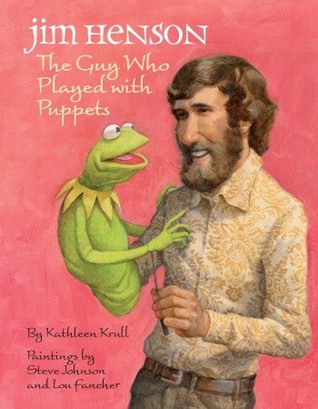
Jim Henson: The Guy Who Played with Puppets
Author: Kathleen Krull
Paintings by: Steve Johnson and Lou Fancher
Published August 23rd, 2011 by Random House Books for Young Readers

Goodreads Summary: Sesame Street and The Muppet Show introduced Jim Henson’s Muppets to the world, making Kermit the Frog, Oscar the Grouch, and Big Bird household names. But even as a child in rural Mississippi, listening to the radio and putting on comedy shows for his family, Jim recognized the power of laughter to bring people together. On Sesame Street, Jim’s Muppets transformed children’s television by making learning fun for kids everywhere. A visionary, Jim always believed that puppets could reach a wider audience. In 1976, he proved it, drawing millions of family viewers to The Muppet Show. With his feature film The Dark Crystal and his Star Wars characters—including Yoda—Jim continued to push the boundaries of what was possible in puppetry until his death in 1990 at the age of 53.

Kathleen Krull, recipient of the Children’s Book Guild 2011 Non-fiction Award and many other accolades, once again does what she does so well—illuminating the life of an important figure in history, art, and culture with her informative but approachable writing style.

Review: I love Jim Henson. I remember when he passed away and I was devastated. I thought that Sesame Street was dead too, but Jim Henson’s influence is stronger than death. He has continued to live through his show, characters, and legacy. Kathleen Krull does an amazing job of sharing with the reader what made Jim Henson who he was and how he became (I believe) the most influential person when it came to children and children’s entertainment in the 20th century.

Teacher’s Tools For Navigation: Jim’s story is a great story to tell children, because like many successful creative persons, he was passionate and went for what he enjoyed, was good at, and was his passion. Jim also will be someone that many students will connect with as he was quiet, smart, not athletic, in school plays, a reader, a story teller, and fascinated with TV.  There are more students like Jim than unlike him and they need to hear about those like them who were successful.

This book would also be a great way to incorporate the CCSS’s diverse media and formats by showing clips of Jim Henson’s work as they are discussed in the book. For example, Jim got his very own TV show when he was in college, Sam and Friends, and clips of this show are on You Tube.

Discussion Questions: How has television changed since Jim Henson got his first TV?; How did not listening to what others thought influence Jim Henson’s decisions in life? If he listened to others, what would be different?

We Flagged: “Puppets struck some people as babyish, but Jim really wanted to go on TV. Now! He checked out books from the library and joined his high school’s puppet club as a way to learn how to make them.” (p. 16)

“He practiced for hours in front of a mirror, trying to get his puppets’ movements and expressions just right, voicing silly and witty thoughts he normally kept to himself.” (p. 18)

Read This If You Loved: Before You Leap by Kermit the Frog, Who Was Jim Henson? by Joan Holub, On A Beam of Light: A Story of Albert Einstein by Jennifer Berne, The Fantastic Undersea Life of Jacques Cousteau by Dan Yaccarino, Lost Boy: The Story of the Man Who Created Peter Pan by Jane Yolen, Sandy’s Circus: A Story about Alexander Calder by Tanya Lee Stone

Recommended For: 

classroomlibrarybuttonsmall readaloudbuttonsmall

Signature

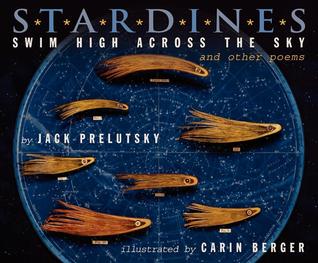
Stardines Swim High Across the Sky and Other Poems by Jack Prelutsky

Share

NF PB 2013

Nonfiction Picture Book Wednesday

Nonfiction Picture Book Wednesday is hosted by Kid Lit Frenzy and was started to help promote the reading of nonfiction texts. Most Wednesdays, we will be participating and will review a nonfiction text (though it may not always be a picture book). Be sure to visit Kid Lit Frenzy and see what other nonfiction books are shared this week!


stardines

Stardines Swim High Across the Sky and Other Poems
Author: Jack Prelutsky
Illustrator: Carin Berger
Published February 26th, 2013 by Greenwillow Books

Summary: Jack Prelutsky combines inanimate objects with animals to give us a new collection of fun poetry that is accompanied by Carin Berger’s amazing fine artwork.

My Review: I love the concept behind this book. It is set up like an informational nonfiction book with each poem being presented like a specimen. Carin Berger’s artwork is full of found objects that were photographed to add to the nonfiction feeling of each poem.   And, of course, Prelutsky adds a sense of humor to each poem as that is what he does.

The creatures that Prelutsky came up with are so clever – SOBCATS who are sad cats, JOLLYFISH who are happy jellyfish, TATTLESNAKE are snakes that won’t stop tattling, and GLOOSE are a bird that keep sticking to everything. And these are just four examples of sixteen in the book.

I cannot review this book without talking about the artwork. I originally chose this book because I saw it on a Mock Caldecott list and I can definitely see why. Carin Berger illustrates this novel with beautiful pieces of artwork. As stated on the copyright page: “The miniature dioramas in this book are assemblages created using a combination of cut paper, found ephemera, vintage engravings (which were scanned, manipulated in Photoshop, and then printed out), beeswax, wire, thread, and wood. Once each piece was made, it was then photographed digitally to prepare the full-color art.” What a fantastic process to discuss with students and it definitely added an essential aspect to the book.

Teacher’s Tools for Navigation: Each poem is its own discussion starter. First, to separate the title creatures into the two words that were combined and looking at what the animals is and what the word is that it was combined with. For example: “Chormorants” is a combination of CORMORANT and CHORES. Then I’d look through the poem and find where the animal is represented and where the combined word plays a role. And on top of that, each poem can be looked at as a poem and look for poetic elements within it.  Each poem is a stand-alone, well done poem that is sure to start a conversation.

Discussion Questions: Which poem is your favorite? Why?; Combine an animal with a word and write a poem about this new creature.; How do you think Berger’s artwork added to the book? How would cartoon illustrations have made the book different?

We Flagged: Every poem is a gem, but this is my favorite-

“PLANDAS sit around all day,
Planning what to do.
Their plans amount to nothing,
For they never see them through.
They plan to run a marathon
Or take a railroad trip.
They plan to cross the ocean
On a wooden sailing ship.
***
They plan to learn to roller-skate,
To juggle, and to fence.
They plan to go to clown school
And cavort in circus tents.
They plan to play the saxophone
And form their own brass bands. . . .
But PLANDAS never do these things –
They just keep making plans.” (p. 21)

Read This If You Loved: Behold the Bold Umbrellaphant by Jack Prelutsky, My Teacher Likes to Say by Denise Brennan-Nelson,  Lemonade by Bob Raczka

Recommended For:

closereadinganalysisbuttonsmall readaloudbuttonsmall classroomlibrarybuttonsmall

Signature