Author Guest Post: “Co-Authoring a Novel” by Amie Kaufman & Meagan Spooner, Authors of Lady’s Knight

Share

“Co-Authoring a Novel”

The number one question that we get asked when we do book events is: how do you co-author a novel?

Even now, over a decade since our first co-authored novel hit the shelves, we find ourselves a little baffled by the ubiquitousness of that question. We get asked it at every event, in every interview, whether we’re talking about a co-authored book or one we’ve written solo. For us, writing together comes so naturally that we find the fascination with the process a bit confusing. At first, we even struggled to answer reader questions on that front because we couldn’t quite figure out why people kept asking us that question.

“But what happens when you disagree?” asked one reader, insistent. “Which one of you has the final say?”

We just eyed each other across the signing table, realizing that we had no answer for that. We never disagree.

To those of you now reading on with some skepticism: yeah, you’re not wrong. Of course we disagree, but the point is we never disagree in ways that put us on opposite sides of an issue. We actually learned very early on in writing our first book together that if we disagreed about what should happen next in our story, or what a character would say, or how the relationship arc would go, what was actually happening was that we were both wrong. Or, rather, we were both right—but going about listening to our instincts the wrong way. Amie thinks it has to be A, Meg thinks it’s obvious that it should be B – what’s really going on is that we’ve both missed the fact that the right answer is really the hidden, secret option C.

For instance, Amie might think the next scene ought to be full of action, but Meg thinks it ought to be a romantic scene. It’s not because one of us is wrong and one of us is right, it’s because actually what we’re picking up on is that neither of us has the perfect next scene. So we talk about why Amie feels the need for a fight scene—we need to see the characters showing off their strengths, perhaps—and why Meg feels more pulled toward romance—because we need to see the characters becoming closer, and cementing their bond. And it turns out that the perfect scene for both those things is actually a scene where they confront an obstacle together in a way that binds them and shows them being good at what they do.

Writing with a partner in a full, 50/50 split of the responsibilities requires the ability to set aside ego in favor of the book. It took us many years to figure out why this seemed to come naturally when it struck so many others, usually budding artists and young writers themselves, as strange. “I could never do that,” we keep hearing from readers. “Give up control that way!” But the truth is that any good, healthy relationship between friends (or anyone, really) demands that you value the strength of your connection over whatever project you might be embarking upon. From the very beginning, we always said that if writing together ever started threatening our friendship, we would simply stop. The friendship mattered most.

When we began writing Lady’s Knight, Amie suggested that we try a new way of outlining the book. Meg was a bit resistant to it, because that’s not how we’d worked before, and it wasn’t what came naturally to her, but we gave it a go and it turned out to be the perfect way of approaching this book. With the plot largely decided upon in advance, it meant that we could pour ourselves into the joyful anachronistic world-building, witty dialogue, and pretty much every joke we’ve ever wanted to put into a book we were writing.

Each book is a little different in terms of how we go about writing it, but Lady’s Knight was an exercise in joy and healing from the very beginning. Conceived of during the height of the pandemic, when we were all confined to our homes and wondering how many years it would be before we could see our loved ones in person again, this book just became our happy place. We’d call each other from opposite sides of the planet, bursting with ideas and jokes, laughing and writing them down as fast as we could.

We wrote about a girl who dreams of being a knight, and a noblewoman who finds herself put up as the prize for a tournament—and rather than waiting for someone to save her, she decides to engineer her own salvation. Each of the girls learn a lot about themselves, during the adventure that ensues. We learned a lot about ourselves, writing them.

We wrote this book to delight each other—whether it was breakfast on the balcony with plates of delicious pastries, a makeover scene with incredible fashion, a breathless rush through the castle after a falling-out, or the satisfaction of skewering a sexist old man (only verbally, don’t worry), we always came back to what we loved. We told a story from our hearts, and in pursuit of joy.

There’s a beautiful merging of egos, when you write something with someone you deeply trust, and even though this was our eighth book together, there was still a special kind of magic as we watched all our ideas merge into a very special “secret option C.” This book ended up being the best of both of us, and a love letter to our friendship, and it was such fun to write.

Published June 3rd, 2025 by Storytide

About the Book: An undeniably fierce, unforgettably funny, unapologetically queer feminist romp through the England of medieval legend. Bestselling and acclaimed authors Amie Kaufman and Meagan Spooner bring readers along on an epic quest for valor, freedom, and, above all, love. A Knight’s Tale meets the Lady Jane series, with a dash of The Great!

Gwen is sick of hiding—hiding the fact that she’s taken over her father’s blacksmithing duties, hiding her attraction to girls, hiding her yearning for glory as a knight.

Meanwhile, Lady Isobelle of Avington, queen bee of the castle, has never once considered hiding who she is—until now. She’s been chosen as the grand prize in the Tournament of Dragonslayers, to be given to whichever knight can claim her hand. And for the first time in her life, she can’t talk her way out of trouble.

When Isobelle discovers Gwen’s knightly ambitions, they hatch a scheme together—Gwen will joust in the tournament, disguised as Sir Gawain. Winning means freedom for Isobelle, and glory for Gwen. Losing means… well, let’s not go there.

One thing’s for sure: Falling in love was never the plan.

But the best laid plans…are often trampled all over by dragons.

About the Authors: Amie Kaufman is a New York Times and international bestselling author of young adult and middle grade fiction and the host of the podcast Amie Kaufman on Writing. Her multi-award-winning work is slated for publication in over thirty countries and has been described as “a game-changer” (Shelf Awareness), “stylistically mesmerizing” (Publishers Weekly), and “out-of-this-world awesome” (Kirkus Reviews). Her series include the Illuminae Files, the Aurora Cycle, the Other Side of the Sky duology, the Starbound trilogythe Unearthed duology, the Elementalstrilogy, and The World Between Blinks. Her work is in development for film and TV and has taken home multiple Aurealis Awards, an ABIA, and a Gold Inky, made multiple best-of lists, and been shortlisted for the Prime Minister’s Literary Awards. Raised in Australia and occasionally Ireland, Amie has degrees in history, literature, law, and conflict resolution and is currently undertaking a PhD in creative writing. She lives in Melbourne with her husband, daughter, rescue dog, and an extremely large personal library. Learn more about her and subscribe to her newsletter at amiekaufman.com.

New York Times bestselling author Meagan Spooner grew up reading and writing every spare moment of the day while dreaming about life as an archaeologist, a marine biologist, or an astronaut. She graduated from Hamilton College in New York State with a degree in playwriting. She’s traveled all over the world, to places such as Egypt, Australia, South Africa, the Arctic, Greece, Antarctica, and the Galápagos Islands, and there’s a bit of every trip in every story she writes. She currently lives and writes in Asheville, North Carolina, but the siren call of travel is hard to resist, and there’s no telling how long she’ll stay there. She’s the author of Hunted and Sherwood and the coauthor of the award-winning Starbound Trilogy (These Broken StarsThis Shattered World, Their Fractured Light) and the Skylark Trilogy (Skylark, Shadowlark, Lark Ascending). In her spare time she plays guitar, plays video games, plays with her cat, and reads. meaganspooner.com

Thank you, Amie & Meagan, for sharing your process!

Student Voices: George O’Connor’s Visit to Kellee’s Middle School

Share

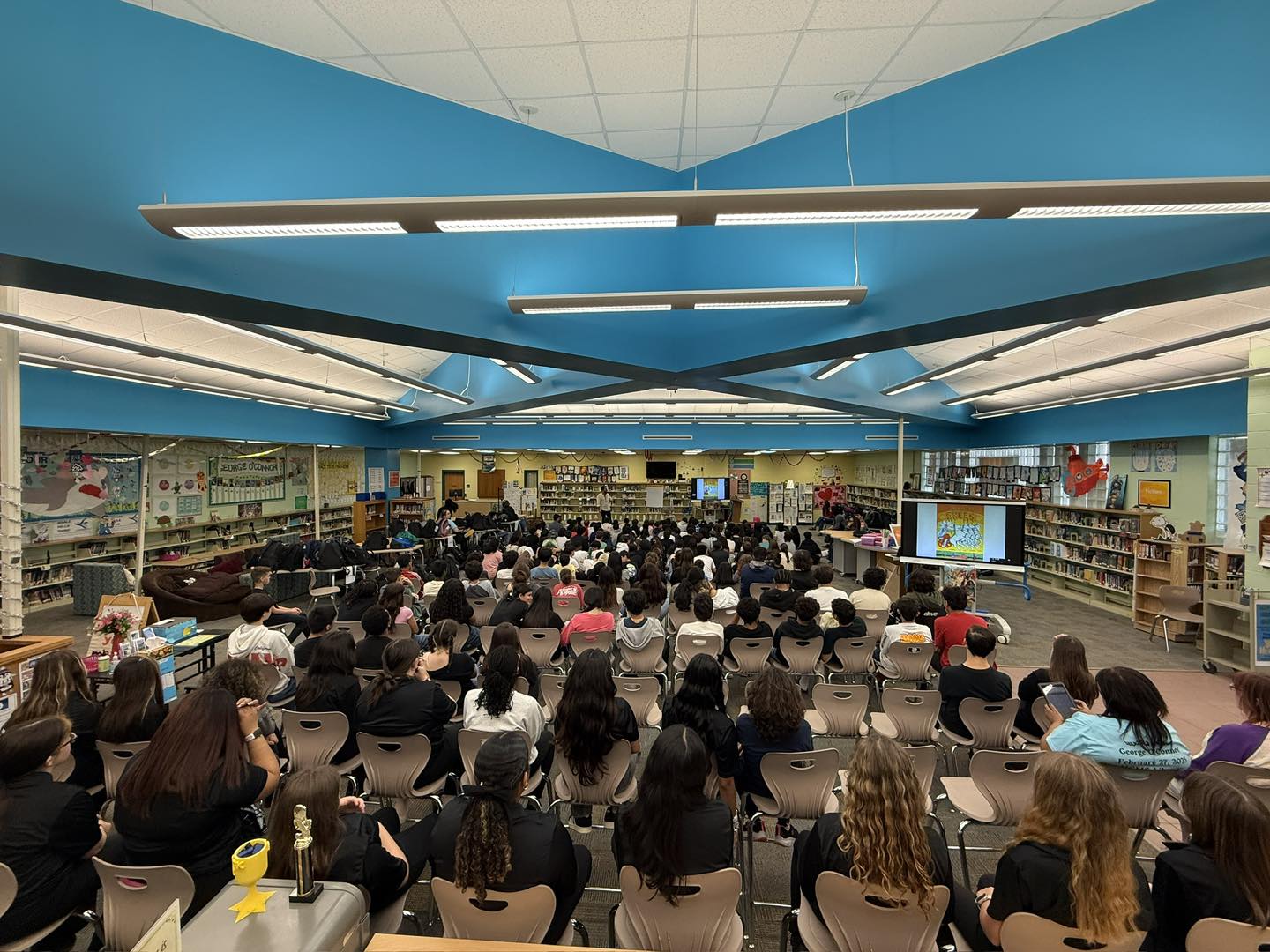
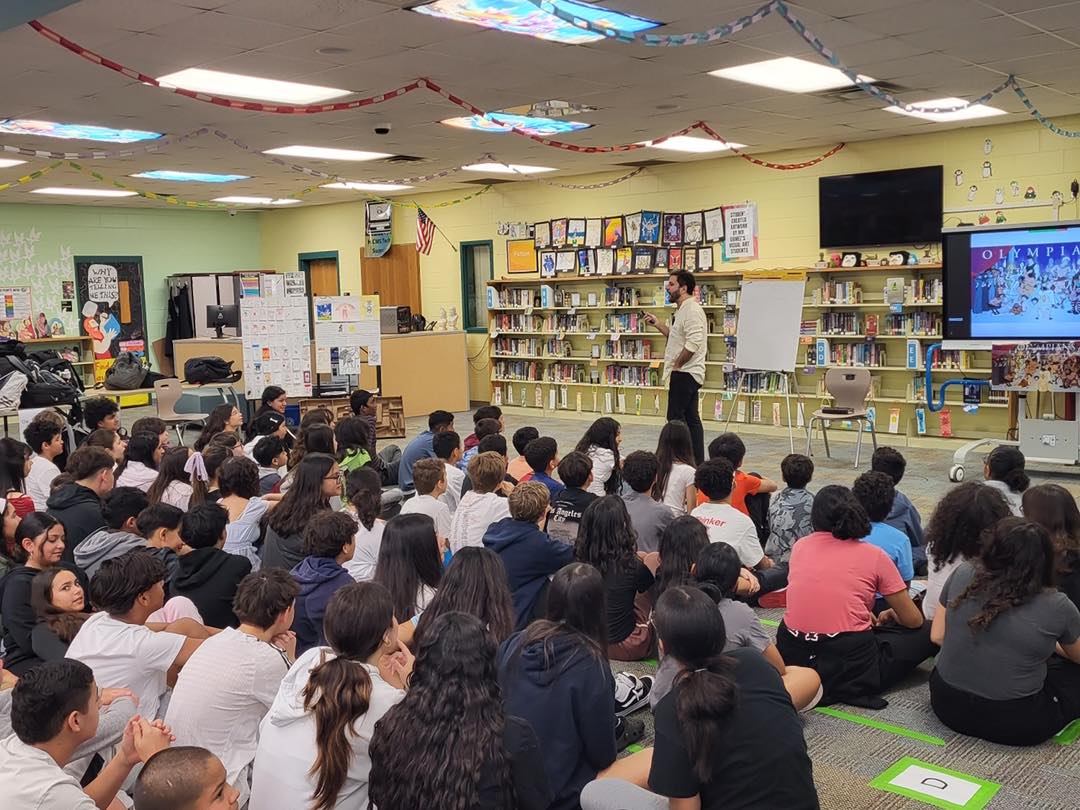
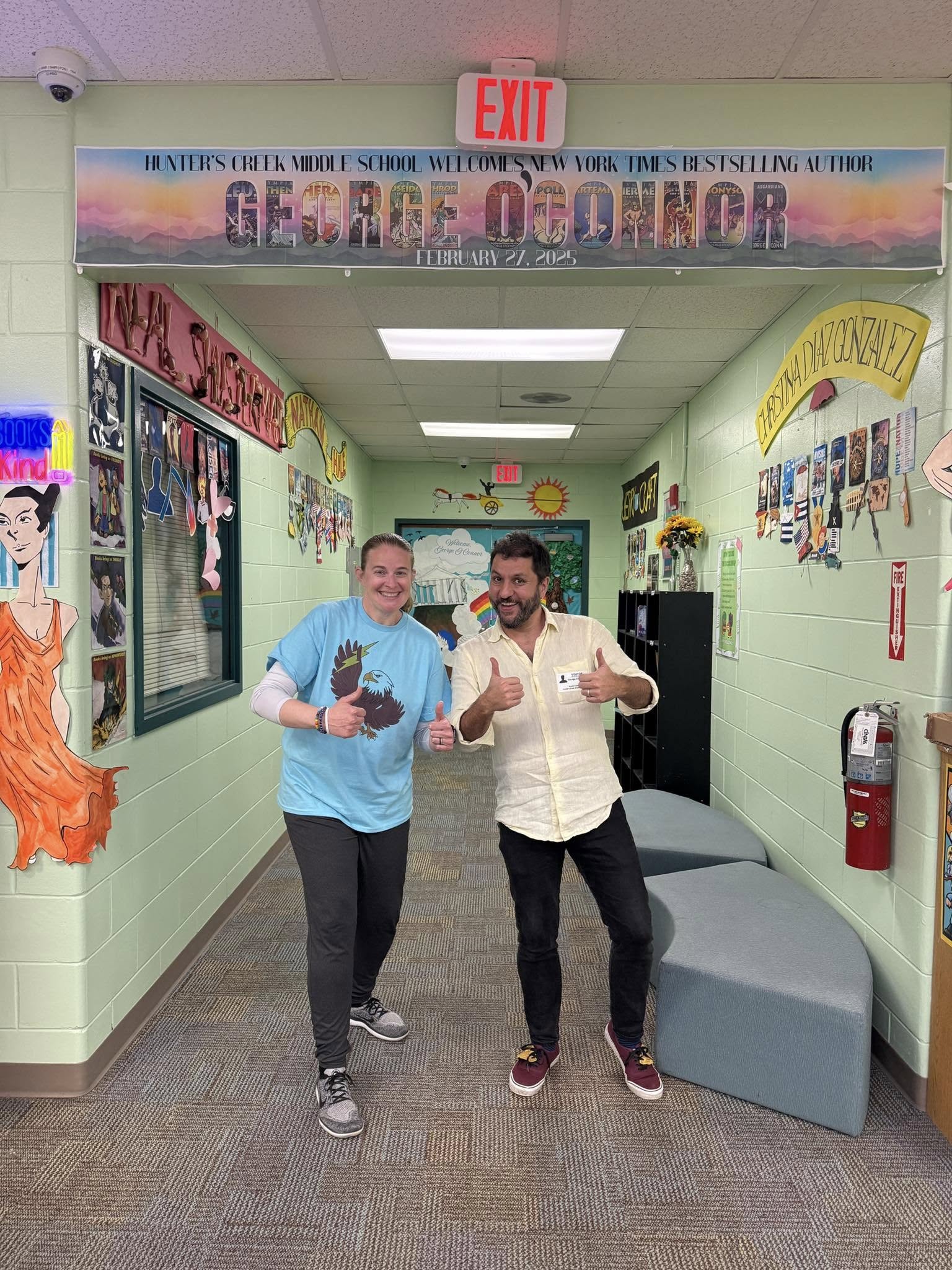
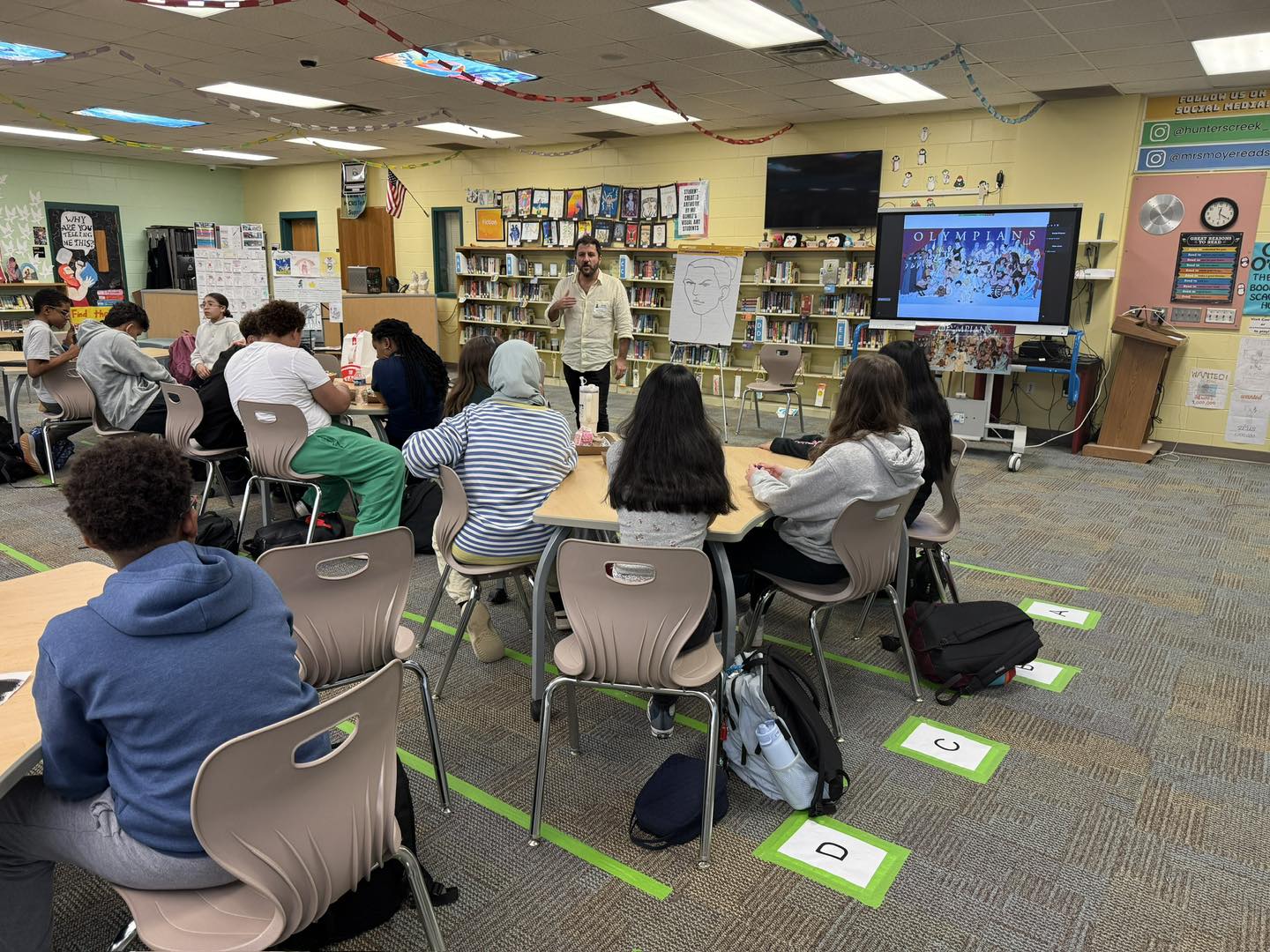
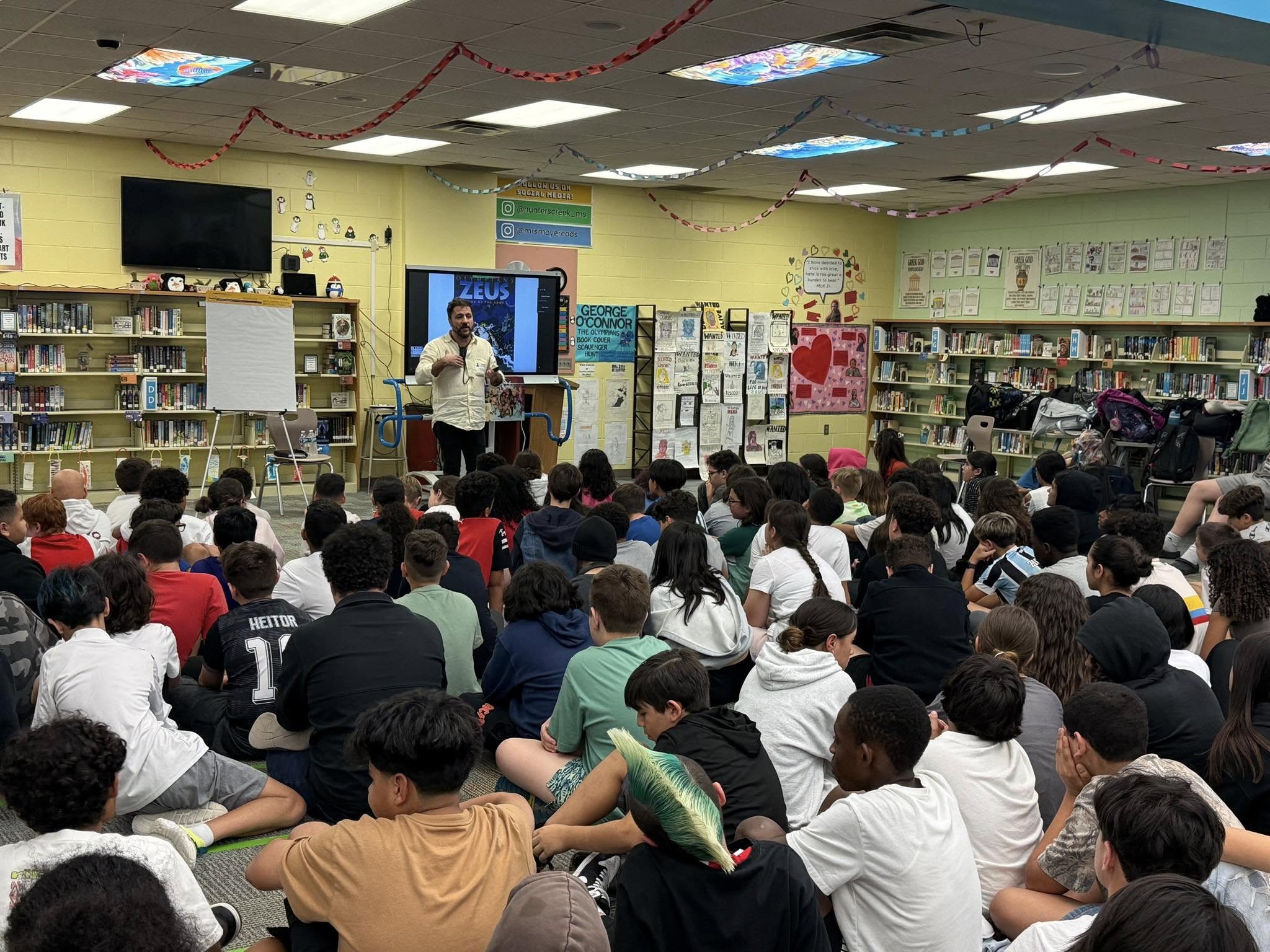
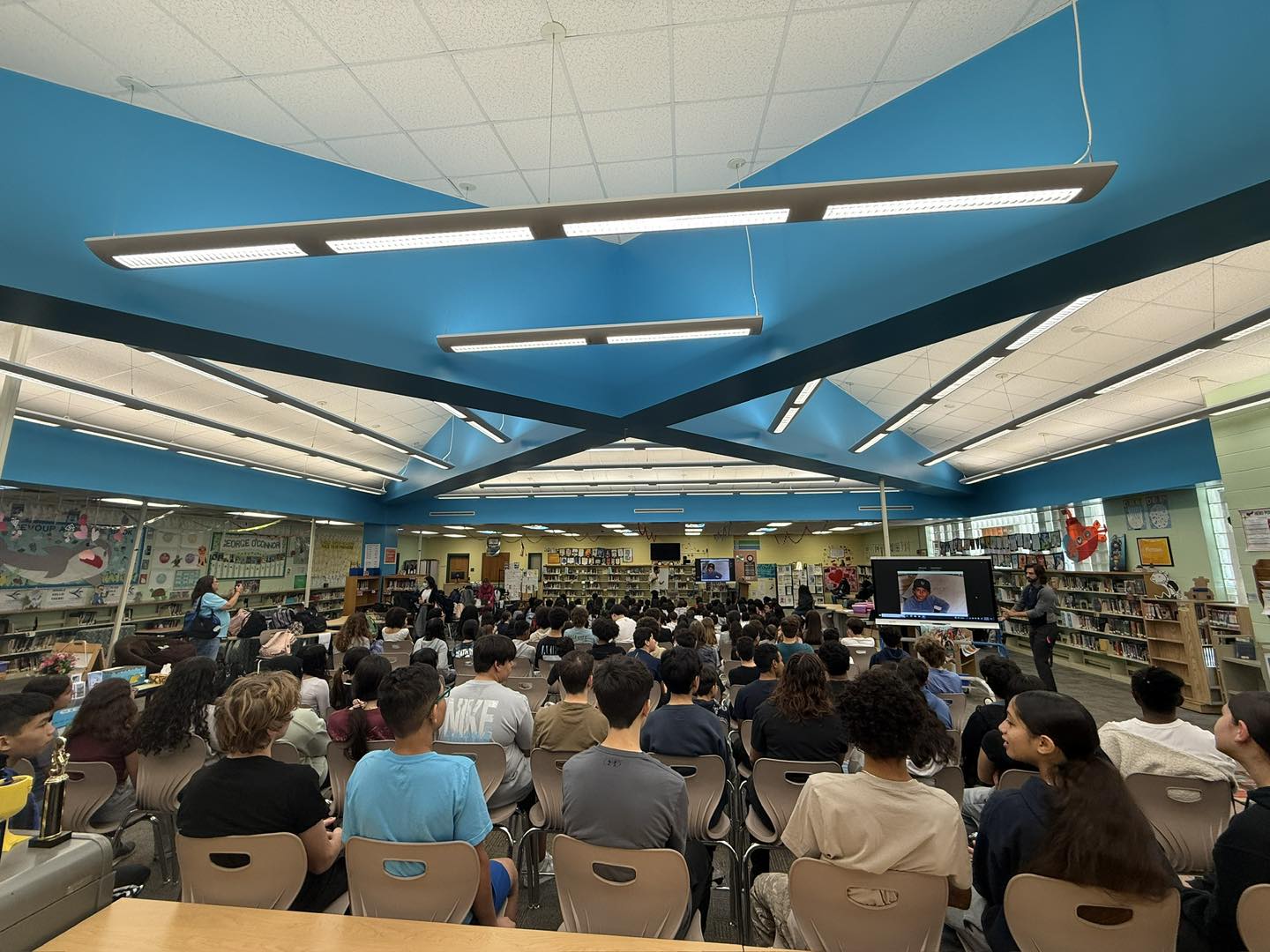
I am so lucky because my principal began an initiative at my school where we get to have an author visit our school yearly (2024: Jerry Craft, 2023: Christina Diaz Gonzalez, 2022: Nathan Hale, 2020: Neal Shusterman, 2019: Jennifer A. Nielsen). The author sees all students in the school, so it is a great community literacy event for my school, and I love being able to bring this experience to all of my students each year!


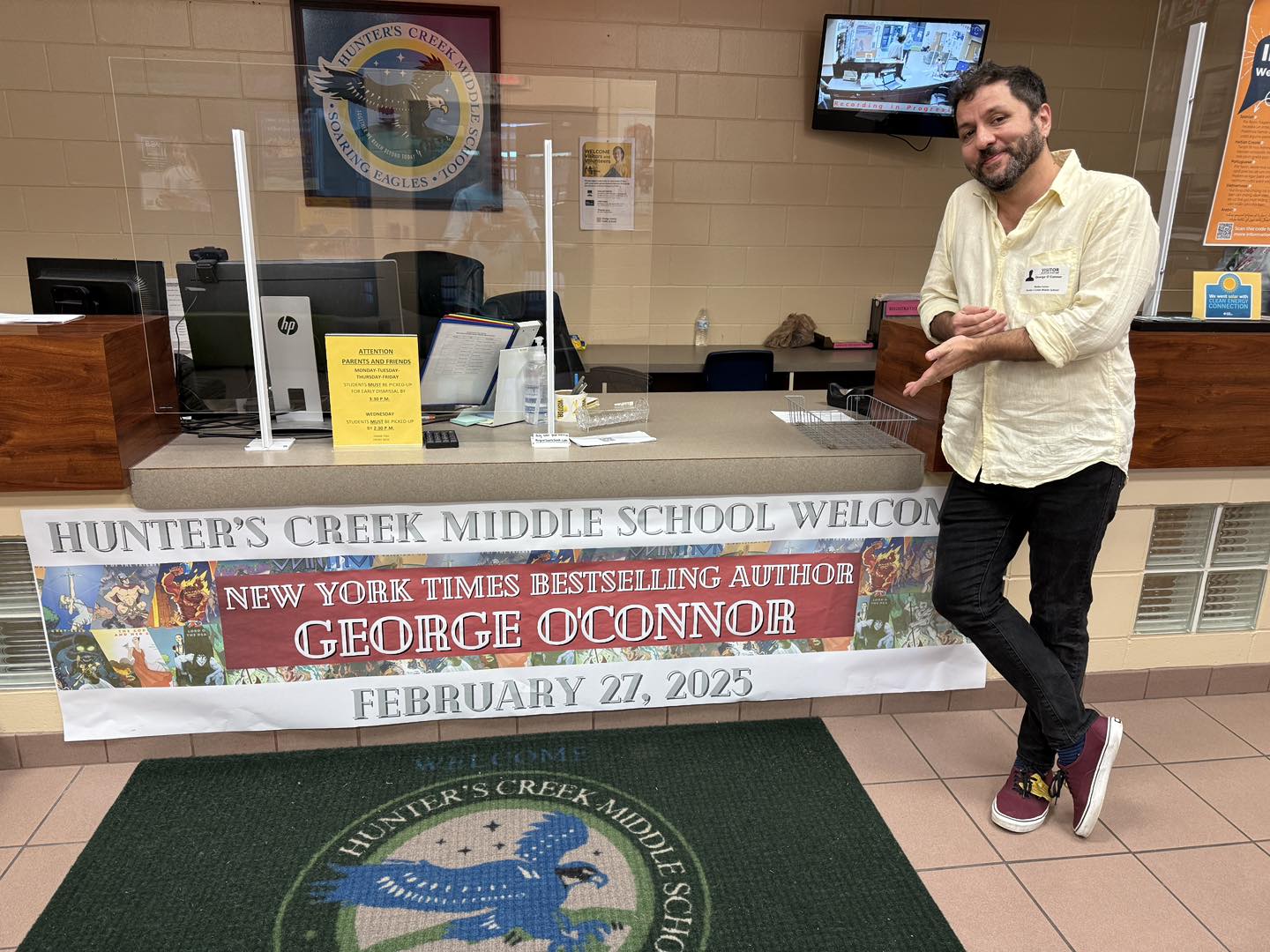
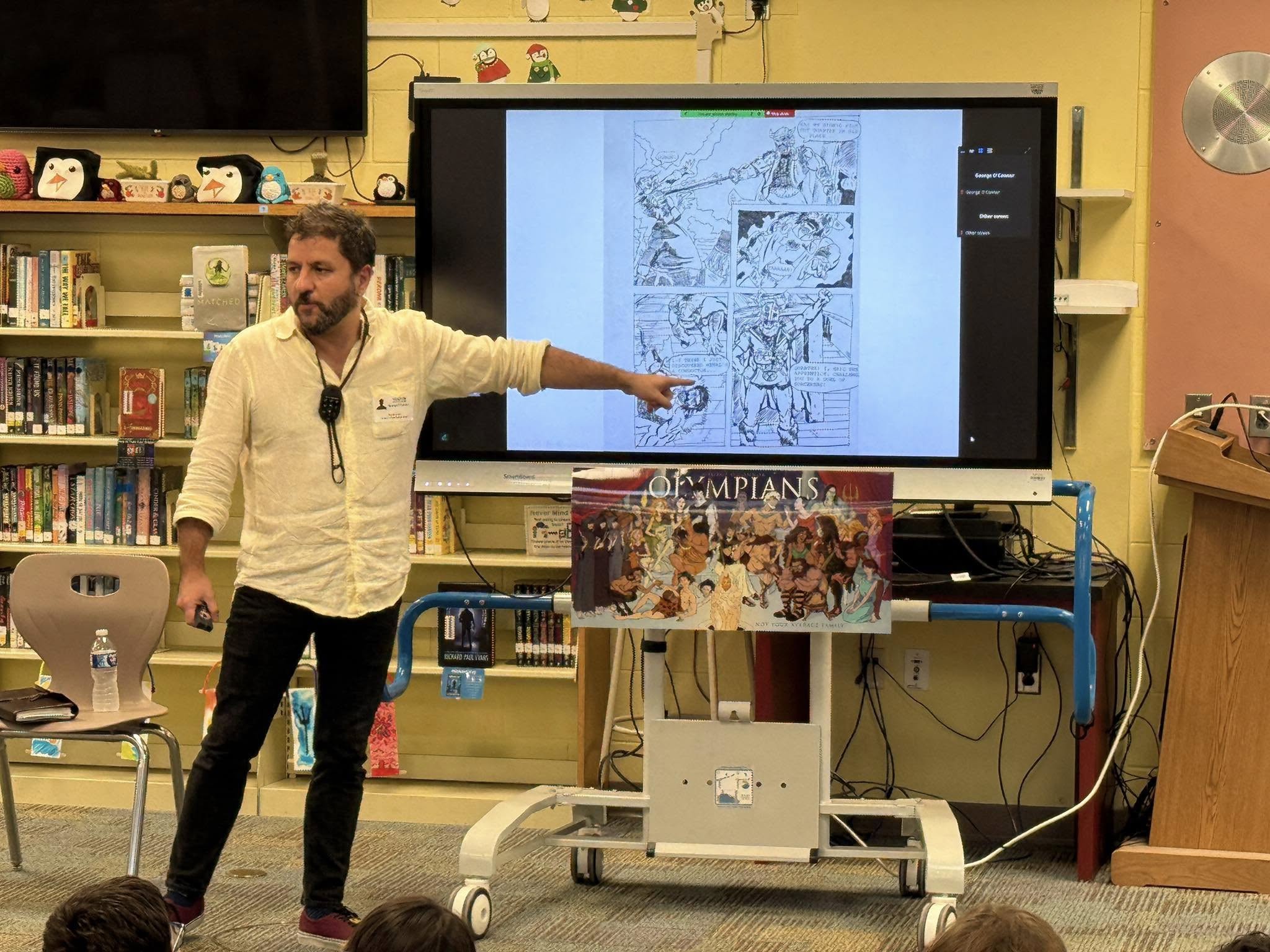
This year, we hosted New York Times Best-selling Author George O’Connor!

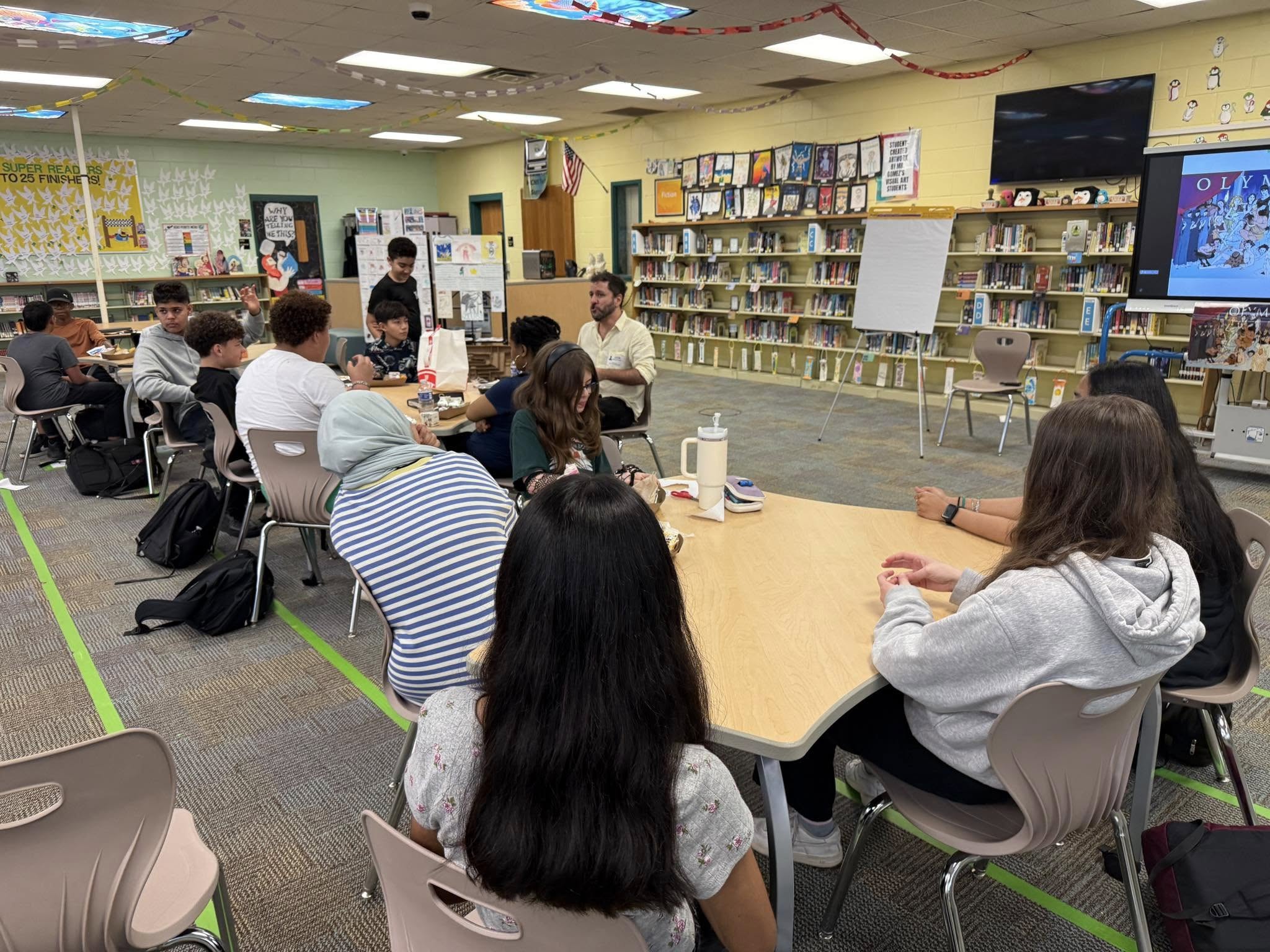
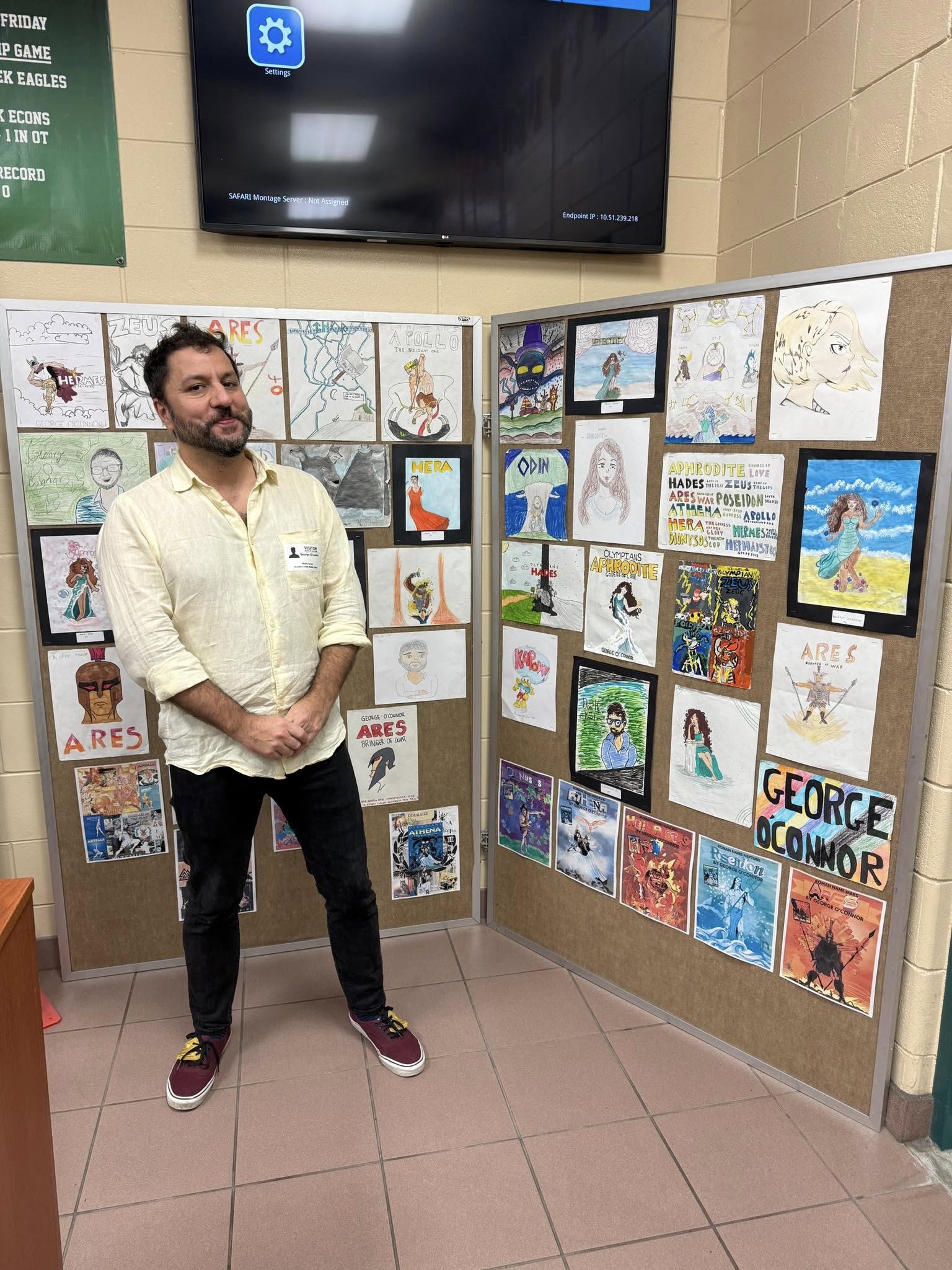
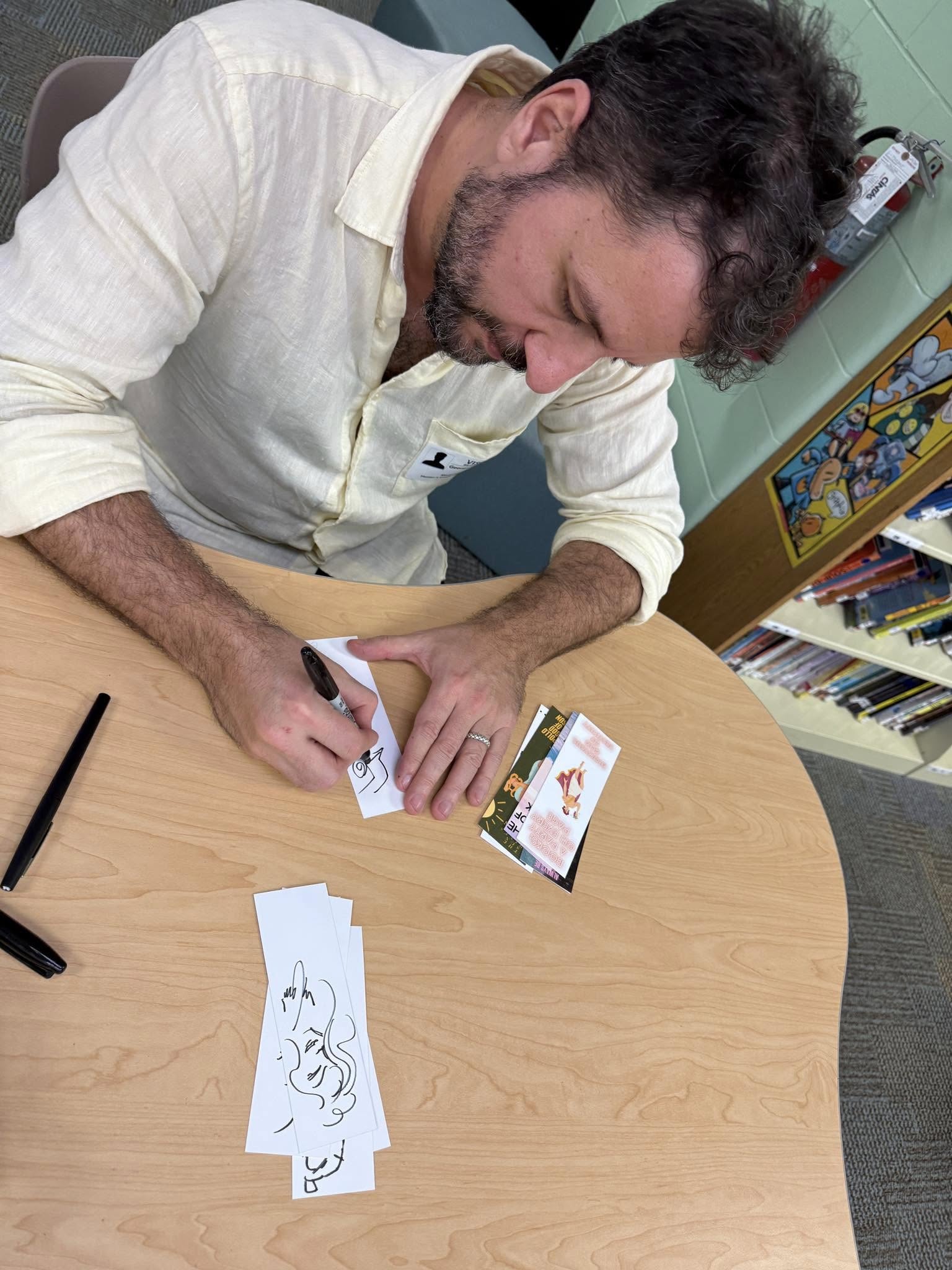
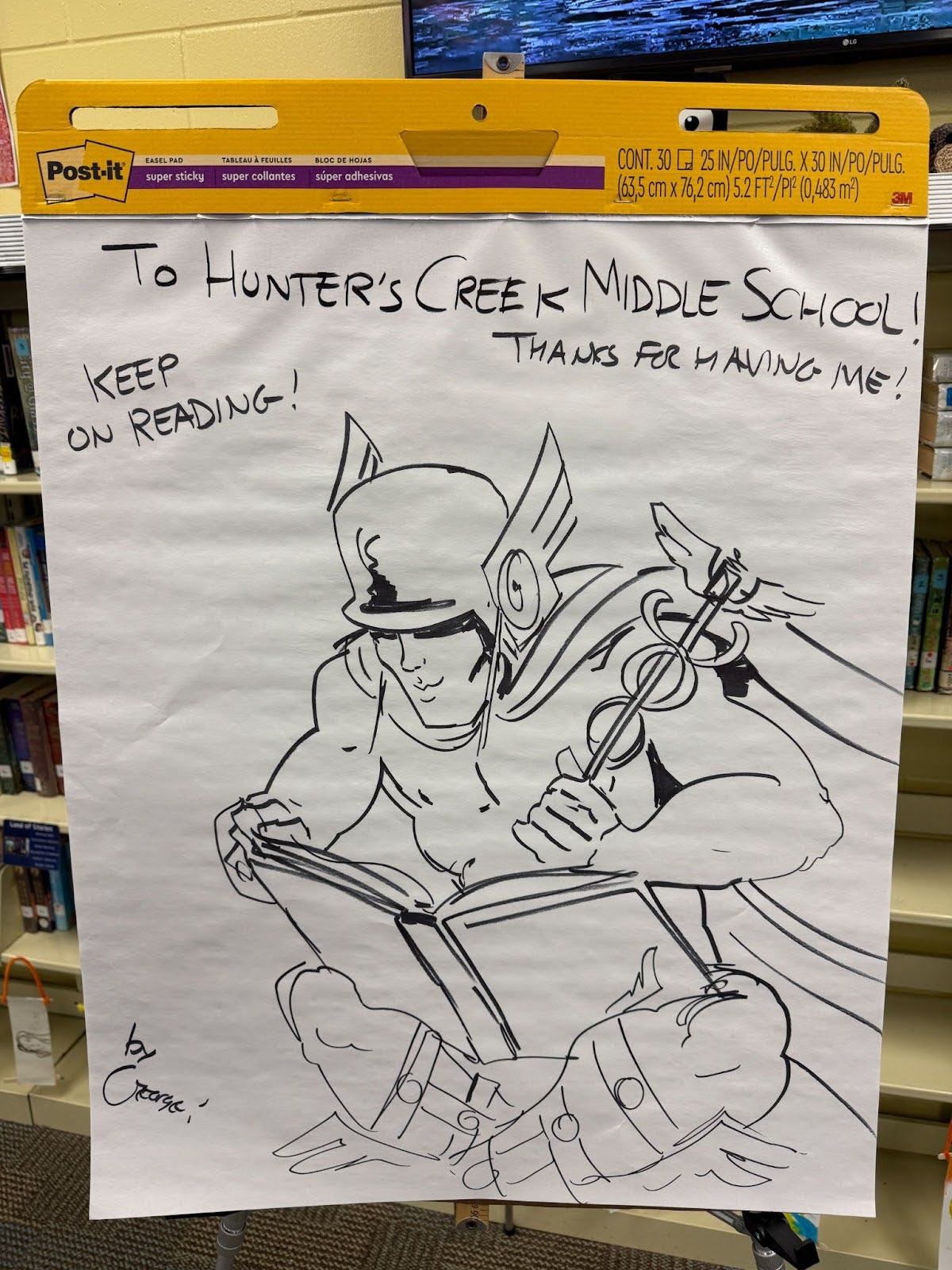
We are so thankful to George O’Connor for being with us all day. Not only did he present to over 1,000 students, he did a signing time for any student who wanted his autograph; he did an author lunch with students who read over 6 of his books; he stayed after school to draw us a special image, finish signing anything left to sign, including bookmarks for each of our Olympians Community Night finishers (our literacy night that we hosted 2 days before his visit), and take pictures with the library team. It  was phenomenal!

Here are some reflections from my students after the visit. I asked them to think about what they learned, what they enjoyed, how they were impacted, or anything else they wanted to share:

  • I really liked the day. It was a fun experience learning about him and how he became an author.
  • I really liked the day! Meeting the author was exciting, and their presentation was inspiring. The workshop helped me think creatively, and I enjoyed sharing ideas with my classmates. It was a great experience that made me love reading and writing even more!
  • I liked it. George O’ Conner was funny and I liked how he gave a description of the god’s story.
  • I really like how the authors show the process of how they make the books that we read everyday
  • he said that we shouldn’t try to erase our mistakes and try to learn from them
  • George O’Connor taught me that you have to keep trying for your dreams because he got rejected from a job at marvel but eventually got it.
  • My biggest takeaway is that nobody is perfect, and it takes a while to get where you want to be.
  • My biggest take away from George O’Connor’s visit is that it’s ok to make mistakes. He talks about even as an adult, and artists, he still regularly makes mistakes, and going over how it is ok to do so was so refreshing to hear in a world where people are so often afraid to be anything but perfect. Really motivating and inspiring!
  • My biggest take away was when he told us that he started drawing at such a young age and has always had a passion for the Olympian books he has written.
  • An author visit is important because it inspires us to read and write. Meeting a real author shows us that we can be writers too! They share their stories and challenges, which motivates us to keep trying. It makes reading more fun and exciting, helping us appreciate our own creativity!
  • This visit was very important because these author visits can really help people get inspired and help them not doubt themselves.
  • This visit was important because it made me understand how George O’Connor made his books and his journey in general. It’s important and powerful to have an author visit our school because it gives us a chance to learn from people who have experience in actually making a book.

  • His advice about drawing about not being perfect was a HUGE takeaway for me.
  • My biggest take away was that nobody is perfect because I draw a lot and I make mistakes and I learned that it is okay to.
  • My biggest take away from this visit was that our changing moment in life can happen wherever and whenever.
  • My biggest takeaway was that your imagination can take you anywhere in life.
  • That it takes a long time to do things perfectly and to achieve something you are want so you have to be patience
  • George O’ Connor taught me some very valuable life lessons and made the presentation funny.
  • It impacted me because it allowed me to learn more about the writing and illustrating process, something which I didn’t know much about before.
  • It helped me understand better on how the author makes his books and connect to the author better which was good.
  • I learned some new stuff about Greek mythology that I didn’t know before.
  • It helped me understand the whole journey to become an author.
  • It’s important to have authors visit our school because it could help people who want to be authors in the future. It could also help someone find a new favorite book or series.
  • It is important and powerful to have an author visit the school in order to inspire kids to read more books and make the author more relatable and real, which I think could also encourage kids to pick up books and start reading more.
  • This visit was important because he first off is a New York Times best author which is crazy to think that he actually came to our school and that some people really like mythology books and George O’Connor is the best author for that.
  • Author visits are important because it can encourage people to read and for people who want to become authors to learn from them.
  • I think that it’s important and powerful to have an author visit our school because they can help give us advice and tell their story to people who enjoyed reading their books.

  • It was very impactful since I got to see the POV of an author’s life and how he draws!
  • This visit impacted me because it let me learn that even New York Best Time Selling authors make mistakes and learn from them to help them grow as a person and author.
  • The visit impacted me by showing me how much work goes into these books.
  • The visit really inspired me! Hearing the author share their journey made me want to write my own stories. Learning about their creative process showed me that it’s okay to struggle sometimes. The interactive workshop was fun and helped me think more creatively. Overall, it made me excited about reading and writing!
  • I thought it was really cool as his upbringing as an author and it is really motivating.
  • Having a yearly visit means getting to learn about the lives of authors, how they got to where they are, and what inspires them. This. in turn, inspires me to stay motivated and chase my dreams no matter what goes wrong.
  • Yearly author visits mean a lot to not just me but I bet to so many others too because its so cool getting to have a well known author come to our school and tell us their story and their perspective of their own books they wrote.
  • Author visits let me meet “famous people” that other people don’t get to meet and I get to meet the authors of the books that I love.
  • Having a visiting author yearly is something that excites me and is something for me to look forward to.
  • Having a visiting author yearly makes me read more books that I might not have read if it wasn’t for the author visit.
  • Yearly author visits mean that kids get to explore different genres and books. Like I did not know who George O’Connor was and I had never read his books but then I read them and now I love them.
  • Having an author yearly means a lot to me because they are really inspiring.
  • Author visits mean a lot to me because it shows that our school and staff want to put together something fun for us and that they care, Gorge O’Connor also took time out of his day to come see us.
  • Author visits educate children; it always makes them more tempted to read more and learn about the author. Also the author can teach us valuable things.
  • This visit was important because it helped us see and talk to George O’ Connor in-person, it also helped us learn more about Greek Mythology. It is important and powerful to have an author visit our school because it helps us talk or see our favorite authors and learn more about them. In addition, it also gives us a small break from school.

Another teacher also shared her students’ responses to “What I liked the best was…”

  • the way he explained his book and the way he drew ZEUS in 28 seconds; how he is able to make a small period of time into something really cool; When he showed his drawings/drawing fast
  • Book signings and pictures with him after school; seeing him at lunch; really enjoyed when I met him because he was really nice and caring
  • When he said that nobody is perfect and we can all make mistakes, that was really nice of him; 
  • My favorite moment from the author’s visit was when he told us the lesson which was like don’t be afraid to make mistakes and fail
  • How he used the errors without being scared
  • Funny stories; when he was making us laugh
  • I love this part because he explains books and explains how he did it. That’s why I love it.

As you can see from the comments and love, my students and I would highly recommend George for a school visit!

Signature

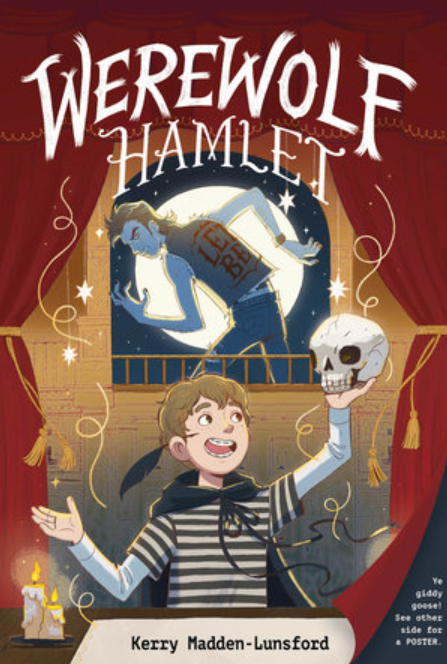
Werewolf Hamlet by Kerry Madden-Lunsford

Share

Werewolf Hamlet
Author: Kerry Madden-Lunsford
Published February 18th, 2025 by Charlesbridge Moves

Summary: Humor, heart, and Shakespeare abound in this middle-grade novel about Angus, a 10-year-old theater fanatic, his struggling family, and his changing relationship with big brother Liam.

Perfect for fans of books that handle difficult subjects and family dynamics in a sensitive way, like Better Nate Than Ever and Rule of Threes.

10-year-old Angus is unique. He quotes Shakespeare and wants to stage a Werewolf Hamlet play for his 5th grade legacy project. Angus’s 17-year-old brother, Liam, is like a werewolf now—Angus never knows if he’ll be nice or mean or when he’ll sneak out to get drunk or worse.

Meanwhile, tension continues to build for Liam’s family in Los Angeles. Mom and Dad are going to default on the mortgage. Older sister Hannah is fed up and ready to move herself to Maine, and little sister Sidney doesn’t really get what’s happening. Then Liam goes missing, and Angus decides he has to find him.

A realistic, heartfelt look at the complexities of family relationships and struggles. Along with Angus’s loveable charm, sense of humor, and desire to stage his original play, Werewolf Hamlet is sure to win its audience—on and off the page—over.

“A story that is rich in wise insights.”—Booklist (starred)

About the Author: Kerry Madden-Lunsford has been a regular contributor to the LA Times OpEd page. For several years, she directed the creative writing program at the University of Alabama at Birmingham, where she is still a professor, and she taught in Antioch University’s MFA program in Los Angeles for a decade. She is the author of the picture book Ernestine’s Milky Way. She also wrote the Maggie Valley Trilogy, which includes Gentle’s Holler, Louisiana’s Song, and Jessie’s Mountain. Her book, Up Close Harper Lee, was one Booklist’s Ten Top Biographies for Youth. Her first novel, Offsides, was a New York Public Library Pick for the Teen Age. Kerry is the mother of three adult children, and she now lives full-time in Birmingham, Alabama. Visit her at kerrymadden.com.

Check out Kerry Madden-Lunsford on social!
Bluesky
Threads
Substack

Review: As an educator, I have over the years sadly heard about so many different tough situations that my students were dealing with: being unhoused, divorce, death in the family, mental health struggles, etc. Too often, middle grade books stay away from tough topics because they are “too mature,” but anyone who has worked with middle graders has wished at different times that there was the perfect book to give to students at a certain moment of time but couldn’t find it–this book is going to be the perfect book at one of those times.

What an interesting mix within this book: Shakespeare, classic movies & movie stars, Los Angeles, growing up, foreclosure, runaway, pet wellness, friendship, and more. It seems like a lot, but it just works in this book because all of it is what makes Angus and his story come to life. Parts were hard to read, such as descriptions of Angus’s brother spiraling into addiction; Angus and his friends making more choices to find his brother; Angus’s families financial struggles and eviction; Angus’s dogs illness; and Angus’s struggles at school, but the author does a great job with including enough for emotional response and plot/character development and keeping the story developmentally relevant.

Educators’ Tools for Navigation: The publisher has created an amazing supplemental page for Werewolf Hamlet which will be perfect to use if teaching the book as a whole or if students are reading it in groups or independently! Visit https://www.charlesbridge.com/pages/werewolf-hamlet for resources about:

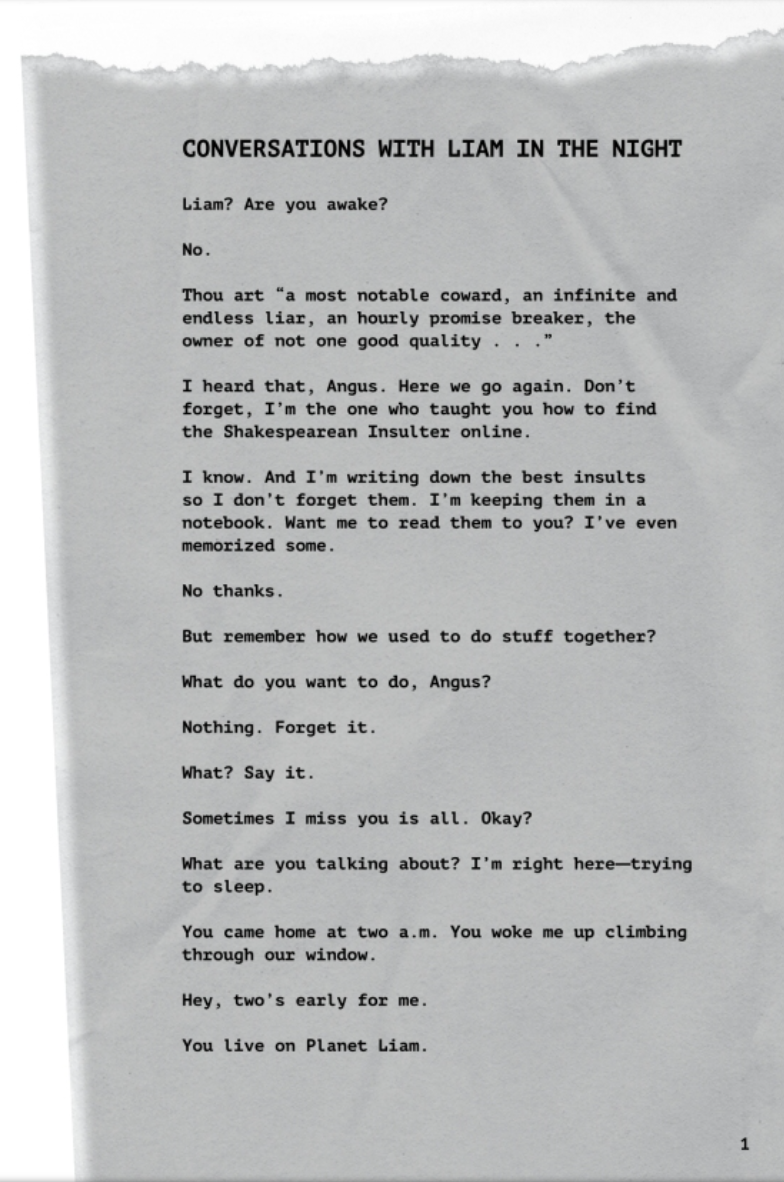
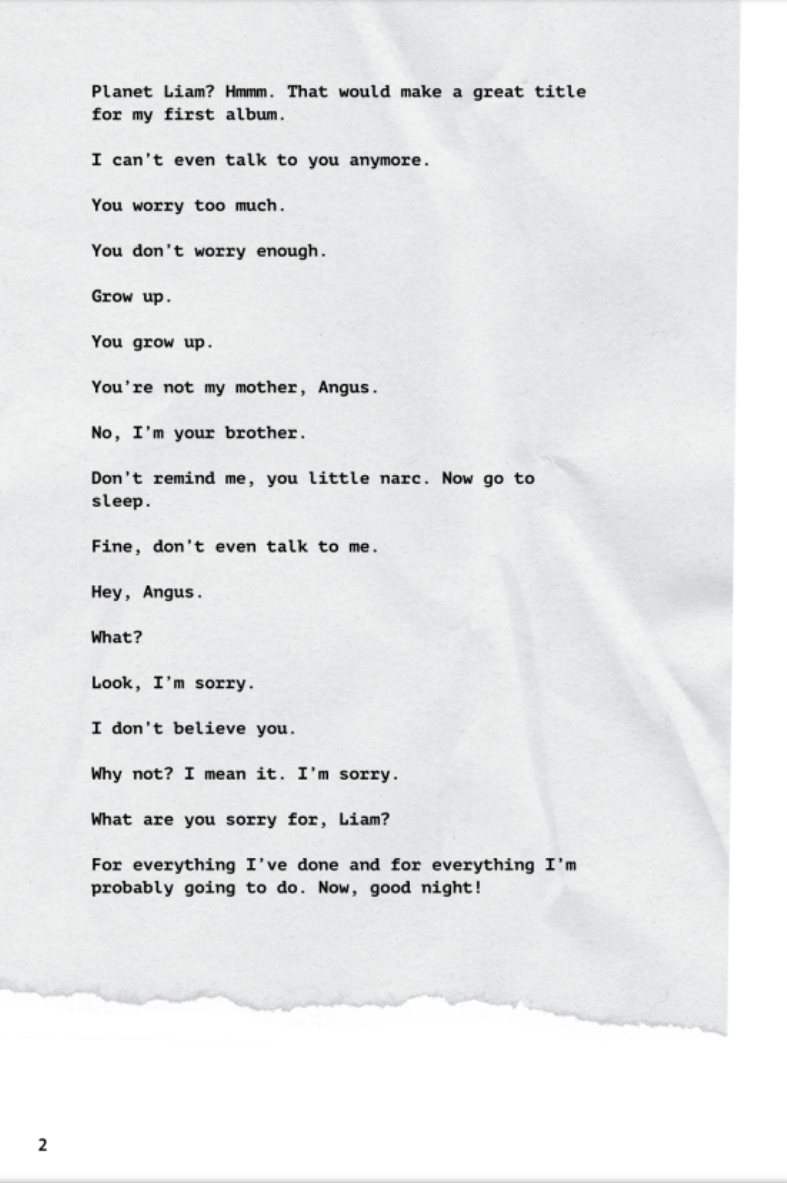
  • Insulting like Shakespeare
  • Geography and landmarks around Los Angeles
  • Classic films
  • Heroes of the silver screen
  • Hamlet

I also think that the book could be a great introduction to one-man plays, and students could take a story and transform it like Angus did with Hamlet.

Discussion Questions: 

There is a Reader’s Group Guide found on the publisher’s resource page, too!

Flagged Passages/Spreads: 

The Tar Feeling

Anybody can forget to wear shoes to school. Well, almost anybody. It’s an innocent mistake. And I didn’t forget my trumpet. Why doesn’t that count?

“Mom,” I say as she needles her way through crazy Los Angeles traffic to make it to the bus stop on time with all four of us kids in the car.

“People, I’m trying to sleep,” says my brother, Liam, who is seventeen and always sleeps on the way to school. That’s because he sneaks out at night. I’m not supposed to tell, and I’m going to make him quit doing it.

“We’re going to be late,” Hannah warns. She’s sixteen and thinks life would be perfect if only she’d been born in a hippie commune in the 1960s in Maine, the farthest state from California. She also loves sunflowers and paints them on her ceiling and makes us tiedye shirts. Mom and Dad call her a sunflower girl. She also loves an old-time singer, Joni Mitchell, and she plays her music loud to drown us out sometimes.

Sidney and I are who get dropped off at the bus stop first because we go to a magnet school far away. Sometimes we miss it, making Mom and Liam and Hannah late, and that means Mom grits her teeth and races to the next bus stop in hopes of still catching our bus. Those are not good mornings. After she drops us off, Mom drives to the high school where Liam and Hannah go, where she is the assistant girls’ volleyball coach and PE teacher. Their mascot is a tiger, so they are the Lady Tigers. Roar!

“Mom!” I yell again.

“What, Angus?” She blasts through a yellow light, eyes on the prize of the bus.

“I forgot my shoes at home.”

“We’re not turning around!” yells Hannah. “I have a test first period.”

Liam says, “Show some respect. I need to sleep. Geez.”

“Did you hear me, Mom?” I ask her.

Stony silence. From the look on her face in the rearview mirror, flaring nostrils like a bull and her fingers gripping the steering wheel, she hears me all right. But instead of turning around, she pulls up to the bus stop and says in a low voice, “Out. Now. Have a good day.”

“But Mom! I’m wearing only socks!” I stick a foot in the air.

Mom growls. Maybe more wolf than Lady Tiger, but for sure a growl.

My little sister, Sidney, tugs my arm. “Better forget it, Angus.”

“Fine! I’ll go shoeless! Who cares?” I climb out of the van, and then it happens. Mom yanks off her tennis shoes and hurls them out the window at my head while I’m standing in my socks on the curb with Sidney.

BAM! BAM!

Good thing I duck. Isn’t it against the law to throw shoes at your own children?

Read This If You Love: Sunny Side Up by Jennifer L. & Matthew Holm, The Seventh Wish by Kate Messner

Recommended For: 

classroomlibrarybuttonsmall

Signature

**Thank you to Blue Slip Media for providing a copy for review!**

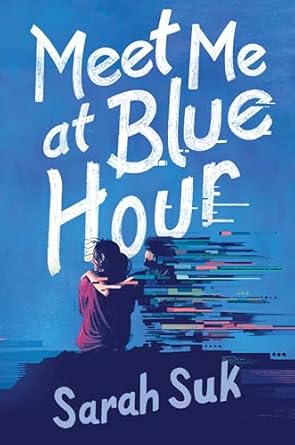
Author Guest Post: “Me, Myself, and My Five Senses” by Sarah Suk, Author of Meet Me at Blue Hour

Share

“Me, Myself, and My Five Senses”

I spend a lot of time inside my head. This is something that’s always been true about me. As a kid, one of my favourite pastimes was playing pretend, letting my imagination run loose and turning my ideas into dramatic plays for my stuffed animals to star in or for my friends and I to adopt for the afternoon. Today we are princesses and Pokémon trainers—both, at the same time. Tomorrow we’ll be spies, detectives, dragons on a mission. I could spend hours outside with a bouncy ball, just bouncing it up and down the street while I spun stories inside my head.

Now as an author, many of my days are much of the same, though the rhythm of the bouncy ball has turned into the tapping of keys on my computer. And while I can say that letting my imagination run loose and turning my ideas into dramatic scenarios for my characters to star in is still one of my favourite things to do, there are times when being in my head feels more tumultuous than not. When the feeling of stuckness seeps in and spirals into a state of overthinking and then overthinking the overthinking (as one does), I begin to feel more like I’m in the passenger seat of my own mind than the one behind the wheel.

Something I’ve been trying to do lately is to spend a little less time in my head and a little more time in my body. One of the ways I’ve been doing this is pausing to make note of my five senses in real time. I’ll ask myself, what do I see? A chunky mug, red spines on the bookshelf. Hear? Construction outside my window. Smell? Leeks in the pan, my daughter’s baby scent. Taste? Water, cold and refreshing. Feel? The couch beneath me, holding me up. It brings me back to the moment in a tangible way that reminds me that I’m not actually falling no matter how far my mental spiral seems to go. I’m simply right here.

Curiously, the senses have made an appearance as key details in my most recent young adult novels. The Space between Here & Now follows the story of a teenage girl who has a rare condition that causes her to travel back in time to her memories when she smells a scent linked to them. And in my upcoming book Meet Me at Blue Hour, memories are erased through sounds collected on a mix tape.

While I didn’t necessarily or purposefully plan to write these novels centering the senses, I found that’s where my ideas naturally took me. And in writing these stories, I found something else: leaning into the senses is great for worldbuilding! There’s nothing that makes a setting feel more alive than being able to vividly see what your characters see, hear what they hear, taste what they taste. I recall receiving this writing tip from an author friend of mine years ago, but as someone who often gravitates toward scenes with two talking heads in a description-less room, I feel like I needed to write these stories with the senses as a focal point to truly grasp my own style with it.

Now, no matter what I write, I find this exercise helps ground me in the reality of the story, just like how it grounds me in the reality of my own life. So whenever I’m feeling stuck in my head or stuck in the words, I go back to the senses. I take a breath. I plant my feet on the ground. And I remember that I’m here.

Publishing April 1st, 2025 by Quill Tree Books

About the Book: Eternal Sunshine of the Spotless Mind meets Past Lives in this gripping, emotional story of two childhood friends navigating the fallout of one erasing their memory of the other, from acclaimed author Sarah Suk.

Seventeen-year-old Yena Bae is spending the summer in Busan, South Korea, working at her mom’s memory-erasing clinic. She feels lost and disconnected from people, something she’s felt ever since her best friend, Lucas, moved away four years ago without a word, leaving her in limbo.

Eighteen-year-old Lucas Pak is also in Busan for the summer, visiting his grandpa, who was recently diagnosed with Alzheimer’s disease. But he isn’t just here for a regular visit—he’s determined to get his beloved grandpa into the new study running at the clinic, a trial program seeking to restore lost memories.

When Yena runs into Lucas again, she’s shocked to see him and even more shocked to discover that he doesn’t remember a thing about her. He’s completely erased her from his memories, and she has no idea why.

As the two reconnect, they unravel the mystery and heartache of what happened between them all those years ago—and must now reckon with whether they can forge a new beginning together.

Sarah Suk profile image

About the Author: Sarah Suk (pronounced like soup with a K) lives in Vancouver, Canada, where she writes stories and admires mountains. She is the author of young adult novels Made in Korea and The Space between Here & Now, as well as the co-writer of John Cho’s middle grade novel Troublemaker. When she’s not writing, you can find her hanging out by the water, taking film photos, or eating a bowl of bingsu. You can visit Sarah online at sarahsuk.com and on Twitter and Instagram @_sarahsuk.

Thank you, Sarah, for this writing exercise to bring our writing to life!

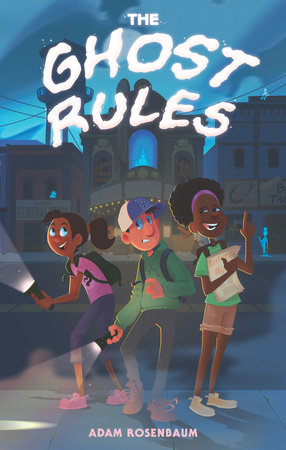
Author Guest Post: “Using Storytelling to Flip the Script on our Fears” by Adam Rosenbaum, Author of The Ghost Rules

Share

“Using Storytelling to Flip the Script on our Fears”

I used to be afraid of sharks when I was a kid. Like, really afraid. And maybe still am? Okay, that’s a lie. I am definitely, 100% still afraid of sharks, across the board, all the time. I blame a way too early viewing of JAWS and a wildly active imagination. But instead of facing my fears head-on back in the day, I am now an adult with children of my own who won’t venture more than a few feet into the ocean because a 30-foot great white shark might pop out of the depths and turn me into a morning snack.

There are so many amazing ways to help kids face their fears. And while I am by no means an expert on emotional health (see: my inability to swim in an ocean), I’d like to throw out a suggestion that might help some kids view their fears from a different angle. And it involves a little creativity!

My debut Middle Grade novel, The Ghost Rules, is about a boy named Elwood who can see ghosts. But in my book, ghosts aren’t scary at all. They aren’t haunting the living or terrifying children at night. My ghosts are goofy and annoying and drool a lot and are kind of obsessed with coffee. I took another fear of mine from when I was a kid (I was an anxious child, believe it or not), put a funny spin on it, and built a story around it.

Which is exactly what you can do!

I’ve brought this simple exercise into schools and nonprofits and have been blown away at the creativity and vulnerability of the kids who participate. Not only do some of the kids genuinely confront their fears, they also end up revealing those fears to one another before turning what they’re afraid of into something a little less scary.

If that sounds like something that could be valuable, here are some suggestions for how you can encourage the kids in your life to face their fears through storytelling:

1) IDENTIFY A FEAR

Some kids are MORE THAN happy to share their fears. Other kids have kept those fears bottled up for so long that to even utter them out loud is too much. So I usually say, “Let’s pick something that can be scary. It doesn’t have to be your own fear. Maybe it’s something your little brother or sister is afraid of, or something you used to be afraid of.” And I usually give my fear of sharks as an example to kick things off.

2) FIND A WAY TO MAKE IT SILLY

For The Ghost Rules, I made my ghosts bumbling, forgetful, and covered in ghost drool. To extend my shark example, I ask the kids how we can make something like a shark a little less scary. The ideas they’ve come up with have been so fun and imaginative: a shark who can’t see underwater and needs glasses, or a shark that only wants to eat pickles.

The opportunities here for fun, creative discussion are endless.

3) BUILD A STORY

When crafting a story with kids, I narrow it down to 3 basic things: a main character, a problem, how the main character overcomes that problem.

Sometimes they build a story together in smaller groups, sometimes the kids want to go off on their own and write and illustrate by themselves.

4) SHARE OUR STORIES

The best part of the whole exercise is when we come back together to share our stories, and the kids reveal what fear they chose (individually or as a group) and how they made it goofy. I give extra points to the kids who also illustrate their stories.

To state the obvious, I doubt any child walks away completely changed and fear-free. But it’s pretty amazing to see a kid smile and laugh as they’re talking about something that just minutes earlier had made their voice quiver.

And hopefully it’s a good first step toward their own emotional health so they avoid turning into a 40-something who still can’t swim in the ocean.

Published August 13th, 2024 by Holiday House for Young Readers

About the Book: Twelve-year-old Elwood McGee never asked to have “ghost-sight,” and it involves a lot more drool-dodging than he expected. Ghosts are the WORST—and they’re all over the place in this sharp-witted middle grade debut novel.

Did you know that ghosts love coffee? They’re not trying to be scary. They’re just deprived of an appropriate amount of caffeine! They also bump into things by accident, are occasionally nosy, and get a little nervous when they’re seen by the living.

Elwood McGee knows these ghost facts because he’s one of those rare people with the gift of ghost-sight. And it turns out ghosts are everywhere! Especially in the small Tennessee town where Elwood and his family had to move following the death of his big brother Noah, which Elwood thinks was his fault.

Once Elwood figures out he can see ghosts, he becomes single-mindedly determined to use his powers to see Noah and talk to him once last time. With the help of two girls who live on his street, Elwood embarks on a journey through the surprisingly funny world of ghosts and faces the realities of letting go.

At once hilarious and heart wrenching, Adam Rosenbaum makes his middle grade debut with a supernaturalish novel about grief that’s perfect for fans of Gordon Korman and Dan Gutman.

A Junior Library Guild Gold Standard Selection

Thank you, Adam, for this exercise to use with students to face fears and do some writing!

Author Guest Post: “Using Objects as Inspiration and Ignition for Young Writers” by Brigit Young, Author of Banned Books, Crop Tops, and Other Bad Influences

Share

“Using Objects as Inspiration and Ignition for Young Writers”

In my writing workshops with kids, I teach the older writers about the difference between a strong, hook-the-reader opening and an inciting incident. The inciting incident, I explain, is the event that not only changes the protagonist’s life but also makes them choose another one. They must be compelled to action that inevitably transforms their path.

In my most recent middle grade novel, Banned Books, Crop Tops, and Other Bad Influences, a book serves as my protagonist’s catalyst for change. While the opening involves a new girl parading into school and disrupting the setting’s equilibrium, my protagonist could still choose to go on living her life as is, albeit with a new person to gossip about. But after unexpectedly seeing this new girl in synagogue on Yom Kippur, the new girl hands my protagonist a book. This book tells the story of the MS St. Louis, a ship full of Jewish refugees that was turned away by North America and sent back to Europe during World War II. For my main character, this book shakes her to her core. It changes her sense of her country and the world around her. When she finds out the book is on a list of challenged books at her school, she’s incensed, and therefore her change of paths becomes inevitable. She must act, even if it takes her much of the book to figure out how or even exactly why.

As I worked on a manuscript that employs a physical book as a tool for the inciting incident, I found inspiration for a new writing exercise for students. Like a key in the door, in this exercise students use an object to open their story. Give each writer an object, either in words on slips of paper or from pictures – sometimes photos from magazines spark the imagination in a special way. Anything works! You can assign them a mirror, a lamp, the wooden plank of a raft, a cell phone, a family heirloom, a tennis ball, or even whatever they see around the room. The students must write two scenes. The first scene is the opening, and it does not involve the object. The first scene tells us who the character is, and it sets up their flaws and inner desires. This scene can be a paragraph or ten pages, depending on how long the class is and how much gusto the students feel that day.

At the very end of that first scene, students must introduce their character to their assigned object. The second scene reveals how that object instigates a new path for the character. I’ve had one student write about finding a text on a cell phone that wasn’t meant to be sent to them, and it informed them their best friend was betraying them. Their character had to leave her previous social life behind, despite being terrified of change, and from there a story began. Another was instructed to use “a piece of jewelry” as their object, and they took some inspiration from Travis Kelce and Taylor Swift! Their first scene placed the character at a Taylor Swift concert, and someone she didn’t take any note of slipped a friendship bracelet onto her wrist. Only at the end of the second scene did she realize that the bracelet held a code telling her where her lost mother might be. These kids are little geniuses!

As a modification for the younger writer, instead of asking for two scenes, give the writer an object and ask them to write a description of the object. Then tell them to end their scene with that object changing a character’s life. You’ll be surprised at what magic comes from this – often literally! Apparently, according to my youngest students, pretty much any object in our world can turn into a magical portal that takes people to alternate dimensions. Watch out the next time you’re picking up that soda can or turning on the night light…

So often the role of a writing teacher is to help young writers find an “in.” Kids just require a way to put pen to paper. They need a nudge to tap into that vast imagination already existing within them and ready to pour out. While there are hundreds of techniques to do so, I’ve been pleased to find one more. Put that book or mirror or friendship bracelet in their mind’s eye and allow the visceral muscle and sense memory of a literal object to ignite the events in their story.

Published September 17th, 2024 by Roaring Brook Press

About the Book: Perfect for fans of Star Fish and From the Desk of Zoe Washington, a nuanced middle grade from the author of The Prettiest about two girls—one “bad” and one “good”—who join forces against book banning and censorship.

Rose is a good girl. She listens to her parents and follows every rule. After all, they’re there for a reason—right? And adults always know best.

Talia, the new girl from New York City, doesn’t think so. After only a week at school, her bad reputation is already making enemies. First on the list: Charlotte, Rose’s lifelong best friend.

So why can’t Rose stop wondering what it would be like to be Talia’s friend? And why does Rose read a banned book that she recommends? Rose doesn’t know. But the forbidden book makes her ask questions she’s never thought of in her life. When Talia suggests they start a banned book club, how can Rose say no?

Pushing against her parents, her school, and even Charlotte opens a new world for Rose. But when some of Talia’s escapades become more scary than exciting, Rose must decide when it’s right to keep quiet and when it’s time to speak out.

About the Author: Brigit Young was raised in Ann Arbor, Michigan and now lives with her husband, daughters, gecko, and dog in New Jersey. Her debut middle grade novel, Worth a Thousand Words, was a Junior Library Guild selection as well as a Best Book of 2019 from The Bank Street College of Education. The Italian translation was the recipient of the Andersen Prize for Best Book for 12-14 year olds. Her sophomore novel, The Prettiest, received multiple starred reviews and was featured on several reading lists including Best Books of 2020 from the Chicago Public Library, Seventeen Magazine‘s 50 Books for Teens That You Won’t Be Able to Put Down, and NBC News’ 9 Books to Help Young Girls Build a Positive Image. Bank Street College of Education listed her third novel, Bright, as a Best Book for 12-14 year olds with the honor of outstanding merit. Her next middle grade novel, Banned Books, Crop Tops, & Other Bad Influences, is forthcoming in September, 2024. Additionally, Ms. Young has published short fiction and poetry in journals like The North American Review2 River ViewEclectica Magazine, and Burrow Press, among others. She has taught creative writing to kids of all ages in settings ranging from a library to a hospital.

Thank you, Brigit, for this awesome writing activity!

Author Guest Post: “Why I Write About Messy Teens—And Why We Should Honor the Mess Inside of Us All” by Jen Ferguson, Author of A Constellation of Minor Bears

Share

“Why I Write About Messy Teens—And Why We Should Honor the Mess Inside of Us All”

One of the lies we tell each other is that the point of living is we’re supposed to get it all together. First off, I don’t know exactly what it is, and I worry it is maybe, act in a manner benefitting the patriarchy or the government, or even like what many older cis, het white people want everyone else to act like: speak English (but the right English), get a job (but the right job), work hard (but the right kind of hard), and don’t question why the work you do never results in exactly what you were told it would—in fact, stop asking questions entirely. I worry together means that an individual does this alone. I worry that all is never achievable, but it’s the thing we’re faced with, the thing we’ll fail at again and again, and worse yet, believe that we’ve failed, believe that we haven’t worked hard enough, haven’t done this simple thing everyone else seems to be doing.

And I worry that when we tell ourselves these lies as teachers, in our home life, our community life, and our school life, that we’re doing the work of socializing teens toward something we all know, in our hearts, doesn’t work well, and isn’t designed to work well for the large majority of us.

I am a teacher too.

I fight against telling my students this get it all together narrative, this hard-work-is-rewarded narrative, this we-live-in-a-meritocracy narrative every day.

After all, we know life is easier for everyone involved if young people would, for example, learn to submit their work on time.

But submitting things on time won’t save them, not really.

#

So, with this lie—get it all together—in mind, I write about messy teens. Teens who get to remain messy. Whose identities are hybrid, this-plus-this-plus-this, or whose identities are flexible the way gender identity is for many young people, or, for example, whose identities are radically changing the way a person’s perception of self needs to change after a 30-foot uncontrolled fall to the ground results in a traumatic brain injury. I write about teens who learn to love their mess. Teens who grow with their mess or into their mess, instead of getting it all together in the way that (Western ideas about) character development, as well as other power structures, might tell us we ought do see done in a novel.

My characters don’t always have the words or the skills to handle the world around them. But that is not their fault.

The world, it can be what’s wrong, what needs to change, too.

#

Let’s turn to my new book filled with messy teens, A Constellation of Minor Bears, out from HarperCollins’ Heartdrum imprint.

Meet Molly Norris-Norquay, an overachieving fat, maybe queer, Métis and white seventeen-year-old high school graduate, who is walking away from her life as fast as her feet can carry her 60-liter hiking pack and all the things she’ll need to successfully complete the Pacific Crest Trail.

At her high school graduation, the afternoon before her flight to San Diego, California, she says: “The anger inside me pulses like it has its own veins and arteries. The noise, the pressure, is overwhelming. A breeze brushes tulle against my heated skin. I want to crush something or run a 5K race or sit down in the grass and have a big cry, a full-fledged temper tantrum, and I have no idea which.”

I could tell you about Molly’s white brother Hank and his messiness, how he’s recovering from a sports-related traumatic brain injury, or about Hank and Molly’s best friend Tray and how he might look like he’s under control, behaving, following the rules, but he’s awfully messy too. And I could tell you about Brynn, another fat hiker, how she’s on the trail for the right reasons but walking away from her life at the same time.

Instead, I want to stay with Molly’s anger.

In A Constellation of Minor Bears, Molly gets to be angry, gets to be frustrated with her brother, her best friend, her parents, with other hikers, and the world at large, gets to be wrong and double-down, and she also gets to be right and wrong at the very same time. Molly is doing an incredible thing—walking 2,650 miles, from the US/Mexico border to the US/Canada border through mountain ranges in California, Oregon and Washington.

But she’s also barely managing it most days.

And if she’s learning anything, together, means relying on her community, her friends no matter the mess between them.

On the trail, all, means getting up and doing this hard thing over again. But sometimes all means taking a zero day—a day where a hiker walks exactly zero miles. Sometimes all means you leave the trail entirely, without finishing. Sometimes all means you find another trail.

#

I want to return to the idea that the characters I write about aren’t always able to handle the world around them, and the idea that supposes this is not their fault. Instead, it’s systems, power structures, the world around them that needs to change.

This is a critical perspective for activists who fight for a world where BIPOC and queer and trans people’s lives are full and rich and unencumbered by systems of power that tell us we are less, that tell us we don’t fit, that legislate against us, that encourage violence in word and action against us.

This perspective is foundational for fat and disability activism too. Bodies change throughout our lives. Bodies are messy in so many delightful ways. If living is anything, it’s the embodied experience of constant change, of becoming, of re-becoming.

I want to allow those of us who live in these messy, imperfect, most excellent bodies to not to have to tame ourselves, or shape ourselves to fit the world, but for the world to open up to all of us, to recognize living is not about containing our messiness, but existing in relationship with our mess and the world and all the other living and not-living things around us.

When messy teens grow up to be adults who get it all together we lose part of what makes us human.

Long live messy teens.

Long live the messy adults we become.

#

I’ll leave you with a short writing challenge for your students to play with in order to embrace mess.

  • Create a messy character. What makes them messy? How is their messy different from everyone else’s? Spend a few minutes here. Orchestrate a mess.
  • Now, get your character into trouble. What is the perfect trouble for their mess? Not to “fix” them, but to challenge your character.
  • They don’t need to get rid of their mess by the end of the story. See what parts of their mess they want to keep, what parts help them against their trouble, what parts of their mess should be celebrated.
  • Okay, now for the hard part: take a risk or two! Your risk should be something you consider risky. For example, if you always write in the first person (“I”) maybe you could try writing in the 2nd person (“You”). Your risk can be a content one too: what’s the story you’ve told yourself you aren’t brave enough to tell? What happens if you tell a story with a character you’re familiar with but you set it on a space station orbiting Mars or in a wheat field full of strange bugs or somewhere else that challenges your storytelling brain?
  • But really, your job here, today is to have some fun! Play, embrace the mess inside us and around us.

<3 Jen

Published September 24th, 2024 by Heartdrum

About the Book: Award-winning author Jen Ferguson has written a powerful story about teens grappling with balancing resentment with enduring friendship—and how to move forward with a life that’s not what they’d imagined.          

Before that awful Saturday, Molly used to be inseparable from her brother, Hank, and his best friend, Tray. The indoor climbing accident that left Hank with a traumatic brain injury filled Molly with anger.

While she knows the accident wasn’t Tray’s fault, she will never forgive him for being there and failing to stop the damage. But she can’t forgive herself for not being there either.

Determined to go on the trio’s postgraduation hike of the Pacific Crest Trail, even without Hank, Molly packs her bag. But when her parents put Tray in charge of looking out for her, she is stuck backpacking with the person who incites her easy anger.

Despite all her planning, the trail she’ll walk has a few more twists and turns ahead. . . .

Discover the evocative storytelling and emotion from the author of The Summer of Bitter and Sweet, which was the winner of the Governor General’s Award, a Stonewall Award honor book, and a Morris Award finalist, as well as Those Pink Mountain Nights, a Kirkus Best Book of the Year!

About the Author: Jen Ferguson is Michif/Métis and white, an activist, an intersectional feminist, an auntie, and an accomplice armed with a PhD in English and creative writing. Visit her online at jenfergusonwrites.com.

Thank you, Jen, for celebrating the messiness!