Speak Out! For Banned Books #BannedBooksWeek

Share


This week is Banned Books Week (hooray!). Banned Books Week is one of my favorites. I always find it helpful to talk first about how books are classically banned. This video from ALA is great:

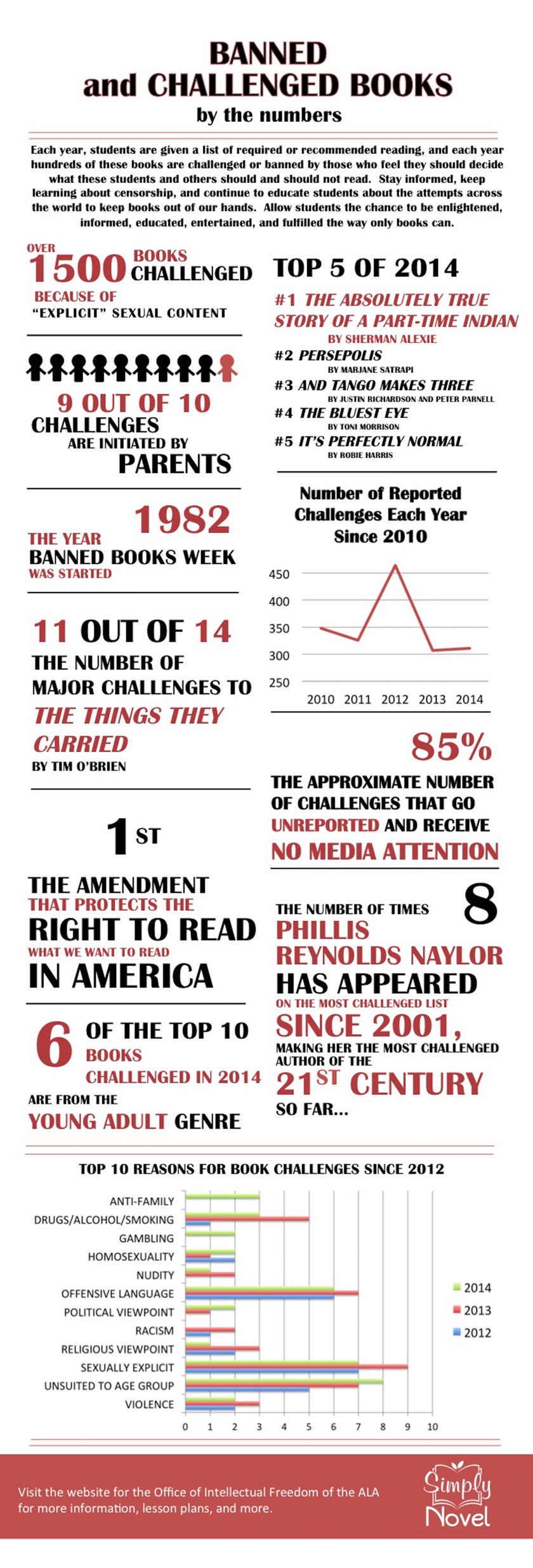
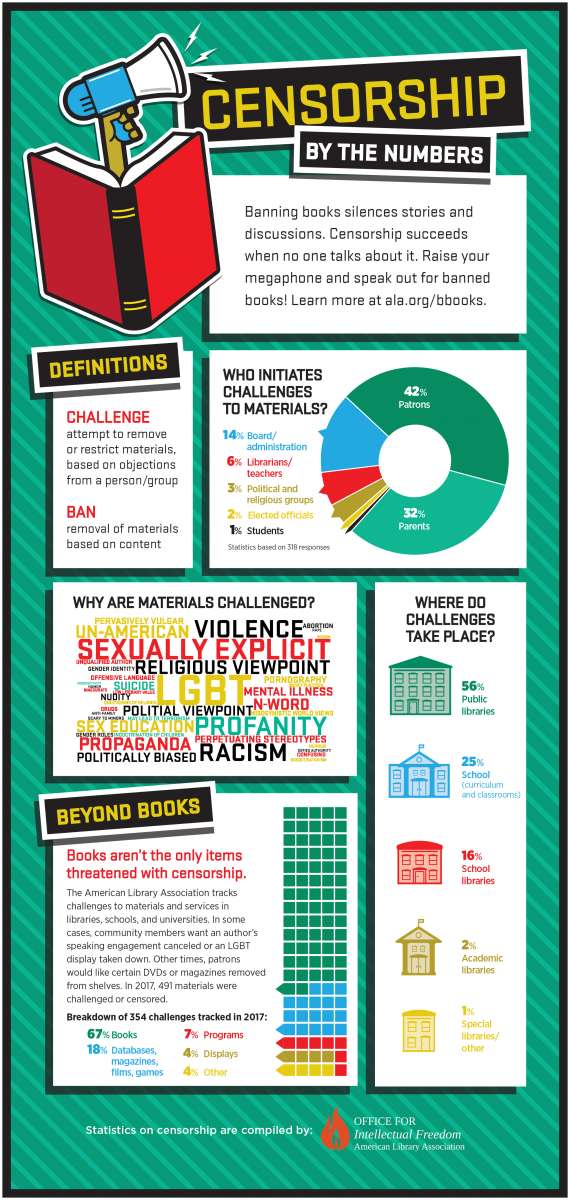
This often leads well into a question and answer period where we talk through why certain topics appear often on banned books lists. Next, I show the following infographics, which I find helpful. The first one is a bit dated, but it is beautifully done.

For more banned books infographics and fun graphics, in general, click here!

We had a great discussion today about where politics belong in the classroom. Students offered some phenomenal comments about how they could be fair in their presentation of politics but also show they didn’t support hateful speech. In past years, I’ve had students read popular banned picture books to talk through how and why books are banned. This has proven very effective as well.

We always end by talking through the many resources available to teachers. These include those available on NCTE’s Intellectual Freedom Center. If you haven’t checked this out (or ILA’s comparable resource center), I recommend these resources highly.

Happy reading! Let’s celebrate our FREEDOM TO READ!

 and

Teaching Tuesday: Using Dialogue Journals with High Schoolers

Share

When I was my Methods of Teaching English course as an undergraduate many moons ago (with my smart, thoughtful mentor Wendy Glenn), she used dialogue journals with us. I absolutely loved the idea and used it with my own students when I became a teacher. Since my graduation, I’ve seen dialogue journals used in a variety of different ways. Many teachers have students write to each other. I like this, but there is something particularly special about getting to know your students through their dialogue journals and having a conversation with them.

I follow the way that I was taught to use dialogue journals. I begin with a prompt and staple it to the first page. The student writes a response to the prompt or writes about anything of interest. I then write back (a minimum of a paragraph but usually longer). The student then responds to me and writes back to me. Throughout, I introduce new prompts, or the students can continue our conversations.

How do I evaluate them?

I choose to evaluate dialogue journals based on completeness. I ask students to write a lengthy note to me, and as long as they do this, they receive an A. For me, dialogue journals are not about the grade. They are about a) me getting to know my students, b) me showing my students that I am interested in their lives and passions, c) me learning about my students’ interests to cater the curriculum to their needs, and d) me learning about their strengths and needs with respect to writing.

How do I purchase that many journals?

I invite students to get their own journal. They enjoy picking them out. But I always buy a few dozen cheap journals before the school year starts (during the crazy sales) to support students who prefer to use mine. To prevent a divide between the haves and the have-nots, I typically say, “If you don’t feel like going out and getting one, you can have one of mine.” Some teachers request department money be allocated for this.

How do I grade 100 dialogue journals in a semester?

Easy. I stagger when the students turn them in. I take home five to seven journals a night, and I read students’ journals every two weeks or so. If I am having a light grading time period, I take more of them home. I know that this is the scariest part for teachers, but I have always found it to be manageable. I have learned so much about my students’ lives in these journals, and they have been an invaluable part of my teaching.

What ideas do you have for using dialogue journals with students? What recommendations do you have for teachers? I’d love to hear your thoughts and suggestions! 

Teaching Tuesday: Books for Ricki’s Fall 2018 Adolescents’ Literature Course

Share

Selecting books for my Adolescents’ Literature course is always a struggle. There are so many good books out there, and a week after I submit my book order, I always wonder if I should have used X book or highlighted the amazing work of X author. I will admit that some of my favorite authors aren’t even on the list. I try to mix it up each semester. I believe that I am only keeping four (of almost forty) books from last semester. This allows me to spread the author love and placate my guilt for not being able to include X work or X author. I am really excited to hear what the students think about the books this semester! Sharing this list brings some anxiety for me. I really struggle to build a list that is diverse, but I recognize that I am missing major topics and texts. This feels inevitable, but it doesn’t make it feel right.

For some of the weekly topics, only one book is listed. This means the entire class is reading the book. For other topics, three books are listed. This means that the class is divided in thirds. Each third reads a different book, and then we look across the texts to talk about the topic. I recognize that categorizing books has its problems, but we unpack this and discuss how it also helps us talk about many aspects of adolescence in a focused way. Many of the texts on this list could fit under several topics.

Identity (and Complications with Studying Identity)

If I Ever Get Out of Here by Eric Gansworth

Nontraditional Forms of YAL

American Born Chinese by Gene Luen Yang

Family and Friendship

Piecing Me Together by Renée Watson

Drums, Girls, and Dangerous Pie by Jordan Sonnenblick

They Both Die at the End by Adam Silvera

Sexuality

Aristotle and Dante Discover the Secrets of the Universe by Benjamin Alire Sáenz.

Gender

If I Was Your Girl by Meredith Russo

When the Moon Was Ours by Anna-Marie McLemore

The 57 Bus by Dashka Slater

Time and Place

Between Shades of Gray by Ruta Sepetys

Grief

Goodbye Days by Jeff Zentner

We Are Okay by Nina LaCour

The Astonishing Color of After by Emily X. R. Pan

Nonfiction

Americanized: Rebel Without a Green Card by Sara Saedi

Vincent and Theo by Deborah Heiligman

Mary’s Monster by Lita Judge

Mental Health

Anger is a Gift by Mark Oshiro

Highly Illogical Behavior by John Corey Whaley

Little & Lion by Brandy Colbert

Considerations of Class

The Smell of Other People’s Houses by Bonnie-Sue Hitchcock

The Serpent King by Jeff Zentner

Me and Marvin Gardens by A.S. King

Refugees and Immigration

Refugee by Alan Gratz

American Street by Ibi Zoboi

A Land of Permanent Goodbyes by Atia Abawi

Disability and the Body (Literature Circles)

Wintergirls by Laurie Halse Anderson

Out of My Mind by Sharon Draper

Girls Like Us by Gail Giles

Fish in a Tree by Lynda Mullaly Hunt

Wonder by R. J. Palacio

Not If I See You First by Eric Lindstrom

Challenger Deep by Neal Shusterman

Marcelo in the Real World by Francisco X. Stork

The Politics of Adolescence

All American Boys by Jason Reynolds and Brendan Kiely

Tyler Johnson Was Here by Jay Coles

The Hate U Give by Angie Thomas

What books do/would you include on a course list? 

Teaching Tuesday: Small Things to Build Community and Rapport in Your Classrooms

Share

For any seasoned teacher, they will tell you that building a community within your classroom will help not only with discipline but also with achievement since students who feel comfortable and engaged in a classroom will be more successful. Here are some tips for helping build rapport and community within your classroom:

Spend Time

Spend some time at the beginning of the year getting to know your students. I know this seems like a no brainer, but you know that your curriculum map always yells at you to get started. However, students are going to do better in your classroom if they feel like it is a place they want to be and learning about them will help you make the classroom that place.

Inventory

Have students fill out interest and book inventories sharing about themselves and read them! After receiving them and reading them, write each student back a letter. The letter can be quick, but make it personal. Take it to another level by recommending books based on their interests!

Allow Input

For rules, for procedures, for texts, for lessons… let students have input! What is the easiest way to get buy in? Allow students to feel ownership of what is going on in the classroom.

Share

Don’t forget to also talk about yourself! Show them you are human.

Collaboration

Part of making community is students trusting and respecting each other. The only way to do this is to allow students to get to know each other through group work.

Greet

Greet every student, every day. Show them from the minute they walk in that you care and are happy they are there. It is such a small thing that will make a huge difference.

Listen

Remember, these are kids we are teaching. Don’t jump to conclusions. Listen to them; they have a story to tell. This will show them that you respect their stories, and giving respect leads to receiving it.

What do you do to help build community in your classroom? 

Student Voices: Visual Reflections on School Shootings by Two of Kellee’s 2017-18 Middle School Students

Share

After Parkland, school shootings and any topic associated with them was often talked about in my classroom. Students needed someone to talk to about everything that was going on. They also had to mourn, as Parkland seemed too close to home for us, and the lives lost were grieved by all of my students. When I allowed students to write a blog post, these two sixth graders asked if they could write about school shootings and how they need to stop. And I am posting it now as the next school year starts, to keep the conversation going–this needs to stop. Here is how they reflected:

Visual Reflections on School Shootings by Sasha M. and Maelynn A. (6th graders)

Facts found during research:

  • On an average day, 96 Americans are killed by guns.
  • America’s gun homicide rate is more than 25 times the average of other high income countries.
  • Black men are 13 times more likely than White men to be shot and killed with guns.
  • There are nearly 13,000 gun homicides a year in the United States.
  • Seven children/teens 19 and under are killed with guns in the U.S. on an average day.
  • There have been 22 shootings involving schools since January, 2018 (as of the end of May, 2018).
  • 187,000+ students have been exposed to gun violence at school since Columbine.
  • As of mid-March, 2018, 12,752 students have been present at school shootings.
  • There are school shootings in small and large towns.
  • Targeted shootings are far more common than indiscriminate slaughter (64.5% to 22.3%).
  • Our country has about 250 million guns.
  • Students who were victims of school shootings can suffer from post-traumatic stress disorder that can be cripling.
  • Black students make up 16.6% of school populations, but experience shootings at 2x the rate of other students.
  • It is now safer to go to war than to be at school (in 2018).
  • Kids SHOULD NOT be afraid to go to school.

Resources:

This poster includes quotes from protest posters and students speaking out. We also put the schools and cities along with the causalities to raise awareness that this is a problem that is occurring way too often.

This is a remake of a poster that somebody made for a protest though we improvised a bit to make our own version.

Thank you to my wonderful students, Sasha and Maelynn, for sharing! This is a topic that is too close to home for all of us

Things We Do Over the Summer (Educators DO Work During the Summer!)

Share

Ah. Summer is here! That means teachers are going to nothing for the next nine weeks, right?!
NO! Here are just some of the things we’re up to this summer during our “free” time.

(We ended up combining our lists because there was a lot of overlap; some are for one of us but most are for both–it turns out that we do a lot of similar summer prep!)

Attend the Future Problem Solvers International Competition

Write common final exams for the school district

Plan curriculum and write syllabi

Attend the American Library Association Annual Conference

Blog!

Read for pleasure

Read professional books that we never get to all year

Read all of the journals we’ve gotten all year and have not had time to read

Write teaching guides

Answer emails for questions about summer reading and course-related questions

Go into school when test scores come in to analyze them

Meet with counselors to help with reading and language arts scheduling

Meet up with teachers who want to chat about curriculum or books before the start of the school year

Professional Learning Community pre pre-planning days

Host a Summer Book Club

Start planning for NCTE and ALAN presentations

Leadership Team meetings planning for pre-planning

See past students who are in town for the summer from college

Take part in Twitter Chats with my PLN for e-PD

Go to doctor and dentist appointments

Go to the bathroom whenever we want (Ricki admits that this has become possible year-round now that she teaches college)

Submit a book proposal

Read dozens of books seeking new material for course adoption

Write manuscripts for publication (Publish or perish at the college level, right?)

Meet with colleagues to plan and streamline college courses

Write dozens of letters of recommendation for preservice teachers seeking jobs

Review for academic journals

What are you doing this summer during your “free” time? 

 and

Teaching Tuesday: Things I Wish I’d Known as a Beginning Teacher

Share

Teaching is hard. I don’t pretend that I am an expert. I operate under Tom Newkirk’s idea that each year, we should change at least 5% of our teaching, and after several years, these changes are exponential. I am always trying to do better and be better. In the section below, I share a few of the things that I learned as a beginning teacher. However, I want to emphasize that I am always learning and growing.

*Let me start by saying that I learned many of the items below in my teacher preparation program. Many of them didn’t quite sink in until I had been teaching for at least a few months.*

1. Initiation and Closure are very important.

Getting students into the mood of your class is important to frame their thinking. Further, I learned quickly that closing class quickly with the homework assignment isn’t enough. Students will leave class unsure of what they learned. I dedicate at least five minutes (ten to fifteen, if possible) to frame and close class and ask students, “So What?” I try to make this as student-centered as possible.

2. Learning Targets (or Objectives) are critical. Posting them is helpful.

I try to start and end each class by asking a student to read the learning targets posted on the board aloud. This allows me to talk about the day’s objective and how we will meet (or how we met) it.

3. Every Learning Target (or Objective) should have a matching assessment.

Even if it means walking around and informally checking in with students, I learned that it is important to measure whether the students met the learning target by providing an (SMALL) assessment each day. Often, this came in the form of an exit slip or an artifact that emerged from classwork.

4. Differentiation is Easier than We Imagine It To Be

Differentiation seems scary. I imagined this dark day where I was creating 5 forms of every test and assignment. But differentiation is really about student-centeredness. It’s allowing students choice in process and product, it’s allowing students to choose texts that match their learning needs and interests, it’s grouping students purposefully, it’s creating a classroom environment that supports individualized learning.

5. When We Need To Get Students’ Attention, Talking Louder Is Not the Answer

I respect students’ voices. If a student is talking, I ask students to stop talking and listen. The same goes for me. If I am giving directions, it is important to wait until everyone is focused. Everyone should respect those who are speaking (and hopefully, this isn’t me, most of the time!).

6. Write Everything on the Board

Directions, homework, etc. Working with a co-teacher, I learned that if I am saying it out loud, it helps students to have it written on the board, too. This is particularly helpful for students with special needs and for students who are emergent bilinguals.

7. Ask for Help

I always tell students, “If you feel it, steal it. (And cite it.)” Teaching is about sharing, so we learn and grow together. Ask colleagues for ideas and search the internet. Adapt ideas to become your own.

8. Take Home a Few Papers at a Time

If you take them all, they will likely remain in your teacher bag. Taking home small chunks makes grading feel less overwhelming.

9. Stagger Your Assignments

Don’t assign the same due date for all of the essays and projects for all of your classes.

10. Ask for Student Feedback

And be open-minded to their criticism. This is how I grow.

11. Find Your Personal Learning Community Online and Find the Positive Energy within Your School

Find your people. Feed off of each other’s positive energy. Ignore the negativity within your school.

12. Keep a Drawer of Happy Things

If a lesson doesn’t go well, open the drawer and eat the chocolate and read the thank you notes from students.

13. Be Flexible

As much as I may have loved my pre-planned lesson plan, I often have to adapt it to fit students’ needs. I learned that it was important to pay close attention to them and adapt the lesson as it occurred.

14. Student-Centered Learning

While I might want to do a unit on a theme, my students might not be interested. As I learn from them, I try to shape unit themes and topics to meet their interests.

15. Learn About Students

I start the year by asking students about themselves, and I ask them to share dialogic journals to stay connected with them and show them how much I value their voices and learning needs. In my calendar, I make notes about their sports games or activities, so I am reminded to ask them how it went. I care deeply about my students, and I try to remind them of this through my attention to their lives.


What have you learned that you wish you knew as a beginning teacher?