Grumbles from the Forest: Fairy-Tale Voices with a Twist by Jane Yolen and Rebecca Kai Dotlich

Share

grumbles

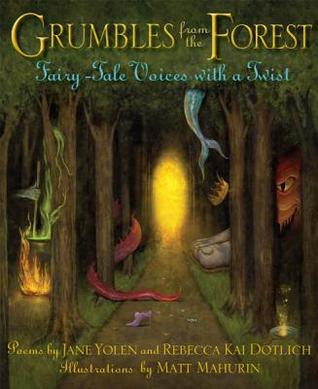
Grumbles from the Forest: Fairy-Tale Voices with a Twist
Authors: Jane Yolen and Rebecca Kai Dotlich
Illustrator: Matt Mahurin
Published March 1st, 2013 by Wordsong

Goodreads Summary: What were all those fairy-tale characters thinking? Jane Yolen and Rebecca Kai Dotlich answer this question in paired poems, with sometimes startling results. The Princess claims all those mattresses kept her awake–“not” a silly pea–while the poor pea complains that the princess snores. One Snow White begs the witch to settle by the bay and throw that mirror away. Another boldly tells the mirror she “won’t be guided by a glass that’s so one-sided.” Grumbles from the Forest is a bewitching brew of voices–grumbling, pleading, bragging, reminiscing, confiding–that bubbles with magic and wonder. The spectacular paintings that tie the poems together are full of surprise and intrigue. This stunning collection includes end notes that briefly describe the tales and their history and an introduction that invites readers to imagine their own poems from unusual perspectives.

My Review: Jane Yolen just doesn’t make bad books. Every time I read one of her books, I know I am reading a piece of great literature. This book is no different. Grumbles from the Forest takes 15 different fairy tales and then has a poem from two different perspectives for each fairy tale. Some are two different characters: Cinderella and her stepsisters, the frog and the princess, the wicked fairy and Sleeping Beauty, etc. including some characters who didn’t have a voice in the original fairy tale like the pea from The Princess and the Pea. Some are from one character, but two points of view: Snow White talking to the witch and with the magic mirror. I was fascinated with all of the poems they came up with!

Teacher’s Tools For Navigation: This book was built for being used in the classroom. First, each fairy tale section could start its own discussion about what the poem is saying vs. the original fairy tale. Second, the poetry itself stands alone. Look for figurative language and other poetic elements and there is even a haiku and cinquain. Third, we are always trying to get students to see things from different points of view and this is a perfect way. The introduction of the book even invites readers to: “Why not try writing a fairy-tale poem yourself? Pick a character or an object—maybe the bridge in Three Billy Goats Gruff, or Beauty’s father or the chair that Goldilocks broke. Imagine. Enchant. Write a poem that rewrites the tale. Make a little magic.”

Discussion Questions: Why do you think the authors chose to write from ____’s point of view? Do you agree with the point of view they gave the character/object? What would you have had them say instead? Who/what would you have written about instead?

We Flagged: Thumbelina 

“Thumbelina: A Cinquain”
Being
small has its down-
side, but what, pray tell, is
the choice of a little missy
at birth?

“Little Big: A Haiku”
I am just a bit
Of a proper young lady,
Still I got my prince.

(p. 34-35)

Read This If You Loved: The True Story of the Three Little Pigs by Jon Scieszka, Revolting Rhymes by Roald Dahl, and other fractured fairy tales; Stories told from different points of view like The Day the Crayons Quit by Drew Daywalt and Who Stole Mona Lisa? by Ruthie Knapp

Recommended For: 
closereadinganalysisbuttonsmall readaloudbuttonsmall

Signature

Stardines Swim High Across the Sky and Other Poems by Jack Prelutsky

Share

NF PB 2013

Nonfiction Picture Book Wednesday

Nonfiction Picture Book Wednesday is hosted by Kid Lit Frenzy and was started to help promote the reading of nonfiction texts. Most Wednesdays, we will be participating and will review a nonfiction text (though it may not always be a picture book). Be sure to visit Kid Lit Frenzy and see what other nonfiction books are shared this week!


stardines

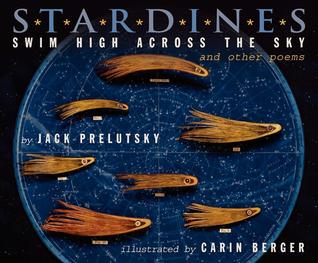
Stardines Swim High Across the Sky and Other Poems
Author: Jack Prelutsky
Illustrator: Carin Berger
Published February 26th, 2013 by Greenwillow Books

Summary: Jack Prelutsky combines inanimate objects with animals to give us a new collection of fun poetry that is accompanied by Carin Berger’s amazing fine artwork.

My Review: I love the concept behind this book. It is set up like an informational nonfiction book with each poem being presented like a specimen. Carin Berger’s artwork is full of found objects that were photographed to add to the nonfiction feeling of each poem.   And, of course, Prelutsky adds a sense of humor to each poem as that is what he does.

The creatures that Prelutsky came up with are so clever – SOBCATS who are sad cats, JOLLYFISH who are happy jellyfish, TATTLESNAKE are snakes that won’t stop tattling, and GLOOSE are a bird that keep sticking to everything. And these are just four examples of sixteen in the book.

I cannot review this book without talking about the artwork. I originally chose this book because I saw it on a Mock Caldecott list and I can definitely see why. Carin Berger illustrates this novel with beautiful pieces of artwork. As stated on the copyright page: “The miniature dioramas in this book are assemblages created using a combination of cut paper, found ephemera, vintage engravings (which were scanned, manipulated in Photoshop, and then printed out), beeswax, wire, thread, and wood. Once each piece was made, it was then photographed digitally to prepare the full-color art.” What a fantastic process to discuss with students and it definitely added an essential aspect to the book.

Teacher’s Tools for Navigation: Each poem is its own discussion starter. First, to separate the title creatures into the two words that were combined and looking at what the animals is and what the word is that it was combined with. For example: “Chormorants” is a combination of CORMORANT and CHORES. Then I’d look through the poem and find where the animal is represented and where the combined word plays a role. And on top of that, each poem can be looked at as a poem and look for poetic elements within it.  Each poem is a stand-alone, well done poem that is sure to start a conversation.

Discussion Questions: Which poem is your favorite? Why?; Combine an animal with a word and write a poem about this new creature.; How do you think Berger’s artwork added to the book? How would cartoon illustrations have made the book different?

We Flagged: Every poem is a gem, but this is my favorite-

“PLANDAS sit around all day,
Planning what to do.
Their plans amount to nothing,
For they never see them through.
They plan to run a marathon
Or take a railroad trip.
They plan to cross the ocean
On a wooden sailing ship.
***
They plan to learn to roller-skate,
To juggle, and to fence.
They plan to go to clown school
And cavort in circus tents.
They plan to play the saxophone
And form their own brass bands. . . .
But PLANDAS never do these things –
They just keep making plans.” (p. 21)

Read This If You Loved: Behold the Bold Umbrellaphant by Jack Prelutsky, My Teacher Likes to Say by Denise Brennan-Nelson,  Lemonade by Bob Raczka

Recommended For:

closereadinganalysisbuttonsmall readaloudbuttonsmall classroomlibrarybuttonsmall

Signature