Author Guest Post!: “How to Love the Language Your Students Use” By Matthew Jobin, Author of The Nethergrim series

Share

“How to Love the Language Your Students Use”
By Matthew Jobin, Author of The Nethergrim series

In sooth, I know not why I am so sad:
It wearies me; you say it wearies you;
Antonio, The Merchant of Venice (slightly abridged), Act 1, Scene 1.

It is a truism, or at least a trope, of adult life that we grownups inevitably begin to hear slang uttered by children and teens that we fail to understand. It’s never fun to hear words bandied back and forth between your juniors and be unable to follow it. Worse still, an adult might justifiably fear breaking into the conversation of younger people with the equivalent of ‘Hey, cool cats, I sure am hip to your rad lingo!’. No one has to deal with this divide more than teachers, who are not only grownups in constant contact with children, but also the gatekeepers to those students’ future. One of the things I learned in graduate school studying anthropology is that language serves many functions, only one of which is the simple conveyance of information. Another major function is inclusion within or exclusion from a group. Using slang correctly is a way of waving a door pass to get into a club. If you use the words the same way the cool kids do, then the cool kids either have to admit you know what they are talking about or change the slang to make sure you no longer do. The latter is, of course, the most likely occurrence of a fortysomething bursting into a gang of teenagers uttering “O hai random swag is amazeballs, bae!” or something to that effect. Knowing that there are words set up to exclude you from youth culture can sting (though to be honest, I’m fine with no longer being fifteen), but more importantly, a teacher might worry that he will have trouble getting ideas across in full to his students.

One way to talk across that barrier without breaking it down is to show students how language changes over time, and thus how what now sounds archaic was once the latest slang. Consider the currently hated word ‘literally’. It drives many people nuts to hear the word used to emphasize truth in a statement. It drives me especially nuts to hear it emerging from my own mouth from time to time, knowing all the while that I was getting by just fine without saying it nearly so much five years ago. It is easy to simply dismiss this as a symptom of the lazy thinking that goes on these days, or lax standards in the home, or not enough ten-year-olds reading Kant’s Critique of Pure Reason, or some such. Don’t go that way; the kids are all right, just like you were. I am not saying that it is nice to hear ‘literally’ overused, but consider, though, what this use of ‘literally’ actually means. It is a way of saying “I assert the truth of this statement”. Can you think of other ways to say this? Have a look up at the Shakespeare quote from the top. Yup, that’s right. “In sooth” and “forsooth” do more or less the same job as “literally”. We might not talk exactly the same way they did in 1602, but we have mostly the same things to talk about. Connecting students to the fact that slang is ever-changing but at the same time never really new might give them a fresh perspective on the classics.

“I literally do not know why I am so sad:
It wearies me; you say it wearies you;”
Antonio, The Merchant of Venice (slightly abridged), Act 1, Scene 1.

Let’s go one step further. Some of you might have taken on the task of teaching Beowulf, a text in English so old that it is no longer intelligible to the untrained reader. The very first line, however, begins with “Hwaet!”, the call from the poet for the listeners to shut up, put down their mead cups and bend an ear. The word is an opener, a way to convey the idea that the speaker needs to to start listening so that he can tell you what he needs you to hear. That sounds an awful lot to me like “Listen up!” or even “O hai!”.

Is not “boon companion” another way of saying “bruh”? Is not “Zounds!” a form of “Wow. Just wow.”? Meanings shift and change context, but the basics of human life do not. The struggle for personal identity that characterizes late childhood and adolescence is much older than Shakespeare and the Beowulf poet. It is something fundamentally human, something our language hints at over and over in ever-changing guises through the years.

Personally, I would love to hear young folks bandying around ‘forsooth’ and ‘yea verily!’ for a while, just for a change-up. If any teacher out there can make a game out of that, she might find that she has squared the proverbial circle and made learning fun. Good writing deals in universals, and the interested reader will find more similarities than differences between his world and the world of the book he reads. This is because we are humans making human stories for humans. The jargon of Shakespeare might seem at first as impenetrable and intimidating as a gang of cool kids uttering the very latest gatekeeper slang around a teacher (or a nerd), but once the bridge has been crossed and the student understands that with slang, ’twas ever thus, he might begin to see the outlines of the very familiar ideas underneath the archaic forms of speech. After all, many of Dickens’ works are exposés of social injustice and inequality. Romeo and Juliet, rather famously, is partly about a gang war. If you read The Canterbury Tales and do not feel like taking a gap year and going backpacking through Europe, then I think you must be reading it upside-down. Slang, usage and jargon is surface; the depths are the common experiences of human life.

We few, we cray, cray few, we band of bruhs;
For he to-day that sheds his blood with me
Shall be my bruh; be he just some random n00b,
This day he shall be totally amazeballs.
Once more unto the breach, bruh. Yolo.
Henry V, King Henry V (slightly abridged and a bit mashed up), Act 4, Scene 3-ish.

So, hope that was not too random, but anyway, meh whatever. Hungry. Time for noms.

Matthew Jobin’s latest book, “The Skeleth”, second in the Nethergrim series, will be published May 2016.

Author Bio: A native of Canada, Matthew Jobin holds a Ph.D. in anthropology from Stanford University. He lectures in anthropology at Santa Clara University. The idea for The Nethergrim came to Matthew as a young boy exploring the forest surrounding his home. Intent on telling the story of this fantasy world, he’s been developing it and its inhabitants ever since. Matthew lives in the San Francisco Bay Area with his wife, Tina.

For more information visit his website at: http://www.matthewjobin.com and follow him on Facebook and Twitter.

nethergrim nethergrim 2

By Matthew Jobin
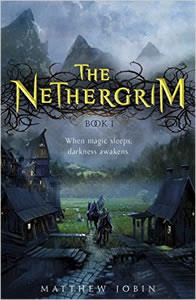
Series: The Nethergrim (Book 1)
Published by Puffin Books
Paperback: 368 pages
Age Range: 10 and up
February 5, 2015; $8.99 US/$9.99 CAN; 9780142422687

Description
The Next Great Fantasy Epic is here! For fans of Ranger’s Apprentice and the Chronicles of Narnia.

Everyone in Moorvale believes the legend: The brave knight Tristan and the famed wizard Vithric, in an epic battle decades ago, had defeated the evil Nethergrim and his minions. To this day, songs are sung and festivals held in the heroes’ honor. Yet now something dark has crept over the village. First animals disappear, their only remains a pile of bones licked clean. Then something worse: children disappear. The whispers begin quietly yet soon turn into a shout: The Nethergrim has returned!

Edmund’s brother is one of the missing, and Edmund knows he must do something to save his life. But what? Though a student of magic, he struggles to cast even the simplest spell. Still, he and his friends swallow their fear and set out to battle an ancient evil whose powers none of them can imagine. They will need to come together–and work apart–in ways that will test every ounce of resolve.

In a story reminiscent of the Ranger’s Apprentice epic and the Chronicles of Narnia, Matthew Jobin weaves reality, magic, and adventure into the next great fantasy phenomenon.

The Skeleth
By Matthew Jobin
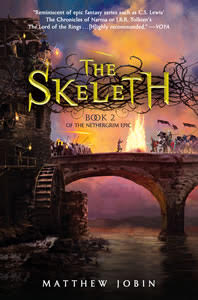
Series: The Nethergrim (Book 2)
Published by Philomel Books
Hardcover: 400 pages
Age Range: 10 and up
May 10, 2016; $17.99 US/$23.99 CAN; 9780399159992

Description
Discover for yourself why reviewers are comparing The Nethergrim to Lord of the RingsNarnia, and Ranger’s Apprentice! The next great epic fantasy is here . . .

For the lords of the north, land is power. The Nethergrim, now awoken and free to wreak its evil upon the world, offers the promise of victory to those ruthless enough to accept its foul bargain. One ambitious lord, eager for the chance to conquer and rule, succumbs to temptation and helps to free the Skeleth — eerie, otherworldly beings said to be unstoppable in battle. The Skeleth merge with the bodies of their victims, ruling their minds and turning them into remorseless killers. Worse yet, to kill the man inside the Skeleth only frees it to seize a new host, starting a cycle of violence that has no end.

Such chilling tales are not enough to stop young Edmund, innkeeper’s son and would-be wizard, from seeking for a way to turn back the oncoming tide of destruction. Along with his best friends — Katherine the trainer of war-horses and Tom the runaway slave — Edmund searches for a magical weakness in the Skeleth, something that might allow him to break their never-ending curse. The three friends join with the legendary hero Tristan in a battle of courage, wisdom, wits, and sacrifice to stop the Skeleth from ravaging their homeland and all they hold dear.

This adventurous tale that marries earthly greed to otherworldly evil is perfect for fans who enjoy the epic worlds of John Flanagan’s Ranger’s Apprentice, Robert Jordan’s The Wheel of Time, J.R.R. Tolkien’s The Lord of the Rings, and George R.R. Martin’s Game of Thrones. Discover for yourself why so many are making the comparisons!

Thank you Matthew for this thought-provoking post!

Kellee Signature andRickiSig

Author Guest Post!: “Finding the Joy in Writing” by Laurisa White Reyes, Author of The Kids’ Guide to Writing Fiction

Share

“Finding the Joy in Writing”

Any parent knows that if you want a kid to really hate something, just tell him he has to do it, or else. That was my son’s reaction when I told him he had to write a five paragraph essay. My instructions were met with so much whining and moaning you would have thought I’d asked him to scrub the bathroom with a toothbrush. His reaction, however, was not an unusual one. Many parents can attest to their children’s seemingly built-in aversion to writing. While some kids seem naturally drawn to writing, others would rather carry a load of rocks up a mountain than write a compound sentence. This is why I wrote The Kids’ Guide to Writing Fiction, because within every child is a story waiting to be told, whether they realize it or not.

Make Writing Fun

Remember the classic children’s film Mary Poppins? Jane and Michael Banks live in turn of the century London. These conniving pranksters manage to chase away every nanny their father hired for them. Their parents are at their wits’ end. Then Mary Poppins arrives. One of the first tasks she requests of the children is to pick up their room. Jane and Michael balk and whine. To them it is a tedious, pointless chore. What does Mary Poppins do to change their attitudes? She throws in a spoonful of sugar and makes the whole thing a game. In no time at all the room is clean and the children are tucked neatly in their beds.

Now, obviously, real life doesn’t work quite like that. We have no magical carpetbag from which to pull out hat racks and measuring sticks. But as parents and/or educators, we do have the same power as Mary Poppins to create an atmosphere of cooperation and optimism in our homes and classrooms. Whether or not our children will hate what we ask them to do, or do it willingly and cheerfully, depends largely on us.

I started teaching creative writing classes to children and teens about the same time my son was learning to write those essays. I looked for ways to encourage my students to write, and met with great success. Once I applied what I was using in my classes to my son, his attitude toward writing changed. And although it is still not his favorite activity, he has become a capable and skilled writer.

Writing is a Means of Self-Expression   

Writing well demands that the writer enjoy writing. When writing is nothing more than an assignment with no purpose except to earn a grade on a report card, chances are that the student will come to dread writing. He will view it as chore, just like washing the dishes or making his bed.

Is this the attitude we want our children to have about writing? Do we want them to write five-paragraph essays just for a grade? Is that really the purpose of a writing education? Of course not. The ultimate goal is for our children to feel confident in their writing skills, to use writing as a means of self-expression. But to achieve that goal requires that we, as adults, help our kids find the joy in writing.

In my writing classes, I taught students how to write. I did not, however, grade anything, nor did I spend much time critiquing their work. In fact, my students didn’t even realize they were learning to write well, because they were so excited about what they were doing. Over the years, I’ve heard from many of my students’ parents about how their children were transformed from reluctant writers to kids who wouldn’t put their pencils down. The key to this transformation was that I made writing fun.

To me, there is nothing more enjoyable than sitting alone at my computer in the middle of the night to write. I would rather do that than just about anything else. The question is, how do we transfer this love of writing to our kids?

The first step in helping kids write well is to take writing out of the picture. Writing is a means to an end, a tool for getting what is inside someone’s head onto paper. What’s really important is the message or information writing conveys.

Think of words as clay. Clay by itself is nothing but a gray lump on a potter’s wheel. But in the hands of the potter, the clay begins to take shape. If the potter doesn’t like the form, he can squash it and start all over again. He can do this over and over until he gets it just right. Once it is finished and the piece is fired and glazed, we see not the lump of clay, but a beautiful piece of art or a functional object, such as a vase.

Writers use words to create something beautiful and useful. They are not as concerned with the words as they are with the finished product. When children focus on that finished product, be it a poem or essay or story, words become tools, the medium by which they can bring their dreams to life.

The Storyteller Within

One the most effective ways to help kids fall in love with writing is by helping them discover the storyteller within. We are all storytellers. A storyteller is someone who relates events in a logical order to someone else. Think about the last time you told a friend about a movie you a saw, or an event you attended, or even just something that happened that was interesting. How did you share that information? Most likely, you told it in the form of a story.

The reason so many children and teens are averse to writing, particularly in school, is because they have not yet tapped in to their own natural storytelling abilities. That is my objective with The Kids’ Guide to Writing Fiction. In this book, I teach kids about the six fundamental building blocks needed to create stories: characterization, setting, plot, perspective, imagery, and dialogue. I take them step-by-step through the process of crafting a story and help them excavate their own imaginations for ideas. Then I help them put those ideas into words and onto paper.

Once a child has written a story of his own, he feels a great sense of satisfaction. He discovers that writing is fun. This discovery is what can tear down the walls of resistance and self-doubt, and can build confidence in his ability to learn other forms of writing, such as those dreaded 5 paragraph essays.

The ultimate goal of a writing education is to teach kids to write well, but if they hate writing, that goal is nearly impossible to achieve. However, once a child discovers the joy of tapping into his own creativity, then, like Mary Poppins’ carpet bag, writing becomes limitless…and magical.

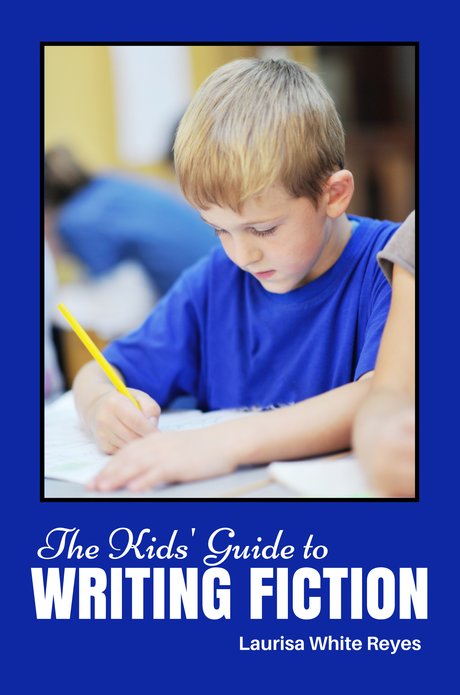
The Kids’ Guide to Writing Fiction

rsz_front_cover

About the Book: We are all storytellers. Whether weaving mythologies in ancient times or describing the plot of a favorite movie today, humans have, since the beginning of time, loved to tell stories. In The Kids’ Guide to Writing Fiction, students explore the building blocks needed to construct a story: characterization, setting, plot, perspective, plot, imagery, and dialog. Then, using these building blocks, they create their own stories.

Accessible to both the struggling student and the budding novelist—as well as to teachers, parents, and even adult aspiring writers, author Laurisa White Reyes presents key elements of story writing and clarifies them with examples and worksheets. Concepts are explained in simple, clear language while gently introducing vocabulary words.The Kids’ Guide to Writing Fiction offers welcome guidance to storytellers of all ages.

Links:
Twitter: @lwreyes


P10 (2)

About the Author: Laurisa White Reyes is the author of four novels for young readers, including the 2015 Spark Award winner, The Storytellers. She is also the author of The Kids’ Guide to Writing Fiction & Teaching Kids to Write Well: Six Secrets Every Grown-up Should Know. In addition to writing, she also manages to squeeze time into her busy life to teach college English; run her own editorial/publishing business, Skyrocket Press; and be mom to her five children. You can learn more about her at: www.LaurisaWhiteReyes.com.

Thank you to Laurisa for this very helpful post!

RickiSigandKellee Signature

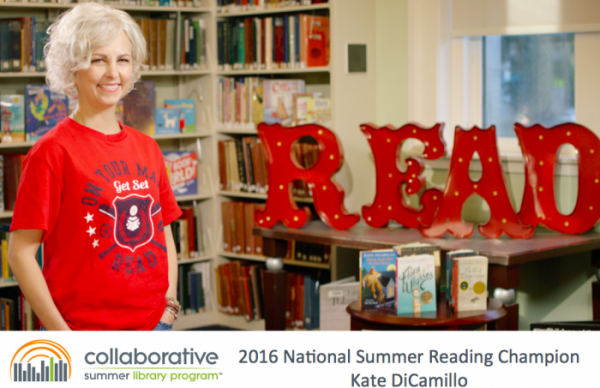
Kate DiCamillo: Collaborative Summer Library Program Summer Reading Champion for 2016

Share

Screen-Shot-2015-12-13-at-1.01.23-AM-e1452184891507 
Two-time Newbery Medalist, former U.S. Ambassador for Young People’s Literature, and bestselling author Kate DiCamillo has  another title to add to her growing list of accomplishments. She is the 2016 National Summer Reading Champion for the Collaborative  Summer Library Program (CSLP) for the second year in a row.

“I know this sounds kind of funny,” says DiCamillo, “but I feel like I was born to be the CSLP Summer Reading Champion. The library was such a magical place for me as a kid—a place of possibility, safety, and promise. And my being a Summer Reading Champion is all  about hoping that kids and their families will get the chance to feel the same way about their own local library. Kids and libraries belong together all year long, but the summer is particularly special—a time of freedom and fun in reading. And freedom is how lifelong readers are made.”

CSLP is a nonprofit consortium of state libraries that work together to provide an annual unified summer reading theme and professionally created, evidence-based materials for member libraries to enable them to provide high-quality summer reading programs to their communities at the lowest possible cost. They reach approximately 15,000 member libraries nationwide, representing all fifty states.

The 2016 theme is “On Your Mark, Get Set . . . Read!” CSLP has created a comprehensive array of resources for libraries to use in their summer reading programs, including program ideas, booklists, posters, clip art, and activities for four age groups, from babies to adults. All materials are available in English and Spanish. DiCamillo has provided a top ten list of reasons to join a library summer reading program and will also create a list of her favorite recommended summer reads for 2016.

“We think the 2016 theme is perfect for an Olympic summer and have created a host of materials that are easily adaptable to any community,” says CSLP board chair and Mississippi Library Commission’s Senior Library Consultant Mac Buntin. “We’re absolutely thrilled to have Kate DiCamillo as our Champion. Her passion for summer reading and love of libraries—and librarians—is inspiring and infectious.”

Turn learn more about CSLP, visit their website at http://www.cslpreads.org and view the official press release here.

As a fan of DiCamillo, including her newest Raymie Nightingale, we are so happy to see her promoting not only summer reading, but book and library love in general. 

Kellee Signature


Author Guest Post!: “Taking the Fear out of Shakespeare” by Stephanie Kate Strohm, Author of The Taming of the Drew

Share

“Taking the Fear out of Shakespeare”

When I started writing The Taming of the Drew, I had a very specific audience in mind. If I’m being perfectly honest with myself, I was writing it for me at sixteen.

The Taming of the Drew is a reverse-gendered retelling of The Taming of the Shrew set at an outdoor summer Shakespeare theatre in Vermont, where the backstage hijinks begin to mirror the plot playing out onstage. All of the characters have recently graduated from high school and are one hundred percent bonkers obsessed with theatre, just like I was. I was a passionate reader as a teen, but I never read any books about teens who were really into acting, and believe me, I would have loved one. So I set out to write The Taming of the Drew for past me, and, hopefully, any high school drama dorks who are currently caking on the foundation before the curtain goes up on their production of Much Ado About Nothing.

I’m not just a writer; I also work at a high school on the west side of Chicago. When my students asked me what my book was about, I found out that none of them had heard of The Taming of the Shrew – most of them, in fact, only had a vague idea of who Shakespeare was, and the ones who did know Shakespeare were most decidedly not fans of his. But the more I talked about my book, the more I realized I’d actually been writing for a different audience.

I was a Shakespeare nut from an early age – a freakishly early age – but I was first exposed to Shakespeare not from reading his plays, but from Charles and Mary Lamb’s Tales from Shakespeare. I loved the stories I read about exiled sorcerers and tragic kings. They were like fairy tales, and I devoured them. Thanks to those books, I loved Shakespeare before I’d heard a single line of his or watched any of his plays. By the time 10 Things I Hate About You came out in 1999, I was twelve and already a pretty advanced Shakespeare snob, but I loved that movie. Still do. I remember feeling a sense of supreme vindication when it came out. “See?!” I practically shouted at my friends. “Shakespeare is cool! I told you so!”

If students are first introduced to Shakespeare as seniors in a high school English class, it can be kind of a shock. The language is weird. It seems like too much effort to try and understand what anyone is saying.   Frankly, the whole thing is intimidating. Shakespeare is so scary there’s even a whole series of books called No Fear Shakespeare! But I was never afraid of Shakespeare because I didn’t know I was supposed to be.

Several summers ago I taught the five to eight year old age group at the summer camp at MaineStage Shakespeare, an outdoor summer Shakespeare theatre in Kennebunk, Maine. Many people are surprised that five year olds attended a Shakespeare camp, but they made magnificent fairies in A Midsummer Night’s Dream. We wrote silly plays and learned fairy dances, but they also declaimed lines from Richard III in their vocal classes and offered lots of opinions on the nuances of Titania and Oberon’s relationship. They didn’t know Shakespeare was supposed to be hard. They knew he wrote funny stories about guys with donkey heads.

I wish we could some how introduce all five year olds to Shakespeare before they know he’s “supposed” to be scary. I realize, of course, that’s insanely unrealistic – but rest assured, if I ever become the benevolent dictator of this country, that will certainly be part of the program – but I also know there are ways to show that Shakespeare isn’t scary. That’s why I’m such a huge fan of retellings. Retellings are a great way to introduce reluctant readers who might otherwise balk at Shakespeare to the world of his plays. I know there isn’t a guarantee that everyone who reads Saving Juliet by Suzanne Selfors or The Fool’s Girl by Celia Rees or Ophelia by Lisa M. Klein will immediately search out the original source material, but I think it’s definitely a step in the right direction. The more the stigma of “scary” gets taken out of the conversation, the better students will fare when they’re inevitably staring down a Macbeth monologue in English class.

I had thought I was writing The Taming of the Drew for students like I had been, who have the entirety of Juliet memorized “just in case.” And if those students find the book, I really hope they like it. But I realized later on that this book is just as much, if not more so, for readers who have only the vaguest idea of who Shakespeare is, or who actively dislike him and his frequent usage of the word “forsooth.” I hope this book becomes somebody’s 10 Things I Hate About You: a pop culture gateway drug into classical theater.

“This sounds funny, Ms. Strohm,” one of my students said after I explained the plot of The Taming of the Shrew. “I can’t believe he ripped up her clothes like that. He’s crazy.”

“You think that’s crazy?” I asked. “Let me tell you about a guy named Titus Andronicus.”

And so I did.

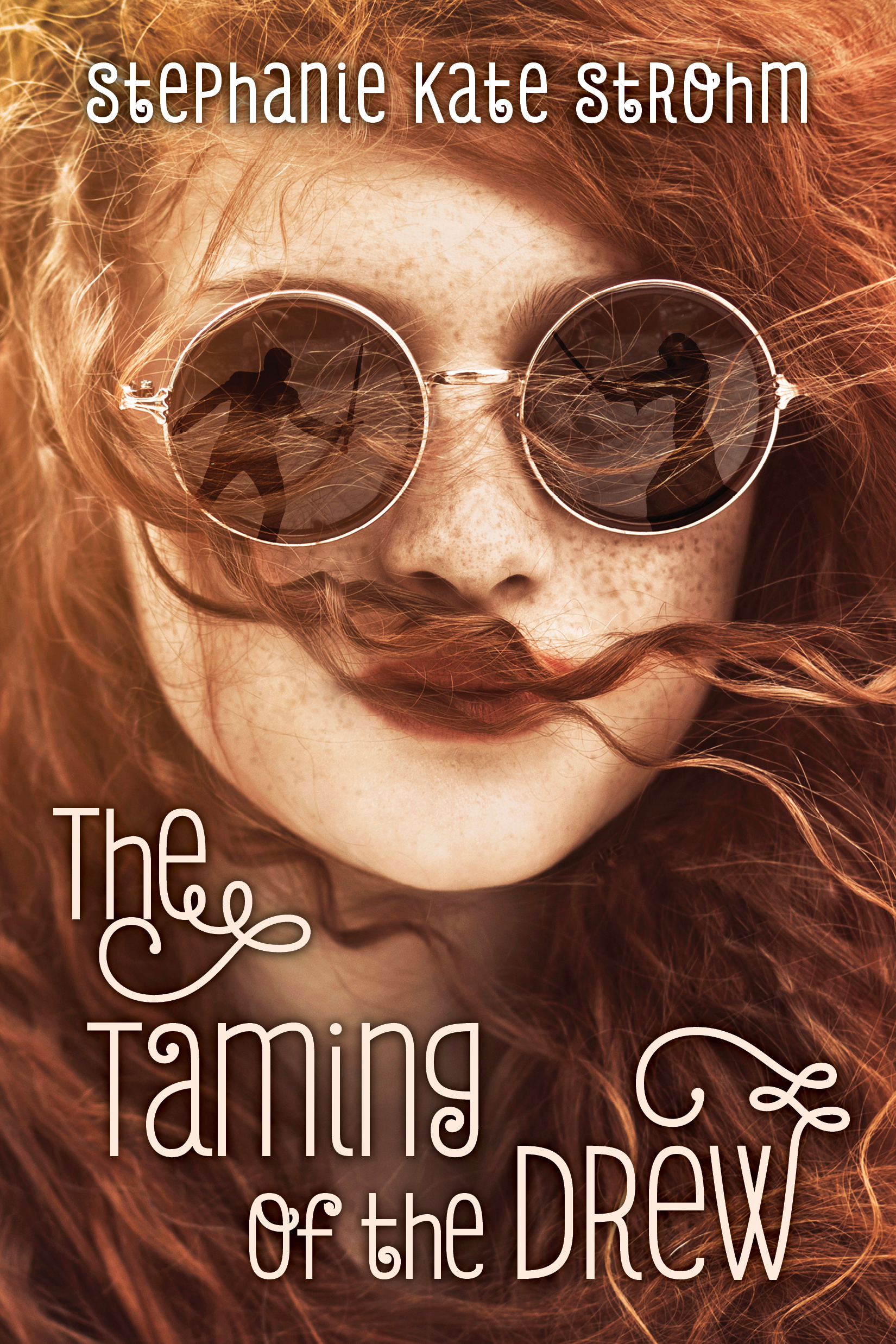
The Taming of the Drew

Taming of the Drew_REVISED

About the Book: Cass McKay has been called stubborn, temperamental, difficult, and that word that rhymes with “witch” more times than she cares to count. But that’s all about to pay off. She has finally landed the role she was born to play—Kate, in The Taming of the Shrew—in the summer apprentice program of a renowned Shakespeare theater company in the forests of Vermont.

But Cass can barely lace up her corset before her troubles begin. Her leading man, Drew, is a complete troll, and he’s going to ruin Cass’s summer. Even worse, Cass’s bunkmate Amy has somehow fallen head over heels for Drew. Cass can’t let Amy throw herself at a total jerk, so she comes up with a genius plan to give Drew the personality makeover he so desperately needs: they’ll tame Drew just as Petruchio tames Kate! But as Shakespeare’s classic plays out offstage, Cass finds it harder and harder to resist falling for Drew herself.

The best kind of entertainment, The Taming of the Drew is smart, funny, fresh, and original. You’re going to love this badass heroine and her friends. You might even end up liking Drew, too.


stephanie kate strohm

Author Stephanie Strohm photographed for her “Pilgrams don’t wear Pink” book. Copyright Melissa Lynn 2011

About the Author: Stephanie Kate Strohm is the author of Pilgrims Don’t Wear Pink and Confederates Don’t Wear Couture. She graduated with a dual degree in theater and history and has acted her way around the United States, performing in more than twenty-five states. She currently lives in Chicago with her fiancé and a dog named Lorelei Lee.


Thank you to Stephanie for this honest post. 

Thank you to Cheryl at Skyhorse Publishing for connecting us with Stephanie!

RickiSigandKellee Signature

Author Guest Post!: “Science Fiction and Science Fact: World-building in The Riven Chronicles” by Amalie Howard

Share

“Science Fiction and Science Fact: World-building in The Riven Chronicles”

According to the laws of physics, time travel and inter-dimensional travel are both possible. Having been a science fiction fan for most of my life (Star Wars, Dune, Aliens, and The Fifth Element all grace my top 10 movie list), when I wrote The Riven Chronicles, I knew the world-building and the concept of jumping between universes, had to be complex but relatable, especially for a young adult market. As a fiction writer, any world has to have rules, and those rules have to be consistent or the world falls apart. So step one was definitely research.

I really disliked physics in high school. Disliked is probably an underestimation—I loathed it. During class, I took excessively long bathroom breaks. At home, I agonized over pages of homework I could barely understand. And yet, when I was researching worm holes and parallel universes for The Almost Girl, the first book in my series, I found myself completely fascinated by the laws of physics—a nightmare realm that had instigated far more than its fair share of cold sweats during my teen years. I became sucked into a deliciously dark underworld of sub-quantum mechanics, astrophysics, advanced robotics, nanotechnology, and claytronics.

Building off of Albert Einstein’s space and time theories, physicists throughout history have been hell-bent on reverse engineering the universe and explaining it at its most basic level—discovering the so-called Theory of Everything. Who knew that Hugh Everett’s “Many-Worlds Theory” was an interpretation of quantum mechanics where every possible outcome could happen causing multiple universes (though we wouldn’t be aware of them)? Or that Michio Kaku would come up with String Field Theory demonstrating that gravity could interact between two parallel universes? Or that Stephen Hawking would contend that wormholes exist in a phenomenon called quantum foam? Mind blown. Literally.

Using quantum theory and the microscopic gaps in the universe to allow two distinct points in time and space to connect, I could jump off of Kaku’s string theory, and bolster it with Kip Thorne’s theories of anti-gravitational quantum vacuums to engineer my wormholes, and then tie it into zero-point energy as my “launch” spots to jump between universes (for which I invented the term eversion). Ultimately, I had to take whatever theory I decided to use and make it work for my intended reader. I was looking for complex simplicity—something rooted in the laws of physics, but also accessible to my readers of any strata … meaning making it credible for savvy, erudite sci-fi readers and making it relatable for high-concept teen ones. It was a delicate balance.

Here’s an excerpt from The Almost Girl where I explain this element in my mythology.

A picture forms on the flat-screens in the center of the room. It looks like an hourglass broken up into small squares. “That is a two-dimensional drawing of a traversable wormhole. It’s basically a bridge in space with two different end points. Think of the universe as made up of an infinite number of universes. Some of these universes are coupled by a gravitational field, which means that we can communicate between them.” […] “How it works is a whole other story. We’re talking string theory and sub-quantum mechanics, basically the relationship between space-time, gravity, energy, and matter.”

~ The Almost Girl

As I indicated earlier, I also came up with the concept of “eversion” or “to evert,” which in my mythology means to jump between universes. It’s based on the words trans-inversion (reversal of position) and trans-eversion (turning inside out). I knew I wanted something unique that would work within my framework and wouldn’t be something too generic. I wanted the word to convey an inimitable sense of what it intended—not just something as ordinary as jumping. The word itself had to be a process, one of flipping inside out, and one that conjured thoughts of its own journey.

All in all, writing The Riven Chronicles was an incredible learning experience, especially as it related to science fact and science fiction. I learned that the world of physics is a fascinating one, and that there is so much more to who we are and the universe in which we exist.  I learned that something you experience in middle school or high-school could evolve into something extraordinary when approached in a different way—even something as painful as physics (gasp). I learned that science fiction is an awesome space to be in as a writer—it’s a world of infinite possibility with so many opportunities to create. I’m pretty sure that we aren’t the only intelligent life out there, whether that’s in alternate or parallel universes, or in other galaxies. And until that’s proven, for now, I’ll continue to exist in the universes of my own making.

Howard, Amalie - Alpha Goddess

About the Author: Amalie Howard is the award-winning Indie Next author of Alpha Goddess, the Aquarathi series, and the Cruentus Curse series. Her debut novel, Bloodspell, was an Amazon bestseller and a Seventeen Summer Read. Visit her website at www.amaliehoward.com and follow her on Twitter at @AmalieHoward.

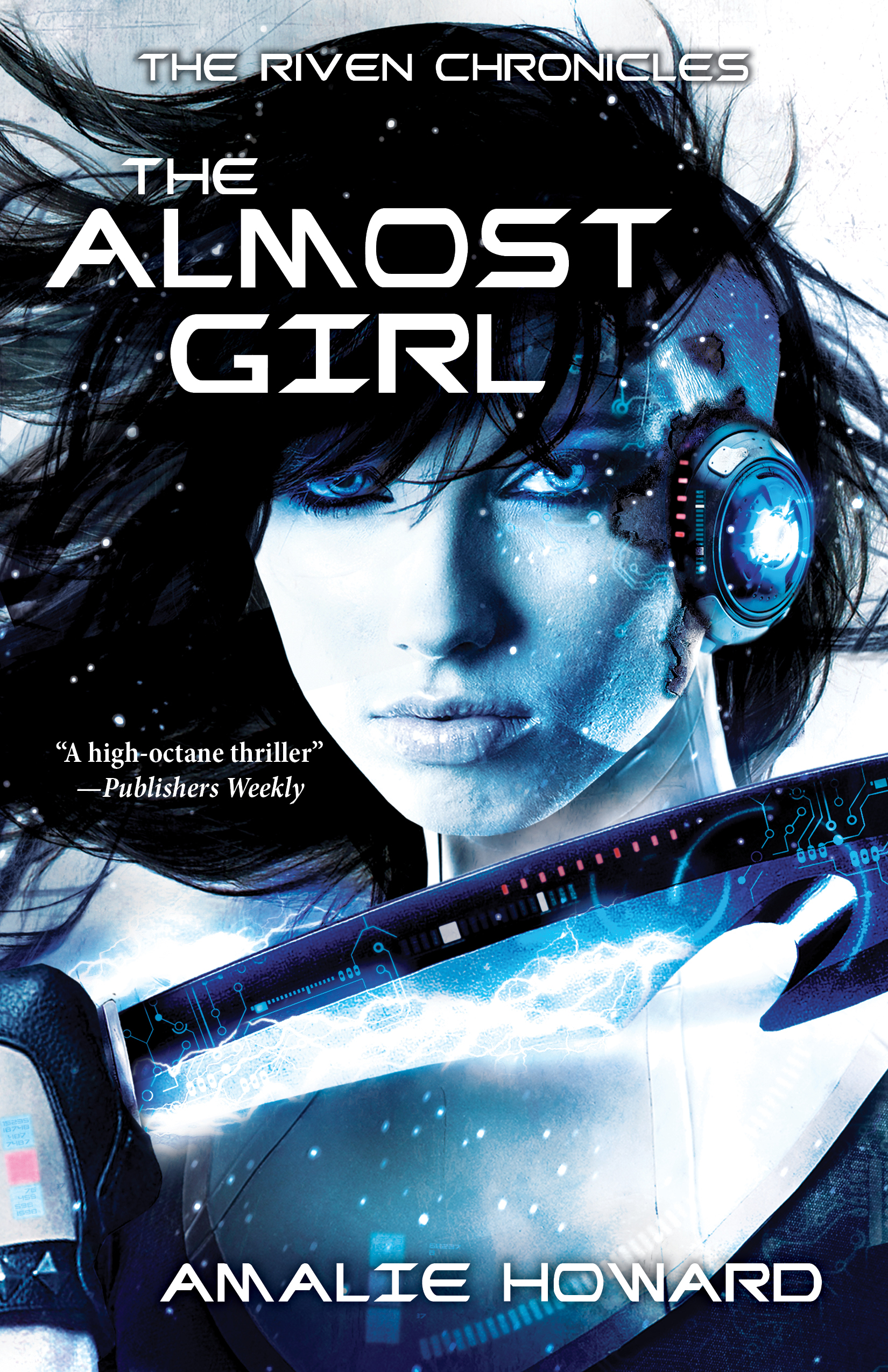
Almost Girl 9781510701717 FallenPrince_cover

About The Almost Girl: Seventeen-year-old Riven comes from a world parallel to Earth, a world that has been ravaged by a devastating android war. As a Legion General, she is the right hand of Prince Cale, the young Prince of Neospes. In her world, she’s had everything: rank, responsibility, and respect. But when Prince Cale sends her away to rescue his long-lost brother, Caden, who has been spirited to modern day Earth, Riven finds herself in uncharted territory.

Armed with the mindset of a soldier and racing against time to bring Caden home, Riven must learn how to blend in as a girl in a realm that is the opposite of all she’s ever known. Will she be able to find the strength to defy her very nature? Or will she become the monstrous soldier she was designed to be?

About The Fallen PrinceWhen a new enemy threatens her home, Riven’s only hope may be the man who made her a monster.

Riven has fought for a hard-won peace in her world, and has come to shaky terms with who and what she is—a human with cyborg DNA. Now that the rightful ruler of Neospes has been reinstated, Riven is on the hunt for her father in the Otherworld to bring him to justice for his crimes against her people.

But when she receives an unwelcome visit from two former allies, she knows that trouble is brewing once again in Neospes. The army has been decimated and there are precious few left to fight this mysterious new threat.

To muster a first line of defense, her people need help from the one person Riven loathes most: her father. But what he wants in return is her complete surrender. And now Riven must choose: save Neospes or save herself.

This exciting sequel to The Almost Girl combines science, action, and romance in a compelling, hard-to-put-down package.

Thank you to Amalie for the guest post! 

Kellee Signature andRickiSig

Blog Tour, Giveaway, and Author Guest Post!: “When Characters Come Alive” by Beth Vrabel, Author of Camp Dork

Share

BT-PackofDorks-BethVrabel_FINAL

“When Characters Come Alive”

“Do Lucy and Alice know each other?”

A young reader asked me this recently when I met with their class to talk about writing and reading. The students had read Pack of Dorks as a classroom read-aloud and several of them went on to read A Blind Guide to Stinkville on their own.

The grin on my face had to look ridiculous as I tried to figure out how to answer this question. Did Lucy, my snarky and loyal protagonist in Pack of Dorks, know quiet and brave Alice from A Blind Guide to Stinkville?

Luckily another student piped in. “There is no way they’d like each other, if they have met. Alice is way too mature for Lucy.”

“But Alice and Sam would get along,” replied the first student, mentioning Lucy’s best friend.

“Actually,” I said, and there really is no word to describe the thrill pulsating through me at that moment. “Sam and Alice are cousins.”

“What?” they said together, minds blown.

I nodded. “Look for clues in Camp Dork.”

As an author, that was the best conversation ever, one that’s making me grin like a scary clown as I write about it now. These readers weren’t asking if Alice and Lucy would meet in further books. They wanted to know if they knew each other now, in the land fictional characters live when we close our books. To them, Lucy and Alice aren’t personas I created. They’re real.

I see the same thing in my son when he talks about his current literary obsession—Harry Potter. “I wish he’d be a little more careful with his Invisibility Cloak,” he mused as I put him to bed. “It makes me nervous that he just leaves it lying around.”

Ask my son anything about Harry Potter, and he can immediately give you the answer. What’s in his pocket? “A golden snitch.” What’s on his bedroom floor? “Chocolate Frog wrappers.” What’s his biggest fear? “Dementors.”

This ability to talk about characters with the same conviction and intimate understanding we would use to describe as our friends happens because of one thing: Voice.

When a character has a distinctive and authentic voice, not only do the stories become alive, so do the characters.

Finding that voice is the hardest aspect of writing for me. Even writing the dreaded synopsis is easier than this essential step.

It’s tricky because it feels like I’m not working. It feels—and looks like—a lot of staring into space, eating candy and drinking coffee. But really, I’m thinking of my characters, trying to unravel what makes them meaningful, how they view the world, what makes them unique.

Assigning them quirks is easy. Making those quirks meaningful and capable of moving forward characters’ stories is tough.

A Blind Guide to Normal (releasing in October) tells the story of Ryder Raymond, a fourteen-year-old boy who always has a pun or a joke at the ready. The reason for this is pretty obvious: He wants to make you laugh before you can laugh at him.

But sometimes, as an author, I’m the only one who understands a character’s quirks. Take for example Sheldon in the Pack of Dorks series. He is completely obsessed with dinosaurs. He wears shirts with iron-on dinosaurs and shoelaces with dino prints. Every conversation with Sheldon will eventually go back to dinosaurs. I haven’t yet shared in the series why Sheldon is obsessed—how when he was a toddler, he and his dad used to go for walks looking for tracks and spend hours playing with toy dinosaurs. I haven’t mentioned that Sheldon’s dad isn’t part of his life any more, but the dinosaurs still are. But I know that, and it helps me move Sheldon through the series.

When I’m to the point where I can talk about my characters the way those students did Lucy and Alice—putting them in new situations and seeing how they’d respond—only then am I able to write their stories.

And it’s only when I see that these characters have blossomed to life for readers, too, that I know all that space-staring potato-chip-eating coffee-drinking was time well spent.

Young writers who are just beginning to tap into their own ability to story tell might benefit from continuing the stories of characters they already know and love.

I remember doing this myself when I was in middle school.  Winnie Foster went on to have many more adventures in my mind after finishing Tuck Everlasting. I told myself stories about her growing older, times when she would run to the stream and debate drinking from it. Times that she was so glad she never had.

Another classroom I visited offered up another pinch-me moment as an author. The students told me they loved to play Pack of Dorks at recess, taking turns being Lucy, Sam and the rest of the gang. The character most coveted was Lucy’s baby sister Molly.

The teacher told me she encourages them to put these new adventures on paper during classroom free writing time. What an incredible idea!

Young writers given the freedom to continue their favorite characters’ stories will no doubt give them the confidence to tap into their own storytelling, find their own voice.

“I still think Lucy and Alice should meet,” the student told me as our classroom discussion ended. “It’d be a good story.”

“I think so, too,” I told her. “And you should write it.”

Camp Dork

Pack of Dorks Camp Dork

About the Book: 

Lucy and her pack are back, in this sequel to Beth Vrabel’s heartwarming and humorous debut, Pack of Dorks. Sheldon convinces Lucy, Sam, April, and Amanda to join him at a weeklong sleep-away summer camp—Camp Paleo: Live Like a Caveman. Like cavemen, they’re going to have to make do without air conditioning or a heated pool. They’ll learn archery and dig for fossils. And Grandma’s coming too; she’s taking a job as lunch lady for the camp next door.

At the last minute, Sam backs out to go to a gymnastics training camp instead. Lucy wonders why she misses him so much—it’s not like he’s her boyfriend or anything. Why does the word “boyfriend” make her blush, even when she’s only thinking it? She needs a distraction. Enter Mr. Bosserman, the grouchy camp leader who won’t budge on the caveman aspect of the camp. The old man needs some softening up, and Lucy knows just the person for the job: Grandma.

One successful match made, Lucy starts to see potential lovebirds everywhere. And setting up couples keeps her from facing the question tickling the back of her mind: Is she in love with Sam? But when the wrong campers fall for each other, the pack falls apart, all under the watchful eye of a super secret blogger who’s been writing about the camp’s activities Gossip Girl–style. Even worse? A thief is targeting everyone but Lucy, setting her up to look guilty. Soon Lucy again finds herself alone, left to fix the messes she’s made and face her own feelings. If she fails, the pack may be splintered for good.

For readers aged 8 to 12, this is a funny but poignant book about bullying, crushes, the harmful nature of rumors, and the importance of friendship and telling the truth. A great book to read aloud in the classroom for discussions or to simply read on a summer trip.

Goodreads Link: https://www.goodreads.com/book/show/25898670-pack-of-dorks

Giveaway!:

a Rafflecopter giveaway


Beth_Vrabel

About the Author: Beth Vrabel grew up in a small town in Pennsylvania. She won a short-story contest in fourth grade and promptly decided writing was what she was going to do with her life. Although her other plans–becoming a Yellowstone National Park ranger, and a professional roller skater–didn’t come to fruition, she stuck with the writing. Beth’s backround is journalism and was editor of two regional magazines and a lifestyle columnist. Beth now writes full time.

Her books include Pack of Dorks series and A Blind Guide to Stinkville (Sky Pony Press). Her latest release, Camp Dork, hit bookstores in May.

A Blind Guide to Normal releases in October.

Author Links:

Website: www.bethvrabel.com

Facebook: https://www.facebook.com/AuthorBethVrabel/

Twitter: https://twitter.com/beth_vrabel

GoodReads: https://www.goodreads.com/author/show/7710163.Beth_Vrabel

Instagram: https://www.instagram.com/authorbethvrabel/

Thank you to Beth for this post. We hope our readers enjoyed her conversation with these students as much as we did! We’ve been fortunate to feature Beth on the blog before. Please check out her other guest post, “My Son’s Teacher’s Approach to Reading.

Thank you to Lisa at Tasty Book PR for connecting us with Beth!

RickiSigandKellee Signature

Author Guest Post!: “Reading the Middle Grade Mind” by Sally Barlow-Perez, Author of The Unintended Runaways

Share

“Reading the Middle Grade Mind”

Have you ever tried to steer one of your favorite kids toward one of your favorite books? You’re in eager enthusiasm mode. “Hey, you are going to LOVE this book!”

Then the kid rears back, looks like you asked him to drink a glass of hot chalk, gives you that look, and says, “Uh, thanks, but I don’t think so.”

Just like adults, kids pick books for their own reasons. And timing is everything. One week a reader might feel like something light that reflects familiar problems like, The Mother Daughter Book Club series; the next week he or she might relish the challenges of Wonder or maybe a visit to a whole to universe in The Lightning Thief or something as wacky as one of the Wimpy Kid books. It all depends on mood, just like it does with you and me. Or stress level. Or time availability. I’ve seen a 9-year old read and enjoy a Babysitter Club book – standard 3rd grade level reading—during a school week, and Wonderstruck— 5thgrade level reading–on her vacation. Makes sense. You and I don’t read Dostoevsky when we barely have time for lunch. Middle grade readers thrive on a huge variety of choice. Which is lucky, since as authors, we are just as eclectic as our young readers!

That said, I am sure there are those of us who try to shake loose a few practical thoughts before we set pen to paper to write our deathless prose. No doubt, in addition to prayer, you’ve tried to psyche out just where that sweet spot in middle grade literature is. Sure, there are trends and the Goodreads lists and I’m sure there are some left-brain writers out there who can successfully write to the formula. But since I’ve always favored on-the-spot research, I thought I’d go directly to the source: my sixth grade consultants: Sarah, Haley, Carolyn, Mia and Emily. “What have you been reading lately?” I asked them. These are just a few samples of the many titles they sent me:

  • Escape from Mr. Lemoncello’s Library by Chris Grabenstein
  • I Will Always Write Back:  How One Letter Changed Two Lives by Martin Ganda
  • The Agony and the Ecstasy by Irving Stone.
  • The Port Chicago 50 by Steve Sheinkin
  • School of Charm by Lisa Ann Scott
  • Black Beauty by Anna Sewall
  • Little Women by Louisa Mae Alcott
  • Number the Stars by Lois Lowry
  • Hope is a Ferris Wheel by Robin Herrera
  • The Hunger Games by Suzanne Collins
  • Wonder by R.J. Palacio
  • The Egypt Game by Zilpha Keatley Snyder

Sure, it’s a girls list; not much blood and guts there but look at the variety. From dystopia to Victoriana to the serious issues of an adolescent with a disability to pure escapism. Irving Stone, no less! Remarkable that reading tastes could vary so widely among such friends from the same school in the same grade with such similar backgrounds. My point being, that predicting subject matter that will appeal to every middle grader is a losing proposition.

Picture this—and if you’ve taken your children or your students to the library, you’ve seen it many times. A middle grader sitting on the floor between the stacks taking out book after book off the shelf, looking at it very briefly, and then returning it to that empty slot among the other books. Those poor, forlorn, rejected books. Someone put his or her heart and soul into writing that book! What was wrong with it! Well, it just didn’t suit, that’s all. For reasons we, as onlookers (or the unfortunate author of said rejected volume) will never know. My conclusion: short of writing a tome on the love life of ants, I might as well forget trying to guess what will suit the middle grade reader and suit myself instead.

At the same time—trying with some difficulty to recall my past life as a lit. major—I tryed to find the commonalities in the lists of books my sixth graders sent me. It wasn’t in the eras, the settings or the subject matter. They varied from Hogwarts, to Ghana, to the rural South, to a dystopian future, to small town USA, to ancient Rome.  Lots of variety there and choice in those areas can be a matter of cover art, flap blurb or momentary whim. But in the protagonist (Lit. 101 !) I do think young people make a conscious choice to read a book featuring one of two different kinds of protagonists:

  1. A character with whom they can completely identify; someone who shares their sensibilities, their strengths, their weaknesses, and their secret feelings; someone who permits them to sigh in relief, saying, “I am not alone; Someone else feels or behaves that way too.”
    Or
  2. A character with whom they can partially identify, but who is perceived as an individual to emulate; someone with qualities to admire, or aspire to, even if those qualities are as basic as patience, or self-assurance, or courage rather than the ability to fly or fight dragons.

It might be simplistic to say that the former is featured in reading that requires a little less concentration than the latter. I’m sure there are examples either way. But the best authors show us well rounded characters who evolve and change in both cases. What a privilege it is to read the work of the many wonderful authors of middle grade fiction who make their characters come alive for us. I see my young friends absorbing Palacio’s Auggie, Hodgson Burnett’s Sara Crewe, Pullman’s Lyra, Selznick’s Ben and Rose; Riordan’s Percy, and Lowry’s Jonas and I think, “These characters are becoming part of who my young friends are.” How could they not?

I too feel as though I too have been influenced by the thousands of fictional characters that have filled me up over the years. A good number have come from middle grade books. Many from young adult books. One memorable one was the picture book that inspired my own middle grade novel, The Unintended Runaways, with its lively painting of a gypsy wagon and the carefree little girl who lived in it.

The tale that formed around that picture was the story I wanted to tell. I fought it. I’d been in marketing and public relations and I knew historical fiction was emphatically NOT in vogue. Would anyone read it? Newsletters and conferences told me I would never sell it.  “Write it anyway,” I told myself. I already had visions of the beautiful blue wagon and the big shire horse trotting down the lovely rural roads of mid-19th century England. market.

“Don’t be an idiot,” I argued back. “You’re a journalist. You wrote a history book. Get out there and write something that’ll sell. How about an academy for shapeshifters? A middle school mafia? An underground society ruled by 12-year olds? You can do it! Get with the program!”

“Yeah,” said my better self. “And it will suck, big time and you will hate every minute of it. This is 40,000 words we’re talking about.”

So I did it my way. I wrote my historical novel about 19th century young people. Unfashionable as my setting might be, I knew today’s middle graders would identify with the larger themes of justice, freedom, and family. And I hoped they would fall in love with my characters just as I did.

Thus The Unintended Runaways came into being. My sixth grade consultants – who were very generous early readers!—say they like it. (They kind of have to say that.) But the proof will be in the sales figures. Because as a general rule……

There’s just no reading the middle grade mind.

____________________________________________

Links:

Website:  www.theunintendedrunaways.com

____________________________________________

unintended Runaways

Summary: For a girl who loved adventure, twelve-year old Lia Leonides had the perfect life. Every summer, she and her grandfather traveled the rural roads of England in their gypsy wagon, stopping at fairs and selling horse brasses along the way. It was exactly the life Lia wanted, until the day a mysterious letter arrived. Lia’s grandfather warned her not to get her hopes up, but lifelong dreams are hard to ignore. Lia’s father was alive and looking for her. But when her grandfather suddenly passes away, Lia is sent to work as a servant in an orphanage and is left with a choice that she never wanted to make: let the world decide her future for her, or run away and decide it for herself? Lia, with the help of her beloved pets and some unexpected friends, must take her gypsy wagon south on a harrowing journey before her father disappears forever. A persistent sheriff and the constant threat of misfortune won’t make the trip easy, but Lia and her friends don’t plan to let anything stop them from forging their own destinies.

____________________________________________

sally b-p

About the Author: Sally Barlow-Perez openly admits that books have taken over a good chunk of her life. She gobbles down two or three library books a week, ranging in genre from young adult, to middle grade, to fantasy, to mystery. She tries to balance her book obsession with writing, hiking, and hanging out with the young people who inspire her. But no matter how hard she tries, she always comes back to books. As a fiction writer, Sally’s focus is curiosity. “Curiosity is a great excuse for writing, as well as for reading,” she says. “Even when I finish a book, I still wonder what the characters are doing!” Sally makes her life in Palo Alto, California. She has two grown sons, whom she believes to be her greatest contribution to mankind. The Unintended Runaways is her first middle-grade novel. More information is available at www.theunintendedrunaways.com.

Thank you Sally for this insightful guest post!

Kellee Signature andRickiSig