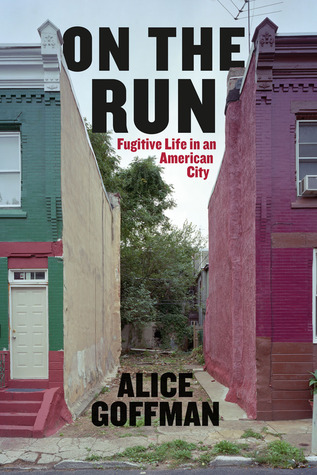
On the Run: Fugitive Life in an American City
Author: Alice Goffman
Published: May 1, 2014 by University Of Chicago Press
Summary: Forty years in, the War on Drugs has done almost nothing to prevent drugs from being sold or used, but it has nonetheless created a little-known surveillance state in America’s most disadvantaged neighborhoods. Arrest quotas and high-tech surveillance techniques criminalize entire blocks, and transform the very associations that should stabilize young lives—family, relationships, jobs—into liabilities, as the police use such relationships to track down suspects, demand information, and threaten consequences.
Alice Goffman spent six years living in one such neighborhood in Philadelphia, and her close observations and often harrowing stories reveal the pernicious effects of this pervasive policing. Goffman introduces us to an unforgettable cast of young African American men who are caught up in this web of warrants and surveillance—some of them small-time drug dealers, others just ordinary guys dealing with limited choices. All find the web of presumed criminality, built as it is on the very associations and friendships that make up a life, nearly impossible to escape. We watch as the pleasures of summer-evening stoop-sitting are shattered by the arrival of a carful of cops looking to serve a warrant; we watch—and can’t help but be shocked—as teenagers teach their younger siblings and cousins how to run from the police (and, crucially, to keep away from friends and family so they can stay hidden); and we see, over and over, the relentless toll that the presumption of criminality takes on families—and futures.
While not denying the problems of the drug trade, and the violence that often accompanies it, through her gripping accounts of daily life in the forgotten neighborhoods of America’s cities, Goffman makes it impossible for us to ignore the very real human costs of our failed response—the blighting of entire neighborhoods, and the needless sacrifice of whole generations.
Review: Inspired by a college course in her sophomore year, Alice Goffman seeks an ethnographic experience in inner-city Philadelphia. She gets a part-time job tutoring an African American girl, Aisha, and soon befriends the boys of 6th Street (pseudonym). Mike adopts her as a younger sister, and she comes to live with these boys—studying their every move. This quality piece of ethnographic research is a page turner. While it reads a bit more like a book than a scholarly publication, readers can glean her methodological approach through the footnotes. Goffman’s mission is clear. She wants readers to understand the inequities these African American boys of 6th Street face, and she shows how the criminal justice system (both law enforcement and the justice/prison system) are not working. I was ashamed at the actions of the police, specifically, and think this is very educational to readers of all ages, particularly in the wake of the racially based crimes that we consistently see in the news.
Teacher’s Tools for Navigation: This book is written for adults, but I think it would be very educational for high school students. I would use excerpts of this text to show students the realities of life on 6th Street in Philadelphia. It could be used to better understand crimes in the news, to teach inequity, to examine class issues, to understand the drug trade, and to fight racism. It would be eye-opening for students. While teaching this, I would also consider pairing it with Malcolm Gladwell’s review.
Discussion Questions: What can we do to stop the injustice of the court system? How is it flawed?; What role does race play in this text?; Was Goffman too close to the subjects of her ethnography? Do you think this affected her portrayal of 6th Street? What are the positives and negatives of this approach of qualitative study?
We Flagged: “To be on the run is a strange phrase for legally compromised people, because to be on the run is also to be at a standstill.”
“Thus, the great paradox of a highly punitive approach to crime control is that it winds up criminalizing so much of daily life as to foster widespread illegality as people work to circumvent it. Intensive policing and the crime it intends to control become mutually reinforcing. The extent to which crime elicits harsh policing, or policing itself contributes to a climate of violence and illegality, becomes impossible to sort out.”
Read This If You Loved: Punished: Policing the Lives of Black and Latino Boys by Victor M. Rios; The New Jim Crow: Mass Incarceration in the Age of Colorblindness by Michelle Alexander
Recommended For: