
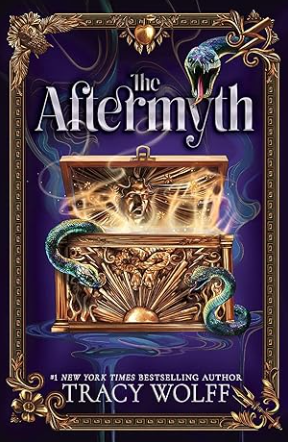
The Aftermyth
Author: Tracy Wolff
Published February 3rd, 2026 by Aladdin
Summary: In a world ruled by the tenets of Greek mythology, one girl’s fate is more than it appears in the first book in a new dark academia fantasy middle grade series from #1 New York Times bestselling author of the Crave series Tracy Wolff.
What’s your myth?
Penelope Weaver has spent her whole life preparing to attend Anaximander’s Academy, where students learn how to bring to life the stories of Greek mythology as well as discover the Greek god whose principles they most embody. Penelope knows she’s an Athena—all smart, practical, and rule-following girls who take part in stories that matter are Athenas.
But when Penelope and her twin brother Paris arrive at Anaximander’s, it appears fate has other plans. Penelope isn’t placed with Athena but with students who are anything but practical and who prefer parties to rules. And that’s just the beginning. She’s given the world’s worst muse, her assigned tasks feel impossible, and the magic of Anaximander’s is overwhelming. Not to mention, there are two very different boys making her new life even more confusing.
But as things go from bad to dangerously worse, one thing becomes in a world where everything is fated to happen a certain way, some stories need to be rewritten. As the world around her shifts and cracks, Penelope is asked to forget everything she thought she knew to help create a better story…even if that changes every plan and breaks every rule.
About the Author: Tracy Wolff is the #1 New York Times, #1 internationally, #1 Wall Street Journal, and USA TODAY bestselling author of the Crave series as well as many other novels. A lover of mythology, vampires, and getting lost in a great book, she’s spent her whole life asking “what if” and “what happens next”—questions being a writer has helped her answer again and again. At six, she wrote her first short story—something with a rainbow, a unicorn, and a shapeshifting prince—and at seven, she forayed into the wonderful world of middle grade literature with her first Judy Blume novel. A one-time English professor, she now devotes all her time to writing fun, action-packed, romantic stories with fantastical worlds and characters who leap off the page. She has written all her seventy-plus novels from her home in Austin, Texas, which she shares with her partner, her sons, and their three adorable dogs.
Review: There is so much that go on in this book, but I love that the author started directly with character development of Penelope followed by a wild event that helped the reader get to know the protagonist while also devleoping the plot. And this trend continues–each event allows the reader to get to know Penelope more while also moving along the plot simultaneously. It keeps the reader wanting to turn the page. The book has a quote: “Sometimes the goal isn’t really the point. Sometimes it’s how you get there that’s important.” This encompasses the book and Penelope’s journey.
This book is the exposition to a series that I look forward to following. I do have a lot of questions still about what is going on and why the mythology is how it is, so be ready for an open ended ending and so many questions swirling around in your head!
Educators’ Tools for Navigation: There is so much I wanted to do with this book!
- Each god/goddess’s building has a banner, and it would be so much fun to have students make banners (after sorting them, of course!).
- There are so many myths mentioned in the book: Hercules, Pandora, Muses, and Prometheseus specifically, so the parts that mention these would be great to look at when also reading the myths.
- One main point of the book is looking at the point of view of myths, specifically Pandora in this book. Who is telling the myth? Who were those in power when the myth was written? How could the myth have been different when from another’s point of view?
- The book also looks at how there are different versions of myths which is a great opportunity to talk about oral tradition and how stories were passed around before text.
- I love the focus on constellations in the book and would be a fun way to have a science/oral tradition lesson!
- Lastly, Fifi’s muse has pun-y muse shirts, and it would be so much fun to have students make their own.
Discussion Questions: Provided by Simon & Schuster (this is just a sample of the discussion questions on the reading guide; visit The Aftermyth page on Simon & Schuster):
- 1. Describe Penelope’s family and background. What are her parents like? What is her social life like before the book opens? Why do she and Paris end up going to Anaximander’s Academy?
- 2. Why is Penelope uncomfortable when Fifi starts to call her Ellie? What is Penelope’s image of herself and why is it important to her? Why is she anxious when Fifi wants to decorate the apple in front of Aphrodite Hall?
- 3. How does Penelope grow throughout the story? Contrast her self-image and her values at the beginning of Aftermyth to how she is at the end.
- 4. What is Penelope’s relationship like with her twin brother, Paris? In what ways are they close? How are they alike, and how are they different? How does their relationship change during their time at Anaximander’s? Who is Rhea, what is she like, and what role does she play in the changes between Penelope and Paris?
- 5. What are some examples of Penelope’s courage and leadership? How does she deal with the eagle in Dr. Minthe’s class? Later, during that class, how does she help others when her group is looking for the key to the door? (Chapters 27–37)
- 6. What is the purpose of Anaximander’s Academy? Describe the five halls, the gods to which they are each dedicated, and how the halls are different in spirit. Which hall does Penelope hope and expect to join? Which one does she end up in?
- 7. On the way to Anaximander’s, Penelope and her family meet PT. What is he doing? How does he respond to Penelope blowing out the lantern fire? Who does PT turn out to be in Greek mythology? What is his role in the story about Pandora’s box? What effect do Penelope’s actions have on him and his story?
- 8. How does Penelope initially feel about Fifi? Why does Fifi become, according to Penelope, “the best friend I’ve ever had”? (Chapter 41) What do they have in common? How are they different? How do they help each other?
- 9. Describe Fifi’s personality and style. Discuss her statement about herself, “‘I’m not good at much except directions and people.’” (Chapter 20) What are examples that show she is right about her strengths? What else is she good at? When does she show leadership? Explain why Penelope thinks, “I’ve learned that Fifi is a force of nature.” (Chapter 38)
- 10. What role do muses serve at Anaximander’s? What is Fifi’s muse, Frankie, like? How do they get along? Contrast Frankie with Penelope’s muse, Calliope. What is Calliope like? What is her role in Greek mythology? When do the muses help their students?
Flagged Passages: Read a sample of this book on its Amazon page.
Read This If You Love: Greek mythology
Recommended For:




**Thank you to the publisher for providing a copy for review!**
1 thought on “The Aftermyth by Tracy Wolff”