
“Why Children Need Stories That Make Room for Difficult Emotions”
We often want children to be happy. As parents, grandparents, teachers, even writers, we look for ways to make difficult things easier for them. When a child is sad, we try to cheer them up. When they are afraid, we reassure them. When they are angry, we encourage them to calm down. When they are disappointed, we look for something positive that might help them feel better. There is nothing wrong with any of this. We want children to feel safe, and we want to protect them from things that hurt.
But I have often wondered whether, in trying so hard to protect children from difficult emotions, we sometimes forget to teach them that these emotions belong in their lives, too.
Growing up is not only about learning how to be happy. It is also about learning what to do with fear, sadness, anger, disappointment, loneliness, and longing. These feelings can be uncomfortable, and sometimes they can be overwhelming but that does not mean they are feelings children need to be taught to avoid. Before we can learn how to handle an emotion, we first need to understand that it is there.
This thought stayed with me while I was writing Mina and the Recipe of Lost Emotions.
The story began in a very personal place: my niece. She is a sensitive, emotional child who experiences things deeply, and watching her made me think about how valuable it can be for a child to encounter characters that are not always sure what to do with their feelings. I wanted to write about a child who could be frightened or overwhelmed, who might not always know what to do but who could keep going anyway. I wanted her to have a character she could recognize, not someone who was always confident and brave but someone who could discover that courage does not require the absence of fear.
At first, Mina was simply a story I wanted my niece to have. As I continued writing, however, I found myself thinking more and more about what happens when we decide that some emotions are simply too difficult to live with.
What if we could remove every unpleasant feeling?
That question became the starting point for Mina’s story.
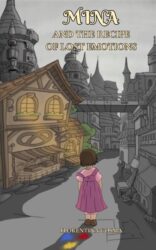
Mina is eleven years old and lives with her grandfather above his bakery in the magical town of Opalis, a place where tastes, smells, and emotions are deeply connected. Mina has always felt different because she cannot taste anything. She can see the beautiful pastries her grandfather creates, she can smell everything that comes from the kitchen. She even can hear them speak, feel or giggle but the experience that seems so ordinary to everyone else is completely missing for her.
Then, something strange happens in Opalis. People begin losing their unpleasant emotions. At first, it seems like a wonderful thing. The town becomes calmer, arguments disappear, people stop complaining, and feelings such sadness, anger, fear, no longer seem to get in anyone’s way. It is easy to understand the appeal. If someone offered us a life without grief, fear, disappointment, or anger, wouldn’t part of us be tempted to say yes?
Mina is not so sure. She begins to notice that as people lose the emotions they consider unpleasant, they also begin losing other things. Memories fade, desires become weaker, relationships lose their meaning, and people slowly become disconnected from the things and the people they once cared about. They are not simply happier, they are becoming less themselves.
That became one of the central ideas of Mina’s story. Emotions are not separate little boxes that we can open and empty one at the time. They are connected to one another and to the experiences that shape us. Sadness is often tied to something we have loved and lost. Longing can tell us how deeply someone or something matters. Fear can make us pay attention, while anger can tell us that something feels wrong or unfair.
None of this means that every feeling should control our actions. Children still need to learn how to express anger without hurting someone, how to cope with fear, and how to move through sadness. But there is a difference between learning to live with an emotion and learning that emotion itself is something shameful or wrong.
The danger of a perfect world
In Opalis, the person behind this transformation is the Architect, the creator of a system called the Flattening. He believes that people would be happier, more efficient if unpleasant emotions could simply be removed.
What makes it unsettling is that it begins with something many of us can understand: the desire to eliminate suffering. If we could take away a child’s grief, fear, or pain, most of us probably want to do it. We do not like watching children hurt. The problem is that emotions do not work like unwanted objects that can simply be taken away without changing anything else.
In Opalis, a person’s shadow represents the parts of themselves they might prefer to hide. When the emotions disappear, the shadows disappear with them. The world looks cleaner and calmer, but it also becomes strangely empty. The people of Opalis have not simply lost their sadness. They have lost some of the experiences that gave their lives depth.
That was important to me because I did not want the story to suggest that difficult emotions are somehow good simply because they are painful. They are not. Grief hurts, fear can be exhausting, and anger can make us say things we later regret. But removing an emotion is not the same as learning how we live with it, and a world without difficult feelings may come at a much greater cost than we first imagine.
Children do not need perfect characters
This is also why I think children need characters who are allowed to be imperfect.
One of the things I love about middle grade fiction is that young readers are at an age when they are beginning to understand themselves in more complicated ways. They notice when they are different. They compare themselves with their friends. They worry about how people see them. They make mistakes and sometimes have no idea how to fix them.
So why should the characters they read about always have everything figured out?
I did not want Mina to be the kind of heroine who knows exactly what to do in every situation. She gets frightened, she becomes confused, she makes mistakes. There are moments when turning around would be much easier than continuing. What matters is that she gradually learns she does not have to wait until she feels fearless before she can move forward.
To me, that feels much closer to what courage actually is.
Mina also does not have to face everything alone. Her best friend, Maya, travels with her, while Splinter, a strange little puppet, becomes an unexpected companion. Together they enter an adventure where emotions can be stored, manipulated, and stolen. The adventure becomes increasingly strange, but underneath all the magic is something very familiar: sometimes a frightening experience becomes easier simply because someone we trust is there with us.
Friendship cannot take away difficult emotions, but it can make them easier to carry. I think children learn this long before they have the words to explain it. A friend may not know what to say when you are upset, but sitting beside you can be enough. Sometimes being understood matters more than being given a solution.
Stories give children a safe place to feel
A child may not be ready to say, “I am afraid” but they may be perfectly willing to talk about a character who is frightened. They may not know how to explain why they are angry, but they can have very strong opinions about whether a character was right to be angry. They may not know how to talk about missing someone but they can understand a character who feels the same longing.
Stories give us a little distance from ourselves, and sometimes that distance makes difficult emotions easier to approach.
A parent or a teacher can ask why a character reacted the way they did, whether they think a decision was right, or whether they would want to live in a world where nobody was ever sad. The child does not have to talk about their own feelings. They can simply talk about the story. And yet, somewhere in that conversation, they may recognize themselves.
That is one of the quiet things books can do. They give children language for experiences they may not yet know how to name.
Making room for difficult emotions
I do not think children’s books should become therapy disguised as fiction. Children deserve stories that are funny, exciting, strange, magical, and completely unnecessary in the best possible way. Sometimes a book should simply take a child somewhere wonderful and let them enjoy the journey.
But a story can also leave room for something deeper without turning into a lesson. It can show a child that being afraid does not mean being weak, that anger does not make you a bad person, that sadness does not mean happiness has disappeared forever, and that being different does not automatically mean something is wrong with you.
That is what I wanted to explore through Mina’s story. By the end of her journey, the emotions that have been captured are released, and Opalis begins to regain its colours, sounds, smells and life. The town is no longer as orderly or as comfortable as it was under the Flattening, but is alive again. Its imperfections have returned along with everything else.
For Mina, there is another kind of return. In her grandfather’s bakery, she finally tastes sweetness.
For a girl who spent so much of her life feeling that something essential is missing, the moment means more than simply recovering a sense she never had before. It represents a new understanding of what it means to experience the world fully. There will be things she loves and things she wishes she could avoid, moments of happiness alongside moments of pain, and she cannot separate one from the other without changing the experience itself.
Perhaps that is one of the things children need most from the stories we give them. Not a promise that they will never be sad or afraid. Not a world where everyone always knows what to do. And not characters who overcome every difficulty without getting hurt along the way.
They need to see that difficult feelings can exist alongside friendship, laughter, curiosity, love, and joy. They need characters who make mistakes and keep trying, who feel different and discover that difference is not a flaw, and who can be frightened without giving up.
Mina’s world is filled with strange places, mysterious machines, chocolate maps, a silver fork, a mischievous puppet, and a town that slowly changes around her. But beneath that magic is a very simple idea: we are made up of more than the feelings that are easy to live with.
Sometimes the emotions we most want to push away are connected to the things we care about most.
And perhaps children do not need stories that promise them a life without difficult emotions. Perhaps they need stories that remind them they can feel deeply, make mistakes, be frightened, be sad, miss someone, and still find their way home.
Published June 12th, 2026
About the Book: Mina and the Recipe of Lost Emotions is a middle grade fantasy adventure about eleven-years-old Mina, a girl who cannot taste anything and has always felt different from the people around her. She lives with her grandfather above his bakery in the magical city of Opalis.
When the people of Opalis begin losing emotions such sadness, fear, anger, the town initially seems happier. But Mina soon discovers that removing difficult emotions also takes away memories, desires, connections, and even people’s shadows.
With her best friend Maya and a mysterious little puppet named Splinter, Mina enters a world where emotions can be captured and manipulated. There she discovers the truth behind the Flattening, a system created by the Architect to build a happier and more controlled world.
As Mina fights to restore what has been taken from the people of Opalis, she learns that difficult emotions are not flaws to be erased. They are part of identity, memory, love, and what makes us human.
Mina and the Recipe of Lost Emotions is a story about friendship, courage, emotional acceptance, and learning that every feeling has a place.
About the Author: Florentina Cosma is the author of Mina and the Recipe of Lost Emotions, a middle grade fantasy adventure inspired by her relationship with her young niece. Her writing explores friendship, courage, identity, and the complicated emotions that are part of growing up. She believes children’s stories can be both imaginative and meaningful, giving young readers space to recognize their own feelings while following characters through exciting adventures.
Mina and the Recipe of Lost Emotions began as a story Florentina wanted her niece, a deeply sensitive and emotional child, to have—a story that would remind her that strong emotions are not something to be ashamed of or afraid of.
Thank you, Florentina, for sharing this thoughtful post about why children need stories that help them understand, accept, and navigate difficult emotions!
