
“Empathy and Gratitude Through Immigration Stories”
I’ll come right out and say it: the world has me worried.
From tragic ICE events, to the ongoing conflicts around the globe, to heat domes, and measles outbreaks, I am worried about a lot of things that I feel helpless to affect. And, if a fairly reasonable, generally non-panicking adult (me) is worried, what are our kids feeling?
Anxious?
Confused?
Maybe a little less kind than usual?
Did that last one surprise you?
Let me explain. When I have a lot on my “worry” plate, I don’t have as much room to think about others. For me, this creates an isolating narrative, which transforms the worries into frustration and anger. I think this is true for others, too.
The best way I know to tackle this spiral is with gratitude and empathy. These are small mindset pivots I can make to create space for problem-solving, dialogue, understanding, and hopefully respect. Our kids need that infusion of gratitude and empathy to operate in this uniquely challenging world, too.
All stories hold the power to inspire gratitude and empathy. In particular immigrant stories, which are also timely right now, offer eye-opening perspectives, even for those of us who are immigrants. These stories can provide a bridge toward understanding and appreciating every member of our community a little better.
When I wrote My America Blooms, I hoped it would help more people understand the challenges of starting a new life in a new place, and I wanted those who have experienced it to know they weren’t alone—that they could share their story, too. But I also wanted to share my gratitude for all the kindnesses and opportunities people offered my family.
Here are eight great immigrant story picture books I recommend for spreading gratitude and empathy.
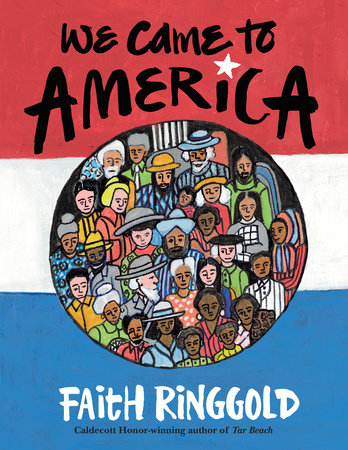
We Came to America by Faith Ringold (Alfred A. Knopf, 2016) – a boldly illustrated, simple and poetic text that pays tribute to “every American who came before us” and honors the children who will carry the “message of diversity into our nation’s future.”
-
- Activity: Using colors and inspiration from Ringold’s illustrations, have children recreate their favorite page.
- Discuss: Is the picture you chose about your own ancestors? Did you learn something new about other Americans?
Mama’s Nightingale, A Story of Immigration and Separation by Edwidge Danticat, illustrated by Leslie Staub (Dial Books, 2015) – a family is separated because of the mother’s immigration status and the child “discovers that her words can change the world” and reunite her family.
-
- Activity: Have children write a short letter about something they want to see changed.
- Discuss: How did writing a letter help make people aware of the mother’s situation? What would you feel if someone you knew was experiencing something like this?
Some of Us, A Story of Citizenship and the United States by Rajani LaRocca, illustrated by Huy Voun Lee (Christy Ottaviano Books, 2025) – describes the path to becoming US citizens in a poetic way with beautiful images depicting the diversity of immigrants.
-
- Activity: Create a short citizenship quiz like the story describes (There are several resources available online, including this article published by the Washington Post in 2026.)
- Discuss: Would this be easy to take or would you have to study and prepare?
The Welcome Chair by Rosemary Wells, illustrated by Jerry Pinkney (Paula Wiseman Books, 2021) – follows the journey of a chair through generations and various families of immigrants. There is a heartwarming story of belonging with each new owner.
-
- Activity: Have children tell the story of the welcome chair’s next home. They can write and/or illustrate their story, or share it aloud.
- Activity: Create a “welcome” space in by writing welcome in as many languages as you can collect.
- Discuss: What does it mean to be welcoming? How does it feel when you are welcomed?
Rostam’s Picture-Day Pusteen by Ryan Bani Tahmasek, illustrated by Fateme Mokhles (Charlesbridge, 2024) – Rostam is worried about wearing his father’s traditional pusteen for picture-day. When he braves sharing about his Persian culture, his classmates are excited to learn more and try on the pusteen.
-
- Activity: Using paper bags cut to fit like vests, have children draw and decorate their own pusteens with symbolic colors, patterns, and materials.
- Discuss: Do you have any traditional clothes or clothes that have been passed down? Have you ever worried about standing out and feeling out of place?

Gibberish by Young Vo (Levine Querido, 2022) – Everything Dat hears in his new country sounds like gibberish, until a new friend helps him start to make sense of the strange sounds.
-
- Activity: Make up new words or share words from a different language for items around the room. Make signs and put them on the items. Have gibberish day where you use the alternate words when talking about the items.
- Discuss: How do Young Vo’s illustrations show how the world changes for the main character as he begins to understand his classmate’s words?
Wishes by Mu’o’n Thi Văn, illustrations by Victo Ngai (Orchard Books, 2021) – spare, lyrical text shares several wishes, while illustrations depict a family leaving their home, becoming refugees, and eventually arriving in a new country.
-
- Activity: Make a list of wishes, either the children’s own (“I wish”) or inanimate objects like the story does. These can be shared or kept private in a personal wish jar. Children can share wishes to create decorations, like mobile(s) hung from the ceiling or a constellation of wishes on a wall.
- Discuss: What do the things that we wish for tell us about each other? Do most people have the same wishes? Are wishes important? Why or why not?
New by Niña Mata (Harper, 2025) – an uplifting story of a child starting school in a new country and making a friend.
-
- Activity: Make a poster of things everyone can do to help someone new feel welcome.
- Discuss: Share stories of when each of you were new somewhere. How did it feel to be new? What helped you feel comfortable? What made you feel uncomfortable?
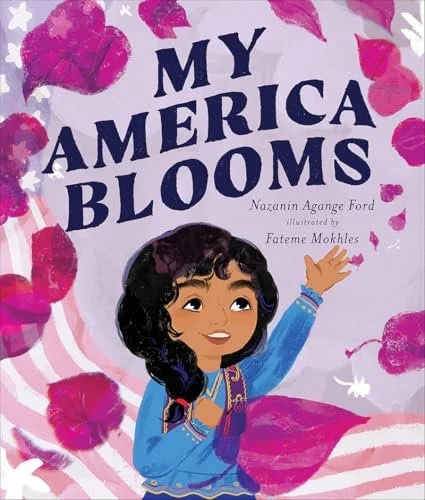
My America Blooms
Author: Nazanin Agange Ford
Illustrator: Fateme Mokhles
Published June 30th, 2026 by Beaming Books
View Discussion and Activity Suggestions for Educators and Parents for My America Blooms HERE
About the Book: Inspired by the author’s experience of immigrating to the U.S. from Iran, My America Blooms shares a story of hope.
My America Blooms is a story about a young girl who is uprooted from her home in Iran. When she and her family are forced to flee Tehran, she brings a pocket of golnar petals from her beloved garden. In America, she begins to tend a new garden as she creates a new life as an immigrant. America brings friendships, community experiences, and stability, planting the seeds of hope. But every garden has its thorns–the girl must dig deep within herself to cultivate the promises of her new home.
This hopeful story embodies the American dream in all its complexity. Fateme Mokhles’ evocative, impressionistic art depicts the immigrant experience through the eyes of a child, while Nazanin Agange Ford’s moving words remind all readers that they belong.

About the Author: Nazanin Agange Ford was born in Tehran, Iran and moved to the United States at a young age. She grew up in Southern California and now lives in Nevada with her husband, two daughters, and an Aussie Labradoodle. Her writing explores her Persian heritage and the adventure of growing up. Naz is a former teacher and journalist. She is a member of Inked Voices, the 12×12 Picture Book Challenge, and the American Library Association.
About the Illustrator: Fateme Mokhles is an illustrator and interdisciplinary artist whose practice is rooted in storytelling. Born in Iran and now based in California, she often draws inspiration from her heritage and lived experiences. Fateme is also the illustrator of Rustam’s Picture-Day Pusteen. Her illustrations bring a sense of belonging and depth to children’s literature, inspiring imagination and connection.
Thank you, Nazanin, for sharing these books that we can bring to our spaces to spread empathy and gratitude!

1 thought on “Author Guest Post: “Empathy and Gratitude Through Immigration Stories” by Nazanin Agange Ford, Author of My America Blooms”