
“5 Ways Mysteries Help Clue Students into Reading and Writing”
I fondly remember devouring stacks of Encyclopedia Brown, Sherlock Holmes, and Hardy Boys mysteries as a kid. As I scrutinized every page, trying to figure out whodunnit before the final pages, little did I know that one day I’d be writing mysteries of my own. Or that all the reading I was doing was building my understanding of things like story structure, plot, and deductive reasoning.
Here are five reasons that mysteries are a great way both to hook young readers and to teach the principles of reading and research that lay the groundwork for writing:
1. Learning with Puzzles. Mysteries are puzzles that encourage active participation with the story. Young readers can follow along with their favorite sleuth to uncover a trail that leads to the ultimate solution. For teachers, you might further encourage this by having your students fill out a simple grid like below as they read, keeping their own miniature crime journal where they collect clues that teach them how an author points toward the solution while layering in a red herring or two to keep readers guessing.
| The Clue | Connection to Crime
(Use this space to record details about clues that have a connection to the crime) |
Distractions
(Use this space to record details about clues that are a distraction to solving the crime) |
|
|
||
|
|
||
|
|
2. Outline by Design. Once students complete a clue grid like above, it’s easy to illustrate how they can use this same method to create an outline for writing a story of their own. The clues are the outline. Now instead of completing the above grid from top to bottom, have students think of a fun, silly mystery of their own (e.g. Who ate all the cookies?), then work backward to build up clues that all lead to the culprit. Then they’ll have a basic outline to use for telling that mystery.
3. The Mystery Is the Structure. Next we move on to fleshing out that outline into the basic structure of a story, and mysteries are great examples of that: There’s a clear problem (often a crime that occurred) and a clear understanding of the main character’s goal (to solve the crime). Many young writers begin by telling stories that are simply a recounting of events that happened to their characters with no clear direction or purpose. But by adding an element of a mystery that needs to be solved, they intuitively begin to connect these events in a way that leads to the resolution of some problem their character is facing.
4. Training Wheels. Students feeling a little stumped when it comes to putting all the pieces of a story together on their own? Real-life mysteries like those in True Crime Files are a great way for students to practice learning to tell a story using details from historical events while developing their research skills. Heist at the Museum! ends with an appendix that includes brief summaries of other heists from around the world. Try having students research these or other crimes and act like a reporter, retelling the story of their chosen crime in their own words. This eases the pressure of coming up with an idea and details for their story all on their own and lets them focus on telling the story.
5. Fun-Sized. From short news articles about crimes to full-length novels, there’s a mystery out there for every reader, even the reluctant ones. At a slim 91 pages including illustrations, Heist at the Museum! is designed as a fun-sized read for kids in grades 3-7. And as a bonus, check out the Heistogram puzzles on the book’s website. These are very brief 5-minute mysteries based on fun heists that really happened (like a maple syrup theft and a missing toilet made of solid gold) where students use logic grids to uncover the culprit.
These are just a handful of ways to engage young readers and writers with mysteries. For more ideas, exercises, and a full educator’s guide to using Heist at the Museum! as part of your curriculum, visit the book’s website at https://www.samsubity.com/heist-at-the-museum/.
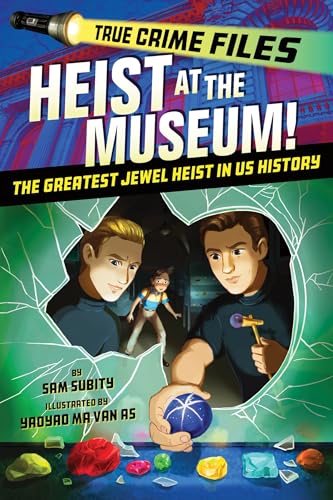
True Crime Files: Heist at the Museum!
Author: Sam Subity
Illustrator: Yaoyao Ma Van As
Published October 6th, 2026 by Sourcebooks Explore
About the Book: The story is unbelievable. The heist actually happened.
Charlie O’Neill is still grieving his mom and desperate for his dad’s attention when he overhears three smooth-talking surfers planning the heist of the century. The target? The priceless gems of the American Museum of Natural History. The problem? Nobody believes a kid. So Charlie decides to stop it himself. What follows is a breathless night of locked iron gates, cut glass, a swaying rope five stories up — and a choice that makes right and wrong a lot more complicated than Charlie expected.
True Crime Files: Heist at the Museum! is inspired by the real 1964 theft of the Star of India sapphire, one of the most legendary jewel heists in U.S. history. The thieves were real. The gems were real. And the story is even wilder than you’d imagine.
- A kid who won’t be ignored, a heist that can’t be stopped — when Charlie overhears surfers plotting the robbery of the century, no one believes him. So he decides to stop it himself
- Based on a jaw-dropping true story — the real 1964 theft of the Star of India sapphire from New York’s American Museum of Natural History, one of the most audacious jewel heists in U.S. history
- Perfect for fans of I Survived and true crime — cinematic action, a heartfelt family story, and a mystery that keeps the pages turning all the way to the end
- A lot of this actually happened — additional material breaks down what’s true, what’s fictional, and what became of the real thieves and the stolen gems
- For readers ages 8–12 who love saying “wait…that really happened?” — mystery, history, and museum lore packed into one adrenaline-charged adventure

About the Author: Sam Subity grew up on a steady diet of books about Encyclopedia Brown and Sherlock Holmes, so he knew from an early age that he would either be a detective or a writer. Then he figured out he could have the best of both worlds by writing about crime-solving kids! When he’s not writing, you might find him running the trails of northern Ohio where the endless, winding miles past rivers and Buckeye trees inspire stories of adventure and mystery.
Thank you, Sam, for these great recommendations to bring mystery to the classroom!
