
Importance of Nonfiction

“Are Nonfiction Books Actually Difficult or Are You Just Reading Nonfiction Books Wrong?” by Kathy R., 7th grade
Books are loved worldwide and pretty much everywhere, it comes in all formations and genres but the two main ways to separate books are in fiction and non-fiction. Fiction is formally more popular since it allows the reader to escape their worries and focus on the imaginative story they are reading. On the other hand non-fiction is usually depicted as boring and written with a ‘fact-heavy’ tone. But most of the time non-fiction isn’t a difficult read, maybe you are reading non-fiction the wrong way.
Finding the different types of non-fiction literature
There is a variety of types of non-fiction literature like history, science, biographies, essays. Going deeper into non-fiction there are types of books like narrative nonfiction which is telling a real life story in the form of a story, this is an easier way to read nonfiction if you are used to reading more story-like books. Another few examples are Art books if you are more on the art side of the reading spectrum, music is another example of reading non-fiction like a ‘how to’ book on learning the violin. Exploring these genres will help you find which is just right for you. Most of the time when people call non fiction ‘too hard’, it’s almost always because they are reading books that they can’t connect to or learn anything about said topic.
What to avoid when reading non-fiction books
Other times people rush or try reading multiple genres at once which can lead to not understanding what you just read and not learning anything. Arun Suresh, Finding It Difficult to Read Non-Fiction? You’re Probably Reading It the Wrong Way: “It’s common for people to switch between genres and read a variety of books on a variety of topics. It gives them a feeling of gaining knowledge of different subjects, but in the longterm, they won’t remember most of it. Which is why you should stick with a genre or two.” Frankly, one of the most important things to do while reading non fiction is to take in some of the information you’re gaining from that book. Why do the exact opposite by reading everything and anything at the same time? It completely defeats the purpose.
Tips when it comes to reading non-fiction
When it comes to reading non fiction there are a few tips and tricks that can help you greatly in understanding what you’re reading a little bit more. How to Read More Nonfiction (and Actually Enjoy It) gives a few examples such as:
- Annotating your book with a highlighter and or sticky tabs
- Starting a non-fiction book with a friend or book club
- Skimming through chapters and getting the main details
- Set small goals that are easy to digest
Why should people go through all the troubles of reading a non-fiction book? What’s in it for them in the end?
The biggest question of all is why? Why is reading non-fiction important? Why should people go through the process of reading non-fiction? The best answer I can give you is that it helps you to learn and understand the world around us. You see, non-fiction as a whole is diverse and every book you read on one topic can help you understand more chapter by chapter. Every time you read something informational no matter what your age is you can learn and expand your knowledge.
Some non-fiction books I could recommend to people
Here are a couple books that I would recommend to people with a variety of what the books are about!
- The Medici by Paul Stranthern (A European history book about the Medici Family)
- The Beatles Anthology (An autobiography about the Beatles’ lives)
- The Art Of Natural History by Pascale Heurtel (A collection of beautiful antique painting of plants and animals)
- Triangle: The Fire That Changed America by David von Drehle (American history, A book about the Triangle shirtwaist factory fire.)
- Turning to Stone: Discovering the Subtle Wisdom of Rocks by Marcia Bjornerud (A memoir by geologist Marcia Bjornerud)
- The Lost World of the Dinosaurs by Armin Schmitt (A book about paleontology)
Conclusion and final thoughts
In conclusion, non-fiction in a whole may seem ‘too complex’ and ‘overly academic’ but the truth is non-fiction and informational literature is for us to be able to understand more about this world we live in. Non-fiction may not be for everyone but it is better to try than and see if there is a book for you than to not give it a try.
“I Think Readers Should Read More Nonfiction” by Elise A., 8th grade
Nonfiction should be promoted better because it is useful for learning different facts about life, history, science and any topic you like.
I’m not saying that reading fiction is bad. But they attract more people to them because of how popular they are which leads to more people buying them or checking them out unlike nonfiction books that are not that popular.
Nonfiction is also keeping our history alive. It tells us about our past and gives kids something to base our future off of. If we didn’t have the books then we won’t remember how different things changed and adapted to different environments.
Nonfiction shows real information all the way through and shows more facts than anything else. Some people may look at nonfiction and say that it’s boring but it’s just that they aren’t reading about a topic that they enjoy, they just pick up a nonfiction book and start reading instead of picking one that interests them.
Nonfiction books to read
There are many history books that can be used to promote like:
- The Rediscovery of America by Ned Blackhawk
- Hidden Figures by Margot Lee Shetterly
- Night Flyer: Harriet Tubman by Tiya Miles
There are many science books that can be used to promote like:
- The Immortal Life Of Henrietta Lacks by Rebecca Skloot
- Being Mortal by Atul Gawande
- Lab Girl by Hope Jahren
These books are a good example of books to read to better understand certain subjects in school or everyday life.
Personally I like books about presidents. I look at those to understand how the new presidents are different from past presidents.
Nonfiction vs Fiction
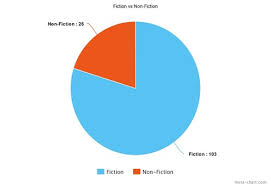
As you can see based on this graph there is a good amount of people who read nonfiction but it’s smaller in comparison to the people who read fiction. This shows that nonfiction isn’t disappearing, it’s just in the shadow of fiction.
But the thing is that most of the time people look at the books, and they judge it based on the cover.
Also, fiction isn’t the only type of books with series nonfiction also has series. Fiction series continue the story the author made up while nonfiction books show how different things in life are connected like how different parts of history are connected.
How librarians and educators could make it so their nonfiction books are something people want to read.
So I think to make nonfiction books look more appealing to people is to have it more in color or just more fun. If you make the area look more fun, like after you read the book, have people color by number with facts that they learn.
The reason to do all of this is because there are many fiction book activities like people have made many word searches for fiction books. So if the nonfiction books have activities then it will feel like something people read a lot convincing people to read them. Or have them take a quiz so they know what type of nonfiction books to look for kinda like finding different genres people like except there are science, history, and geography nonfiction books.
To conclude, nonfiction books should be read more because there are many good nonfiction books that need to get more love!
Thank you so much to my student voices today and their look at reading nonfiction!
